Central Italy Grand Tour: 10 Days
Assisi & Orvieto Day Trip from Rome
Quick answer: Ten days covering Rome (three days), a half-day at Tivoli’s villas, an overnight or day trip to Orvieto and Civita di Bagnoregio, two days in Assisi and Umbria, then north by train to Florence and Siena. A car is needed for the Umbria leg and Tuscany; Rome and Florence work best on foot and public transport.
| Region covered | Lazio → Umbria → Tuscany |
| Best for | Culture lovers, repeat visitors, photographers |
| Transport | Trains in Rome/Florence, car for Umbria + Chianti (Days 5-9) |
| Budget | Mid-range; allow more for car hire, tolls and agriturismo stays |
| Booking priority | Colosseum, Vatican and Borghese Gallery — all fill up 1-4 weeks ahead |
Ten days in central Italy is the right amount of time to move beyond surface impressions. Rome gets three full days — enough for the ancient core, the Vatican, and one museum of your choosing. Tivoli adds a half-day of Renaissance and imperial gardens. Orvieto delivers volcanic geology and a medieval cathedral that stops you in the street. Assisi gives you Francis, Giotto, and a hilltop town that has not entirely been overtaken by pilgrimage commerce. Florence gets two days for the Uffizi and the Duomo. Siena and the Chianti close the trip on Tuscan wine country.
The logistics require a car for Days 5-7 (Orvieto, Civita, Assisi) and optionally for Day 9 (Chianti). Rome and Florence are faster and less stressful on foot and public transport; car hire in either city is counterproductive given ZTL camera fines and the near-impossibility of parking.
If ten days feels too long, the Rome and Florence Tuscany 7-day itinerary covers a compressed version dropping Tivoli, Orvieto and Assisi. If it feels too rushed even at ten days, treat Days 5-7 as a genuine slow patch rather than a race between three towns — Orvieto and Assisi both reward an unhurried morning far more than a checklist visit does.
Day-by-day summary
| Day | Base | Focus |
|---|---|---|
| 1-3 | Rome | Colosseum/Forum, Vatican, Borghese + Caravaggio trail |
| 4 | Rome (day trip) | Tivoli — Villa d’Este and Hadrian’s Villa |
| 5 | Orvieto | Duomo, Pozzo di San Patrizio, Civita di Bagnoregio |
| 6 | Assisi | Basilica di San Francesco, medieval town |
| 7 | Assisi → Florence | Optional Perugia, drive north |
| 8 | Florence | Uffizi, Duomo, Accademia |
| 9 | Florence → Siena | Piazza del Campo, Chianti Classico wine route |
| 10 | Return | Train or drive back to Rome for departure |
Booking this trip in the right order
Book the three Rome anchors — Colosseum and Roman Forum, Vatican Museums, and Borghese Gallery — the moment your dates are fixed, since all three run timed-entry systems that sell out. The colosseum tickets guide and the Borghese booking guide both cover the exact windows to book within. Car hire should be reserved for pickup after Day 3 (not Day 1 — you do not want a car sitting idle and accumulating city-centre parking risk while you’re on foot in Rome). Reserve Orvieto’s Cappella di San Brizio slot and any Assisi accommodation at the same time, since both fill in high season.
If choosing between doing Perugia on Day 7 or pressing straight to Florence, skip Perugia unless you are already a fan of Umbrian painting — the honest trade-off is one fewer relaxed afternoon in Florence for one rushed 90 minutes in a second regional gallery.
What this trip costs, honestly
Budget for three separate cost centres beyond the usual flights and hotels: timed-entry tickets (Colosseum, Vatican, Borghese, Uffizi and Accademia together run roughly €120-160 per person if bought individually, less if bundled through guided tours), car hire for six days (€250-400 depending on season and vehicle class, plus fuel and tolls), and the ZTL risk if you misjudge a route into a historic centre. Agriturismo stays in Umbria and Tuscany are usually better value per night than city hotels and often include a home-cooked dinner, which softens the overall daily budget more than people expect. Wine tastings in Chianti (€15-25 per person for three or four pours with food) are optional but genuinely worth building into Day 9 rather than skipping for time.
Day 1: Rome — Colosseum and the ancient city
Morning: Colosseum, Roman Forum, Palatine Hill
Start with the essential: the Colosseum and the ancient core of Rome. Book the Colosseum timed ticket in advance — the named reservation system means walk-up access is not guaranteed, and in high season the slots fill days or weeks out. A guided tour is useful for making sense of the Forum’s dense ruins.
Colosseum, Roman Forum and Palatine Hill guided tourThe standard ticket covers all three: the Colosseum interior, the Forum below (where the Senate, temples, and triumphal arches once stood), and Palatine Hill, where emperors built their palaces above the city. Allow four hours for the complete complex.
Afternoon: Capitoline and Circus Maximus
Walk up to the Capitoline Hill for Michelangelo’s cordonata ramp, the Piazza del Campidoglio, and the terrace view back over the Forum. The Capitoline Museums — on the piazza itself — hold the original equestrian Marcus Aurelius and the She-Wolf of Rome. Two hours is enough for a focused visit.
Evening: Testaccio
Dinner in Testaccio — Rome’s working-class food neighborhood and the birthplace of Roman pasta. The carbonara, amatriciana, and cacio e pepe you eat here will be the benchmark for everything you try elsewhere.
Day 2: Rome — Vatican
Morning: Vatican Museums and Sistine Chapel
The Vatican visit requires planning. Walk-up queues regularly reach two hours. Pre-purchased tickets or a guided tour are the default. The museums’ one-way route passes through the Gallery of Maps (the painted topography of Italy is astonishing even without context) and the Raphael Rooms before reaching the Sistine Chapel. Allow three hours minimum.
Vatican Museums and Sistine Chapel guided tour — book the equivalent Vatican entrySt. Peter’s Basilica is free and a five-minute walk from the museum exit. The dome climb (€8 stairs, €10 lift) is the best elevated view in Rome — do it before 10am if you want it without a queue.
Afternoon: Castel Sant’Angelo and Prati
Castel Sant’Angelo — the cylindrical mausoleum built for Hadrian, later converted to papal fortress — is a ten-minute walk from the Vatican and offers the best-value combined view: the parapets look back across the Tiber to St. Peter’s. Allow 90 minutes.
Lunch and afternoon in Prati: the neighborhood west of the Vatican has excellent mid-range restaurants, good gelato, and a pleasant evening atmosphere without the tourist intensity of the centro storico.
Evening: centro storico
Walk east across the Tiber into the historic center for the evening. Piazza Navona and the surrounding streets are worth an evening wander; the Pantheon neighborhood has the best concentration of wine bars if you want to sit rather than walk. The Trevi Fountain is best in the evening when the crowds thin slightly.
Day 3: Rome — Borghese and hidden churches
Morning: Borghese Gallery
Book the Borghese Gallery the moment you confirm your dates — 2-hour timed slots, maximum 180 visitors, usually fully booked 10-14 days out in high season. The collection is the finest in Rome: Bernini’s early sculptures (Apollo and Daphne, Pluto and Persephone, David), Raphael’s Deposition, Titian’s Sacred and Profane Love, and several Caravaggios. Two hours is not enough, but it is all you get.
Afternoon: Caravaggio and hidden Rome
Spend the afternoon on the Caravaggio trail: San Luigi dei Francesi (the Matthew cycle), Sant’Agostino (the Madonna di Loreto), and Santa Maria del Popolo (the Cerasi Chapel, with the Crucifixion and Conversion canvases). These three churches contain six large-scale Caravaggio paintings that most visitors never see because nobody mentions them in the mainstream guides. All three churches are free and accessible on foot.
Then take 30 minutes at Basilica di San Clemente — three vertical layers of history (twelfth-century church, fourth-century basilica, first-century Roman building with Mithraic temple) accessible by stairs. This is one of Rome’s most extraordinary underground experiences and almost none of the day-tour groups visit it.
Evening: Monti
Aperitivo and dinner in Monti, Rome’s most liveable central neighborhood. The streets around Piazza della Madonna dei Monti are Rome at its most manageable and most genuine.
Day 4: Tivoli — Villa d’Este and Hadrian’s Villa
Take the regional train from Roma Tiburtina to Tivoli (50 minutes, every 30 minutes, €2.50) or join a day tour that handles transport.
Tivoli day tour: Villa d’Este and Hadrian’s Villa from RomeMorning: Hadrian’s Villa (Villa Adriana)
Tivoli contains two UNESCO World Heritage Sites in the same small town. Start with Hadrian’s Villa (Villa Adriana), 6 km from the town center — take a local bus or taxi. This is the pleasure palace that the emperor Hadrian built in retirement from 117-138 CE: a vast complex of pools, libraries, baths, theatres, and garden pavilions spread over 300 acres. The Canopus canal, the Teatro Marittimo (his private island study), and the Maritime Theatre are the highlights. Allow two hours; go early before the sun gets high.
Afternoon: Villa d’Este
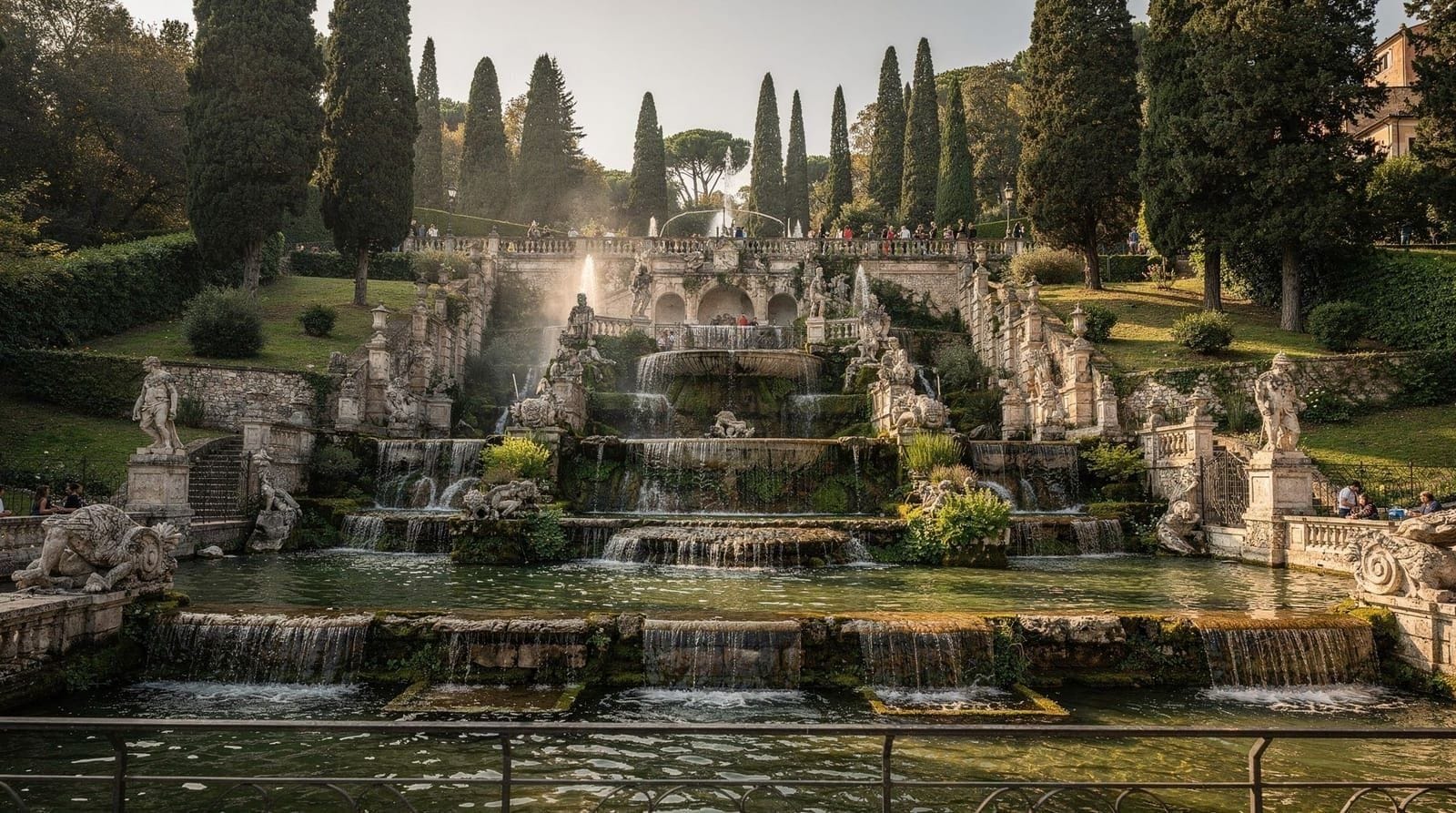
Return to the town center for Villa d’Este, the sixteenth-century Cardinal d’Este’s garden — the original inspiration for all subsequent European garden fountains. The cascade systems descend in tiers from the villa, driving 51 fountains, 364 jets, and 220 basins using nothing but gravity and the natural gradient. The Organ Fountain runs on a hydraulic organ and still plays. Especially beautiful in late afternoon light. Allow 90 minutes.
Return to Rome for the evening or continue south and west for Day 5.
Day 5: Orvieto and Civita di Bagnoregio
Collect a rental car from Rome (Roma Termini has all major agencies) and drive north on the A1 autostrada for approximately 90 minutes to Orvieto in Umbria. Alternatively, Orvieto is directly accessible by train from Roma Termini (1h15 — one of Italy’s more convenient regional connections).
Orvieto and Civita di Bagnoregio day trip by trainMorning: Orvieto
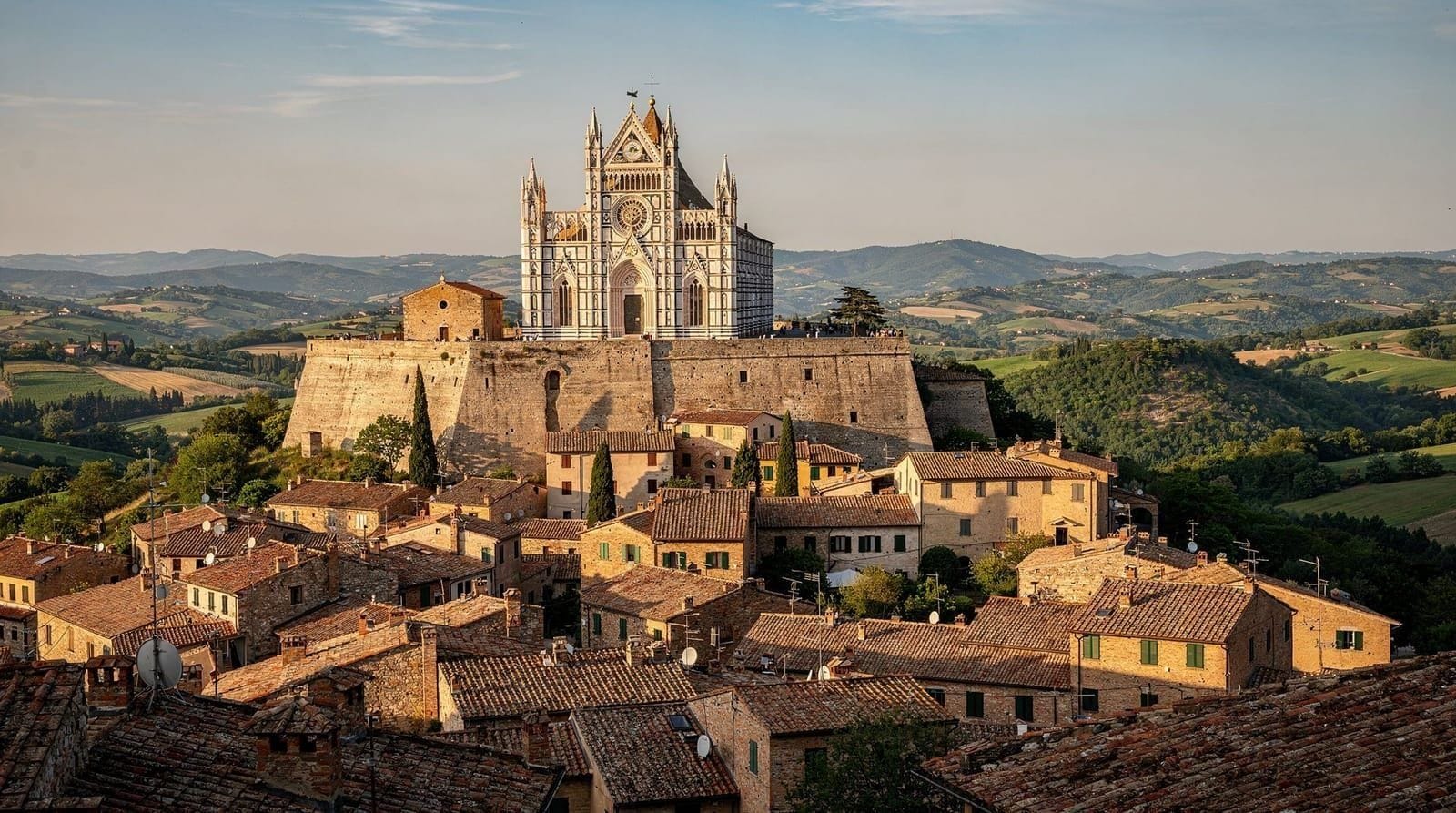
Orvieto sits on a volcanic tufa cliff above the valley — the approach by car or train from below, with the town’s rooftops and cathedral tower rising from the rock, is one of the great Italian landscape moments. The Duomo is the reason most people come: a Gothic facade covered in polychrome marble and gold mosaics, and inside, Luca Signorelli’s Last Judgement frescoes in the Cappella di San Brizio (1499-1504). These frescoes are, art historians agree, one of the primary sources for Michelangelo’s Sistine Chapel ceiling — the twisting muscular figures, the dramatic foreshortening, the dense narrative. Book ahead; the chapel has limited entry.
The Pozzo di San Patrizio (St. Patrick’s Well, 53 metres deep, with a double-helix staircase so donkeys carrying water could descend on one ramp and ascend on the other without meeting) is a remarkable piece of sixteenth-century engineering. The Orvieto Underground tours descend into the Etruscan caves and medieval cisterns beneath the cliff — worth an hour.
Lunch at a simple trattoria in the centro storico. Orvieto’s wine, Orvieto Classico (a dry white from Trebbiano and Grechetto grapes), is worth a bottle over lunch.
Afternoon: Civita di Bagnoregio
Drive 30 minutes northeast to Civita di Bagnoregio — a medieval village on a narrow tufa pinnacle connected to the modern town by a footbridge, so isolated that it was until recently nicknamed “la città che muore” (the dying city). Permanent residents number fewer than twenty. The village has been impeccably preserved (or touristically restored, depending on your view) and the walk across the bridge and up into the piazza is one of the strangest and most beautiful experiences in Lazio. Entry fee €5-7; arrive in the late afternoon when the day trippers thin out.
Evening: stay in Orvieto or drive to Assisi
Orvieto has several good agriturismo options in the surrounding hills. Alternatively, drive two hours northeast to Assisi for an early start on Day 6.
Day 6: Assisi
Morning: Basilica di San Francesco
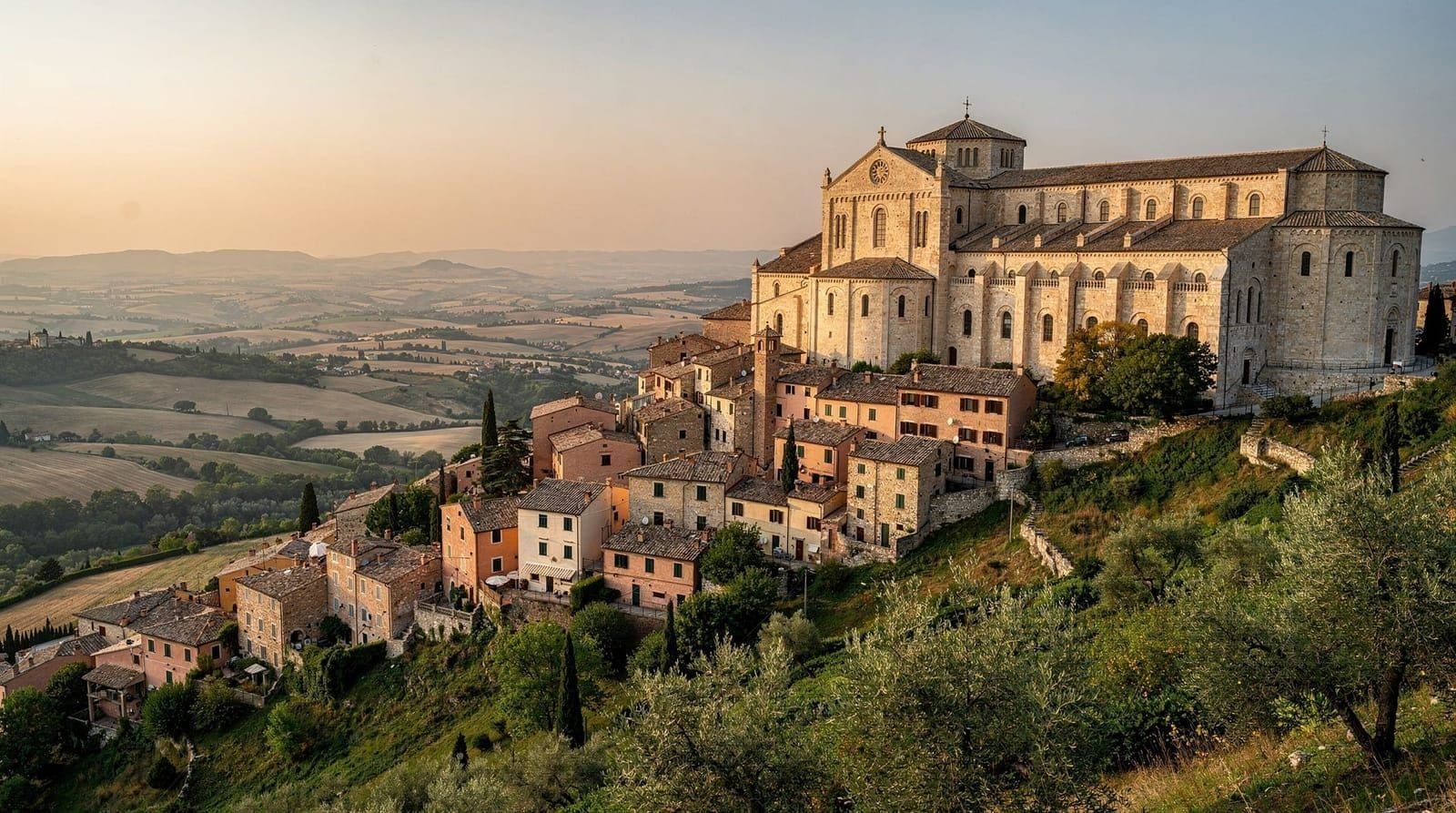
Assisi on the slope of Monte Subasio is one of the best-preserved medieval hilltop towns in Italy, and the Basilica di San Francesco is among the most artistically significant churches in the world. The Lower Church (1228) contains Cimabue’s damaged but still powerful frescoes and Pietro Lorenzetti’s Passion cycle. Climb to the Upper Church for Giotto’s cycle of the life of St. Francis (1297-1300) — 28 scenes painted when fresco was still a new medium, and the moment when medieval painting begins to turn toward the Renaissance. Photography is not permitted; make that work in your favor and actually look.
Assisi and Orvieto day trip from RomeThe basilica is free but receives enormous numbers of pilgrims and tourists — arrive at opening (6am lower church, 8:30am upper) for the most contemplative experience. By 10am the tour groups arrive in quantity.
Afternoon: medieval Assisi
Walk the medieval town itself: the Piazza del Comune (with the Roman Temple of Minerva, now a church, still in impeccable condition), the Basilica di Santa Chiara (St. Clare, Francis’s companion, and the original San Damiano crucifix that spoke to Francis), and the steep streets between them. The views east across the Umbrian valley are extraordinary in clear weather.
Walk or drive down to the Basilica di Santa Maria degli Angeli in the town below — the enormous domed church built around the tiny Porziuncola chapel where Francis founded the Franciscan order and where he died. The scale contrast (a huge Baroque church containing a tiny medieval one) is one of the most surprising architectural experiences in Italy.
Evening: stay in Assisi
Assisi has good accommodation options within the walls; the quality of dinner in the hilltop restaurants (wild boar pasta, truffles, Sagrantino wine) makes staying preferable to leaving immediately.
Day 7: Umbria to Florence
Morning: Perugia (optional)
If time and energy allow, drive 25 km north of Assisi to Perugia for 90 minutes. The Galleria Nazionale dell’Umbria in the Palazzo dei Priori contains the best collection of Umbrian painting (Perugino, who taught Raphael, is the centerpiece) and the Fontana Maggiore in the main piazza is a thirteenth-century sculptural programme of considerable ambition. Perugia is also where Perugina chocolate (Baci) originates.
Midday: drive north to Florence
From Assisi, Florence is 2h30-3h by road via the E45 north to Arezzo and then the A1. Alternatively, train from Assisi (changing at Terontola or Foligno) reaches Florence in 2h30-3h; a car is more flexible for the Tuscan days ahead.
Afternoon: Florence arrival
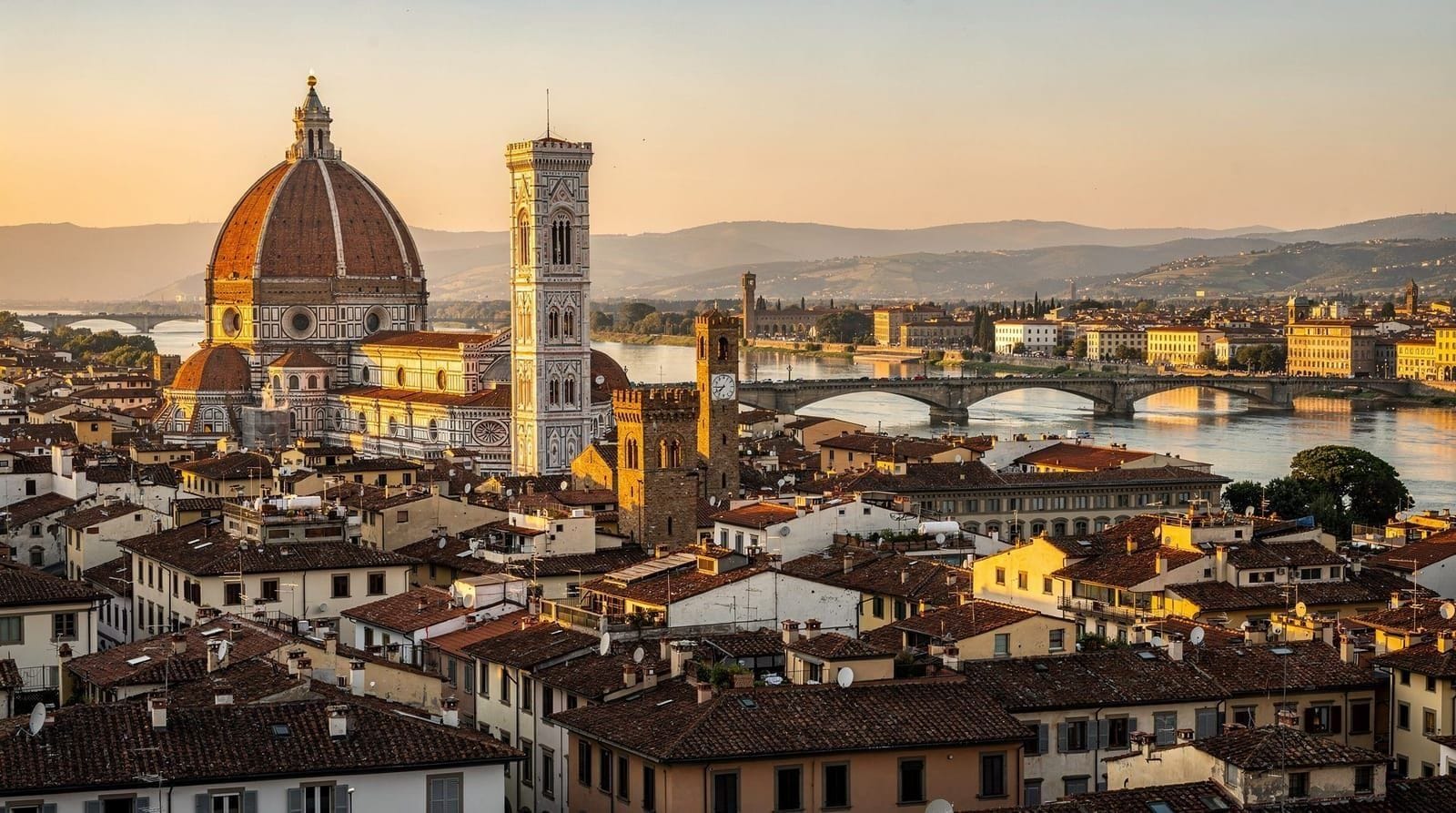
Check in and orient. A walk across the Ponte Vecchio and up to Piazzale Michelangelo for the first aerial view of the city — all rooftiles and Brunelleschi’s dome — is the standard and deserved introduction.
Evening: Oltrarno
Dinner in the Oltrarno (south bank) neighborhood, which has the best non-tourist-facing restaurants in Florence. Buca Mario (the oldest restaurant in Florence, founded 1886, near Piazza della Signoria) or Il Latini (crowded, communal tables, excellent Tuscan food) are both reliable. Bistecca alla Fiorentina is sold by weight (usually 600g-1kg for one serving) and is not cheap but is exactly as good as everyone says.
Day 8: Florence — Uffizi and Duomo
Morning: Uffizi Gallery
The Uffizi requires pre-booked timed entry. The permanent collection includes the most important concentration of early Italian Renaissance painting anywhere: Botticelli’s Birth of Venus and Primavera (room 10-14), Raphael, Leonardo’s Annunciation and the unfinished Adoration of the Magi, Michelangelo’s Doni Tondo, Titian, Caravaggio. Allow three to four hours; the building is enormous and the chronological hang rewards a slow walk through.
Afternoon: Duomo and Accademia
The Duomo complex ticket covers the cathedral interior, Brunelleschi’s dome climb (463 steps, timed slots, essential to pre-book), Giotto’s Campanile, the Baptistery, and the museum. The dome is the architectural achievement of the fifteenth century; getting to the lantern at the top and looking down at Brunelleschi’s ribbed structure from inside is worth every step.
If you did not already see the David, the Accademia Gallery is a 15-minute walk from the Duomo — it requires a pre-booked ticket and the queues without one are long. The David is 5.17 metres of Carrara marble and the original is in this room; the ones you have seen elsewhere are copies.
Evening: San Miniato al Monte
Walk (or take a bus) up to San Miniato al Monte, the eleventh-century Romanesque church above the Piazzale Michelangelo, for one of the most beautiful views of Florence in evening light. The Romanesque facade, the cosmatesque floor inside, and the acoustics at Vespers (5:30pm, sung by the monks) make this a better Florence memory than most ticketed sights.
Day 9: Siena and Chianti
Drive south from Florence on the Chiantigiana (SR222) through the heart of Chianti Classico country to Siena.
Siena, Chianti and wine tasting with lunchMorning: Siena
Arrive early and walk to the Piazza del Campo — arguably Italy’s most beautiful public square, a shell-shaped descending piazza of medieval brick. The Palazzo Pubblico on the south side contains Ambrogio Lorenzetti’s Allegory of Good and Bad Government (1338-1339), the most important secular fresco cycle in Italian medieval art: a detailed depiction of good urban government with a named city and a named landscape, painted as civic propaganda for the Sienese merchant republic.
The Duomo — striped black-and-white marble, extraordinary inlaid marble floor (fully uncovered October-November), Nicola Pisano’s pulpit, and the tiny Piccolomini Library with Pinturicchio’s vivid fresco cycle — deserves 90 minutes. The Torre del Mangia climb gives the rooftop view over the Piazza del Campo and beyond.
Lunch at a trattoria in the streets around the Campo — pici pasta (hand-rolled thick spaghetti) is the Sienese specialty.
Afternoon: Chianti Classico wine route
Drive north on the Chiantigiana through the Chianti Classico zone. The black rooster (Gallo Nero) on a label means the wine meets the Chianti Classico DOCG standard — Sangiovese dominant, aged a minimum of 12 months. Stop at two or three estates: Castello di Verrazzano (between Greve and Panzano), Fontodi (Panzano), or Badia a Passignano (Tavernelle Val di Pesa) for tastings. Most estates offer a simple tasting menu of 3-4 wines with local bread and cured meats for €15-25 per person; call ahead or book on the estate website.
The village of Greve in Chianti has a good permanent wine shop (the cooperative Enoteca del Chianti Classico) if you want to buy a selection to take home.
Evening: Florence or drive toward Rome
Return to Florence for a final night, or begin the drive south — Florence to Rome is 3 hours on the A1.
Day 10: Return
If returning to Rome from Florence, trains run from 5:30am and reach Termini in 1h30 — convenient for an afternoon flight from Fiumicino (FCO) or Ciampino (CIA). If driving, allow 3 hours plus traffic and factor in car return at the airport.
Where to stay
Rome (nights 1-3): Monti or Prati. Both neighborhoods are well-placed for the sights on Days 1-3, with good independent restaurants and a quieter atmosphere than the centro storico.
Tivoli (optional night 4): A night in Tivoli itself allows early access to both villas before the day trips arrive. Several agriturismo options in the surrounding hills are pleasant.
Orvieto/Umbria (nights 5-6): Orvieto has a good selection of hotels within the walls. The countryside around Assisi (agriturismo options) is the better base for Days 6-7 if you want space over convenience.
Florence (nights 7-8): The Oltrarno south bank is quieter and cheaper than the historic core north of the Arno, with better restaurants. The area around Piazza Santo Spirito is particularly good.
Sienese countryside (optional night 9): An agriturismo in the Chianti hills makes the wine country feel like the point rather than a day trip. Relais Vignale (Radda in Chianti) and Castello di Spaltenna (Gaiole) are both good at the mid-luxury end.
Notes on the car: Pick up in Rome after Day 3 at a station location (Termini or Tiburtina) to avoid driving in Rome city itself. Drop off in Florence at Santa Maria Novella if continuing by train, or at Florence airport if flying. ZTL camera fines in both Rome and Florence city centers are automatic and significant (€84-335 per offence, charged to your credit card by the rental company). Check your route carefully and do not drive into the historic center of either city.
FAQ
Do I need a car for the whole ten days? No — a car is a liability in Rome and Florence, both of which have ZTL zones and near-impossible parking. You only need one for Days 4-9 (Tivoli through Chianti); pick it up at a station location after leaving Rome and drop it off in Florence or before returning if you finish by train. See the Rome vs Florence guide for why neither city rewards driving.
Is this itinerary too rushed for first-time visitors to Italy? It moves at a steady but not frantic pace for repeat-minded travellers who want breadth across three regions. First-timers who only care about Rome should look at the dedicated Rome for first-timers 3-day itinerary instead and save Tuscany and Umbria for a second trip.
What’s the single hardest booking to get right? The Borghese Gallery on Day 3, without question — it caps at 180 visitors per two-hour slot and regularly sells out 10-14 days ahead in high season. Book it in the same sitting as the Colosseum and Vatican, not as an afterthought.
Top experiences
Bookable activities with verified prices and instant confirmation on GetYourGuide.