Piazza Navona: Bernini, baroque and what to skip
Trevi, Pantheon & Spanish Steps Guided English Walking Tour
What is special about Piazza Navona and is it worth visiting?
Piazza Navona is Rome's finest baroque piazza — a 270-metre oval built over the ancient stadium of Domitian, anchored by Bernini's Fountain of the Four Rivers (1651) at the center. It is free, open 24 hours, and at its best in the early morning or late evening when the tourist density drops. The surrounding restaurants are overpriced; the fountains and architecture are genuinely extraordinary.
The most beautiful oval in Rome
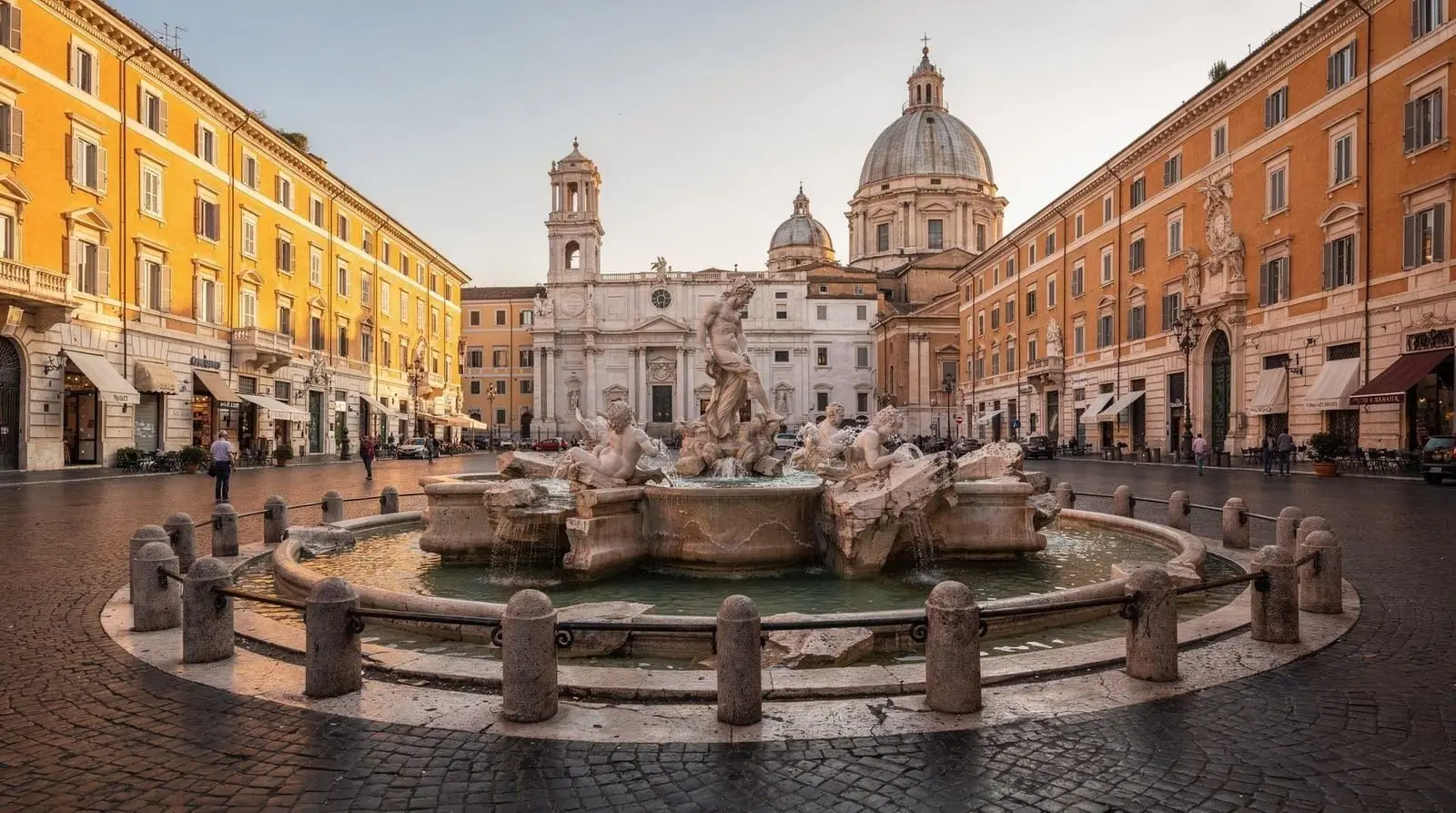
Piazza Navona works at every scale. From above — and there is a rooftop view from the hotel above Ristorante del Governo Vecchio — it reads as a perfect elongated oval, an ancient athletics track fossilized in urban form. From ground level, it is one of the most theatrical public spaces in Europe: Bernini’s fountain at the center, Borromini’s church facade to the west, baroque palaces on every side, and the everyday life of Rome going on around all of it.
It costs nothing to enter. The fountains run constantly. And most visitors, frankly, misread it entirely — arriving at midday, photographing from two metres away, and spending more time at the overpriced cafés than looking at the architecture.
This guide is about how to read Piazza Navona well.
| Cost | Free — no ticket, no timed access |
| Time needed | 20–40 minutes for the fountains and church |
| Best time | Early morning (07:00–09:30) or after 19:00 |
| Avoid | Piazza-facing restaurants, “rose sellers” |
| Nearby | Pantheon (10 min walk), Campo de’ Fiori (8 min walk) |
The shape: what the oval means
The piazza’s distinctive elongated oval footprint is not an architect’s conceit. It is the exact outline of the Stadio di Domiziano — the Stadium of Domitian, built in 86 CE as a 30,000-seat athletics and chariot-racing venue. The arena floor is now the piazza level. The seating banks have become the surrounding buildings. The medieval and baroque structures you see around the edge were literally built on the ancient stadium’s skeleton.
You can confirm this by visiting the underground museum at the piazza’s north end (Piazza di Tor Sanguigna, entrance on the side street). The museum exposes the ancient tunnels and passages below the modern surface. It is inexpensive, rarely crowded, and gives a clarifying context for the whole piazza. See our guide to Rome’s underground sites for more on the city’s subsurface layer.
The name “Navona” is a corruption of “in agone” — in the games — the Italian medieval rendering of what the stadium was used for. Some accounts trace it to the word “navona” relating to water (the piazza was periodically flooded in summer, 17th through 19th centuries, as a cooling ritual for Romans who waded in the shallows while the wealthy watched from carriages).
The Fountain of the Four Rivers: a slow look
Most visitors spend 30 seconds photographing the Fountain of the Four Rivers. Spend ten minutes instead.
The fountain was commissioned by Pope Innocent X Pamphilj in 1647 and completed by Gian Lorenzo Bernini in 1651. It was a commission Bernini almost did not get — Innocent X had initially excluded Bernini from consideration after the latter had been closely associated with the previous Barberini pope. Bernini regained the commission through a maneuver that became one of Rome’s most-told art world stories: he had a model secretly placed in the Palazzo Pamphilj where the pope would encounter it, and Innocent X’s interest was captured. The commission followed.
The obelisk: An ancient Roman-made obelisk (not Egyptian-made but a Roman copy of an Egyptian form, carved during the reign of Domitian) that had been lying in pieces in the Circus of Maxentius on the Appian Way. Bernini not only re-erected it but placed it on a hollow base — a technical achievement that dazzled contemporaries. The obelisk sits on a rock formation through which you can see the sky and water passing, giving it an apparent weightlessness.
The four river figures:
- The Nile (Africa): A hooded, muscular figure with his face covered — because the source of the Nile was unknown to Europeans in 1651. The gesture expresses geographical ignorance in sculpture. The figure is also surrounded by lush vegetation.
- The Danube (Europe): A bearded figure reaching toward the papal coat of arms on the fountain — a gesture of deference and homage to Innocent X’s patronage.
- The Ganges (Asia): A figure holding a long oar, referencing the navigability of the river.
- The Río de la Plata (Americas): The figure most often shown with a raised arm, popularly claimed to be shielding his eyes from Borromini’s church. He is accompanied by armadillos, snakes and coins — representing New World riches.
The Borromini story: The Nile covers his face not to avoid seeing Borromini’s facade; the fountain was finished before Borromini took over the church. The Río de la Plata’s raised arm was explained by early commentators as a gesture of horror at the supposedly unstable Borromini church. Both interpretations are post-hoc impositions — the gestures are expressive baroque poses chosen for visual drama, not architectural commentary. But the rivalry between Bernini and Borromini was real and documented, and the Piazza Navona was where their work faced each other directly. It is the most concentrated site of the greatest architectural rivalry of the 17th century.
The church: Sant’Agnese in Agone
Borromini’s contribution to Piazza Navona is the church of Sant’Agnese in Agone, on the west side of the piazza. The facade (1653–1655) is Borromini’s most public statement in Rome — a concave composition that pushes the two bell towers apart to make the central dome seem to swell forward, an optical trick that creates depth and drama impossible with a conventional flat facade.
Go inside. It costs nothing and is usually quiet. The interior is small and concentrated — a Greek cross plan with a central dome and lavish coloured marble throughout. The floor plan contains the crypt of the Pamphilj family (not typically accessible). A subterranean chamber marks the traditional location of St. Agnes’s martyrdom (she was a Roman Christian girl executed in 304 CE at approximately the age of 12; her name and the stadium’s connection to contests gave the church its name).
The church is a functioning parish and opens for masses. Visiting outside mass times is straightforward; doors are typically open 09:30–12:30 and 15:00–19:00.
The flanking fountains
Fountain of Neptune (north): The main sculptural group — Neptune fighting a sea monster, surrounded by sea horses and Nereids — was added in 1878 by Antonio della Bitta to correct the visual imbalance of an empty basin. The basin itself is 16th century. The composition is competent but not in the league of the central fountain. Worth a proper look; often dismissed because of its proximity to the greater work.
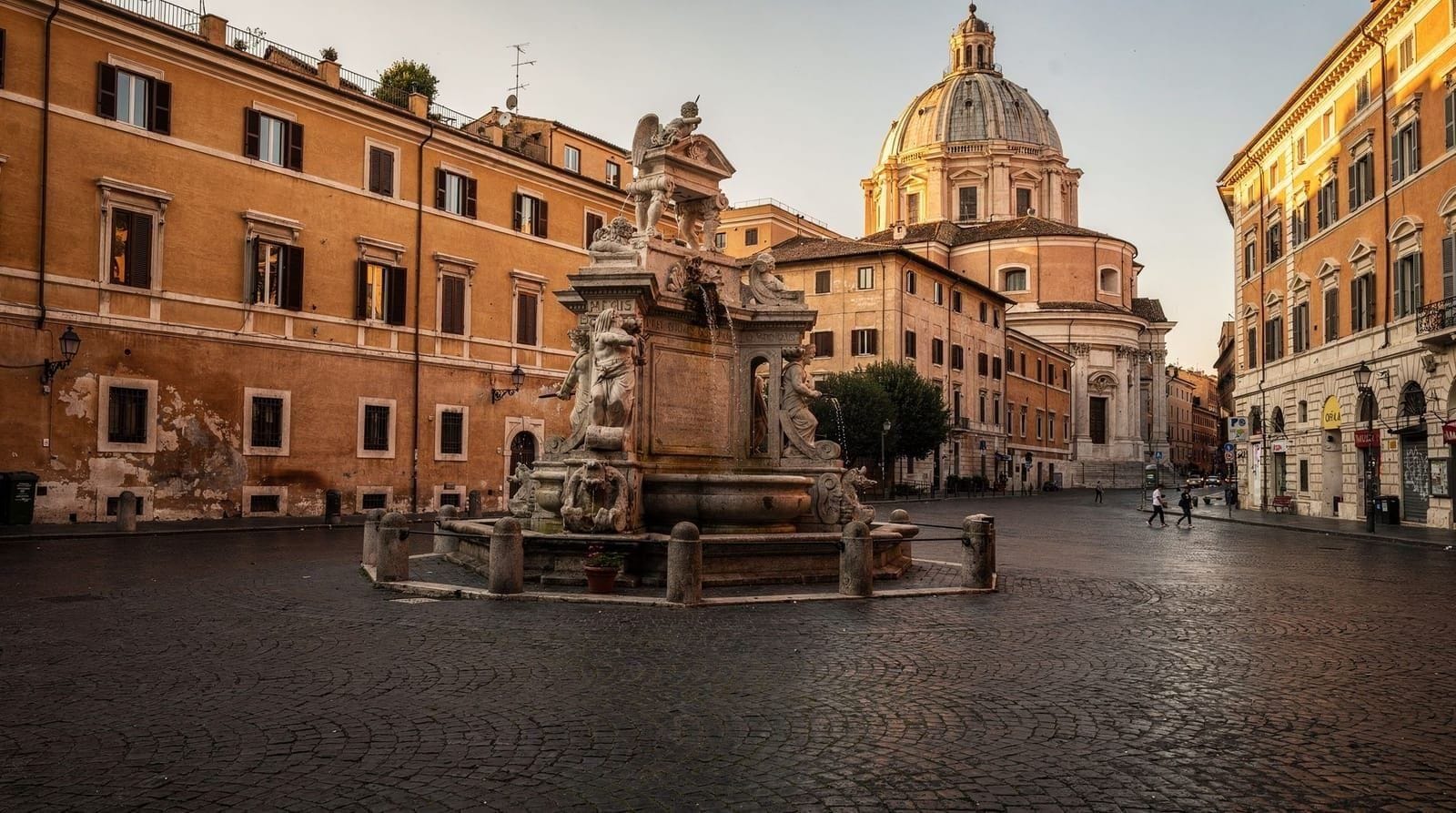
Fountain of the Moor (south): The central figure (a dark-skinned figure wrestling a dolphin, hence “Moro”) was designed by Bernini in 1653 based on a sketch by Giacomo della Porta. The surrounding Tritons and figures are by della Porta (1576). The composition is harmonious and the Moor figure is one of Bernini’s more energetic creations — twisting dynamically against the dolphin. Often overlooked entirely.
Guided walking tour of Piazza Navona, Trevi Fountain, Pantheon and the Spanish Steps — the complete baroque Rome circuit in one morning.What actually surrounds the piazza
Palazzo Pamphilj (now the Brazilian Embassy): The massive palace directly behind Sant’Agnese in Agone was built for Pope Innocent X’s family, designed partly by Borromini. Not open to the public generally.
Palazzo Braschi (Museo di Roma): On the southeastern corner of the piazza, this neoclassical palace (late 18th century) houses Rome’s municipal history museum. The collection covers Rome from the medieval period to the 20th century and is interesting if you want to see how the city looked before modern tourism transformed it.
Pasticceria Bar Tre Scalini: The café at the south end of the piazza is famous for its tartufo — a chocolate gelato ball with a cherry center. It is overpriced relative to neighbourhood gelato shops (expect to pay €8+ for a tartufo at table) but the recipe has been unchanged since the 1940s and is genuinely excellent. If you are going to pay piazza-premium prices for something here, the tartufo is the thing to pay them for.
The three fountains compared
| Fountain | Location | Sculptor | Best feature |
|---|---|---|---|
| Four Rivers | Center | Bernini (1651) | The obelisk balanced on a hollow rock base |
| Neptune | North end | Della Bitta (1878 addition to 16th-c. basin) | Neptune’s dynamic fight with the sea monster |
| The Moor | South end | Bernini’s design, della Porta execution (1653/1576) | The twisting central figure wrestling a dolphin |
Most visitors see only the central fountain and miss the other two entirely, which is a mistake given that both are a two-minute walk from wherever you are standing. A full circuit of all three, at an unhurried pace, takes about 20 minutes.
Getting to Piazza Navona
The piazza has no direct Metro stop — this is part of what keeps it feeling like a neighbourhood square rather than a transit hub. The closest options are Metro A’s Spagna or Barberini stops, followed by a 15–20 minute walk through the Centro Storico, or a bus along Corso Vittorio Emanuele II (several routes, including 40 and 64) with a short walk from Corso Vittorio to the piazza. Most visitors reach it on foot as part of a wider Centro Storico walk rather than as a standalone transit destination, which is the right way to experience it in any case — the surrounding streets are as much the point as the piazza itself.
The tourist trap assessment
Restaurants on the piazza: Marked up significantly relative to comparable food one street away. The view is pleasant; the value is not. If you want to eat near Piazza Navona, walk to Via del Governo Vecchio or Via della Pace — both within three minutes and a different price world.
Portrait artists: Generally skilled and not aggressively pushy, but their rates are high (€20–60 for a quick sketch). If you want to have it done as a souvenir, that is fine; just agree the price before sitting.
“Rose sellers”: Typically target couples with single roses, then become insistent about payment once the rose is accepted. Simply do not take the rose from anyone who approaches offering it. This applies throughout central Rome.
Horse-drawn carriages: Expensive, slow, and the horses are often poorly cared for. Not a recommended way to see the city.
Christmas market (late November–early January): The seasonal market that fills Piazza Navona is a genuine Roman tradition, but it has become heavily commercialized and prices for food and trinkets are elevated. It is atmospheric and worth a 30-minute walk through; it is not where you should do Christmas shopping.
When to visit
Early morning (07:00–09:30): The best time. The piazza is quiet, the light is good for photography, and you see Romans walking dogs and having breakfast at the cafés at normal prices. This is the Piazza Navona that residents know.
Midday: Busy but not overwhelming by Rome standards. The fountains are fully in sun for good photographs.
Evening (19:00–22:00): The most atmospheric for a casual visit — evening light, restaurants opening, the fountains lit. But the restaurant prices are fully in tourist mode.
Christmas market season: Crowded, festive, and uniquely Roman. If you are visiting in December, it is worth seeing. If you are not visiting in December, ignore this as a consideration.
Private walking tour focused on the Trevi Fountain and Piazza Navona — your own guide with time to explore both spaces in depth and ask questions.The piazza in context
Piazza Navona is the showpiece of the Centro Storico, Rome’s historic heart. It is surrounded by some of the best walking streets in the city — the area between Navona, Campo de’ Fiori and the Pantheon is dense with smaller churches, Renaissance palaces, artisan workshops and ordinary Roman street life.
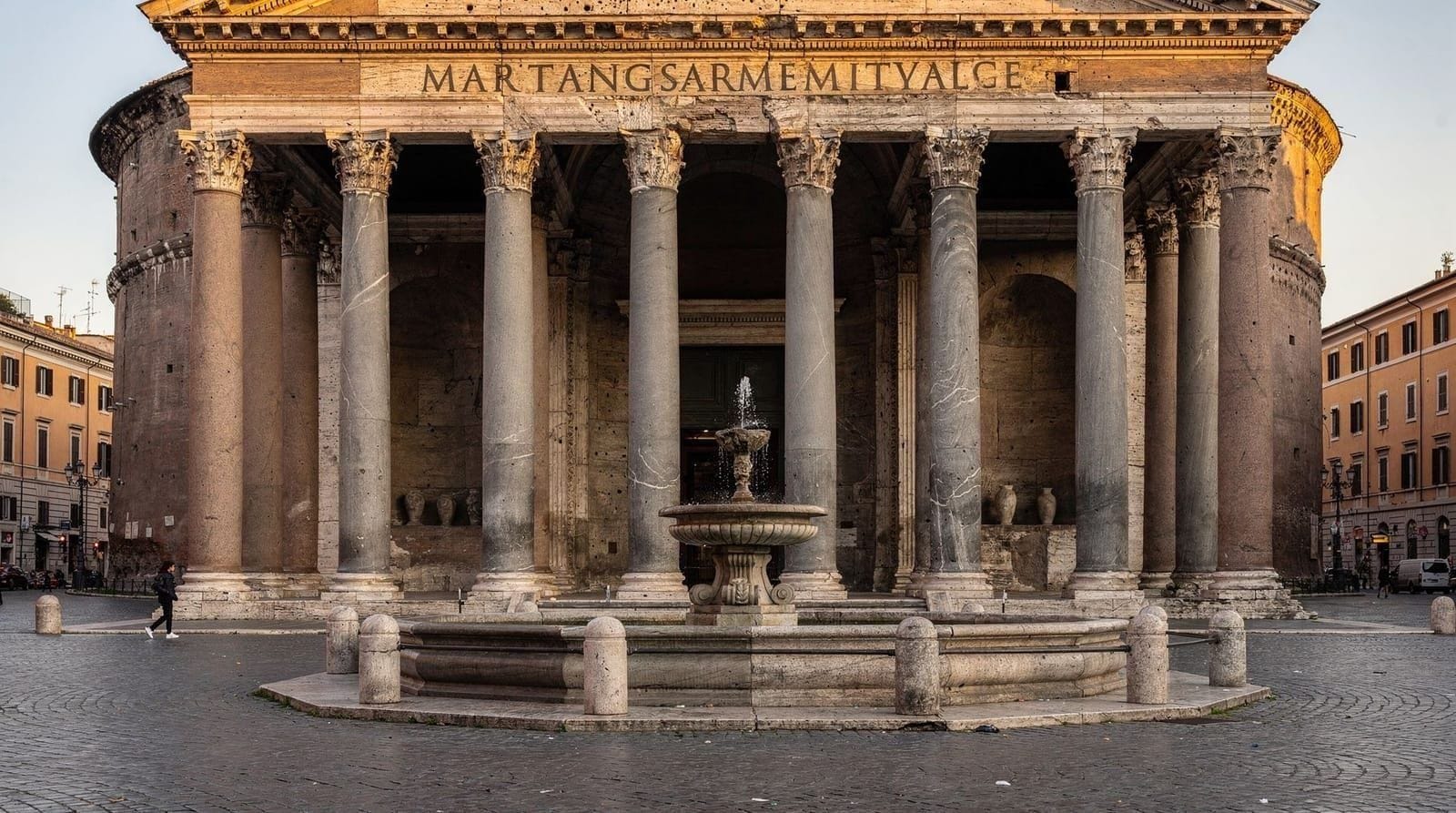
To understand this area more fully, combine a Navona visit with the Pantheon guide (10 minutes’ walk east), a walk down Via del Governo Vecchio (one of Rome’s best-preserved medieval streets), and a stop at Campo de’ Fiori for the morning market. Our Rome’s best piazzas guide covers several Navona-adjacent squares that most visitors never reach.
For the broader walking circuit connecting Navona, Trevi and the Spanish Steps, see our baroque Rome walking guide.
Photography notes
The fountain of the Four Rivers is best photographed:
- From the south end of the piazza looking north, which captures the full obelisk height and the church facade behind it
- From the southeast corner to include Sant’Agnese in Agone in the same frame
- At night when the fountain is lit and the piazza is relatively empty — though the light temperature contrast between the illuminated white travertine and the dark sky requires some exposure management
The piazza is wide enough that you need to be standing 15–20 metres back to capture the full central fountain composition. A 24–35mm equivalent lens (phone or camera) works well from this distance.
Best photo spots in Rome covers the specific positions and times for the best Navona shots alongside Rome’s other major locations.
Avoiding the crowds without avoiding the piazza
Piazza Navona is never truly empty, but its crowd pattern is predictable enough to plan around. The busiest window is roughly 11:00–17:00, when day-trippers, tour groups and lunch crowds overlap. Arriving before 9:30 or after 21:00 genuinely changes the character of the visit — you get the same fountains and the same architecture with a fraction of the people, and the piazza reads much closer to how it functioned as a neighbourhood square for centuries before mass tourism. For a broader strategy on timing Rome’s headline sights around crowd patterns, see our avoiding Rome’s crowds guide.
If you are visiting as part of an evening out — dinner, a walk, a proposal, or simply an unhurried look at Bernini’s fountain lit at night — Piazza Navona is one of the strongest choices in the city. See our Rome evening tours guide and romantic things to do in Rome for how it fits an evening itinerary alongside the Trevi Fountain and the Spanish Steps.
Nearby churches worth a short detour
Beyond Sant’Agnese in Agone, the streets immediately around Piazza Navona hold several small, free, and consistently undervisited churches. Our Rome hidden churches guide covers several within a five-minute walk of the piazza — a good option if you have spent your allotted 30 minutes at Navona and still have time before your next stop, and want something quieter than the piazza itself.
Frequently asked questions about Piazza Navona: Bernini, baroque and what to skip
Is Piazza Navona free to visit?
What are the three fountains in Piazza Navona?
What is the Bernini versus Borromini story at Piazza Navona?
What is under Piazza Navona?
When is Piazza Navona at its best?
What should I skip in Piazza Navona?
Is Sant'Agnese in Agone church worth visiting?
Top experiences
Bookable activities with verified prices and instant confirmation on GetYourGuide.