Florence from Rome: a high-speed-train day trip
Day Trip to Florence by High-Speed Train From Rome
How long is the train from Rome to Florence?
The Frecciarossa or Italo high-speed train from Roma Termini to Firenze Santa Maria Novella takes 1h25–1h35. Fares start from €20 if booked in advance. Trains run roughly every 30 minutes throughout the day.
Florence in a day: what you can actually do
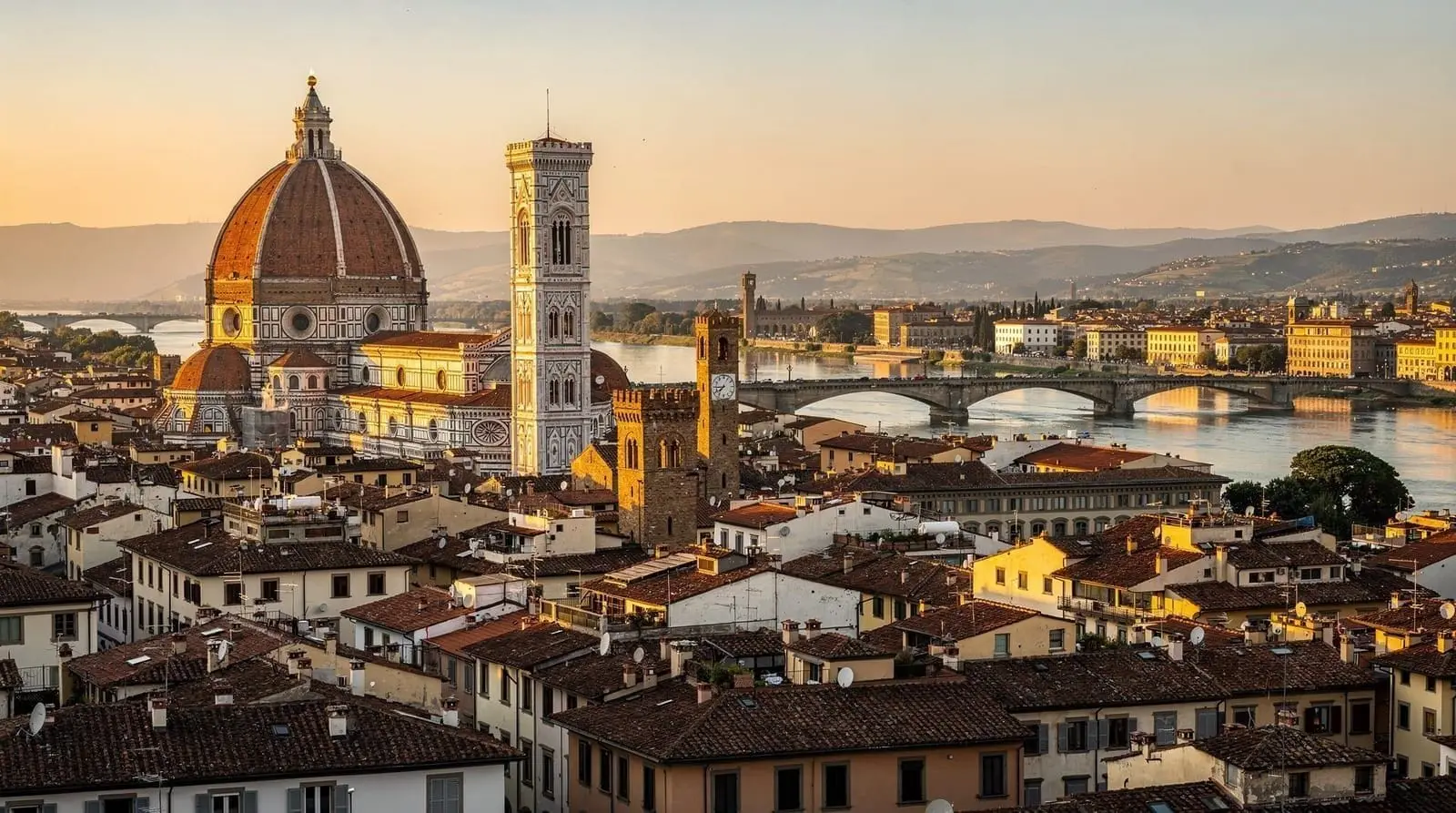
Let’s start with the honest version: Florence is too much for one day. It is arguably the most art-dense city in Europe — a city of 360,000 people that contains an extraordinary fraction of the world’s greatest Renaissance masterpieces in a relatively compact area. The Uffizi alone deserves a full morning. The Accademia (Michelangelo’s David) needs at least an hour of focused attention. The Duomo complex — cathedral, baptistery, dome climb, museum — is a full day in itself. The Oltrarno neighbourhood, Boboli Gardens, and Pitti Palace would fill another day.
None of this means you should not go. Florence in half a day is better than no Florence at all. The 1h30 Frecciarossa journey is effortless; the city is completely walkable from the station; and even three hours in the Uffizi’s first-floor rooms constitutes one of the finest cultural experiences in Europe.
Just go in with a plan rather than trying to do everything.
| Travel time | 1h25–1h35 by Frecciarossa/Italo from Roma Termini |
| Cost | from around €20 each way if booked in advance |
| Time on the ground | 4–6 hours realistic on a day trip |
| Booking | museum slots (Uffizi, Accademia, Duomo) need advance booking |
| Best for | a taste of Florence; book an overnight for real depth |
The logistics
Getting there
From Roma Termini: Frecciarossa (Trenitalia) or Italo high-speed trains to Firenze Santa Maria Novella (the main Florence station, in the city centre). Journey time: 1h25–1h35.
Frequency: Roughly every 30 minutes in the morning, sometimes more frequent. Both operators run throughout the day.
Fares: Book in advance at trenitalia.com or italotreno.it. Advance fares from approximately €20–25 each way. Same-day fares can be €40–65. For a round trip, budget €40–130 depending on timing.
Seat reservation included: High-speed tickets come with a reserved seat. No need to arrive early to secure standing room.
Getting from Firenze SMN to the sights: The station is 10 minutes’ walk from the Uffizi, 12 minutes from the Duomo, and 15 minutes from the Accademia. There is essentially no reason to take a taxi or bus within the historic centre.
When to go
Early departure is essential. The 07:00–07:30 train from Roma Termini arrives in Florence by 08:30–09:00, giving you 5–6 hours before you need to catch the return. An 09:00 departure gives you only 4 hours — tight for a first visit.
Return timing: The last comfortable train to catch a 21:30–22:00 arrival in Rome departs Florence at around 19:30–20:00. Check the specific timetable for your date.
The three options compared
| Option | Best for | Booking needed | Pace |
|---|---|---|---|
| A — Art track (Uffizi + Accademia) | First-time visitors, Renaissance painting fans | Uffizi + Accademia slots | Structured, museum-heavy |
| B — Duomo track | Visitors who prefer architecture and engineering | Opera del Duomo pass, dome climb slot | Structured, physical (463 steps) |
| C — Slow walk | Visitors who want atmosphere over ticked boxes | None | Relaxed, flexible |
None of the three is objectively correct — they suit different travel styles, and a repeat visitor to Florence might deliberately choose C after having done A or B on a previous trip.
What to do: three options
Option A — The art track (Uffizi + Accademia)
Book in advance:
- Uffizi: uffizi.it (€20 entry + €4 booking fee). Choose a 09:00 slot.
- Accademia (David): uffizi.it (€12 entry + €4 booking fee). Choose a 13:00 slot.
09:00–12:30 — Uffizi Gallery: The Uffizi is the flagship gallery of Florence and one of the most important art museums in the world. For a focused first visit, concentrate on the rooms that are unambiguously unmissable:
- Room 2–3 (Cimabue and Giotto): The moment Western painting began moving toward naturalism, visible in the transition from Cimabue’s Byzantine-influenced Madonna to Giotto’s more three-dimensional treatment of the same subject just feet away.
- Room 10–14 (Botticelli): The rooms most people come for. The Birth of Venus and Primavera are both here — large, luminous, and more powerful in person than any reproduction suggests. These rooms get crowded from mid-morning; being at the museum at 09:00 gives you 30–45 minutes before the main groups arrive.
- Room 35 (Michelangelo — Doni Tondo): Michelangelo’s only completed panel painting. The technical virtuosity is extraordinary; so is the strangeness of the composition.
- Room 66 (Raphael): Leo X with Cardinals, Madonna of the Goldfinch.
- Room 83 (Titian, Caravaggio): Including Caravaggio’s Medusa and Sacrifice of Isaac.
12:30–13:30 — Lunch near the Uffizi: The Piazza della Signoria and surrounding streets have tourist-trap pricing. For a better lunch, walk two blocks into the Oltrarno (cross the Ponte Vecchio, turn right): Buca Mario on Via Guicciardini is a traditional trattoria with bistecca and ribollita; Osteria dell’Enoteca is more wine-focused. Budget €20–35 per person.
Alternatively: Mercato Centrale (15 minutes’ walk north of the Uffizi) has a ground floor of excellent food stalls — the best option for a quick, affordable, high-quality lunch (€8–15).
13:30–14:30 — Accademia Gallery: Michelangelo’s David is in a purpose-built tribune at the end of the central hall. The scale (5.17m, not counting the pedestal) is what surprises visitors — reproductions don’t convey it. Michelangelo carved it from a single block of flawed Carrara marble between 1501 and 1504, when he was 26. The technical achievement is easier to appreciate in person than in any photograph. Budget 45–60 minutes.
The Prisoners (Prigioni) — four unfinished Michelangelo sculptures in the corridor leading to the David — are arguably more emotionally compelling: figures in the act of emerging from the stone, frozen at the point where Michelangelo stopped work.
15:00–17:30 — Afternoon walk: Cross back over the Arno and walk the Piazza della Signoria (the political center of Renaissance Florence — the Palazzo Vecchio, the replica David, the Loggia dei Lanzi with original ancient and Renaissance sculptures), Ponte Vecchio (lined with goldsmiths since the 16th century), and Piazza del Duomo.
Day trip to Florence by high-speed train from Rome — guided tour with Uffizi skip-the-line entryOption B — The Duomo track
For visitors who want to understand Florence as a physical city rather than primarily as an art museum, the Duomo complex deserves centre stage.
Book in advance: The Opera del Duomo pass (€30, covers cathedral, baptistery, dome climb, Campanile, and museum) is available at duomo.firenze.it. The dome climb slot must be pre-booked; entry to the dome without advance booking is not possible.
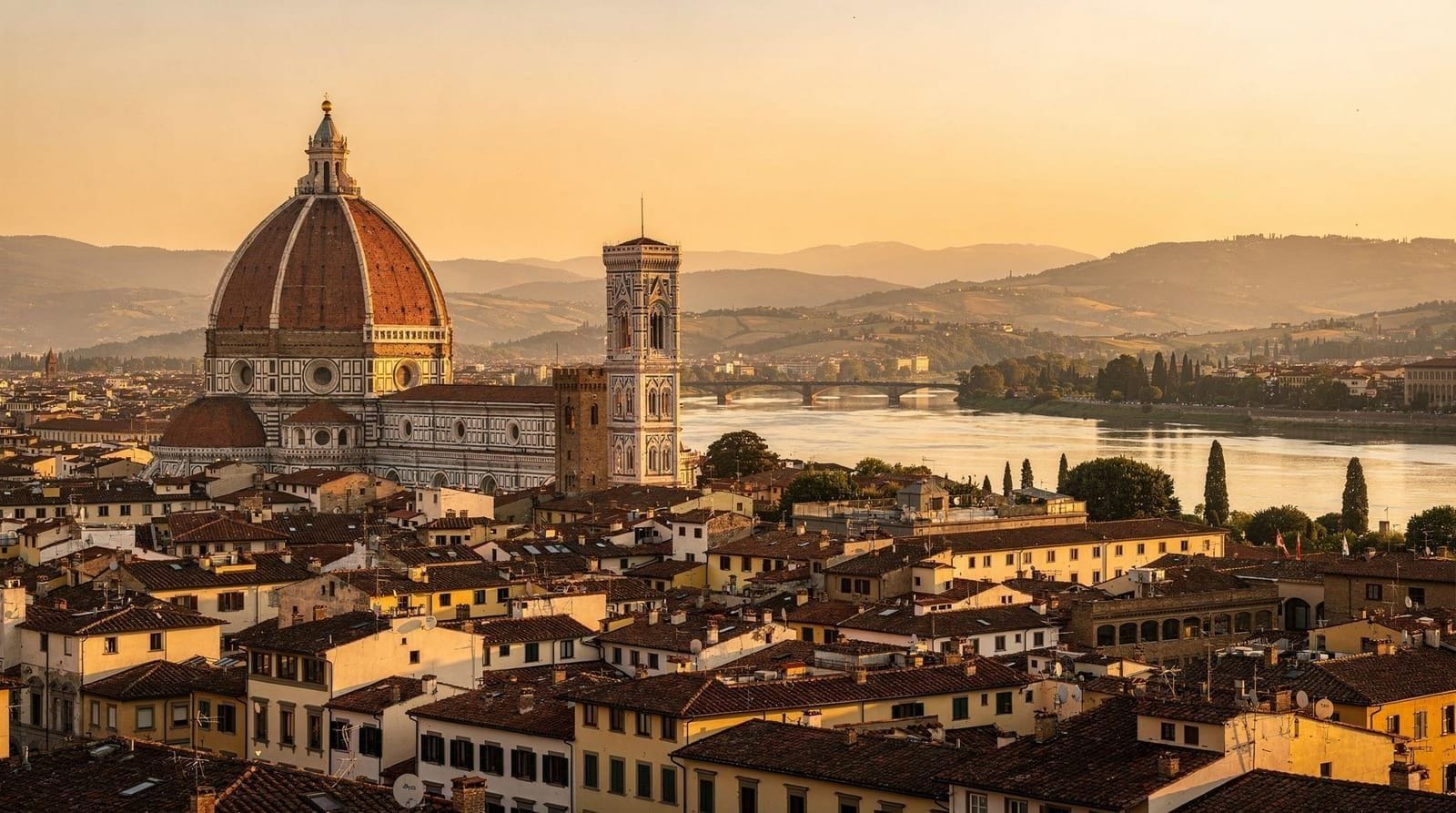
- 09:00 — Dome climb (Cupola del Brunelleschi): 463 steps to the lantern. The views are extraordinary; so is the engineering. Brunelleschi designed the first double-shell masonry dome since antiquity without any centring support — a structural feat so revolutionary that other European architects copied his techniques for a century. From inside the drum just below the dome, Vasari and Zuccari’s frescoes cover the interior of the lantern — walking the interior gallery gives you a close-up view and a vertiginous sense of scale.
- 11:00 — The Baptistery and Ghiberti’s Gates of Paradise: The doors on the east face (currently copies; originals in the Museo dell’Opera del Duomo) are Ghiberti’s masterpiece — ten Old Testament scenes in gilded bronze relief, which Michelangelo said were worthy of being the gates of Paradise. The copies are genuine art objects; the originals in the museum are exceptional.
- 12:30 — Lunch and Ponte Vecchio:
- 14:00 — Museo dell’Opera del Duomo: Often overlooked, genuinely extraordinary — the museum houses the original Gates of Paradise, Michelangelo’s late Pietà (carved for his own tomb), Donatello’s Mary Magdalene, and Luca della Robbia’s Cantoria (choir gallery).
- 16:00 — Piazza della Signoria and surrounding streets.
Option C — The slow walk
For visitors who want an impression of Florence rather than a museum intensive, walking the city takes you through one of the most beautiful urban environments in Europe with no entry tickets required.
- Piazza della Repubblica (commercial heart)
- Via Calzaiuoli to Piazza della Signoria
- Loggia dei Lanzi (open sculpture gallery, free)
- Ponte Vecchio and the Oltrarno bank
- Piazza Santo Spirito (the local square, surrounded by antique shops and cafes)
- Back north through the Bobolino gardens or Via Maggio
- Duomo exterior (no ticket required for the exterior — the facade alone is extraordinary)
The honest case for an overnight
A day trip to Florence works. It does not, however, give you:
- The Oltrarno neighbourhood at twilight, when the light on the Arno turns orange and the narrow streets fill with aperitivo drinkers
- A second morning at the Uffizi for the rooms you missed the first time
- The Boboli Gardens, which require half a day for justice
- The Brancacci Chapel (Masaccio’s frescoes — one of the most important rooms in Western painting history), which needs a separate booking and at least an hour
- San Miniato al Monte, the 11th-century church on the hill above the Oltrarno, with one of the most beautiful Romanesque interiors in Italy
A night in Florence allows you to choose two or three of these at leisure. See Rome vs Florence for a full comparison if you are deciding whether to add a Florence overnight to your Italy trip.
Train to Florence from Rome plus Uffizi skip-the-line tickets — good option if the Uffizi is your priorityTrain vs organised tour
Train independently is completely straightforward for Florence. The city is walkable from the station; the museum booking sites are in English; and the city itself requires no guide to navigate. Book your train tickets and museum slots in advance and you are sorted.
Organised tours have one practical advantage: some include guided entry to the Uffizi with a licensed art historian, which transforms the experience significantly. Walking through the Botticelli rooms with someone who can explain the Medici patronage, the Neoplatonic programme, and the specific mythological identifications in Primavera is genuinely different from reading a wall label. If art history is important to you, a guided tour is worth considering.
Guided day tours from Rome to Florence with Uffizi entry cost approximately €100–150 per person including train, guide, and skip-the-line tickets.
What to eat in Florence
Bistecca alla Fiorentina: The T-bone steak from Chianina cattle, served rare on the bone, charged by weight (typically €50–70 per kg). The defining Florentine dish. Best at Buca Mario (€80–100 for two people sharing a steak) or Il Latini (chaotic, communal tables, excellent, queue outside).
Ribollita: The thick Tuscan bean and vegetable soup — a cucina povera classic, eaten across Tuscany, but the Florence versions are particularly good in autumn and winter.
Schiacciata: The Florentine version of focaccia — thinner, olive-oil rich, often with salt and sometimes grapes (schiacciata all’uva in September). Buy from a forno (bakery) for €1–2 as a snack.
Lampredotto: The street food unique to Florence — cooked tripe (the fourth stomach of the cow), simmered in broth, served as a panino with green salsa. Nerbone in the Mercato Centrale is the most respected. Not for everyone, but authentically Florentine.
Practical checklist
- Book train: trenitalia.com or italotreno.it, 2–4 weeks ahead; fares from €20 each way. See trains from Rome day trips for the full guide.
- Book Uffizi: uffizi.it, €20 + €4 booking fee, morning slot
- Book Accademia (optional): uffizi.it, €12 + €4 booking fee
- Book Duomo dome climb (optional): duomo.firenze.it, €30 combined pass
- Departure from Rome: 07:00–07:30 from Roma Termini. See Fiumicino to Rome guide if arriving from the airport and heading straight to the train.
- Return from Florence: 19:30–20:00 from Firenze SMN
- Wear: Comfortable walking shoes; the historic centre is cobblestone throughout
- Destination context: Florence destination page for extended visit planning.
- 7-day itinerary: Rome, Florence and Tuscany 7 days for an overnight extension.
- All day trips: Best day trips from Rome and day trips by train from Rome.
Frequently asked questions
Which is better for a first visit to Italy — Rome or Florence?
They are complementary, not competing. Rome gives you ancient history and the Catholic world’s greatest monuments on a grand urban scale. Florence gives you Renaissance art and the most beautiful city environment of the period in a compact, walkable city. Most visitors to Italy want both. See Rome vs Florence for the full comparison.
Can I do the Uffizi without a guide?
Yes — the gallery provides an audio guide (approximately €6) and has good English-language panels. Most visitors navigate it successfully without a live guide. A licensed guide adds context and prioritisation; it is not essential for a rewarding visit, particularly for visitors with some art history background.
What should I skip on a one-day Florence visit?
The Pitti Palace (needs half a day), the Boboli Gardens (an hour at minimum), San Marco and Fra Angelico’s cells (less famous but superb — better for a second visit), and the outlying churches (Santa Croce, Santa Maria Novella). These are all excellent; they are simply lower-priority than the Uffizi, David, and Duomo on a first day.
Is it worth doing Florence as a day trip if I have 10+ days in Italy?
With that much time, an overnight is usually the better choice — the marginal cost of one hotel night is small relative to the value of an evening and a second morning in the city. See central Italy in 10 days or Rome, Florence and Tuscany in 7 days for how a longer Italy trip typically allocates Florence more generously than a single day.
How physically demanding is the day trip?
Moderately. Between the museum queues, the walking between sights (all flat, but covering 8–10 km if you do a full itinerary), and the 463-step dome climb if you choose Option B, expect a tiring day. Comfortable shoes are non-negotiable, and pacing yourself with a proper lunch stop matters more on a single intensive day than it would on a more relaxed overnight visit.
Top experiences
Bookable activities with verified prices and instant confirmation on GetYourGuide.