Assisi
Assisi is 2h from Rome by train. Giotto's frescoes in the Upper Church are among the greatest in Western art. Here's how to plan a smart day trip.
From Rome: Assisi and St. Francis Basilica Day Trip
Quick facts
- Train from Rome
- ~2h (Roma Termini → Assisi, via Foligno or Terontola + change)
- Train cost
- €15–€30 each way
- Day trip feasibility
- Yes — 6–7 hours on the ground with an early start
- From Assisi station to town
- Bus C1 (10 min, €1.30) or taxi (~€10)
- Best time
- April–May and September–October; October 3–4 for the Feast of St Francis
- Walking
- Hilly — the basilica is lower, Santa Chiara and the Rocca are higher
Assisi: more than a pilgrimage destination
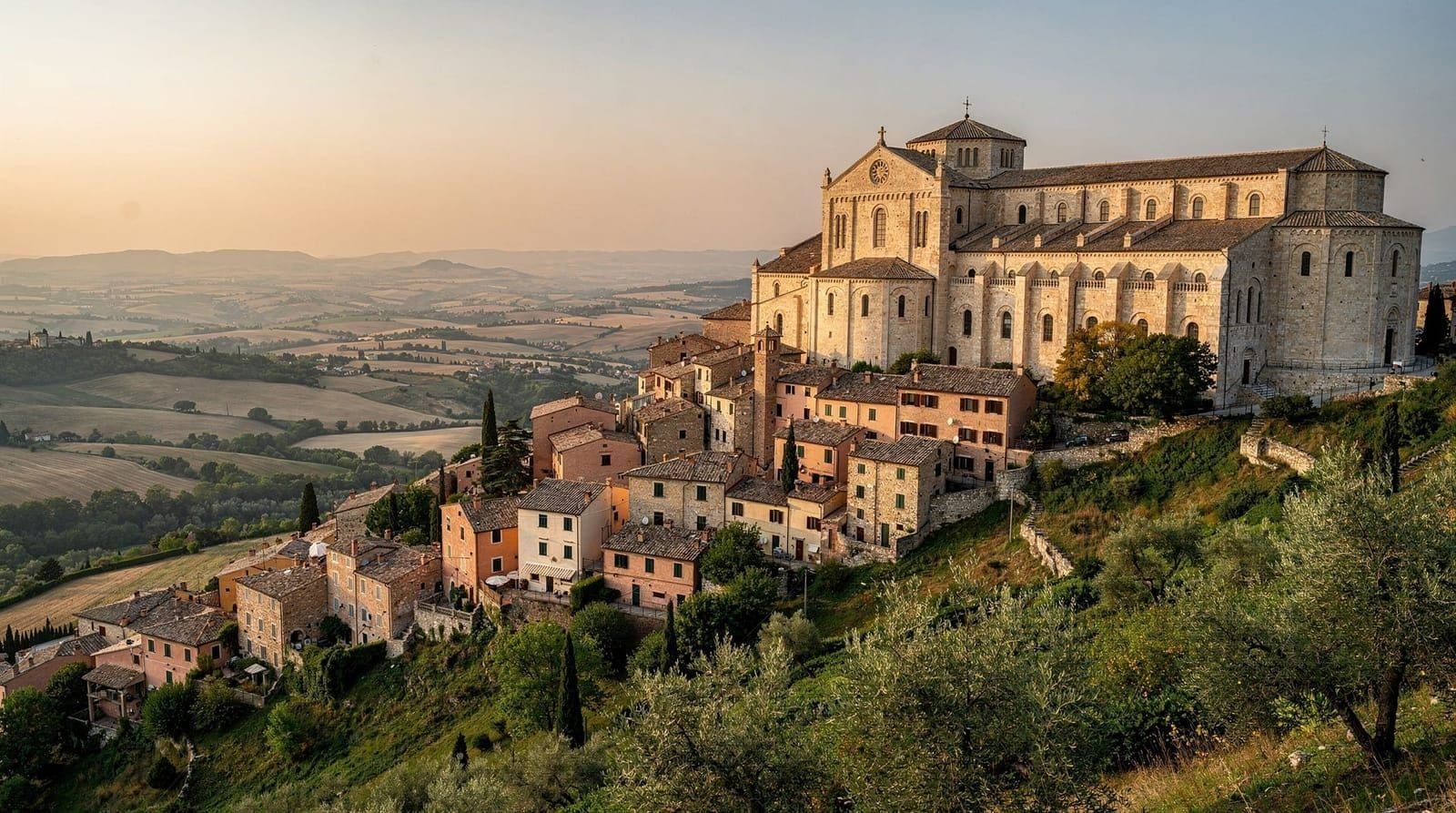
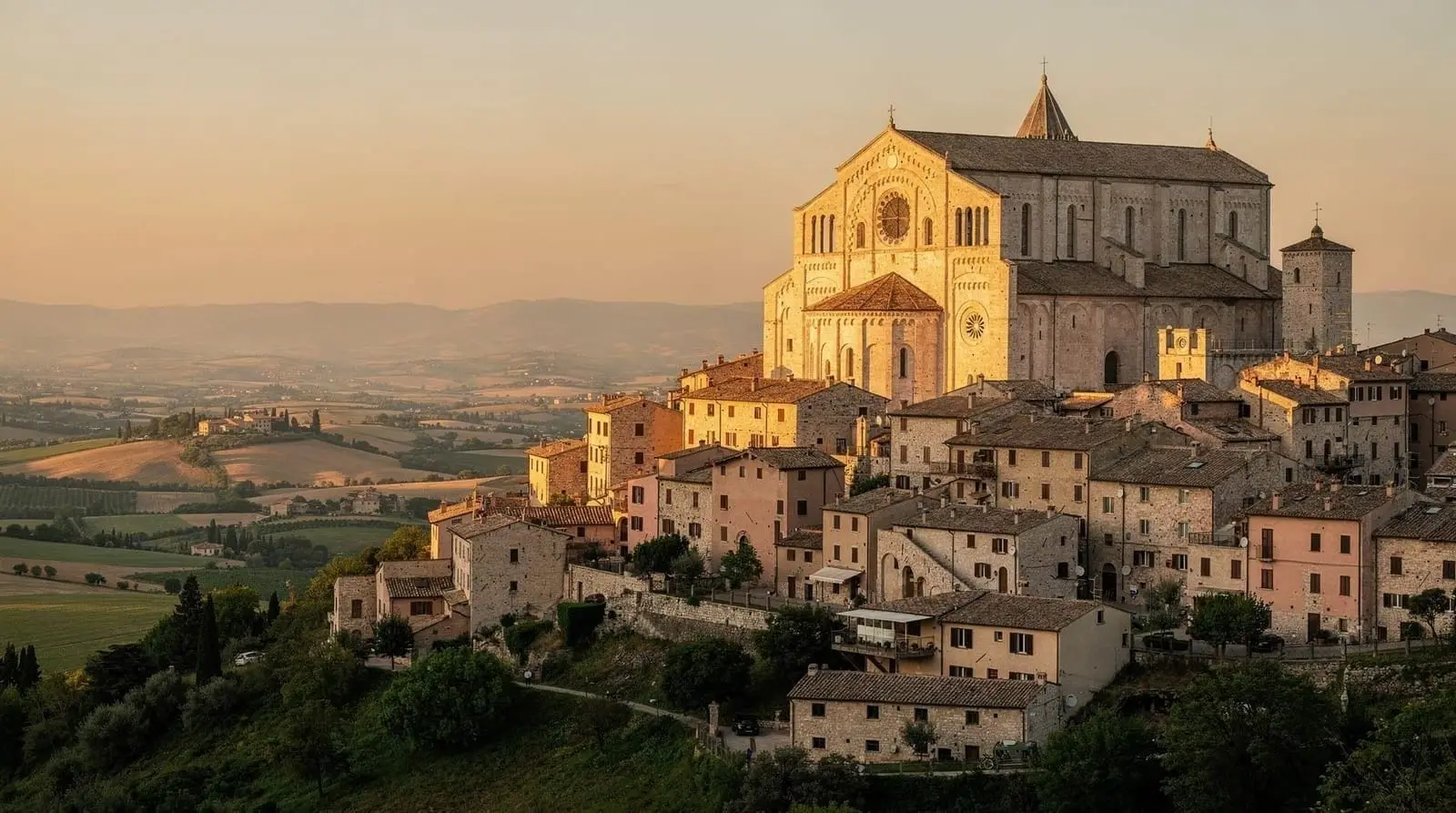
Assisi is one of those places where the religious significance and the artistic and architectural significance happen to coincide completely. St Francis of Assisi (1181–1226) is the most popular saint in the Catholic world. The basilica built in his honour starting in 1228 contains the most important cycle of Giotto frescoes in existence — arguably the most important narrative fresco cycle of the medieval period, full stop. And all of this sits in a pink-stoned hill town above the Umbrian plain that looks essentially unchanged from how a medieval Italian city was supposed to look.
You don’t have to be Catholic, or even remotely religious, to find Assisi extraordinary. The frescoes alone are worth the journey.
The practical consideration: Assisi is 178 km from Rome and requires a train change, which makes it a slightly more logistically demanding day trip than Orvieto (direct, 1h). But with an early start, 6–7 hours in Assisi is entirely feasible and more than enough to see everything.
Getting there by train
Rome to Assisi is not a direct journey by train. You’ll change either at Terontola-Cortona (on the main Rome–Florence line) or at Foligno (on the Rome–Ancona line, which passes closer to Assisi).
Fastest route: Roma Termini → Foligno by Intercity/Regionale (about 1h45), then regional train Foligno → Assisi (20 minutes). Total: ~2h05–2h20.
Alternative: Roma Termini → Terontola (1h30 on Frecciarossa), then regional train to Assisi (~40 minutes via Perugia and Spello). Total: ~2h10–2h30 but sometimes faster on fast trains.
Ticket price: €15–€30 each way depending on train type and booking timing. Book at trenitalia.com.
Assisi railway station is in Santa Maria degli Angeli, the plain below the hill town. Take bus C1 (Piazza Unità d’Italia in town, €1.30, 10 minutes) or a taxi (€10). The bus runs frequently.
Recommended departure: 7:30 am from Roma Termini puts you in Assisi by 9:45–10:00 am. Leave Assisi at 5:30–6:00 pm, back in Rome by 8:30–9:00 pm.
The Basilica di San Francesco: a complete guide
The Basilica di San Francesco is two churches built one on top of the other (the Lower Church, begun 1228; the Upper Church, begun later in the 13th century). Below both is the crypt containing the tomb of St Francis.
Lower Church: darker, more atmospheric, with painted vaults by Cimabue and Simone Martini. The Maestà by Simone Martini in the Chapel of St Martin is one of his finest works. The ceiling vault above the high altar has Cimabue’s Angels and a much-discussed figure once attributed to Giotto. Spend at least 45 minutes here.
Upper Church: the famous space. The nave is painted with 28 episodes from the Life of St Francis by Giotto (or Giotto’s workshop — art historians have debated attribution for a century; the consensus is that Giotto designed and directed the cycle). The frescoes depict St Francis’s life in narrative sequence from bay to bay. The cycle is genuinely revolutionary in Western art — figures with weight, emotions, spatial depth, a visual storytelling logic that was new in 1297.
In the transepts and apse of the Upper Church are Cimabue’s earlier frescoes, severely damaged in the 1997 earthquake and partially restored. The famous Crucifixion in the left transept, badly deteriorated, still commands the space.
Practical:
- The basilica is open daily 6:00 am–6:45 pm (summer hours; winter closes at 5:45 pm).
- Entry is free but modest dress is required: shoulders and knees covered. This is strictly enforced at the entrance. Disposable shawls are sometimes available but bring your own cover.
- No photography inside is technically the rule, though it varies in enforcement.
- Groups must contact the Sacro Convento office to book guided access.
- Arrive early (before 9:30 am) or late afternoon (after 4:00 pm) — midday is when cruise and coach tour groups are at maximum density.
The rest of Assisi: walking the hill town
The basilica will absorb most of your morning. The afternoon is for exploring the rest.
Piazza del Comune: the main square, built on the site of the Roman forum. The Temple of Minerva (1st century BC) is incorporated into a Baroque church but the front columns are intact and arresting — a Roman temple facade in a medieval Umbrian square. The civic tower adjacent has a small museum and climb.
Basilica di Santa Chiara: the church of St Clare (co-founder of the Poor Clares), built 1257–1265. Inside is the original San Damiano Cross, the Byzantine crucifix in front of which St Francis received his mission. More intimate than San Francesco and much less crowded.
Rocca Maggiore: the 14th-century fortress at the top of the hill, offering the most complete view of Assisi and the plain below. Entry €5. The walk from the centre takes 20 minutes uphill on paved paths.
Eremo delle Carceri: a hermitage 4 km above the town in the Monte Subasio forest — the cave where St Francis and his companions would retreat for prayer. It’s peaceful and surprising: a complex of small stone buildings clinging to the hillside above the treeline. Accessible by taxi (€15–€20 return, ask the driver to wait) or on foot (1.5 hours uphill). Most day-trippers skip it, which is partly why it’s worth going.
Via San Francesco: the main pedestrian street from the piazza to the basilica, lined with ceramic shops, linen merchants, and the odd decent café. Much of the merchandise is standard religious tourist ware. The exception is local ceramics in Umbrian green and yellow — some of it genuinely handmade.
Organised tours: the logistics benefit
Getting to Assisi independently involves a train change, a bus from the station, and self-navigating the hill town. It’s all doable, but an organised tour simplifies it.
The Assisi and St Francis Basilica day trip from Rome is the direct option: coach from Rome, guided visit to the basilica with commentary, free time in the town.
For a two-destination day covering both Assisi and Orvieto, the Assisi and Orvieto day trip from Rome is the most popular combination in Umbria — hitting both the religious-artistic highlight (Assisi) and the Gothic cathedral and underground (Orvieto) in one day.
If you want a local guide who can tailor the visit, the private Assisi day trip with a local guide provides more depth in smaller groups.
Where to eat in Assisi
Assisi has a tourist economy and prices reflect that, but there are good options off the main drag.
- Trattoria Pallotta (Vicolo della Volta Pinta 2): historic family trattoria, umbricelli (Umbrian thick pasta), roast meats. One of the consistently recommended places locally. €20–€35 per person.
- Ristorante Buca di San Francesco (Via Brizi 1): medieval cellar, proper Umbrian menu. Slightly more expensive but reliable. €25–€40.
- Alimentari on Via Portica (various small grocery/deli shops): the practical day-tripper option. Buy a porchetta roll, Umbrian pecorino, and a glass of Sagrantino at the nearest bench. €6–€10 total.
- Bar Sensi (Piazza del Comune): central, reliable espresso, good cornetti. For a morning coffee before the basilica opens.
Umbrian food specialities to try: umbricelli pasta (with truffle or norcineria sausage), porchetta (roasted pork), torta al testo (flatbread), farro (spelt) soups, Sagrantino di Montefalco red wine (produced nearby).
Feast of St Francis (October 3–4)
Assisi’s major annual festival commemorates the death of St Francis on October 3, 1226. Events begin the evening of October 2 with a candlelight procession. October 3–4 see solemn masses, processions, and the traditional ceremony where the mayor of Assisi offers olive oil to light the lamp over the tomb. Pilgrims come from across the world.
The crowds are significant but the atmosphere is completely different from standard tourist visits — more composed, more meaningful. Accommodation books up months ahead. If this timing aligns with a Rome trip, it’s worth adjusting.
St Francis of Assisi: who he was and why it matters
Francis Bernardone (1181–1226) was born into a wealthy cloth merchant family in Assisi. He renounced his inheritance after a conversion experience, lived in poverty, and founded the Franciscan order of friars — a movement that would become one of the most influential religious orders in Catholic history and one of the key forces behind the building boom in Italian Gothic art and architecture.
The theological contribution was the idea that God could be encountered through nature, poverty, and direct pastoral work — a significant departure from the more hierarchical structures of institutional religion at the time. The Canticle of the Sun (1224) — widely considered one of the first major poems written in Italian (rather than Latin) — praises creation through “Brother Sun,” “Sister Moon,” and “Sister Death.”
Why does this matter for visiting the basilica? Because the frescoes are not just decoration — they are a deliberate programme of storytelling for an order whose followers were largely illiterate. Giotto’s genius was making the narrative legible, emotionally direct, and humanly relatable in a way that Latin texts could not be for most people in 1300. The cycle is simultaneously one of the most important religious documents and one of the most important works of Western art.
Spello: the detour most people miss
Thirty kilometres south of Assisi, on the same Foligno train line, is Spello — a small pink-stoned Roman and medieval hill town with a fraction of Assisi’s tourists and its own extraordinary art.
The Cappella Baglioni in the Collegiata di Santa Maria Maggiore contains frescoes by Pinturicchio (1501) — the Annunciation, the Nativity, and the Dispute in the Temple — that are considered among his finest work. Entry to the chapel is free (though donations appreciated). The town has a Roman amphitheatre outline, well-preserved gates (Porta Consolare, Porta Venere), and the kind of café where the espresso costs €1.20 and the clientele is entirely local.
Getting there from Assisi: regional train Assisi → Spello (12 minutes). From Rome, Spello is a further 15 minutes past Foligno on the return route — add it at the beginning or end of the day if your train schedule allows.
Umbrian hill towns in context: why they survived
One of the stranger aspects of central Italian geography is how many intact medieval cities survive on hilltops that would seem impractical for modern living. Assisi, Spello, Todi, Spoleto, Norcia, Orvieto — all of them perched on defensible positions, their medieval street plans largely intact.
The reason is dual: the geography that made them defensible in the medieval period made them difficult to develop in the 20th century. Roads didn’t reach many of these towns until after World War II; some were connected to rail only marginally. The post-war Italian industrial economy grew in the Po Valley and coastal plains, not in the Apennine highlands. So the towns stayed medieval, not because anyone decided to preserve them, but because there was no particular pressure to tear them down.
The 1997 earthquake (magnitude 6.1) caused significant structural damage throughout this region — the Upper Church of San Francesco in Assisi lost two sections of Cimabue’s transept ceiling, and several medieval buildings in Assisi itself required reconstruction. The restoration effort was comprehensive, though some frescoes were lost entirely. The visible damage in some areas is a reminder that these buildings are neither indestructible nor infinitely resilient.
Links to Rome: the Franciscan trail in the city
Before and after the Assisi visit, it’s worth noting that Rome has its own significant Franciscan sites.
Basilica di Santa Maria in Aracoeli (on the Capitoline Hill): a major Franciscan basilica housing the Santo Bambino — a wooden figure said to have healing powers. Also contains a Pinturicchio fresco cycle (chapel of San Bernardino da Siena).
San Francesco a Ripa (Trastevere): the church occupies the site where Francis himself stayed when visiting Rome in 1219. A cell he is said to have used is preserved. The church also contains Bernini’s Beata Ludovica Albertoni — one of his most dramatic later sculptures.
Basilica di San Giovanni in Laterano: where Francis obtained papal approval for his Order from Innocent III in 1209/1210 — a pivotal moment in Franciscan history.
A complete day in Assisi: practical schedule
Here’s how to structure the day from an early Rome departure:
7:30 am: depart Roma Termini by Intercity or Regionale toward Foligno.
9:20 am: arrive Foligno. Change platforms for regional train to Assisi (15-minute connection; confirm platform at Foligno station board).
9:35 am: board Foligno–Assisi regional train.
9:55 am: arrive Assisi train station (Santa Maria degli Angeli). Board bus C1 from directly outside the station (€1.30, runs every 20–30 minutes).
10:10 am: arrive in Assisi town (Piazza Unità d’Italia, main bus stop). Walk down toward the Basilica di San Francesco (10 minutes, downhill).
10:20 am–12:30 pm: Lower Church of San Francesco (45–60 minutes), crypt (20 minutes), Upper Church and Giotto cycle (60 minutes).
12:30–1:30 pm: lunch in the streets between the basilica and Piazza del Comune.
1:30–2:15 pm: Piazza del Comune, Temple of Minerva, civic tower view.
2:15–3:00 pm: Basilica di Santa Chiara.
3:00–3:45 pm: walk up to Rocca Maggiore (20 minutes on foot from Santa Chiara, steep). Views over Assisi and the plain.
3:45–4:30 pm: descend, walk Via San Francesco back toward the basilica, browse ceramic and artisan shops.
4:30–5:00 pm: bus back to train station.
5:00–5:30 pm: buffer time at the station.
5:30–5:45 pm: train to Foligno, then connection toward Rome.
7:45–8:15 pm: arrive Roma Termini.
This is achievable without rushing. If you want to add the Eremo delle Carceri, leave at 6:30 pm instead (adds cost of return taxi but worth it for the hermitage atmosphere).
Choosing between Assisi, Orvieto and Civita di Bagnoregio
Umbria and northern Lazio have three of the best hill-town day trips from Rome, and they suit different priorities. Here’s an honest comparison for deciding which one (or which combination) fits your trip.
| Assisi | Orvieto | Civita di Bagnoregio | |
|---|---|---|---|
| Train from Rome | ~2h, one change | ~1h15, direct | ~1h20 to Orvieto, then 25-min transfer + walk |
| Main draw | Giotto frescoes, Franciscan history | Gothic cathedral facade, underground caves | Dramatic hilltop setting, near-ghost-town atmosphere |
| Crowd level | Moderate, coach-tour heavy at midday | Moderate | Low on weekdays, busy on weekends/photo-hour |
| Best for | Art and religious history | Cathedral architecture + wine | Scenery and a slower, quieter walk |
| Independent difficulty | Easy (one change) | Very easy (direct) | Harder (no direct train; footbridge access only) |
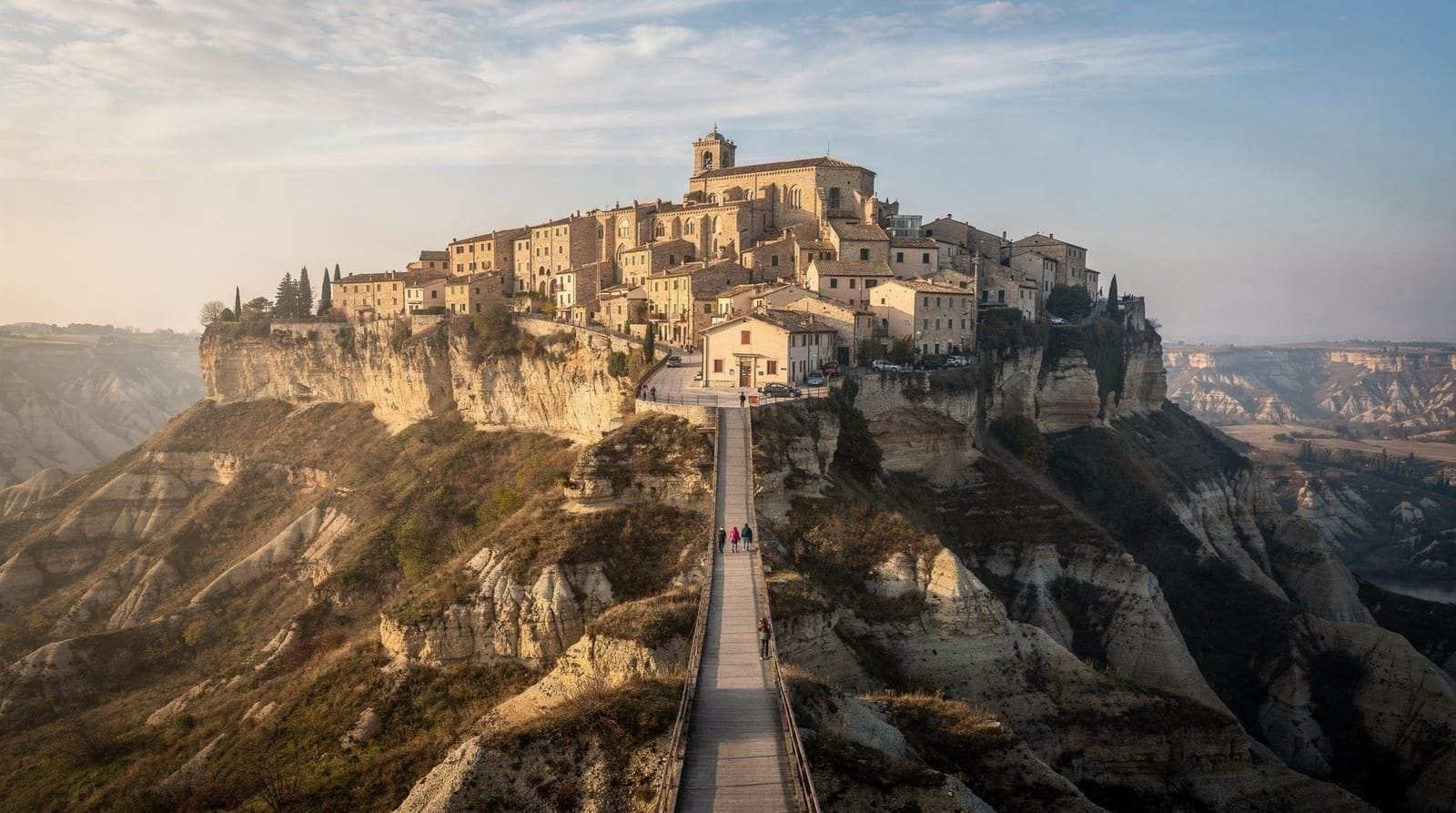
Assisi and Orvieto pair naturally on an organised day tour (see below); Civita di Bagnoregio is usually better as its own half-day add-on to Orvieto, since the footbridge and entry fee slow things down. For a longer central-Italy trip that includes all three towns alongside Rome itself, see the 10-day central Italy itinerary or the general best day trips from Rome overview. If you’re deciding between doing this independently by train or joining a coach tour, train vs. tour day trips walks through the trade-offs in more detail — for Assisi specifically, the train change at Foligno is the main reason many visitors choose the guided option instead.
Assisi off-season and in bad weather
Assisi works well outside the April–October peak, arguably better for the basilica itself: the Upper Church nave and its Giotto cycle are indoors regardless of weather, and winter crowds thin dramatically — you can often walk into the Lower Church with no queue at all in January or February. The town itself is quieter but several restaurants and shops reduce their hours or close one weekday, so check ahead if a specific trattoria matters to you.
Rain doesn’t meaningfully disrupt an Assisi day trip, since the basilica, Santa Chiara, and most of the walking is on paved streets with covered stretches near the main piazza. The one casualty is the Rocca Maggiore view and the walk up to it, which is unpleasant and occasionally closed in heavy rain or high wind — treat it as a fair-weather add-on rather than a fixed plan. The Eremo delle Carceri hermitage walk is also best skipped in poor weather given the uphill forest path.
Frequently asked questions about Assisi
Is Assisi worth visiting from Rome?
Yes, particularly for those interested in medieval art and architecture, religious history, or simply beautiful Umbrian hill towns. The Giotto frescoes in the Upper Church of San Francesco are among the most important artworks in Western tradition and can be seen in a day trip. The town is also considerably less crowded than Siena or Florence.
How do you get from Rome to Assisi by train?
Take a train from Roma Termini toward Foligno (Intercity or Regionale, ~1h45) and change at Foligno for a short regional train to Assisi (20 minutes). Alternatively, take a fast train toward Florence, change at Terontola for Perugia/Assisi direction. Total journey 2–2.5 hours. Tickets from trenitalia.com.
Do you need to book the Basilica di San Francesco in advance?
No advance booking required for general visit. Arrive early (before 9:30 am) or late afternoon to avoid peak coach tour hours. Modest dress is required — shoulders and knees covered — and is enforced at the entrance.
What are the Giotto frescoes in Assisi?
The 28 panels in the Upper Church nave depicting the life of St Francis were painted around 1297–1300 (attribution to Giotto himself or his workshop remains debated in art history). They represent a turning point in Western painting — naturalised figures, narrative sequence, spatial depth, emotional expression. Before the Sistine Chapel, before Leonardo, this is where Italian painting became recognisably modern.
Can I combine Assisi and Orvieto in one day?
On an organised tour, yes — it’s the most popular Umbria combination and both towns are between 1.5–2 hours from Rome. Independently, it’s complex without a car. Most visitors who want both take a guided tour or rent a car for the day.
What is the Feast of St Francis and when is it?
October 3–4 each year. It commemorates the death of St Francis in 1226 with processions, solemn masses, and the famous ceremony of the lamp offering at the crypt. Atmospherically distinct from regular tourist visits. Accommodation must be booked months ahead if you want to attend.
Is Assisi better than Orvieto as a day trip from Rome?
They’re different, not better or worse — Assisi has the stronger art and religious history (the Giotto cycle), Orvieto has an easier direct train and a striking cathedral facade plus underground caves. Many visitors do both on a single guided Assisi and Orvieto day trip, which is the most popular Umbria combination for exactly this reason.
Should I visit Spello on the same day as Assisi?
Only if you have a flexible schedule and are comfortable adding a short regional-train detour — Spello is 12 minutes from Assisi by train and worth it for the Pinturicchio frescoes, but most day-trippers already have a full schedule with the basilica and hill town alone. It fits more comfortably on a second Umbria trip, or as a stop on the way back toward Foligno.
Top experiences
Bookable activities with verified prices and instant confirmation on GetYourGuide.