Borghese Gallery: how to visit and what not to miss
Rome: Galleria Borghese Museum Entry Ticket and Guided Tour
How do you visit the Borghese Gallery and what does it cost?
Borghese Gallery tickets cost €15 adult plus a €2 mandatory booking fee — total €17. Entry is strictly timed: you must book a 2-hour slot in advance (capacity is approximately 180 people per session). Slots open around 10 days ahead and popular times (09:00, 11:00) fill fast. Book directly on the official Galleria Borghese website or via GetYourGuide to secure your slot before making any other plans.
One of Rome’s greatest museums — and the hardest to enter spontaneously
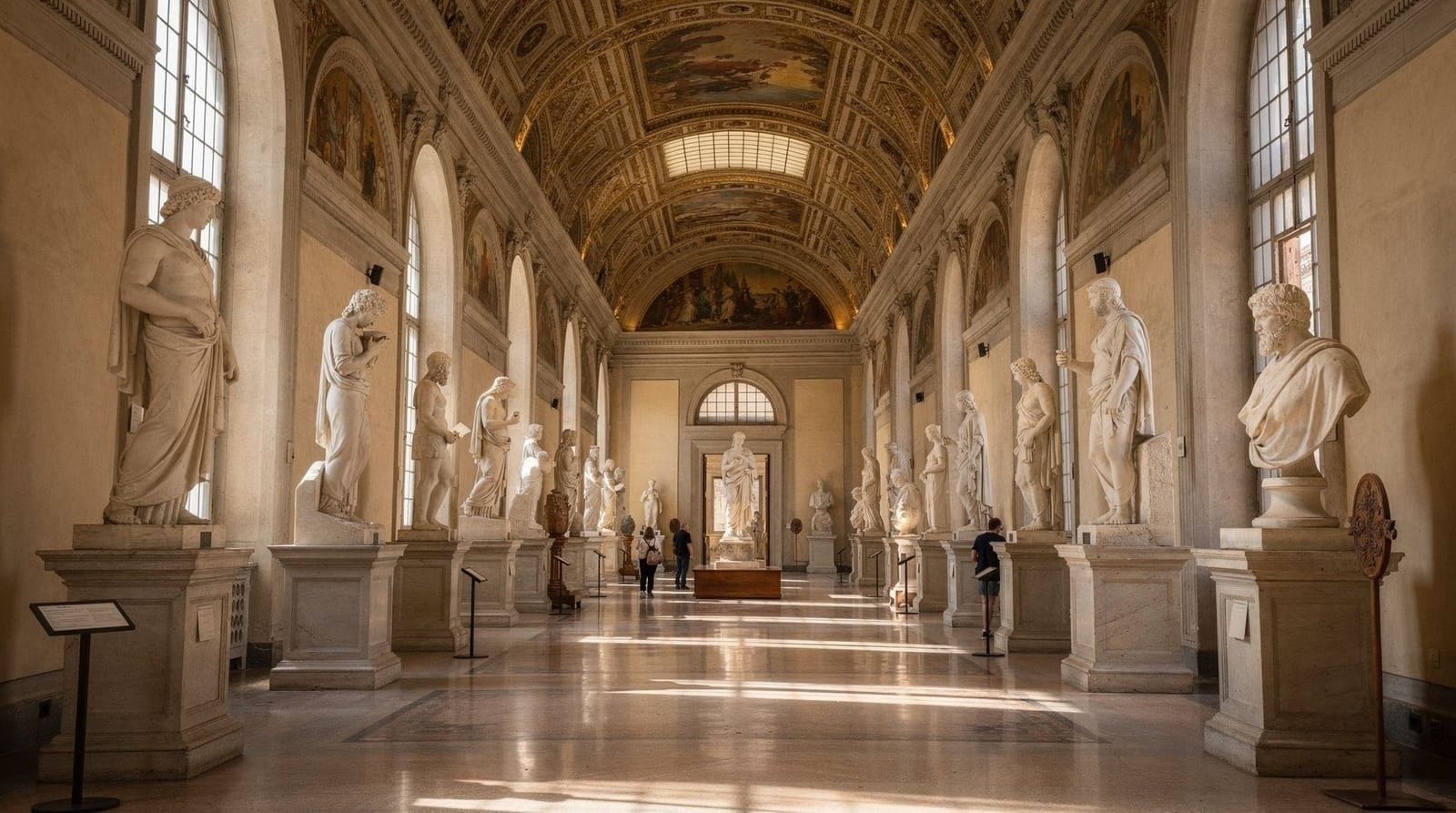
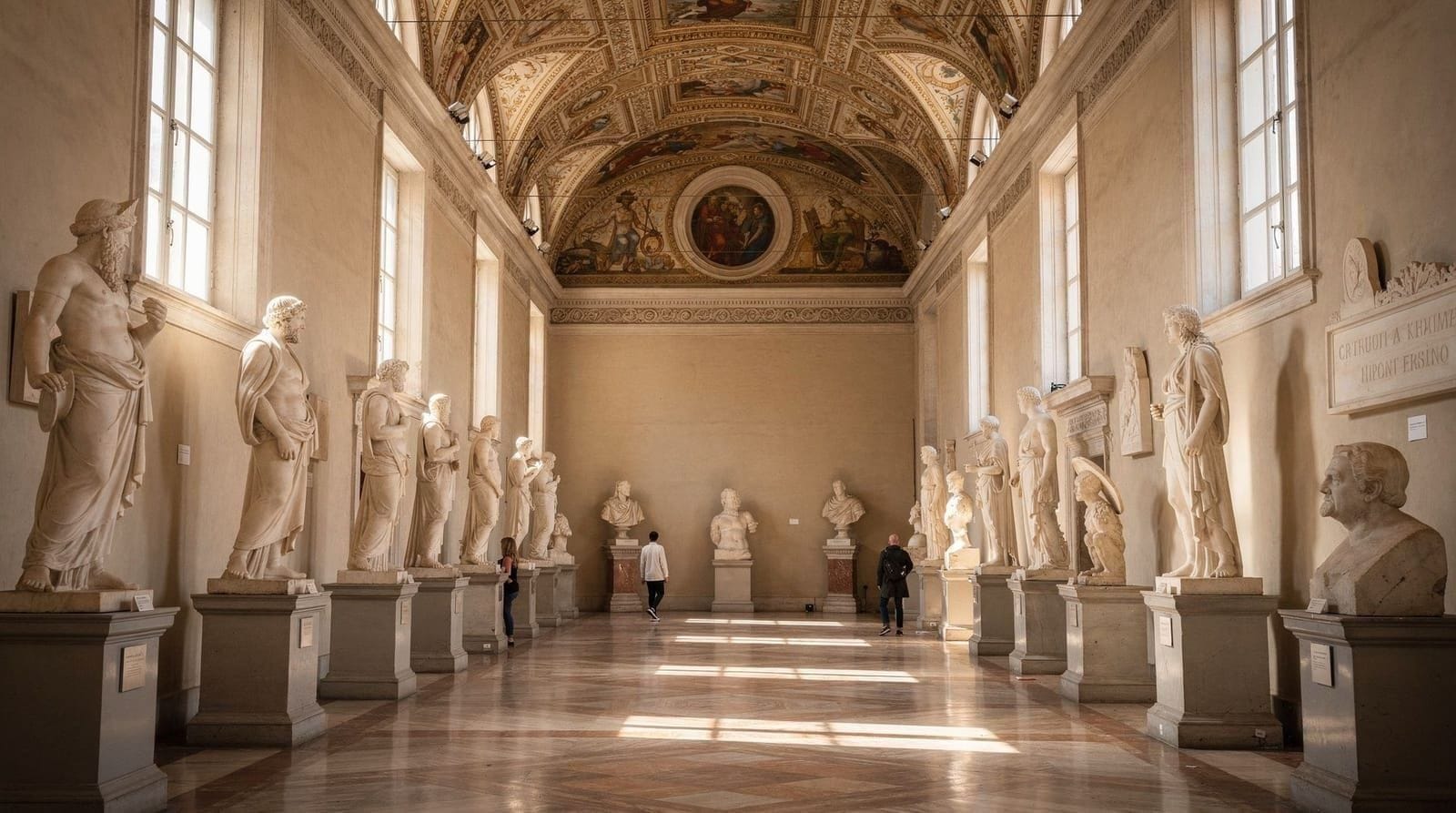
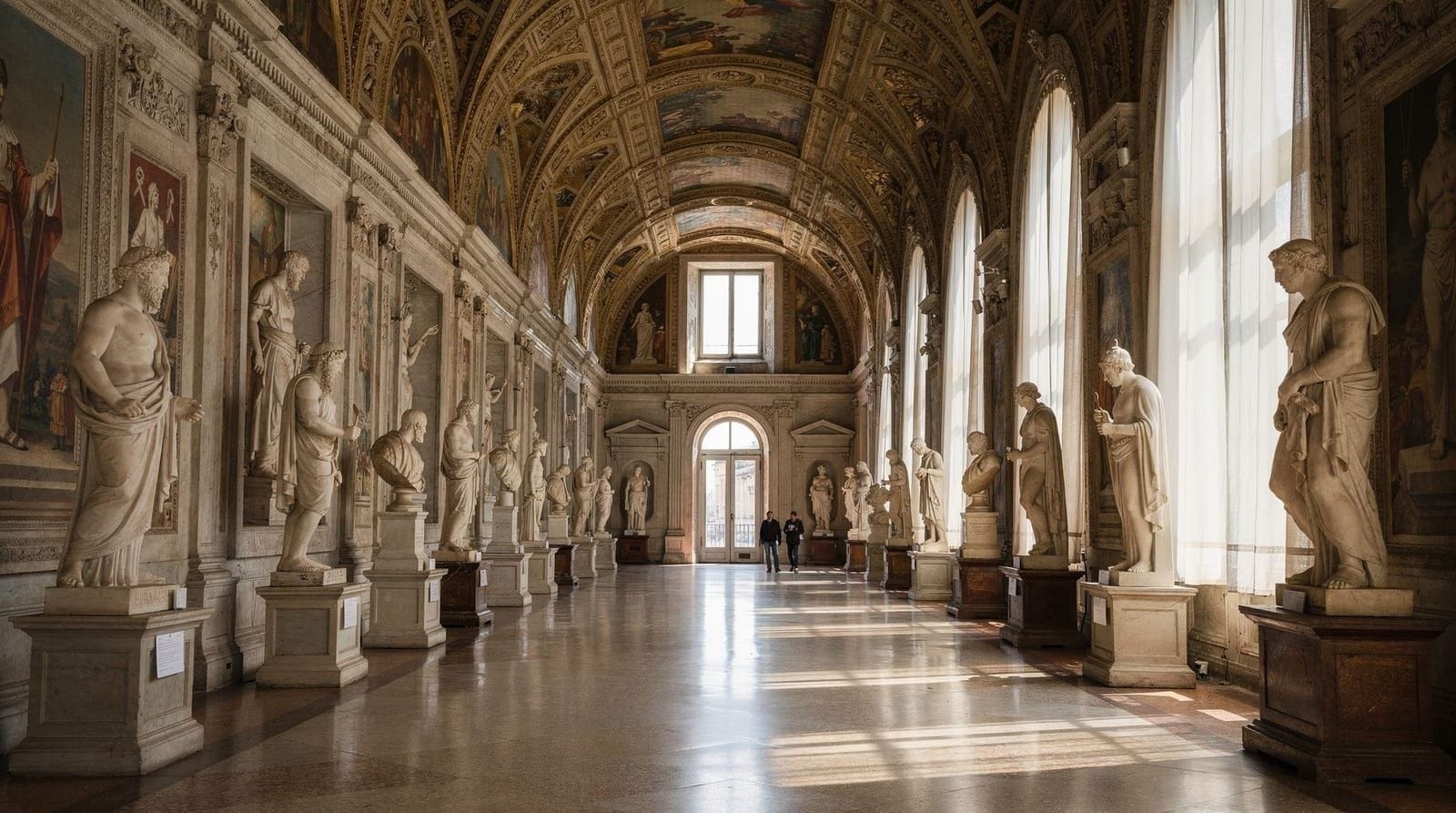
The Galleria Borghese holds what many art historians consider the finest concentration of Baroque sculpture and painting anywhere in the world. In approximately 20 intimate rooms spread across a 17th-century villa on the edge of Villa Borghese park, you will find four early Gian Lorenzo Bernini sculptures that redefined what was possible in marble, six works by Caravaggio including his most psychologically complex paintings, and a supporting cast from Raphael, Titian, Rubens, and Canova that would be headline attractions anywhere else.
The catch: you cannot simply show up. The Borghese Gallery operates a strict timed-entry system — 2 hours per group, approximately 180 people maximum per session. Tickets sell out days or weeks ahead. Visitors who arrive at the door without a booking are turned away, regardless of how long they have travelled to get there.
This guide covers everything you need to know to plan the visit properly — the booking mechanics, what to see first, the stories behind the key works, and how to make the most of the fixed 2-hour window.
| Where | Villa Borghese park, northern Rome (Metro Spagna + 15-min walk) |
| Cost | €15 + €2 booking fee (€17), free first Sunday of the month |
| Time needed | Exactly 2 hours, fixed by the timed-slot system |
| Getting there | Metro Line A to Spagna, or Tram 3/19 to Bioparco |
| Best time | 09:00 or 11:00 slot for morning light; 17:00 for a calmer, golden-hour finish |
The collection and its origins
Cardinal Scipione Borghese (1577–1633), nephew of Pope Paul V, assembled this collection with a combination of genuine connoisseurship and ruthless institutional power. He commissioned Bernini directly — the sculptor was in his early twenties when he carved the major pieces now in the ground-floor rooms. He also acquired Caravaggio’s work at a time when the artist was a fugitive from Rome following a murder charge, and he effectively pressured other collectors and institutions to surrender paintings he wanted.
The collection passed through Borghese family ownership for centuries before being sold to the Italian state in 1901. The villa has operated as a public museum since 1903, though the conservation requirements of the space mean it has always maintained strict visitor limits.
The building itself — the Casino Borghese — was constructed between 1613 and 1615 by architect Flaminio Ponzio and his successor Giovanni Vasanzio. The exterior is relatively modest; the interior decoration, particularly the ceiling frescoes and inlaid marble floors, is extravagant. Both serve as setting for the collection rather than competing with it.
Understanding the layout before you arrive
The gallery occupies two floors of the Casino Borghese.
Ground floor (piano terreno): Sculpture. Eight rooms arranged around a central hall (Salone). The Bernini marbles are concentrated in Rooms I through IV, with additional antique sculptures, mosaics, and busts throughout. The ground floor is where most visitors spend the majority of their 2 hours.
First floor (piano nobile): Paintings. Approximately 12 rooms. Caravaggio’s six works are distributed across two or three rooms. The paintings by Raphael, Titian, Rubens, Cranach, and Canova’s statue of Pauline Borghese as Venus (technically a sculpture on the upper floor) are spread throughout.
The standard visitor route moves through the ground floor rooms in sequence, then climbs to the first floor. Allow roughly 70 minutes for the ground floor and 50 minutes for the first floor — adjust based on which collection interests you more.
The Bernini sculptures: room by room
Room I — Aeneas, Anchises and Ascanius (1618–1619)
Bernini carved this group at age 19–20. It shows the moment from Virgil’s Aeneid when Aeneas escapes burning Troy carrying his elderly father Anchises on his shoulders, while his young son Ascanius holds the sacred flame. Three generations, three different stages of human life — young muscle, aged slack skin, childish softness — all differentiated in a single block of marble.
This is not the most technically bravura of the four Bernini rooms, but understanding it contextually matters: you are seeing a teenage sculptor working out the problems that the later masterpieces solve with apparent effortlessness.
Room II — David (1623–1624)
Where Renaissance Davids (Michelangelo’s, Donatello’s) show the hero before or after the battle, Bernini’s David shows the moment of action — the body coiled in the act of throwing, the face clenched in concentration. Bernini reportedly used a mirror to capture the expression from his own face.
The figure is positioned so that the implied trajectory of the stone passes through the viewer’s space, or toward a now-lost companion Goliath figure. Stand to one side to understand the implied movement.
Room III — Apollo and Daphne (1622–1625)
The transformation of the nymph Daphne into a laurel tree to escape Apollo’s pursuit, from Ovid’s Metamorphoses. This is the room that stops most visitors cold.
Marble fingers become leaves. Marble feet become roots. The texture transitions from skin to bark mid-figure. The laurel leaves at Daphne’s fingertips are paper-thin and technically should not survive — they have no structural support from below, and stone of that thinness should crack under its own weight. They have survived for 400 years.
The work was commissioned by Cardinal Scipione Borghese for his nephew, and a Latin inscription was added at the base to make the mythological scene morally acceptable: “Those who love to pursue fleeting forms of pleasure, in the end find only leaves and bitter berries in their hands.” A fig leaf of theological justification for extraordinary sensuality.
Room IV — The Rape of Persephone (1621–1622)
Pluto abducting Persephone to the underworld, his three-headed dog Cerberus at his feet. The famous detail: Pluto’s fingers pressing into Persephone’s thigh appear to dimple the marble as flesh would dimple. The illusion is not an accident of viewing angle — it works from multiple positions. Bernini was 23 when he finished this.
Borghese Gallery ticket with licensed guide — includes reserved entry, skip the line access, and 2-hour expert-led tour of the Bernini sculptures and Caravaggio paintingsThe Caravaggio works on the first floor
David with the Head of Goliath (c. 1610)
This is probably the most discussed Caravaggio in Rome. The young David holds the severed head of Goliath at arm’s length; the head carries Caravaggio’s own features, rendered with an expression of anguished resignation. The painting was reportedly sent to Cardinal Scipione Borghese as a plea for papal pardon — Caravaggio had fled Rome in 1606 after killing a man in a street fight and was seeking permission to return.
The pardon was apparently granted, but Caravaggio died in 1610 before he could return to Rome. The self-portrait as a severed head, whether read as self-condemnation or supplication, is the most psychologically loaded piece of self-portraiture in Baroque art.
Boy with a Basket of Fruit (c. 1593–1594) and Sick Bacchus (c. 1593)
Both early works, painted when Caravaggio was in his early twenties and working in Rome. Sick Bacchus is widely believed to be a self-portrait painted during a period of illness; the greyish pallor and slack features are notably different from the idealized Bacchic figures of the same period. Boy with a Basket of Fruit demonstrates Caravaggio’s already-mastered still life technique — the fruit is botanically specific and verifiably slightly overripe, which was understood as a commentary on mortality.
Madonna dei Palafrenieri (1605–1606)
Commissioned for St. Peter’s Basilica and rejected almost immediately — the Virgin was considered too peasant-like, the Christ child too physically unglamorous, and the depicted scene (the Virgin and Christ child crushing the serpent together) was theologically controversial. Cardinal Borghese acquired it within days of its rejection, recognising its quality immediately.
The picture gallery: beyond Caravaggio
The first floor holds works that would headline a lesser museum. Raphael’s Deposition (1507) is one of his early masterpieces, painted at age 24. Titian’s Sacred and Profane Love (c. 1514) remains one of the most discussed paintings in European art — the exact meaning of the two women (clothed and unclothed versions of the same figure? Earthly and divine love?) continues to be debated.
Canova’s Pauline Borghese as Venus Victrix (1805–1808) is on the first floor — an idealised portrait of Napoleon’s sister Pauline, wife of Prince Camillo Borghese, reclining as Venus with an apple in her hand. The story that the marble was kept in a locked room and shown only to select visitors is apocryphal, but it captures something true about the work’s intimate eroticism.
Rubens’ large canvases and Cranach the Elder’s paintings of Eve and Venus provide further visual range. The variety is genuinely remarkable for a single private collection in a single villa.
Practical information for 2026
Tickets and booking: €15 adult admission plus €2 mandatory booking fee = €17. Book directly on the official Galleria Borghese website (galleriaborghese.beniculturali.it) or through a licensed ticket reseller. The gallery holds a small allocation of tickets via GetYourGuide and similar platforms, which sometimes show availability when the official site is sold out.
Slot times: Sessions start at 09:00, 11:00, 13:00, 15:00, and 17:00. The 09:00 and 11:00 slots are most popular and fill fastest. The 15:00 and 17:00 slots are easier to book and slightly less crowded within the gallery.
Arrival: Arrive at least 10 minutes before your slot — the museum will not admit late arrivals. The entrance is through the ground floor. Bags larger than hand luggage size must be checked at the cloakroom (free).
Getting there: Villa Borghese is in northern Rome, accessible by metro (Spagna station on Line A, then a 15-minute walk through the gardens) or by tram (Tram 3/19 to Bioparco or Torquato Tasso stop). Taxis to the main gallery entrance cost approximately €10–15 from the historic centre. There is no practical parking at the gallery.
Audio guide: Available for hire at the entrance kiosk (approximately €5). English language. Recommended for self-guided visitors — the information panels are good but an audio guide adds biographical context for Bernini and Caravaggio that makes the works substantially more meaningful.
Borghese Gallery skip-the-line entry ticket — secured timed slot with guaranteed access, no waiting at the doorThe 2-hour strategy: what to prioritise
Two hours is tight for 20 rooms. Most visitors find the ground floor takes longer than expected (Bernini is genuinely detaining), leaving less time for the first floor. Here is a realistic allocation:
Ground floor (70–75 minutes suggested):
- Salone entrance hall: walk through but do not linger (5 minutes)
- Room I (Aeneas): 5 minutes
- Room II (David): 8 minutes — the coiled tension rewards close examination
- Room III (Apollo and Daphne): 15 minutes minimum — this is why you are here
- Room IV (Rape of Persephone): 10 minutes
- Remaining ground floor rooms (antique sculptures, mosaics, other Bernini works): 25 minutes
First floor (45–50 minutes):
- Caravaggio rooms: 20 minutes — David with the Head of Goliath is the priority
- Raphael, Titian, Canova: 20 minutes
- Remaining picture gallery: 10 minutes
If you are an art specialist or particularly interested in the paintings, reverse the allocation — spend 70 minutes upstairs and move more quickly through the ground floor.
After the gallery: Villa Borghese gardens
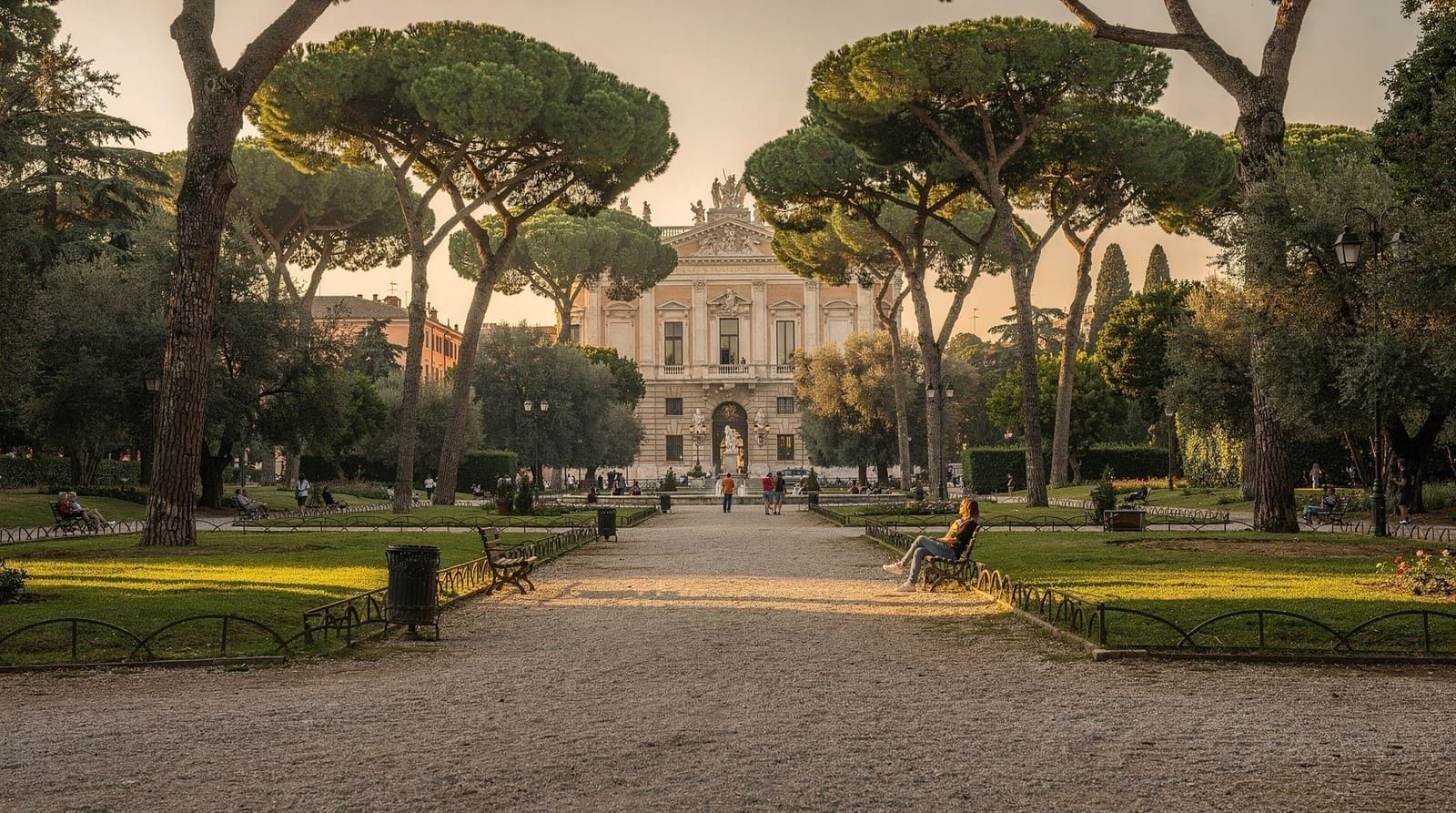
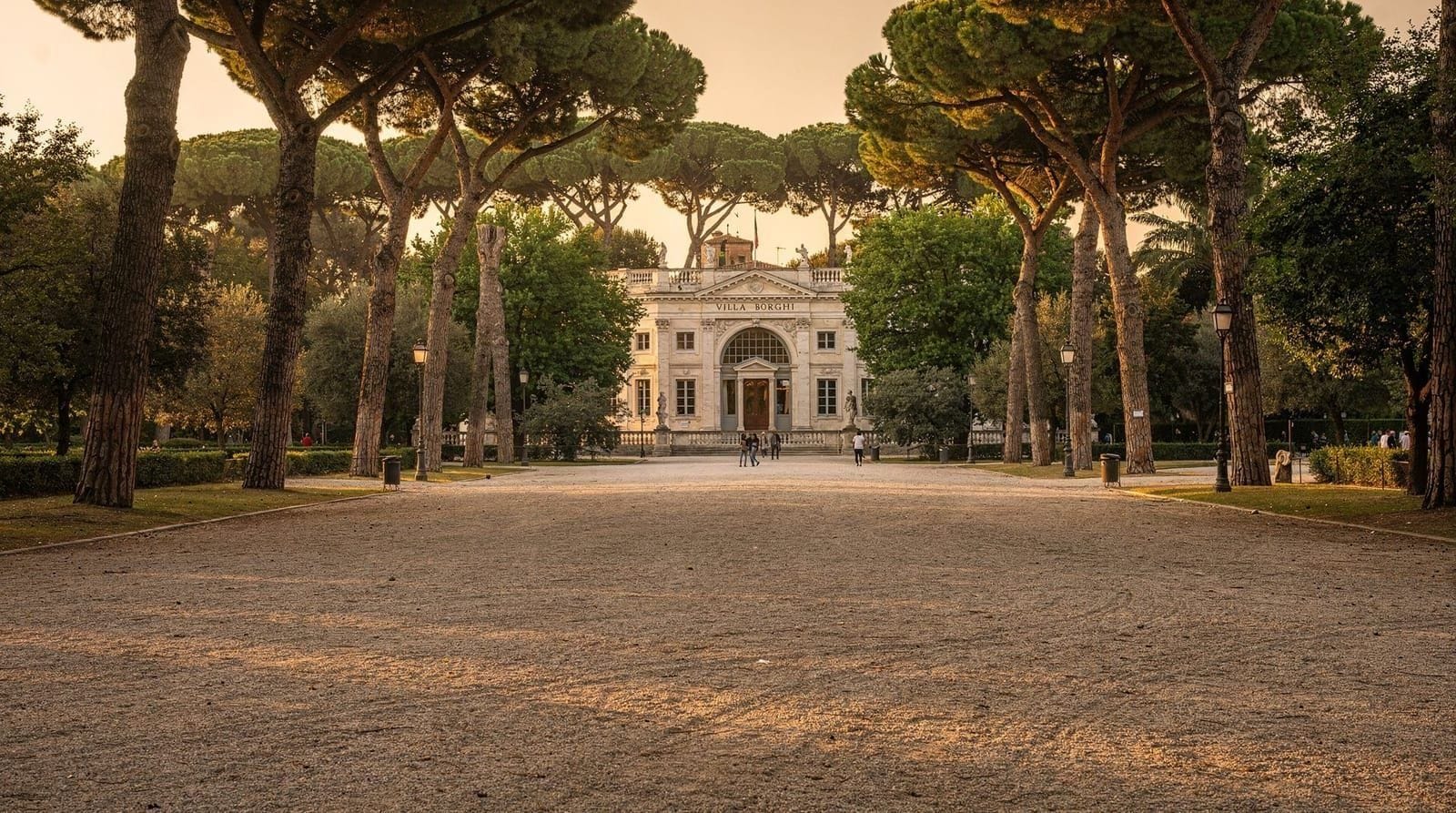
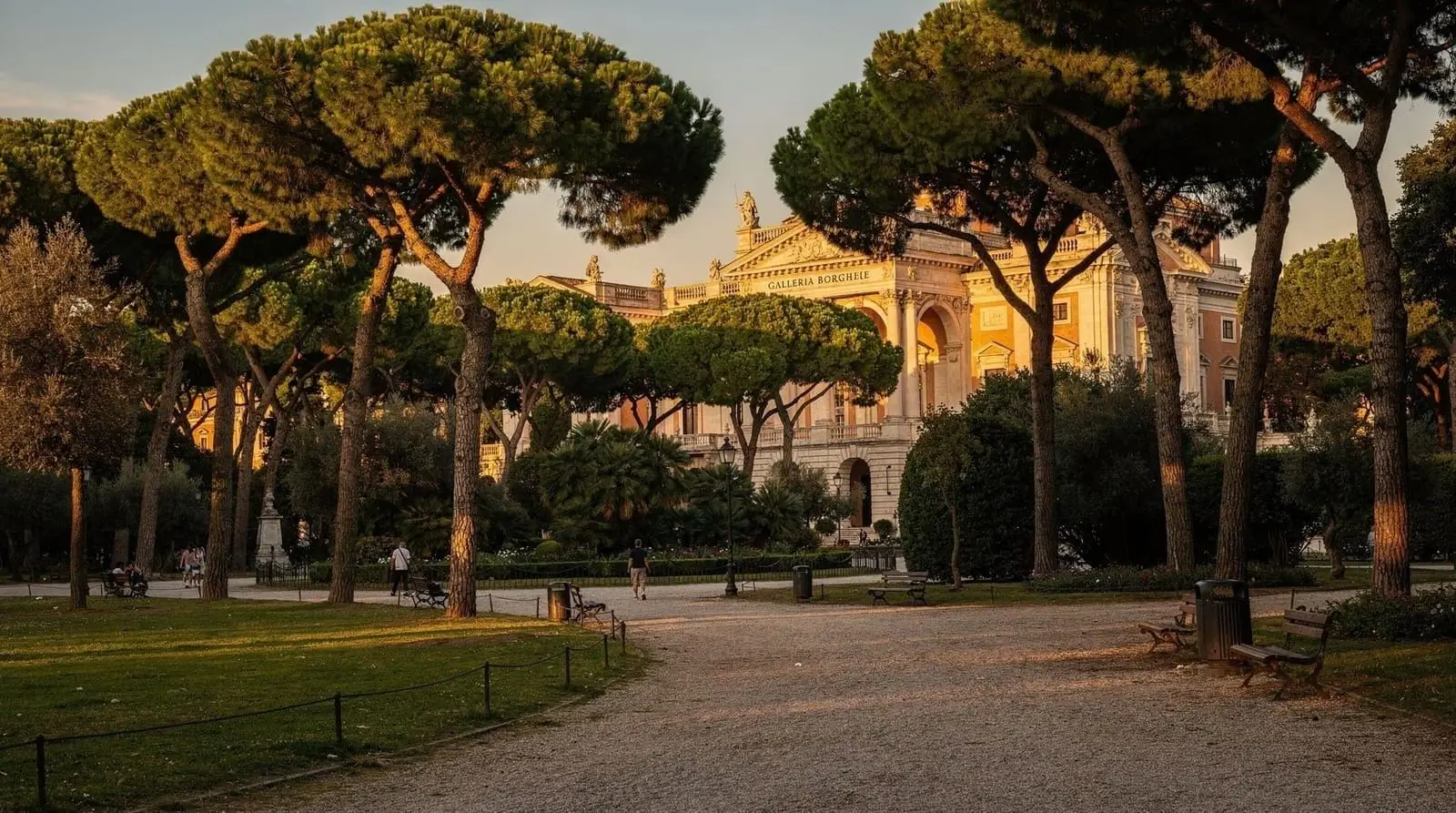
The Casino Borghese sits within the 80-hectare Villa Borghese park, Rome’s most central large green space. After your timed visit, the gardens are worth an hour of exploration, particularly in good weather.
The Giardino del Lago features a small ornamental lake with a temple on an island — the setting for the gallery’s most-photographed exterior views. The rose garden (giardino delle rose) near the Piazza di Siena is at its best in May and June. The Bioparcо zoo is at the park’s northern edge (separate ticket).
From the terrace of the Pincian Hill (Pincio), reached by the park’s northern paths, you get one of Rome’s best panoramic views across to St. Peter’s dome — free, no ticket required. See our guide to avoiding Rome crowds for the best times to visit this viewpoint.
Combining Borghese Gallery with other museums
The Borghese is geographically isolated from Rome’s other major museums. Combining it efficiently with other sightseeing requires planning:
Same day as Borghese (morning slot at 09:00 or 11:00): Afternoon options within walking distance or a short taxi ride: Capitoline Museums (30-minute taxi), or the Palazzo Barberini gallery in the Monti area (20-minute walk downhill from the Pincio via the Spanish Steps area).
Caravaggio trail: If Caravaggio is your primary interest, combine the Borghese with a walk through the Caravaggio trail in Rome’s churches — Santa Maria del Popolo (10 minutes’ walk from the gallery’s north entrance) has two Caravaggio paintings in the Cerasi Chapel.
Vatican Museums: Do not try to combine these in a single day. Both are mentally exhausting at full engagement; doing both back-to-back produces fatigue rather than enrichment. See our guide to Vatican vs Colosseum priority for advice on sequencing Rome’s major museum visits.
For a structured introduction to booking all of Rome’s timed-entry museums in the right order, see the Rome skip-the-line tickets guide and the dedicated Borghese booking guide.
Borghese Gallery guided tour with tickets — small group format, expert guide covering both Bernini and Caravaggio, gardens walk includedWhat the Borghese is not
A few realistic calibrations for visitors who may have unrealistic expectations:
The gallery is not the Vatican Museums. It is an intimate villa with 20 rooms. If you are expecting the scale and breadth of a major national museum, adjust: the Borghese offers depth over breadth — arguably four or five objects of absolute world-class importance in a focused space.
The 2-hour limit genuinely cannot be extended. Do not ask staff for extra time; they cannot grant it and are regularly asked. Plan to finish within the slot.
The gardens visible through the villa windows are not accessible mid-visit. You enter, you visit the 20 rooms, you leave. The garden walk is before or after, not during.
Despite the booking complexity, the visit itself is calm and unhurried compared to the Colosseum or Vatican. Because 180 people spread across 20 rooms means roughly 9 per room at any given moment, the Borghese is one of Rome’s least crowded major attractions during the actual visit — all the friction is front-loaded into the booking process.
For the full booking process step by step — including what to do when official slots are sold out — see our dedicated Borghese booking guide.
Borghese vs Rome’s other major museums
| Museum | Typical visit length | Booking pressure | Style |
|---|---|---|---|
| Borghese Gallery | Fixed 2 hours | Highest — book weeks ahead in peak season | Intimate, focused, Baroque masterworks |
| Vatican Museums | 3-4 hours self-paced | High for morning slots | Vast, exhausting, unmatched breadth |
| Capitoline Museums | 2-3 hours self-paced | Low to moderate | Ancient sculpture, less crowded |
Use this to set expectations: Borghese rewards a focused, unhurried 2 hours with a handful of masterpieces, while the Vatican rewards stamina across a much larger collection. Neither substitutes for the other, and combining them in a single day (discussed above) does a disservice to both. See our Capitoline Museums guide for a lower-pressure alternative if Borghese slots don’t align with your dates.
Photography and accessibility
Photography without flash is permitted throughout the gallery, but tripods, selfie sticks and any equipment beyond a phone or compact camera are not allowed — the rooms are too small and dense with other visitors for a tripod to be practical anyway. Flash is prohibited to protect the paintings’ pigments and the marble surfaces from repeated light exposure.
The Casino Borghese has a lift providing step-free access to the first-floor picture gallery; the ground floor sculpture rooms are level access from the entrance. Wheelchair users should notify the booking system or call ahead, as capacity for wheelchairs per session is limited and reserved in advance. Benches are available in several rooms for visitors who need to rest during the 2-hour session — useful for older visitors or anyone recovering from a long walk through the gardens beforehand. Toilets are available near the entrance lobby but not on the upper floor, so plan accordingly before climbing to the picture gallery — there is no way back down to the ground floor facilities without effectively leaving and re-entering your allotted time.
What to skip if you’re short on time
Even within the 2-hour limit, some rooms reward a quick pass rather than a full stop. The ground-floor antique sculpture collection outside Rooms I-IV — Roman copies of Greek originals, assorted busts and sarcophagi — is respectable but not the reason people book weeks ahead; a few minutes’ glance is enough unless classical antiquity is a specific interest. On the first floor, the smaller Flemish and Northern European paintings in the side rooms can similarly be walked past quickly in favor of more time with Titian’s Sacred and Profane Love or a second look at the Caravaggio room. The goal within a fixed 2-hour window is not seeing every object but spending real time with the handful that justify the trip: Apollo and Daphne, the Rape of Persephone, and David with the Head of Goliath, in that rough order of priority.
Is the Borghese worth it if you’re not an art specialist?
Yes, more than most museums of its type, because the collection is small enough to be genuinely absorbed rather than skimmed. Visitors who feel Baroque sculpture is not “their thing” going in are consistently surprised by Apollo and Daphne — the technical illusion of stone becoming leaf and bark reads as remarkable even without any art history background. The Caravaggio room requires slightly more context to appreciate fully (the biographical story behind David with the Head of Goliath adds significant weight), which is the strongest argument for the audio guide or a guided tour on a first visit. If you dislike museums generally and are visiting Rome once, the Colosseum and Roman Forum deliver more immediate, context-free impact; if you have a second museum slot to fill and any interest in art, the Borghese is very likely worth the booking hassle.
Frequently asked questions about Borghese Gallery: how to visit and what not to miss
Why does Borghese Gallery limit visits to 2 hours?
How far in advance should I book Borghese Gallery tickets?
What are Bernini's must-see sculptures at Borghese Gallery?
Which Caravaggio paintings are in the Borghese Gallery?
Is there a free day at the Borghese Gallery?
Can I see the Borghese Gallery gardens without a ticket?
How long does the Borghese Gallery visit actually take?
Is a guided tour better than a self-guided visit at Borghese Gallery?
Top experiences
Bookable activities with verified prices and instant confirmation on GetYourGuide.