Tivoli
Tivoli: UNESCO Villa d'Este fountains + Hadrian's Villa ruins, 40 min from Rome by train. Full logistics, honest time planning, and both sites explained.
Rome: Tivoli Day Trip with Villa d'Este and Villa Adriana
Quick facts
- Train from Rome
- Regional train from Roma Tiburtina to Tivoli; ~40–55 min; €3.50–4 each way
- Villa d'Este entry
- €10 adults; timed booking required in peak season
- Villa Adriana (Hadrian's Villa)
- €14 adults; open daily except first Monday of the month
- Distance between sites
- 5 km apart; use local bus (CAT line 4) between sites; €1.50
- Full day needed
- Yes — both sites together require 6–8 hours including transit
- UNESCO status
- Both Villa d'Este (2001) and Hadrian's Villa (1999) are UNESCO World Heritage Sites
Tivoli is Rome’s most rewarding day trip for visitors interested in either Renaissance gardens or Roman imperial archaeology — and ideally both. Two UNESCO World Heritage Sites sit 5 km apart on a hilltop above the Aniene valley: Villa d’Este, a 16th-century cardinal’s palace whose terraced gardens contain over 500 fountains powered entirely by gravity, and Villa Adriana (Hadrian’s Villa), a 2nd-century imperial estate spread across 120 hectares that is arguably the single greatest surviving complex of Roman architecture outside Rome itself. Most visitors choose one or the other. A properly planned full day accommodates both, and the combination is spectacular.
Villa d’Este: the fountain garden
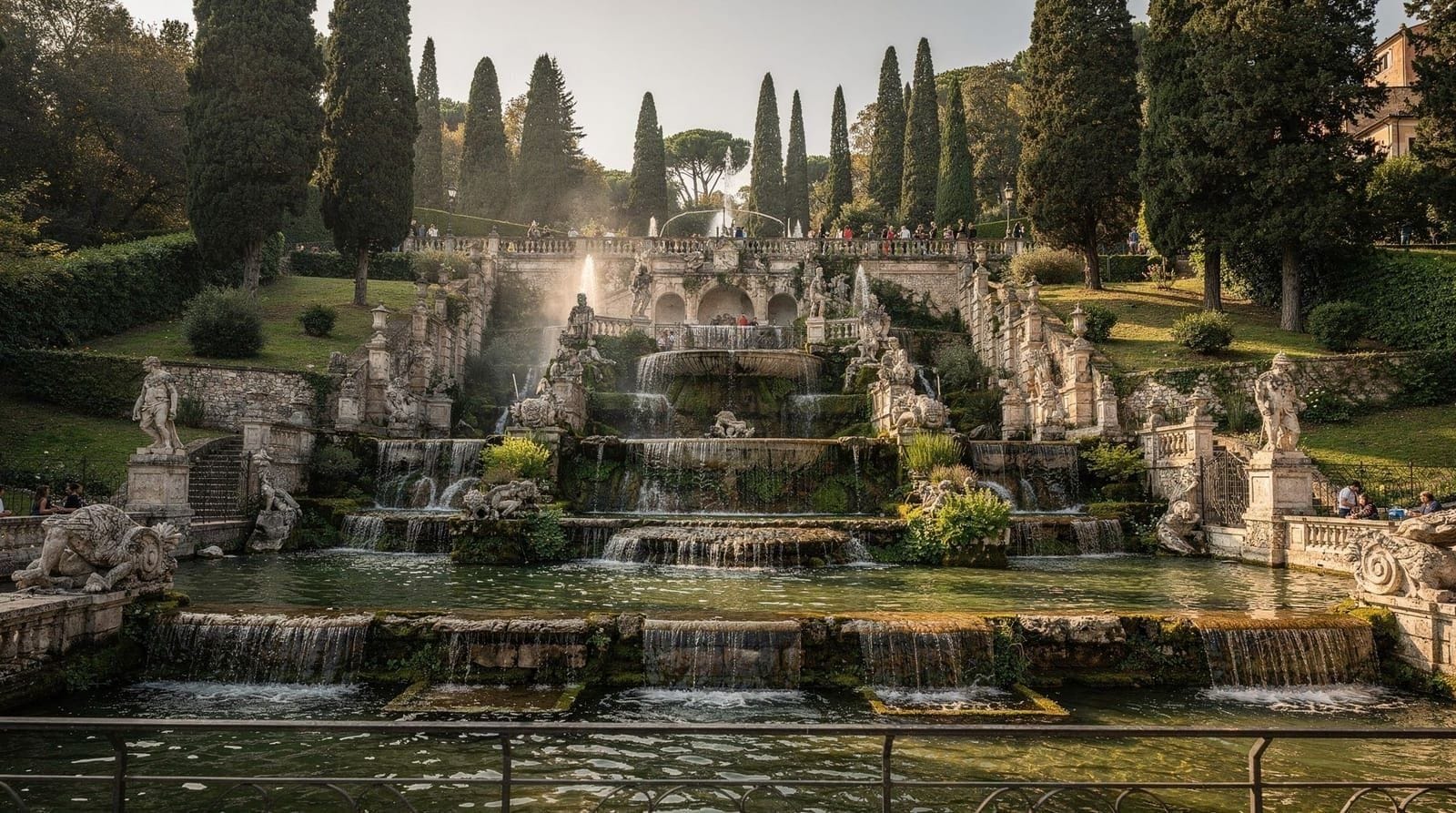
Cardinal Ippolito II d’Este, son of Lucrezia Borgia and Alfonso I d’Este, was appointed Governor of Tivoli in 1550 as a political consolation prize after losing a papal election. His response was to commission one of the most ambitious private gardens in European history: terraced across a hillside, fed by water diverted from the Aniene river, with fountains operating entirely without pumps through a 15th-century system of pipes and gravity. The garden took 20 years to complete. Ippolito never lived to see it finished. It is extraordinary.
What you see: The terraced garden descends from the villa level down to the lowest garden over about 40 metres of vertical drop. The main axis runs east-west, crossed by horizontal terraces linked by stairways and ramps. The biggest set-pieces:
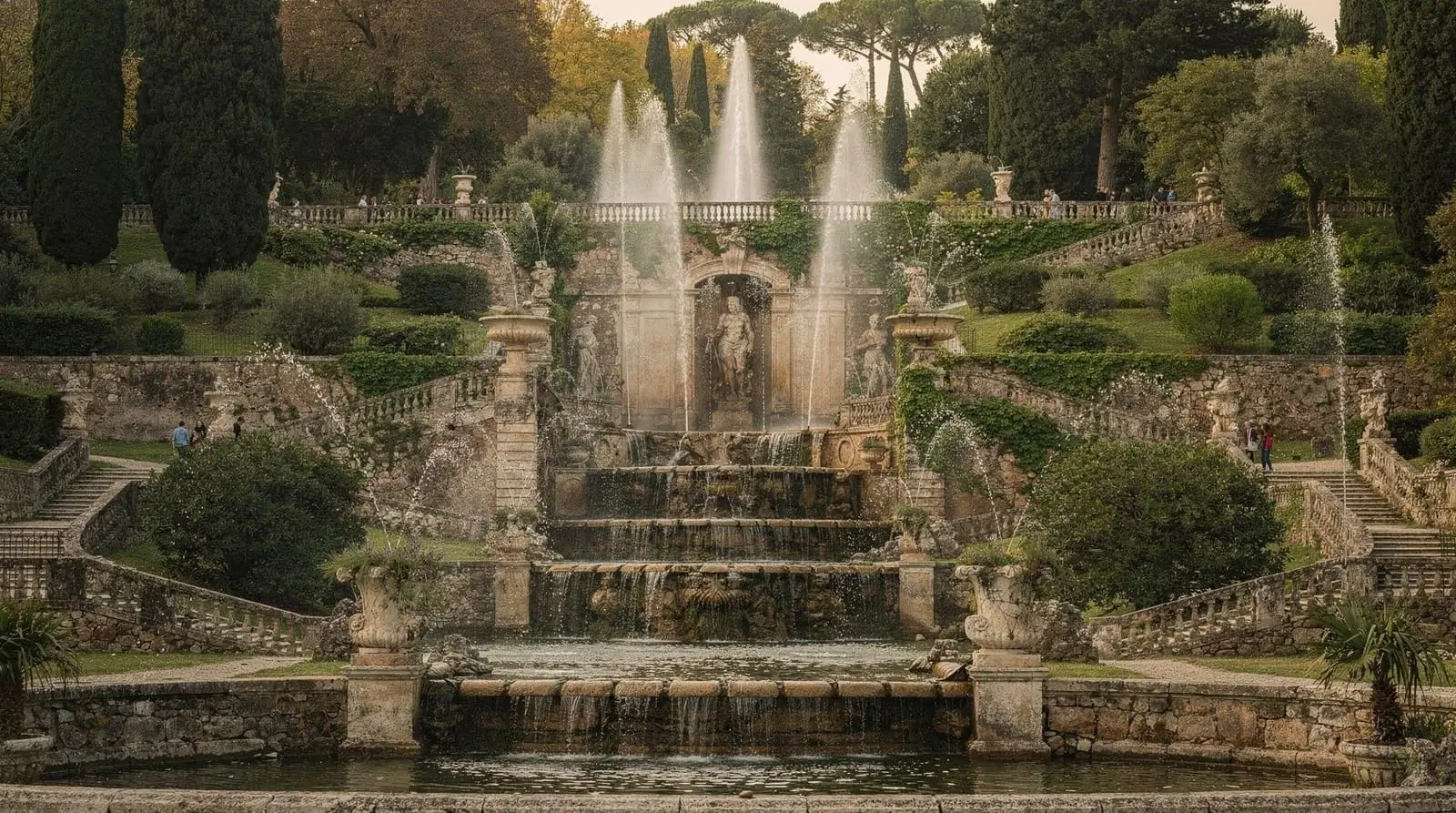
- Viale delle Cento Fontane (Avenue of a Hundred Fountains): A long terrace with three tiers of continuous fountains, the most photographed element of the garden. In spring, wisteria drapes along the walls above it.
- Fontana dell’Ovato (Oval Fountain): A large semicircular cascade framed by statues of nymphs, with a walk-behind waterfall. One of the best examples of hydraulic theatre in the garden.
- Fontana dei Draghi (Fountain of the Dragons): Built for a single-day visit by Pope Gregory XIII in 1572; water jets 15 metres into the air.
- Fontana della Rometta: A miniature model of Rome — hills, Tiber island, and key landmarks in hydraulic form.
- Fontana dell’Organo Idraulico: A water organ that played music powered by water pressure (18th-century mechanisms now restored).
The garden covers 4.5 hectares and requires 90–120 minutes to see comfortably. The villa interior itself contains frescoed rooms open for viewing and is included in the entry ticket.
Practical notes: Entry is €10 (timed booking advisable in peak season). Stairs throughout — not wheelchair accessible beyond the main terrace. Café inside at garden level. The garden is most beautiful in the morning light (east-facing aspect).
Villa Adriana (Hadrian’s Villa): the imperial complex
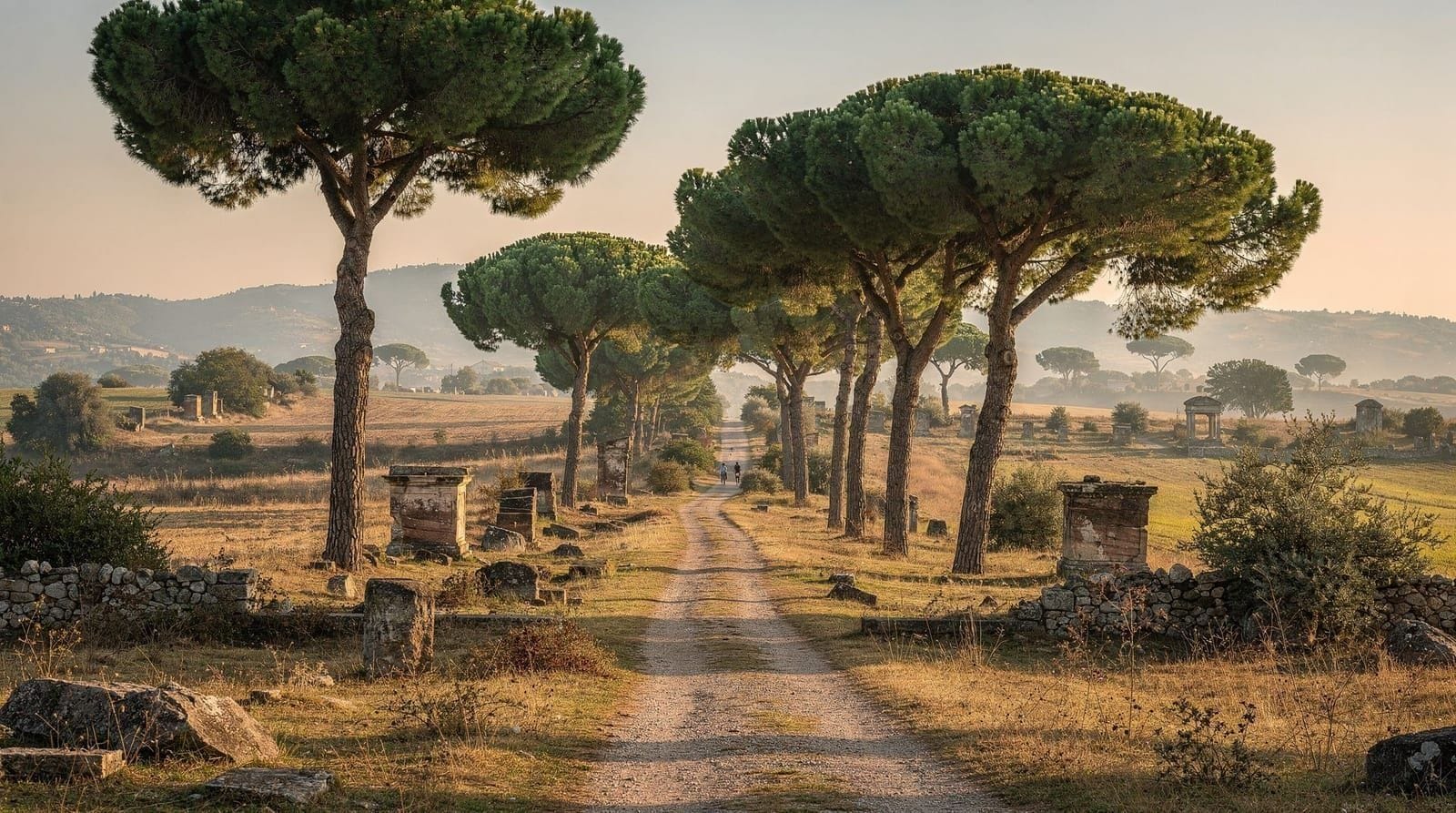
Hadrian (ruled 117–138 CE) was the most widely-travelled emperor in Roman history. On returning from his vast inspections of the empire — Egypt, Greece, Syria, Britannia — he built a private retreat that recalled the places he had seen. The result is not a villa in the conventional sense but an entire town of palaces, temples, baths, libraries, theatres, gardens, and engineering experiments across 120 hectares of Lazio hillside. At its peak, Villa Adriana supported several thousand residents and staff.
Key structures:
- Canopus and Serapeum: A long reflecting pool (119 metres) flanked by copies of Egyptian and Greek sculpture, named after a canal near Alexandria. The curved dining room (Serapeum) at the far end is the most atmospheric corner of the site — best light in the afternoon.
- Maritime Theatre (Teatro Marittimo): A circular island palace surrounded by a moat on a circular island — likely Hadrian’s private retreat within the retreat. A drawbridge gave access. The concentric structure is technically and aesthetically extraordinary.
- Imperial Palace (Palazzo Imperiale): The main residential complex, covering several hectares. The scale is difficult to comprehend even walking through it.
- Small Thermal Baths and Large Thermal Baths: Two separate bath complexes, showing different periods of construction. The vaulted concrete ceilings (some partially collapsed, some intact) demonstrate the Roman mastery of barrel and groin vaulting.
- Pecile: A vast rectangular garden walkway (232 × 97 metres) enclosing a reflecting pool — used for morning walks. The portico originally stretched around all four sides.
- Greek and Latin Libraries: Twin library buildings with distinctive plans designed to separate Greek and Latin scrolls.
The site requires 3–4 hours minimum for a meaningful visit. Guided tours add crucial context — the ruins require explanation to make sense.
Tivoli day trip from Rome — both UNESCO villas with guide includedGetting to Tivoli from Rome by train
The train is the most practical and enjoyable way to reach Tivoli.
From Roma Tiburtina station (recommended): Regional trains operated by Trenitalia run directly to Tivoli in approximately 40–55 minutes. Journey time varies by service. Ticket: approximately €3.50–4 each way (standard regional fare; buy at Tiburtina ticket machines or windows). Trains run every 30–60 minutes depending on time of day. Tiburtina is on Metro Line B (4 stops from Termini, direction Laurentina), making it very convenient from central Rome.
From Roma Termini: Less direct — typically requires a change at Roma Tiburtina or goes via a slower route. Tiburtina is the correct departure point for the direct train.
Arriving in Tivoli: The train station (Tivoli FS) is at the base of the town. Villa d’Este is uphill in the town centre (15-minute walk uphill, or taxi €5). Villa Adriana is 5 km from the town centre — take local bus CAT line 4 (from Largo Garibaldi near the town centre, €1.50, 15 min) or taxi (€7–10).
Bus from Rome (alternative): COTRAL buses run from Rome Ponte Mammolo (Line B metro stop) to Tivoli town. Approximately 50–70 minutes. Ticket €3.40. Less convenient than the train for most visitors, but serves areas the train doesn’t.
Organised day trip tour: If managing the logistics independently feels complex (especially for visitors who want to see both sites efficiently), a guided day trip that handles transport and timings is a good option.
Tivoli Villa d’Este and Hadrian’s Villa day tour with lunch from RomeDoing both sites in one day: realistic planning
This is possible but requires an early start and smart sequencing. The two sites are 5 km apart; you need local transport between them.
Recommended order:
- 9:00 — Leave Rome from Tiburtina (train ~40–55 min to Tivoli)
- 10:00/10:30 — Villa Adriana first (opens 9:00; buy ticket in advance or at the gate; 3–4 hours needed; gets busy from 11:00)
- 14:00 — Bus or taxi from Villa Adriana to Villa d’Este (15–20 min)
- 14:30 — Villa d’Este (opens 8:30; afternoon light on the gardens is excellent; allow 2 hours)
- 17:00 — Walk from Villa d’Este to the bus stop or Tivoli FS station (~20 min downhill)
- 17:30 — Train back to Rome
Why Hadrian’s first: Villa Adriana gets busier through the day (tour groups arrive late morning). Going early means fewer people on site. Villa d’Este’s fountains are active throughout the day and the afternoon visit is perfectly pleasant.
Choosing only one site: If you have only a half day or want a relaxed pace, choose:
- Villa d’Este only for garden and fountain enthusiasts, couples, those prioritising beauty
- Villa Adriana only for Roman history, architecture, and archaeology depth
See Tivoli vs Ostia Antica — which day trip from Rome for a direct comparison.
Where to eat in Tivoli
La Cantina di Villa d’Este (Via della Sibilla 29): A wine-focused osteria near Villa d’Este serving local Castelli Romani wines alongside Roman food. Pasta e ceci, grilled meats, excellent local Frascati. Lunch €15–20.
Ristorante Sibilla (Via della Sibilla 50): The most atmospheric option in Tivoli, perched on a terrace above the Villa Gregoriana gorge with views of the ancient temples of Vesta and Sibilla. Mid-range pricing (€18–25 per main); booking advisable for weekend lunch.
Bar and trattoria near Villa Adriana: The area around the Adriana site entrance has a bar (Le Scuderie di Villa Adriana) with basic food. Adequate for a quick break but not a destination.
Town centre: Tivoli town centre (around Piazza Garibaldi and Via del Trevio) has several unremarkable but honest local bars and pizza-by-the-slice options for a budget lunch.
The Villa Gregoriana: Tivoli’s third attraction
Less famous than the two UNESCO villas, the Villa Gregoriana is a 19th-century landscape park created by Pope Gregory XVI in 1835 after a catastrophic flood — the Aniene river was diverted through a tunnel blasted through the rock, creating two dramatic artificial waterfalls in the ravine below Tivoli’s old town. The result is a Romantic-landscape ravine garden: steep wooded paths descending to the river, the Grande Cascata delle Acque Albule waterfall (110 metres), ancient grottoes, and, on the cliffs above, two of the best-preserved Roman temples in the world: the Temple of Vesta (the round one — actually the Temple of the Sibyl) and the Temple of the Sibyl (rectangular). Both date to the 1st century BCE. The temple complex is what you see in almost every historic illustration of Tivoli.
The Villa Gregoriana is managed by FAI (Fondo Ambiente Italiano, the Italian National Trust). Entry approximately €8. Open daily except Mondays and January–February. From the Villa d’Este, it is a 10-minute walk downhill into the town’s ravine.
The honest caveat: The paths down to the river are steep and numerous steps are involved. Not suitable for visitors with limited mobility. In heavy rain the waterfalls are spectacular but the paths become slippery. Wear proper shoes.
Hadrian’s Villa: the architectural context
Understanding why Villa Adriana is extraordinary requires understanding its builder. Hadrian (76–138 CE, ruled 117–138 CE) was the most unusual of the Roman emperors: a Spaniard by birth, a Hellenist by passion, an architect by training, and an administrator of genuine competence who spent more of his reign travelling the empire than governing from Rome. His journeys took him to Britain (the wall bears his name), to Egypt (where he grieved conspicuously for his companion Antinous, drowned in the Nile in 130 CE), to Greece (where he rebuilt Athens), and across the eastern provinces.
When he built his retreat at Tivoli from 118 CE onwards, he incorporated references to the places he had seen. The Canopus — the reflecting pool named after the Egyptian city — is the most famous. The Poikile (the large rectangular garden walkway) is named after the Painted Stoa in Athens. The Academia, the Praetorium, the Inferi — each complex within the villa has a name that evokes a specific place or concept from Hadrian’s intellectual and physical journeys.
The result is not just an architectural complex but a kind of built memoir — the private landscape of a man who had seen more of the world than any other ruler of his era, reconstructed in travertine and concrete on a Lazio hillside.
The scale problem: Villa Adriana covers 120 hectares — the same area as ancient Rome’s entire Republican city centre. No modern visitor sees all of it in a single visit. The actively excavated and presented areas cover approximately a quarter of the total estate; the rest is archaeological context. The main visitor circuit takes 3–4 hours at a reasonable pace. Dedicated archaeology visitors can spend a full day.
The maritime theatre problem: The Teatro Marittimo is often photographed but less often understood. It is a circular canal (30 metres in diameter) surrounding a small circular island connected to the outer ring by a rotating wooden bridge (reconstructed). The inner island has a small private apartment — bedroom, library, bath. This is believed to have been Hadrian’s private retreat within the retreat: a place he could access by rotating the bridge, removing it, and becoming genuinely unreachable. The concept — an emperor so powerful he needed to engineer his own inaccessibility — captures something essential about the psychology of absolute power.
Itinerary integration: fitting Tivoli into a Rome trip
For visitors with 3–5 days in Rome, Tivoli fits best on day 3 or 4 — after the major in-city sights (Colosseum, Vatican, Borghese, food) have been covered. It is a demanding full day when combining both UNESCO villas; a comfortable half-day for Villa d’Este alone.
With a 3-day Rome itinerary: On a tight 3-day schedule, Tivoli as a full-day requires sacrificing an in-city afternoon. Villa d’Este alone (half-day) is the compromise.
With a 5-day or longer stay: Both villas comfortably, plus an hour in the Villa Gregoriana. Optimal combination.
Combined with Castelli Romani: Possible but ambitious — Tivoli is 40 km northeast; the Castelli are 25 km southeast. Combining both requires a car (about 1 hour between the two areas via the Roma ring road). See Castelli Romani & Frascati.
See the day trips by train from Rome guide for logistics on combining multiple excursions into a multi-day itinerary.
How Villa d’Este’s fountains actually work
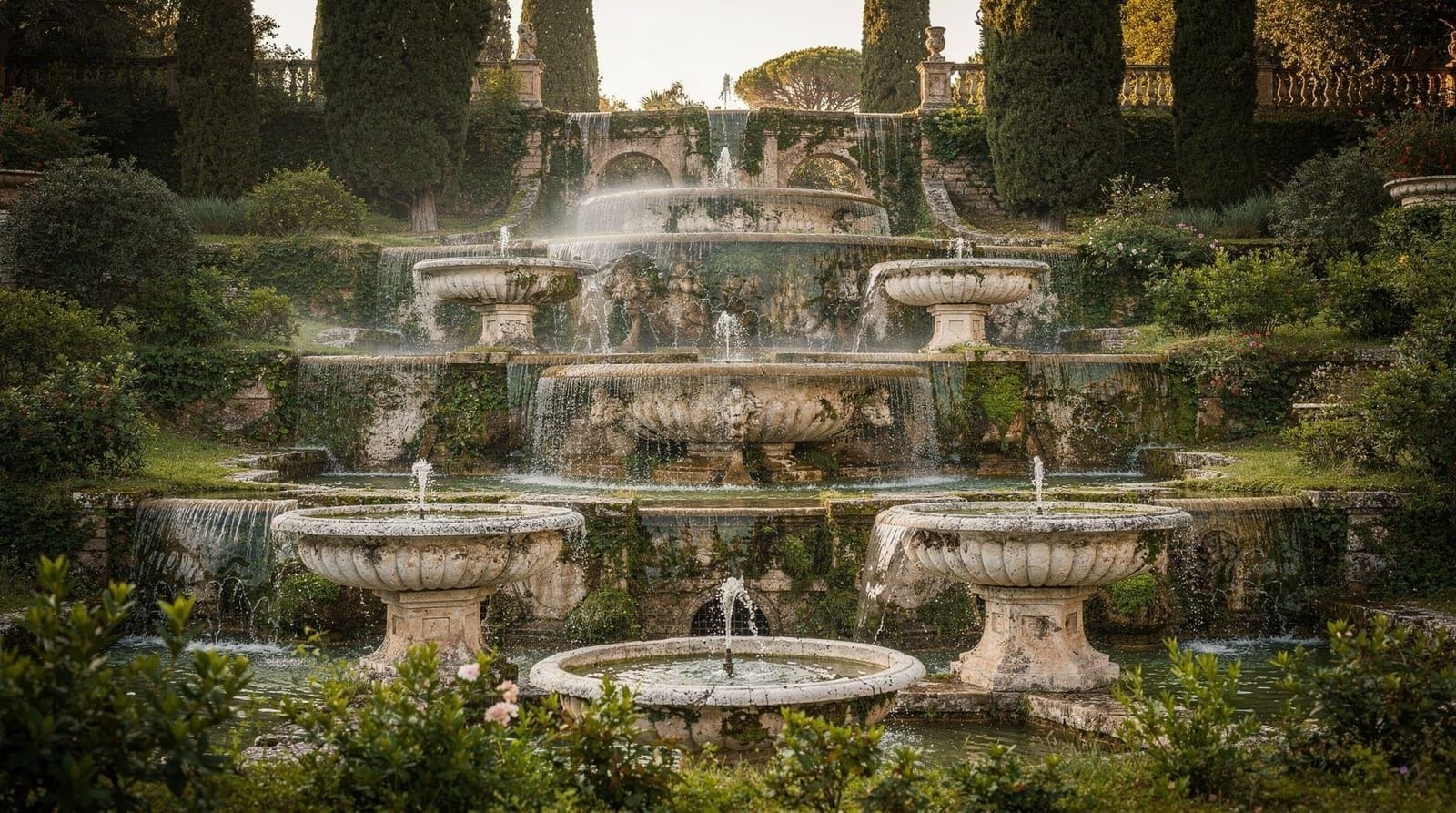
Villa d’Este’s 500-plus fountains are one of the great engineering achievements of the Renaissance, and understanding the mechanism makes the visit considerably more interesting than simply admiring the water. Every fountain in the garden operates without a single pump. Cardinal Ippolito’s engineers diverted water from the Aniene river through an aqueduct and a system of underground channels that exploit the natural 45-metre drop between the top of the garden and the bottom — gravity alone provides all the pressure needed to drive fountains, jets, and even the water organ.
This is not a small technical footnote. Renaissance hydraulic engineers had to calculate pipe diameters, channel gradients, and reservoir capacities with a precision that modern engineers would recognise, using instruments far cruder than anything available today. The Fontana dell’Organo Idraulico is the most vivid demonstration: water pressure alone forces air through pipes to play actual music on a schedule, a mechanism that astonished visitors in the 16th century and still works (with periodic restoration) today. Walking the garden with this in mind — noticing how each terrace’s fountains feed the ones below it — turns a beautiful walk into something closer to touring a working machine that happens to also be one of the most photographed gardens in Europe.
Staying overnight in Tivoli
Most visitors treat Tivoli as a single day trip, and for good reason — it’s close enough to Rome that an overnight isn’t strictly necessary. But a night in Tivoli has real advantages if your schedule allows it: you can see Villa d’Este’s gardens in the golden evening light after the tour groups have left (the gardens sometimes open for special evening visits in summer, worth checking in advance), start Hadrian’s Villa at its 9:00 opening without an early train to catch, and add the Villa Gregoriana’s waterfalls without feeling rushed against a return-train deadline.
Accommodation in Tivoli itself is modest compared to central Rome — a handful of small hotels and B&Bs in the town centre near Villa d’Este, generally in the €70–110/night range for a double, considerably cheaper than equivalent central Rome options. For most visitors, though, the easy train connection makes a day trip the more practical choice, reserving an overnight for those specifically drawn to seeing both villas without any time pressure at all, or to the Tivoli countryside’s cooler summer evenings compared to central Rome.
Tivoli vs Ostia Antica vs Castelli Romani
Tivoli is one of three close-in, easy-train day trips from Rome that often get weighed against each other:
| Tivoli | Ostia Antica | Castelli Romani | |
|---|---|---|---|
| Train from Rome | 40–55 min from Tiburtina | 30–35 min from Piramide | No direct train |
| What it delivers | Renaissance gardens + imperial villa ruins | Ancient Roman port city, in situ | Wine, hill towns, papal history |
| Minimum time | Half day (one villa) to full day (both) | Half day | Full day, ideally with a car |
| Physical demands | Moderate — Villa d’Este has many steps | Moderate — flat but large | Low — mostly hill-town walking |
If gardens and imperial-scale Roman architecture both interest you, Tivoli is the strongest single choice among the three — it’s the only one offering both in a single, easy-to-reach day. The Tivoli vs Ostia Antica guide covers that specific comparison in depth, and the day trips by train from Rome guide covers the fuller shortlist including Castelli Romani.
Photographing Tivoli’s two villas well
The two UNESCO sites reward different timing. Villa d’Este’s fountain terraces face east, so morning light (arrival at the 8:30 opening) catches the Avenue of a Hundred Fountains and the Oval Fountain at their most photogenic, with the crowds still thin. By early afternoon the gardens are equally beautiful but noticeably busier with tour groups.
Villa Adriana works in reverse: the Canopus and Serapeum are at their best in the afternoon, when low light rakes across the reflecting pool and the Egyptian-style sculptures along its edge. This is one of the practical reasons the recommended sequencing in this guide visits Hadrian’s Villa first (morning, before the crowds build) and saves Villa d’Este’s fountains for a still-lovely afternoon visit — the light logic actually points the other way for photography purposes, so if photography is your priority over crowd avoidance, consider reversing the order and accepting busier midday conditions at Hadrian’s Villa in exchange for better afternoon light there.
Tivoli day tour covering Villa d’Este and Hadrian’s Villa with a guide is worth considering if you’d rather have a guide manage the sequencing and timing trade-offs than work them out yourself.
Frequently asked questions about Tivoli
How do I get from Rome to Tivoli by train?
Take Metro B to Roma Tiburtina station, then board a regional Trenitalia train to Tivoli FS. Journey approximately 40–55 minutes. Ticket ~€3.50–4 each way. Trains run every 30–60 minutes; buy at Tiburtina station ticket machines.
Can I see both Villa d’Este and Villa Adriana in one day?
Yes, with an early start. Leave Rome before 9:30, visit Hadrian’s Villa first (3–4 hours), take the local bus or taxi to Villa d’Este (15 min), visit in the afternoon (2 hours), then return to Rome by 18:00. It is a full day but perfectly feasible.
Do I need to book Villa d’Este in advance?
In April–June and September–October, advance booking (coopculture.it or through an operator) is advisable for Villa d’Este. Villa Adriana is typically available for walk-up entry except on weekends in peak season. Both sites are included in some GYG guided tours with all logistics handled.
Is Villa Adriana accessible for visitors with reduced mobility?
The main paths at Villa Adriana are broad gravel or paved surfaces and largely flat, with some uneven sections. A significant portion of the site is accessible with care. Villa d’Este is terraced with many steps — accessibility is limited. An electric golf cart can be hired at Villa Adriana for visitors with mobility needs.
What is the Villa Gregoriana?
A third site in Tivoli — a romantic 19th-century landscape park in a ravine below the town, with waterfalls, caves, and ancient temples on the cliffs above. Managed by FAI (Italian National Trust). Entry ~€8. Less visited than the two UNESCO villas; worth adding if you have extra time after Villa d’Este.
Is the train back to Rome reliable in the evening?
Regional trains from Tivoli to Rome run regularly until late evening. The last trains are around 21:00–22:00 depending on the day. Check Trenitalia’s timetable the morning of your visit to confirm return options. The service is generally reliable; occasional delays of 10–15 minutes do occur.
Is Tivoli better than Ostia Antica or Castelli Romani as a day trip?
It depends on interest. Tivoli is the strongest single choice if you want both gardens and large-scale Roman archaeology in one day. Ostia Antica is faster and flatter if archaeology alone is the goal; Castelli Romani suits wine and hill towns over ruins or gardens. See the comparison table above.
What’s the best time of day to photograph Villa d’Este and Hadrian’s Villa?
Villa d’Este’s fountains photograph best in the morning (east-facing light, thinner crowds at the 8:30 opening); Hadrian’s Villa’s Canopus and Serapeum are at their best in the afternoon light. The standard visiting order in this guide prioritises crowd avoidance over ideal photography light — reverse it if photos matter more to you than dodging tour groups.
Top experiences
Bookable activities with verified prices and instant confirmation on GetYourGuide.