Orvieto from Rome: an easy Umbrian hill-town day trip
Rome: Orvieto and Civita di Bagnoregio Day Trip by Train
How do you get from Rome to Orvieto by train?
Direct regional or intercity trains from Roma Termini to Orvieto take about 1h10–1h25, costing €8–25 depending on service. Trains run several times per day. From Orvieto station (in the valley), take the funicular (€1.30 each way) or a bus up to the town on the tufa cliff.
A clifftop town with one of Italy’s greatest church facades
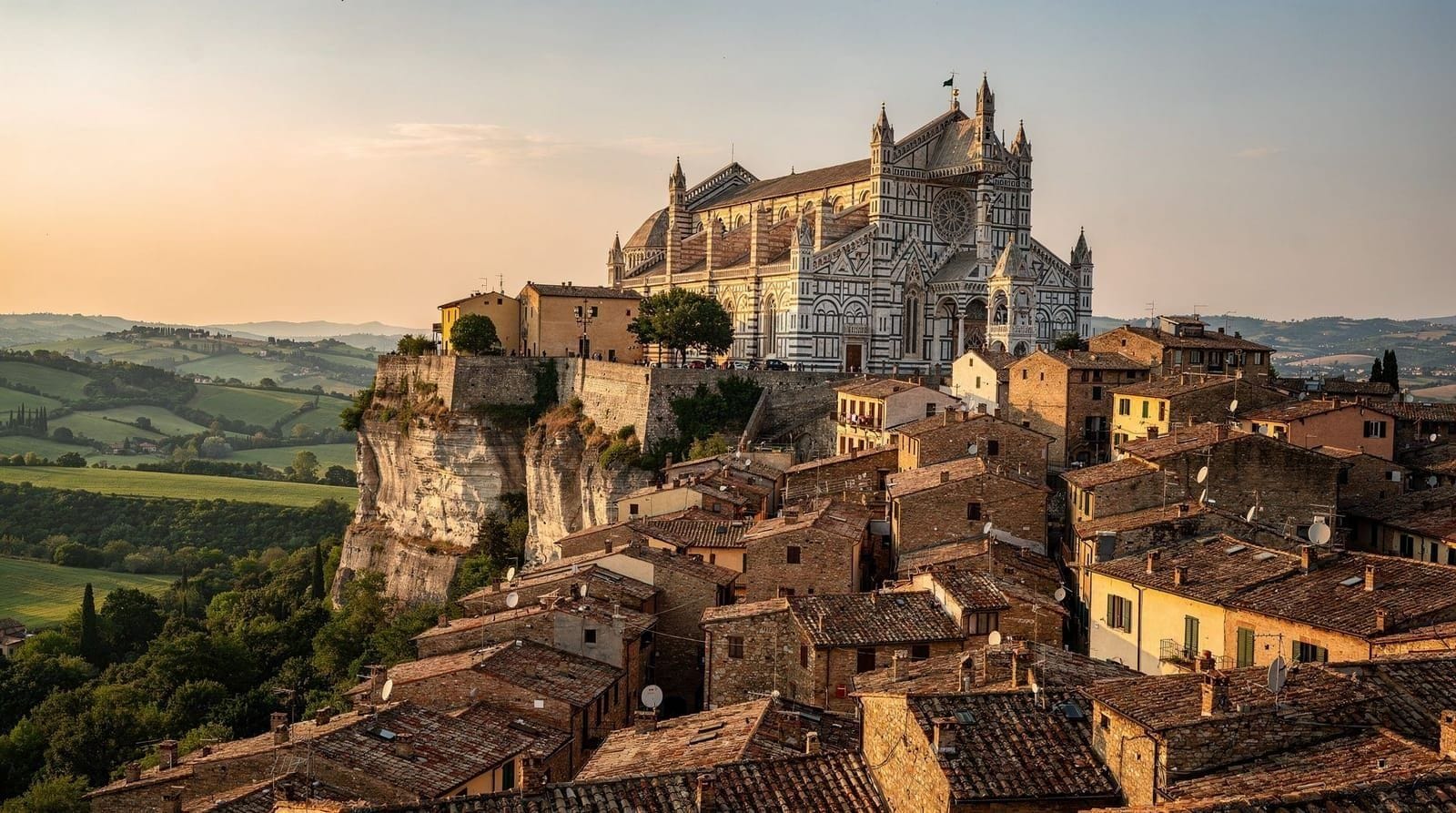
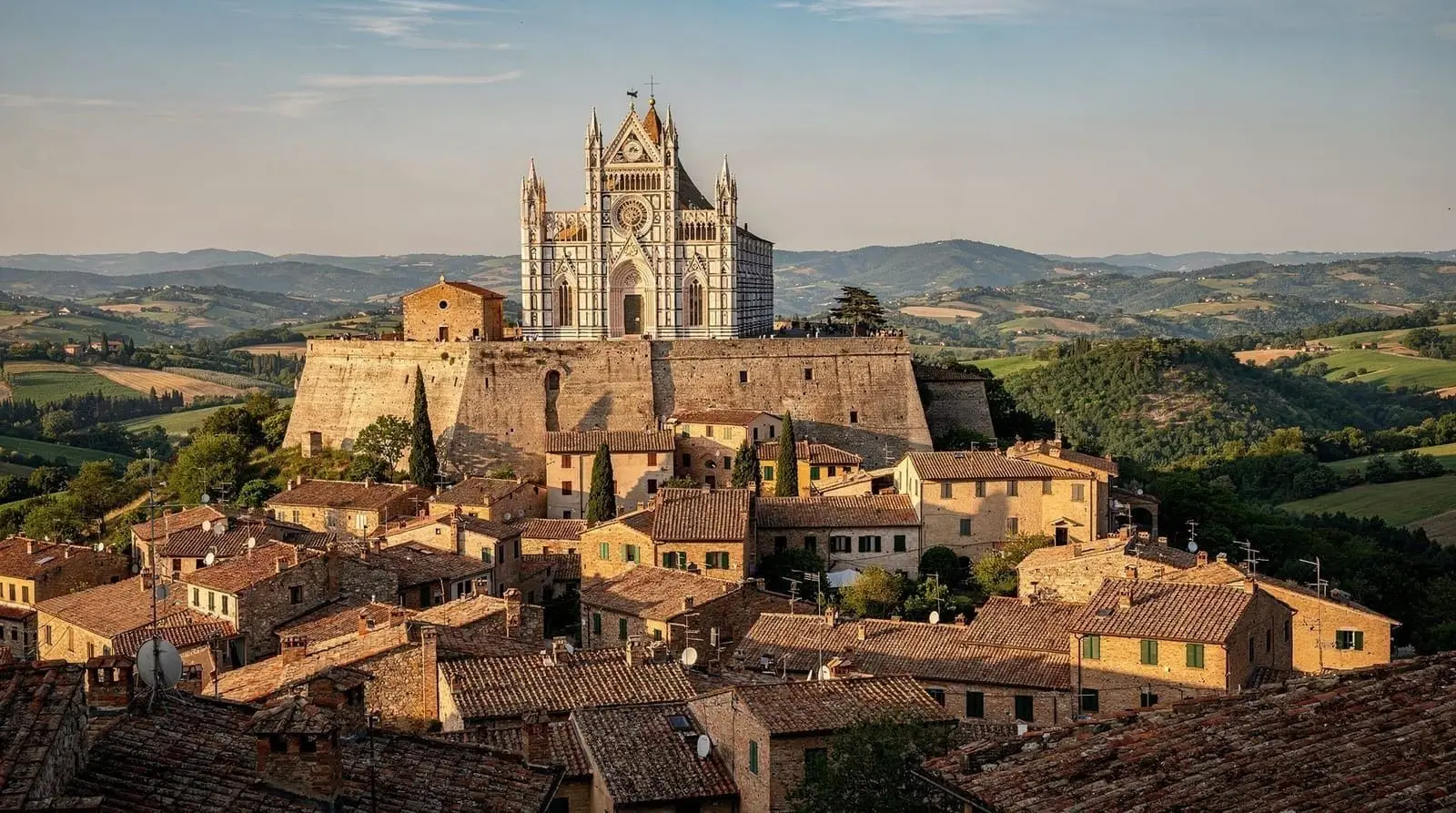
Orvieto sits on a flat-topped plug of volcanic tufa rising abruptly from the Umbrian plain, 80km north of Rome. The town has occupied this rock since Etruscan times — the dramatic defensive position explains why it survived when so many other Umbrian settlements didn’t. The medieval city that replaced the Etruscan one is compact, well-preserved, and genuinely beautiful.
The Duomo’s western facade is what most visitors come for, and it does not disappoint. The polychrome marble panels, the gilded mosaics above the central portal, and the extraordinary bas-relief carved cycles of the Pilasters of the Prophets are among the finest decorative programmes on any Gothic building in Italy — built between 1290 and 1591 (the facade was not completed for three centuries), and still used as the town’s parish church.
But Orvieto has more than the facade. The frescoes inside the Cathedral are arguable more important than the exterior. The Etruscan underground network beneath the town is one of the best-preserved examples of ancient infrastructure in Italy. And the town itself — a single main street (Corso Cavour) lined with craft shops, cantinas, ceramic workshops, and cafes — is exactly the right size for a day trip: enough to fill the day without becoming overwhelming.
| Getting there | Train, Roma Termini to Orvieto, around 1h10–1h25 |
| Cost | Around €8–25 train + €1.30 funicular each way |
| Time needed | Half day feasible; a full day is comfortable |
| Getting up the cliff | Funicular (90 seconds) from the station |
| Best for | The Duomo facade, Signorelli frescoes, Etruscan tunnels |
Getting from Rome to Orvieto
By train: Direct regional or intercity trains from Roma Termini to Orvieto station. Journey time: approximately 1h10–1h25 depending on service.
Fares and services: Regional trains (Regionale Veloce) cost approximately €8–12 and take about 1h15. Intercity trains are slightly faster (1h10) and cost €12–25. Check trenitalia.com for timetables; trains run several times per day, with the most frequent service in the morning.
The funicular: Orvieto station is at the base of the tufa cliff. The funicular (funicolare) takes 90 seconds to climb to Piazza Cahen at the top. Cost: approximately €1.30 each way, or included in the Carta Unica Orvieto combination pass (€28, covering funicular, bus travel within town, entry to the underground tunnels, and the Torre del Moro). The funicular runs from around 07:15 to 20:30 (later in summer). If you miss the last funicular, a bus (linea A) makes the same climb.
By car: The A1 Autostrada connects Rome to the Orvieto exit (Orvieto Scalo) in about 1h20. Parking is available near the funicular station or in the town. Cars are not permitted in the historic centre.
By organised tour: Tours combining Orvieto with Civita di Bagnoregio are the most popular format — see the section below on combinations.
What to see and do
The Duomo di Orvieto
The Cathedral is open from approximately 09:30–18:30 (hours vary seasonally; check the Opera del Duomo di Orvieto website). Entry to the nave is free; entry to the Chapel of San Brizio requires a combined ticket (approximately €5–8, available at the ticket office inside the main portal).
The facade: Stand in Piazza del Duomo and spend ten minutes looking before entering. The facade was designed by Lorenzo Maitani (whose bronze relief cycles on the four central pilasters are the finest narrative reliefs of the Italian Gothic) and evolved over the following two centuries as tastes shifted. The four pilasters narrate the Book of Genesis (left) through to the Last Judgment and the Elect and the Damned (right). Maitani’s carving — particularly the Last Judgment pilaster — shows writhing figures of extraordinary dynamism and psychological detail.
The interior: The striped Romanesque nave (alternating bands of dark basalt and pale travertine) is simple and grand. The Chapel of San Brizio at the far end of the right transept is the reason most art historians come.
The Chapel of San Brizio (Cappella Nuova): Fra Angelico began the ceiling vaults in 1447 (two bays only before being called away by the Pope). Luca Signorelli completed the programme between 1499 and 1504. The result is one of the most important fresco cycles in Italy: The Preaching of the Antichrist, The End of the World, The Resurrection of the Flesh, The Damned Consigned to Hell, and The Elect Ascending to Paradise. The figures in the Resurrection — shown emerging from the earth as flesh forms on bones — are directly cited by Michelangelo when he painted the Sistine Chapel ceiling starting in 1508. Signorelli’s mastery of the male figure in motion, in foreshortening, and in psychological expression is visible on every wall.
The self-portraits of both Fra Angelico and Signorelli are included in the composition (Fra Angelico in the blue mantle looking at the viewer; Signorelli in black armour on the left of The Preaching of the Antichrist).
Orvieto Underground (Orvieto Sotterranea)
Beneath the town, an extensive network of tunnels, cisterns, wells, and rooms cut into the tufa over 2,500 years — from Etruscan water management systems through medieval olive presses to World War II air-raid shelters. The accessible section is a 45-minute guided tour departing from Piazza del Duomo (several daily departures; guided tour approximately €7). The tunnels maintain a constant 14°C temperature — welcome in summer.
The main highlights include a large Etruscan cistern (a double-spiral shaft descending 36 metres, designed so that donkeys could descend on one side and ascend on the other without obstruction), medieval olive presses with intact machinery, pigeon lofts carved into the tufa, and a section of Etruscan wall with its original wooden framing preserved in carbonised form.
The Pozzo di San Patrizio (Well of Saint Patrick)
The most architecturally ingenious structure in Orvieto: a 53-metre-deep cylindrical well built on order of Pope Clement VII in 1527, designed by Antonio da Sangallo the Younger. The engineering solution — two interlocking helical staircases winding around the central shaft, with 248 steps each, and 72 windows cut into the central shaft to provide natural light — allowed donkeys carrying water to descend on one staircase and ascend on the other without ever crossing.
The well is on the eastern edge of town near Piazza Cahen (top of the funicular). Entry approximately €5.
The medieval centre
Walk Corso Cavour, Orvieto’s main street, from Piazza della Repubblica at one end to Piazza del Duomo at the other. The street is lined with ceramic and craft shops (Orvieto has a strong local ceramics tradition in the Umbrian palette of deep blue, green, and ochre), cantinas selling local wine and olive oil, and small restaurants.
Piazza della Repubblica has the church of Sant’Andrea, which sits on an extraordinary palimpsest: a 12th-century Romanesque church built over a 6th-century church built over a pre-Christian building. The excavated lower levels are occasionally accessible.
Wine in Orvieto
Orvieto Classico DOC is the local white wine. The best examples are grown in the “classico” zone immediately around the town — volcanic tufa soil that gives the wines a mineral quality distinctive to the area. Orvieto Classico Superiore is the better classification.
Look for Barberani (one of the best producers in the zone, with a cantina outside town), Palazzone (quality-focused, slightly south of Orvieto), and Decugnano dei Barbi (near the lake, excellent for late-harvest versions).
In town, buying a glass at a cantina on Corso Cavour for €3–5 is the easiest option. Ask specifically for Classico Superiore if you want the better wine.
Combining Orvieto with Civita di Bagnoregio
This is the most popular combination for the northern Lazio region. Civita di Bagnoregio — the “dying town on a cliff” described in the Civita di Bagnoregio day trip guide — is 25km from Orvieto by road. Without a car, you need an organised tour or a taxi.
Tours combining both sites typically depart from Rome, visit Civita in the morning (before the worst crowds) and Orvieto in the afternoon. Journey time from Rome to the combined day trip destination is about 1h30–2h.
Day trip from Rome to Orvieto and Civita di Bagnoregio — guided tour with transportTrain vs organised tour
Train independently is straightforward for Orvieto as a standalone destination. Direct trains from Termini; funicular to the top; compact town navigable on foot. Cost: approximately €16–25 return plus €2.60 funicular return plus museum entries.
Organised tour makes sense when:
- You want to combine Orvieto with Civita di Bagnoregio (requires a car or tour coach)
- You want a guide for the Cathedral and Underground (both are significantly richer with commentary)
- You are combining Orvieto with Assisi in a single long day
Tours covering Orvieto and Civita di Bagnoregio from Rome cost approximately €70–100 per person including transport and guide. Some include lunch.
Rome: Orvieto and Civita di Bagnoregio day trip by train — guided visit with Cathedral and undergroundA suggested day in Orvieto
09:00 — Train from Roma Termini (arrive Orvieto approximately 10:15)
10:15 — Funicular to the top (3 minutes, €1.30)
10:30 — Duomo facade and Cathedral — spend 45 minutes on the facade before entering; 30 minutes in the nave; 45 minutes in the Chapel of San Brizio. Total approximately 2 hours.
12:45 — Lunch on or near Piazza del Duomo — several good options in the vicinity. Trattoria del Moro Aronne on Via San Leonardo is consistently reliable for local pasta and Orvieto Classico; budget €20–30 per person.
14:00 — Orvieto Underground tour — 45-minute guided visit departing from Piazza del Duomo.
15:00 — Pozzo di San Patrizio — 30 minutes including the descent and ascent.
15:45 — Walk Corso Cavour — shops, cantina visit, ceramic browsing.
17:00 — Return funicular and train back to Rome.
Practical information
- Train: Roma Termini to Orvieto, approximately 1h10–1h25, €8–25. trenitalia.com. See trains from Rome day trips for booking tips.
- Funicular: Approximately €1.30 each way from the station.
- Duomo entry: Free for the nave; Chapel of San Brizio approximately €5–8 combined ticket.
- Orvieto Underground: Approximately €7, guided tours several times daily from Piazza del Duomo.
- Pozzo di San Patrizio: Approximately €5.
- Opening hours: Cathedral typically 09:30–18:30; underground tour year-round; Pozzo year-round.
- Carta Unica Orvieto: €28 combined pass (funicular, bus, Torre del Moro, Orvieto Underground). Good value if you plan to use all included elements.
- Best months: April–June and September–November. See best time to visit Rome for broader seasonal context.
- Combine with: Civita di Bagnoregio day trip by car or tour coach.
- Destination page: Orvieto destination for extended trip planning.
- Assisi alternative: Assisi from Rome is another Umbrian option; the best day trips from Rome guide ranks them both.
- 10-day itinerary: Central Italy 10 days if combining Orvieto with a broader Umbria circuit.
Frequently asked questions
Can I do Orvieto in half a day?
Yes — the Cathedral and Chapel of San Brizio, plus a walk to the Pozzo and along Corso Cavour, takes 3–4 hours. A half-day visit is feasible if you are adding Orvieto to a longer journey or combining it with another destination.
Is Orvieto suitable for families?
The town is very walkable and safe for children. The funicular is a highlight for younger visitors. The Duomo frescoes (particularly the Damned in the Last Judgment) are memorable and may prompt questions that require some parental preparation. The underground tunnels are fascinating for older children (the 14°C temperature feels dramatically cool even in summer).
What is the best viewpoint in Orvieto?
The Colle della Rocca (the west end of the town, where the medieval fortress stands) gives a panoramic view over the Umbrian plain and the valley below. Accessible on foot from the town centre; no entry charge. The view in late afternoon light is particularly good.
Is Orvieto better than Assisi or Civita di Bagnoregio for a single day trip?
Each covers different ground. Orvieto has the stronger single monument (the Duomo and the Signorelli frescoes) and the most complete self-contained day-trip experience — train, funicular, cathedral, underground, wine, all within easy reach of each other. Assisi is better for those drawn to the Franciscan story and Giotto’s frescoes in the Basilica. Civita di Bagnoregio, covered in our dedicated guide, is smaller and more purely visual — a place to look at rather than explore in depth — and works best paired with Orvieto rather than visited alone. If you can only choose one and want depth plus ease of independent travel by train, Orvieto is the strongest single choice.
Where Orvieto rewards slowing down
Beyond the headline sights, Orvieto is a town where wandering pays off in a way that busier day-trip destinations often do not. The streets south of Corso Cavour, around Via della Cava and Via Malabranca, see far fewer visitors than the Duomo approach and retain a genuinely lived-in medieval texture — narrow lanes, small workshops, and views down toward the valley between buildings. Via della Cava itself is named for a set of ancient tufa quarry caves that are separately open to visitors (small entry fee), offering a second, less-visited underground experience distinct from the main Orvieto Underground tour near the Duomo.
If time allows beyond the standard day-trip itinerary, the Museo Claudio Faina on Piazza del Duomo (facing the Cathedral) holds one of Umbria’s best Etruscan archaeological collections — vases, bronzes, and sarcophagi recovered from tombs in the surrounding countryside — and is consistently underrated relative to the Duomo it sits opposite. Entry is a modest add-on (around €7–8) and 30–40 minutes is enough for a focused visit.
For travelers building a longer central Italy trip rather than a single day trip, Orvieto sits naturally on the rail line between Rome and Florence, making it a plausible one-night stopover rather than only a there-and-back excursion — see our Florence from Rome guide for how the two combine, and the Central Italy 10 days itinerary for a fuller regional circuit including Orvieto, Assisi, and Civita di Bagnoregio.
Top experiences
Bookable activities with verified prices and instant confirmation on GetYourGuide.