Trevi Fountain: when to go, what to know, how to avoid the crush
Rome: Trevi Fountain and Piazza Navona Private Walking Tour
What is the best time to visit the Trevi Fountain?
Dawn, between 06:00 and 07:30, is by far the best time — minimal crowds, clean morning light, and you can actually stand still and look at the fountain. After 21:00 on weeknights is the second-best option. Midday in summer (11:00–17:00) is the worst time: thousands of people, no room to move, and the experience is genuinely unpleasant.
Why the Trevi is worth the effort
The Trevi Fountain is genuinely, unambiguously magnificent. The problem is not the fountain; it is almost always the timing. Visit at midday in July and you will be pressed against strangers in 35°C heat with your view blocked by selfie sticks. Visit at 06:30 on a weekday morning in May and you will understand why people have been making special trips to see this fountain for 250 years.
This guide is about how to see the Trevi well — the mechanics of timing, the €2 access fee, what the fountain actually is and what it shows, where to go nearby, and how to avoid the two things that ruin most Trevi visits: crowds and pickpockets.
| Where | Piazza di Trevi, 300m from the Pantheon |
| Best time | 06:00–07:30, or after 21:00 weeknights |
| Cost | €2 access fee during roughly 09:00–19:00; free outside those hours |
| Time needed | 15–30 minutes, longer for photos or a nearby coffee |
| Nearest metro | Barberini (Line A), about 400m |
The access fee and timing in 2026
Since late 2024, Rome has operated a timed-access system at the Trevi Fountain during peak hours, with a €2 entry fee. The paid hours run approximately 09:00 to 19:00 in summer; the exact schedule varies seasonally and is published on the official Rome municipality app.
What this means in practice: if you arrive before around 08:00 (in summer), you can walk straight to the fountain at no charge. After 19:00, the access point typically closes and the fountain is again freely accessible — though crowds do not disappear, they thin considerably after 21:00.
The €2 fee is not refunded if the fountain is busy. It controls density but does not guarantee a quiet experience during paid hours. Dawn or late evening remains the rational choice if you want the fountain to yourself.
The right approach in 2026:
- Plan a dawn visit as your primary option — set an alarm, walk over at 06:30, see it in peace
- If you are not a morning person, 21:30 on a weekday is your best alternative
- Accept that you may need to pay €2 if you arrive in the access window
- Do not rely on visiting “quickly” at midday during a route between other sights — it will be the low point of your day
What the fountain actually is
The architecture
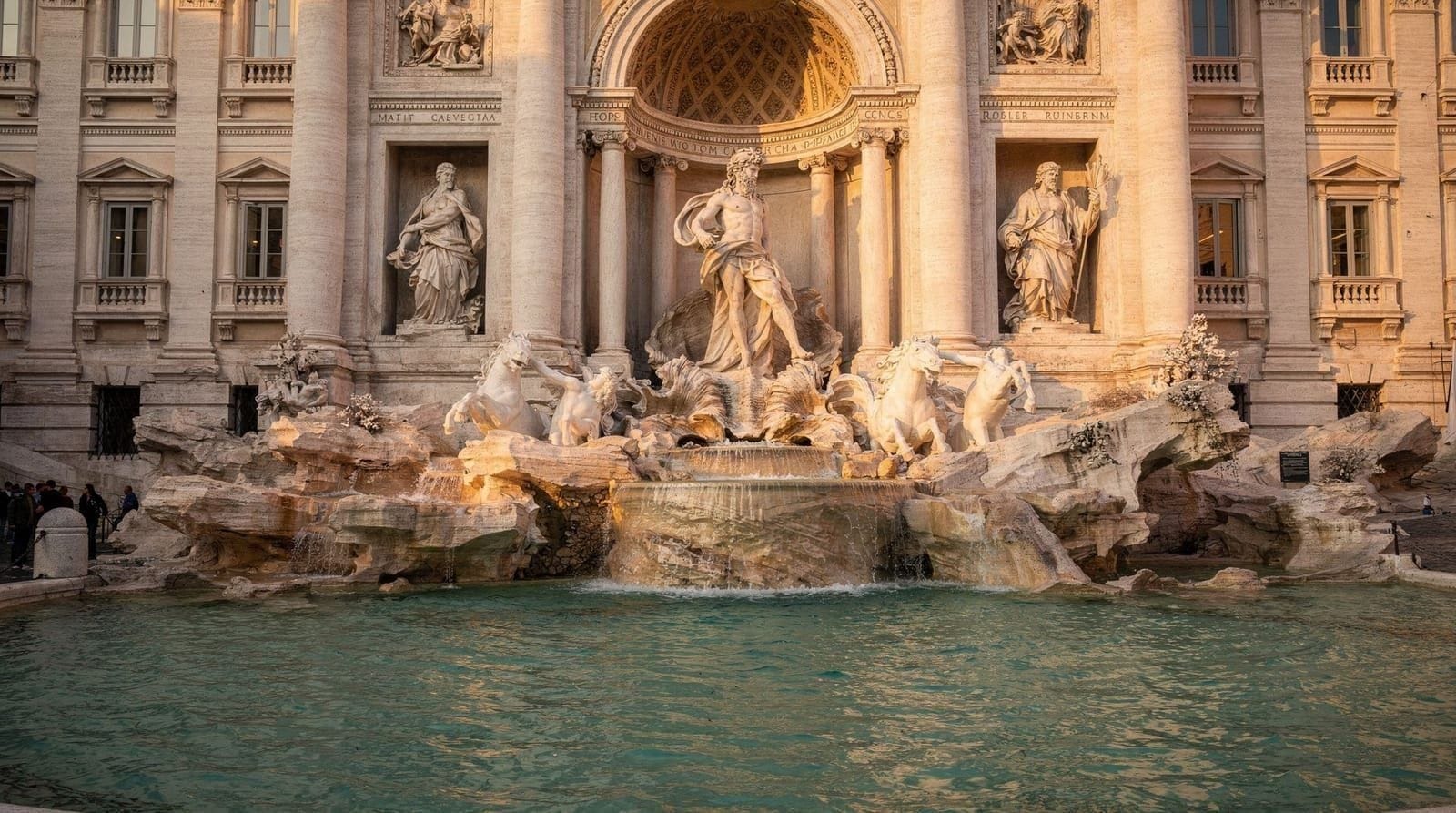
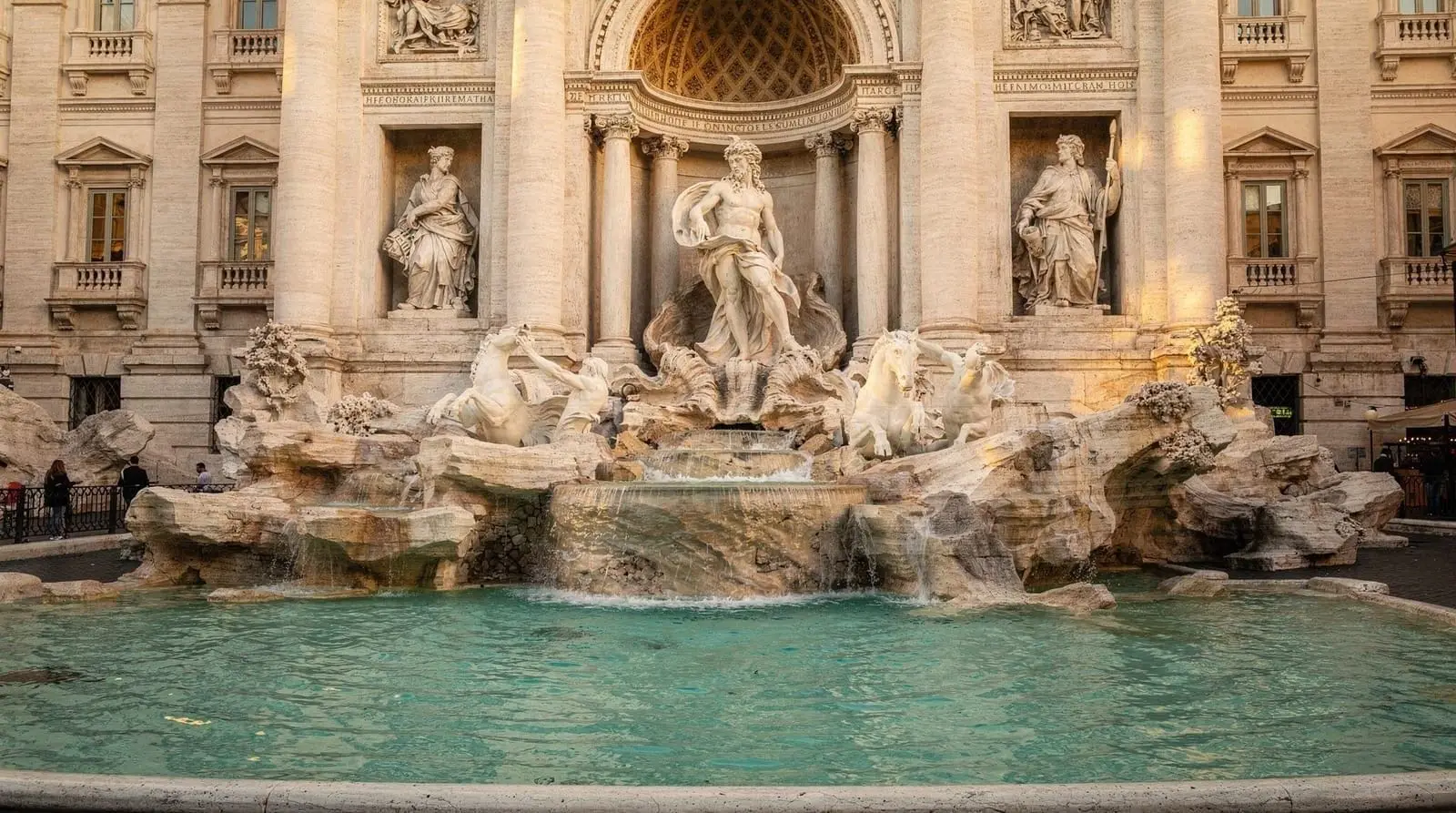
The Trevi Fountain is not a standalone structure — it is built into and against the rear facade of Palazzo Poli, a large aristocratic palazzo. Nicola Salvi’s 1762 design treats the palace wall as the backdrop for a triumphal arch composition, with Neptune (Oceanus) at the center in a pedimented niche, flanked by Abundance and Health, surrounded by cascading rocks, horses, marine figures and the main cascade basin.
The total height is 26 metres; the width is 49 metres. It is the largest baroque fountain in Rome and one of the largest in the world.
The horses: two sea horses (hippocampi) are guided by two Tritons. The left Triton struggles with a wild, rearing horse — symbolizing turbulent seas. The right Triton controls a docile horse — calm seas. The contrast is deliberate and expresses the duality of the ocean.
The water supply: the Acqua Vergine aqueduct, built by Agrippa in 19 BCE to supply the baths he constructed in the Campus Martius. The name means “virgin water” — according to legend, a young girl (virgo) showed thirsty Roman soldiers a spring 13 kilometres from Rome. The aqueduct follows the natural contour of the ground; unlike the great aqueducts that crossed the campagna on arches, the Acqua Vergine runs underground and emerges at very low pressure — which is why the Trevi and several other central Rome fountains cannot throw water high in the air. Salvi designed around this constraint brilliantly.
The design competition
Pope Clement XII held a competition for the fountain’s design in 1730. The leading candidate was Alessandro Galilei (who had just finished the Lateran Basilica facade). Public opinion was strongly against awarding the contract to a Florentine architect for this most Roman of commissions. The pope switched to Nicola Salvi, a Roman architect who had not previously built anything of significance.
Salvi spent the rest of his life on the Trevi. He died in 1751 — eleven years before the fountain was completed. Giuseppe Pannini finished the project largely following Salvi’s designs, with some modifications.
The story that Salvi placed a large urn at the corner of the fountain to block the view from a barber who kept commenting on the design is almost certainly apocryphal, but the anecdote has circulated since the 18th century and you will find the urn still there.
The coin tradition: the actual facts
The custom of throwing a coin into the Trevi is traced to a 1954 film (Three Coins in the Fountain), though earlier tourist accounts mention coin-throwing. By the 1960s it was established as an international ritual.
One coin: you will return to Rome. This is the standard version.
The coins are collected weekly — by a team from the municipality, early on Monday mornings, using a special vacuum system that draws them from the fountain basin. The total annual collection runs to approximately €1.4 million, all of which goes to Caritas, Rome’s Catholic charitable organization, for food banks and meals programs.
The legality: a 2018 Italian court ruled that the coins belong to the municipality of Rome, not to the state. Previous disputes between the city and the state over the money have been settled.
Stealing coins from the Trevi is illegal. A Romanian man was arrested in 2002 after spending years entering the fountain at night and collecting coins systematically. His name is Roberto Cercelletta; he collected an estimated €1,000 per night at peak operation.
Photographing the Trevi
Best position: The upper-left side of the piazza looking across to the right gives you the widest angle with Neptune centered. The exact center of the piazza gives you maximum symmetry but maximum people in frame.
Best time for photography: Dawn is the only practical answer if you want an unobstructed shot. At 06:30 in May you can set up a tripod on the piazza edge and take unobstructed long exposures. By 09:00, this is impossible on most days.
Lens: A 24–35mm equivalent captures the full composition without distortion. Longer focal lengths compress the water and sculpture favorably.
Phone photography: The fountain is large enough that a phone at normal shooting distance (5–8 metres) captures it adequately in good light. Dawn light is flattering; midday sun creates harsh shadows on the sculpture.
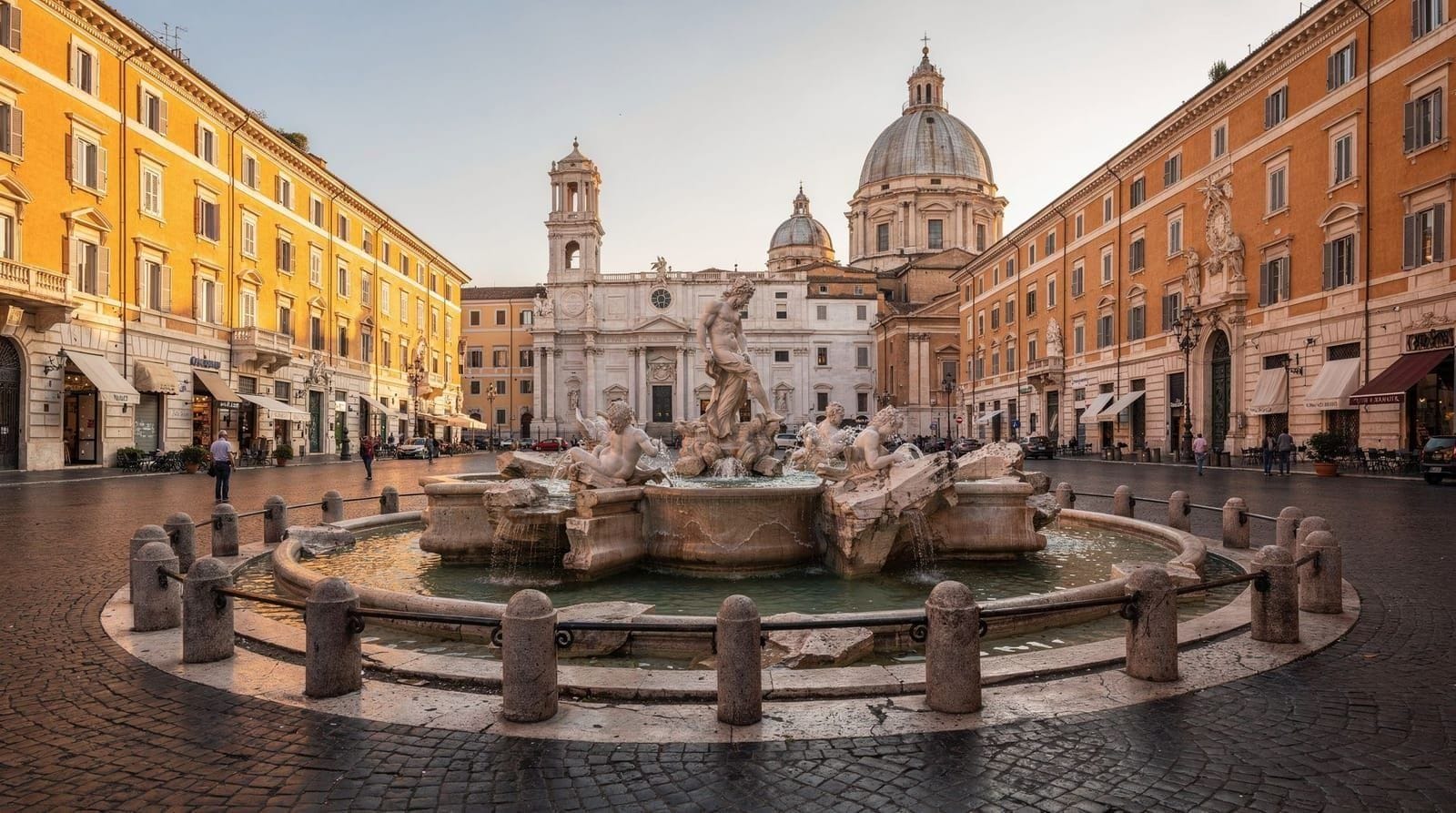
Private walking tour of the Trevi Fountain and Piazza Navona — a guide dedicated entirely to your group, with flexibility to linger and photograph without the pressure of a larger tour.The surrounding neighbourhood
The streets immediately around the Trevi are unremarkable by Rome standards — tourist souvenir shops, mid-range restaurants, gelato chains. But two minutes in any direction, the neighbourhood changes considerably.
Via della Croce and Via del Lavatore (between the Trevi and Piazza di Spagna): a cluster of good Roman trattorie. Al Moro (Vicolo delle Bollette 13) has been serving Roman classics since 1929 and is one of the neighborhood’s most honest restaurants.
Piazza San Silvestro (west): an unremarkable bus hub, but the surrounding streets have several good coffee bars at local prices.
Palazzo del Quirinale (400 metres uphill): Italy’s presidential palace occupies the highest point of the Quirinal Hill with a view over the entire city. The palace is occasionally open on Sundays for guided visits; the gardens open more regularly. The gate change ceremony occurs daily at 16:00 in summer.
Fontana del Tritone, Piazza Barberini (500 metres east): Bernini’s 1643 masterwork, commissioned by Pope Urban VIII. A muscular Triton kneels on four dolphins, holding a large shell to his lips and blowing water upward. It is one of Bernini’s most purely joyful sculptures — uninhibited by the architectural framing that constrains the Trevi — and is one of Rome’s most underappreciated fountains precisely because the Trevi is nearby. See our Rome fountains trail for more on the Tritone and the other great Rome fountains worth seeking out.
Combining the Trevi with a broader itinerary
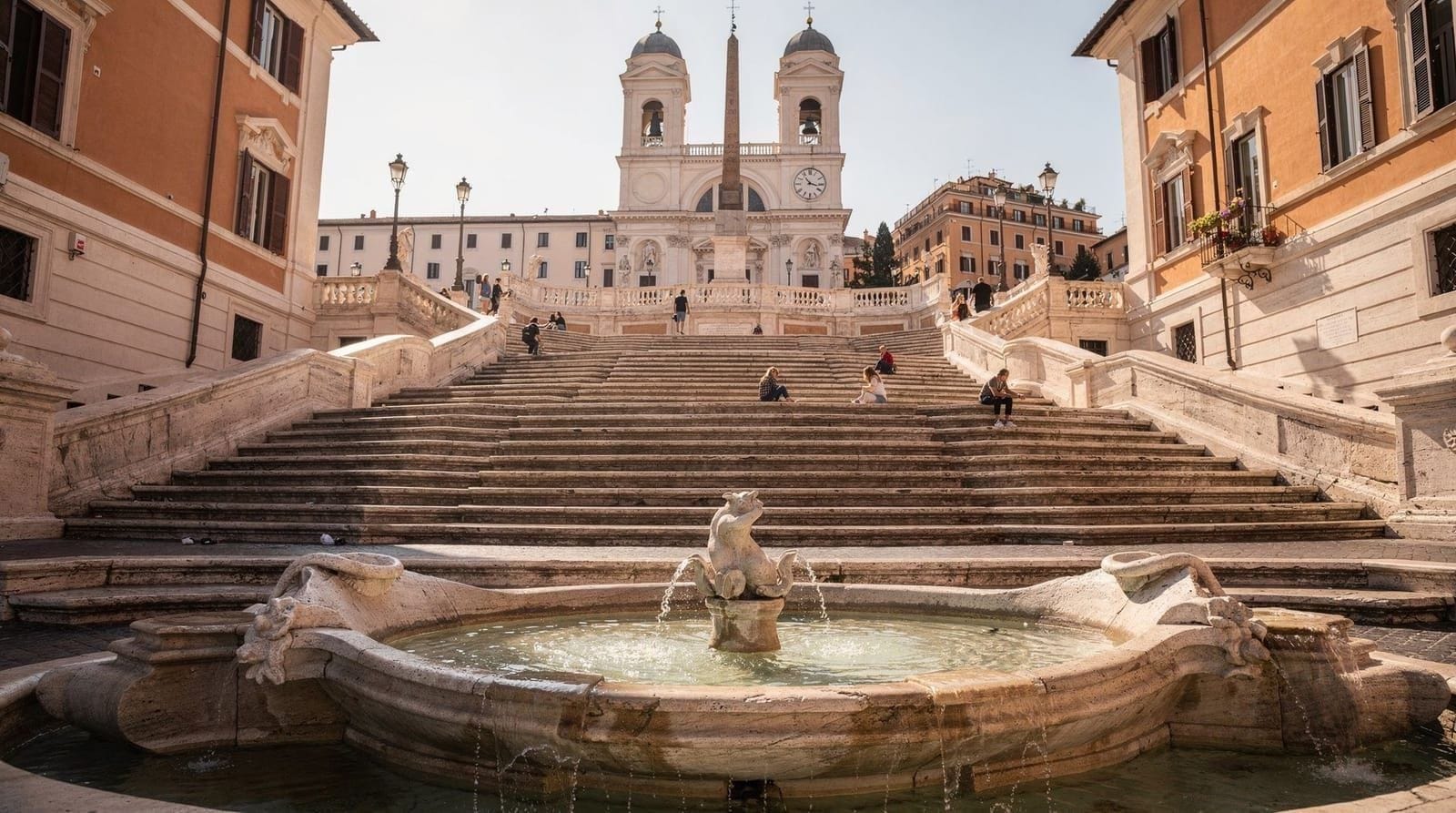
The Trevi fits naturally into the classic centro storico walking circuit that covers Piazza Navona, the Pantheon quarter and the Spanish Steps. This is the standard baroque Rome walk and is best done as a full half-day with good pacing. For the full context of how the Trevi compares to Rome’s other famous squares, see our best piazzas guide, and for general crowd-avoidance strategy across the whole city, our avoid Rome crowds guide applies the same dawn-visit logic to the Colosseum and Vatican.
Alternatively, the Trevi makes a good dawn detour before or after a morning at the Colosseum and Roman Forum — the Trevi is about 2 kilometres from the Forum area. An early start to the Colosseum (opening at 09:00), then a walk northwest to the Trevi arriving by 11:30, is a logical sequence — though the Trevi will already be busy by that point. Dawn-first at Trevi, then Colosseum at 09:00 opening, is the better order.
For those combining Piazza Navona and the Trevi in a single evening, our underground tour option that visits both the Domitian stadium beneath Piazza Navona and the ancient infrastructure under the Trevi area is an unusual way to experience the foundations of these famous spaces.
Classic English-language walking tour of Rome’s baroque highlights — Trevi Fountain, Pantheon, Piazza Navona and the Spanish Steps in a well-paced 2.5 hours.The underground water: where the Trevi’s water actually comes from
One aspect of the Trevi Fountain that most visitors never consider: the water you are looking at has been flowing through the same underground channel for over 2,000 years.
The Acqua Vergine springs are located about 13 kilometres east of Rome, in the hills near Salone. From there, the aqueduct runs underground at a gentle gradient, emerging at the Trevi as its terminus. Because the gradient is very shallow and the aqueduct runs underground (avoiding the evaporation losses of exposed channels), the Acqua Vergine reaches the Trevi at low pressure — around 4 metres of head pressure. This is why the cascade is wide and sheet-like rather than jet-propelled.
The aqueduct was restored and extended multiple times: by Pope Paul V in the early 1600s (creating the Fontanone on the Janiculum), by successive popes through the 17th century, and with modern infrastructure additions in the 20th century. It continues to supply several of Rome’s historic fountains and is still operating as a functioning water supply for ornamental purposes.
The Trevi is, among everything else it is, the terminal monument of a Roman engineering project that has been running since the time of Augustus. That is not something visible in the baroque marble and Neptune — but it is there.
Practical notes
Hours: The fountain runs continuously, 24 hours. The timed-access fee applies approximately 09:00–19:00 in peak season; exact hours vary. Check the Rome municipality app for current schedule.
Access fee: €2 during paid hours. Book online or pay at the access control point.
Getting there: 400 metres from Barberini metro (Line A). No bus stop directly adjacent. Easiest on foot from any central accommodation.
Nearest nasone: There are several cast-iron drinking fountains (nasoni) within 200 metres of the Trevi — look for the small green pipes with continuously running water. Free, clean, cold.
Restaurants nearby: La Matriciana (Via del Viminale) is slightly further but worth the walk; for something closer, avoid the immediately surrounding tourist-menu restaurants in favour of the streets two blocks north or east.
For the broader piazza and fountain context, see our full walking guide to Rome’s baroque circuit and our self-guided Rome fountains trail.
Is a dawn visit really worth the early alarm?
It is one of the most common hesitations readers raise, so it’s worth addressing directly. A 06:00 alarm on holiday feels like a genuine sacrifice, and it’s reasonable to wonder whether the payoff justifies it. Having the Trevi essentially to yourself — able to walk right up to the basin edge, hear the water rather than a crowd, and take a photograph without a stranger’s arm in frame — is a materially different experience from the midday version, not just a quieter one. If you are a committed night owl, the 21:00–22:00 weeknight window is the honest second-best option and requires no alarm at all. For couples planning a romantic Rome visit, a dawn or late-evening Trevi stop is consistently one of the highest-rated small moments of a trip, precisely because it’s the version of the fountain without the crowd.
Frequently asked questions about Trevi Fountain: when to go, what to know, how to avoid the crush
Is there an entry fee for the Trevi Fountain in 2026?
How long does the Trevi Fountain visit take?
Where exactly is the Trevi Fountain?
What is the coin-throwing tradition at the Trevi Fountain?
What is the history of the Trevi Fountain?
Are there pickpockets at the Trevi Fountain?
What is near the Trevi Fountain worth combining with a visit?
Is the Trevi Fountain worth visiting at night?
Can I skip the Trevi Fountain if I've already seen photos of it?
Top experiences
Bookable activities with verified prices and instant confirmation on GetYourGuide.