Ostia Antica
Ostia Antica: Rome's ancient port city, 45 minutes by train. Better than Pompeii for most visitors. Tickets, trains, best routes, and honest comparison.
From Rome: Ostia Antica Guided Half-Day Trip by Train
Duration: 4 hours
Quick facts
- Train from Rome
- Roma-Lido line from Piramide/Magliana; ~30–35 min to Ostia Antica station
- Train ticket
- €1.50 BIT (same as metro/bus); valid within ATAC zone
- Site entry
- €14 adults; €2 booking fee; under-18 free
- Time on site
- 3–5 hours; comfortable half-day excursion
- Opening hours
- Tue–Sun 9:00 to ~17:00 (earlier closing Nov–Jan); closed Mondays
- Crowds
- Significantly less crowded than Pompeii; still quiet on weekday mornings
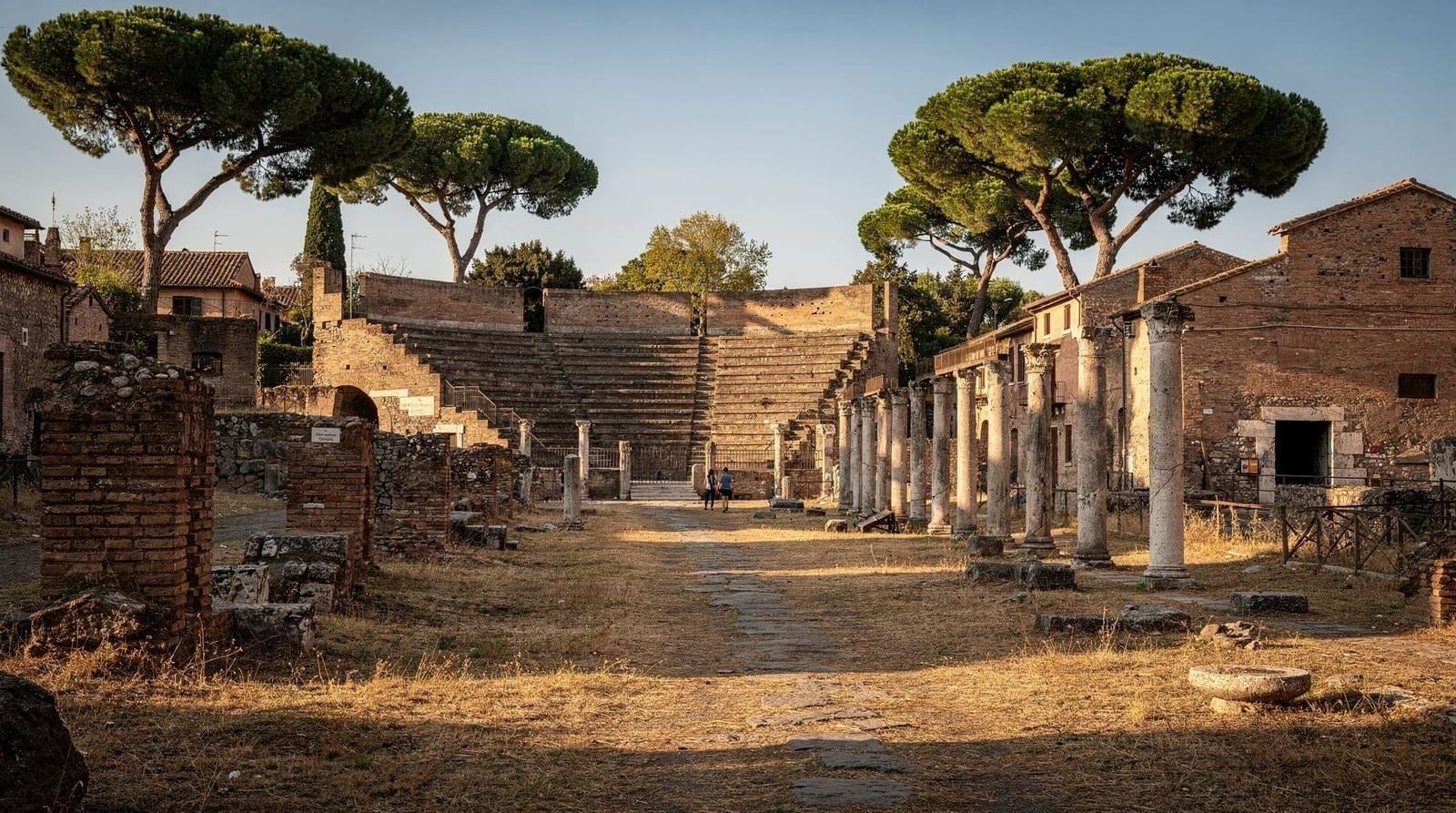
Ostia Antica is Rome’s ancient harbour city, once home to 50,000–100,000 people who handled the Mediterranean grain supply for the empire. It was buried by silt and abandoned in the medieval period, excavated from the 18th century onwards, and is today one of the most complete Roman urban sites in existence. Less famous than Pompeii, considerably less crowded, and 45 minutes from Rome by suburban train. For most visitors making a one-day excursion from Rome, Ostia Antica delivers more genuine Roman urban experience per hour than the more celebrated sites in Campania.
Why Ostia Antica vs Pompeii
The comparison matters because many Rome visitors include a day trip to Pompeii (2.5–3 hours by train) and skip Ostia entirely. This is a defensible choice — Pompeii is extraordinary and well worth the travel. But the sites serve different experiences.
Pompeii: A city frozen in 79 CE by the Vesuvius eruption. The dramatic appeal is the sudden death — streets, houses, bodies, food still in pots. Enormously moving and visually overwhelming. But the journey from Rome takes 2.5–3 hours each way (Frecciarossa to Napoli + Circumvesuviana), the site now receives 4+ million visitors per year, and a meaningful visit requires a full day.
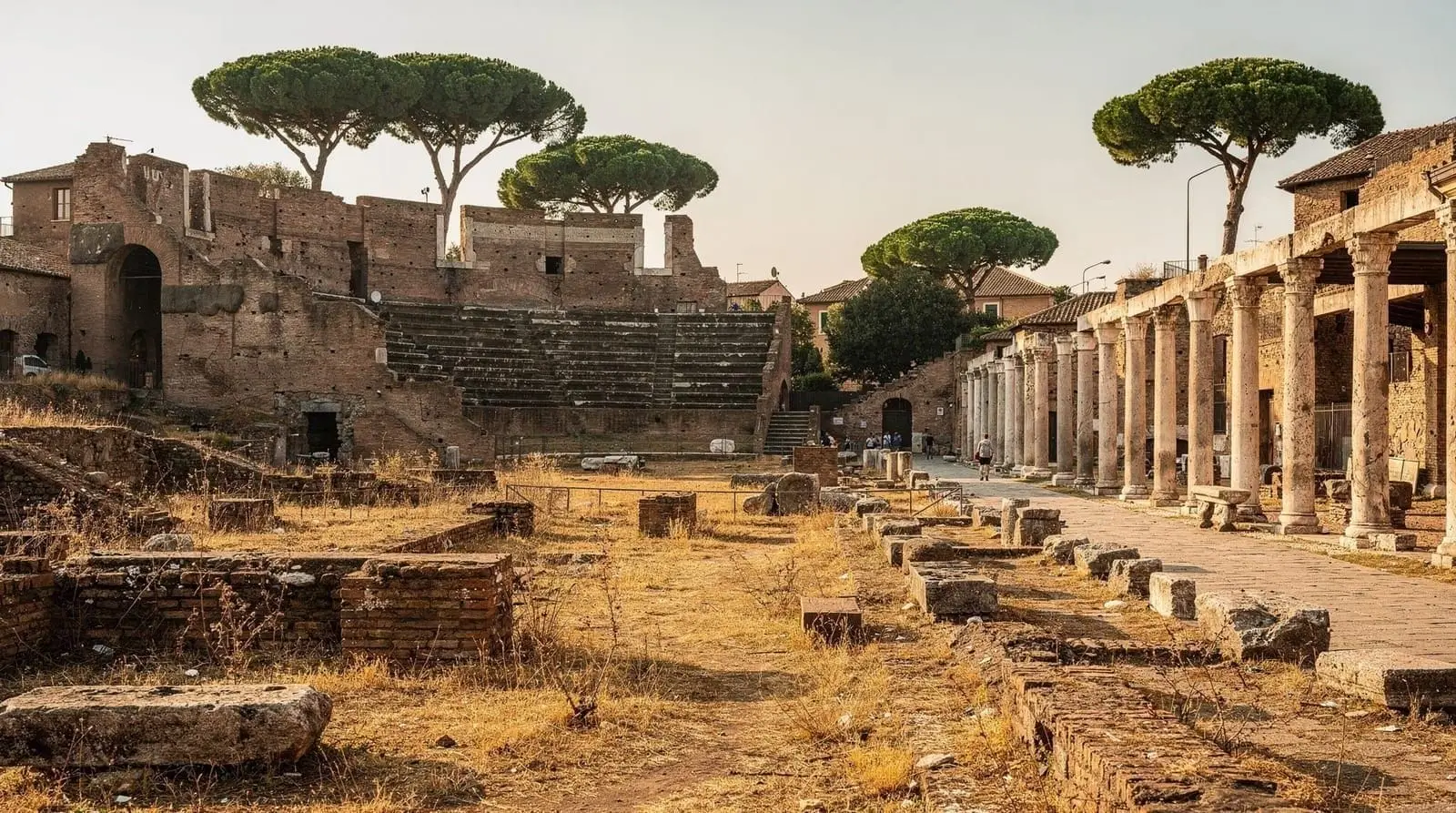
Ostia Antica: A city that declined gradually, was abandoned, and was buried by river sediment over centuries. No volcanic drama — but the result is different. You see the natural accumulation of 400 years of Roman urban life: warehouses from the 1st century, apartment buildings from the 2nd, mithraeum temples from the 3rd. Multi-storey insulae (apartment blocks) survive to their second or third floors. The mosaics at the Piazzale delle Corporazioni (Guild Square) — advertising the trading companies of the ancient Mediterranean — are intact underfoot. The site has a working 2nd-century theatre. And you can see it all in 3–4 hours, a 30-minute train ride from central Rome, for €14.
For visitors with limited days in Rome: Ostia Antica is the rational day trip. For visitors with a full week and special interest in the Vesuvius story: Pompeii in addition. For a wider view of how Ostia Antica stacks up against every other option, see the best day trips from Rome guide and the day trips by train overview.
See Tivoli vs Ostia — which day trip to choose and Ostia Antica vs Pompeii for detailed comparisons.
Getting to Ostia Antica by train
The Roma-Lido commuter line is the practical route. It is managed by ATAC (Rome’s urban transport authority), and a standard BIT ticket (€1.50) covers the entire journey — the same ticket as the metro and city bus.
How to take the train:
- Take Metro B to Piramide station (Linea B, direction Laurentina). Exit the metro into the Piramide station building.
- The Roma-Lido trains depart from a platform inside the same building — follow signs to “Ostia.”
- Ride to Ostia Antica station (not “Lido di Ostia” — one stop further). Journey: approximately 30–35 minutes.
- From Ostia Antica station, walk ~10 minutes following signs to the excavation entrance.
Trains run every 15–20 minutes. The journey is perfectly safe and straightforward. The trains are older rolling stock; they work. Some guidebooks suggest the Roma-Lido line is unreliable — this is exaggerated. Minor delays are possible; a functional service operates every day.
Common mistake: Buying a separate regional train ticket thinking the BIT doesn’t cover it. It does. The Roma-Lido is an ATAC service — the same €1.50 ATAC ticket is valid.
By car: Via del Mare runs directly to Ostia (30–40 min from central Rome in normal traffic). Parking near the entrance is available and free. Only worth driving if you are combining with a beach visit at Lido di Ostia and prefer the flexibility.
What you’ll see on site
The site is large — roughly 34 hectares under excavation — and a well-signposted walkway guides visitors through the main zones. Highlights:
The Decumanus Maximus: The main east-west street of the city, about 1.5 km long. Walking its length takes you through the commercial and civic heart of Ostia.
Piazzale delle Corporazioni (Guild Square): A large forum behind the theatre, once the headquarters of trading companies from across the Mediterranean. The mosaic floors in front of each office show what each company traded: grain sacks, elephants (from Africa), a lighthouse (indicating shipping agents). Some of the best-preserved and most intelligible mosaics in any Roman site, fully exposed and free to walk among.
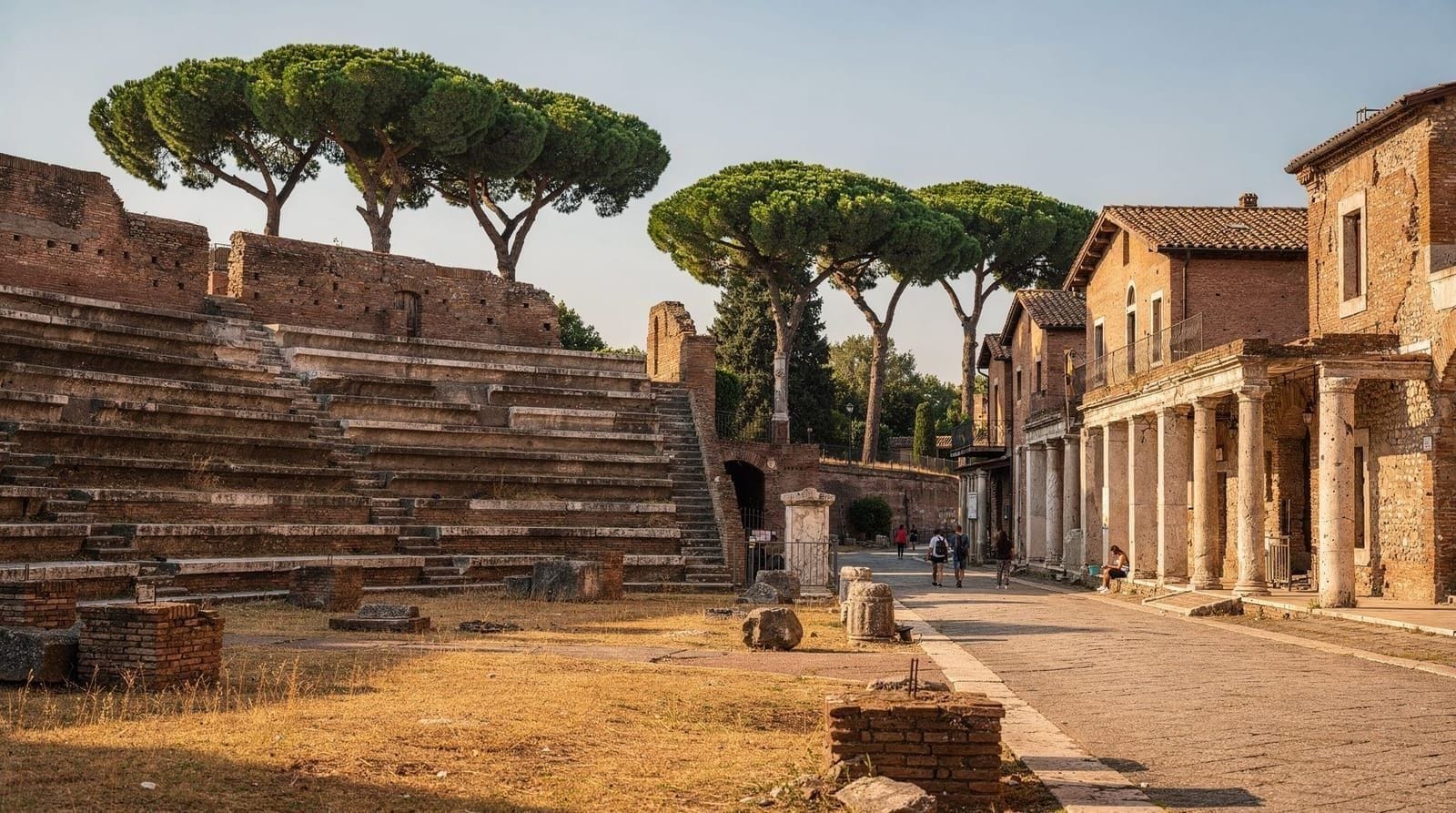
The Theatre: A 2nd-century theatre still in substantial form. Used today for summer performances. Capacity was about 3,000.
The Insulae: Multi-storey apartment buildings that housed Ostia’s working population. Unlike Pompeii (mostly single-storey domestic houses), Ostia has genuine Roman apartment blocks. The Casa di Diana is the best example — concrete and brick construction, ground-floor shops opening onto the street, upper floors reached by internal stairs.
The Thermal Baths: Multiple large bath complexes, including the Terme di Nettuno (Neptune’s Baths) with spectacular mosaic floors showing Neptune in his chariot — some of the finest pavement mosaics in any Roman site.
The Mithraea: Ostia has more mithraeum temples than any other city in the Roman world — 17 identified to date. These underground sanctuaries of the mystery cult of Mithras are intriguing because they are visible in situ throughout the site, integrated into ordinary buildings.
Museum: The site museum contains sculpture, architectural fragments, and artefacts excavated over 200 years. Included in the site ticket.
Ostia Antica half-day tour by train from Rome — guided, includes ticketPractical tips for visiting
Bring water: The site has one bar/café near the entrance and one near the theatre. In summer, carry at least 1.5 litres. The site has limited shade.
Wear comfortable shoes: The roads are paved in Roman cobblestones or dirt paths. Not extreme — but heels are inadvisable, as with all of Rome.
Guidebook or guide: The site’s signage is adequate but thin. A guidebook (€10 at the entrance shop) adds enormously to the experience by explaining what each building was. Alternatively, a guided tour identifies what you are looking at without the reading burden.
Photography: Permitted freely throughout; no flash restrictions apply outside the museum.
Accessibility: The main Decumanus Maximus is broadly accessible, though some secondary streets have uneven surfaces. The museum is accessible. Not all areas of the site are fully navigable with a wheelchair — see accessible Rome guide for specific detail.
Closed Mondays: Unlike Pompeii (open every day), Ostia Antica closes on Mondays. Plan accordingly.
Where to eat near Ostia Antica
The area immediately outside the site entrance is minimal — a single café inside the site and a handful of options in the village of Ostia Antica (the modern village, 5 minutes walk from the entrance).
Ristorante Monumento (Piazza Umberto I 8, Ostia Antica village): A reliable, unfussy trattoria in the village square. Roman classics — spaghetti alle vongole (clams from the coast, appropriate here), grilled fish, pasta e fagioli. €14–18 for a full meal. Good option after a morning at the site.
Bar/café at the site entrance: Basic sandwiches and drinks at normal (not inflated) prices. Fine for a mid-visit break.
Take-away from Rome: If you want to control quality and cost, buy lunch supplies in Rome — a bakery panino or market supplies — and eat in the site’s grassy areas (permitted in designated zones).
Combining Ostia Antica with Lido di Ostia
The Roma-Lido train continues one stop past Ostia Antica to Lido di Ostia, Rome’s city beach. It is not a glamorous beach resort — it is an urban beach, busy in summer, with a mix of private beach clubs (lidi) charging €15–25 for a sun-lounger and free public sections (spiagge libere). The water quality has improved significantly over the past decade but is not Mediterranean-holiday standard.
If your Rome trip is in summer and you want a half-day at ruins and a half-day at the beach, the combination is logistically easy: Ostia Antica in the morning, Lido di Ostia in the afternoon, return on the same line to Rome. This doubles the value of the trip.
History: what Ostia was and why it declined
Ostia Antica was Rome’s original port city, founded (according to tradition) by Rome’s fourth king, Ancus Marcius, in the 7th century BCE — making it Rome’s oldest colony. The name comes from ostium, Latin for “mouth” (of the river). In practice, what we see today is almost entirely the Imperial-era city built between the 1st and 3rd centuries CE; the Republican-era city beneath has been less excavated.
At its height (late 1st–early 2nd century CE), Ostia had a population estimated at 50,000–100,000 and handled the Mediterranean grain supply for Rome — the annona, the food supply that kept 1 million Romans fed. The harbour complex (Portus) was actually 3 km north of Ostia, at the mouth of a canal dug by Claudius; Ostia served as the administrative, commercial, and residential city of the entire port operation.
The decline was gradual. The harbour at Portus superseded Ostia as the main commercial facility from the 2nd century onwards. The Tiber mouth silted up progressively, making river navigation increasingly difficult. Malaria became chronic in the coastal wetlands. From the 4th century, population declined; the city was not violently destroyed but simply abandoned over generations. By the medieval period, the site was marsh and scrubland. The river continued depositing silt; by the time of the first modern excavations (18th century), parts of the city were buried under 1–3 metres of alluvial sediment — which, paradoxically, preserved the pavements, mosaics, and lower walls in excellent condition.
Systematic excavations began under Pope Pius VII in the early 19th century and accelerated dramatically under Mussolini in the 1930s, when the Via del Mare was built to connect Rome to the coast and the area was cleared for the 1942 World’s Fair (which was also to have a new harbour city nearby). The 1930s excavations uncovered about two-thirds of the city we see today; work has continued at a slower pace since.
What makes Ostia different from Pompeii archaeologically
The preservation modes differ. Pompeii was buried in a single catastrophic event — volcanic deposit from Vesuvius in 79 CE — which sealed the city at a particular moment in time. The result: extraordinary snapshots of daily life (food in pots, election graffiti on walls, bodies in their final positions), but limited stratification. You are seeing essentially one layer of one city at one moment.
Ostia accumulated and changed over 400 years of urban life. What you see is the result of successive construction, rebuilding, and renovation. A warehouse from the 1st century may stand next to a mithraeum inserted in the 3rd century into a 2nd-century apartment block. This stratigraphic complexity is less visually dramatic than Pompeii’s frozen moment, but more representative of how Roman cities actually developed. The insulae (apartment blocks) of Ostia, for instance, represent the ordinary urban housing of empire-era Rome — the kind of housing that did not survive elsewhere.
The mosaics at the Piazzale delle Corporazioni deserve special emphasis. They are a record of the commercial Mediterranean: shipping agents, grain merchants, rope-makers, pilots — each company’s floor mosaic advertises what it does through image rather than text. An elephant indicates African trade. A lighthouse indicates navigation. A ship emerging from a river mouth indicates fluvial transport. Reading these images while standing on them gives a concrete sense of Rome’s trading network that no text-based source can match.
The site museum and its collections
The Museo Ostiense, located within the archaeological park near the theatre, contains finds from 200 years of excavation. The collection is large and significant: portrait sculpture (including several Imperial portraits in excellent condition), marble architectural fragments, household objects, commercial amphorae with painted inscriptions identifying their contents (oil from Spain, wine from Gaul), and a remarkable series of cinerary urns and funerary reliefs.
The museum is often neglected by visitors who exhaust themselves on the outdoor site and lack time for the indoor collection. If you must choose: do the outdoor site first, museum at the end, allow 45–60 minutes. Some of the sculpture, particularly the 2nd-century portrait busts, is as fine as anything in Rome’s major museums.
Best season and time of day to visit
Ostia Antica has limited shade across most of its 34 hectares, so timing matters more here than at many indoor-heavy Rome sites:
| Season | Conditions | Recommended timing |
|---|---|---|
| April–May | Mild, green, comfortable | Any time; mornings for best light on mosaics |
| June–August | Hot, little shade on site | Arrive at 9:00 opening; avoid 12:00–15:00 |
| September–October | Warm, fewer crowds | Late morning through afternoon |
| November–March | Cool, shorter opening hours | Midday, when light and temperature peak |
Weekday mornings are consistently the quietest slot year-round — tour groups tend to arrive from around 10:30 onwards. If you can only visit in high summer, treat the 9:00 am opening as non-negotiable rather than optional.
Ostia Antica for families with children
The site suits children better than many Rome attractions precisely because it’s outdoors, spacious, and doesn’t require hushed museum behaviour. Kids can walk the Decumanus Maximus, climb (carefully, where permitted) into the lower levels of the insulae, and see a real Roman theatre they’re allowed to sit in. The Piazzale delle Corporazioni mosaics work well as a simple game — spot the elephant, the ship, the lighthouse — that keeps younger children engaged without needing to read anything.
Practical family notes: bring more water than you think you need, as the on-site cafés are limited and shade is sparse; a stroller works on the Decumanus Maximus but struggles on the smaller side streets’ uneven Roman paving. Budget 2–3 hours rather than the full 3–5 for a family visit, and consider combining with Lido di Ostia for a beach afternoon that rewards the morning’s walking. For wider Rome-with-kids planning, see the Rome with kids guide.
Ostia Antica small-group guided tour keeps groups manageable and paces the visit well for mixed-age travelling parties.
Frequently asked questions about Ostia Antica
How far is Ostia Antica from Rome?
About 25 km southwest of central Rome, at the mouth of the Tiber. The Roma-Lido train from Piramide station reaches Ostia Antica station in 30–35 minutes.
Is Ostia Antica better than Pompeii?
Different, not objectively better. Pompeii is more dramatically preserved (volcanic deposit) and covers more of the domestic experience. Ostia Antica has better mosaics in situ, more visible multi-storey urban buildings, and is a far shorter journey from Rome with far smaller crowds. Most visitors doing a Rome-based trip will find Ostia Antica more practical and almost equally rewarding.
Do I need to book Ostia Antica tickets in advance?
Booking online (€2 booking fee) is advisable in April–June and September–October to guarantee entry, particularly for weekend mornings. In low season and on weekdays, same-day tickets at the box office are generally available.
Is a guide worth it at Ostia Antica?
Yes, for most visitors. The site’s own signage is limited. A guided tour (typically 2–3 hours) provides context that transforms the ruins from “old walls” to a comprehensible ancient city. Half-day guided tours with train transport and ticket included are available through GYG.
Ostia Antica guided tour with lunch — full half-day with local guideCan I visit Ostia Antica without a guide?
Yes. The main sights are signposted, the Decumanus Maximus is obvious, and a printed or downloaded site plan is easy to follow. Buy the site’s own guidebook (€10) at the entrance. Solo visitors who read about the site beforehand will have a perfectly satisfying experience.
Is Ostia Antica safe to visit?
Entirely. It is an official archaeological park managed by the Italian state, with staff throughout. The village of Ostia Antica and the surrounding area are unremarkable suburban Rome — safe and ordinary.
Is Ostia Antica good for a family with children?
Yes, generally better suited to kids than many Rome sites — it’s outdoors, spacious, and has a real theatre and mosaics that work as a simple spotting game for younger visitors. Bring extra water and plan for 2–3 hours rather than a full day. See the Rome with kids guide for wider planning.
What is the best time of day to visit Ostia Antica?
Weekday mornings, ideally at or near the 9:00 am opening, especially between June and August when shade is limited across the site. Late morning through early afternoon works well in the shoulder seasons (April–May, September–October).
Top experiences
Bookable activities with verified prices and instant confirmation on GetYourGuide.