Tivoli day trip from Rome: Villa d'Este and Hadrian's Villa
From Rome: Villa d'Este and Hadrian's Villa Tivoli Day Tour
How do you get from Rome to Tivoli?
Take the regional train from Roma Tiburtina to Tivoli — about 45–60 minutes, roughly €4 one way. From Tivoli station, Villa d'Este is a 20-minute uphill walk or a short bus ride. Hadrian's Villa is 5 minutes by local bus from town. A full day gives you time for both UNESCO sites comfortably.
Two UNESCO sites, one day, 40 minutes from Rome
Tivoli is the easiest genuinely great day trip from Rome. It sits 30km east of the city in the Apennine foothills, and it contains two separate UNESCO World Heritage Sites — Villa d’Este, one of the most spectacular Renaissance gardens in existence, and Hadrian’s Villa, the largest and most lavish private residence ever built in the Roman Empire. You do not need a car, you do not need to speak Italian, and the train is four euros.
The question is not whether to go. The question is how to structure the day so you see both sites properly rather than rushing one in the fading afternoon light.
This guide tells you exactly how.
| Where | Tivoli, ~30 km east of Rome |
| Cost | ~€30–55/person independent; €55–100 guided |
| Time needed | Full day for both UNESCO sites |
| Getting there | Regional train from Roma Tiburtina, ~45–60 min |
| Best time | April–May or September–October |
Getting to Tivoli from Rome
By train: The regional train from Roma Tiburtina station to Tivoli runs frequently (roughly every 30–60 minutes) and takes 45–60 minutes. The ticket costs approximately €4 one way and is purchased at the station or from automated machines. Validate your ticket before boarding.
Important: use Roma Tiburtina, not Roma Termini, for this journey. If you are staying in the historic centre, take Metro B to Tiburtina station (about 20 minutes from Termini, or 25 from Spagna). Budget 20–25 minutes to reach Tiburtina before your train.
By car: Tivoli is on the A24 motorway (Roma–L’Aquila direction). Driving takes 30–40 minutes without traffic, but Rome traffic can double that in the morning. Parking in Tivoli is available near the town centre. Do not bring a car into Rome — the ZTL zone covers the historic centre, and cameras issue automatic fines of €84–335 charged directly to the rental company and then to you. See the Rome driving and ZTL guide for full details.
By organised tour: Multiple operators run half-day and full-day tours from Rome with direct coach pickup near major hotels. Journey time is similar to the train; the benefit is door-to-door service, skip-the-line entry, and a guide who contextualises both sites. Costs vary from €45–80 per person depending on tour length and group size.
Full-day guided tour from Rome covering both Villa d’Este and Hadrian’s Villa, with transport and entry includedSuggested itinerary: doing both sites in one day
The logical sequence is Villa d’Este first (in the town centre), then Hadrian’s Villa (6km outside town by local bus).
Morning: Villa d’Este (09:00–11:30)
Opening time: Generally from 08:30 (varies by season — check the official site). Arriving at opening gives you 45 minutes before tour groups arrive in volume.
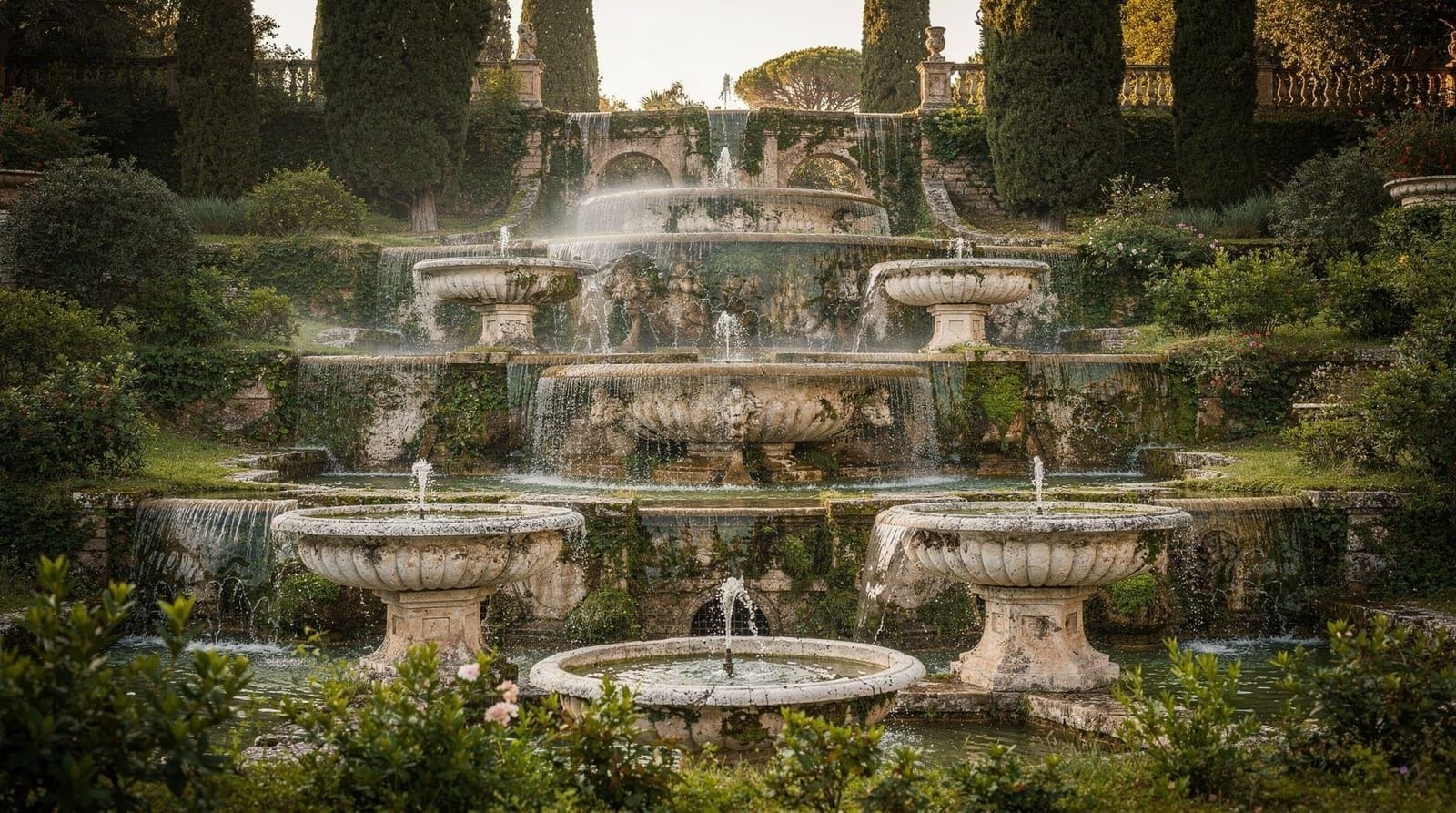
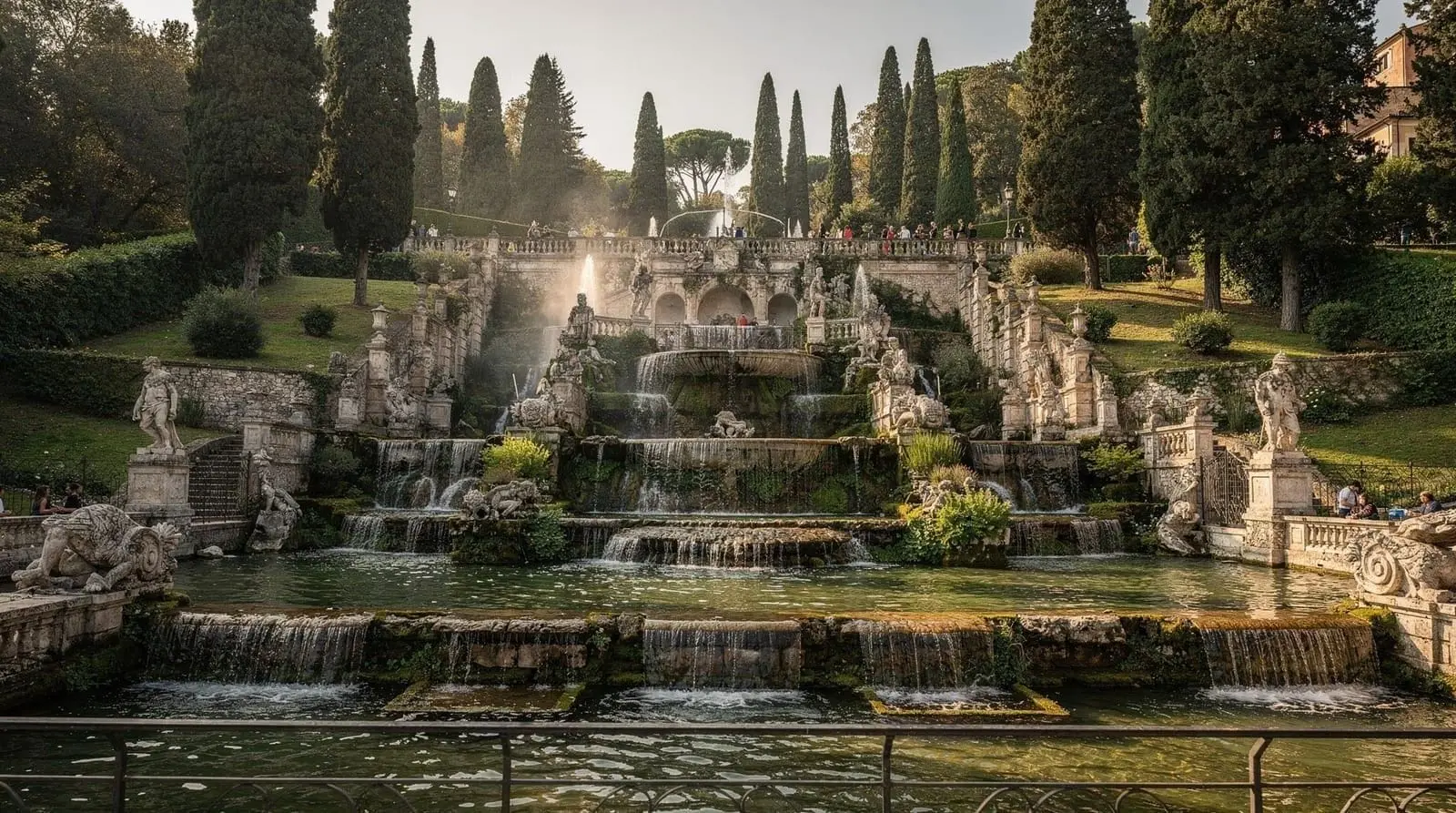
Villa d’Este was built in the 1550s for Cardinal Ippolito II d’Este on the site of a Benedictine convent, using engineering schemes of extraordinary complexity to pipe water from the Aniene river uphill to power over 500 fountains on multiple terraced levels. The result — four centuries later, still largely intact — is a masterpiece of Renaissance hydraulic engineering and garden design.
The highlights:
- Viale delle Cento Fontane (Avenue of a Hundred Fountains): the central horizontal axis with three continuous rows of carved masks and spouts, moss-covered and theatrical
- Fontana dell’Ovato (Oval Fountain): the largest and most dramatic single fountain, framed by statues of the Tiburtine Sibyl and river gods
- Fontana della Rometta (Little Rome Fountain): a miniature model of Rome — the Tiber island, Castel Sant’Angelo — built as a cultural statement of the cardinal’s ambitions
- Fontana dei Draghi (Dragon Fountain): designed in a single night to impress Pope Gregory XIII during a surprise visit in 1572
Allow 1.5–2 hours for a thorough visit. The gardens slope steeply, with uneven stone paths — wear comfortable shoes.
Ticket: €14 full, €7 reduced (EU citizens 18–25). Book at ticketeria.it or at the villa entrance.
Villa d’Este vs Hadrian’s Villa: what to expect from each
| Villa d’Este | Hadrian’s Villa | |
|---|---|---|
| Character | Renaissance garden, fountains, compact | Ancient Roman ruins, vast, spread out |
| Time needed | 1.5–2 hours | 2.5–3.5 hours |
| Terrain | Steep stone paths, many steps | Flat but extensive walking |
| Best light | Early morning, before groups arrive | Afternoon, low sun on brick and marble |
| Needs a guide? | Enjoyable without one | Strongly recommended — hard to read alone |
If you can only manage one site, choose Villa d’Este for spectacle and ease, or Hadrian’s Villa for historical depth and fewer crowds relative to its size.
Lunch in Tivoli town (12:00–13:00)
Tivoli has a genuine local restaurant scene that serves the town rather than tourists. Ristorante Sibilla on Via della Sibilla is the most famous and most expensive (€40–60 per person); it has a terrace overlooking the gorge and the circular Temple of Vesta — worth it for a special lunch. For a more modest and equally satisfying meal, Trattoria del Falcone on Via del Trevio is a solid neighbourhood option for €20–30 per person.
Afternoon: Hadrian’s Villa (13:30–17:00)
Take local bus line 4 or 4X from Piazza Garibaldi in Tivoli to Villa Adriana — a 10-minute ride (about €1.30). Alternatively, it is a 25-minute walk downhill.
Hadrian’s Villa (Villa Adriana) is not a villa in any domestic sense. It is a complex of 30 buildings spread across 120 hectares — the size of a small town — constructed by Emperor Hadrian from about 117 CE as his personal retreat and effectively his seat of government. The scale and ambition are staggering. Hadrian designed much of it himself, incorporating elements inspired by his travels through Greece, Egypt, and Asia Minor.
The key areas:
- Pecile (Maritime Theatre): A circular island-villa inside an artificial moat, connected to the shore by retractable bridges — Hadrian’s private retreat within the retreat. The engineering is extraordinary.
- Canopus: A long ornamental pool bordered by columns and statues, modelled on the Egyptian town of Canopus near Alexandria. The reflections in the water and the surviving crocodile statues give it an otherworldly quality.
- Small and Large Baths: Two separate bathing complexes; the Small Baths is the better preserved and shows Roman thermal engineering at its most sophisticated — curved vaulted ceilings, underfloor heating (hypocaust) channels, and cold and hot rooms in sequence.
- Heliocaminus Baths: North-facing baths with large windows positioned to capture winter sun.
- Cryptoportico: A long underground service corridor used by staff to move around the complex without appearing on the main level.
Honest assessment of the site: Hadrian’s Villa is magnificent but difficult to comprehend without a guide or solid preparation. The scale works against you — without a map and some historical context, the ruins can blur into an undifferentiated landscape of brick stumps. An audio guide (available on-site) helps significantly. A licensed guide transforms the experience. This is one of the cases where a guided tour genuinely justifies its cost.
Ticket: €10 full, €2 reduced (EU 18–25). Book at coopculture.it.
Hours: Generally 09:00 to one hour before sunset. In midsummer, the site is open until 19:30.
Train vs guided tour: honest comparison
Go independently if:
- You are a confident traveller comfortable reading historical maps
- You are happy to pace yourself without time pressure
- You want to linger in the gardens or have a long lunch
- Budget matters — the train-plus-entry approach costs about €30 per person total
Book a tour if:
- You want expert commentary at Hadrian’s Villa (genuinely adds value here)
- You are travelling with children who need a guide to maintain engagement
- You are short on time and want skip-the-line access arranged in advance
- You prefer door-to-door logistics without navigating Roman public transport
A half-day tour (Villa d’Este and Hadrian’s Villa, 5 hours) costs approximately €55–75 per person including transport and entry. A full-day tour with more time at each site and a lunch break costs €75–100.
Half-day guided tour from Rome to Hadrian’s Villa and Villa d’Este — good option for tight schedulesWhat the guides won’t tell you
The train journey itself is pleasant. The regional service from Tiburtina runs through the eastern suburbs before climbing into the Aniene valley — hills, Roman aqueduct ruins visible from the window in stretches, and the characteristic ochre-and-terracotta colours of the Lazio countryside. It is not just transport; it is a visual transition out of the city.
Villa d’Este at 09:00 is a different experience to Villa d’Este at 11:30. By late morning, cruise-ship groups and tour coaches arrive in waves. The earlier you enter, the more you have the fountains to yourself. The sound of running water through the gardens with no crowd noise is genuinely one of the better sensory experiences available within 40 minutes of Rome.
Hadrian’s Villa is best in afternoon light. The low afternoon sun picks out the red brick and marble fragments in ways the flat midday light does not. If you arrive at 13:30–14:00, you will have 3 hours before closing in winter or 4–5 in summer, which is enough for a thorough visit with the site at its most atmospheric.
Bring water. Both sites are largely exposed with limited shade. In summer, the heat at Hadrian’s Villa (dark stone, open fields) is significant. Carry a litre per person minimum and use the fountain at the Canopus if needed.
The Temple of Vesta viewpoint is free. Above the gorge at the edge of Tivoli town, two circular Roman temples — the Temple of Vesta and the Temple of the Sibyl — are visible from the public road at no charge. The viewpoint from the terrace behind the Sibilla restaurant (accessible without entering the restaurant) gives you one of the most photographed images of Tivoli. Worth five minutes before heading to the bus stop.
Toilets and facilities are limited at Hadrian’s Villa. There are facilities near the entrance and one further into the site, but given the scale of the complex, plan your visit with this in mind rather than assuming conveniences at every turn. Villa d’Este has more frequent facilities given its compact layout.
Phone signal is generally reliable at both sites, which matters if you’re relying on a digital audio guide or map app at Hadrian’s Villa rather than a paper map — download an offline map of the site in advance as a backup in case of patchy coverage in some of the lower, more enclosed areas.
Combining Tivoli with other day trips
Tivoli pairs naturally with Ostia Antica as an ancient-history double for visitors spending a week in Rome — one is the residential and imperial side of Roman life, the other is the commercial and maritime side. See the Tivoli vs Ostia comparison if you are choosing between them.
If you are interested in wine and the Castelli Romani hills, Tivoli and Castelli Romani are in opposite directions from Rome (Tivoli is east, Castelli is south) and do not combine well in a single day. Do them on separate days.
For general context on planning day trips from Rome, see the best day trips from Rome guide and the trains from Rome guide. If you are building a longer itinerary, the Rome with day trips plan and how many days in Rome guide will help you structure the week.
Tivoli’s destination page has local context on the town and its region.
Practical checklist
- Train: Roma Tiburtina to Tivoli, approximately €4 each way. Validate ticket before boarding. See the getting around Rome guide for Metro B to Tiburtina.
- Villa d’Este: Book online at ticketeria.it. Entry €14 full. Open from 08:30 (check for seasonal hours).
- Hadrian’s Villa: Book at coopculture.it. Entry €10 full. Local bus 4/4X from Piazza Garibaldi.
- Lunch in Tivoli: Budget €15–40 per person depending on restaurant choice.
- Full day budget: €30–55 per person (train + entries + lunch) for an independent visit.
- Guided tour alternative: €55–100 per person all-inclusive.
- Best months: April–May and September–October. See Rome in spring and best time to visit Rome for seasonal planning.
- Return train: Last trains back to Rome run until late evening — check the Trenitalia timetable before you leave.
Frequently asked questions
Is Tivoli worth a day trip from Rome?
Unequivocally yes. Two UNESCO World Heritage Sites within 45 minutes of the city centre, accessible by a €4 train ticket, with excellent food options in the town itself. Tivoli is probably the most rewarding per-effort day trip available from Rome.
Can I do Tivoli in half a day?
You can visit one site — Villa d’Este or Hadrian’s Villa — in a half-day. Hadrian’s Villa benefits from a half-day approach (morning or afternoon); Villa d’Este can be done in 1.5 hours. You cannot do both properly in under 5 hours. If time is limited, choose Villa d’Este for the spectacle or Hadrian’s Villa for the historical depth.
What should I see first, Villa d’Este or Hadrian’s Villa?
Villa d’Este first, Hadrian’s Villa in the afternoon. Villa d’Este is in the town centre and opens earlier; Hadrian’s Villa benefits from lower afternoon crowds and the quality of late sunlight on the ruins.
Do the fountains run all day at Villa d’Este?
The fountains operate continuously during opening hours. Some sections may be closed for maintenance at certain times of year. The grand water organ on the central terrace plays on the hour in peak season — an extraordinary spectacle.
Is Tivoli suitable for visitors with limited mobility?
Partially. Hadrian’s Villa is largely flat and manageable with some effort, though the site is extensive and involves significant walking between areas. Villa d’Este is more challenging — the gardens are built on a steep hillside with many stone steps and no lift, and some of the lower terraces are difficult to reach without climbing back up. Visitors with significant mobility limitations may prefer to focus on Hadrian’s Villa alone, or view Villa d’Este’s upper terrace and forgo the lower fountains.
Can I visit Tivoli as part of a longer Lazio trip rather than a single day?
Yes — some visitors combine an overnight in Tivoli with a broader look at the Aniene valley, though most treat it as a single well-structured day from Rome, which this guide’s itinerary is built around. An overnight only makes sense if you want to see the Villa d’Este gardens illuminated at night in summer (a separate evening ticket, seasonal) or to explore the town itself beyond the two UNESCO sites.
Top experiences
Bookable activities with verified prices and instant confirmation on GetYourGuide.