Pantheon guide: tickets, best time to visit and what you are actually looking at
Rome: Pantheon Timeless Marvel Guided Tour with Entry Ticket
Do you still need to pay to enter the Pantheon?
Yes. Since July 2023, the Pantheon charges a €5 admission fee (free for EU citizens under 18 and some other exemptions). Advance online booking (€2 extra booking fee) is strongly recommended; queues for walk-up tickets can be 30–60 minutes in peak season. The Pantheon is closed on Christmas Day, New Year's Day, and during special Masses.
The engineering problem that took 2,000 years to solve
| Cost | Around €5 entry + €2 booking fee online |
| Time needed | 20–45 minutes |
| Best time | 9:00–10:00 opening hour, or 16:00–18:00 |
| Closed | 25 December, 1 January, during Sunday Mass 9:00–10:30 |
| Book at | pantheonroma.com (official site only) |
The Pantheon dome remained the largest concrete dome in the world for over 1,300 years — from its completion around 125 CE until Brunelleschi finished the Florence Cathedral dome in 1436. That statistic understates how radical the achievement was. Roman engineers built a perfectly hemispherical dome 43.3 metres in diameter using unreinforced concrete, and it has stood without major structural repair for nearly two millennia.
Modern structural engineers still study it. The solution involved graduated aggregate density: pumice (lightest) at the dome apex, travertine and brick (heaviest) at the base, with progressively lighter materials used as the dome rises. The dome also thins from approximately 6 metres at the base to 1.2 metres at the oculus. The coffered interior (the deep rectangular recesses in the dome surface) reduces weight while maintaining structural rigidity.
The result is a building that should not, by medieval or Renaissance standards of engineering, be able to stand. It does.
A brief history of the Pantheon
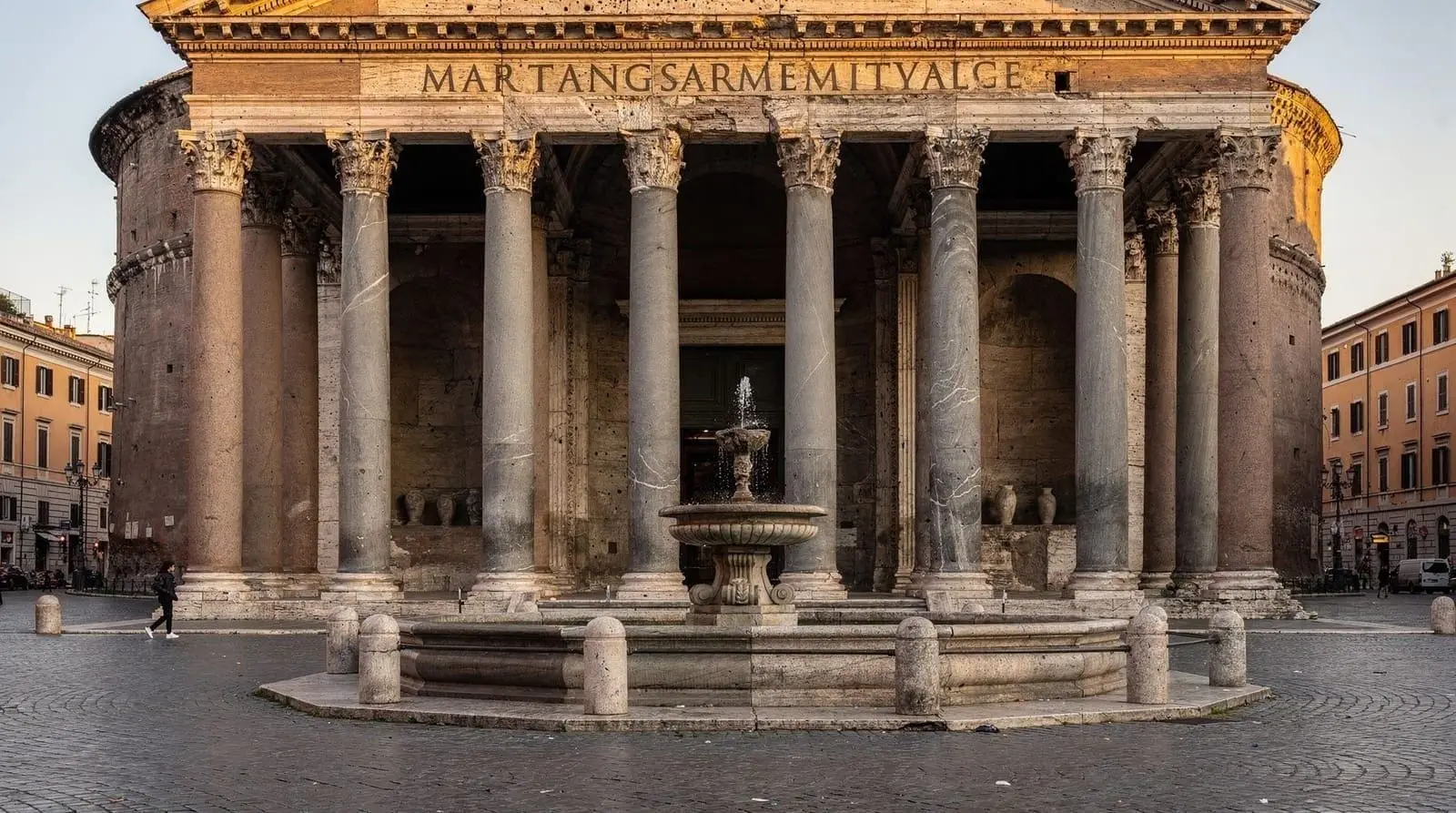
The current building is Hadrian’s work (approximately 118–125 CE), but the site has been a temple since Marcus Agrippa built the first Pantheon around 27 BCE. The inscription on the porch — M·AGRIPPA·L·F·COS·TERTIVM·FECIT (“Marcus Agrippa, son of Lucius, three times consul, made this”) — is Hadrian’s deliberate tribute to Agrippa rather than a claim of original construction. Hadrian regularly credited earlier emperors on his buildings.
In 609 CE, Byzantine Emperor Phocas gave the Pantheon to Pope Boniface IV, who converted it to a Christian church (Santa Maria ad Martyres). This conversion almost certainly saved it from the stone-stripping that destroyed most other ancient monuments in Rome. The church dedication still stands; Mass is held here.
The bronze doors (7 metres tall, original ancient Roman metalwork) are among the few ancient bronze elements that survive in Rome. The marble floor, the porphyry columns, and much of the interior marble cladding are ancient — though some surfaces have been replaced or restored over the centuries.
What to look at inside
The dome and oculus
The oculus — the 8.8-metre circular opening at the top of the dome — is the only light source in the Pantheon. No windows, no additional openings. The entire play of light inside is governed by this single aperture.
The light disc moves across the interior throughout the day, falling differently across the coffered dome surface depending on the time and season. At the spring equinox (around 21 March), the disc of light falls precisely on the entrance door at noon — almost certainly intentional. At noon on other dates, the light traces different paths across the walls and dome. The visual effect of watching this in real time — the dome’s geometry made visible by moving light — is the Pantheon’s deepest experience.
Do not spend your 30–45 minutes circling the walls. Sit on the marble bench, look up, and watch the light for at least 5–10 minutes.
The proportions
The Pantheon is a perfect sphere inscribed in a cylinder: the diameter of the dome (43.3 m) equals the interior height from floor to oculus. A sphere exactly 43.3 metres in diameter would fit precisely inside the building. This was intentional — a cosmological reference to the harmony of celestial spheres. The mathematical perfection is visible once you notice it: the hemisphere above, the equal distance below, the floor as the base of a sphere that the dome completes.
The tombs
Raphael’s tomb is in the third niche on the left as you enter (south wall). The Latin inscription reads: “Here lies that famous Raphael by whom Nature feared to be outdone while he lived, and when he died, feared she herself would die.” He died aged 37 in 1520. His fiancée Maria Bibbiena is buried beside him.
Vittorio Emanuele II (died 1878) and Umberto I (assassinated 1900) are in the two large royal tombs. The Italian monarchy still nominally assigns guards of honour here; this generates occasional ceremony on royal anniversaries.
The porch columns
The porch has 16 monolithic granite columns, each 12.5 metres high and approximately 1.5 metres in diameter — quarried in Egypt (Aswan grey granite and Mons Claudianus granite) and shipped to Rome. The scale of the Roman logistical operation required to move these is worth contemplating: no crane in the pre-industrial world could manage them without specialized engineering.
Tickets, booking and crowd management
Price: €5 adult + €2 online booking fee (total €7 if booked online). Free for EU citizens under 25. No free days.
Book in advance: Strongly recommended April–October. Walk-up queues regularly reach 45–60 minutes in peak season; the advance booking queue is typically under 10 minutes.
Book at: pantheonroma.com (official). Not through Google’s first sponsored results — check the URL carefully.
Opening hours: 9:00–19:00 Monday–Saturday; 9:00–18:00 Sunday; 9:00–13:00 on public holidays. Closed 25 December and 1 January. Mass times (roughly 9:00–10:30 on Sundays) restrict tourist access; arrive before or after.
Best visiting slot: 9:00–10:00 (first hour) or 16:00–18:00. Midday and early afternoon are peak crowd times. The Pantheon is small; 200 people inside simultaneously feels crowded.
The skip-the-line guided Pantheon tour includes entry ticket plus a licensed guide who explains the dome engineering and history — strongly recommended for first-time visitors who want context beyond the panels.What the Pantheon is not
The Pantheon is often called the “best-preserved ancient monument in Rome.” That is true. It is also a single room — there is nothing behind doors, no additional floors to visit, no permanent collection to wander through. The entire experience happens in one space.
First-timers sometimes feel vaguely cheated after 20 minutes, having expected the Colosseum’s multi-level complexity. The Pantheon rewards those who slow down and engage with the space on its own terms: proportions, light, materiality, mathematical intention. Rushed visitors carrying a list of things to see miss the point entirely.
If you have only 10 minutes to spare, it is still worth entering. If you have 45 minutes and you sit on the bench and let the dome’s geometry work on you, it becomes one of the most memorable rooms you have ever entered.
Visitors with children sometimes worry the Pantheon will be “too quiet” or “too art-historical” for younger travelers, but the oculus itself tends to be an immediate hit — a hole in the roof that lets rain fall on the marble floor below (small drainage channels handle this) is a concrete, visible detail that needs no art history background to appreciate. Point it out and let children watch the light disc move; it works as well for a seven-year-old as for an architecture student.
Common tourist traps near the Pantheon
The Piazza della Rotonda (the square in front of the Pantheon) is one of Rome’s most tourist-trap-dense areas. The restaurants and cafés immediately facing the Pantheon charge 2–3 times the going rate for coffee and gelato. Coperto (cover charge) up to €3 per person applies at most table-service restaurants here.
Do not eat immediately in front of the Pantheon. Walk one block in any direction for immediate price normalization. The streets north toward Piazza della Maddalena or east toward Piazza Navona have restaurants where locals still go.
The bracelet sellers around the square employ the same techniques as near the Trevi Fountain and Spanish Steps — approaching you with a “free gift” and then aggressively demanding payment. Decline, don’t make eye contact, keep walking.
Combining the Pantheon with the Centro Storico
The Pantheon sits in the Centro Storico, making it a natural combination with:
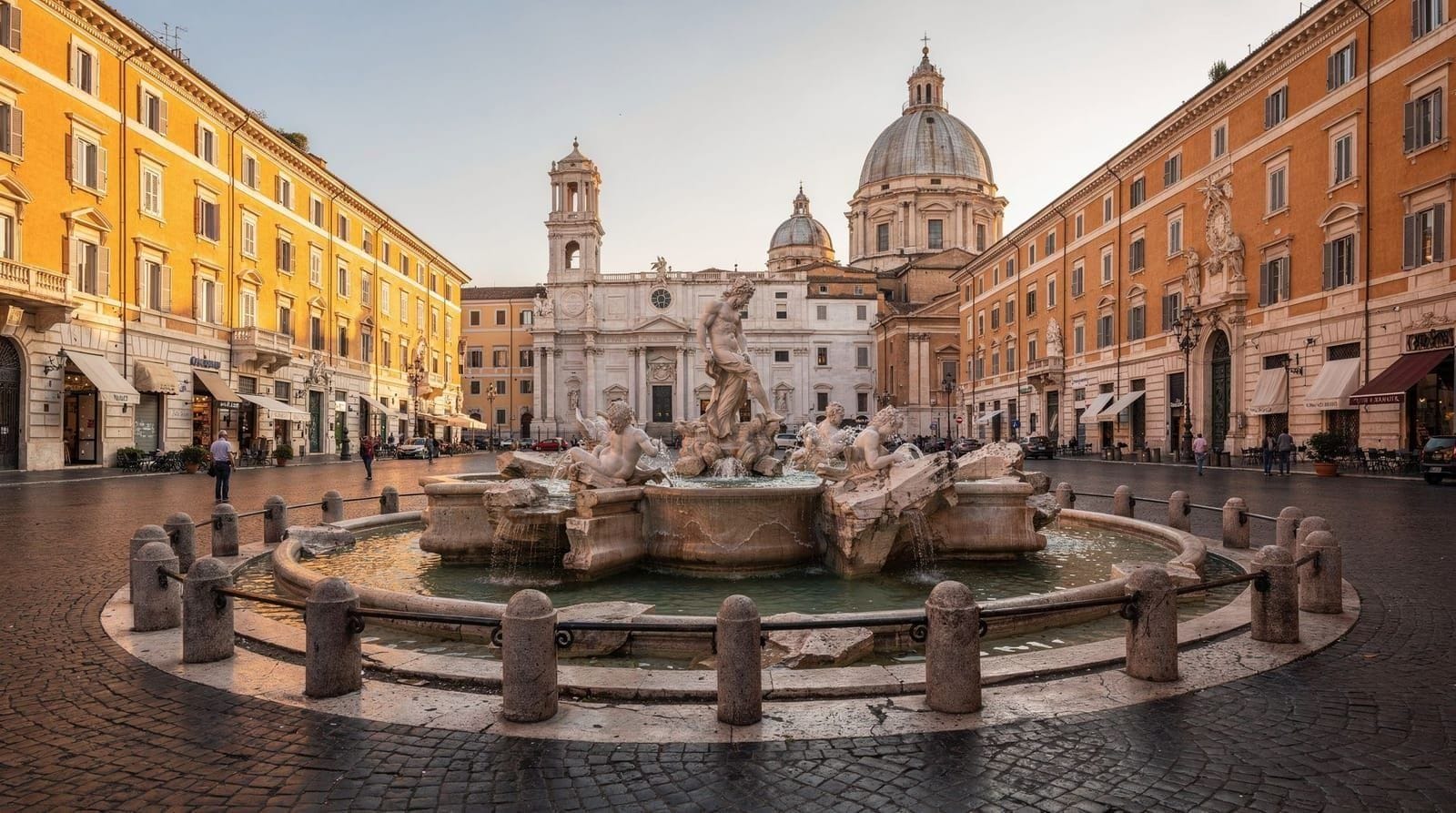
- Piazza Navona (5 minutes’ walk west): the city’s most theatrical baroque piazza. See our Piazza Navona guide.
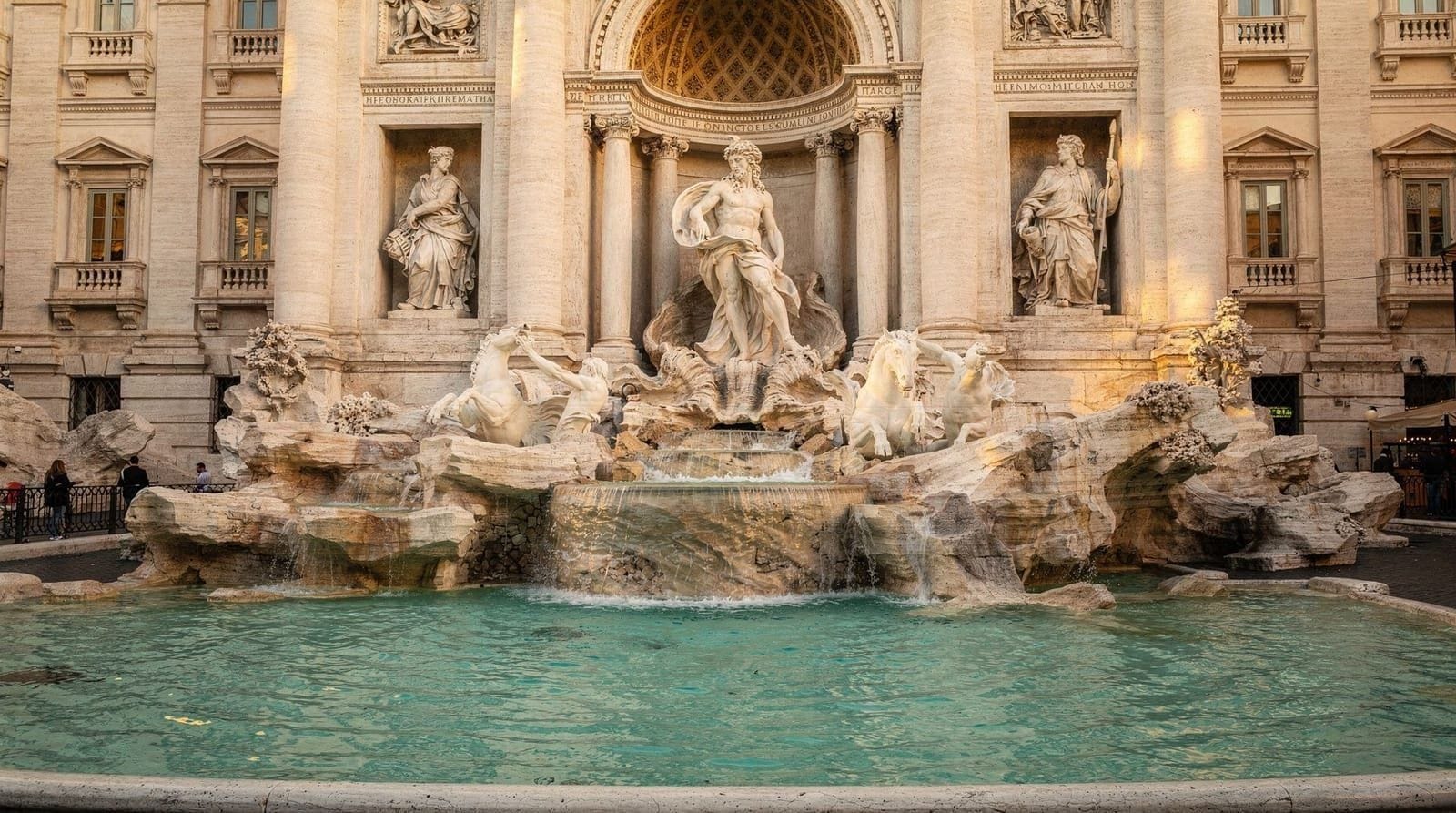
- Trevi Fountain (10 minutes’ walk east): best visited at dawn or late evening. See our Trevi Fountain guide.
- Campo de’ Fiori (8 minutes’ walk southwest): morning market, lively evening. See our Campo de’ Fiori guide.
For ancient Rome specifically, the Pantheon pairs naturally with the Colosseum and Forum as a same-day combination — though note they are 25 minutes apart on foot. See our ancient Rome in one day guide for the optimised route.
The Pantheon small group express tour — quick and informative, suitable when you want context but have limited time before moving to other Centro Storico sights.Frequently asked questions about the Pantheon
Can I attend Mass at the Pantheon?
Yes. Mass is held every Sunday at 10:30 (main Mass) and sometimes Saturday evening. During Mass, tourist entry is restricted or suspended — the Pantheon is an active church, not a museum during services. If you want to attend Mass in the Pantheon specifically, arrive early and sit toward the back; the ritual in this 2,000-year-old space is genuinely moving regardless of faith.
Why does the Pantheon say “AGRIPPA” when Hadrian built it?
Hadrian systematically credited earlier emperors and benefactors on buildings he rebuilt. The inscription is Hadrian’s tribute to the original Agrippa Pantheon on the same site. Hadrian also credited Augustus, Trajan and others on various buildings. Modern historians initially misattributed the Pantheon’s construction to Agrippa because of this inscription; it was only through brick stamps and detailed archaeological analysis that Hadrian’s authorship was confirmed.
Is there anything below the Pantheon floor?
There is a basement level beneath the current floor, not open to the public. The original Agrippa Pantheon’s foundations are incorporated. Archaeological investigations have revealed the earlier building’s layout differs from the current one — the earlier structure was oriented differently, facing south rather than north as it does today.
The Pantheon’s influence on Western architecture
No building in the world has been more imitated than the Pantheon. The combination of the domed rotunda with a columned porch — technically a contradiction (a circular interior space with a rectangular entrance element) — became the template for civic and religious prestige architecture across five centuries.
Direct descendants include:
- Hagia Sophia (Constantinople, 537 CE): the structural solution of a dome over a large circular space, extended to an enormous scale.
- Brunelleschi’s dome (Florence Cathedral, 1436): Brunelleschi studied the Pantheon’s concrete dome construction before designing his own ribbed solution.
- The Panthéon (Paris, 1790): its name is a direct tribute.
- US Capitol rotunda (Washington DC, 1800s): the coffered dome and central oculus are Pantheon-derived.
- Jefferson Memorial (Washington DC, 1943): the porch, the dome, the interior proportions — almost a direct copy.
- University of Virginia Rotunda (Jefferson’s design, 1826): explicitly modelled on the Pantheon, half-scale.
The influence spread through the Renaissance via Palladio’s “Four Books of Architecture” (1570), which included detailed measured drawings of the Pantheon. For 300 years, any architect wanting to demonstrate classical mastery would design a Pantheon-derived building.
The Pantheon and light: a scientific instrument
The relationship between the Pantheon’s geometry and light is more precise than casual visitors realize. The oculus functions as a gnomon — a shadow-casting element of a sundial — tracking the sun’s position across the dome surface.
On the summer solstice at noon, the disc of light enters the oculus and hits the curved floor of the entrance portico — the only flat area it reaches through the year. On the winter solstice at noon, the disc is on the upper dome surface. These solar events may have been intentional: the entrance orientation (north-facing, so the midday sun enters from the south) ensures maximum light penetration through the oculus precisely when visitors coming from the southern piazza would be walking in.
The equinox effect — the disc falling on the entrance door at noon around 21 March — is the most discussed. Whether it was designed or coincidental, the effect is real and reproducible. A beam of light falls directly on anyone entering the main door at noon on the equinox, illuminating them as they cross the threshold from darkness.
The Pantheon in the modern city: what surrounds it
The Piazza della Rotonda (Pantheon Square) and immediate surroundings contain:
Obelisk of Ramesses II on the central fountain (1711): A small ancient Egyptian obelisk, originally from Heliopolis, re-erected on Bernini’s elephant base (a smaller version of the famous Piazza della Minerva elephant just to the east, also Bernini).
Santa Maria sopra Minerva (5 minutes east): Rome’s only Gothic church interior (behind a Baroque façade), containing Michelangelo’s statue of “Christ Bearing the Cross” and Filippino Lippi’s frescoes. Free. See our Rome basilicas and Caravaggio guide for context.
Sant’Ignazio di Loyola (5 minutes north): Baroque church with an extraordinary trompe-l’oeil ceiling painting by Andrea Pozzo (1694) that creates an entirely convincing illusion of a dome that does not exist. Free. Worth 15 minutes.
The Pantheon neighbourhood is excellent for coffee and gelato — provided you walk one block away from the piazza itself. Via della Rotonda and Piazza della Rotonda command tourist prices; Via del Seminario, Via della Palombella, and the streets around Santa Maria sopra Minerva have multiple local bars and gelaterie at normal prices.
Sequencing the Pantheon into a wider Rome day
Because the Pantheon takes only 20–45 minutes, it rarely functions as a destination in its own right — the decision that actually matters is where it sits in a longer day. For visitors focused on ancient Rome, the Pantheon works best as an early-morning or late-afternoon bookend to the Colosseum, Roman Forum and Palatine Hill circuit rather than squeezed into the middle of it, since the two areas are a 25-minute walk apart and best treated as separate legs of the day. See our ancient Rome in one day guide for a full route that accounts for this.
For a broader first Rome trip, the Rome itinerary planning guide and Rome first-visit plan both treat the Pantheon as a Centro Storico anchor point, typically paired with Piazza Navona and the Trevi Fountain on a single relaxed afternoon rather than rushed between major ticketed sites. If you want the deeper historical throughline connecting the Pantheon to Rome’s broader architectural story, our Rome history guide covers how Hadrian’s building program fits into the wider arc of Imperial Rome, and the Capitoline Hill guide covers the civic counterpart a short walk away.
Does the Pantheon get more crowded on weekends?
Weekends see somewhat higher walk-up numbers, particularly Saturday afternoons, but the effect is smaller than at the Colosseum or Vatican because the advance-booking queue moves quickly regardless of day. Sunday mornings are the exception — Mass at 10:30 restricts tourist entry, so plan around it rather than arriving expecting normal access.
Top experiences
Bookable activities with verified prices and instant confirmation on GetYourGuide.