Underground Rome: catacombs, crypts and buried churches
Rome: Catacombs Skip-the-Line Tour in English
What is underground Rome and which sites can I visit?
Underground Rome includes early Christian catacombs on the Appian Way (St. Callixtus, St. Sebastian, Domitilla), the Capuchin Crypt on Via Veneto, the three-level Basilica of San Clemente with its mithraeum, Domus Romane at Palazzo Valentini, and several other buried churches and pagan temples. All are guided-only or semi-guided. Dress in layers — it is a constant 15°C underground year-round.
What lies beneath the Eternal City
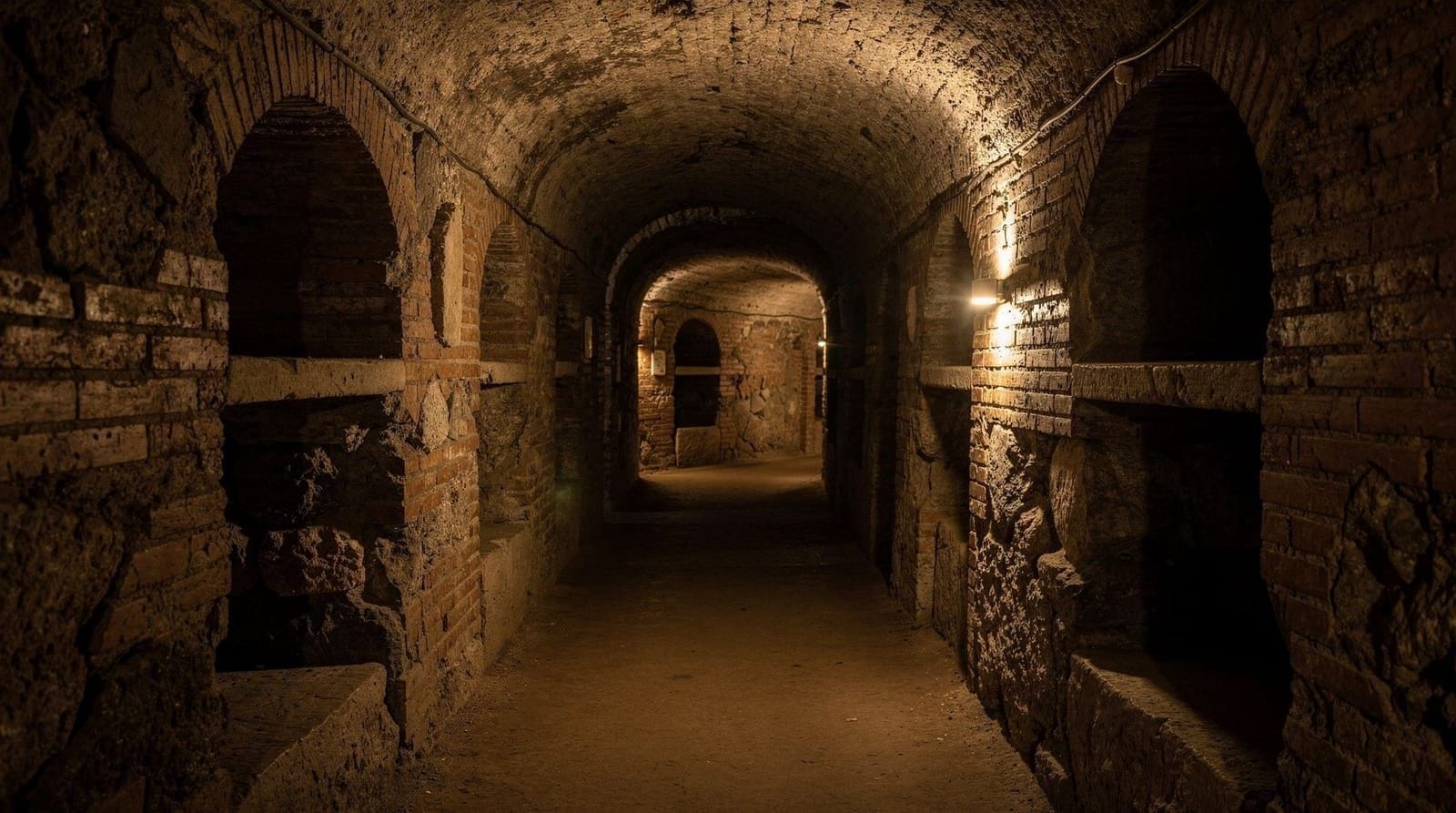
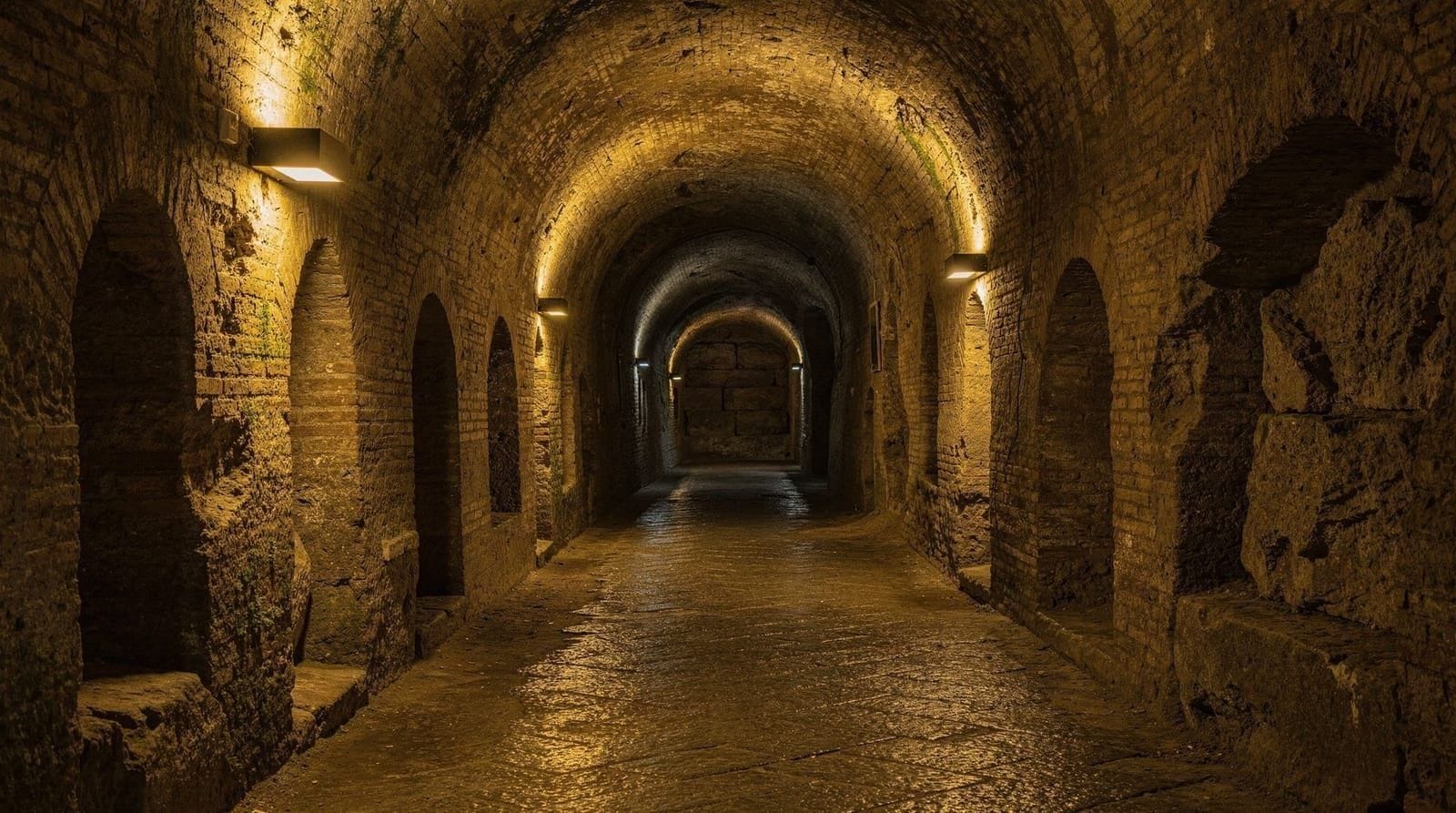
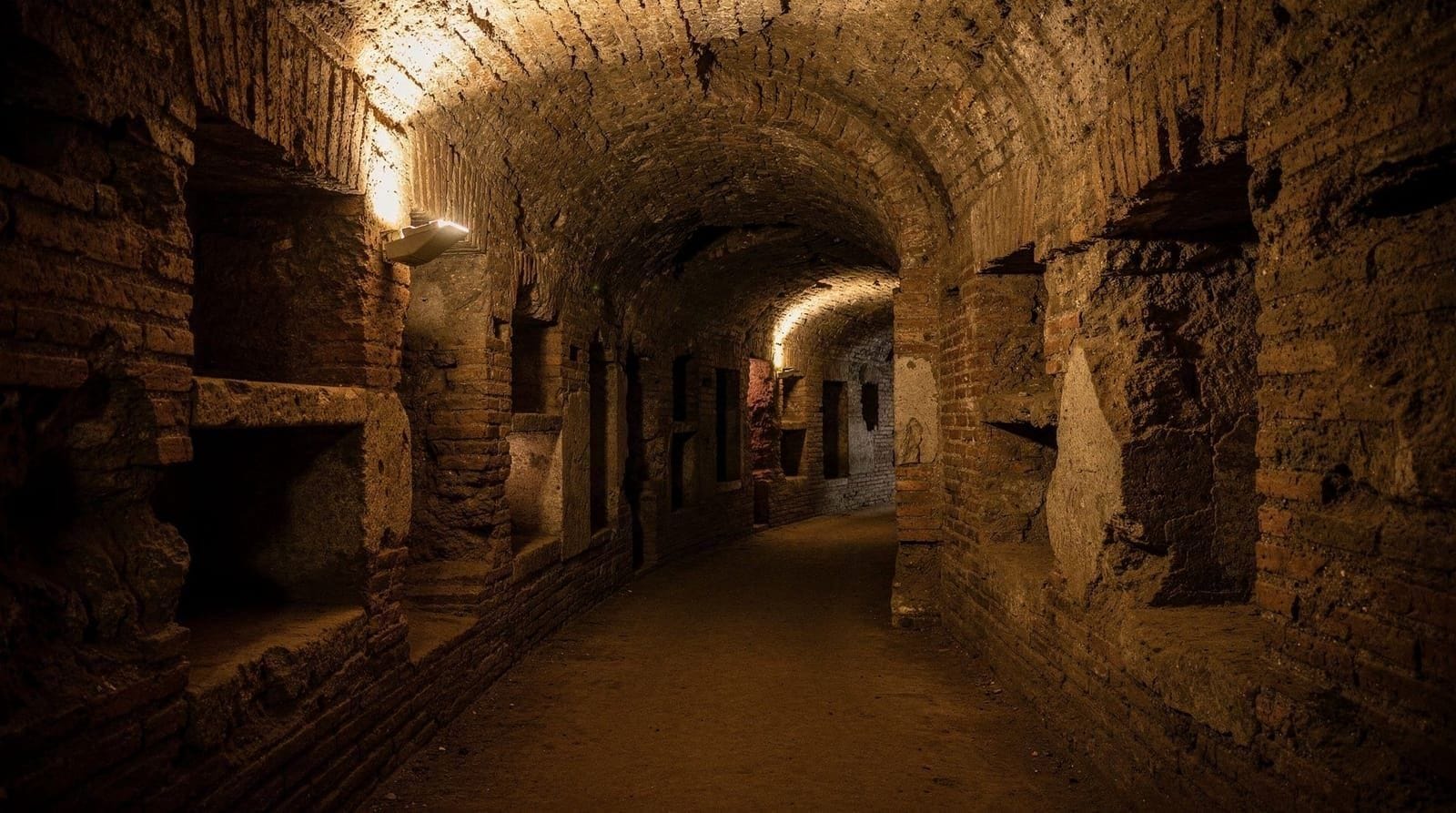
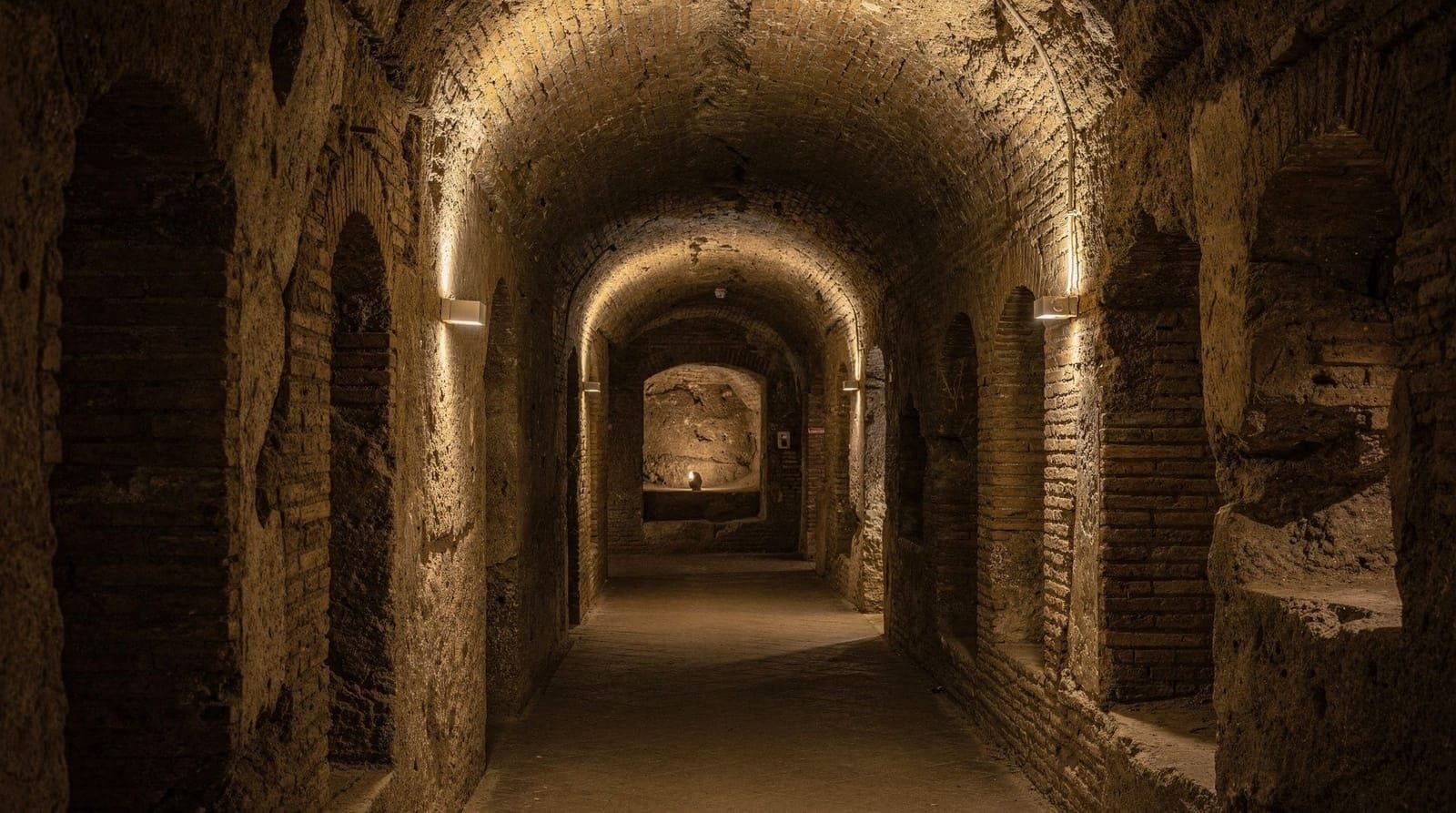
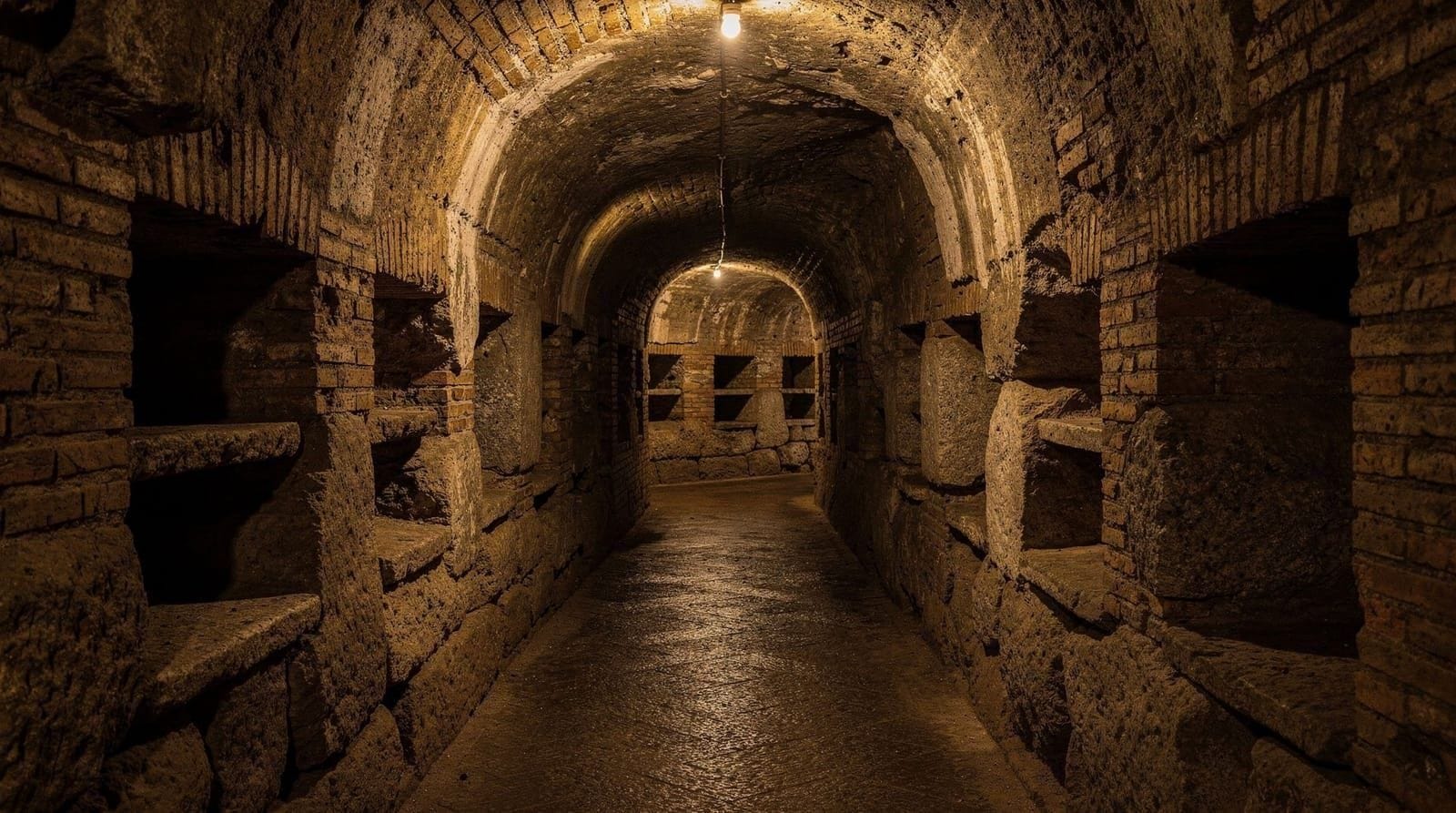
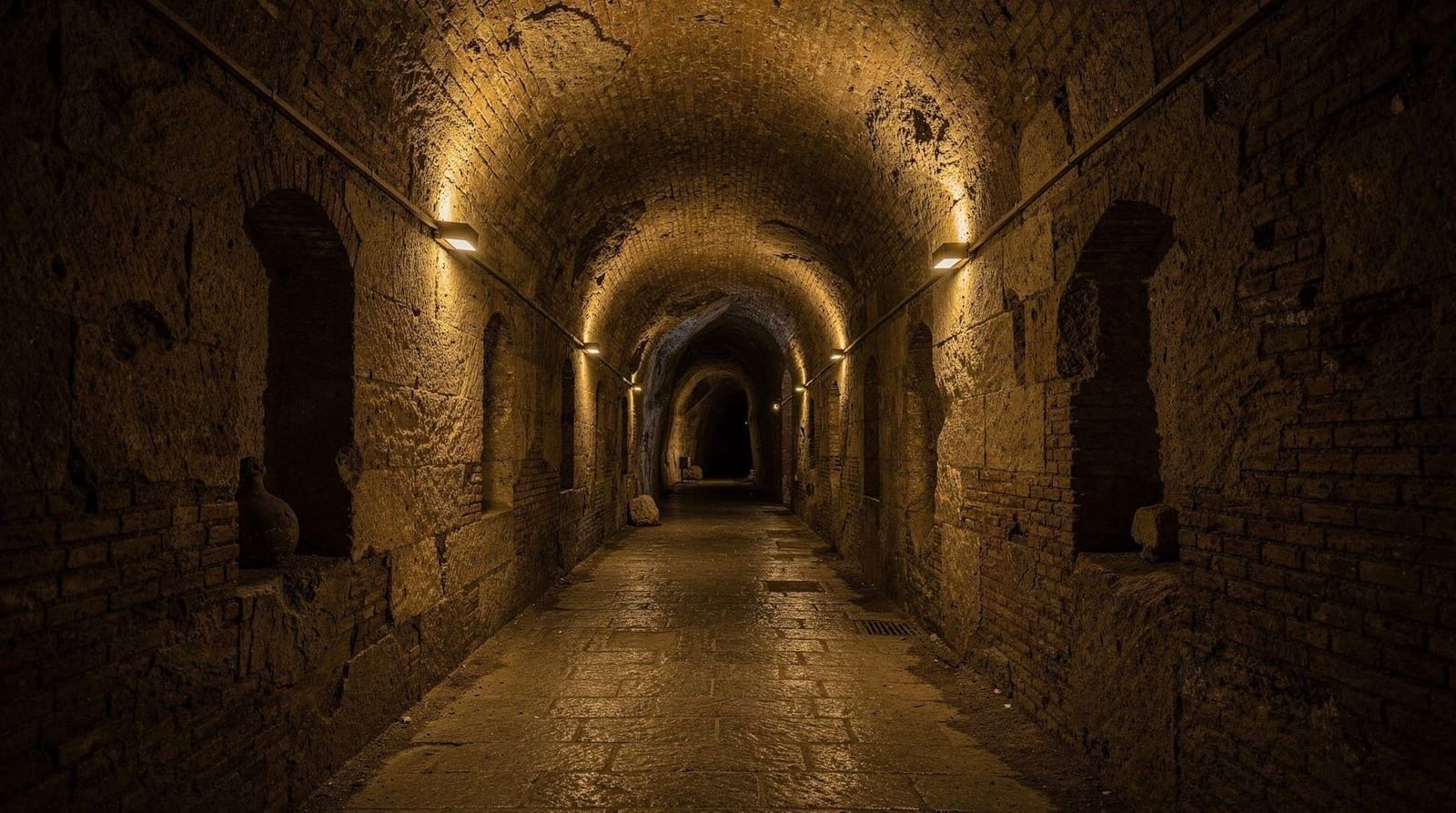
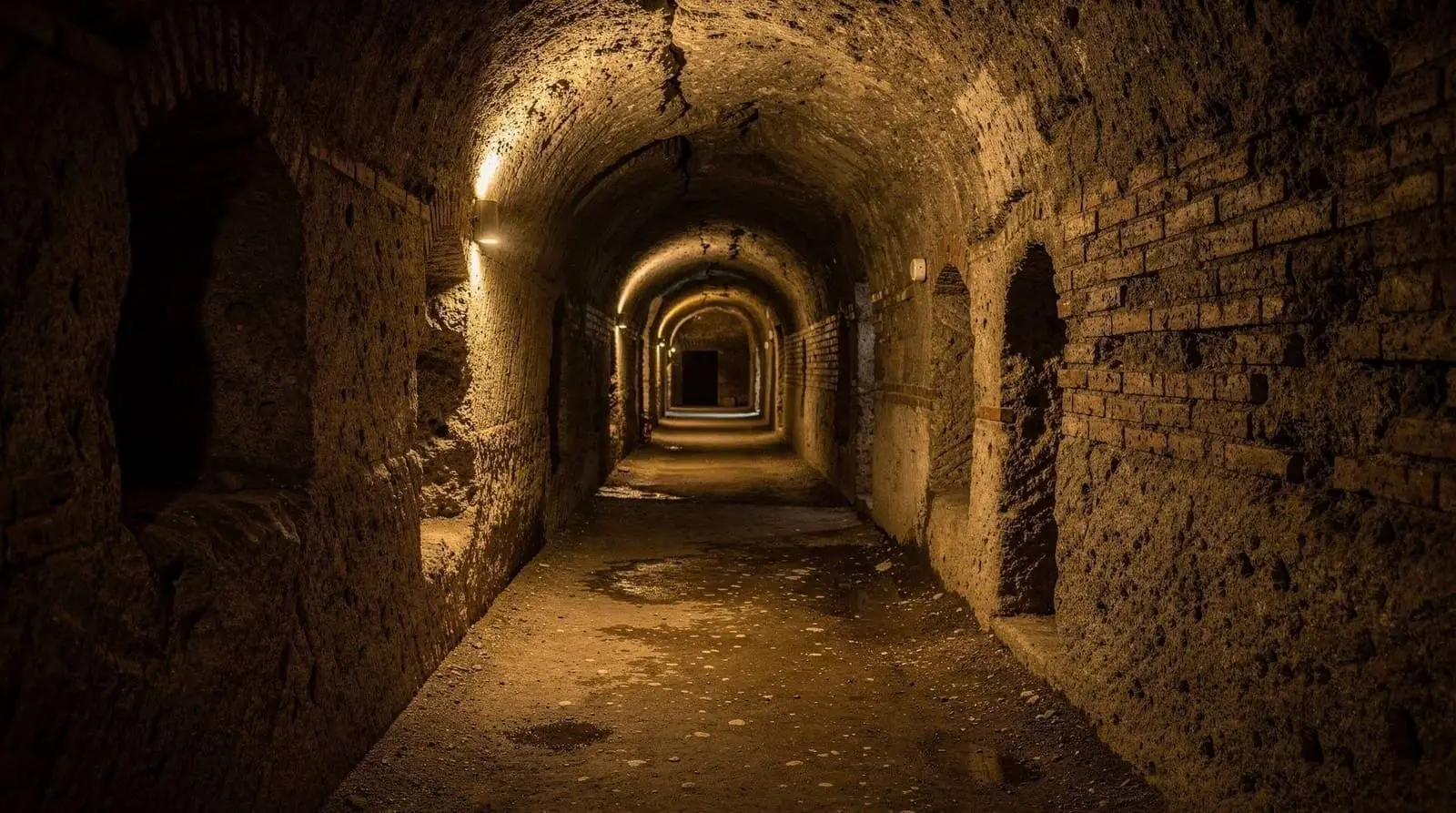
Rome has always been built on top of itself. The street-level city you walk is the fifth or sixth skin of a place continuously inhabited for nearly three thousand years. Below the cobblestones: Roman republican-era foundations, imperial-era domestic structures, early Christian prayer rooms, pagan temples converted and buried, and — extending for dozens of kilometres beneath the Appian Way — the catacombs.
Underground Rome is not a metaphor. It is a literal, accessible network of sites that tells the story of the city’s religious and cultural transitions in ways that no surface monument can match. This guide covers the major sites, explains what makes each one distinctive, and gives you the practical information to visit them confidently.
A note before you begin: all underground sites require warm layers regardless of season. The catacombs and most buried structures maintain a constant temperature of approximately 15°C. In summer, when the surface bakes at 35°C, this feels like walking into a refrigerator. Bring a light jacket.
| Temperature underground | Constant ~15°C (59°F) year-round |
| Booking | Rarely needed for catacombs; mandatory for Palazzo Valentini |
| Cost | €10 (catacombs) to €18 (Domus Aurea, guided only) |
| Photography | Prohibited in catacombs and Capuchin Crypt |
| Best combined with | A walk on the Appian Way itself |
The catacombs of the Appian Way
The city’s most visited underground sites are clustered along the Via Appia Antica — the ancient road stretching southeast from the Porta San Sebastiano gate. Roman law forbade burial within the city’s sacred boundary (the pomerium), so from the 2nd century CE onward, communities established their necropolises along the roads leading out of Rome.
The early Christian community was not alone in this practice — Jewish catacombs exist on the same road, and pagan families used similar underground burial corridors — but the Christian catacombs are the largest and most extensively documented.
Catacombs of St. Callixtus
The Catacombs of St. Callixtus are the most significant and most visited of Rome’s catacomb complexes. Established around 200 CE under the governance of the deacon Callixtus (later Pope St. Callixtus I), they became the official cemetery of the Roman bishop — in practice, the burial site for a significant portion of Rome’s early Church leadership.
The complex extends over approximately 20 kilometres of tunnels on multiple levels, reaching up to 20 metres below the surface in the deepest sections. The highlight of any tour is the Crypt of the Popes: a gallery where nine popes were buried in the 3rd century CE. The original inscriptions in Greek (the language of early Roman Christianity) are still readable in several cases. The adjacent crypt of Santa Cecilia — the martyred patron of music — has a copy of Stefano Maderno’s famous reclining sculpture of the saint (the original is in the Basilica of Santa Cecilia in Trastevere).
Tours run in groups of approximately 20-25 people and last 30-45 minutes, following guides through a set route that covers the major galleries. Tours depart continuously in multiple languages. The site is closed on Wednesdays.
For a focused guide to choosing between the different catacomb complexes, see the catacombs of Rome guide.
Catacombs of St. Sebastian
The Catacombs of St. Sebastian are significant for a specific historical reason: for a period during the 3rd century, the remains of both St. Peter and St. Paul were temporarily stored here before being moved to their current basilicas. A large graffiti inscription from the period (visible on tour) invokes the two apostles together — physical evidence of this exceptional circumstance.
The site includes a well-preserved mausoleum from the pre-Christian period and early fresco paintings. The adjacent 4th-century Basilica of San Sebastiano above ground is one of the seven pilgrimage churches of Rome. The catacombs are closed on Sundays.
Catacombs of Domitilla
The Domitilla catacombs are the largest in Rome — approximately 17 kilometres of tunnels — and contain some of the best-preserved fresco decorations of any catacomb complex. The entry is through an early Christian basilica built over the tomb of the martyrs Nereus and Achilleus in the 4th century, which gives the visit a distinct architectural character absent from the other sites.
One standout fresco here is the earliest known representation of the Good Shepherd as a youthful figure rather than an older bearded man — an important moment in the development of Christian iconography. The Domitilla catacombs are closed on Tuesdays.
Skip-the-line English-language guided tour of the Rome catacombs — includes entrance and expert commentary on the early Christian period.Choosing between the three Appian Way catacombs
| Catacomb | Length | Closed | Standout feature |
|---|---|---|---|
| St. Callixtus | ~20 km | Wednesdays | Crypt of the Popes, best English tours |
| St. Sebastian | Smaller network | Sundays | Peter and Paul relic history, pre-Christian mausoleum |
| Domitilla | ~17 km | Tuesdays | Best-preserved frescoes, earliest Good Shepherd image |
Most first-time visitors should choose St. Callixtus for its combination of historical significance, well-preserved highlights and reliably professional English-language tours. Visitors with a specific interest in early Christian fresco art should prioritise Domitilla instead. If your visit falls on a Wednesday, when St. Callixtus is closed, St. Sebastian or Domitilla make an equally worthwhile substitute.
The Capuchin Crypt: bones as architecture
A ten-minute walk from the Barberini metro stop, the Capuchin Crypt occupies the lower level of the Church of Santa Maria della Concezione dei Cappuccini on Via Veneto. It is nothing like the catacombs.
Between 1631 and 1870, the bones of approximately 3,700 Capuchin friars were arranged by fellow monks into six small chapels. The arrangement is elaborate and deliberate — pelvises form arch frames, vertebrae create rosette patterns, leg bones make chandeliers. Whole skeletal remains of friars in robes stand in several of the chapels. A Capuchin burial legend holds that the soil in the crypts was brought from Jerusalem.
The experience is designed to prompt contemplation of mortality — the Capuchin tradition of memento mori (“remember you must die”) is explicitly theological. A placard attributed to the friars reads: “What you are now, we once were; what we are now, you shall be.”
Photography is strictly prohibited inside the bone chapels. The Crypt is open daily and requires no advance booking for individual visitors, though it can get crowded on weekend afternoons.
For a full account of the Capuchin Crypt, including its theological context and practical visiting information, see the Capuchin Crypt guide.
San Clemente: three cities in one building
The Basilica of San Clemente in the Celio neighbourhood stands as one of the most extraordinary archaeological sites in Rome — not because of its underground alone, but because the building is itself a cross-section of the city’s religious history across 2,000 years.
At street level is the 12th-century basilica, with exceptionally beautiful Cosmatesque floor mosaics and a triumphal arch mosaic depicting the Tree of Life. Descend through a door beside the nave and you reach the 4th-century basilica — partially intact, with frescoes depicting the life of St. Clement and a legend of the Slavic missionaries Cyril and Methodius. Descend further into a corridor of Roman-era construction and you reach a functioning mithraeum: a cult room of Mithras, the Persian mystery deity popular among Roman soldiers in the 2nd and 3rd centuries CE.
The mithraeum at San Clemente is one of the best-preserved in Rome. The central stone couch (triclinium) used for ritual meals is intact, and a carved relief of Mithras slaying the bull — the central image of Mithraic iconography — is clearly visible. Running water can be heard in the lowest tunnels — one of the ancient drainage channels of Rome, still carrying water.
The layers here are not metaphorical: you can physically walk from medieval Christianity down through early Christianity and into pre-Christian Rome in the course of a fifteen-minute descent.
See the full San Clemente underground guide for detailed visiting information.
Domus Romane at Palazzo Valentini
Beneath the Palazzo Valentini near Trajan’s Column, archaeologists excavating in 2007 discovered an extraordinary complex of Roman patrician houses (domus) dating from the 1st to the 4th centuries CE. The site has been transformed into a multimedia experience that reconstructs the rooms in projected light and sound while you walk above them on glass walkways.
The technology is more sophisticated than it sounds. The projection system recreates mosaic floors, painted walls, and furnishings across the original foundations, allowing visitors to see what the houses looked like in their inhabited state. A section of the original baths — with intact floor and wall decoration — is among the best-preserved domestic Roman interiors in the city.
Palazzo Valentini is a significant departure from the atmosphere of the catacombs — it is purpose-built as a modern visitor experience rather than a primarily archaeological or spiritual site. That is not a criticism; for visitors who want to understand how wealthy Romans actually lived, it is more immediately legible than most open archaeological sites.
Advance booking is required for Palazzo Valentini. See the full Domus Romane guide.
Catacombs and Capuchin Crypt guided tour with transfer — covers two of the most distinctive underground sites in a single half-day excursion.Mithraeum sites across Rome
The cult of Mithras — imported from Persia, popular with Roman soldiers, intensely secretive, and eventually suppressed by Christianity — left dozens of underground temples across Rome. Most are inaccessible to the public or visible only by appointment. Several, however, can be visited.
Beyond San Clemente, the most significant accessible mithraeum is beneath the Circus Maximus area. The Mithraeum of Circus Maximus is one of the largest known, with a well-preserved triclinium and fresco fragments. The Mithraeum at Baths of Caracalla is reached via the underground tour of that complex.
For a full account of Rome’s mithraeum sites, see mithraeum sites in Rome.
Underground beneath the piazzas: Navona and Trevi
The historic centre also has underground layers. Beneath Piazza Navona, the Stadium of Domitian is preserved several metres below modern street level — the piazza above traces the exact elliptical shape of the stadium built around 85 CE. A section is accessible from inside the buildings on the south side of the piazza.
Beneath the streets near the Trevi Fountain, the Virgin Aqueduct (Aqua Virgo) runs — the ancient Roman channel still supplying the fountain with water after 2,000 years. One short stretch of the ancient conduit can be visited as part of a tour.
For these sites together, see the guide to underground Rome tours compared, which covers which combinations make practical sense for a single day.
Practical planning: logistics for underground Rome
Transport to the Appian Way catacombs
The Via Appia Antica catacombs are not easily reached by public transport. Options:
- Bus 118 from Circo Massimo metro (Line B): reaches the Via Appia area but service is infrequent. Journey 25-35 minutes.
- Taxi or rideshare: approximately 15-20 EUR from the centre one-way. Not metered for the return journey on the Appian Way — agree on a price in advance.
- Guided tour with transfer: typically includes hotel pickup or central departure and transport both ways. The most practical option if you are visiting the catacombs alone without a full Appian Way itinerary.
- Bicycle or e-bike: the Appian Way is car-free on Sundays. An Appian Way e-bike tour can combine the catacombs with the aqueduct park in a half-day.
The Capuchin Crypt requires no special transport — it is 5 minutes’ walk from Barberini metro (Line A).
San Clemente is in Celio, 10 minutes’ walk from the Colosseum.
Combining underground sites
Half-day combination (catacombs only): St. Callixtus plus a walk along the Appian Way to the tomb of Cecilia Metella. Allow 3 hours including transport.
Full-day underground Rome: Morning catacombs on the Appian Way (2 hours including transport), early afternoon Capuchin Crypt (45 minutes), late afternoon San Clemente (1 hour). Feasible but demanding.
Two-day underground focus: Day 1: Appian Way catacombs + Palazzo Valentini. Day 2: San Clemente + Capuchin Crypt + optional Circus Maximus mithraeum.
After-hours crypts and catacombs tour with the Bone Chapel — an evening visit when the sites are quieter and the atmosphere is markedly different from daytime.What makes underground Rome different from other archaeological sites
Most Roman archaeological sites present the city’s public face: triumphal arches, temples, amphitheatres, civic spaces built for display. Underground Rome reveals the private, the domestic, the spiritual, and the counter-cultural.
The catacombs are where a minority religion buried its dead in secret — not the official version of Rome but the version that eventually replaced it. The mithraeum is where soldiers and merchants gathered for rituals so secret that we still don’t fully understand them, hidden under everyday buildings. The Domus Romane shows how wealthy families actually lived, behind the public colonnades. San Clemente shows in physical form what the history of religion in Rome actually looks like: layer upon layer, each generation building directly on what came before.
For first-time visitors, the surface Rome — Colosseum, Vatican, Trevi — is essential and spectacular. The underground version is where the city becomes genuinely strange and genuinely human in a different way.
The Appian Way and the surrounding area provides the best context for understanding why this road, above all others, became Rome’s principal necropolis. Walking part of the road itself — the stones worn by two millennia of traffic, flanked by tomb monuments visible from the road — gives the catacomb visits a physical and historical grounding that the sites alone cannot provide.
For itinerary planning including underground sites, see the ancient Rome in one day guide and the Rome itinerary planning guide.
Frequently asked questions about Underground Rome: catacombs, crypts and buried churches
Are the catacombs open every day?
Can I take photos inside the catacombs?
How cold is it underground in Rome?
Are children allowed in the catacombs?
Do I need to book in advance for the catacombs?
What is the difference between the catacombs and the Capuchin Crypt?
What is the best underground site in Rome for a first visit?
Can I visit underground Rome in summer?
Top experiences
Bookable activities with verified prices and instant confirmation on GetYourGuide.