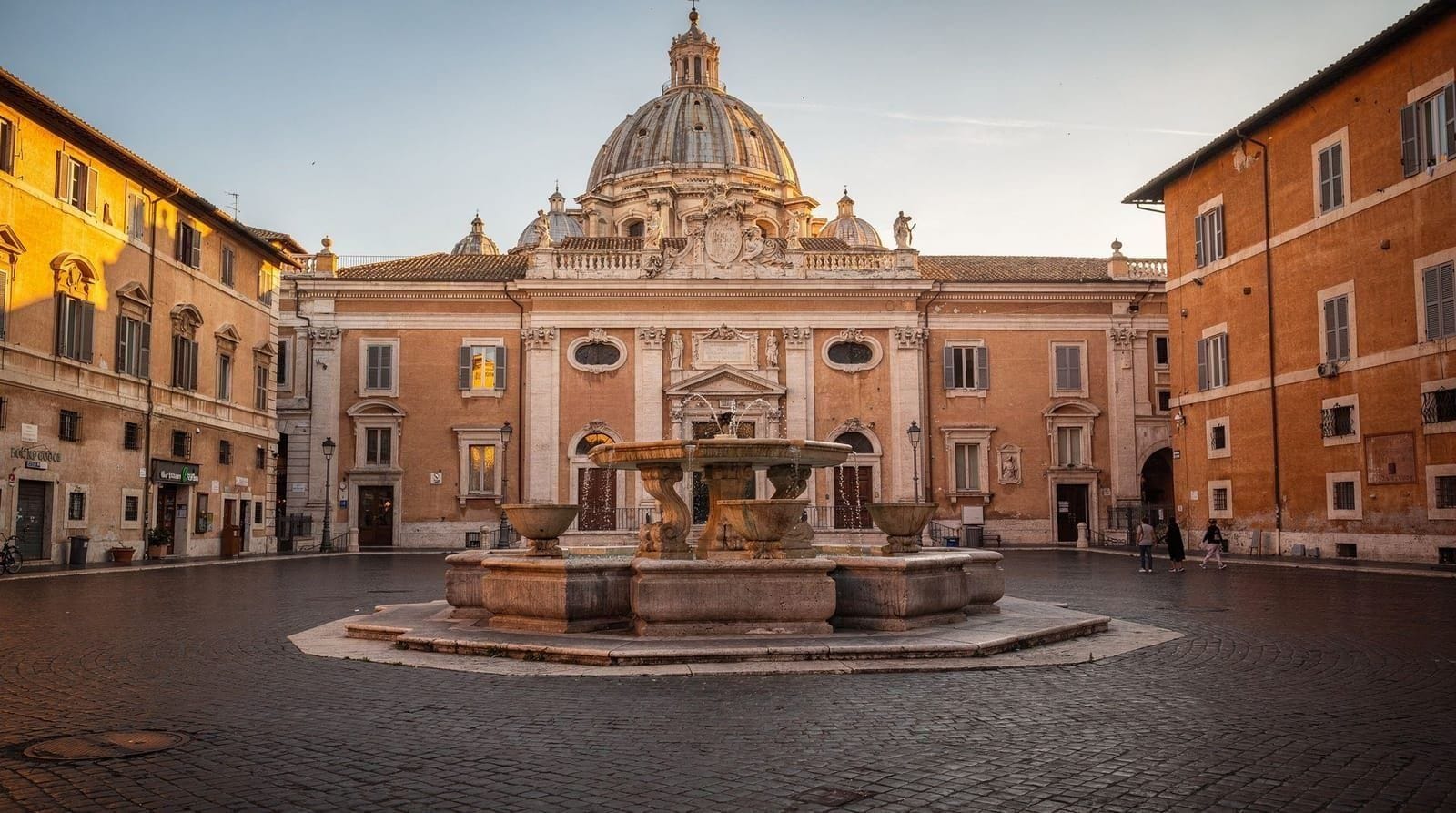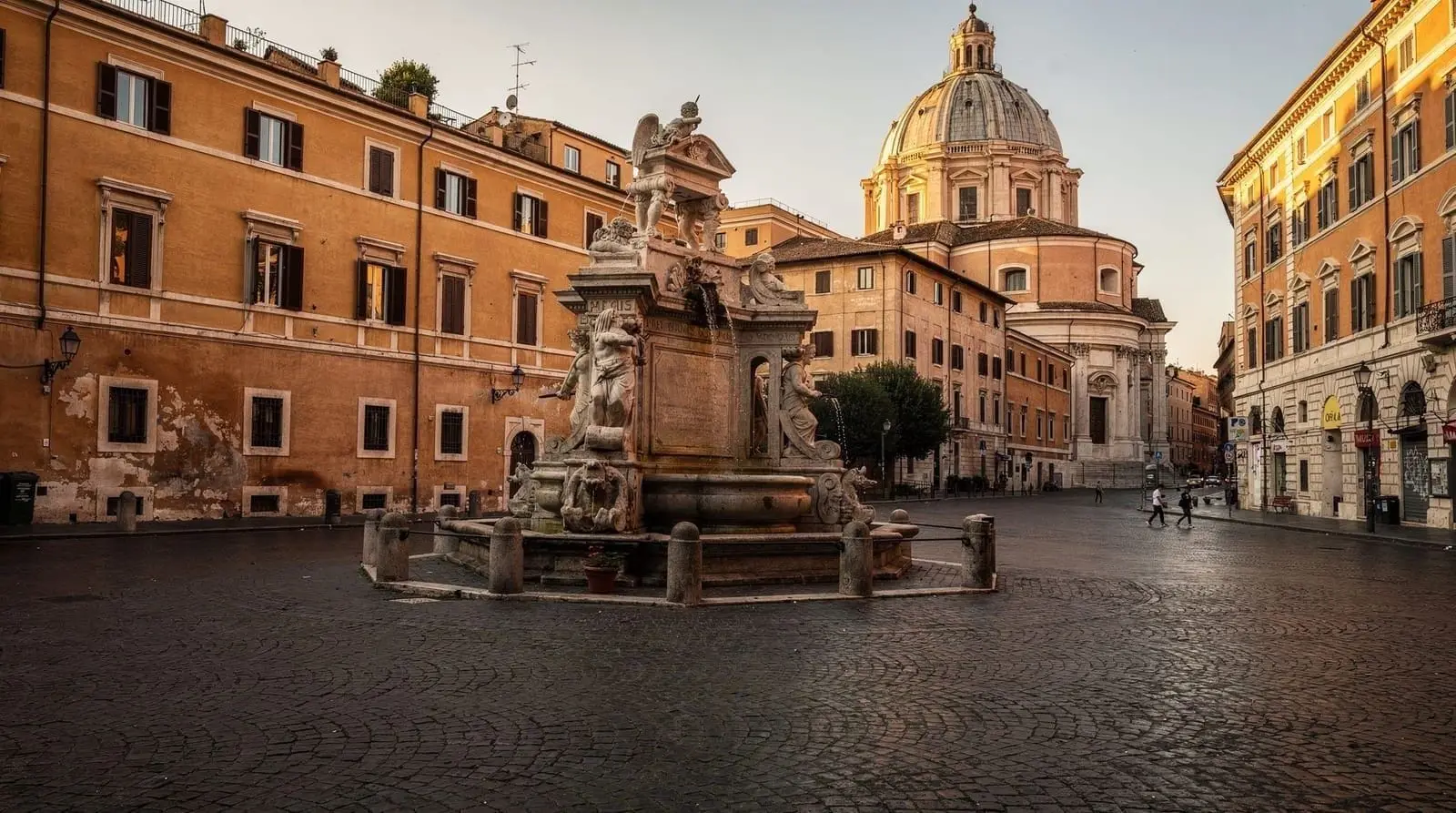
Rome's fountains trail: a self-guided walk through the city's water
Trevi, Pantheon & Spanish Steps Guided English Walking Tour
What is the best walking route to see Rome's fountains?
Start at Piazza del Popolo (Fontana dei Leoni), walk south through the Pantheon quarter (Fontana del Pantheon, Piazza della Minerva elephant), detour to Piazza Navona (Fountain of the Four Rivers), then to Piazza Barberini (Fontana del Tritone), and finish at the Trevi Fountain. This route takes about 3 hours at a steady pace and connects the major baroque and Renaissance fountains of central Rome.
| Route length | 6 km, 3–4 hours at a steady pace |
| Start / finish | Piazza del Popolo → Trevi Fountain |
| Cost | Free — the walk itself has no admission |
| Best time | Early morning (before crowds) or after dark (illuminated) |
| Hydration | Nasoni (free drinking fountains) every 100m or so |
Rome: the city that never ran dry
No city in Europe has Rome’s relationship with water. From the time of the Republic, Rome’s emperors and later its popes understood that abundant public water was both an engineering achievement and a political statement — proof of authority, generosity and civilization. The aqueduct system that supplied ancient Rome was the greatest infrastructure project of the ancient world. Three of those systems, in modified form, still supply the city’s ornamental fountains today.
Walking Rome’s fountains is not just sightseeing. It is a walk through two thousand years of hydraulic engineering, political patronage, and the baroque idea that water could be made into sculpture.
This guide gives you a practical self-guided route through the major fountains of central Rome, with the information you need to understand what you are looking at rather than just photographing it.
The water system: a brief primer
Before the route, the context:
The ancient aqueducts brought water from springs in the Alban Hills and the Apennines, sometimes from over 80 kilometres away, using gravity alone through precisely graded channels. At peak operation, Rome had eleven major aqueducts delivering approximately 1 million cubic metres of water daily to a city of 1 million people — the highest per-capita urban water supply in history until the 20th century.
The key aqueduct for the fountains trail is the Acqua Vergine, built by Agrippa in 19 BCE and named for a girl who, according to legend, led soldiers to a spring 13 kilometres east of Rome. The aqueduct runs underground at low gradient, arriving at the city center with only 4 metres of effective head pressure. This constraint shaped the design of every fountain it supplies — no upward jets are possible, so the Trevi, the Barcaccia, the Pantheon fountain and others all use cascades, overflows and sheet water rather than powered sprays.
The papal aqueducts from the 16th and 17th centuries — Acqua Felice (Sixtus V, 1588) and Acqua Paola (Paul V, 1612) — added new supply lines serving different parts of the city. The Acqua Paola at higher pressure supplies the large fountain on the Janiculum; the Acqua Felice supplies the Quattro Fontane and the Moses Fountain.
The nasoni: Approximately 2,500 small iron fountains throughout Rome, running continuously. The name means “big noses” — a reference to the curved iron spout. Free, clean, cold, and one of Rome’s genuine gifts to visitors. Use them constantly.
The route: full day walk (approximately 6 kilometres, 3–4 hours)
Stop 1: Piazza del Popolo — Fontana dei Leoni (0.0 km)
Start at Rome’s northern gateway piazza. The Egyptian obelisk at the center (from Heliopolis, the oldest in Rome, re-erected here by Sixtus V in 1589) is surrounded by the Fontana dei Leoni — four lion sculptures designed by Giuseppe Valadier in 1822, each spouting water at the four cardinal points.
The lions are bronze, modest in scale, and charming rather than impressive. Their value is contextual: they anchor a piazza designed as the formal entry to Rome from the north, and the combination of the obelisk, the twin baroque churches to the south, and the Fontana dei Leoni creates an ensemble that is more than any of its parts.
What to look for: The two churches are not identical despite appearing so from the piazza — look at the dome drums and you will see the differences Bernini and Carlo Rainaldi introduced to make the buildings appear symmetrical on an actually asymmetrical street plan. This is baroque urban design — managed illusion at city scale.
Walk south along Via del Corso or the parallel Via del Babuino toward the Pantheon quarter. The Via del Babuino route (slightly west) passes the namesake “ugly” Silenus fountain that gives the street its name (il babuino, meaning baboon, was Roman street slang for the worn marble Silenus statue at the street’s north end — one of Rome’s five “talking statues” to which anonymous satirical notes were historically attached).
Stop 2: Piazza della Rotonda — Fontana del Pantheon (1.8 km)
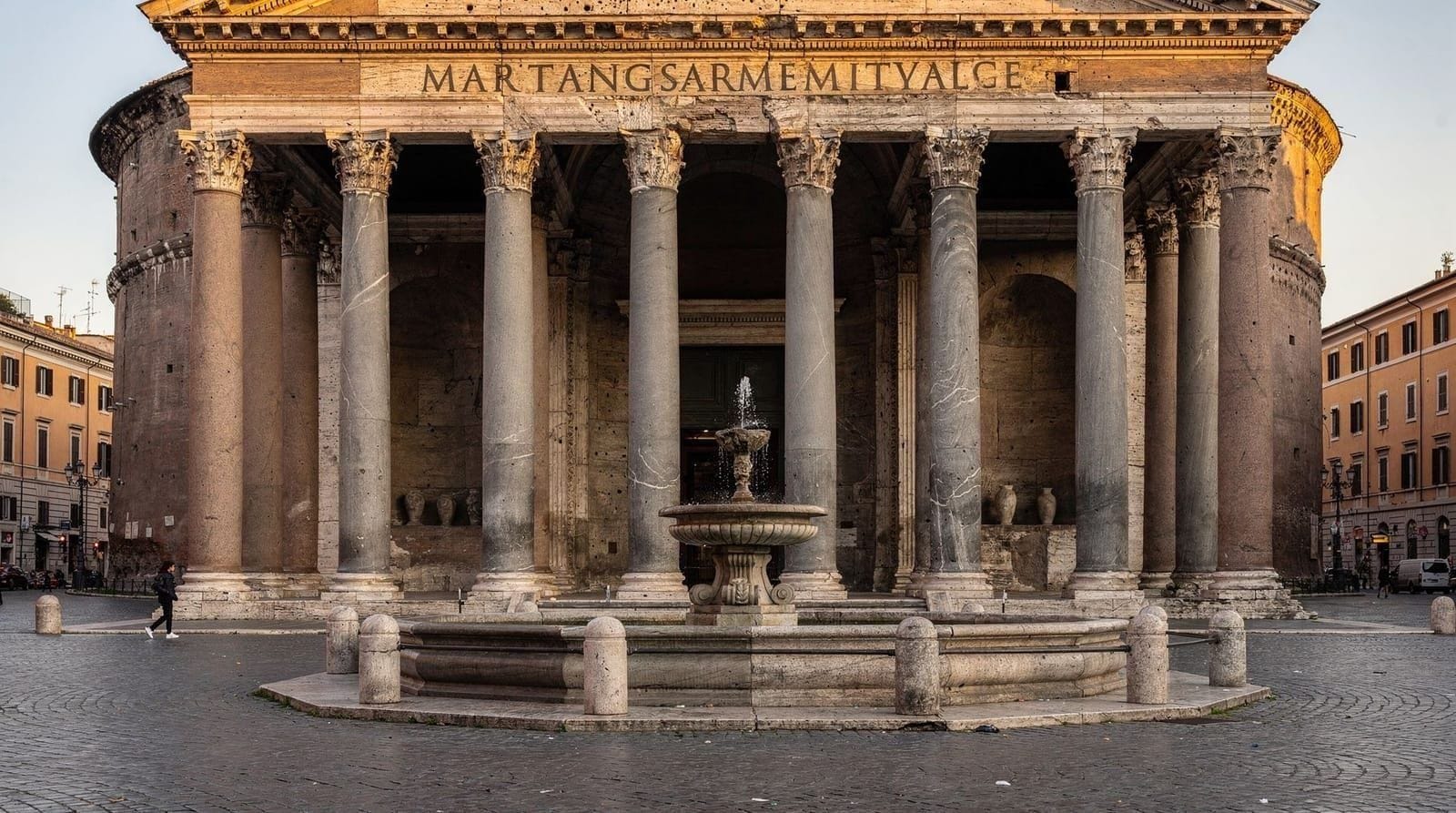
The Fontana del Pantheon was installed in 1575 and redesigned by Giacomo della Porta. The Egyptian obelisk at the top was added in 1711 under Pope Clement XI — one of several obelisks placed on fountain compositions by the baroque popes. The basin is circular travertine; four dolphins support the column; the composition is understated but elegant.
What to look for: The relationship between the fountain and the Pantheon portico behind it. From the correct angle — slightly off-center to the right — the obelisk tip and the Pantheon tympanum align in a composed visual axis. Probably coincidental; unmistakably effective.
The Pantheon now requires entry (€5, timed). See our full Pantheon guide for what is inside.
Stop 3: Piazza della Minerva — Elephant Obelisk (2.1 km)
Fifty metres south of the Pantheon, the smallest and most charming of Bernini’s fountain commissions: a marble elephant (1667) supporting an Egyptian obelisk on its back. The elephant was carved by Ercole Ferrata from a Bernini design; the obelisk is 5th-century BCE, originally from the temple of Isis in Rome’s ancient Egyptian cult district.
The elephant’s expression: Look at the face directly. Bernini gave it an expression of mild, resigned good humor — slightly downcast eyes, a suggestion of a smile. It is one of the most humanized animal sculptures in Rome, and the contrast with the gravity of the ancient monument it carries is deliberate.
The church of Santa Maria sopra Minerva, immediately behind, is Rome’s only Gothic church and contains Michelangelo’s Christ Bearing the Cross (1521) as well as important Caravaggio-era paintings. It is free and usually quiet.
Stop 4: Piazza Navona — Fountain of the Four Rivers (2.4 km)
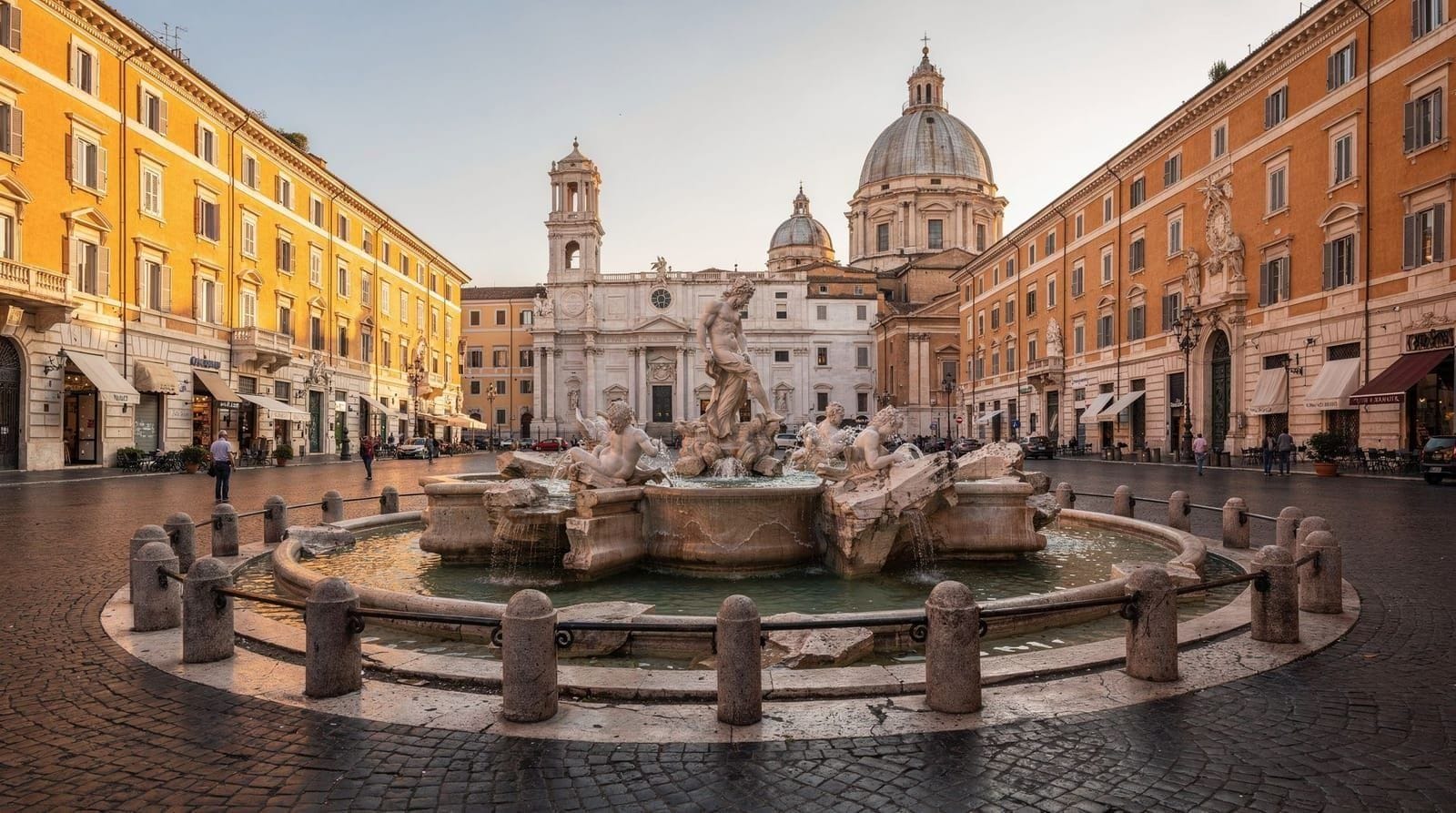
The centrepiece of any Rome fountains walk: Bernini’s masterwork, completed 1651. The full description is in our Piazza Navona guide — for the fountains trail, note specifically:
The water display: The Fountain of the Four Rivers uses the Acqua Vergine’s low-pressure water supply with great sophistication. The cascade falls from the rock formation into the large basin; the rock form is hollow (you can see through it) to create the impression that the obelisk floats above rather than resting on a solid base. The sound — a continuous murmur of water around an otherwise enclosed piazza — is one of the defining sounds of baroque Rome.
Walk the full perimeter of all three fountains before leaving. The Fountain of Neptune (north) and Fountain of the Moor (south) each repay attention.
English-language guided walking tour connecting Piazza Navona, Trevi Fountain, Pantheon and the Spanish Steps — the complete baroque water and piazza circuit.Stop 5: Fontana delle Tartarughe, Piazza Mattei (3.1 km)
This is the detour that most visitors skip and most Rome insiders recommend. From Piazza Navona, walk southeast toward the Pantheon, then south through Campo de’ Fiori toward the Jewish Ghetto (Piazza Mattei is in the ghetto area, about 10–15 minutes from Navona).
The Turtle Fountain (1581) is one of the most refined Renaissance fountain compositions in Rome: four bronze youths (each in a different pose) stand on a base of dolphins, each youth’s raised hand supporting one of four bronze turtles that drink from the upper basin. The composition is simultaneously delicate and energetic — the twisting figures of the youths contrast with the gentle upward gesture of the turtle-pushing.
The turtles themselves were added in the 17th century. Tradition holds they are by Bernini; their lightness and naturalism support this attribution, though documentation is incomplete.
The piazza: Piazza Mattei is small, quiet, and almost tourist-free. The surrounding palazzos are intact medieval and Renaissance buildings. This is the Rome most visitors do not find.
Stop 6: Fontana del Tritone, Piazza Barberini (4.2 km)
Walk northeast from Piazza Mattei toward Via Nazionale, then north to Piazza Barberini. Bernini’s Fontana del Tritone (1643) is here — his earliest major fountain commission and in some ways his most purely sculptural.
A single Triton kneels on four dolphins, holding a large conch shell to his lips and blowing water upward in a 4-metre plume. Unlike the Trevi — which is architectural as much as sculptural, using the palace wall as backdrop — the Tritone exists in open space and works from every angle. The four dolphins have interlocking tails at the base; the central scallop shell between the dolphins and the Triton is the platform; the whole composition rises in a single dynamic vertical.
The fountain is fed by the Acqua Felice, which has enough pressure for the upward jet — the contrast with the Trevi’s cascade (Acqua Vergine) is immediately apparent.
Also in Piazza Barberini: The Fontana delle Api (Fountain of the Bees), a small shell fountain by Bernini (1644) on the corner of Via Veneto. It is small enough to overlook completely — look for it at the base of the steps leading to Via Veneto. The bee motif recurs throughout (Urban VIII Barberini; bees were the family symbol).
Stop 7: Trevi Fountain (5.1 km)
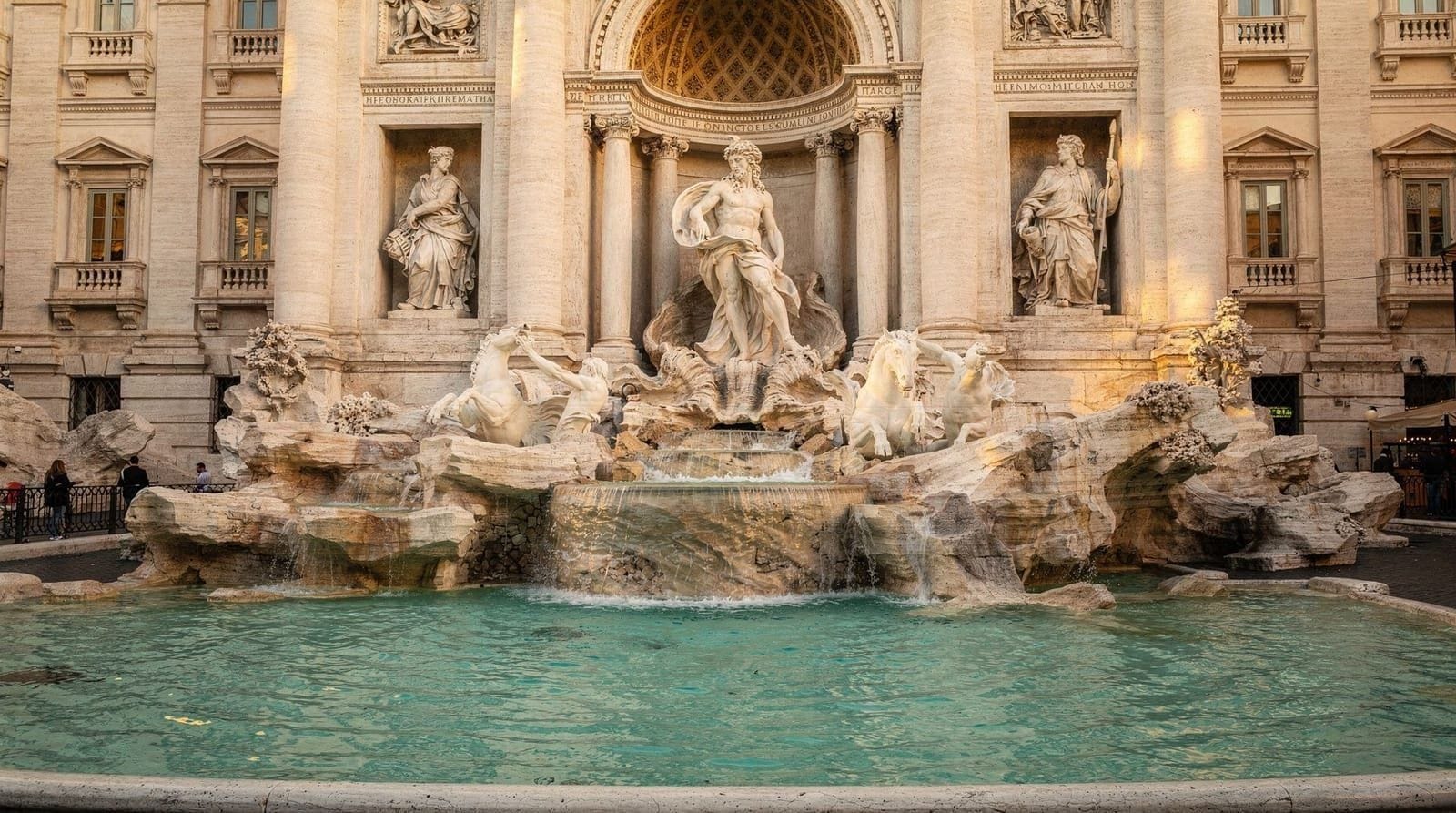
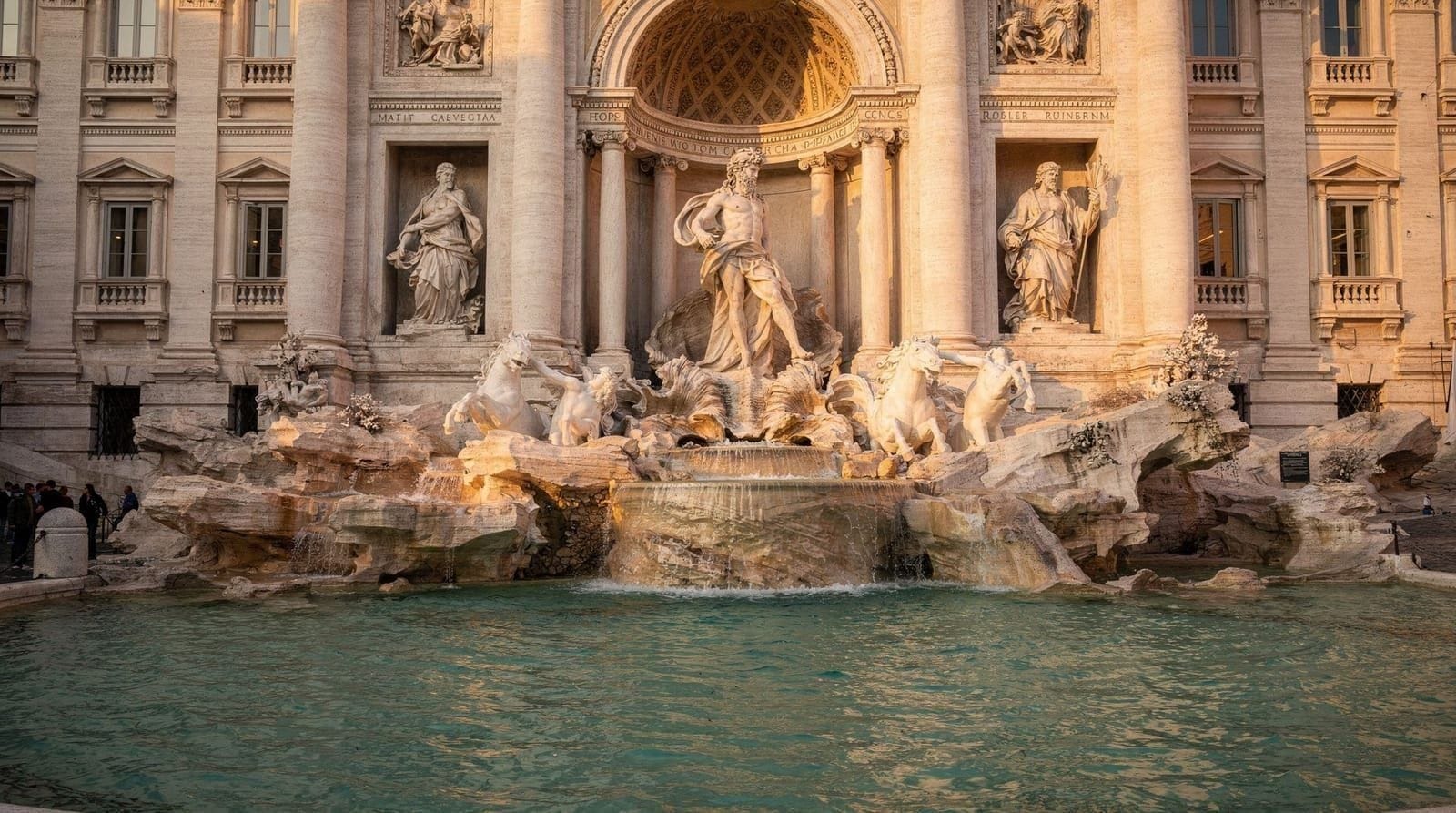
The terminus of the walk, and the most famous fountain in the world. Full detail in our Trevi Fountain guide.
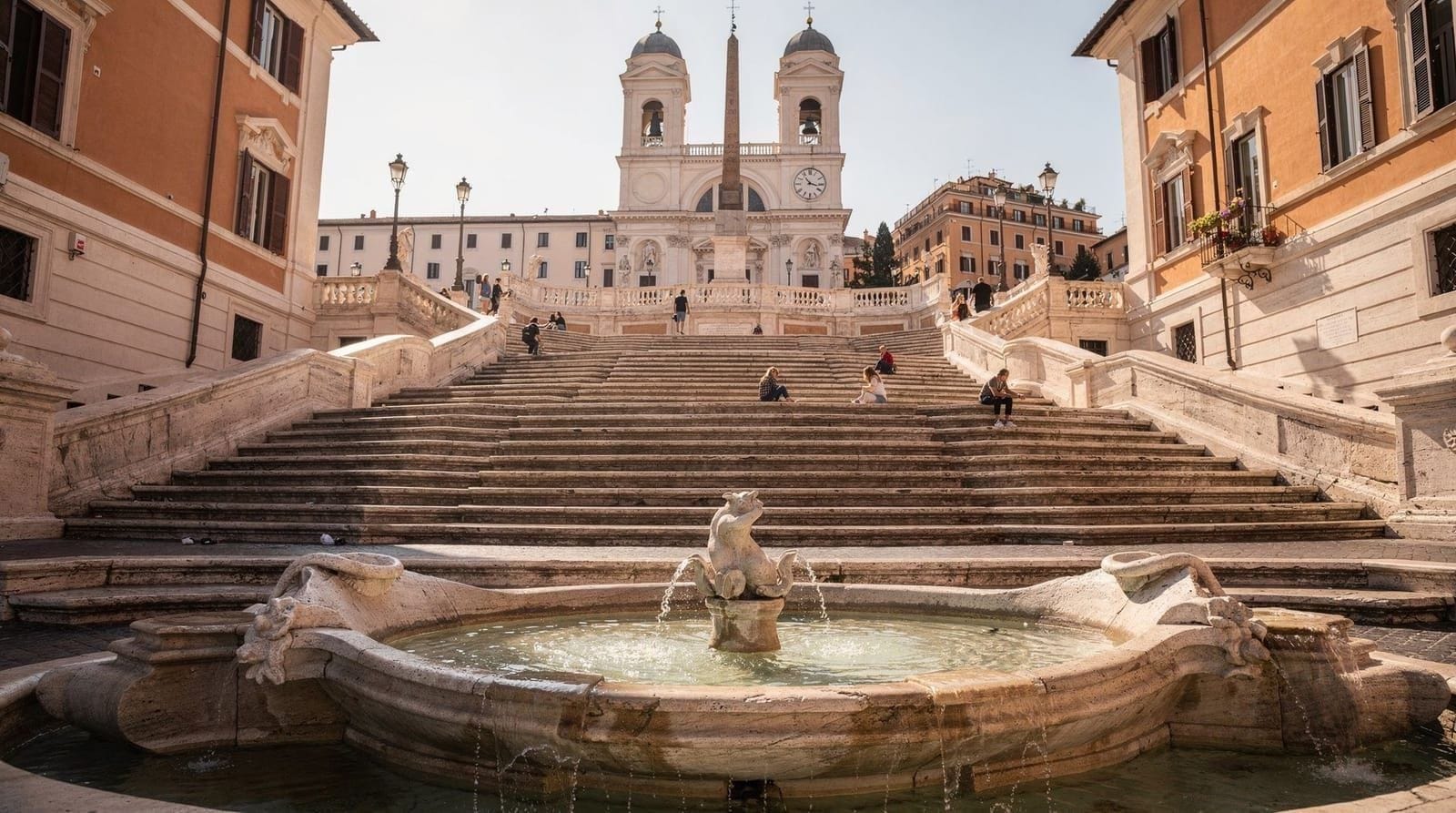
For the fountains trail specifically: stand back and think about what you have seen on this walk. The Trevi is the same Acqua Vergine water that supplies the Pantheon fountain, the Navona fountains, and the Barcaccia at the Spanish Steps. The aqueduct was built in 19 BCE. The water you are watching fall over Nicola Salvi’s travertine has been flowing through underground channels from the springs east of Rome for 2,045 years.
That is not a metaphor. It is engineering.
Timing note: If you are doing this walk as designed, you will arrive at the Trevi in the late morning or midday — potentially the busiest time. Consider reversing the route and doing this stop at dawn (06:30 Start), then walking north for the rest of the day. Alternatively, end the walk here in the evening when the fountain is lit and the crowds have thinned.
Golf cart tour of Rome’s city highlights with a local guide — an efficient way to see multiple fountain piazzas when the full walk is too much for one day.The Janiculum extension: Acqua Paola
For visitors with more time or energy, the Fontanone on the Janiculum Hill is the terminal monument of the Acqua Paola — a large arched nymphaeum (1612, designed by Giovanni Fontana for Pope Paul V) whose five arches pour water into a large basin. The view from the Janiculum over the whole city is one of Rome’s best.
From the Trevi, the Janiculum is approximately 3 kilometres west across the Tiber. Combine with a walk through Trastevere and the Trastevere neighbourhood.
The nasoni route: drinking water everywhere
Throughout the walk, you will pass nasoni at regular intervals — on street corners, in piazza edges, against walls. They are running all the time. The water is clean and cold.
Practical hack: Fill a bottle at each nasone you pass. Rome’s July heat (regularly 32–35°C) requires constant hydration, and paying €3 for a plastic bottle every 30 minutes is both expensive and wasteful when free water is available every 100 metres.
What this walk covers and what it leaves out
This trail covers the baroque and Renaissance fountains of central Rome — the Acqua Vergine circuit plus the Tritone and Barberini fountains. It does not cover:
- The Moses Fountain (Via Nazionale) — the terminal monument of the Acqua Felice, with its controversial giant Moses
- The Quattro Fontane (four corner fountains at the Via Quattro Fontane intersection) — minor but historically interesting
- The Vatican fountain in Piazza San Pietro
- The Piazza Farnese fountains (repurposed Roman bathtubs)
- The Fontana dei Fiumi at Villa Borghese park
A dedicated full-day walk could add these; the core route described above covers the essential narrative.
Fountains at night: the illuminated route
Every fountain on this trail is lit after dark, and several are genuinely better at night than during the day. The Trevi Fountain floodlit against the palazzo facade, with the crowds thinned to a fraction of daytime numbers after 22:00, is the single best reason to consider walking this route in reverse — starting at the Trevi in the evening and working north to Piazza del Popolo, or simply doing the whole route as a self-guided evening walk instead of a daytime one. Piazza Navona’s fountains take on a different character after dark, with the surrounding cafés and street performers adding an atmosphere the daytime piazza (dominated by tour groups) doesn’t have. The Fontana delle Tartarughe in the quiet Jewish Ghetto is worth a specific detour at night for exactly the reason it’s worth one by day — almost no one else is there.
Best time of year for the fountains walk
| Season | Conditions | Notes |
|---|---|---|
| Spring (Mar–May) | Mild, 15–22°C | Best overall — comfortable walking, good light |
| Summer (Jun–Aug) | Hot, 30–36°C | Walk early morning or after 19:00; midday is punishing |
| Autumn (Sep–Oct) | Mild, 18–24°C | Excellent light for photography, fewer crowds than spring |
| Winter (Nov–Feb) | Cool, 8–14°C | Quietest crowds; some fountains occasionally undergo maintenance |
Note that Rome’s monumental fountains occasionally close for scheduled cleaning or restoration — this has affected the Trevi in the past for multi-month stretches. Check recent news or the comune’s public works updates if a specific fountain is essential to your plans.
Guided or self-guided?
The fountains trail works well independently with this guide and our individual fountain guides for depth. A guided tour adds the narrative voice and the specific historical details that transform the experience from looking to understanding — particularly for the Trevi and Navona fountains where the backstory is rich.
Vespa sidecar tour of Rome’s highlights — covers multiple fountain piazzas in an entertaining and efficient format with a driver-guide.For the best piazzas beyond the fountains circuit, and the full baroque walking guide, see the related guides.
Frequently asked questions about Rome's fountains trail: a self-guided walk through the city's water
How many fountains does Rome have?
Are Rome's drinking fountains (nasoni) safe to drink from?
What aqueducts supply Rome's fountains today?
What is the Turtle Fountain and where is it?
What is the best time of day for the fountains trail?
What is special about Bernini's contribution to Rome's fountains?
Is the fountains trail better at night or during the day?
Do Rome's fountains ever close for maintenance?
Top experiences
Bookable activities with verified prices and instant confirmation on GetYourGuide.