The Spanish Steps: rules, history and the best time to visit
Rome: Spanish Steps, Trevi, Navona and Pantheon Sunset Tour
Duration: 2 hours
Can you sit on the Spanish Steps?
No. Since 2019, sitting on the Spanish Steps at any time is prohibited and carries a fine of up to €400, enforced by plainclothes municipal police. Standing, walking, climbing and photographing are all fine. The ban was introduced to prevent damage to the 18th-century travertine from food, drink and concentrated weight. Many tourists are unaware and get cited on the spot.
The Spanish Steps without the confusion
| Where | Piazza di Spagna, centro storico |
| Cost | Free (fine of up to €400 if you sit on the steps) |
| Time needed | 15–30 minutes; longer with Keats-Shelley House |
| Getting there | Metro A to Spagna, exit directly onto the piazza |
| Best time | Before 09:00 or after sunset, for quiet and light |
The Spanish Steps are one of Rome’s most instantly recognisable sights and one of its most misunderstood. Visitors arrive expecting to sit on them — as generations of visitors did, as movies showed, as the name implies — and discover they cannot. They were funded by France, built by an Italian, named after Spain, and associated almost entirely in the literary imagination with England. They are not ancient, not baroque in the grand Bernini-Borromini sense, and not near the Spanish Embassy they are named for.
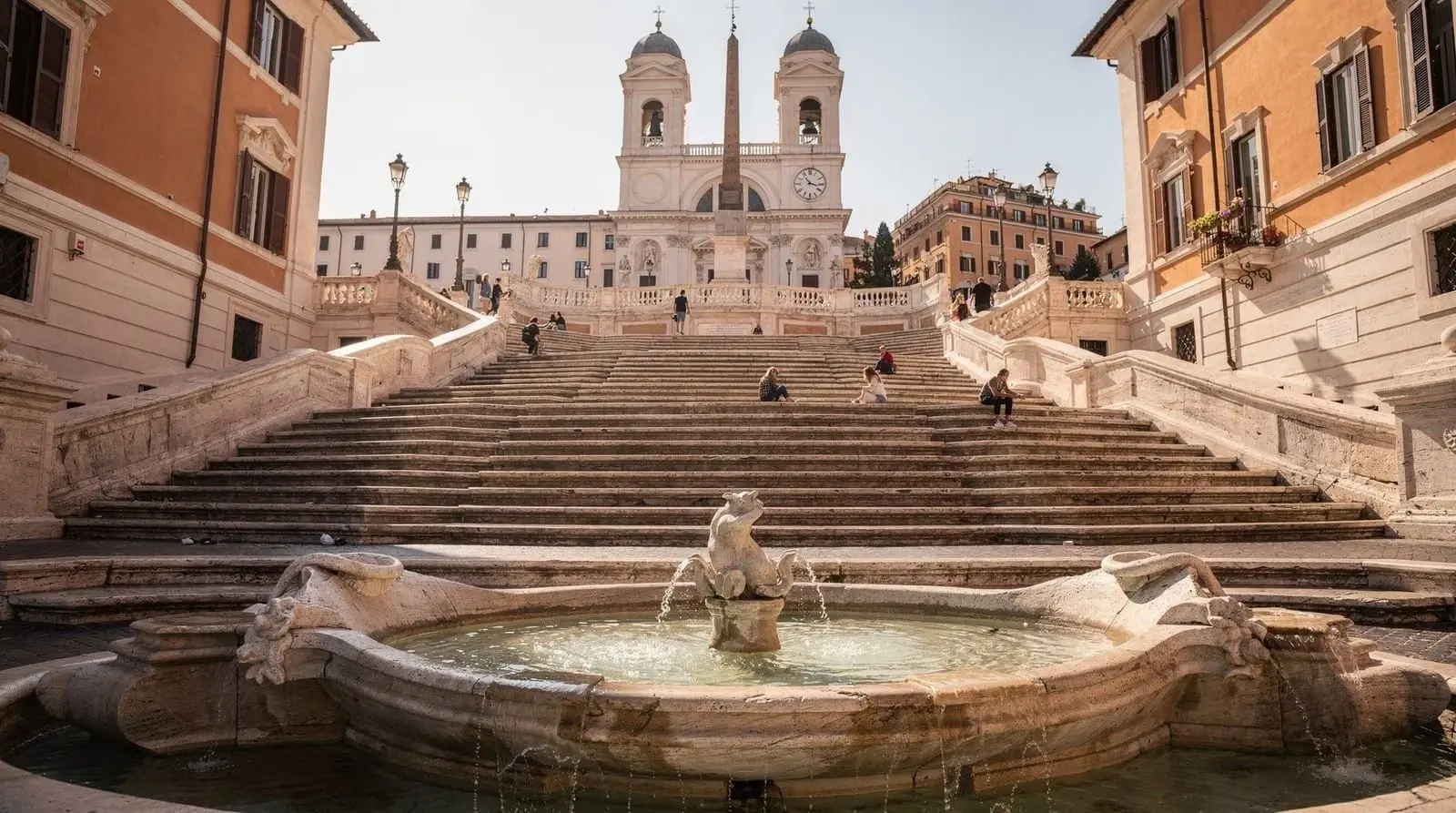
They are, however, genuinely beautiful. The 135 steps sweep upward in a curving double flight, the widest outdoor staircase in Europe, covered in spring with azaleas and in autumn with the warm golden light that makes Rome’s stone so photogenic. The view from the top over Via Condotti is one of the city’s best urban panoramas.
This guide tells you what the Spanish Steps actually are, how to see them at their best, and how to avoid the fine.
The sitting ban: everything you need to know
Since June 2019, it is illegal to sit on the Spanish Steps. The fine is up to €400, issued on the spot by plainclothes officers of the vigili urbani (municipal police) who patrol the area specifically for this. Eating on the steps carries the same fine.
The ban was introduced after years of structural damage from concentrated weight, food residue and drink spills on the historic travertine marble. Tourists had treated the steps as a picnic and socialising venue since at least the 1950s; the cumulative damage to the stone required the intervention.
What remains permitted: walking up and down the steps, standing, photographing, sitting on the metal railing at the edges (not the stone), and the entire range of movement short of resting your body on the travertine. Practically speaking, most visitors now stand at various points on the steps to look at the view and take photographs, then move on.
The ban is widely reported in travel media but a substantial proportion of visitors are still unaware of it. If you see people sitting, they are taking the risk knowingly or in ignorance. Municipal police are not always present; fines are not universal. But they are real and they do happen.
The practical reality: The steps are still worth visiting, and the experience of climbing them and taking in the view has not been diminished by the ban. What has changed is that you can no longer use them as a rest stop during a long walk. Plan your visit to the steps as a brief destination — look around, take the view, move on — rather than a place to sit and recover.
What the Spanish Steps actually are
The name
The steps are named for the Palazzo di Spagna — seat of the Spanish Embassy to the Holy See since 1647 — which occupies a position at the base of the stairs. Spain controlled much of Italy in the 17th century and the territory around Piazza di Spagna was technically Spanish territory (the square itself was considered neutral ground between the French and Spanish embassies), giving the area its Spanish character despite the absence of any Spanish architectural contribution.
The funding and design
The staircase was funded by the estate of French diplomat Étienne Gueffier, who left money specifically to build a connection between the French church of Trinità dei Monti at the top and the city below. Previous proposals for the staircase (going back to the 17th century) had included a grand equestrian statue of Louis XIV on the landing — diplomatically unacceptable to Rome — causing decades of delay.
Francesco de Sanctis won the commission in 1723 and completed the work in 1725. His design achieves the difficult task of making a very long stair feel informal and welcoming through the curving double flights and widening landings. It is not a formal processional stair — it is designed to be inhabited and enjoyed.
The travertine
The steps are made of travertine, the same warm cream-coloured limestone used throughout much of Rome — in the Colosseum, the Pantheon colonnade, St. Peter’s Square and countless other monuments. Travertine is quarried primarily from Tivoli (ancient Tibur), about 30 kilometres east of Rome. It is a relatively porous stone that absorbs stains and accumulates damage from repeated surface contact — which is why concentrated use over centuries required the 2019 ban.
The Barcaccia fountain: what to look at before looking up
Most visitors arrive at Piazza di Spagna, tilt their heads upward toward the steps, and never properly look at the fountain in front of them.
The Barcaccia (the word means something like “old tub” or “damaged boat”) was designed by Pietro Bernini in 1629, commissioned by Pope Urban VIII (Maffeo Barberini). Pietro Bernini was an accomplished sculptor in his own right; this project may have involved his young son Gian Lorenzo in some capacity, though the extent of the younger Bernini’s contribution is debated.
The engineering problem: The Acqua Vergine aqueduct, which supplies the fountain, arrives at Piazza di Spagna at very low pressure — insufficient to drive a jet of water upward. Other Roman fountains — notably the Trevi — face the same constraint and solve it differently. Pietro Bernini’s solution was formally ingenious: a boat (barca) half-sunk into a larger oval basin, with water flowing gently from openings in the hull and over the sides at low pressure. The composition works entirely within the constraint rather than fighting it.
The boat is a Roman boat — shallow-keeled, with a curved prow and stern. The papal bee emblems (Urban VIII was a Barberini pope; three bees were the Barberini heraldic symbol) appear at the bow and stern.
The fountain is small and quiet compared to the Trevi or the Navona centerpiece. It is one of those Rome objects that rewards attention paid in proportion to what it gives rather than its fame.
When to visit: a season-by-season view
| Season | What to expect | Best for |
|---|---|---|
| Spring (Apr–May) | Azaleas on the steps (mid-Apr–early May), mild weather, busy | Photography, flowers |
| Summer (Jun–Aug) | Hot, crowded midday, best early morning or evening | Evening views, gelato afterward |
| Autumn (Sep–Oct) | Warm golden light, fewer crowds than summer | Photography, comfortable walking |
| Winter (Nov–Mar) | Quietest, cold evenings, occasional rain | Solitude, budget travel |
For a broader month-by-month view of the whole city, see our Rome weather guide and our tips on avoiding crowds.
Rome by night walking tour: Spanish Steps, Trevi Fountain, Piazza Navona and the Pantheon — the full baroque evening circuit with a guide.The church at the top: Trinità dei Monti
The twin-towered church at the summit of the steps is the Trinità dei Monti (1502–1519), a French national church belonging to the Order of the Minims, founded by the French king Louis XII. It is rarely crowded and often overlooked — most visitors turn at the top of the steps to take the view down Via Condotti and forget the church behind them.
The interior is modest but contains two notable Daniele da Volterra paintings — the Deposition (1541) and the Assumption — that make it worth the brief visit. Volterra was a student of Michelangelo and the Deposition in particular shows that influence clearly.
The church is typically open on weekend mornings and afternoon hours on weekdays; times are variable and not always posted. Worth a quick check if you are at the top.
The obelisk in front of the church is a Roman-made copy of an Egyptian form (not a genuine Egyptian obelisk) placed here in 1789 by Pope Pius VI. Rome has more Egyptian and pseudo-Egyptian obelisks than Egypt does — thirteen in total, placed by successive emperors and popes as symbols of power and cosmopolitan reach.
The view from the top
Looking down from the top of the steps, the composition is primarily Via Condotti stretching straight to the west: a 300-metre corridor flanked by luxury shops (Gucci, Valentino, Bulgari, Prada all have flagships on this street) leading to the intersection with Via del Corso. In the far distance, slightly right of center, the dome of St. Peter’s is visible on clear days.
The street is best lit from mid-afternoon onward when the sun is to the west. Morning light falls from the east, behind you as you look down — useful for lighting the steps themselves, less useful for the view.
The best photography position is from the church terrace (left side, looking down): from here the steps sweep downward in a full arc with the Barcaccia fountain visible at the base and Piazza di Spagna beyond.
Accessibility: an honest note
The Spanish Steps themselves are, by definition, a staircase — 135 steps with no ramp or lift alternative, which makes the top of the steps and the Trinità dei Monti terrace inaccessible to wheelchair users and difficult for anyone with limited mobility. The good news is that the view and the experience at the base — the Barcaccia fountain, the piazza, Via Condotti — require no climbing at all, so a visit that stops at ground level is still worthwhile. For the panoramic view from above without the stairs, a short taxi or the Spagna metro’s lift can bring you close to Trinità dei Monti from the streets behind it, though the route still involves some walking on uneven pavement. Public accessible restrooms are scarce in the immediate area; the nearest reliable option is inside nearby department stores or cafés with paying customers.
The literary neighborhood
The area between the Spanish Steps and Via del Corso was the centre of the Grand Tour for northern European visitors from the 17th century onward. The English Romantics in particular concentrated here in the early 19th century.
Keats-Shelley Memorial House (Piazza di Spagna 26, to the right of the base of the steps): John Keats died here on 23 February 1821, aged 25, of tuberculosis. The house is now a small but carefully curated museum with Keats’s death mask, a lock of his hair, his writing desk and letters, and material relating to Shelley, Byron and the wider Romantic circle. Entry is €8; the experience is quiet and intimate. Worth visiting if you have any interest in the period. Open Monday–Saturday.
Via del Babuino (north from Piazza di Spagna toward Piazza del Popolo): This street, along with Via della Croce and Via Margutta, forms the heart of Rome’s antique dealer district and was historically the artist quarter of the city. Via Margutta, the parallel street one block west, was Federico Fellini’s address for many years and retains some of its artistic character.
Caffè Greco (Via Condotti 86): Rome’s oldest café, open since 1760, and an institution of Grand Tour history — Goethe, Keats, Byron, Stendhal, Wagner and Hans Christian Andersen all drank here. The interior is intact, with small gilt-framed mirrors and dark wood. The prices reflect the history (espresso at the bar runs to €3–4); the atmosphere is genuine.
Common street scams to watch for
The Spanish Steps area attracts a handful of low-level scams aimed at distracted tourists. The most common: people offering “free” bracelets or roses who then demand payment aggressively once the item is in your hand — politely but firmly decline any unsolicited item, and never take it even to be polite. A related version involves someone offering to take your photo on the steps, then walking off with your phone; keep hold of your own device or ask another visitor you can see clearly instead. Selfie-stick and tripod vendors around the base of the steps sometimes overcharge tourists who ask the price after already using the item. None of this is dangerous, but being aware of it in advance means you spend your visit looking at the architecture rather than fending off distractions.
Combining the steps with the rest of the circuit
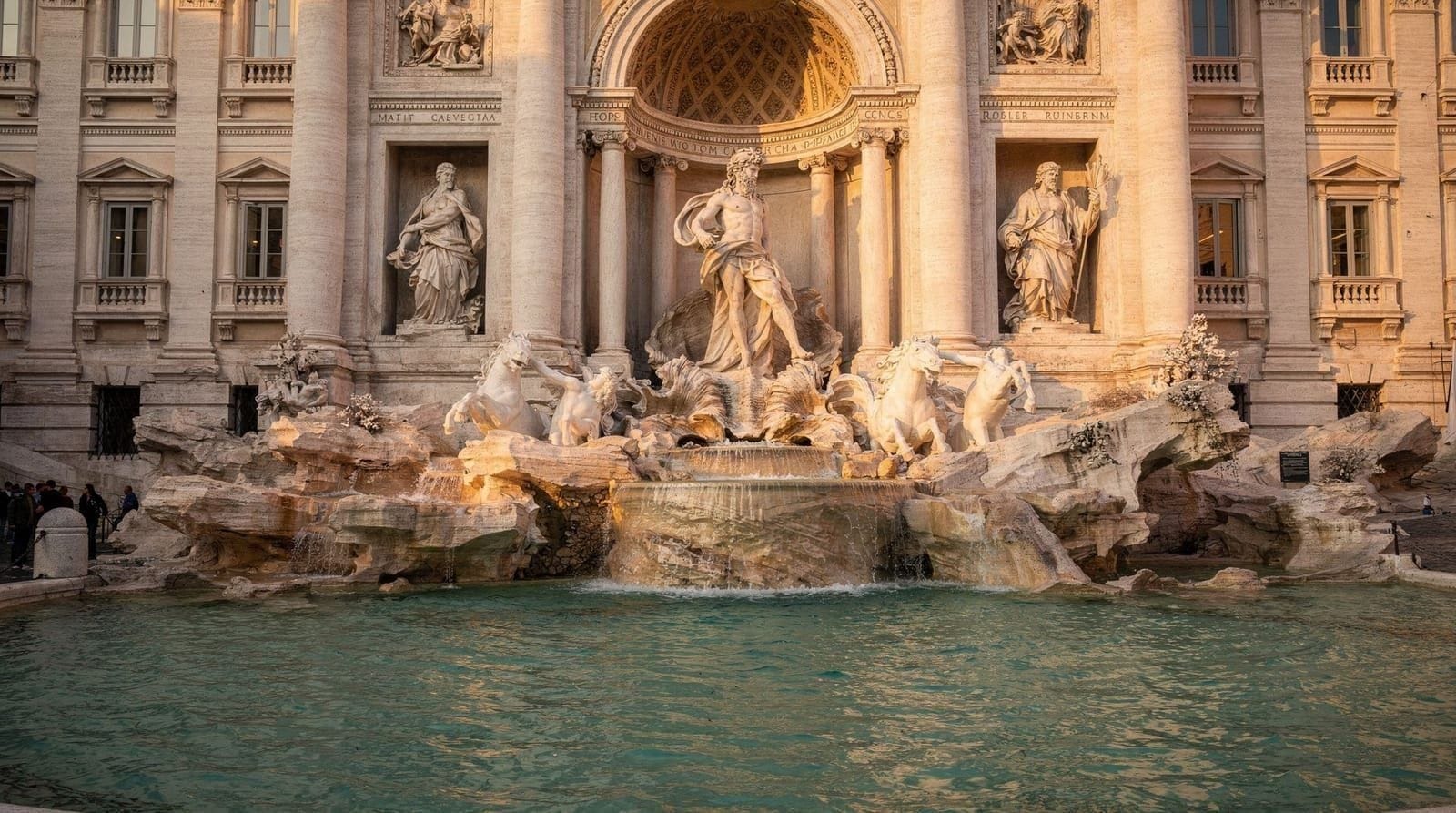
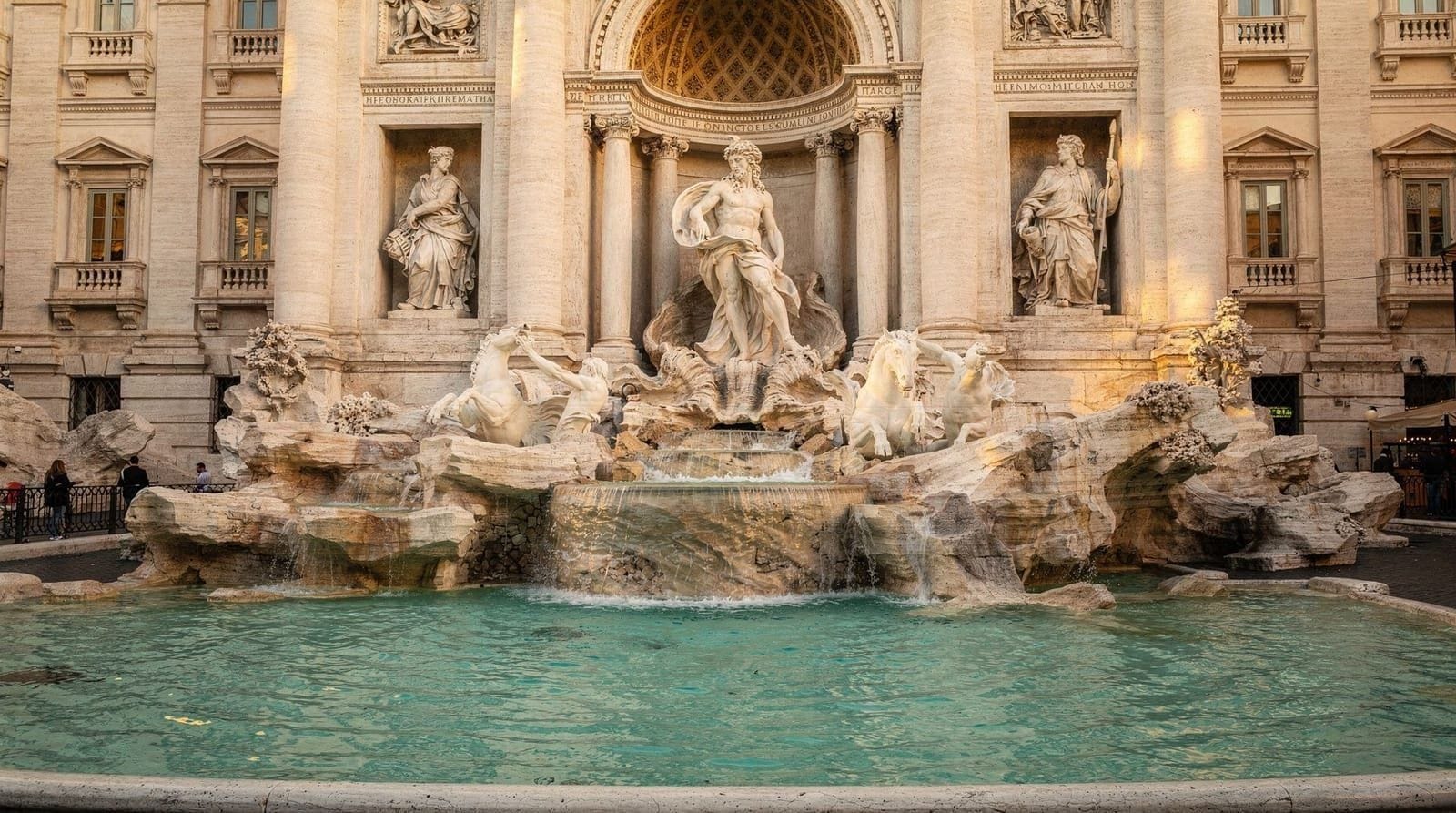
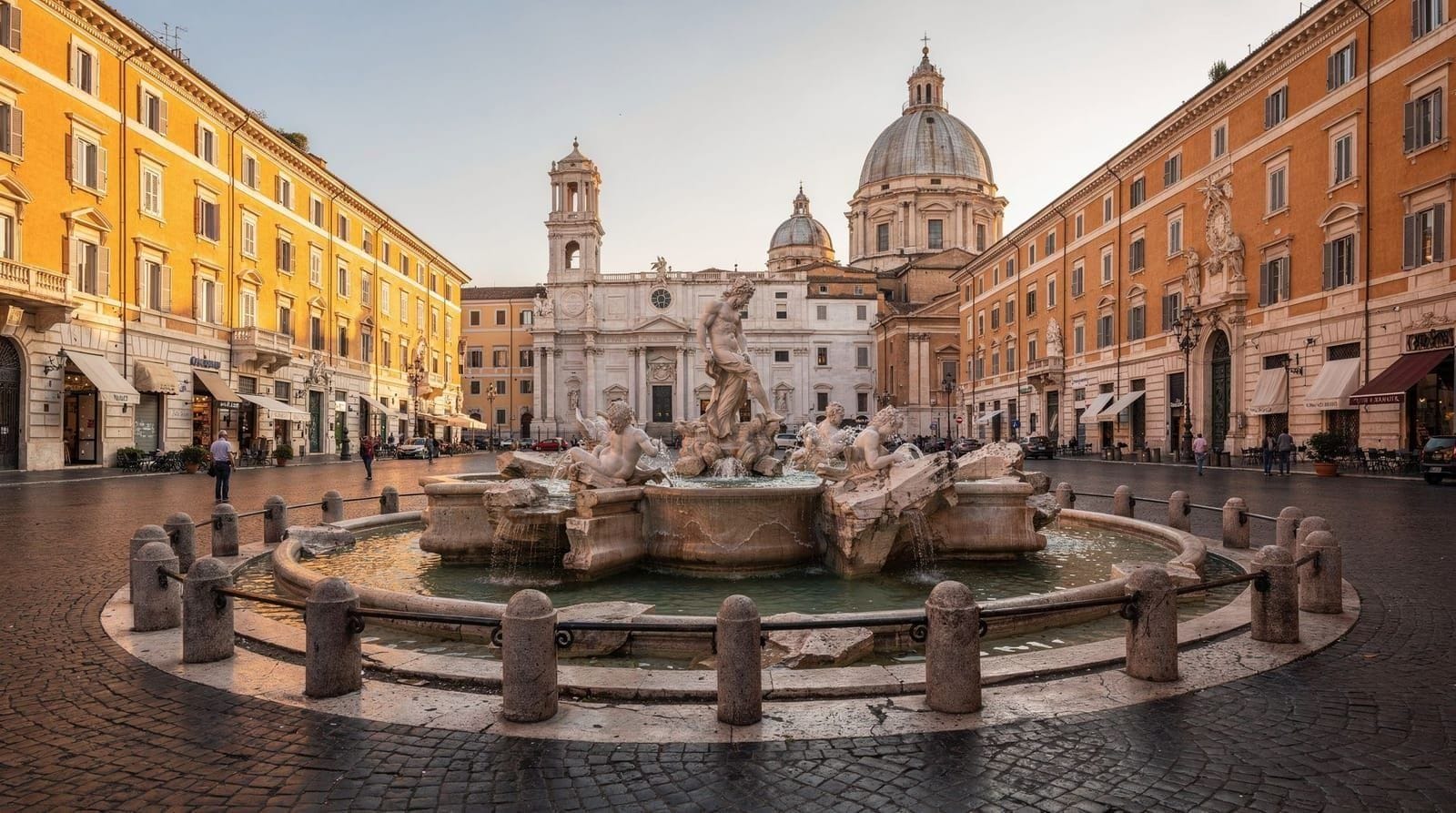
The Spanish Steps are the natural northern anchor of the baroque Rome walking circuit that connects Piazza Navona, the Pantheon and the Trevi Fountain. From the steps, the Trevi Fountain is about 800 metres southeast — an easy 10-minute walk. Piazza del Popolo, with its twin churches and Egyptian obelisk, is 800 metres north along Via del Babuino.
For a morning visit, the logical sequence is: Spanish Steps at 08:30 (quiet, clean light), then southeast to Trevi (arriving around 09:30, paying the access fee or arriving before it opens), then west to Piazza Navona and the Pantheon quarter. This covers the main baroque circuit in a half-day.
For an evening visit, the sequence reverses nicely: Piazza Navona at dusk, Trevi at night, Spanish Steps last to close with the view.
English-language guided walking tour of the Spanish Steps, Trevi Fountain, Piazza Navona and Pantheon — covering all four main baroque stops in one well-paced morning.Practical notes
Sitting ban: €400 fine, enforced by plainclothes officers. Do not sit anywhere on the travertine steps. Sitting on the metal guardrails at the edges is permitted.
Opening hours: The steps are public outdoor space, accessible 24 hours. The Barcaccia fountain runs continuously.
Getting there: Line A metro, Spagna station — exit and the steps are immediately visible. Buses on Via del Tritone and Via del Corso are also close.
Nearby eating: The streets around Piazza di Spagna cater heavily to tourists at tourist prices. For better value, walk a few minutes north to Prati or east toward the Trevi neighborhood — the restaurant density drops and the prices normalise.
Pickpockets: The area around the steps, particularly the bottom piazza and Via Condotti, sees bag-snatching and phone theft. Be aware of your surroundings, particularly when photographing. The steps themselves (people standing on them) are less concentrated a risk than the Trevi, but not zero.
For the full picture of Rome’s piazzas beyond the famous three, see our Rome’s best piazzas guide and the fountains trail for a self-guided water tour of the city. If a romantic evening is the goal, our romantic things to do in Rome guide has other ideas that pair well with an evening at the steps.
Frequently asked questions about The Spanish Steps: rules, history and the best time to visit
Why are they called the Spanish Steps if they were funded by France?
Is there a fee to visit the Spanish Steps?
What is the best time to visit the Spanish Steps?
What is the Barcaccia fountain at the bottom of the steps?
Who lived near the Spanish Steps?
What is the view from the top of the Spanish Steps?
What is the Keats-Shelley Memorial House?
What is the best month to see the Spanish Steps with flowers?
Top experiences
Bookable activities with verified prices and instant confirmation on GetYourGuide.