Rome's piazzas and fountains: a walking guide to the baroque heart
Trevi, Pantheon & Spanish Steps Guided English Walking Tour
What is the best route connecting Rome's major piazzas and fountains?
Start at Piazza Navona in the morning when it is quiet, walk east to the Pantheon and Piazza della Rotonda, then northeast to Piazza della Minerva, then continue to the Trevi Fountain (best at dawn or after 21:00 to beat the crowds). The Spanish Steps at Piazza di Spagna make a logical final stop heading north. The full circuit on foot takes about 3 hours at a relaxed pace.
The baroque heart of Rome — and how to walk it well
Rome’s most famous public spaces are baroque. Not ancient, not medieval — baroque. The Trevi Fountain was completed in 1762. Bernini’s Fountain of the Four Rivers in Piazza Navona was unveiled in 1651. The Spanish Steps opened in 1725. Even the Pantheon’s piazza, though anchored by a building from 125 CE, owes its current character to 17th and 18th-century interventions.
Understanding this changes how you visit. These are not ancient ruins you are walking among — they are an urban design statement, built by popes with money and theatrical ambition, intended to impress visiting Catholics and project the Church’s renewed authority after the Reformation. The drama is intentional. The scale is deliberate. And the walking logic connecting them is, once you see it, elegantly clear.
This guide covers the full piazza and fountain circuit of Rome’s historic center: what each space is, what actually happened there, honest advice on crowds and timing, and how to sequence them for the best experience.
| Stops | Piazza Navona, Pantheon, Trevi Fountain, Spanish Steps |
| Distance | around 3–4 km, flat and walkable |
| Time needed | about 3 hours on foot, 2 hours guided |
| Cost | free except Pantheon entry (€5) and Trevi peak-hour access (€2) |
| Best start time | early morning (Navona-first) or evening (Trevi-last) |
The essential circuit: four stops, three hours
The four main stops — Piazza Navona, the Pantheon quarter, Trevi Fountain, and Piazza di Spagna — form a rough crescent across the Centro Storico and the neighboring districts. On foot, well-paced, they take about three hours. By golf cart or with a guided tour, you can cover them in two.
The logical sequence depends on your timing. Morning visitors should start with Piazza Navona (quietest before 10:00) and finish at Trevi. Evening visitors should do the reverse, ending at the Trevi after 21:00 when the illumination is best and the crowds have thinned.
The worst approach — and the one most visitors take — is to hit the Trevi at midday as part of a rushed march. You will be shoulder-to-shoulder with thousands of people, unable to move, and the experience will feel like a disappointment. The Trevi deserves better than that, and so do you.
Piazza Navona: baroque theater at its best
Piazza Navona is the greatest baroque piazza in Europe. The claim is contestable, but not by much.
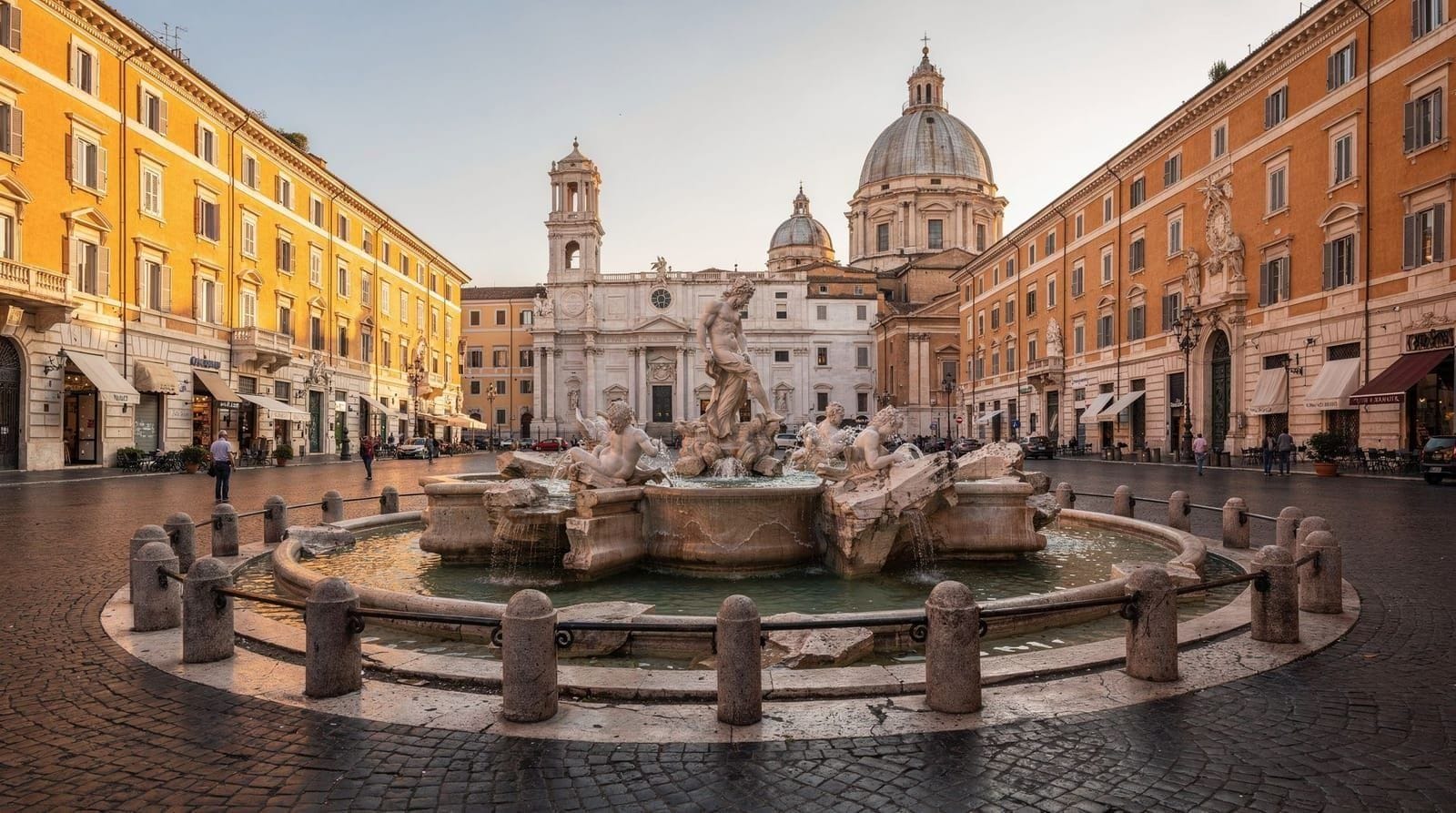
The space itself is extraordinary: an elongated oval 270 metres long, with the proportions of a racetrack — which is exactly what it was. The piazza was built over the stadium of Domitian (86 CE), a 30,000-seat athletics venue whose subterranean structure still runs beneath the square. You can see the underground ruins on a tour if that kind of thing interests you — some operators include the Domitian stadium in underground Rome packages.
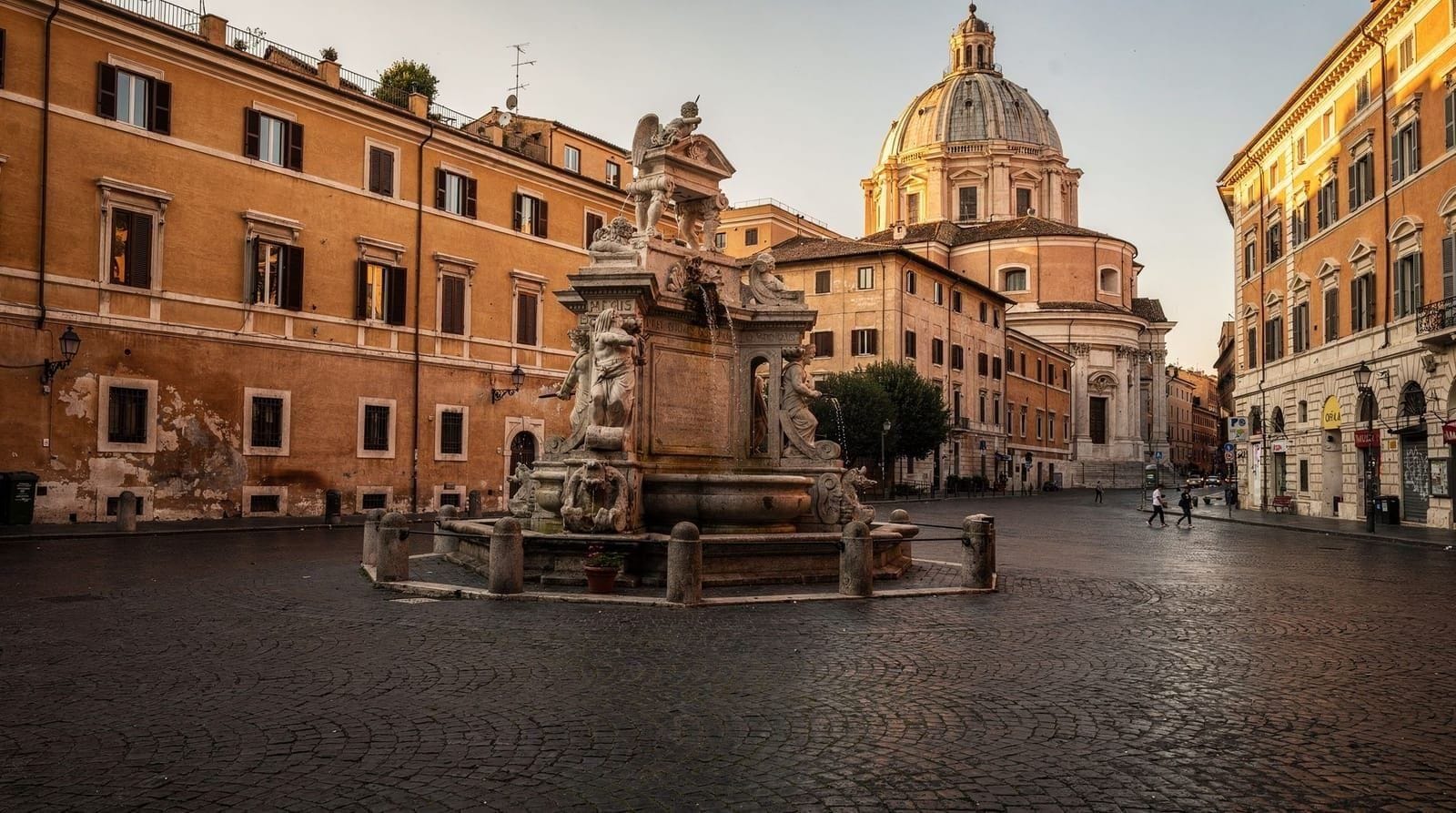
The piazza has three fountains. The central one — the Fountain of the Four Rivers (Fontana dei Quattro Fiumi) — is Bernini’s masterpiece and one of the most discussed public sculptures ever created. Completed in 1651 for Pope Innocent X, it represents the four great rivers known to Europeans at the time: the Nile (Africa), the Ganges (Asia), the Danube (Europe), and the Río de la Plata (Americas). The obelisk crowning the composition is a Roman-era copy of an Egyptian original, re-erected here by Bernini in a feat of engineering theater.
Look at the figure covering his face: he is the Nile, whose source was unknown to Europeans at the time — Bernini depicted him veiled in ignorance. The river figures are not idealized classical bodies; they are massive, energetic, gesticulating forms in the full baroque spirit of controlled drama.
The competing story — that the Nile figure covers his face to block the view of Borromini’s church Sant’Agnese in Agone across the piazza, as a professional slight between the two great rival architects — is entertaining but untrue. The fountain was completed before the church facade was built. But the story has circulated for 370 years and will not stop now.
The two flanking fountains — the Fountain of Neptune (north) and the Fountain of the Moor (south) — are fine, but neither competes with the central work. The Moor fountain is partly Bernini’s work; Neptune’s main figures were added by Antonio della Bitta in 1878 to correct an obvious imbalance.
When to visit: Early morning (before 09:30) is the best time by far — coffee at one of the cafés around the edge, virtually no tourists, and the piazza as Romans experience it. Midday is busy but manageable. Evenings are atmospheric but the restaurants surrounding the square are overpriced relative to quality; walk three streets away for better value and similar atmosphere.
What to skip: The horse-drawn carriage rides and portrait artists around Piazza Navona are aimed entirely at tourists. The carriage rides in particular — offered throughout central Rome — are expensive, the horses are often in poor condition, and they are not a meaningful way to see the city.
The Pantheon quarter: the ancient and baroque meeting point
Walking east from Piazza Navona, you enter the densest concentration of historic architecture in Rome — a zone where temples, medieval towers, Renaissance palaces and baroque churches occupy the same narrow streets.
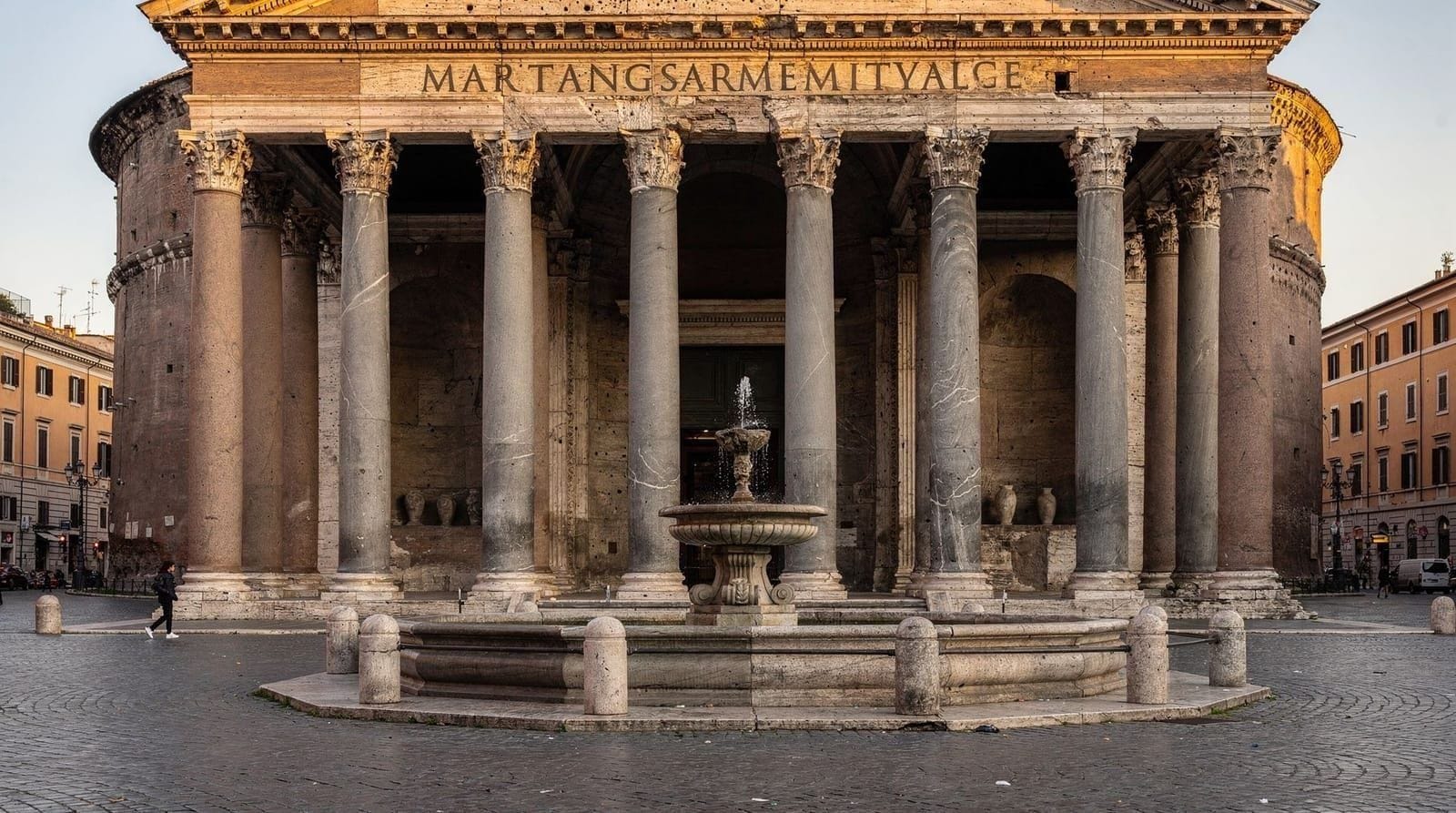
The Pantheon itself is covered in depth in our full Pantheon guide, but the piazza in front of it deserves attention separately. The Piazza della Rotonda is anchored by a smaller Bernini-designed fountain (1575, modified by him in 1661) featuring an ancient Egyptian obelisk — one of Rome’s thirteen obelisks, this one from the temple of Isis and Serapis. The composition is modest by Bernini standards but the setting is extraordinary: a working Roman piazza with a 1,900-year-old temple as its backdrop.
The Pantheon now requires a timed entry ticket (€5, booked online or via the app). Do not skip it on this basis — it is one of the greatest buildings on earth and takes only 30–45 minutes. But if you are focusing purely on the piazza and fountain circuit, the exterior and piazza itself remain free.
Just south of the Pantheon, Piazza della Minerva contains a small elephant obelisk designed by Bernini (1667). The elephant — carved by Ercole Ferrata from Bernini’s design — supports an obelisk originally from the same Egyptian temple complex as the one in Piazza della Rotonda. The combination of an Egyptian monument, a small marble elephant, and a Dominican convent (Santa Maria sopra Minerva, Rome’s only Gothic church) is the kind of layered absurdity that makes Rome endlessly rewarding.
Trevi Fountain: the crowd problem and how to solve it
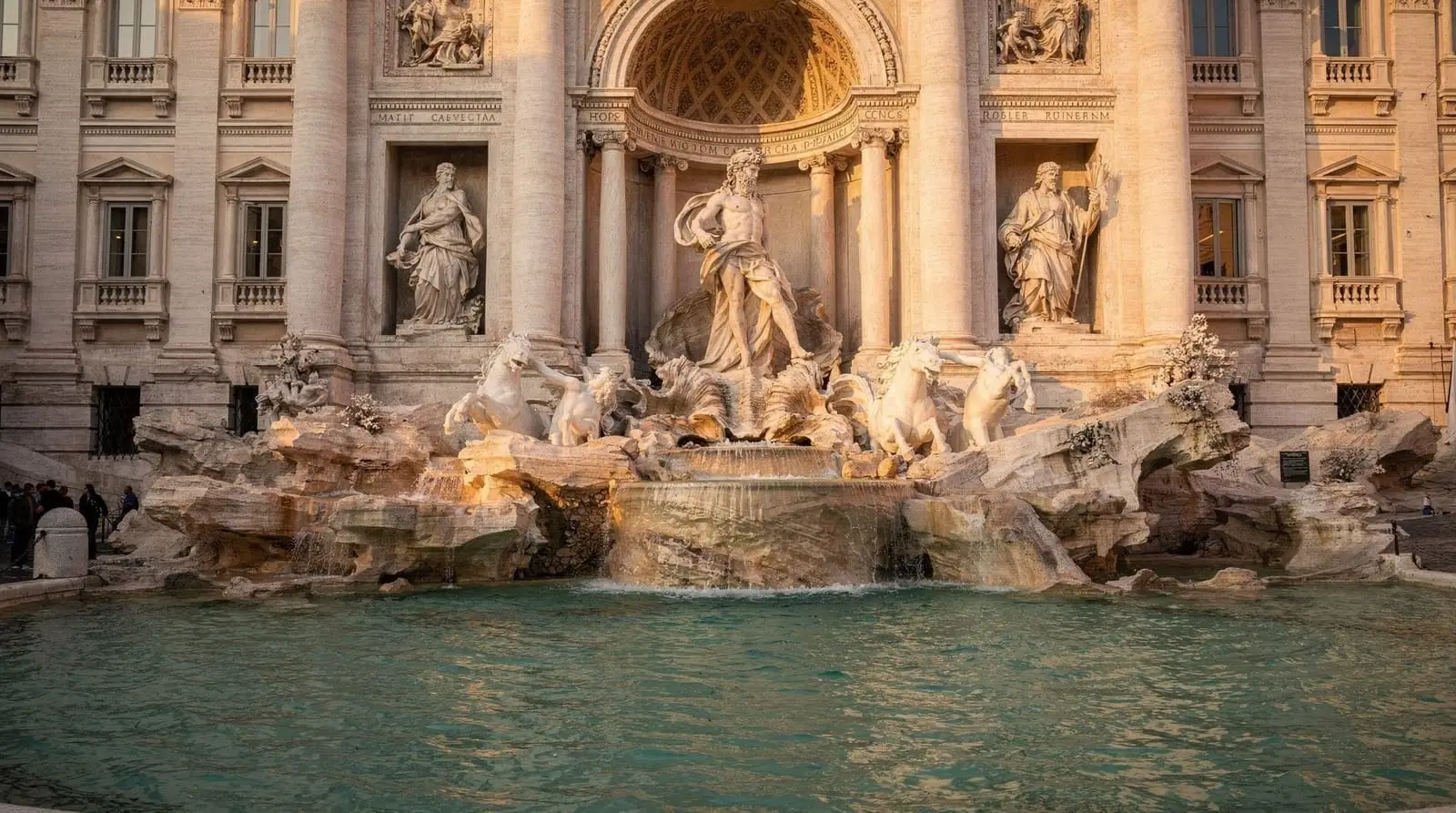
The Trevi Fountain is the most visited monument in Rome that is not an enclosed site. On a summer afternoon, the surrounding streets can hold 10,000–20,000 people. The small piazza (roughly 50 by 80 metres including the fountain basin) becomes genuinely dangerous in the crush.
As of 2024, Rome has introduced timed access with a small fee (€2) during peak hours, improving the situation somewhat. But the fundamentally correct solution remains timing.
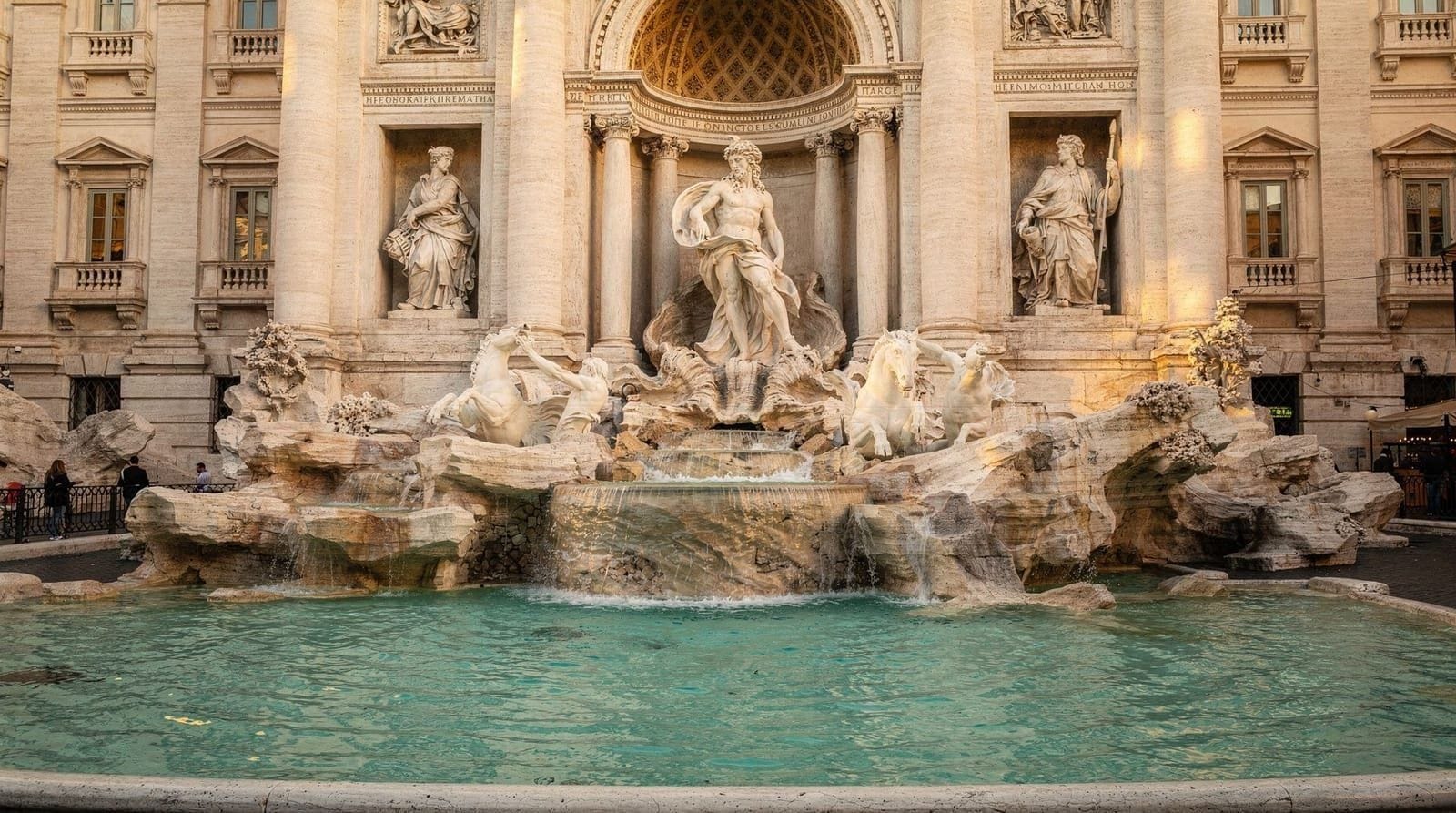
Dawn (06:00–07:30): The best time to see the Trevi. The streets around it are quiet, the light is clean and raking, and you can actually stand still and look at the thing. The fountain runs continuously — the water supply is the ancient Acqua Vergine aqueduct, operational since 19 BCE, one of Rome’s oldest and still-functioning water systems.
After 21:00 on weekdays: The second-best option. Illuminated at night, the Trevi reads differently — the white travertine glows, the water catches the light, and the overall drama of Nicola Salvi’s design (1762) is if anything enhanced. The crowds are smaller but not absent; a Tuesday night in June will be far more manageable than a Saturday afternoon in August.
Midday in summer: Avoid. This is the single most advice people ignore and most consistently regret.
The classic daytime walking tour of Trevi, Pantheon, Piazza Navona and the Spanish Steps — guided commentary in English and small group size.The fountain itself: Nicola Salvi’s design (1732–1762) places Neptune in a central niche framing him between Abundance and Health, with two triumphal arches flanking. The whole composition uses the rear facade of Palazzo Poli as its backdrop — Salvi integrated the building’s exterior wall into the fountain structure, giving it an urban scale that would be impossible in an open setting. The four giant horse-head reliefs at the sides, the marine figures, and the cascading rock formations are all part of a unified theatrical piece.
The coin tradition: one coin over the left shoulder with the right hand means you will return to Rome. Two coins means a romance. Three coins means a wedding. The tradition is informal but generates approximately €1.4 million annually, collected weekly by the municipality and donated to Caritas for food programs. This is a good use of tourist superstition.
Pickpockets: The Trevi Fountain is Rome’s highest-risk location for pickpocketing. The density and distraction combination is ideal for thieves. Keep valuables in front pockets or a cross-body bag. Do not put your phone in your back pocket to photograph the fountain.
Piazza di Spagna and the Spanish Steps: the rules
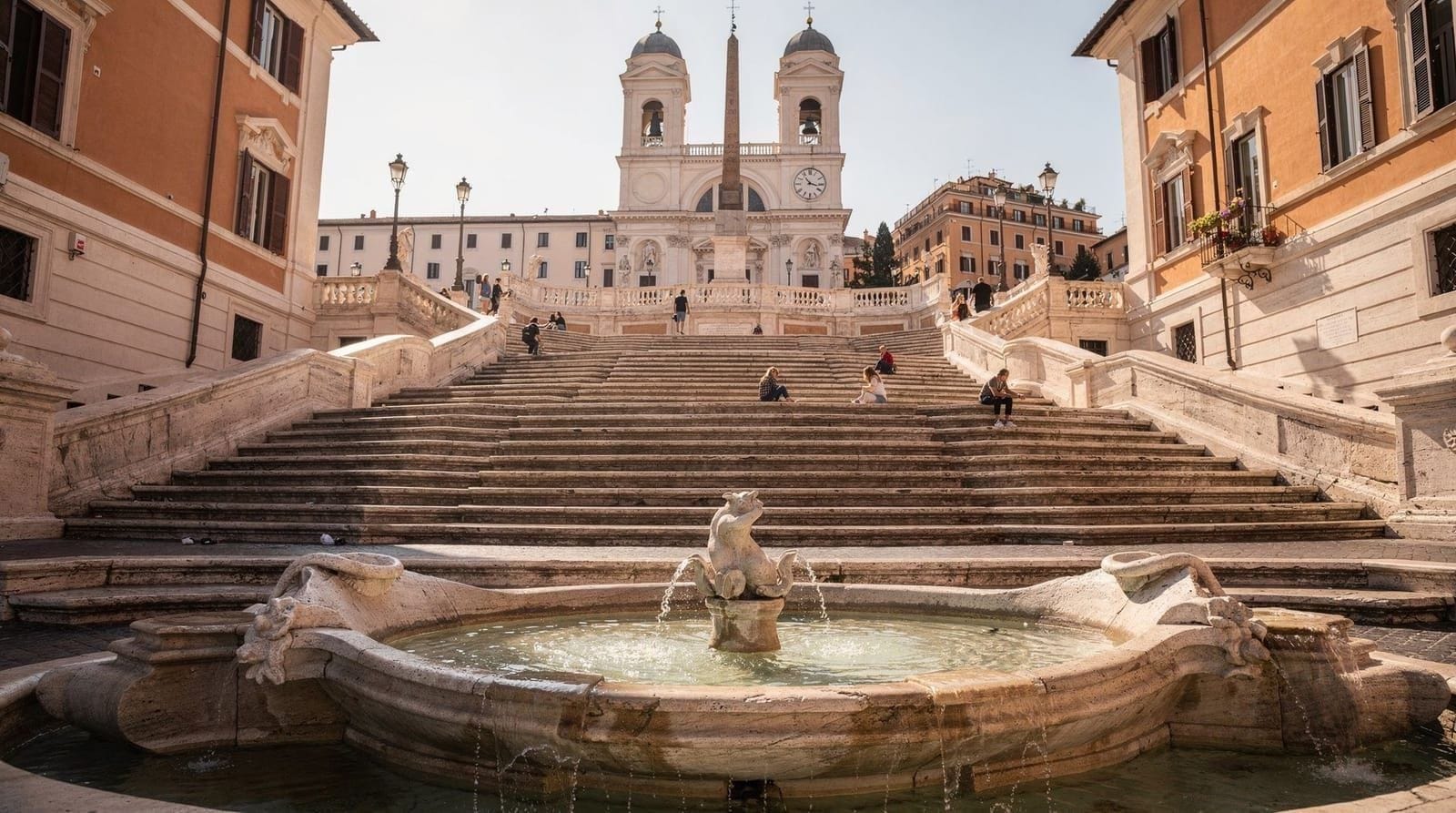
The Spanish Steps (Scalinata della Trinità dei Monti, completed 1725) are neither Spanish (French-funded, designed by Italian architect Francesco de Sanctis) nor steps in the usual sense — they are an outdoor theater seating 135 steps wide, the broadest stairway in Europe, designed to connect the French church at the top (Trinità dei Monti) with the Spanish Embassy at the bottom.
The space has been a meeting point and social hub for centuries — the English Romantic poets lived in the surrounding streets (Keats died in the house to the right of the steps, now a museum), and the area became the centro bohème of 18th-century Rome.
The sitting ban: Since 2019, it is illegal to sit on the steps at any time. The fine is up to €400 and is enforced by plainclothes municipal officers. The ban came after repeated damage to the Baroque travertine from food, drink and general wear. Many tourists are unaware of the rule and get cited on the spot. Stand, photograph, move on.
The fountain at the base — the Barcaccia (sinking boat fountain) by Pietro Bernini (Gian Lorenzo’s father), 1629 — is a lovely small work that solves an engineering puzzle: the Acqua Vergine aqueduct feeding it lacked sufficient pressure for an upward jet. Pietro Bernini solved this by designing a boat half-sunk in a basin, with water flowing gently over the sides at low pressure. Elegant solution. Often overlooked because everyone is looking up at the steps.
The view from the top of the steps: looking down the Via Condotti toward the Tiber, with the dome of St. Peter’s visible to the right on clear days, is one of Rome’s iconic urban panoramas. Worth climbing for this alone.
The Via Condotti shopping district surrounds the bottom of the steps — Gucci, Bulgari, Valentino and most of the major Italian luxury brands have flagships here. Window shopping costs nothing; actually entering costs a great deal.
The lesser piazzas: Campo de’ Fiori and Piazza Farnese
Two stops worth adding if you have time and are starting from the southern edge of the Centro Storico:
Campo de’ Fiori (Field of Flowers) is Rome’s most extroverted public square — a morning market selling produce and flowers on weekdays, a tourist restaurant strip at lunch, and an evening drinking scene that gets progressively louder after 22:00. The statue in the center is Giordano Bruno, burned at the stake here in 1600 for heresy. The market is worth visiting for the theater of it; the evening bar scene is lively but not the most atmospheric Rome experience.
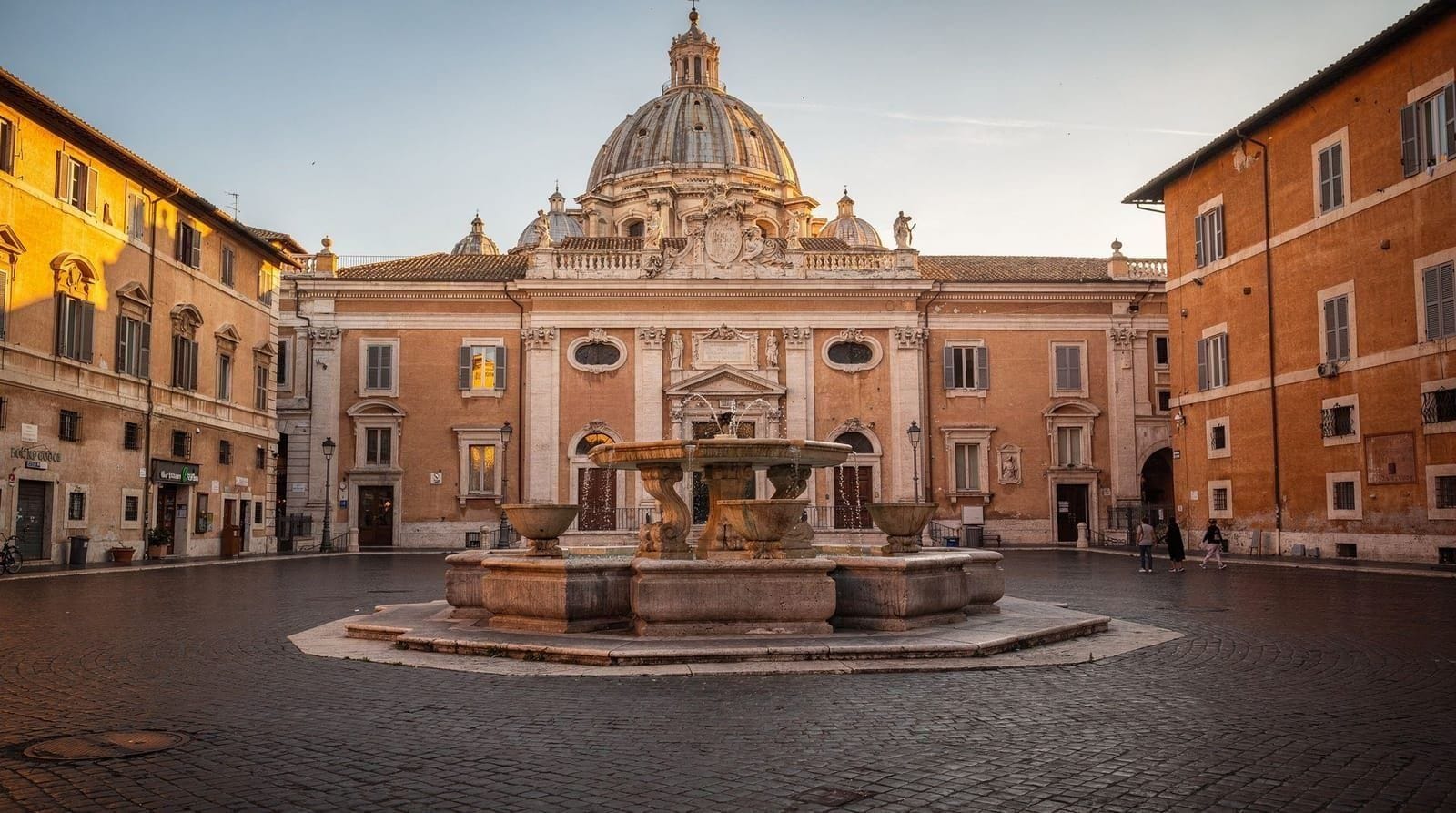
Piazza Farnese is 150 metres south of Campo de’ Fiori and sharply different in character — grand, quiet, formal, and dominated by the Palazzo Farnese (now the French Embassy) on one side. The two fountains in the square are ancient Roman granite bathtubs repurposed as basins in the 16th century. The piazza sees relatively few tourists and gives an accurate sense of the aristocratic Rome that sat alongside the popular Rome of Campo de’ Fiori.
Why these four spaces are grouped together
Visitors sometimes ask why a “guide to Rome” bundles Piazza Navona, the Pantheon, the Trevi Fountain, and the Spanish Steps together rather than treating each as a standalone attraction. The answer is geographic and historical: all four sit within a compact, walkable zone of the Centro Storico, and all four were shaped — directly or indirectly — by the same wave of 17th and 18th-century papal patronage that turned Rome into a baroque stage set. Treating them as a single circuit rather than four separate errands also solves the single biggest practical problem visitors report: without a plan, most people end up doing the Trevi at the worst possible time simply because it falls in the middle of an unplanned wander between the other three.
An evening circuit: the practical sequence
For visitors who want the best possible version of this walk in a single evening:
18:00 — Start at Campo de’ Fiori for the late market atmosphere. Coffee or spritz at one of the cheaper bars on the side streets (avoid the main square bar prices).
18:45 — Walk north to Piazza Farnese. Five minutes, and 400 years different in character.
19:15 — Continue north to Piazza Navona. Arrive before the evening restaurant crush. Walk the perimeter, look at all three fountains in sequence, and get the angle on the Fountain of the Four Rivers that most people miss — from the southeast corner, where the obelisk, the Nile figure, and Sant’Agnese in Agone compose into a single baroque tableau.
20:00 — East to the Pantheon. The piazza at dusk, with the temple facade lit, is extraordinary. Walk around the building; most people see only the front.
20:30 — Northeast to Trevi Fountain, aiming to arrive around 21:30 after pausing for dinner in the streets around the Pantheon.
22:00 — North to Piazza di Spagna. The Spanish Steps in the evening, lit from below, with the city spreading out behind you.
Rome by night guided walking tour — Spanish Steps, Trevi Fountain, Piazza Navona and the Pantheon with expert commentary on the baroque city.Guided or independent?
For first-time visitors, a guided evening walking tour of this circuit is genuinely worthwhile. The narrative of baroque Rome — the papal patronage, the rivalry between Bernini and Borromini, the way each fountain and piazza was a political statement as much as an aesthetic one — is not self-evident from looking at the spaces. A good guide makes it audible.
If you are doing this independently, our Trevi Fountain guide, Piazza Navona guide, and Spanish Steps guide each go deeper on their respective stops.
Three-hour Rome by night walking tour covering the main baroque piazzas and monuments with a licensed local guide.What this circuit is not
It is not ancient Rome. The Trevi Fountain uses ancient water; the Pantheon is ancient; the piazza shapes in some cases follow ancient footprints. But the experience is fundamentally baroque — 17th and 18th century Catholic patronage at enormous scale. Visitors who arrive expecting classical antiquity sometimes feel deflected.
If you want the ancient version, pair this circuit with a half-day at the Roman Forum and Palatine Hill or a morning at the Colosseum. The two periods of Rome — ancient and baroque — are best understood as separate layers.
Practical notes for 2026
Trevi access fee: €2 during timed-access hours (roughly 09:00–19:00 in summer, variable seasonally). Dawn and late night remain free. Book via the official Rome municipality app or pay at the access point.
Pantheon entry: €5, timed entry. Book online. Full guide to Pantheon visit.
Spanish Steps sitting ban: €400 fine, enforced. Do not sit.
Water: Rome has approximately 2,500 nasoni — cast-iron drinking fountains — throughout the historic center. They run continuously with clean drinking water from the same ancient aqueduct systems feeding the ornamental fountains. Free, cold, excellent. Use them.
Best photography spots for the circuit: Trevi at dawn from the upper-left corner with no one in frame. Fountain of the Four Rivers from the southeast corner. Barcaccia fountain from the bottom of the steps looking up. Pantheon piazza at dusk from the right side of the piazza to include the Bernini fountain.
For the full Rome experience beyond this circuit, our guide to Rome’s best piazzas covers the less-visited squares that most tourists never find, and our fountains trail guide maps a self-guided walk through the city’s remarkable water history.
Doing the circuit with children or limited mobility
The route is flat and short enough to work well for families — see our Rome with kids-style planning logic applied here: frequent gelato stops, visually engaging fountains, and short hops between stops mean children rarely tire before adults do. The main adjustment for families or anyone with mobility considerations is timing the Trevi stop for early morning or evening rather than midday, when the crush makes it genuinely difficult to move with a stroller or wheelchair. The cobblestones (sampietrini) throughout the Centro Storico are the one consistent physical challenge — uneven, occasionally loose, and slippery when wet — so sturdy footwear and, for wheelchair users, a companion to help navigate the roughest stretches near Piazza Navona are worth planning for.
Rainy-day version of the circuit
Rome’s baroque piazzas are, if anything, more atmospheric in the rain — wet travertine reflects light differently, and the crowds thin dramatically. The Pantheon’s oculus famously lets rain fall directly onto the floor, which is a genuine spectacle worth timing a visit around if a shower is forecast. Piazza Navona’s cafés with covered outdoor seating make a good rain-watching stop. The Trevi is less pleasant in a downpour (limited shelter, slippery stone), so on a rainy day, consider reordering the circuit to hit Trevi during a lull and spend more time under cover at the Pantheon and in the covered galleries near Piazza Navona.
Frequently asked questions about Rome's piazzas and fountains: a walking guide to the baroque heart
What is the best time to visit the Trevi Fountain?
Is there a fee to throw a coin in the Trevi Fountain?
Can you sit on the Spanish Steps?
Are Piazza Navona's fountains free to see?
Where are the pickpockets worst around these sights?
Which is better: Piazza Navona or Campo de' Fiori in the evening?
Is it worth doing a guided tour of the piazzas and fountains?
What is the best walking order for an evening tour?
How much walking is involved in the full piazza and fountain circuit?
Can I do this circuit with young children?
Top experiences
Bookable activities with verified prices and instant confirmation on GetYourGuide.