The best photo spots in Rome: a location guide with timing
Rome: E-Bike Tour of the Seven Hills
Duration: 3 hours
What are the best photo spots in Rome?
The Pincio terrace for the classic panorama over the domes, Ponte Sant'Angelo at dawn before the crowds, the Aventine keyhole for the framed St. Peter's view, Via Piccolomini for the optical illusion, Gianicolo for the city-wide sunset panorama, and the Colosseum from the Arch of Constantine angle — each requires specific timing to shoot without crowds or harsh light.
Rome rewards the patient photographer
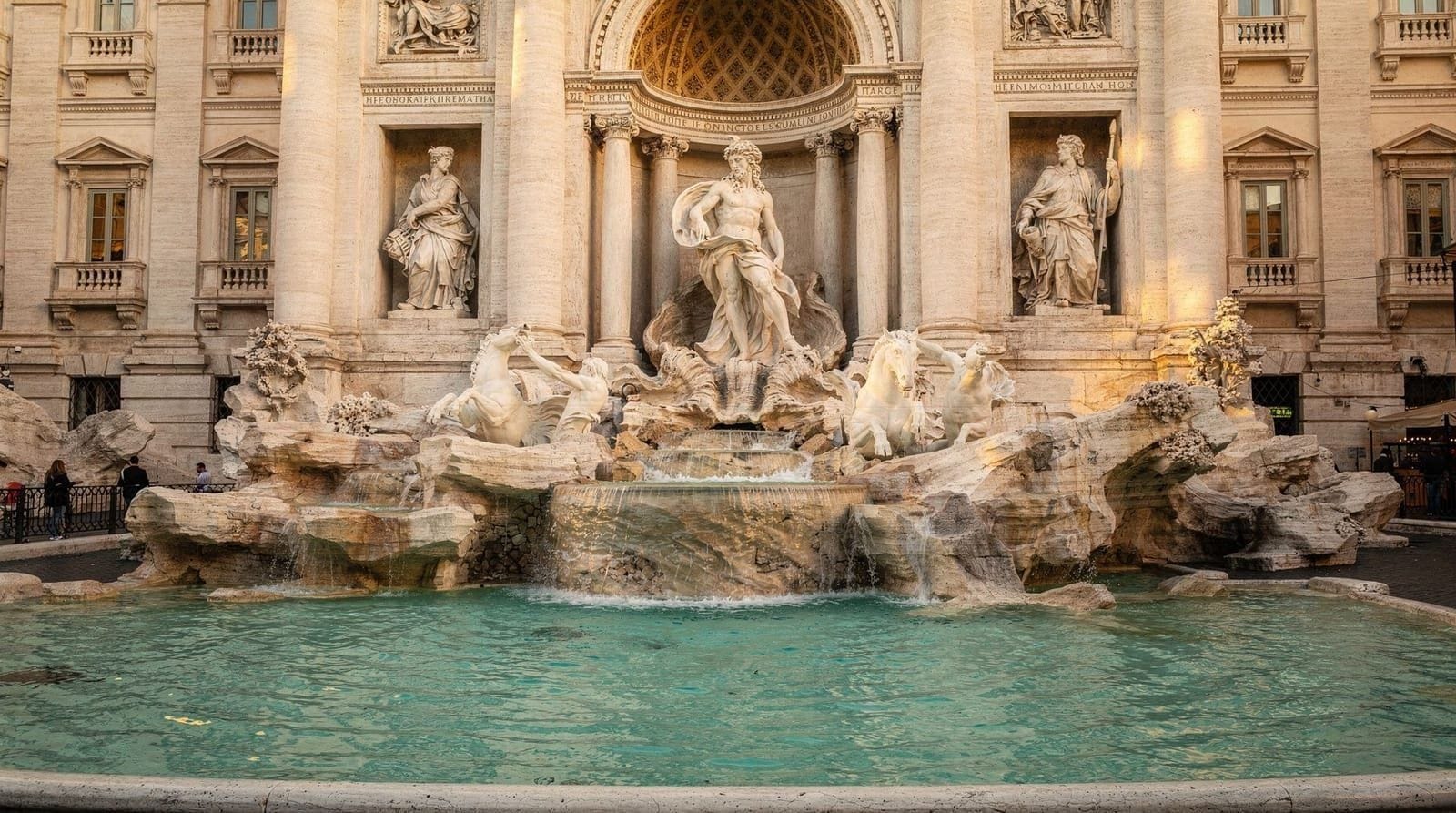
Rome is one of the most photographed cities on earth, and precisely because of that, most images of it look identical — tourist crowds, harsh noon light, lens flare off white marble. The city rewards those who understand two things: timing and position. The same Trevi Fountain that looks exhausted and overrun at 14:00 in July is genuinely transcendent at 06:00 in May. The same Pincio terrace that feels like a theme park on a Sunday afternoon is perfectly serene at 07:30 on a Tuesday.
This guide covers every major photo location in Rome with specific timing recommendations, less-obvious angles, and honest notes on what the popular shots actually require in terms of effort.
| Where | Citywide — Pincio, Gianicolo, Aventine keyhole, Ponte Sant’Angelo, Pantheon, Colosseum |
| Cost | Free at almost every spot; around €5-7 for the Pantheon ticket or Vittoriano terrace |
| Time needed | 20-40 minutes per location, more if you want to wait out the light |
| Getting there | Walking or bus between most central spots; the Gianicolo needs a short bus or climb |
| Best time | Golden hour (dawn or dusk) at almost every location on this list |
The Pincio terrace and Piazza del Popolo: the classic panorama
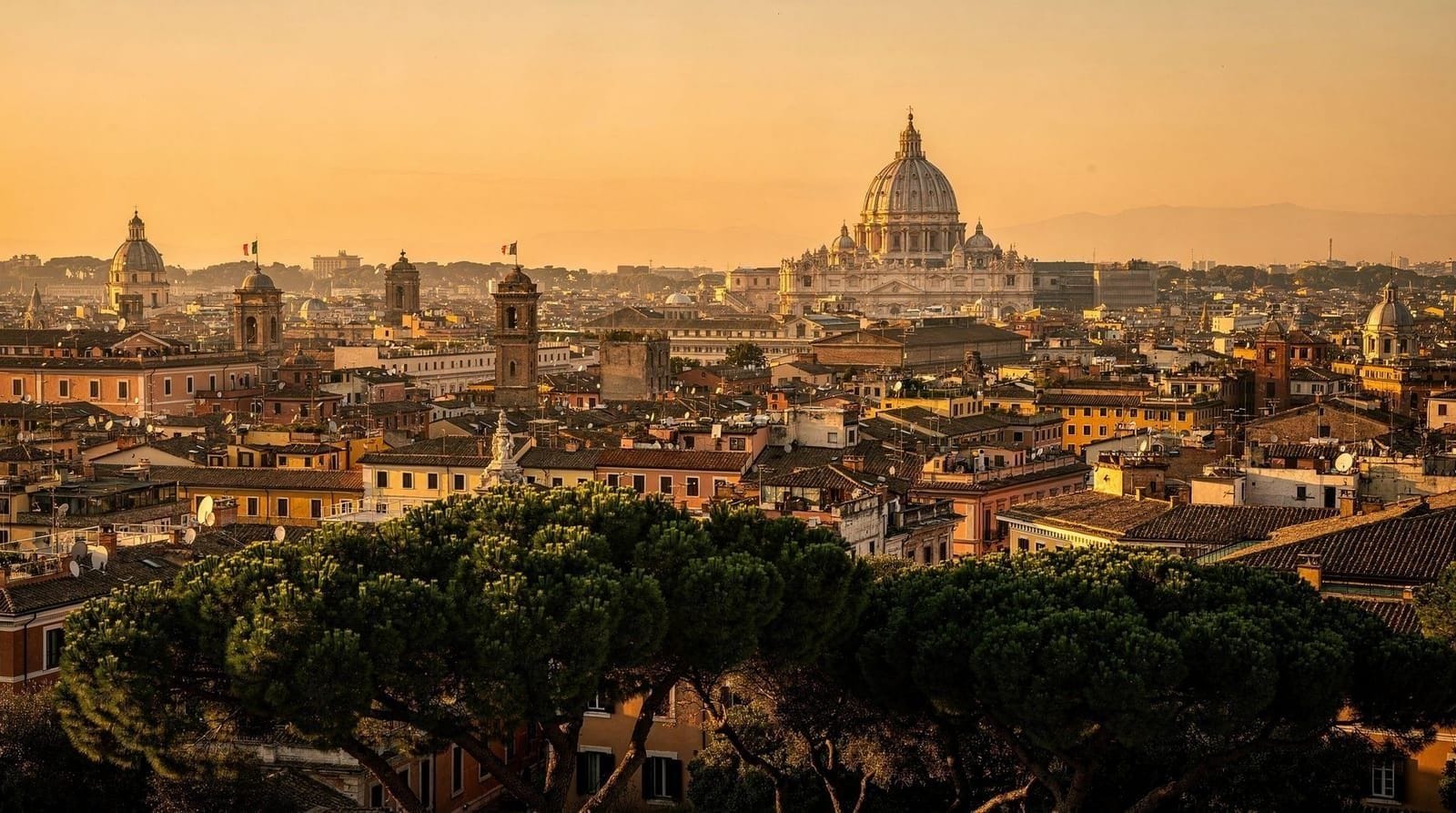
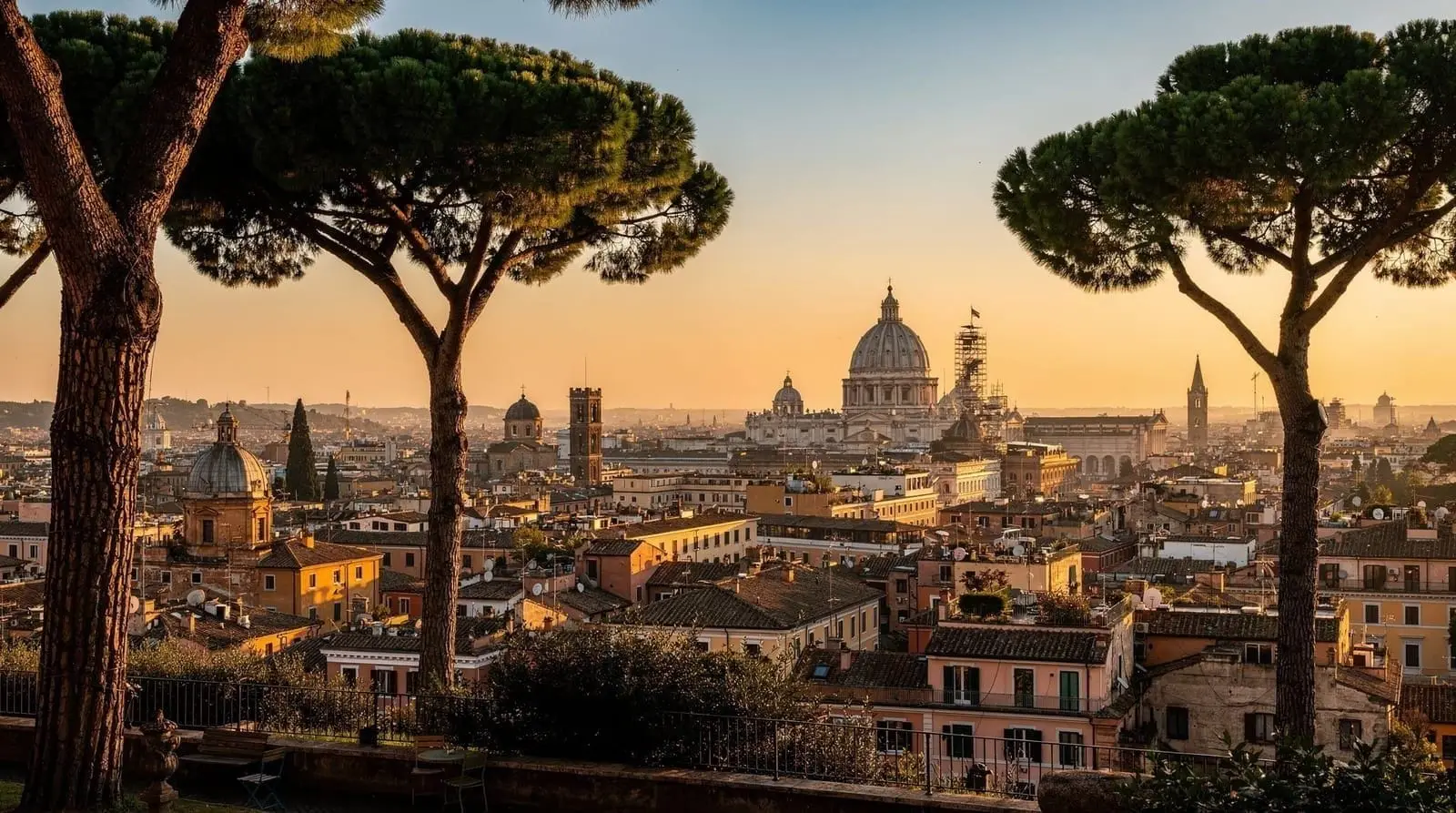
The terrace of the Pincian Hill above the Borghese Gardens is the most photographed panoramic viewpoint in Rome. Standing at the balustrade and looking southwest, you see the dome of St. Peter’s Basilica floating above a dense roofline of terracotta and ochre, with the Tiber somewhere below in the middle distance. It is the composition that appears on a thousand postcards.
The terrace faces almost directly west. This means the ideal times are clear: arrive at sunset for direct warm light on the domes, or arrive in the blue hour just after sunset when the sky goes deep indigo and the city lights click on. Sunrise is also excellent from this spot — you get softer, more diffuse light from the east, and in the early morning the terrace is effectively deserted even in high season.
Practical notes: the Pincio is free, accessible from Piazza del Popolo via the ramp or from the Borghese Gardens side. The terrace has a small café that opens around 10:00 and is usually crowded by 11:00 on weekends. Go before 09:00 or after 18:30 for manageable crowds at any time of year. A 24–70mm at the longer end (50–70mm equivalent) gives the compressed, telephoto-flattened rendering of the domes that makes the classic image work; ultra-wide lenses exaggerate the foreground and separate the domes spatially in a way that weakens the effect.
Gianicolo Hill: the broad view
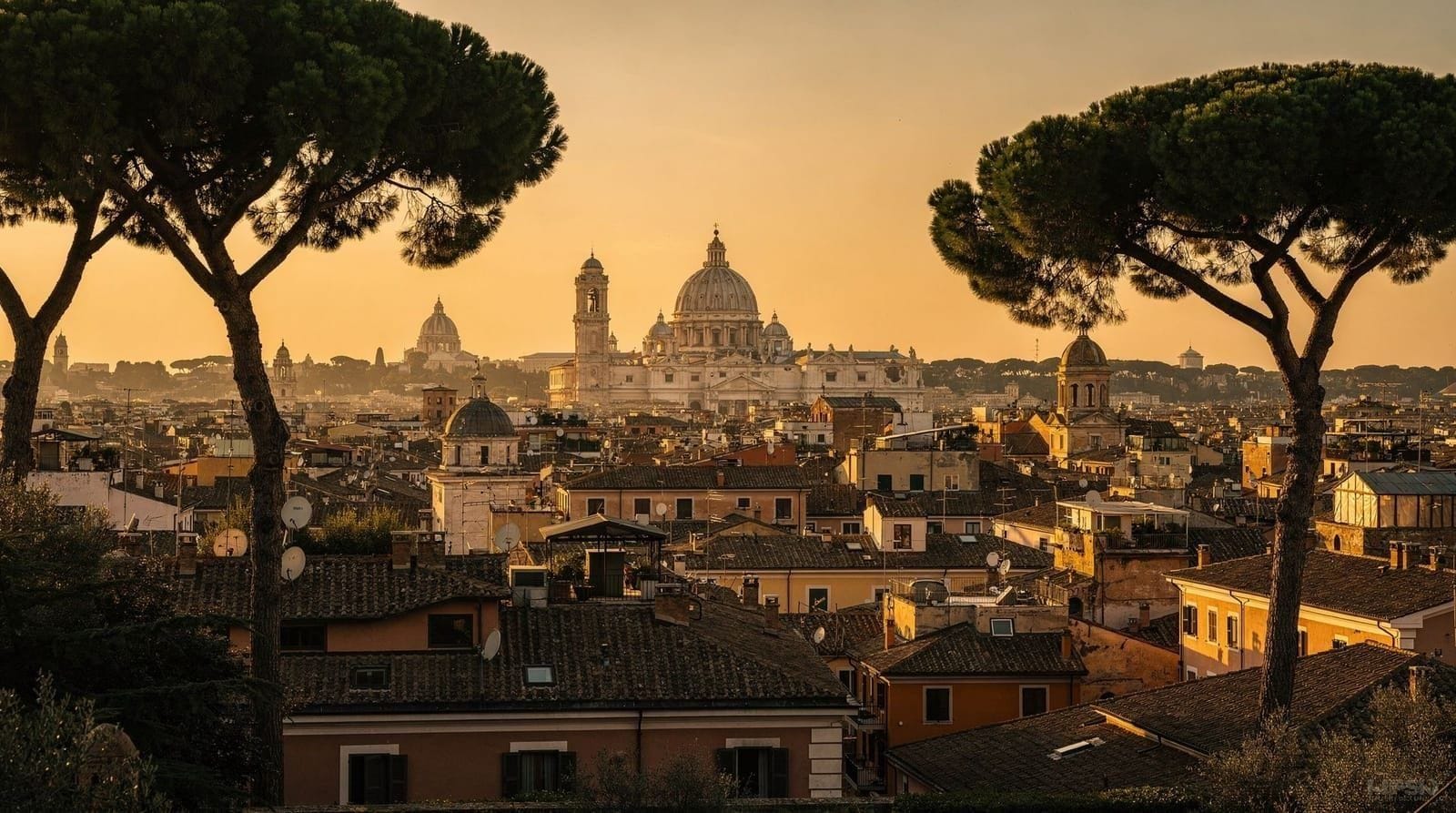
The Gianicolo (Janiculum) hill, west of Trastevere, offers the broadest and highest panorama over Rome from within the city proper. The main terrace near the equestrian statue of Garibaldi gives an almost 180-degree sweep from the Vittoriano monument on the left through the city centre, the Colosseum district, and toward the Castelli Romani hills in the distance. On clear winter days the Alban Hills are visible with snow.
Gianicolo faces east, which means early morning gives the most dramatic and flattering light — the low eastern sun warm-tones everything from Testaccio to the Vatican. For the best shot without tourists obscuring the foreground terrace, arrive before 08:00. A cannon is fired at noon from the Gianicolo as a time signal — it has been doing so since 1847 and the puff of smoke makes for an excellent incidental photo.
Access is straightforward: bus 870 or 115 from Trastevere, or a 20-minute walk up from the Porta San Pancrazio. The Fontana dell’Acqua Paola (the large Baroque fountain on the Gianicolo) is another excellent subject in its own right — the wide basin and triple-arched structure photograph beautifully in the late afternoon when the stone warms up.
Ponte Sant’Angelo at dawn
Ponte Sant’Angelo is the pedestrian bridge built by Hadrian to access his mausoleum (now Castel Sant’Angelo). The angels lining the bridge — designed by Bernini’s studio in the 17th century — are among the most graceful sculptures in Rome, and the view from the bridge in both directions is extraordinary: downstream toward the Castel Sant’Angelo with its floodlit bronze angel on top, upstream toward the Centro Storico. At night the bridge and Castel Sant’Angelo are illuminated in warm amber, with the dome of St. Peter’s visible above the roofline to the southwest.
Dawn is the best time — specifically the 30-minute window around sunrise, when the eastern light begins to pick out the angels while the sky still holds its pre-dawn blues and pinks. In summer (June–August) this means arriving around 05:30. In winter it is more manageable at around 07:00. At this hour the bridge is genuinely empty. By 09:00 there are tour groups. By 10:30 it is shoulder-to-shoulder. The investment of an early start pays back immediately in every photograph you take.
Blue hour is the other premium time: 20–40 minutes after sunset, when the sky goes a deep, saturated blue and every warm lamplight on the bridge and Castel is perfectly balanced against it. Bring a gorilla pod or lean the camera against the parapet — a tripod will be difficult to manage in the foot traffic that builds up on the bridge during evening hours.
A 3-hour guided night walk that covers Ponte Sant’Angelo, the Trevi Fountain and the major piazzas in the evening hours — useful context for understanding how the city illuminates and which positions work for photography.The Aventine keyhole and the orange garden
On Piazza dei Cavalieri di Malta — a small, elegant square on the Aventine Hill designed by Piranesi — there is an iron gate in the wall of the Knights of Malta priory. Through the keyhole in that gate, the long hedge-lined garden tunnel frames St. Peter’s dome in a perfect circle, centred and at a distance that makes it appear almost surreally large relative to the dark hedgerow border. It is one of the most photographed subjects in Rome, and rightly so.
Timing: aim for mid-morning, roughly 09:30–11:30, when the light falls into the garden from the south and illuminates the hedges from the side without blowing out the white dome. In early morning the garden is in shadow and the dome is over-bright; in afternoon the garden is in heavy shadow. There is usually a small queue — 5–15 people — that forms within a few minutes of the spot being listed online. The wait is rarely more than 10 minutes.
Combine this with the Giardino degli Aranci (Garden of the Oranges) 100 metres away on the same hill. This is a public park with a terrace looking toward the Aventine and across the Circus Maximus — the orange trees in blossom make spectacular foreground elements in spring (late March–April). The park opens at dawn and is one of the best sunrise spots on the Aventine side of Rome, with few tourists and excellent light.
See our Aventino neighborhood guide for a full overview of the Aventine’s photographic and historical attractions.
Via Piccolomini: the optical illusion
This is the most unusual photo spot in Rome, and one of the least visited by international tourists. Via Piccolomini runs from the Gianicolo hill back toward the Vatican, and for a portion of its length it is aligned so that St. Peter’s dome appears to grow larger as you walk away from it and shrink as you walk toward it — the opposite of what you expect. This is not a hallucination; it is a result of the road’s slight camber and the converging perspective of the tree-lined avenue.
Photographically this makes for a genuinely surprising image: a car moving away from the dome appears to be approaching an impossibly expanding basilica. The shot works best with a telephoto lens (85–200mm equivalent) from the far end of the avenue, which compresses the perspective and exaggerates the size relationship between the road and the dome. It is most striking in clear weather when the dome is well-defined against the sky.
Best time: early morning for empty road and soft light, or late afternoon for warm directional light on the dome. Weekday mornings see almost no traffic. The effect is best explained in person — it is significantly more striking when experienced by walking the road in both directions before photographing it.
Campidoglio and the Capitoline Hill
The Piazza del Campidoglio, Michelangelo’s masterwork of urban design on the Capitoline Hill, offers two distinct photographic experiences. The piazza itself — the oval geometric pavement pattern, the replica of the Marcus Aurelius equestrian statue at the centre, the twin-staircase approach — is best photographed in the early morning when the pavement is empty and the light catches the geometric relief in the stone at a low angle.
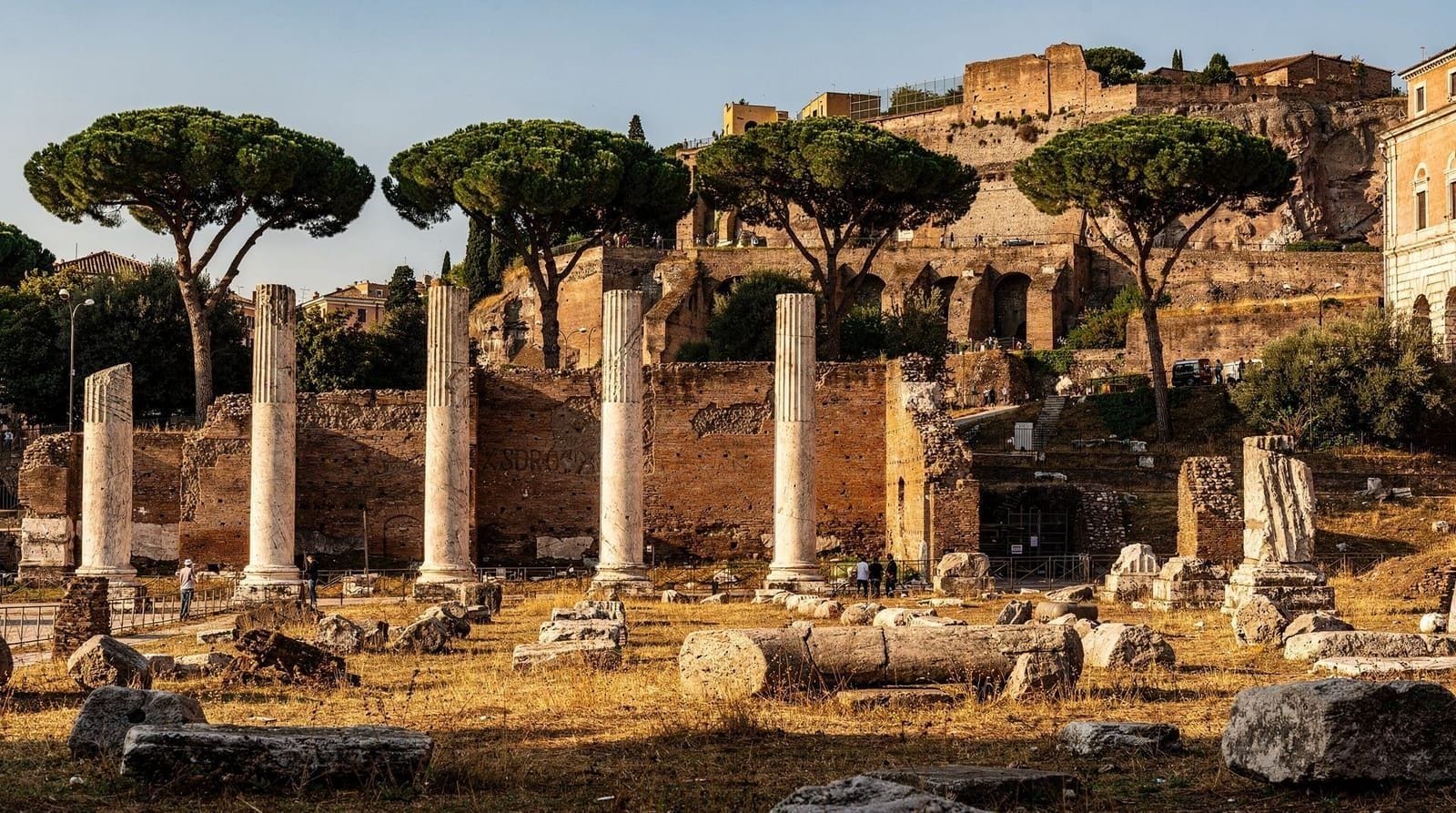
The free terrace at the rear of the Capitoline Museums (you do not need a ticket to access it via the Via del Monte Caprino path from the Roman Forum side) offers an elevated view directly over the Roman Forum. This is arguably the best angle for understanding the Forum spatially, and in the late afternoon golden hour, the ancient columns and arches catch warm low-angled light that turns the travertine to amber.
From the top of the Palazzo Senatorio (the central building), Rome spreads to the south. This terrace is accessible and often missed. See our Capitoline Hill guide for the full context on the piazza’s design and history.
An e-bike tour of the Seven Hills that covers the Gianicolo, Aventine, Capitoline and Pincio — hitting multiple photography viewpoints in a single efficient session without the exhaustion of walking between them.The Pantheon: interior and exterior
Exterior: the Pantheon’s portico and the view from Piazza della Rotonda work best very early — 06:30–08:30 in summer — when the low eastern light skims across the column capitals and the piazza is dry and clean after the night’s hosing down. There is often a mist or light haze in the early morning that softens the background. The fountain in the piazza centre makes a natural foreground element; position at the fountain level looking up at the portico for the most dramatic upward perspective.
Interior: photography without tripod is permitted. The famous oculus — the circular opening 8.2 metres across in the dome’s crown — produces a dramatic light beam in late morning (10:00–12:00 approximately) when the sun’s angle sends direct light through it. On a clear day the beam sweeps slowly across the interior as the earth rotates. Positioning: stand near the entrance and look straight up for the symmetrical oculus shot; move left or right to get the light beam in context with the coffered dome structure.
Entry now requires a timed ticket (€5 standard, booked at the official site). The ticket manages capacity well — the interior is rarely so crowded that photography is impossible, but morning entry slots are the least congested.
Spanish Steps and Piazza di Spagna
The Spanish Steps (Scalinata della Trinità dei Monti) are most effectively photographed from below, looking up along the steps toward the obelisk and the twin-towered church at the top. The church faces east, which means morning light is best — ideally 07:30–09:30 — when the facades are warm and the steps are relatively uncrowded. In spring, 250 pots of pink azaleas line the steps from mid-April to late April, making this one of the most photogenic periods in the Roman calendar.
From the top of the steps, looking down and south toward the Via Condotti, you get a classic compressed telephoto view of the street with the obelisk in the foreground. A 70–200mm equivalent at the long end flattens the perspective pleasingly. From here the Spanish Steps guide has detailed context on the history and layout.
The night shot looking up from the base of the steps works well in blue hour — the illuminated church towers float above the lit steps in a way that is considerably more impressive than the daytime equivalent.
Trastevere: alleys and light
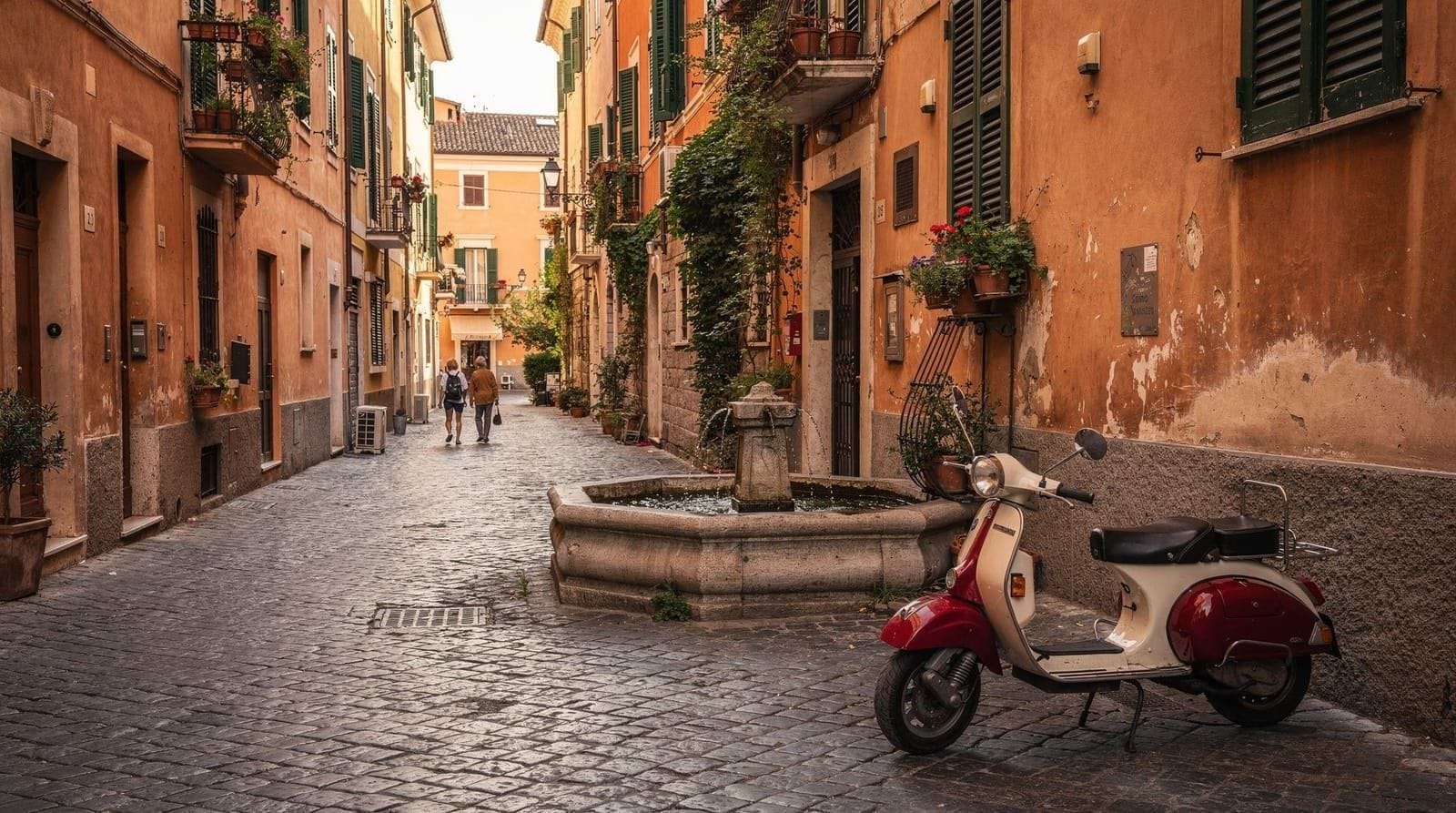
Trastevere is Rome’s most photogenic neighbourhood for street and architectural photography — narrow cobbled alleys, ochre-washed walls, laundry strung between windows, vines trailing over archways. The light here is particularly beautiful in the late afternoon and golden hour, when the low-angled sun enters the east-west alleys and illuminates the wall textures from the side.
The most photographed specific spot is the Vicolo del Cedro and surrounding area around the Chiesa di Sant’Agata — a small square with outdoor tables, a fountain, and typical Roman street architecture. In golden hour this is genuinely extraordinary, but also fairly well known. For less-visited alternatives, explore the northern end of Trastevere above the Viale di Trastevere, particularly the area around Santa Maria dei Sette Dolori and the quieter streets to the east of the main tourist zone.
The Trastevere neighborhood guide has a fuller street-by-street breakdown.
Piazza Navona and Campo de’ Fiori at dawn
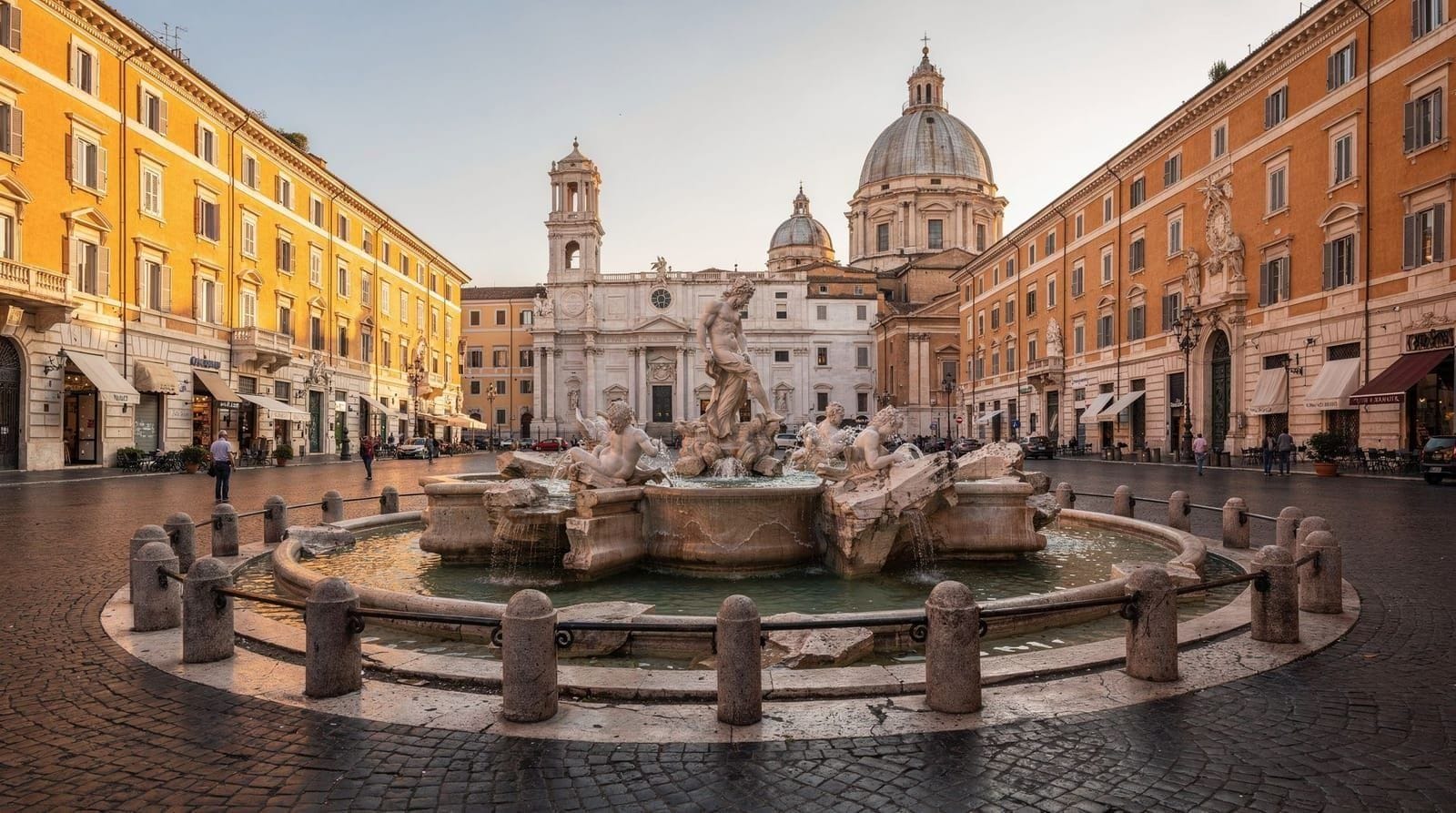
Piazza Navona — with Bernini’s Fountain of the Four Rivers at its centre and the Sant’Agnese in Agone church as its backdrop — is one of the most satisfying piazzas to photograph in Rome, but managing the crowd is everything. At any hour between 10:00 and 22:00 in summer, the piazza is thronged with tourists, café chairs and street performers.
At dawn — 06:00–07:30 in summer — the piazza is virtually empty, the café chairs are stacked, the cleaners have usually finished, and the low eastern light rakes across the fountain sculptures from the side, giving the most dramatic three-dimensional modelling of the figures. The Piazza Navona guide discusses the Bernini fountains in full detail.
Campo de’ Fiori, five minutes’ walk south, is most interesting photographically during the morning market (07:00–13:30 Monday–Saturday) when the fruit and vegetable displays provide vivid colour and the vendors and shoppers create natural street photography opportunities. The statue of Giordano Bruno at the centre makes a dramatic silhouette in morning backlight.
Colosseum: the less-obvious angles
The standard Colosseum shot from the official photo position — west side, slightly angled — is fine but has been taken by approximately 40 million people. Consider these alternatives:
The approach from the Arch of Constantine toward the Colosseum in the early morning gives a low-angle shot looking northeast, with the arch framing the Colosseum behind. This is particularly good in the hour after sunrise in autumn and winter when the light enters from the southeast and warms the travertine directly.
From inside Palatine Hill (combined ticket required) looking west, you can photograph the Colosseum from above and behind, with the Roman Forum in the foreground — an angle almost never seen in standard tourist photography.
From the Caelian Hill (Celio), looking north from near the entrance to Parco del Celio, gives a south-facing view of the Colosseum that is empty of tourist infrastructure, showing the exterior against the sky. Best in mid-morning when the south-facing exterior is well lit.
A city highlights golf cart tour with a local guide — covers the Colosseum, Campidoglio, Trevi, Navona and Pincio in a single session, useful for scoping all the viewpoints before deciding where to return at the right time.Practical photography logistics
Golden hour calculator: In Rome, golden hour runs roughly 05:40–06:40 in June, 06:10–07:10 in March/September, and 07:10–08:10 in December (sunrise times). The Gaisma website gives exact civil/nautical twilight times for Rome by date.
Crowds and season: The least crowded windows for photography are October–early November and February–March. July and August are the worst — not only are tourist crowds maximal, but the flat harsh summer light makes shooting difficult outside of the brief golden hours. Spring (April–May) gives the best combination of reasonable crowds, flowering plants and good light quality.
Equipment considerations: A small daypack keeps your camera inconspicuous in crowded areas. Central Rome is a pickpocket zone — particularly on the Metro A line (Termini to Ottaviano) and at major tourist sites. Use a camera strap worn across the body, not hanging from one shoulder.
Permits: Commercial photography (i.e. for commercial use beyond personal travel) at Rome’s major sites generally requires permits and fees. For personal travel photography, no permit is needed at outdoor public spaces. Museum and monument interiors have their own rules — check on arrival.
For a full exploration of Rome at dusk and night, see our Rome sunrise and sunset spots guide and the Rome by night guide for evening tour options.
St. Peter’s Square and the dome
St. Peter’s Square itself photographs best in the first two hours after opening, when the colonnade’s shadows still stretch long across the travertine and the security queue hasn’t yet built up. Bernini’s elliptical colonnade is designed so that, standing on one of the two round paving stones set into the square (look for them roughly midway between the obelisk and each side of the colonnade), the four rows of columns align into a single row — a genuinely satisfying optical trick and a reliably good photo regardless of light.
For the dome itself, the classic distant view is from the Pincio or Gianicolo (covered above), but the closest dramatic angle is from Via della Conciliazione looking west in early morning, when the avenue is nearly empty and the dome anchors the strip of the street in soft light. Climbing the dome (see our St. Peter’s dome climb guide) adds a genuinely unique elevated perspective over the square and the Vatican Gardens, though the stairwell itself is narrow and not tripod-friendly — a phone or compact camera works best on the climb.
Instagram-famous spots vs. the real thing
Several locations that circulate heavily on Instagram — certain courtyards, specific café corners, particular staircases — are private property or semi-private spaces where photography for personal use is tolerated but not always welcomed, especially by residents tired of tourists posing in their doorway. Treat a geotagged Instagram spot as a starting point, not a guarantee: check whether it’s a public street, a paid attraction, or someone’s actual front step before planning a special trip around it. Public piazzas, hills, bridges and monuments — everything covered in this guide — carry no such ambiguity and are the more reliable investment of an early morning.
Seasonal photography calendar
Light quality, crowd density and specific seasonal subjects change enough across the year that the same viewpoint can produce very different results depending on when you show up.
| Season | Crowd level | Light quality | Best subjects |
|---|---|---|---|
| Winter (Dec-Feb) | Low, except around Christmas | Softer, lower sun angle all day | Clear-air panoramas from Gianicolo, empty piazzas |
| Spring (Mar-May) | Moderate, rising through May | Excellent, long golden hours | Spanish Steps azaleas, Aventine orange blossom |
| Summer (Jun-Aug) | Very high, worst light at midday | Harsh midday, superb dawn/dusk | Early-morning Trevi and Navona, blue-hour bridges |
| Autumn (Sep-Nov) | Moderate, best overall balance | Warm, long shadows | Golden-hour Forum from Capitoline terrace, Colosseum dawn |
For planning a whole trip around this, our Rome in spring guide and best time to visit guide go beyond photography into weather and crowd patterns more broadly.
Rooftop and elevated bar shots
Beyond free public viewpoints, several rooftop bars double as photography spots, trading a drink purchase for an elevated angle you can’t get for free. These work best just before sunset, when you can shoot the light show and then relax with the view rather than rushing off. Expect to spend on at least one drink to justify the table, and arrive 30-45 minutes before sunset to secure a rail-side spot before the crowd builds. See our Rome rooftop bars guide for specific venues, prices and booking advice — some require reservations for sunset slots in high season.
Phone photography and quick edits
Not everyone travels with a dedicated camera, and modern phones handle most of the spots on this list well, with two caveats. First, phone sensors struggle in the harsh contrast of a dark keyhole or archway framing a bright background (the Aventine keyhole is the classic case) — use the phone’s HDR mode or expose for the highlights and brighten shadows afterward. Second, ultra-wide phone lenses distort domes and columns at the edges of the frame; step back and use the main lens rather than the widest one for architectural subjects like the Pantheon or Piazza Navona’s fountains. A simple edit pass — straightening verticals and lifting shadows slightly — closes most of the gap with a dedicated camera for web-sized images.
Frequently asked questions about The best photo spots in Rome: a location guide with timing
What is the best time of day to photograph Rome?
When should I photograph the Trevi Fountain without crowds?
Is a tripod allowed at Rome's photo locations?
What lens focal length works best for Rome photography?
Can I take photos inside the Pantheon?
What is the Aventine keyhole view and when should I go?
What are the best viewpoints for a Rome panorama?
How do I photograph the Colosseum well?
Top experiences
Bookable activities with verified prices and instant confirmation on GetYourGuide.