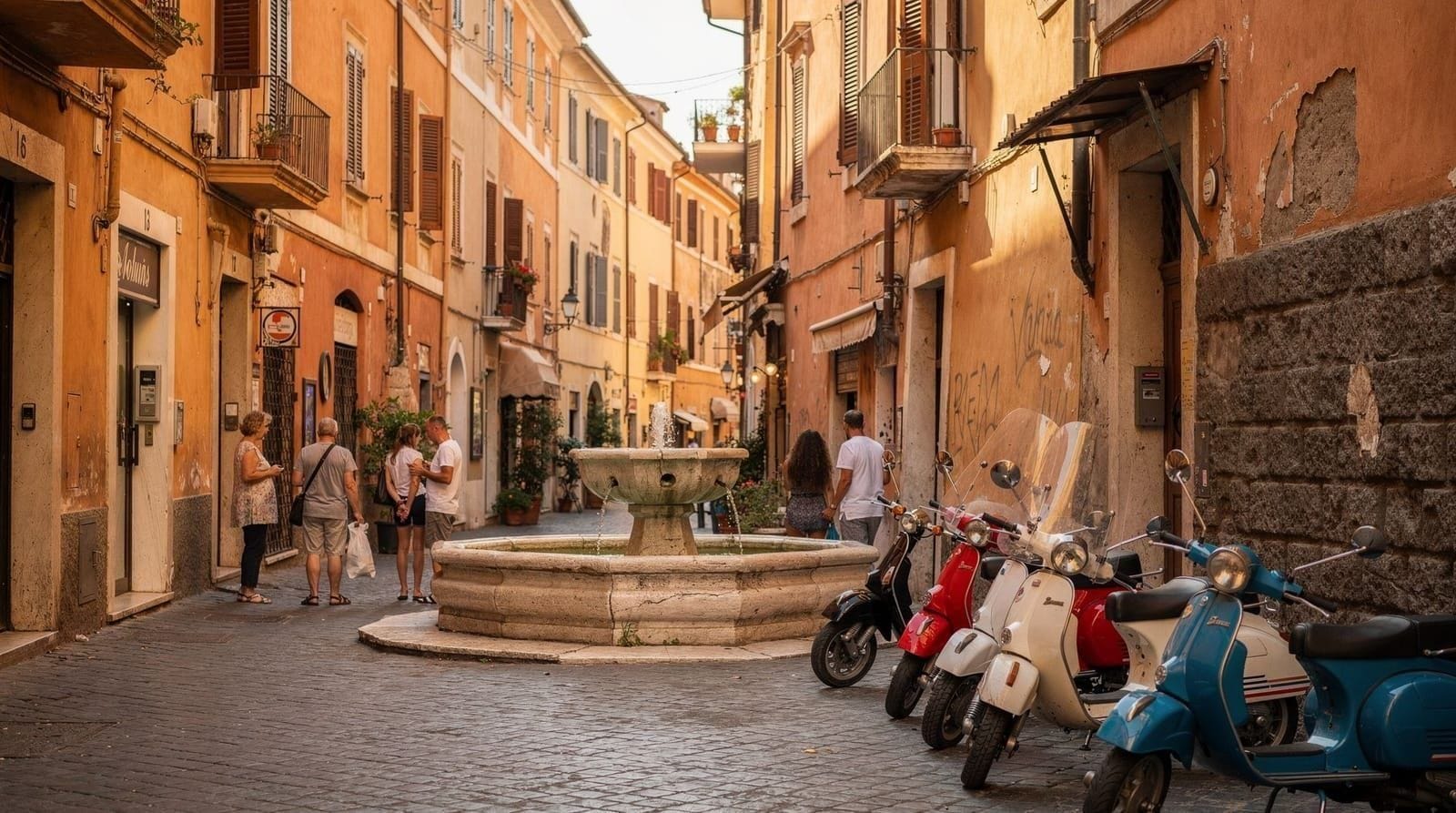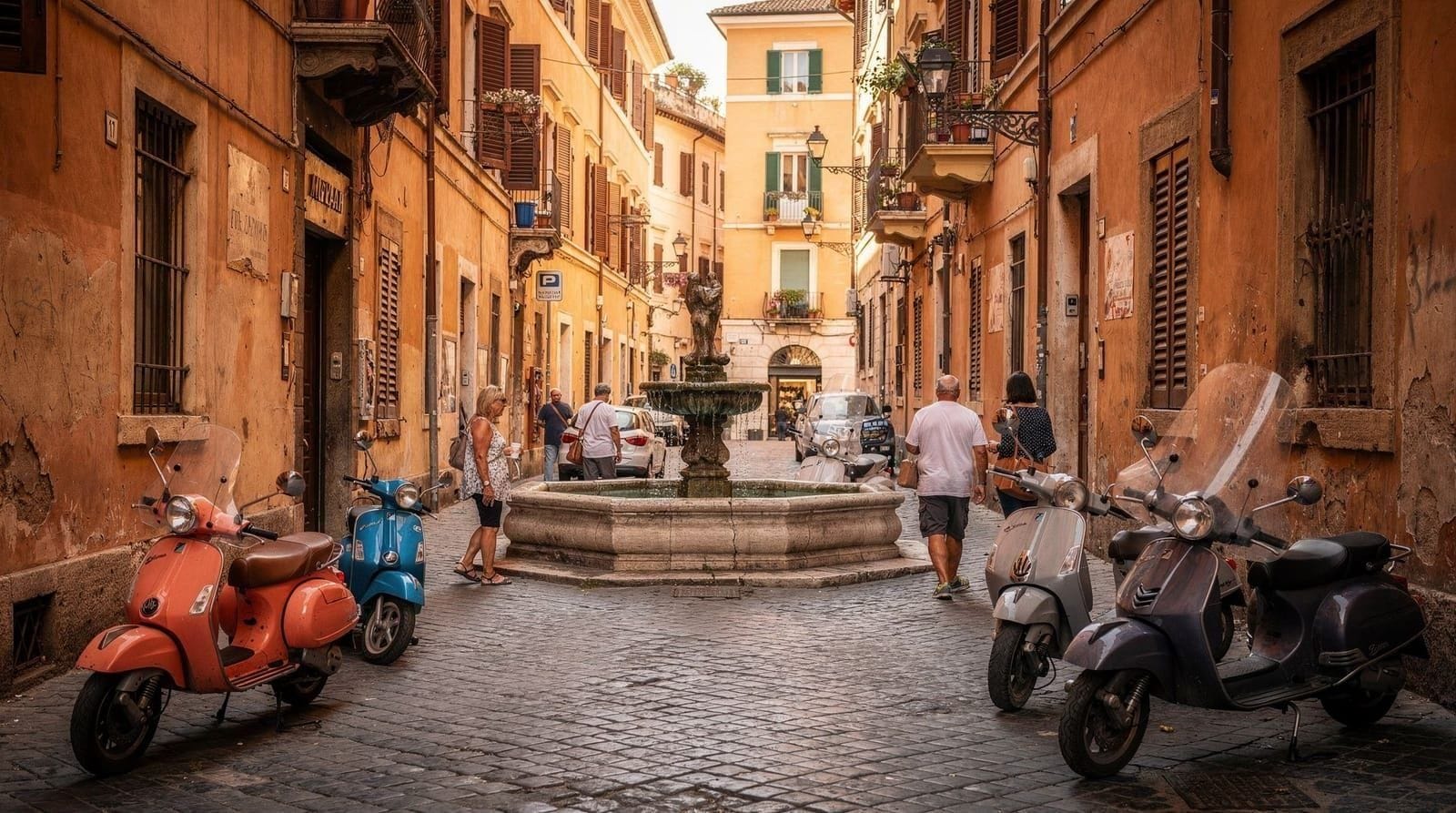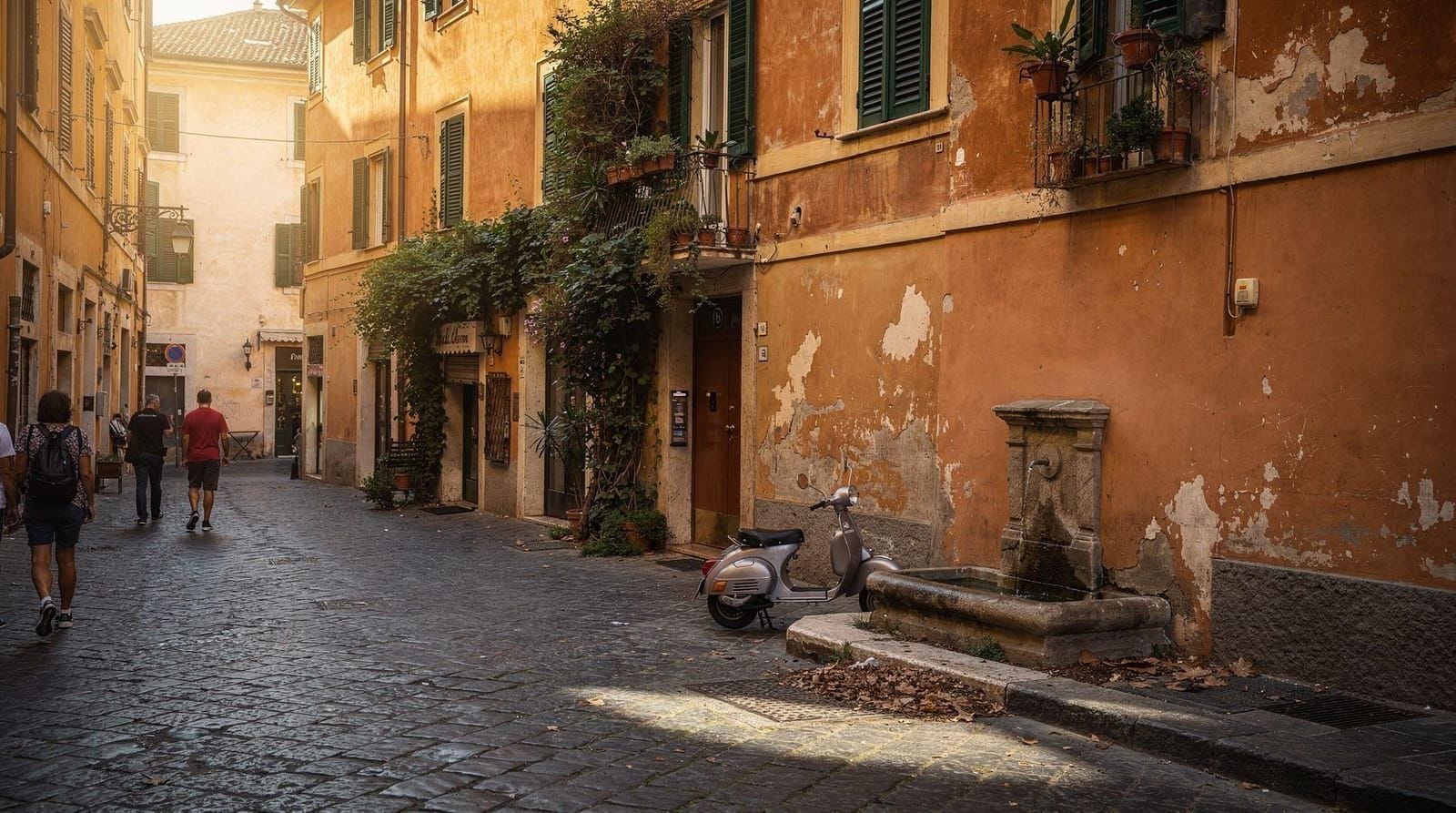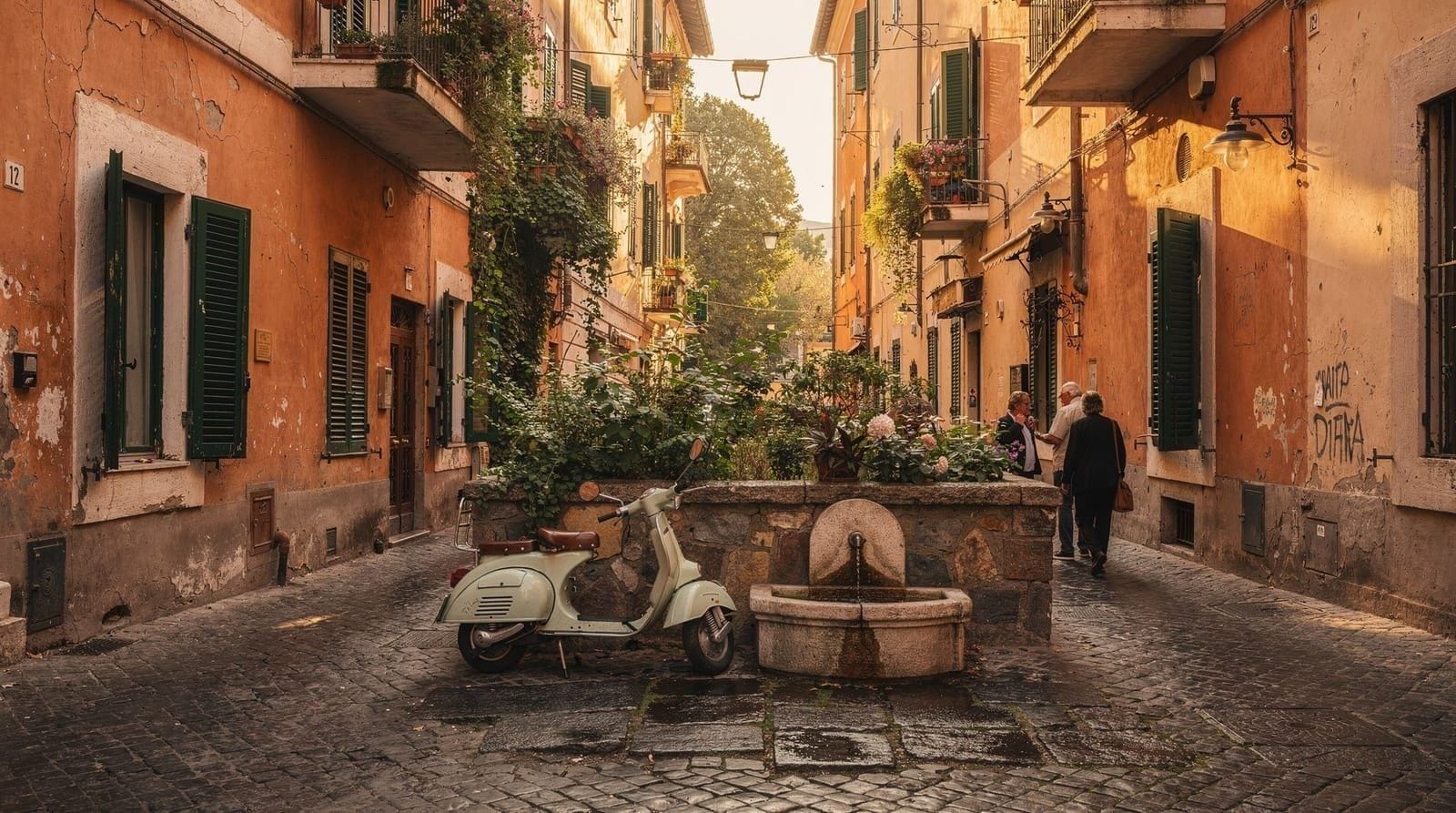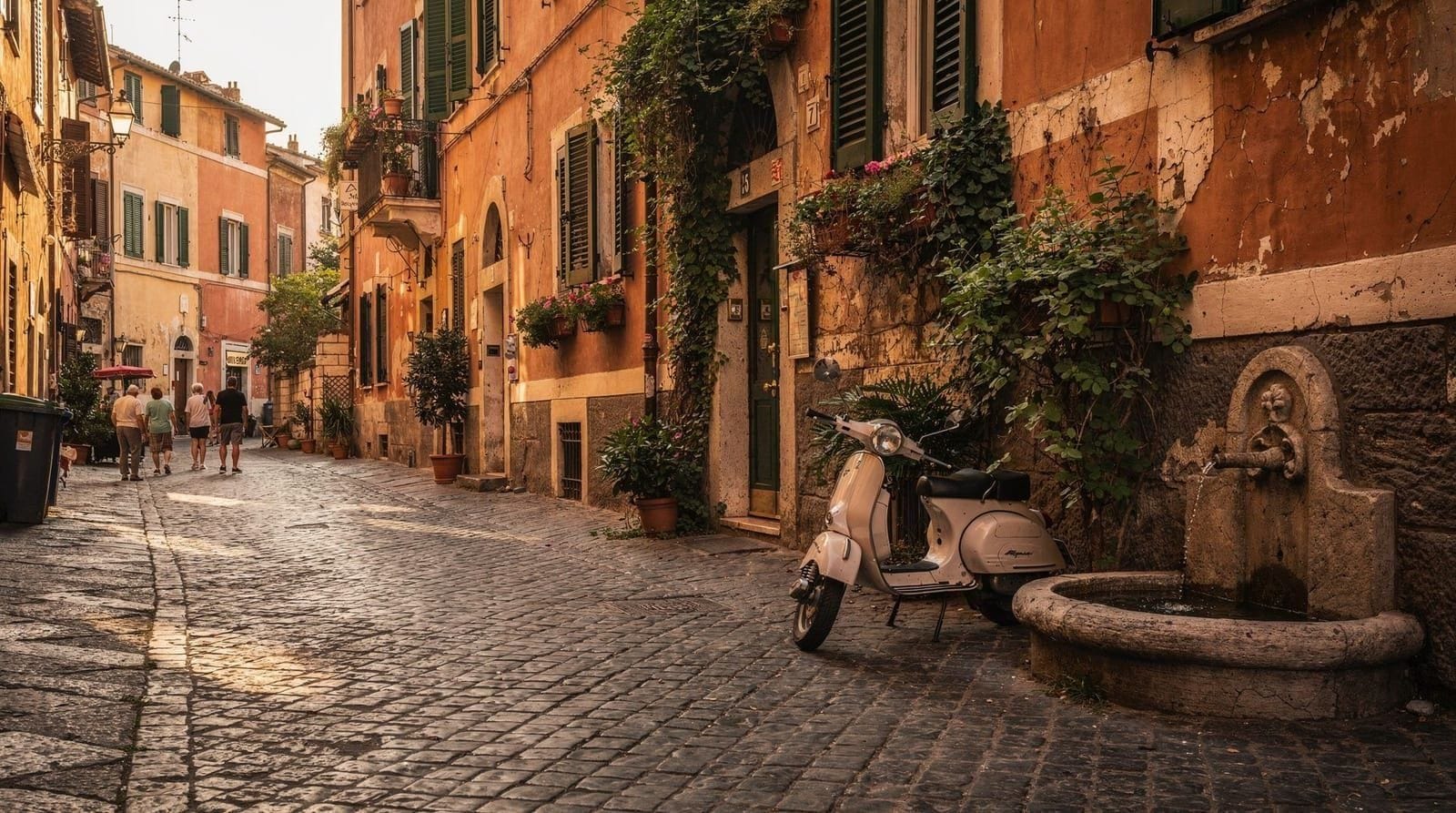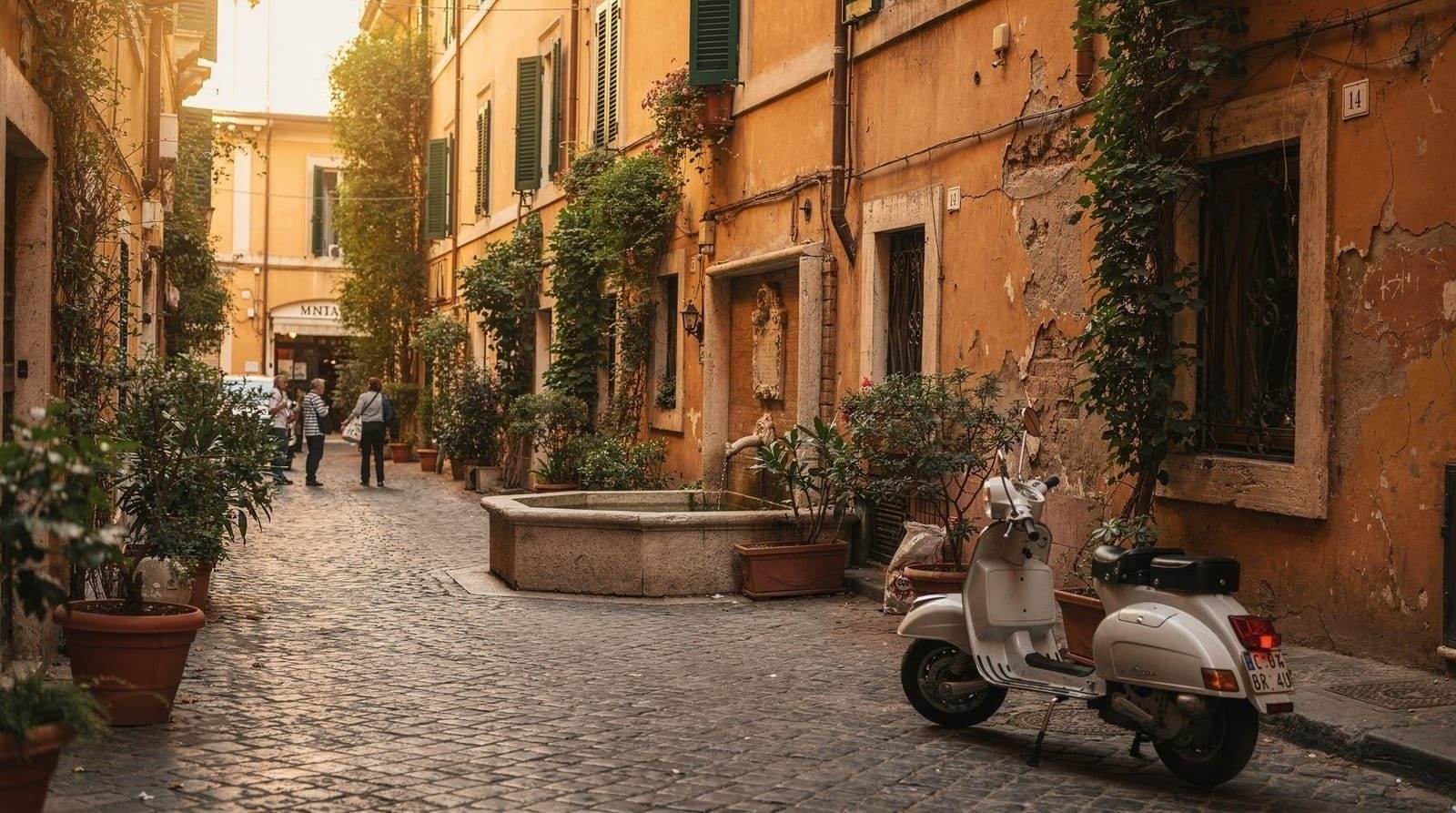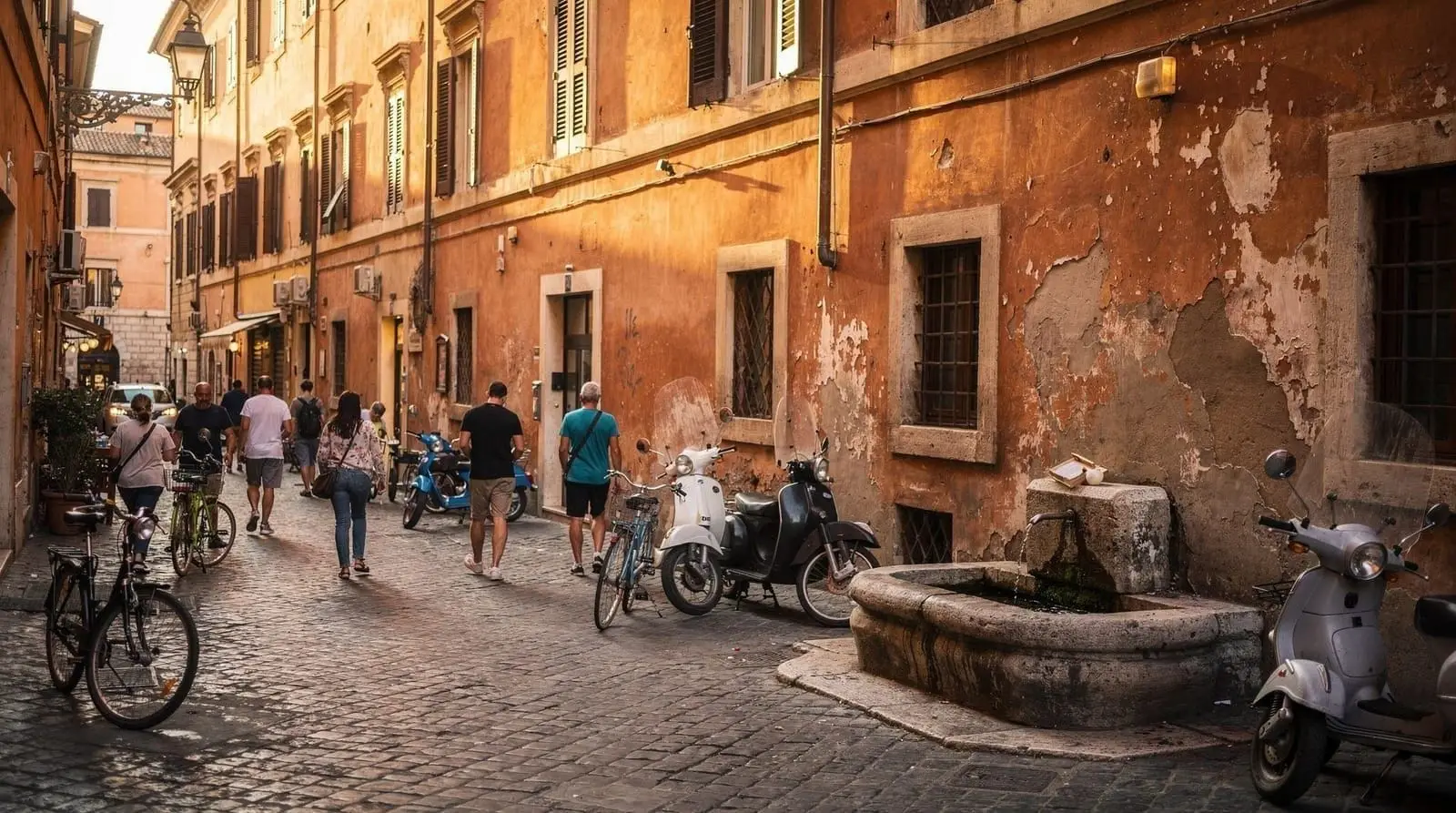
Where locals actually go in Rome: neighborhoods, bars and escapes
Rome: Trastevere Secret Food Tour
Where do locals actually go in Rome?
For daily life: neighbourhood bars in Prati, Monti, Pigneto, and Testaccio. For food: the Mercato di Testaccio and trattorie on Via Galvani. For weekends: Gianicolo Hill, the Borghese Gardens, and — in summer — the beaches at Ostia Lido and Santa Marinella. For aperitivo: Pigneto and Monti. For Sunday morning: Campo de' Fiori market and Porta Portese flea market.
The tourist Rome vs local Rome divide
Rome’s tourist infrastructure and local life overlap very little. A tourist area is a place where the primary function of every business is serving visitors. A local area is a place where the primary function is serving people who live there. The quality of food, the price of coffee, the atmosphere of the bar — all of these change dramatically depending on which type of area you are in.
This guide is about local Rome: where Romans eat, drink, socialise, escape, and spend time when they are not involved in Rome’s enormous tourism industry. None of it is secret. Most of it simply requires walking a few streets in the right direction.
| Where | Prati, Monti, Pigneto, Testaccio for daily life; Ostia Lido and Castelli Romani for weekends |
| Cost | Espresso 1–1.20 € standing; aperitivo 5–8 €; local trattoria pasta 9–13 € |
| When | Sunday morning for markets and the Appian Way; 18:00–20:00 for aperitivo |
| Getting there | Walk 5–10 minutes off the monument routes, or a short metro/train ride for escapes |
| Best time | Any day, though Sunday mornings and weekday evenings show local Rome best |
The neighbourhood bar: Rome’s social infrastructure
The Italian bar is not a pub or a cocktail bar. It is a standing espresso counter in the morning, a quick lunch spot at noon, and a place for an aperitivo in the evening. Italians use the neighbourhood bar daily — often twice — as a social anchor.
The economics are simple: espresso at the counter costs 1-1.20 €. Sitting down costs 2-4 € more. Locals stand. You should stand. In five minutes at a busy bar counter in Prati or Testaccio you will encounter more authentic daily Rome than in two hours of restaurant dining near the Pantheon.
Where to find good neighbourhood bars:
Prati (between the Vatican and the Tiber): This is where Vatican employees, middle-class Romans, and neighbourhood residents drink coffee without tourist markup. Via Candia, Via Cola di Rienzo, and Via Germanico all have solid local bars. The neighbourhood has excellent pizza al taglio shops and a genuine daily market. See our Prati neighbourhood guide.
Monti: Rome’s most artistically inclined neighbourhood, stretching between the Colosseum and Esquilino Hill. Via del Boschetto and Via dei Serpenti have a mix of wine bars, coffee shops, and old-school bars. More visited by tourists than five years ago, but the local character survives on the side streets. See the Monti guide.
Pigneto: East of Termini, this is Rome’s most genuinely local nightlife neighbourhood. No monuments, no tour buses, minimal English menus. Via del Pigneto on a weekday evening has an outdoor bar scene that is entirely Roman in character — aperitivo drinks with snacks, conversations spilling onto the street, no performance of local culture for visitors.
Testaccio: The traditional slaughterhouse neighbourhood. The bars here serve the market workers, the residents of the 19th-century apartment blocks, and the staff of the nearby theatre. No pretension, honest prices, the feeling of a neighbourhood that predates tourism.
Testaccio: the food neighbourhood Romans don’t hype
Testaccio is not a secret. Romans know it well as the neighbourhood where Roman cuisine is most genuine. What makes it underused by tourists is that it requires a deliberate decision — there are no major monuments nearby and no obvious reason to go if you are working from a standard attractions list.
The Mercato di Testaccio (Via Galvani, open Monday-Saturday until approximately 14:00) is the most local market in central Rome. Box 15 (Supplì Roma) makes the definitive version of Rome’s most beloved street food. The artichoke vendors sell Rome’s other defining dish — carciofi alla giudia, deep-fried artichokes in the Jewish style. The market has a wine bar and a pizza stand.
Monte Testaccio, the artificial hill visible from Via Caio Cestio, is made entirely of broken ancient amphorae — approximately 53 million fragments of olive oil vessels discarded from the trading port nearby over several centuries of Roman commerce. The clubs and bars built into its caves are the neighbourhood’s historical nightlife district.
The Cimitero Acattolico (Protestant Cemetery) adjacent to the Pyramid of Cestius is one of Rome’s most beautiful and least-visited spaces — a walled garden where Keats and Shelley are buried, cats walk between Victorian graves, and the sound of the city is muffled by high walls. A suggested donation of 3 € applies. See our Testaccio neighbourhood guide.
A food tour in Trastevere covers some of the same territory as genuine local eating — the spots that are not in front of tourist-facing restaurants.Sunday morning rituals
Sunday morning is when Roman public life is most visible. The Appian Way is closed to cars and open to walkers, cyclists, and runners. Families with children on bicycles mix with elderly couples, joggers, and the occasional horse rider. The ancient basalt paving, the aqueduct ruins, the grassy margins — all part of the Sunday morning backdrop for people who live in the neighbourhood. See our Appian Way guide.
Porta Portese in Trastevere is Rome’s largest flea market, running every Sunday morning from 06:00 until approximately 14:00. The section nearest the Trastevere train station (Porta Portese itself) is oldest and most genuinely second-hand: furniture, clothes, records, books, kitchen equipment, tools. The further sections add new merchandise and tourist items. The energy before 09:00, before tourist crowds arrive, is the authentic Roman Sunday flea market experience. See our Porta Portese guide.
The Borghese Gardens on Sunday morning are Rome’s living room — families on foot, rollerbladers, people reading on the grass near the lake, the occasional rowing boat. Free to enter. The gallery itself requires advance booking but the gardens are open without restriction.
Where locals eat
The restaurants Romans actually use are almost never on the tourist circuit. Some characteristics:
- Handwritten daily specials on a board (not a laminated tourist menu)
- Prices that feel reasonable for Rome (pasta 9-13 €, secondi 12-18 €)
- Mixed clientele including people who live in the neighbourhood
- Coperto of 1.50 € or less
- Open at times that Romans eat (lunch 13:00-15:00, dinner 20:00-22:30)
Note on dinner timing: Romans eat dinner late. Restaurants in local neighbourhoods do not fill until 20:00-20:30. Arriving at 19:00 will result in eating alone in an empty restaurant — or worse, in a restaurant that is only open early because it is catering to tourists. Wait until 20:00 for dinner.
Specific areas for local dining:
- Via dei Salumi and Via della Lungaretta in Trastevere (one block back from the main tourist drag)
- Piazza dei Mercanti and surrounding streets in Testaccio
- Via del Boschetto in Monti
- Via Ostiense and Via Marmorata near Testaccio
- Pigneto for genuinely cheap, genuinely Roman food at informal osterie
The Roman bar culture lexicon
Caffè / espresso: Shot of espresso. Drunk standing at the counter in 2-3 minutes. 1-1.20 €.
Macchiato: Espresso with a drop of steamed milk. Standing price is same as espresso.
Cappuccino: Only at breakfast. Romans do not drink cappuccino after 11:00. Ordering one at lunch or dinner signals tourist. Fine if you want it — Romans will serve it without comment, but will know.
Cornetto: The Italian croissant, filled with cream (panna), jam (marmellata), or plain (vuoto). The breakfast cornetto at a good bar costs 1-1.20 €. Essential.
Aperitivo: The evening drink ritual, 18:00-20:00. Typically a Negroni, Aperol Spritz, or Campari Soda with small snacks. Rome’s aperitivo is not the full Milanese spread but it is a genuine daily social institution.
Digestivo: After dinner — grappa, limoncello, amaro. Often offered free or at low cost at local trattorias to regular customers.
Roman escapes: where people go to decompress
On summer weekends, Romans leave the city. The nearest escapes:
Castelli Romani (Frascati, Castel Gandolfo, Nemi): 30-45 minutes by train or car. The pope’s summer residence is at Castel Gandolfo. Frascati is the wine capital — the local white wine, sold directly from cantinas at under 4 € per litre, is what Romans drink in summer. Lake Albano at Castel Gandolfo is a crater lake for swimming, though the public shores are limited. See our Castelli Romani guide.
Ostia Lido: 30 minutes by train from Piramide, Rome’s nearest beach. Honest assessment: the water quality varies (it has improved but the proximity to Rome’s coast means it is not the Amalfi Coast), and the beach is mostly managed by private beach clubs (stabilimenti) charging 15-25 € per sun lounger and umbrella. Free beach sections exist. Romans go because it is close and a day at the beach beats a day in 35°C city heat. For better beach quality, Santa Marinella (1 hour by train) is the local preference.
Lago di Bracciano: One hour north by car or regional train. A volcanic lake with clean water, small lakeside towns (Bracciano, Anguillara Sabazia), swimming, and sailing. Much less crowded than Ostia. Popular with Romans who have friends with boats. See our Lake Bracciano guide.
Tivoli: 45 minutes by bus from Ponte Mammolo. The Villa d’Este (UNESCO-listed Renaissance gardens with water features) is the main draw, but locals come to Tivoli for the Sunday lunch scene — restaurants in the old town serving whole roasted lamb and local wine — as much as for the monuments. See our Tivoli guide.
An e-bike tour of Rome’s seven hills covers several of the residential and local neighbourhoods in context — useful for building a mental map of the city beyond the tourist centre.The nightlife gap between tourist and local
Tourist nightlife in Rome concentrates near Campo de’ Fiori (increasingly generic), Pigneto (genuine but rapidly changing), and the Prati/Trastevere overlap for late-night bars. Local nightlife for the under-35 Roman demographic centres on Pigneto, Ostiense (around the Gazometro industrial zone), and occasionally San Lorenzo (student neighbourhood).
The aperitivo hour (18:00-20:00) in Monti and Pigneto is the most accessible point of contact between tourist and local nightlife. You do not need insider knowledge or language skills — you just show up at a bar and order a drink, which comes with snacks, and you stand on the pavement and watch Rome go past. This is genuinely what Romans are doing.
See our full Rome aperitivo and nightlife guide.
The local food shopping circuit
Romans do not typically buy food in shops near tourist areas. The everyday food infrastructure is the neighbourhood supermarket (Conad, Carrefour, Despar), the local alimentari (small grocer), and the market.
For visitors who want to eat cheaply and well — picnic lunch, drinks for the hotel room, snacks for monument days — these are the correct places:
Supermarkets in the tourist centre: There is a Despar near Via del Corso (in the basement of a building at Corso Vittorio Emanuele II), a Carrefour Express near Campo de’ Fiori, and several Conad branches within walking distance of most tourist hotels. A picnic lunch from a supermarket — bread, cheese, salumi, fruit — costs 6-8 € and is better quality than a 20 € tourist café sandwich.
Alimentari: The small neighbourhood grocery/deli. Found on every Roman residential street, largely absent from tourist areas. They sell prepared foods (cold cuts, roasted vegetables, mozzarella), fresh bread, and local cheeses at prices around 40% lower than tourist-facing delis. The staff will typically make a panino (sandwich) to order for 3-4 €. Ask for “un panino con prosciutto e mozzarella” and you will be understood immediately.
Wine shops (enotece): Rome has a significant wine shop culture in residential neighbourhoods. Monti has several good enotece on Via dei Serpenti; Testaccio has neighbourhood-priced wine. A bottle of Frascati Superiore DOC that costs 12 € in a tourist restaurant costs 5-7 € at an alimentari and 4 € at a supermarket.
Markets beyond Testaccio and Porta Portese
Testaccio and Porta Portese get most of the attention, but two other markets see heavier local use than tourist traffic. The Mercato Trionfale, near the Vatican in Prati, is Rome’s largest food market by stall count — over 270 vendors selling fresh fish, seasonal produce, cheese, and prepared food to the neighbourhood rather than to Vatican visitors a ten-minute walk away. Few tourists make the detour, which is exactly why it retains honest pricing and unhurried service. The Nuovo Mercato Esquilino, near Termini in the Esquilino neighbourhood, is Rome’s most multicultural market — Chinese, Bangladeshi, North African and Ethiopian grocers alongside traditional Roman produce stalls, reflecting the neighbourhood’s genuinely mixed population. Both markets are functioning food infrastructure for residents, not attractions, and both reward a slow wander with no agenda beyond people-watching and maybe a snack.
Green spaces where Romans actually spend time
The Borghese Gardens get the tourist attention, but two other parks see far more everyday local use. Villa Ada, in the northern residential districts, is Rome’s second-largest park — informal, wooded, with a lake and long running paths, used by locals for jogging, dog-walking and weekend picnics rather than sightseeing. Villa Doria Pamphilj, Rome’s largest park, sits west of Trastevere and functions as the city’s default green lung for the surrounding residential neighbourhoods: families, cyclists, and joggers fill it on weekend mornings with barely a tourist in sight. Neither park has a major monument to justify a special trip on a tight itinerary, which is precisely why they show a side of Roman daily life that the Rome hidden gems guide and the overrated vs underrated guide both touch on from different angles — worth reading if this kind of unhurried, non-monument Rome appeals to you.
Football and local events
Roma and Lazio both play at the Stadio Olimpico in the Flaminio area, northwest of the city. Match days create a specific Roman atmosphere — bars around Prati fill with supporters, the metro becomes crowded with scarves, and the city briefly stops pretending to be a UNESCO World Heritage Site and becomes a football-obsessed Italian city.
Tickets for Serie A matches are available via the club websites (asroma.com, sslazio.it). Prices range from 20 € for far stands to 80-120 € for covered mid-tier sections. A derby (Roma vs Lazio) requires booking months in advance.
Match day is not a tourist activity in the traditional sense — it is a genuinely local event with a specific social dynamic. For the right visitor, it is one of the most vivid local experiences possible in Rome.
Everyday errands: a window into residential Rome
Watching Romans go about ordinary errands is an underrated way to see the city outside its tourist identity. The dry cleaner, the tabaccheria (tobacco shop, which also sells bus tickets, stamps, and lottery tickets — a genuine Italian institution), the edicola (newsstand) with its display of newspapers and gossip magazines, and the farmacia with its green cross sign are all fixtures of residential streets in Prati, Monti, and Testaccio that have no equivalent in the tourist centre. None of these are attractions in themselves, but noticing them while walking between the more obvious stops on this guide is part of what separates a monument checklist from an actual sense of the city. A tabaccheria is also genuinely useful for visitors: it is the easiest place to buy a bus or metro ticket without hunting for a working machine.
The language bridge
Not speaking Italian is not a barrier in Rome’s tourist areas — English is widely spoken. It is more of a barrier in genuinely local areas, but a manageable one.
The key phrases that open doors:
- “Un caffè, per favore” at the bar counter
- “Quanto costa?” (how much does it cost) before agreeing to anything
- “Il conto, per favore” (the bill, please) at restaurants — asking for the bill proactively rather than waiting is normal Italian restaurant etiquette
- “Senza coperto” (without cover charge) — a polite way to signal before sitting down that you know the charge exists and prefer to avoid it, where possible
Romans appreciate any effort at Italian, however limited. A single correctly pronounced “grazie” at the bar signals cultural awareness and changes the interaction slightly. This is not a performance — it is basic respect for the fact that you are in an Italian city.
What this means for your itinerary
A five-day visit to Rome that is entirely monument-centric (Colosseum, Vatican, Pantheon, Trevi, Spanish Steps, Forum) is a valid visit. You will see the greatest ancient monuments in the world. You will not see Rome.
A visit that includes one morning in Testaccio, one evening aperitivo in Pigneto, one Sunday at Porta Portese, and one dinner at a trattoria on a non-tourist street — alongside the monuments — gives you a genuinely composite picture of the city.
This is not about authenticity tourism or avoiding other tourists. It is about seeing a city that has 3 million residents, a daily life, a food culture, a Sunday ritual, and an identity beyond its monuments. That city exists right next to the tourist one.
For context on how to build this balance into a multi-day visit, see our Rome itinerary planning guide and our guide to where to stay in Rome — neighbourhood choice significantly affects how local or tourist-facing your daily experience will be.
The evening walking tour moves through the city at the hour when local Rome is most visible — a good counterpoint to the daytime monument circuit.Frequently asked questions about Where locals actually go in Rome: neighborhoods, bars and escapes
Which Rome neighbourhoods do locals actually live in and enjoy?
What is aperitivo culture in Rome and where do locals do it?
Do Romans go to the beach from Rome?
What do Romans do on Sunday mornings?
Is there a local food market worth visiting?
Are there local markets near the Vatican, away from the tourist stalls?
Where do locals go for green space if not the Borghese Gardens?
Top experiences
Bookable activities with verified prices and instant confirmation on GetYourGuide.