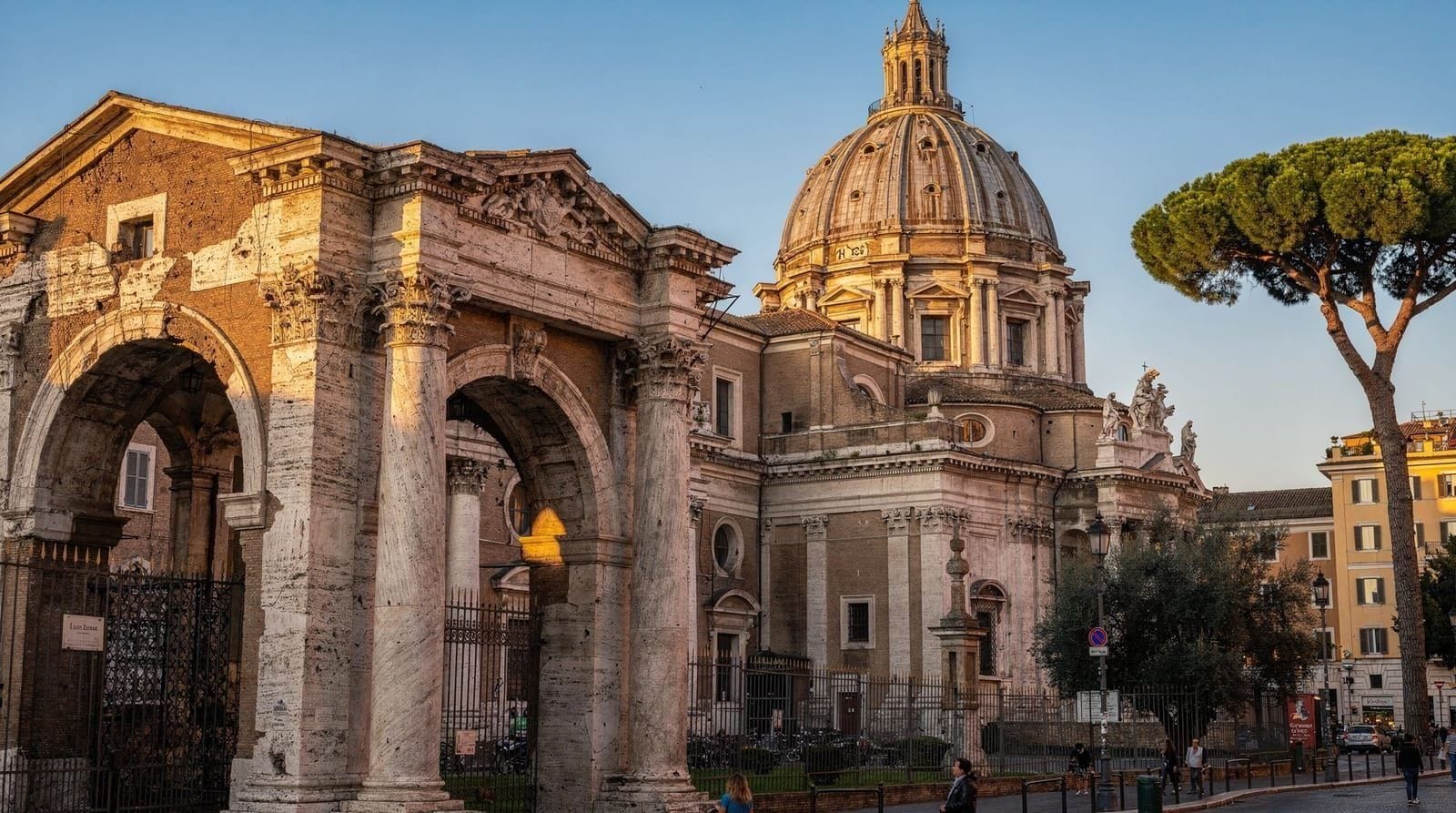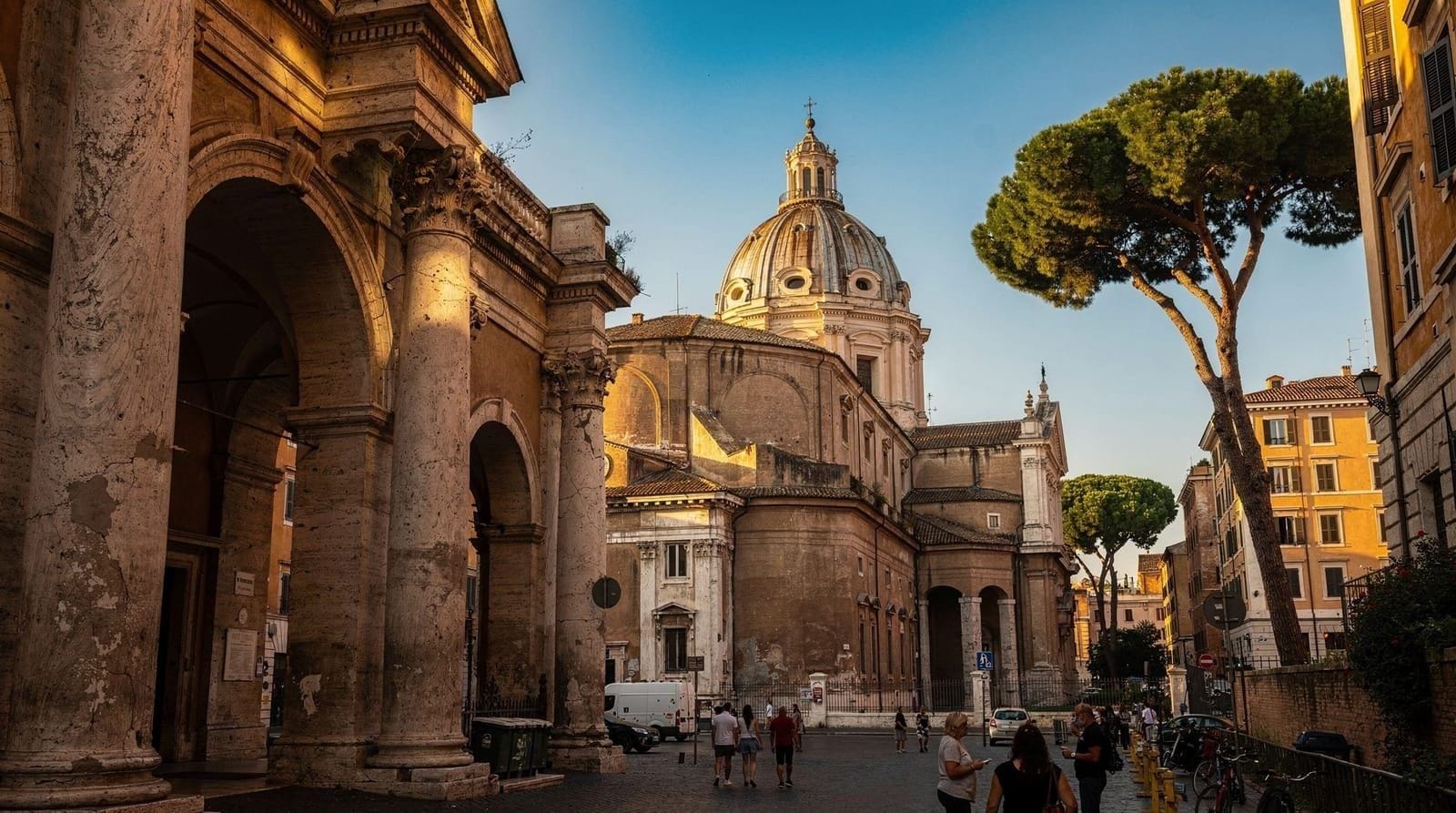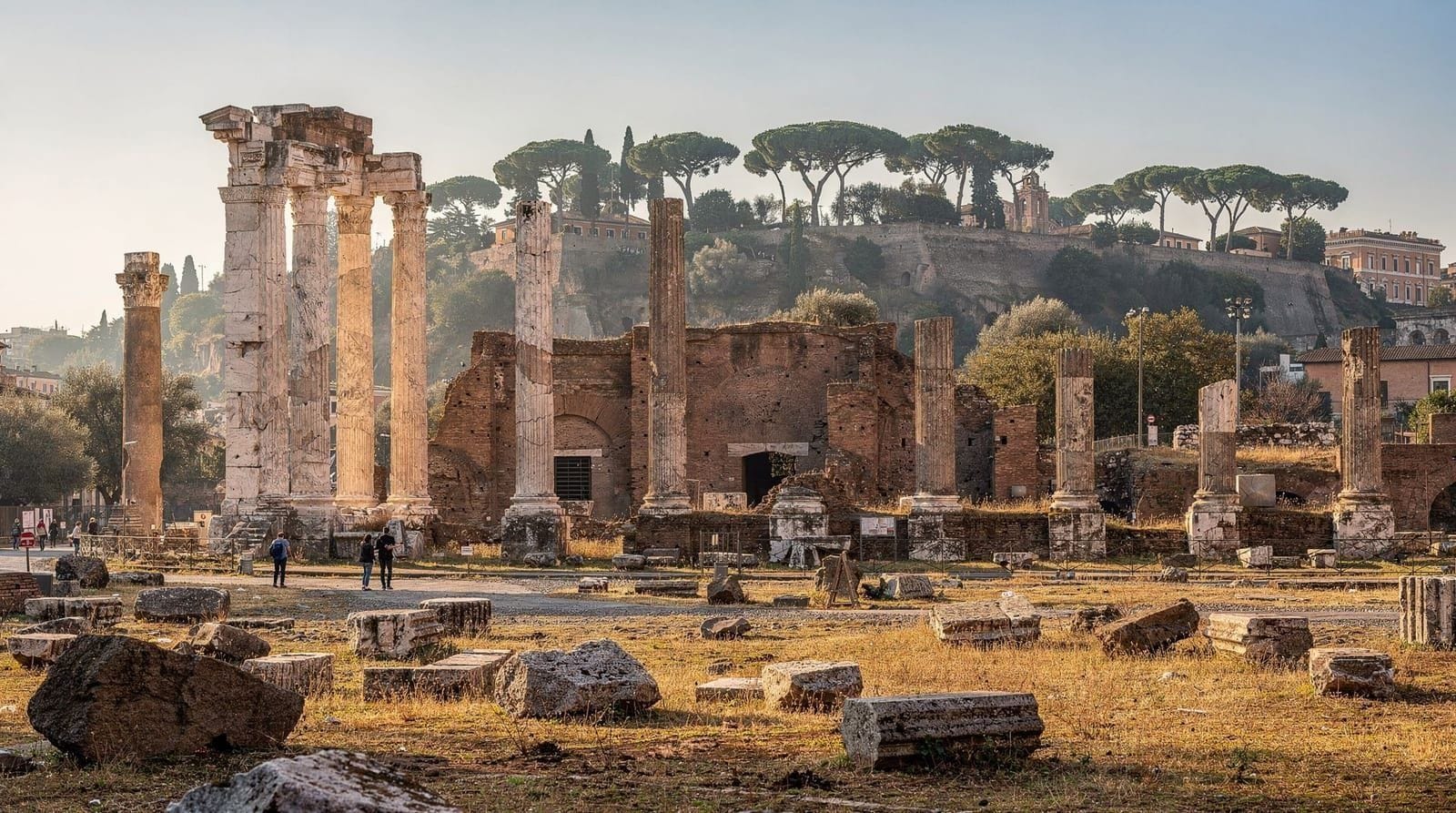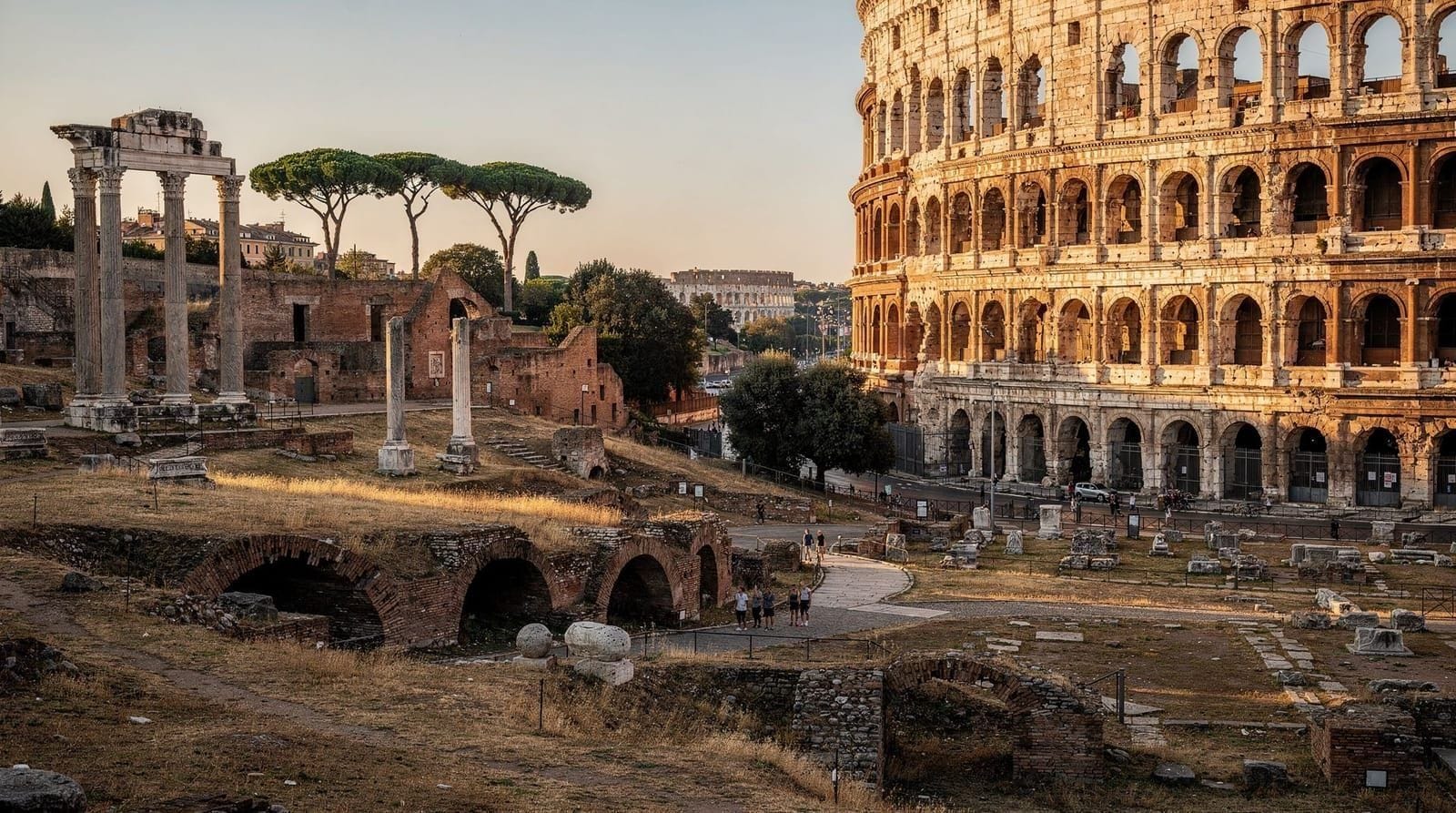
A short history of Rome for travellers: 3,000 years in context
Rome: Guided Tour of Colosseum, Roman Forum & Palatine Hill
How old is Rome and what are the key eras a visitor should know?
Rome's history spans roughly 3,000 years, from the Iron Age settlements on the Palatine Hill (around 900 BCE) through the monarchy, Republic (509–27 BCE), Empire (27 BCE–476 CE), medieval papacy, Renaissance, Baroque, Risorgimento and the modern Italian Republic. For visitors, the most directly visible eras are the Republic (Roman Forum), Empire (Colosseum, Pantheon), early Christianity (basilicas), medieval (churches and towers), Renaissance-Baroque (piazzas, fountains, palaces) and Fascist-era (EUR, Via dei Fori Imperiali). Each layer is literally built on the previous ones — Roman floors sit beneath medieval churches that were rebuilt during the Baroque.
Why history makes Rome make sense
Most visitors arrive in Rome knowing it is old and important. Few arrive knowing enough to make the layers legible. The result is a common experience: standing before the Pantheon, the Colosseum or the ruins of the Forum and feeling that something enormous is being communicated — but not quite being able to decode it.
This guide gives you the decoder. Not a comprehensive history textbook — Rome’s history fills libraries — but a traveller’s framework: the key eras, the pivotal moments, and how what you see today connects to what happened on these streets across three millennia.
| Time needed to read | Around 15-20 minutes, worth doing before you go |
| Best paired with | An audio guide at the Colosseum, Forum or Vatican Museums |
| Cost | Free — this is background reading, not a paid experience |
| Where it pays off most | Churches, where centuries of rebuilding stack visibly |
| Deeper dives | Roman Empire explained, popes and papacy |
The earliest Rome: Iron Age to Etruscan city (900–509 BCE)
The hills of Rome were inhabited long before anyone called the place “Rome.” Iron Age communities occupied the Palatine Hill from around 900 BCE, leaving traces of hut foundations that archaeologists have uncovered beneath the Palatine’s later imperial palaces. These were not Romans — they were Latin-speaking tribal communities of the kind scattered across central Italy.
The territory that would become Rome lay at the lowest natural crossing point of the Tiber River. That location — controlling movement north-south through peninsular Italy and east-west between the sea and the interior — was the geographic fact that made Rome’s eventual dominance almost inevitable. Where rivers can be crossed, trading posts form; where trading posts form, towns grow; where towns grow in strategic locations, cities follow.
By the 7th and 6th centuries BCE, Rome had come under Etruscan influence or control. The Etruscans were the dominant civilization of central Italy at this period — sophisticated, literate, skilled in engineering, religion and statecraft. The Latin kings of Rome’s legendary monarchic period were succeeded by Etruscan ones. The most famous, Tarquinius Priscus and Tarquinius Superbus, oversaw the construction of Rome’s first substantial public works: the Circus Maximus, the temple of Jupiter Optimus Maximus on the Capitoline Hill, and the Cloaca Maxima (the great sewer that still drains beneath the Forum). These are the foundations, literally, of the city that followed.
The Republic: five centuries of expansion (509–27 BCE)
In 509 BCE, according to Roman tradition, the aristocracy expelled the last Etruscan king and established the Republic. The constitutional innovation was significant: power would henceforth be shared among elected magistrates (consuls, praetors, censors) serving limited terms, with the Senate as the deliberative body. The system was designed to prevent any one person from accumulating permanent power — a design that worked imperfectly and ultimately failed.
The Republic’s first centuries were dominated by internal class conflict between the patricians (old aristocracy) and the plebeians (commoners), as well as external wars of expansion. Rome absorbed its Latin neighbours, then the Etruscans, then the Samnites of central Italy, then the Greek cities of the south. By 265 BCE, Rome controlled the entire Italian peninsula.
The Punic Wars (264–146 BCE) against Carthage were the Republic’s defining conflict. Three wars, over a century, against the North African maritime empire of Carthage — a conflict that included Hannibal’s famous crossing of the Alps with war elephants and his series of devastating victories on Italian soil (Trebia, Trasimene, Cannae) before Rome eventually prevailed. The historian Polybius, writing around 150 BCE, identified the Punic Wars as the moment Rome became a world power.
The late Republic (133–27 BCE) saw the system built for a city-state strain under the pressure of an empire. The Gracchi brothers attempted land reform and were assassinated. The general Marius reformed the army, creating professional soldiers loyal to their commander rather than the state. The Social War (91–87 BCE) was fought against Rome’s Italian allies demanding citizenship. Sulla marched on Rome — twice. Pompey and Crassus and Caesar formed the First Triumvirate. Caesar crossed the Rubicon in 49 BCE and a civil war followed. Caesar was assassinated on the Ides of March, 44 BCE, on the steps of the Theatre of Pompey.
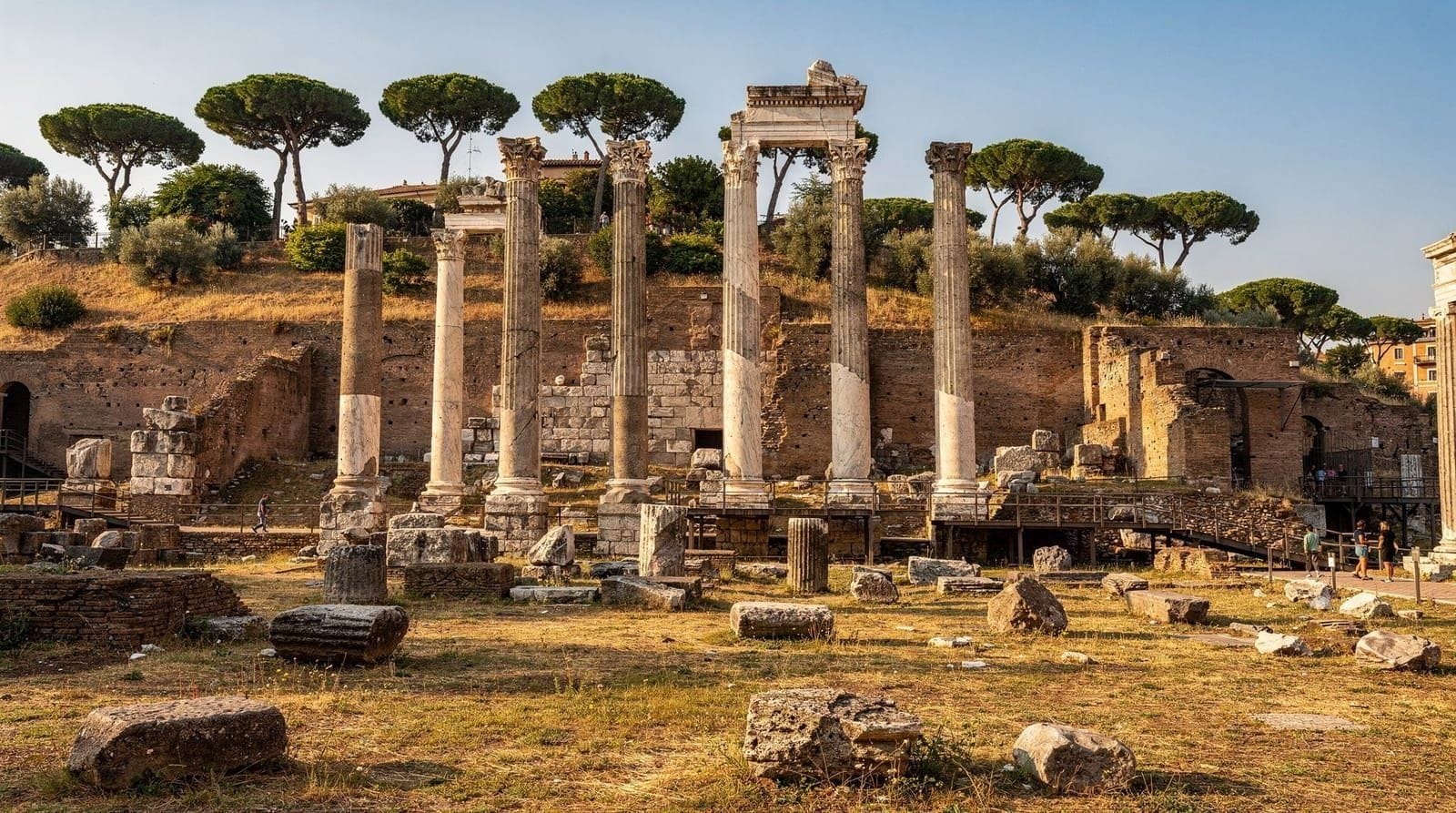
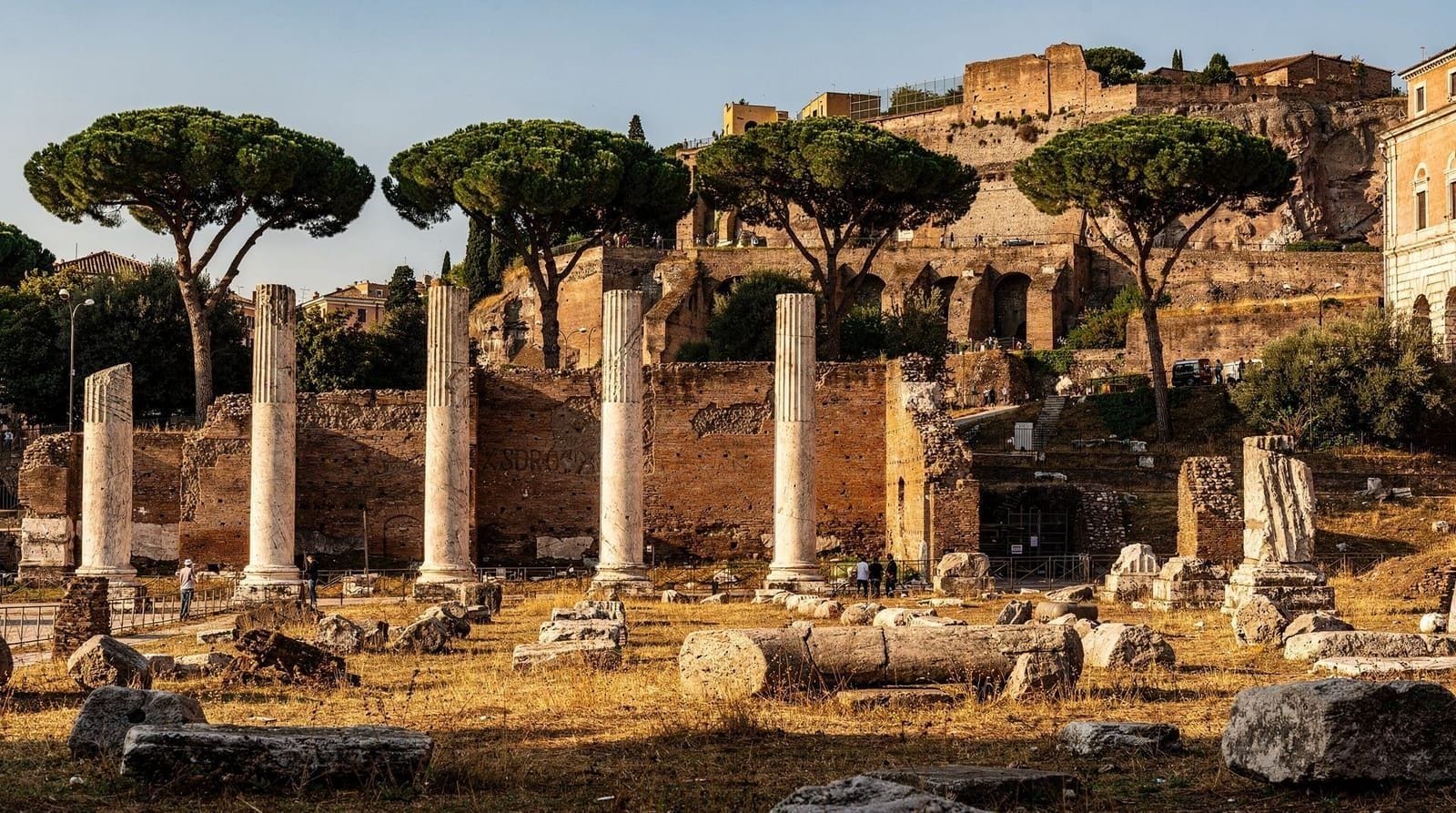
The Forum you walk through today was the stage for all of this: the Rostra where Mark Antony spoke, the Curia where senators debated and occasionally plotted, the Temple of Vesta whose sacred flame represented Rome’s continuity through all these upheavals.
The guided Colosseum, Roman Forum and Palatine Hill tour covers all three major ancient sites with expert commentary — the best introduction to ancient Rome if you have only one day.The Empire: from Augustus to the fall (27 BCE–476 CE)
Octavian, Caesar’s adopted heir, emerged victorious from the civil wars that followed the assassination. In 27 BCE, he received the title “Augustus” and the honorific “princeps” (first citizen) — carefully maintaining the fiction of republican government while holding real power permanently. The Imperial period begins here.
The early Empire (Julio-Claudian and Flavian dynasties, 27 BCE–96 CE) produced both Rome’s most celebrated rulers and some of its most notorious. Augustus oversaw Rome’s physical transformation — famously claiming to have found Rome a city of brick and left it one of marble. The Ara Pacis (Altar of Peace), now in its own museum on the Via Flaminia, is the finest surviving monument of his reign. The Colosseum was built under the Flavian emperors (Vespasian and Titus), completed in 80 CE. Titus’s reign also saw the eruption of Vesuvius in 79 CE, which buried Pompeii and Herculaneum.
The Five Good Emperors (Nerva, Trajan, Hadrian, Antoninus Pius, Marcus Aurelius, 96–180 CE) represent Rome’s administrative peak. Trajan conquered Dacia (modern Romania) and Mesopotamia, expanding the Empire to its maximum extent. His Column still stands near the Roman Forum. Hadrian built the Pantheon in its current form (around 125 CE) — still the best-preserved large building of antiquity — and the Castel Sant’Angelo (his mausoleum). Marcus Aurelius, philosopher-emperor, wrote his Meditations while campaigning on the Danube frontier; his equestrian statue (a copy stands in Piazza del Campidoglio) is the only complete ancient Roman equestrian bronze to survive.
The 3rd century crisis (235–284 CE) saw fifty years of near-constant civil war, plague, economic collapse and external pressure from Germanic tribes and Sasanian Persia. Some twenty emperors reigned and died violently. Rome’s coherence as a state was genuinely threatened.
Diocletian and Constantine (284–337 CE) stabilised the Empire administratively, though Diocletian divided it for governance and Constantine moved the eastern capital to Constantinople in 330 CE. Constantine’s conversion to Christianity — formalised by the Edict of Milan in 313 CE — transformed Rome’s religious landscape. The great basilica-churches began to be built: San Giovanni in Laterano (313 CE), San Pietro in Vaticano (320 CE), Santa Maria Maggiore (4th–5th century).
The Western Empire fragmented through the 5th century under pressure from Visigoths (who sacked Rome in 410 CE under Alaric — the first such sack in 800 years), Vandals (455 CE) and increasingly powerful Germanic warlords. The last Western emperor, Romulus Augustulus, was deposed in 476 CE.
Medieval Rome: city of the popes (5th–15th centuries)
The fall of the Western Empire did not mean the end of Rome — but it meant its near-collapse. Population plummeted from roughly one million to perhaps 20,000 by the 7th century. Aqueducts fell into disrepair or were deliberately cut by besieging armies; without fresh water, the hills were no longer habitable and the population concentrated in the river bend of the Centro Storico. Ancient buildings were quarried for their marble and travertine.
What kept Rome alive — and eventually restored it to significance — was the Church. The bishops of Rome claimed primacy over other Christian communities based on the Petrine succession: Peter had been crucified in Rome, and the Pope was Peter’s successor. This claim, contested in the East, was accepted in the Latin West. As secular power collapsed, ecclesiastical power filled the vacuum.
Gregory the Great (Pope 590–604 CE) is the pivotal figure of early medieval Rome. He organised the city’s administration, negotiated with the Lombard invaders threatening Rome, and laid the groundwork for the papacy as a political institution. The Castel Sant’Angelo (Hadrian’s mausoleum, converted to a fortress) became the popes’ refuge in times of danger — a role it played for centuries.
Medieval Rome was a city of pilgrimage — the three major basilicas (San Pietro, San Giovanni in Laterano, Santa Maria Maggiore) drew pilgrims from across Europe. The Jubilee of 1300, declared by Pope Boniface VIII, brought over 200,000 pilgrims to Rome in a single year — a remarkable demonstration of papal authority and the city’s continuing symbolic power.
The Great Schism of 1378–1417, when rival popes reigned simultaneously from Rome and Avignon, brought Rome to a low point. Population dropped to perhaps 17,000 and the city was largely ungoverned.
Renaissance and Baroque Rome (15th–17th centuries)
The papacy’s return from Avignon (1377) began Rome’s transformation into the city that physically dominates what visitors see today. Between roughly 1450 and 1700, Rome was rebuilt — on an ambition and scale unmatched since the emperors.
Pope Nicholas V (1447–1455) initiated the rebuilding of Saint Peter’s Basilica and commissioned Leonardo Bruni and others to translate classical texts. Pope Julius II (1503–1513) was the decisive patron: he commissioned Michelangelo to paint the Sistine Chapel ceiling (completed 1512) and Raphael to decorate the Stanza della Segnatura (completed 1511), and employed Bramante to design the new Saint Peter’s Basilica and the Cortile del Belvedere. The artistic achievement of Julius II’s pontificate is one of the most concentrated in history.
The Sack of Rome in 1527 by troops of the Holy Roman Emperor Charles V interrupted the Renaissance momentum. An estimated 40,000 of Rome’s approximately 55,000 inhabitants fled. Recovery took decades, but when it came, it produced the Baroque.
Baroque Rome — roughly 1600–1700 — is in many ways the city’s most visible legacy. Gian Lorenzo Bernini shaped more of what tourists photograph than any other single individual: the colonnade of St. Peter’s Square, the baldachin inside the basilica, the Fontana dei Quattro Fiumi in Piazza Navona, the Fontana del Tritone in Piazza Barberini, the Scala Regia. Francesco Borromini, his great rival, gave Rome Sant’Ivo alla Sapienza and San Carlo alle Quattro Fontane. Caravaggio painted his revolutionary canvases for Roman churches in these decades — his work in San Luigi dei Francesi and Santa Maria del Popolo is still in situ.
The Rome by Night walking tour covers the Baroque heart of the city — Trevi, Navona, the Pantheon — when the crowds thin and the piazzas recover their scale.Modern Rome: from Italian unification to today (1870–present)
The breach of Porta Pia on 20 September 1870 ended papal temporal power and incorporated Rome into the Kingdom of Italy. Rome became the national capital in 1871. The newly unified Italian government undertook massive urban expansion: new ministries, the massive Vittoriano monument (completed 1911, derisively nicknamed “the wedding cake” or “the typewriter”), the Prati neighbourhood built on fields west of the Vatican.
Mussolini’s Rome (1922–1943) superimposed a second layer of intervention. The demolition of medieval quarters around the Theatre of Marcellus and the construction of Via dei Fori Imperiali (originally Via dell’Impero) were ideological projects, meant to visually connect the Fascist state to imperial Rome. EUR, the planned district built for a 1942 World’s Fair that war cancelled, remains a striking, coherent example of rationalist architecture — the “Square Colosseum” (Palazzo della Civiltà Italiana) is its most photographed building.
Postwar Rome grew rapidly through the 1950s and 1960s — the Italian economic miracle transformed a city of 1.5 million to one of 2.8 million by 1970. The film industry, based at Cinecittà studios, made Rome the “Hollywood on the Tiber” in this period, with Fellini’s La Dolce Vita (1960) and the Rome sequences of Roman Holiday, Ben-Hur and Cleopatra cementing a global image of the city as sophisticated, sun-drenched and cosmopolitan.
Rome today is a city of 4.3 million metropolitan inhabitants, capital of the Italian Republic, seat of the papacy (Vatican City is an independent state within Rome’s boundaries), and one of the world’s most visited cities. The 2025 Jubilee drew approximately 33 million visitors, reinforcing Rome’s role as a global pilgrimage destination across both secular and religious traditions.
What the layers mean for your visit
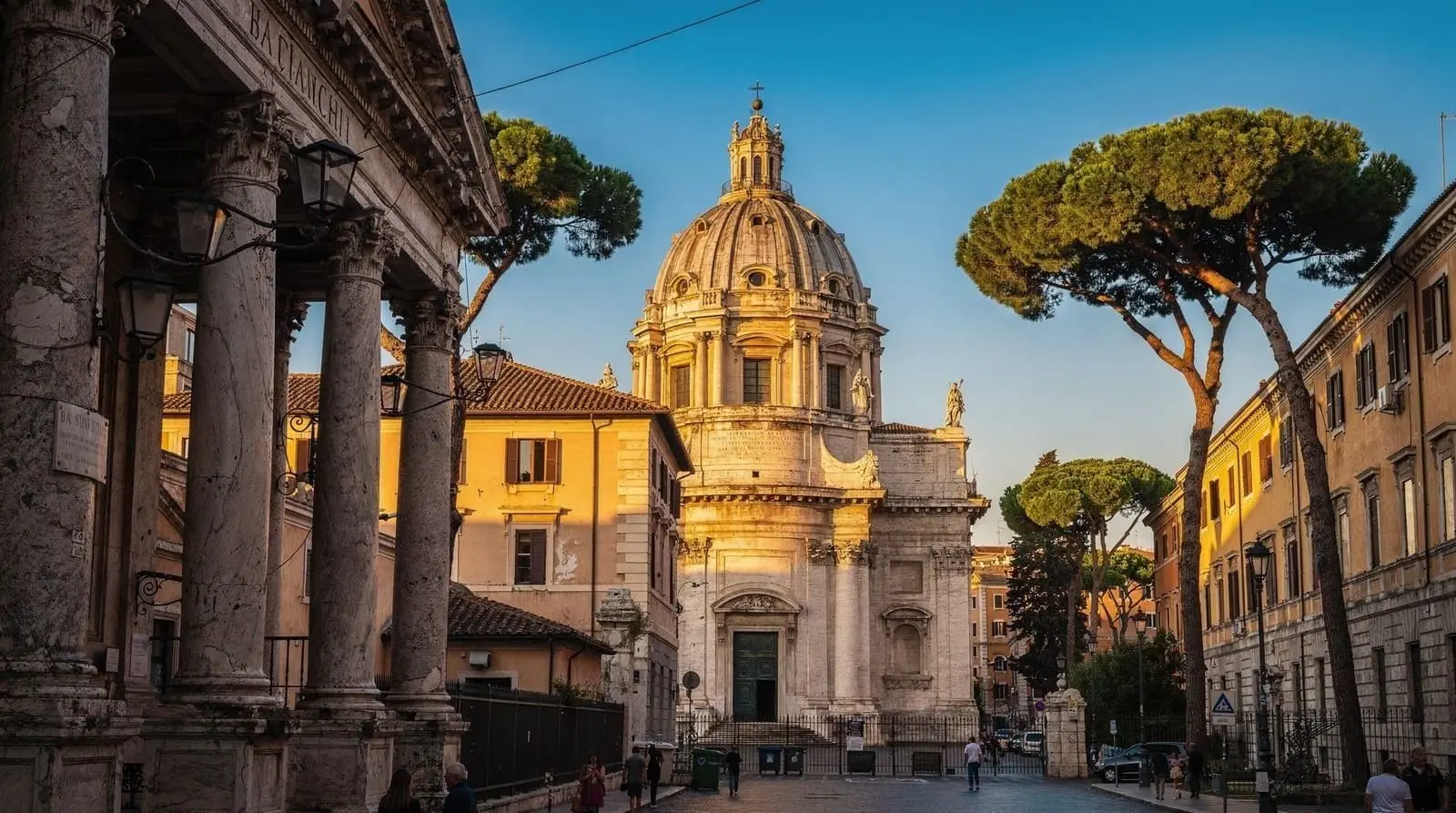
Understanding Rome’s history does something practical for visitors: it makes the architecture readable. When you stand in a Roman church, you may be looking at a building constructed in the 4th century, rebuilt in the 12th, expanded in the 15th, decorated in the 17th, restored in the 20th. Each layer is legible once you know the vocabulary.
In Trastevere, medieval tower houses stand beside Baroque church facades and Renaissance courtyards. In Monti, the neighbourhood sits atop the ancient Subura, Rome’s most densely populated and notoriously rough district — the streets feel narrow for the same reason they did in antiquity. The Centro Storico was built in the loop of the Tiber precisely because medieval Rome needed the river for water after the aqueducts failed.
The reverse is also true: knowing the history changes what you notice while just walking around. A random travertine block reused in a medieval wall, a column embedded sideways in a Renaissance building’s foundation, a street that curves for no visible reason because it follows the outline of an ancient stadium beneath it (Piazza Navona traces the exact oval of Domitian’s stadium) — none of this registers without at least a working sense of the timeline. Rome rarely demolished its past outright; it built over and around it, which is why so much of the ancient city survives embedded, sideways or underground rather than standing free.
The Roman Forum becomes legible as a layered stratigraphy rather than a confusing field of ruins. The churches of the Celio and Colosseum district contain ancient Roman walls in their fabric. The Pantheon’s diameter equals its height because Hadrian built it to enclose a sphere — that geometric intelligence is what makes the building feel timeless and what made it influential for two thousand years.
For the deep dive into any single era, see the Roman Empire explained or popes and the papacy in Rome. For the practical question of how to organise your time across these layers, see the Rome itinerary planning guide.
The Ancient Rome and Skip-the-Line Colosseum tour combines historical context with the major ancient sites — a solid foundation for understanding everything else you’ll see.Where the layers are most visible in a single building
Some sites make the whole idea of “layered Rome” concrete in a single visit, rather than requiring you to piece it together across the city. The San Clemente basilica is the clearest example anywhere in Rome: a 12th-century church sits atop a 4th-century basilica, which sits atop a 1st-century Mithraic temple and Republican-era buildings, all open to visitors on a single descending staircase. The Capitoline Museums hold the Capitoline She-Wolf and the fragments of the Colossus of Constantine within a Renaissance palace designed by Michelangelo, itself built over the ancient Tabularium (Rome’s public records office). And the Castel Sant’Angelo shows the transformation directly: built as Hadrian’s mausoleum in 139 CE, converted into a papal fortress in the medieval period, and connected to the Vatican by a fortified passage (the Passetto) used by popes fleeing danger as late as the 1527 Sack of Rome.
Reading this history in advance turns what would otherwise be an unremarkable staircase, a jumble of ancient fragments, or a squat fortress into something legible — you can place each layer in the timeline above and understand why it is there.
The Domus Romane di Palazzo Valentini makes a similar point with a different technique: digital projections reconstruct the mosaics and frescoes of a 2nd-3rd century patrician house directly over the excavated ruins, so you see the ancient floor plan and its imagined decoration simultaneously. It is a useful complement to San Clemente’s more traditional stacked-layer approach — one shows history by descending physically through it, the other by reconstructing it visually on the spot.
Museums that add depth beyond the ruins themselves
Two collections turn the abstract chronology above into physical objects worth seeing on their own merits. The National Roman Museum, spread across several sites including Palazzo Massimo, holds the finds excavated from the city’s ancient buildings — frescoes, mosaics and sculpture removed from context but presented with enough explanation to reconstruct how Roman homes and public buildings actually looked and functioned. The Capitoline Museums house the founding myth itself in bronze (the She-Wolf), plus the fragments of the 12-metre Colossus of Constantine, giving a visceral sense of scale that ruins alone rarely convey. Both are quieter than the Colosseum or Vatican Museums and reward an hour or two for anyone who wants the history to go a layer deeper than what is visible on the street.
A chronology at a glance
| Era | Dates | What to see today |
|---|---|---|
| Iron Age / Etruscan | 900–509 BCE | Hut foundations on Palatine Hill; Capitoline Hill |
| Republic | 509–27 BCE | Roman Forum, Temple of Saturn, Curia Julia |
| Empire (early) | 27 BCE–180 CE | Colosseum, Pantheon, Circus Maximus, Trajan’s Column |
| Empire (late) | 180–476 CE | Baths of Caracalla, Arch of Constantine |
| Early Christian | 313–600 CE | Santa Maria Maggiore, San Giovanni in Laterano |
| Medieval | 600–1400 | San Clemente basilica; Castel Sant’Angelo fortress |
| Renaissance | 1450–1527 | Sistine Chapel, Raphael Rooms, Piazza del Campidoglio |
| Baroque | 1600–1700 | St. Peter’s Square, Trevi Fountain, Piazza Navona |
| Modern | 1870–present | Vittoriano, EUR, Via dei Fori Imperiali |
The ancient Rome in one day guide covers the most efficient route through the republican and imperial layers. For the full picture of what Rome looked like across its history, the Rome history and culture guides explore how specific myths and legends are still visible in the streets.
Frequently asked questions about A short history of Rome for travellers: 3,000 years in context
When was Rome founded?
When did the Roman Republic begin and end?
When did the Roman Empire fall?
What is the connection between ancient Rome and the Catholic Church?
What is the significance of the year 1870 for Rome?
What did Mussolini do to Rome's ancient monuments?
How many people lived in ancient Rome at its peak?
Do I need to know Rome's history before visiting?
What is the best way to see Rome's history in order, chronologically?
Top experiences
Bookable activities with verified prices and instant confirmation on GetYourGuide.