The Roman Empire explained: emperors, expansion and collapse
Rome: Guided Tour of Colosseum, Roman Forum & Palatine Hill
How long did the Roman Empire last and who were its key emperors?
The Roman Empire is conventionally dated from 27 BCE (when Augustus became the first emperor) to 476 CE (when the last Western emperor was deposed) — a span of 503 years. Key emperors for travellers include Augustus (who transformed Rome physically), Nero (built the Domus Aurea), Vespasian and Titus (built the Colosseum), Hadrian (rebuilt the Pantheon, built his mausoleum — now Castel Sant'Angelo), and Constantine (legalised Christianity). The Eastern Empire continued until 1453 CE.
The Empire you can still walk through
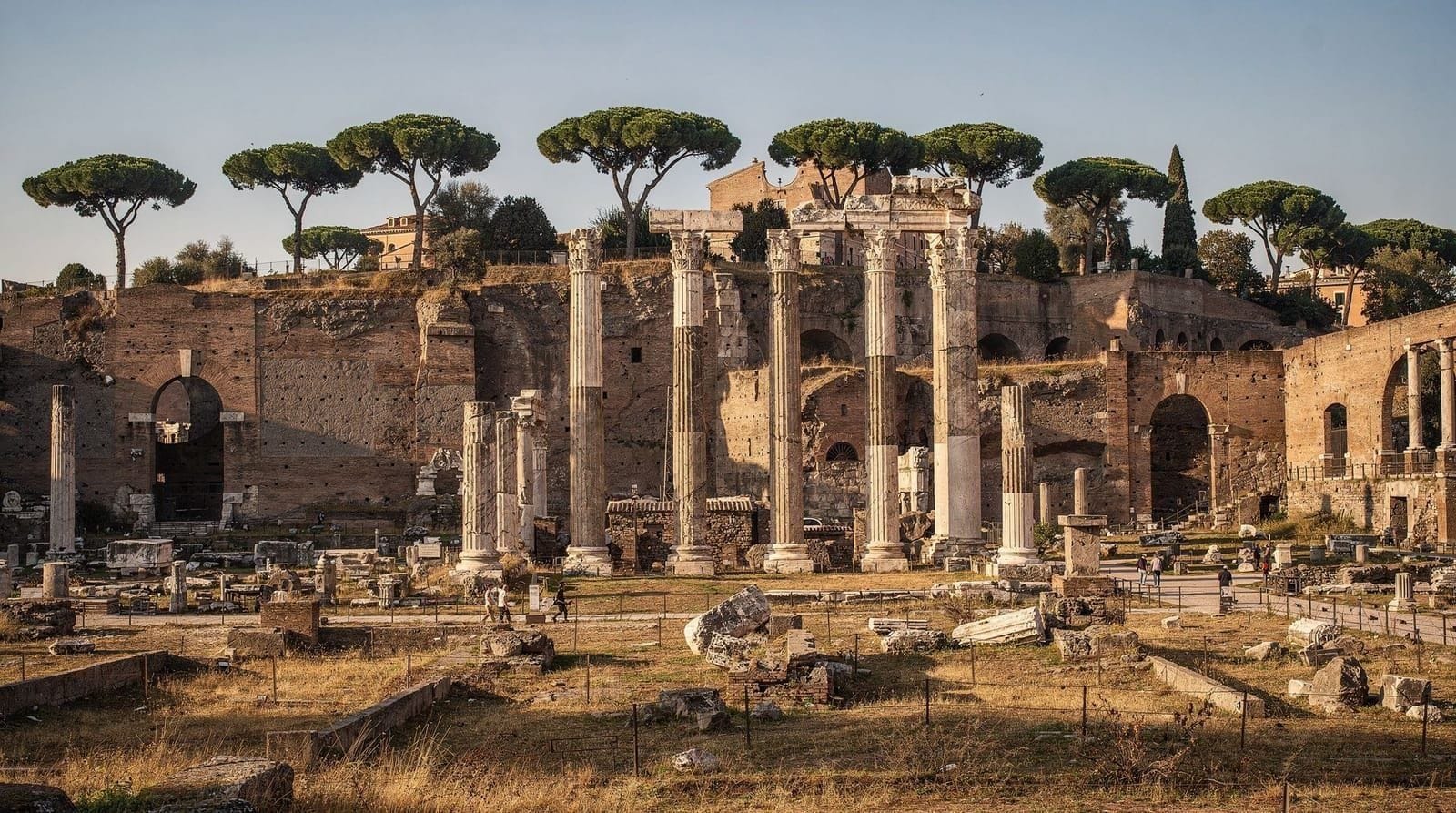
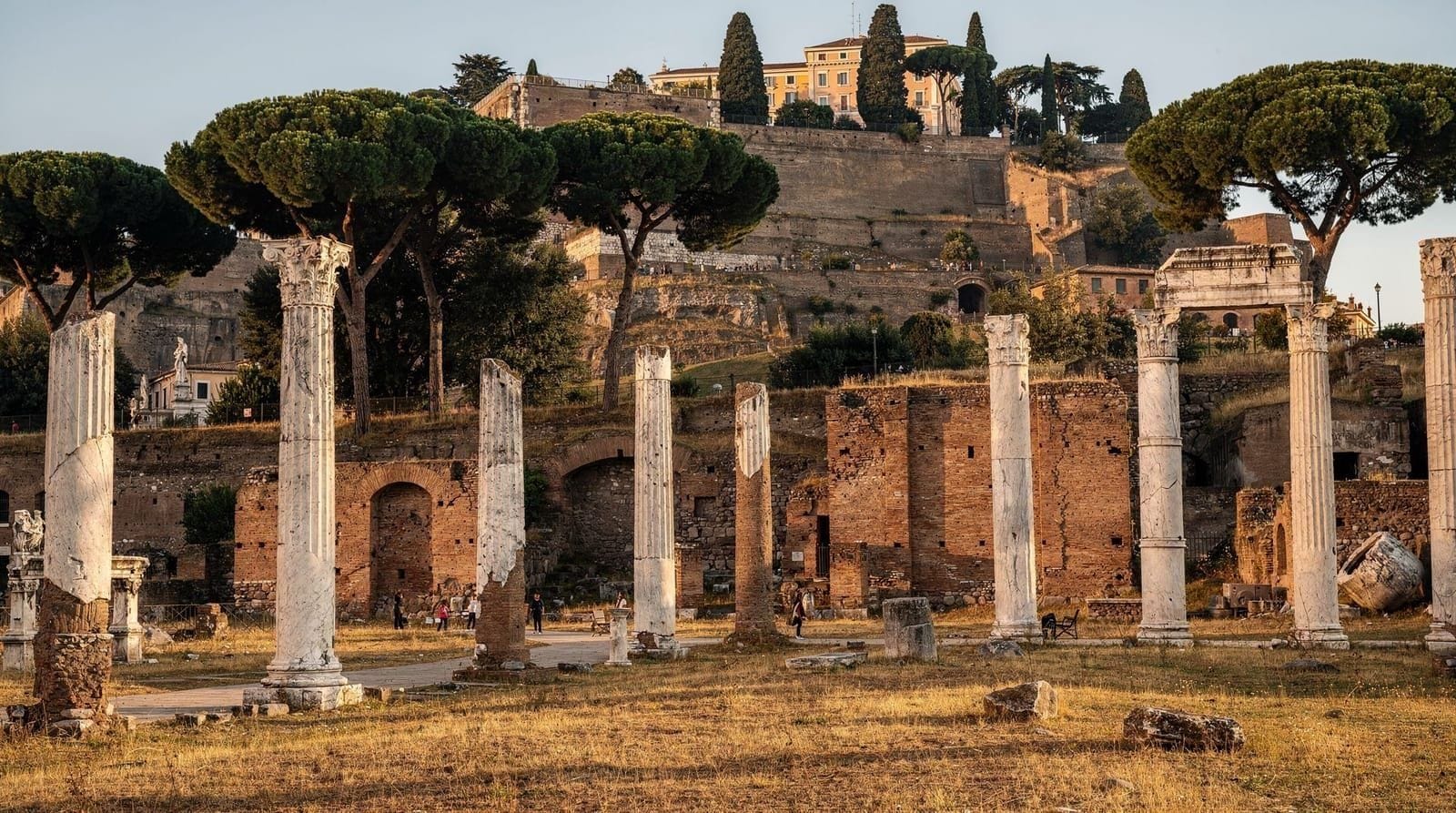
When tourists visit Rome, they are largely visiting the Roman Empire — not the Republic, not medieval Rome, not the Renaissance. The Colosseum is an Imperial building. The Pantheon as it stands is an Imperial rebuilding. The Arch of Constantine, the Baths of Caracalla, the Trajan’s Column — these are all products of the Imperial era.
Understanding who built them, when, and why transforms the experience of standing in front of them. This guide covers the five centuries of Roman Imperial history in the level of detail a traveller actually needs: who the emperors were, what they left behind, and what ended it all.
| Span covered | 27 BCE (Augustus) to 476 CE (fall of the West) |
| Peak extent | c. 117 CE under Trajan, roughly 5 million km² |
| Best sites to see it | Colosseum, Roman Forum, Pantheon, Palatine Hill |
| Time needed | A morning for the core circuit, longer with the Palatine |
| Good starting point | Ancient Rome in one day for a walkable route |
Augustus and the invention of the emperor (27 BCE–14 CE)
The Empire did not begin with a coup or a formal proclamation. It began with a careful, decades-long accumulation of powers by one man — Gaius Octavius, adopted posthumously by Julius Caesar and known to history as Augustus.
Caesar’s assassination in 44 BCE triggered another round of civil wars. The last of these, between Octavian and Mark Antony (allied with Cleopatra of Egypt), ended with the Battle of Actium in 31 BCE and Antony and Cleopatra’s suicides. Octavian was left as the sole power in the Roman world.
In 27 BCE, he performed a theatrical act of “restoration” — returning his extraordinary powers to the Senate. The Senate, predictably, gave them back, and added the honorary title “Augustus” (revered one) and “Princeps” (first citizen). This formula — maintaining republican forms while holding actual power — was the constitutional fiction that allowed the Empire to function for centuries.
Augustus reigned for 44 years and transformed Rome physically. He organised the city into 14 administrative regions and claimed to have found Rome a city of brick and left it one of marble. His building programme included:
- The Forum of Augustus, with its Temple of Mars Ultor (Mars the Avenger), built in fulfilment of a vow before the Battle of Philippi
- The Ara Pacis Augustae (Altar of Augustan Peace), now housed in its dedicated museum on the Via Flaminia — one of the finest pieces of Augustan propaganda in relief sculpture
- The Mausoleum of Augustus on the Via Flaminia, long neglected and now under restoration
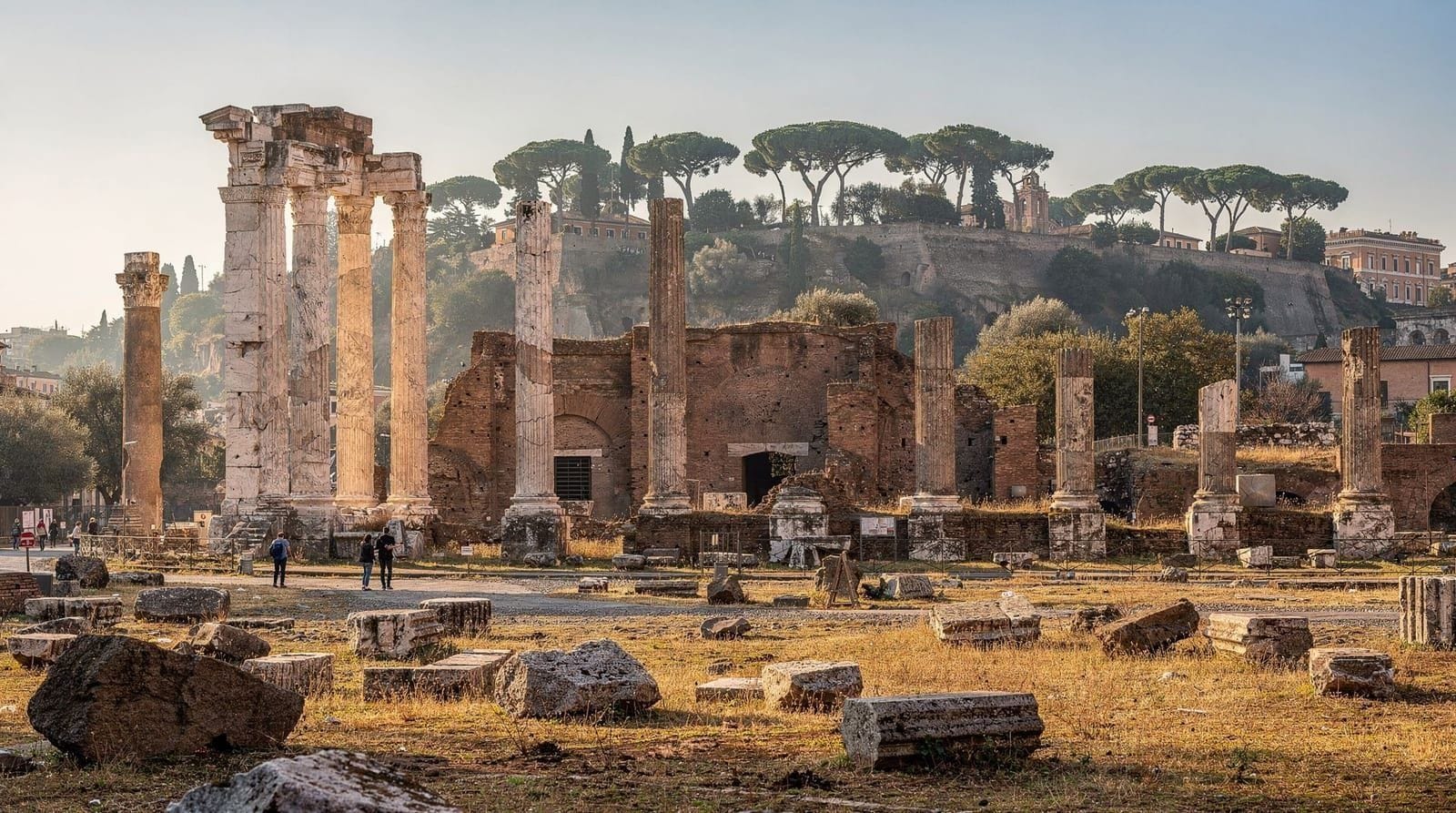
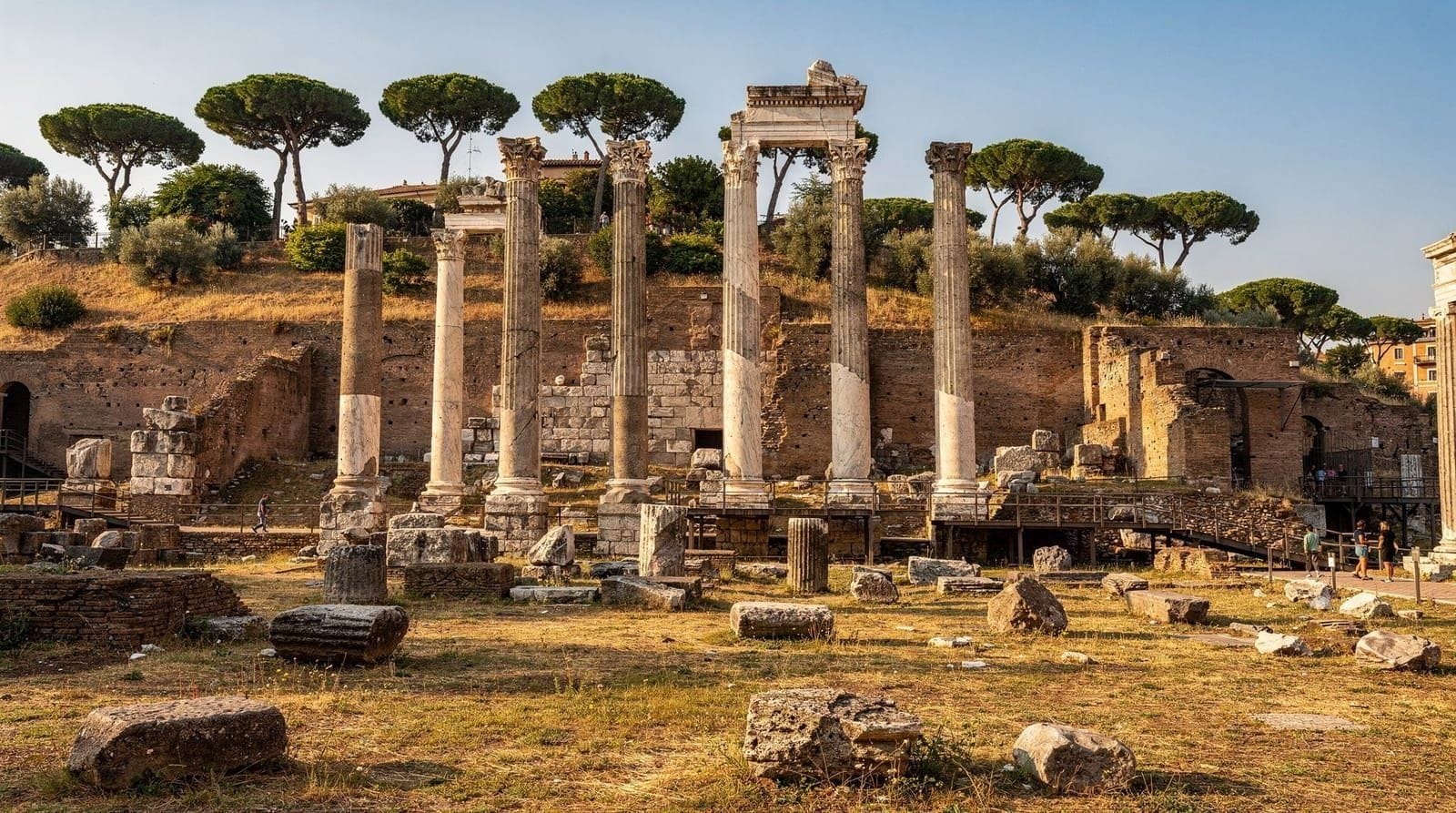
- The transformation of the Roman Forum into an Imperial showcase
- The Pantheon (built initially by his general Agrippa, though the current building dates from Hadrian’s reconstruction)
The Augustan period also produced most of classical Latin literature: Virgil wrote the Aeneid under imperial patronage, Horace and Ovid flourished, and Livy wrote his history of Rome — all directly or indirectly connected to Augustus’s cultural programme.
The Julio-Claudians: dynasty and disaster (14–68 CE)
Augustus established a dynastic principle — emperors succeeding by family connection or adoption — despite having no constitutional authority to do so. His successors through the Julio-Claudian dynasty demonstrated the system’s advantages and its extreme fragility.
Tiberius (14–37 CE) was an effective administrator who withdrew from Rome to Capri late in his reign, governing through correspondence and increasingly relying on the Praetorian prefect Sejanus — a dangerous precedent.
Caligula (37–41 CE) began promisingly but descended (by the ancient sources’ account) into megalomania and unpredictable violence. He was assassinated by the Praetorian Guard after less than four years.
Claudius (41–54 CE) — chosen by the Praetorians largely because he was available — proved a capable administrator who completed the conquest of Britain in 43 CE.
Nero (54–68 CE) is the emperor most physically present in Rome today, though primarily through the ruins of his extravagance. After the Great Fire of 64 CE (which Nero was almost certainly not responsible for, though he exploited it), he appropriated a vast swath of central Rome to build the Domus Aurea — his Golden House, a palatial complex that covered what is now the area between the Palatine Hill, Colosseum valley and the Coelian Hill. After Nero’s death, his successors built over it, filling it with rubble and erecting the Colosseum in the valley of his private lake. The Domus Aurea’s painted ceilings, rediscovered during the Renaissance, were visited by Michelangelo, Raphael and other artists — the “grotesque” decorative style takes its name from the grotto-like underground rooms.
The Domus Aurea today offers guided tours with virtual reality reconstructions — one of Rome’s most unusual and undervisited ancient experiences.
The Flavians and the Colosseum (69–96 CE)
Nero’s death in 68 CE triggered the “Year of Four Emperors” — four rival claimants in a single year — before Vespasian (69–79 CE) emerged as the founder of the Flavian dynasty. His practical, fiscally responsible administration restored stability after Nero’s extravagance.
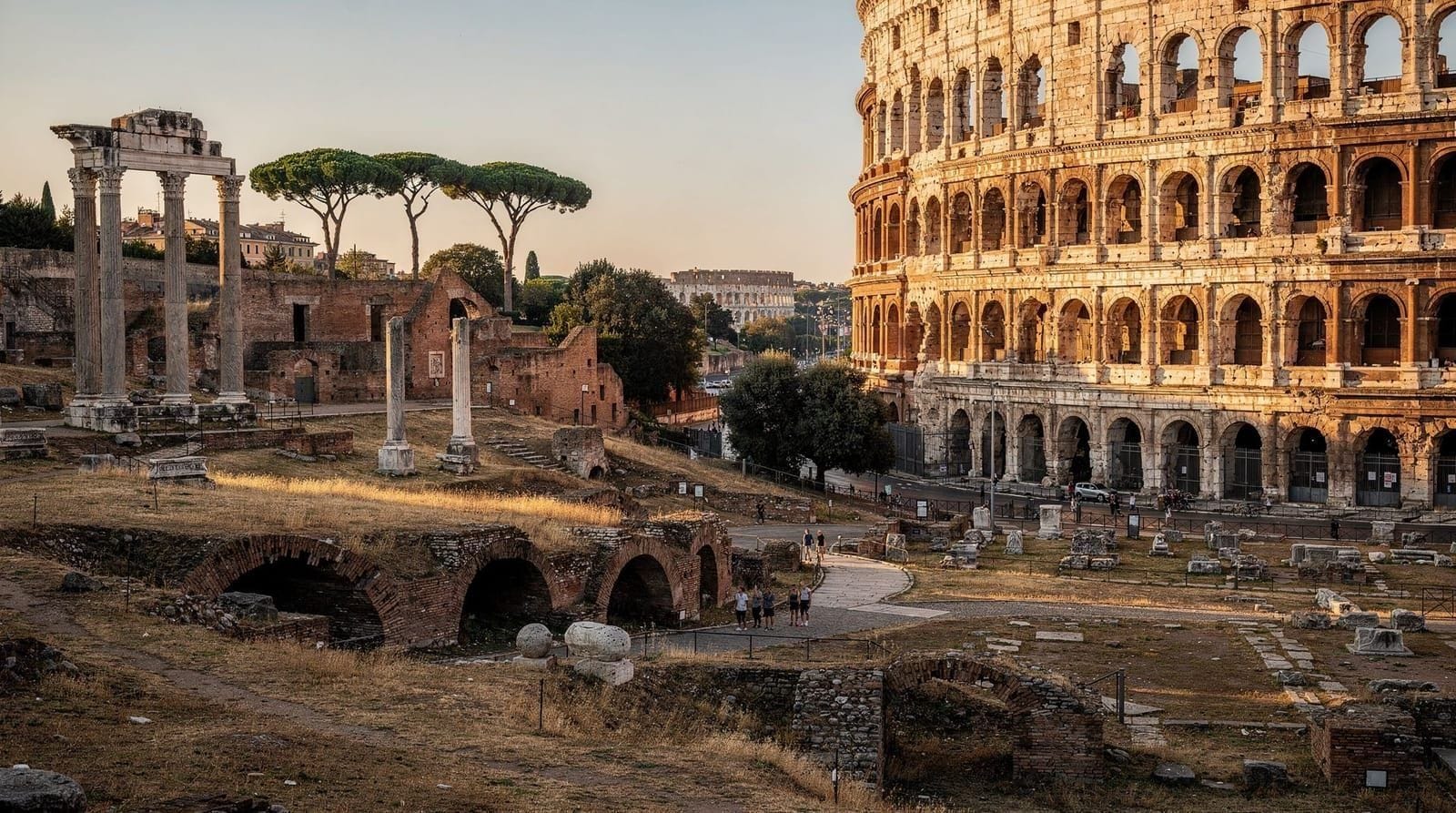
His most visible legacy: beginning construction of the Flavian Amphitheatre, known to us as the Colosseum. Construction started around 72 CE, funded partly by spoils from the sack of Jerusalem in 70 CE. The Arch of Titus in the Roman Forum shows Roman soldiers carrying the Menorah from the Temple of Jerusalem.
Titus (79–81 CE) completed and inaugurated the Colosseum in 80 CE with 100 days of games. His two-year reign also included the eruption of Vesuvius in 79 CE and a major fire in Rome — disasters he responded to generously, earning an unusually positive historical reputation.
Domitian (81–96 CE) built extensively on the Palatine Hill, creating the Flavian Palace complex that became the template for all subsequent imperial residences (and from which our word “palace” derives, via Palatino). His reign ended in assassination, and the Senate condemned his memory — hence the relative absence of his name from surviving monuments.
The guided Colosseum, Roman Forum and Palatine Hill tour covers the Flavian amphitheatre and the imperial palace complex in detail — the essential ancient Rome circuit.The Five Good Emperors: the peak (96–180 CE)
The century following Domitian’s assassination is often called the Empire’s golden age. Five emperors in succession — Nerva, Trajan, Hadrian, Antoninus Pius and Marcus Aurelius — each adopted a capable successor rather than relying on family heredity, and each proved an effective ruler.
Trajan (98–117 CE) expanded the Empire to its maximum territorial extent, conquering Dacia (modern Romania) in two campaigns and then Mesopotamia. Trajan’s Column in the forum that bears his name narrates the Dacian campaigns in 155 continuous scenes of carved relief — the ancient world’s most detailed military documentary. Trajan’s Markets, the multi-storey commercial complex adjacent to his forum, are among the best-preserved ancient structures in Rome and can be visited at the Via dei Fori Imperiali museum.
Hadrian (117–138 CE) reversed Trajan’s Mesopotamian conquest as strategically unsustainable and consolidated the existing frontiers (Hadrian’s Wall in Britain being the most famous example). He was an architect-emperor: the Pantheon as it stands today is his rebuilding (around 125 CE), a geometric masterpiece whose dome remained the largest in the world for over 1,300 years. His mausoleum on the Tiber — the Castel Sant’Angelo — was converted to a fortress by later popes and still dominates the river near the Vatican.
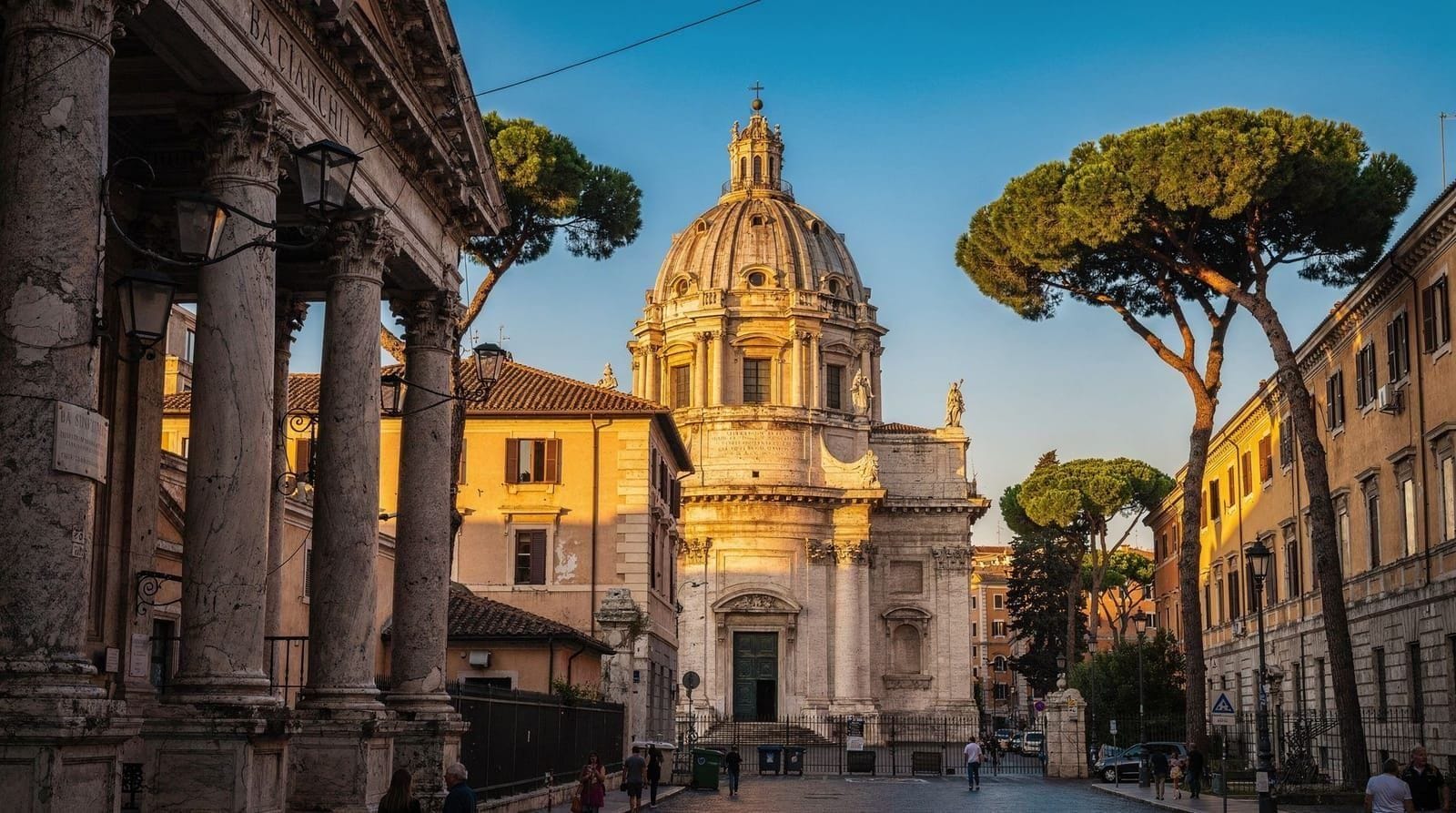
The Pantheon’s inscription still reads “M·AGRIPPA·L·F·COS·TERTIVM·FECIT” — Marcus Agrippa, son of Lucius, consul for the third time, built this — preserving the name of the original Augustan-era building that Hadrian’s structure replaced.
The Pantheon guided tour with entry ticket covers Hadrian’s geometric masterpiece — the best-preserved ancient Roman building and the one that most directly influenced the entire Western architectural tradition.Marcus Aurelius (161–180 CE) spent much of his reign on the Danube frontier, fighting Germanic incursions that prefigured the pressures that would eventually fragment the Western Empire. His equestrian bronze (a copy stands on Piazza del Campidoglio; the original is in the Capitoline Museums) is the only complete ancient Roman equestrian statue to survive — it persisted because medieval Romans mistakenly identified the figure as Constantine, the first Christian emperor.
Crisis and recovery: the 3rd century (180–284 CE)
Marcus Aurelius broke the adoptive succession by designating his biological son Commodus as successor — a catastrophic choice. Commodus’s erratic and increasingly dangerous reign ended in assassination in 192 CE, triggering another civil war. The “Year of Five Emperors” in 193 CE was resolved by Septimius Severus, a North African general, who founded the Severan dynasty.
Caracalla (198–217 CE), Severus’s son, is remembered chiefly for two things: murdering his co-emperor brother Geta (whose face was subsequently removed from all monuments) and building the largest bath complex Rome had ever seen. The Baths of Caracalla covered 27 hectares and could accommodate up to 1,600 bathers simultaneously. They operated until the Ostrogothic King Vitiges cut the aqueducts in 537 CE.
The 3rd century crisis (235–284 CE) was a near-death experience for the Roman state. Roughly 50 emperors reigned and died violently in 50 years. The economy was in crisis, the currency debased, the frontiers under simultaneous pressure from Germanic tribes in the north and Sasanian Persia in the east. Several regions broke away as separate empires (the Gallic Empire in the west, the Palmyrene Empire in the east). Rome survived this period — just.
Constantine and the Christian Empire (284–395 CE)
Diocletian (284–305 CE) stabilised the crisis by introducing the Tetrarchy — dividing imperial authority among four rulers — and by dramatically expanding the bureaucracy. His administrative reforms made the Empire governable again but also sowed the seeds of future division.
Constantine (306–337 CE) reunified the Empire after a further civil war. His victory over Maxentius at the Battle of Milvian Bridge in 312 CE — fought just north of Rome, where the bridge now called Ponte Milvio still stands — was followed by the Edict of Milan in 313 CE, legalising Christianity throughout the Empire. Whether Constantine’s conversion was genuine or politically calculated remains debated; what is certain is that its consequences were enormous.
The Arch of Constantine, erected in 315 CE adjacent to the Colosseum, celebrates his victory. Notably, much of its sculptural decoration was taken from earlier monuments — Trajan’s, Hadrian’s, Marcus Aurelius’s — in what art historians call “spoliation,” a recycling of earlier art that tells its own story about the Empire’s changing relationship to its past.
Constantine founded Constantinople (modern Istanbul) in 330 CE as a new eastern capital, shifting the Empire’s centre of gravity permanently eastward.
The divided Empire and the Western collapse (395–476 CE)
The Emperor Theodosius (379–395 CE) made Christianity not just legal but compulsory — paganism was formally prohibited. He was the last emperor to rule a united Empire; at his death in 395 CE, it was divided between his sons: Honorius in the west, Arcadius in the east.
The 5th century saw the Western Empire disintegrate under pressure it could no longer contain. The Visigoths sacked Rome in 410 CE — the first such sack in 800 years, an event that sent shockwaves through the Mediterranean world. Augustine of Hippo wrote The City of God partly in response to Romans asking why God had permitted the sack of His city. The Vandals sacked Rome again in 455 CE.
The last Western emperor, Romulus Augustulus, was deposed by the Germanic leader Odoacer in 476 CE — the conventional end date of the Western Roman Empire. It is worth noting that contemporaries did not necessarily perceive this as a definitive “fall” — the Eastern Empire continued, and Odoacer and his successors initially governed in the name of the Eastern emperor.
The Eastern Empire: a thousand more years
The “fall of Rome” that schoolbooks describe is specifically the Western Empire. The Eastern Roman Empire, centred on Constantinople, continued for nearly another thousand years — until the Ottoman Sultan Mehmed II conquered Constantinople in 1453 CE.
The Eastern Empire, known to modern historians as the Byzantine Empire (though they called themselves Romans), preserved Roman law, literature and administrative culture. Justinian I (527–565 CE) briefly reconquered Italy from the Ostrogoths and reconsolidated Roman law in the Corpus Juris Civilis — the foundation of European civil law. His general Belisarius sacked Rome in 536 CE in the process, and the counter-campaigns that followed left Rome in ruins.
Roman law, Roman administrative language (Latin, transforming into the Romance languages), Roman Christianity and Roman city-planning persisted long after the legions were gone. In that sense, the Roman Empire’s influence did not fall in 476 CE — it simply transformed into the world we still inhabit.
Travellers sometimes assume Byzantine history is a separate, unrelated subject from “ancient Rome,” but the Eastern court in Constantinople continued to call itself Roman, used Roman law, and for a time even reconquered Italy. Justinian’s brief 6th-century reconquest is the reason some of Rome’s monuments — including sections of the Forum and the Pantheon’s surroundings — show traces of Byzantine-era repair and reuse layered on top of the classical Imperial fabric, one more reminder that almost nothing in central Rome belongs to a single tidy period.
For the story of how Rome’s political identity shifted from empire to papacy, see the guide to popes and the papacy in Rome. For the mythology that underpinned Roman imperial identity, see Roman mythology in the city. And for the full ancient Rome circuit you can walk today, see the ancient Rome in one day guide.
The Ancient Rome skip-the-line tour covers the Colosseum with expert historical commentary — the best way to understand the building as the political instrument it was designed to be.Which emperor’s sites are worth prioritising
With limited time, some Imperial-era sites reward a visit far more than others. The Roman Forum and the Palatine Hill together give you Augustus, the Flavians and the Severans in a single circuit; the Colosseum adds Vespasian and Titus; the Pantheon gives you Hadrian’s architectural ambition in the best-preserved form of any Imperial building. If you have to choose beyond that core: the Baths of Caracalla convey the scale of later Imperial engineering better than almost anywhere else, while the Domus Aurea is the most vivid single-emperor site, since virtually the whole surviving structure belongs to Nero alone rather than being layered over by his successors. For a wider view of the surviving mythological iconography that decorated Imperial Rome, the Roman mythology sites guide is a useful companion.
Coins, inscriptions and how historians actually know all this
Much of what we know about individual emperors’ reigns, dates and building programmes comes from a combination of literary sources (often written decades or centuries later, and not neutral — Suetonius and Tacitus both wrote with clear biases toward or against particular emperors), inscriptions (dedicatory texts on buildings and monuments, remarkably well preserved on structures like the Pantheon and Arch of Titus), and coinage. Roman coins are an underrated resource for travellers: each emperor’s portrait and the propaganda messages stamped on the reverse (victories, building projects, divine associations) functioned as mass media in a world without printing. The Capitoline Museums and the National Roman Museum both hold substantial coin collections where you can trace the changing imperial portraiture across the centuries covered in this guide — a useful, less crowded stop if you want to go deeper than the standard Colosseum-Forum-Pantheon circuit.
Frequently asked questions about The Roman Empire explained: emperors, expansion and collapse
What is the difference between the Roman Republic and the Roman Empire?
How large was the Roman Empire at its peak?
Why did the Roman Empire fall?
What happened to Rome after the Empire fell?
Which Roman emperors are visible in Rome today?
How much of ancient Rome can I realistically see in one day?
Do I need a guide to understand the Imperial sites, or is self-guided enough?
Top experiences
Bookable activities with verified prices and instant confirmation on GetYourGuide.