San Clemente: three churches stacked across 2,000 years
Rome: Catacombs and Capuchin Crypt Guided Tour with Transfer
What is San Clemente and is it worth visiting?
San Clemente is a 12th-century basilica built directly above a 4th-century early Christian church, which itself sits above a 1st-century Roman apartment building housing a Mithraic temple. The underground levels (€10) are among the most remarkable archaeological visits in Rome — 20 metres of compressed history. The upper basilica with its 12th-century apse mosaic is free. Allow 60–90 minutes total.
Three churches, one site, 2,000 years
| Where | Via Labicana 95, Celio — 5 min walk from the Colosseum |
| Cost | Free (upper basilica); around €10 for the underground |
| Time needed | 30 min upper church; 75–90 min for the full visit |
| Getting there | Metro B to Colosseo, then walk south on Via Labicana |
| Best time | Early afternoon, before the 12:30 midday closure |
Rome is a city built on top of itself. Everywhere you walk, there is something under your feet — a layer of medieval over a layer of ancient, rubble pressed into foundations, columns reused as wall material, churches built on temples. San Clemente makes this abstract fact concrete and explorable.
Stand in the 12th-century nave of San Clemente — a functioning basilica administered by Irish Dominican friars — and you are standing in a building built over a 4th-century Christian church, which was itself built over a 1st-century Roman apartment building that contained one of the best-preserved Mithraic temples in Rome. Three distinct civilizations, three distinct religious traditions, three distinct construction phases, stacked in sequence and accessible in a single visit.
This is not a metaphor or a reconstruction. You walk down stairs and enter the actual rooms.
Level 1: the 12th-century basilica (free)
The building
The current basilica dates from around 1099–1130 CE, built by the Irish Dominican order on the site of the older church below (which they apparently did not know existed until 19th-century excavations). The 12th-century construction removed the upper floors of the 4th-century building and used its walls as a platform for the new nave.
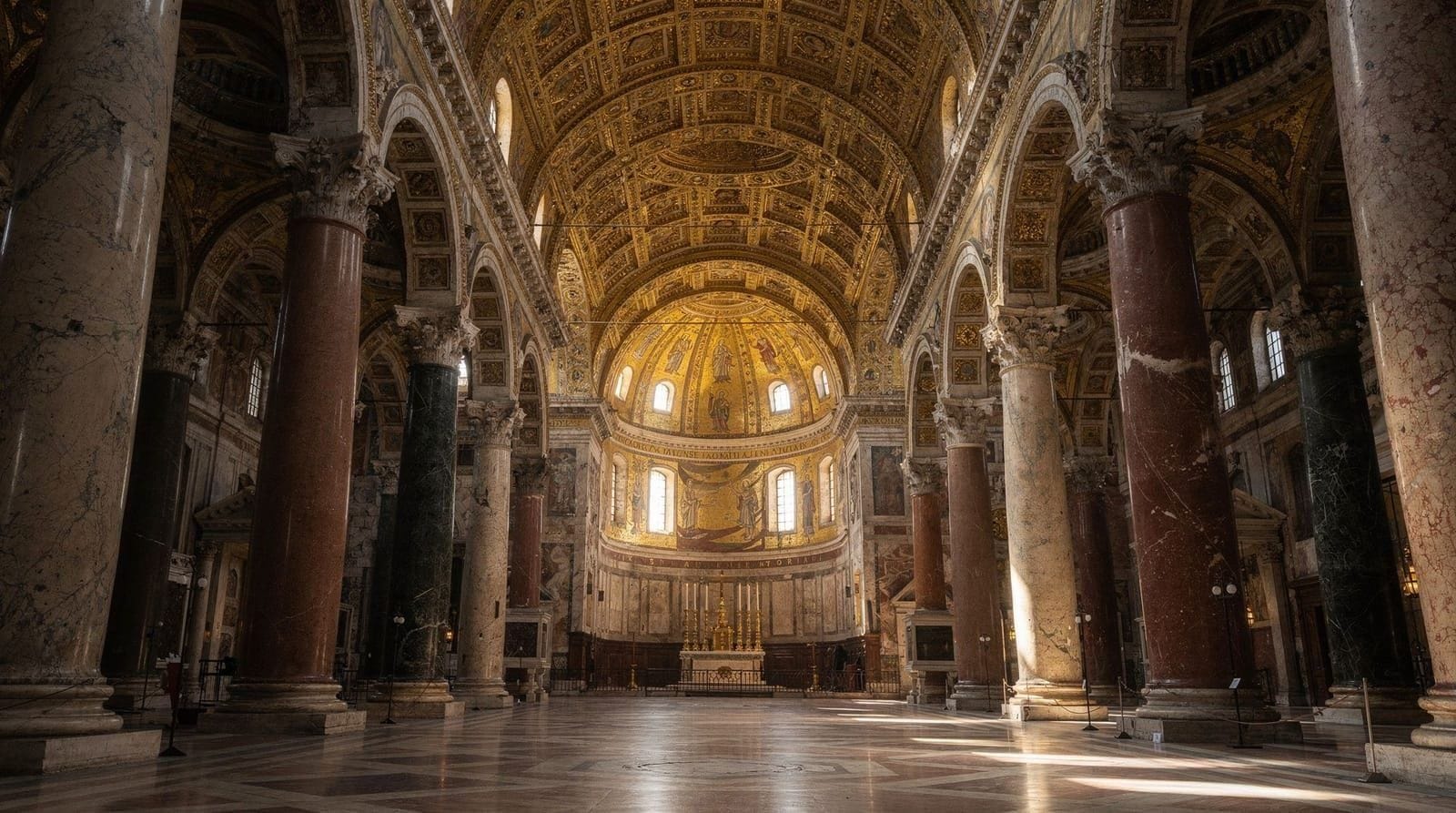
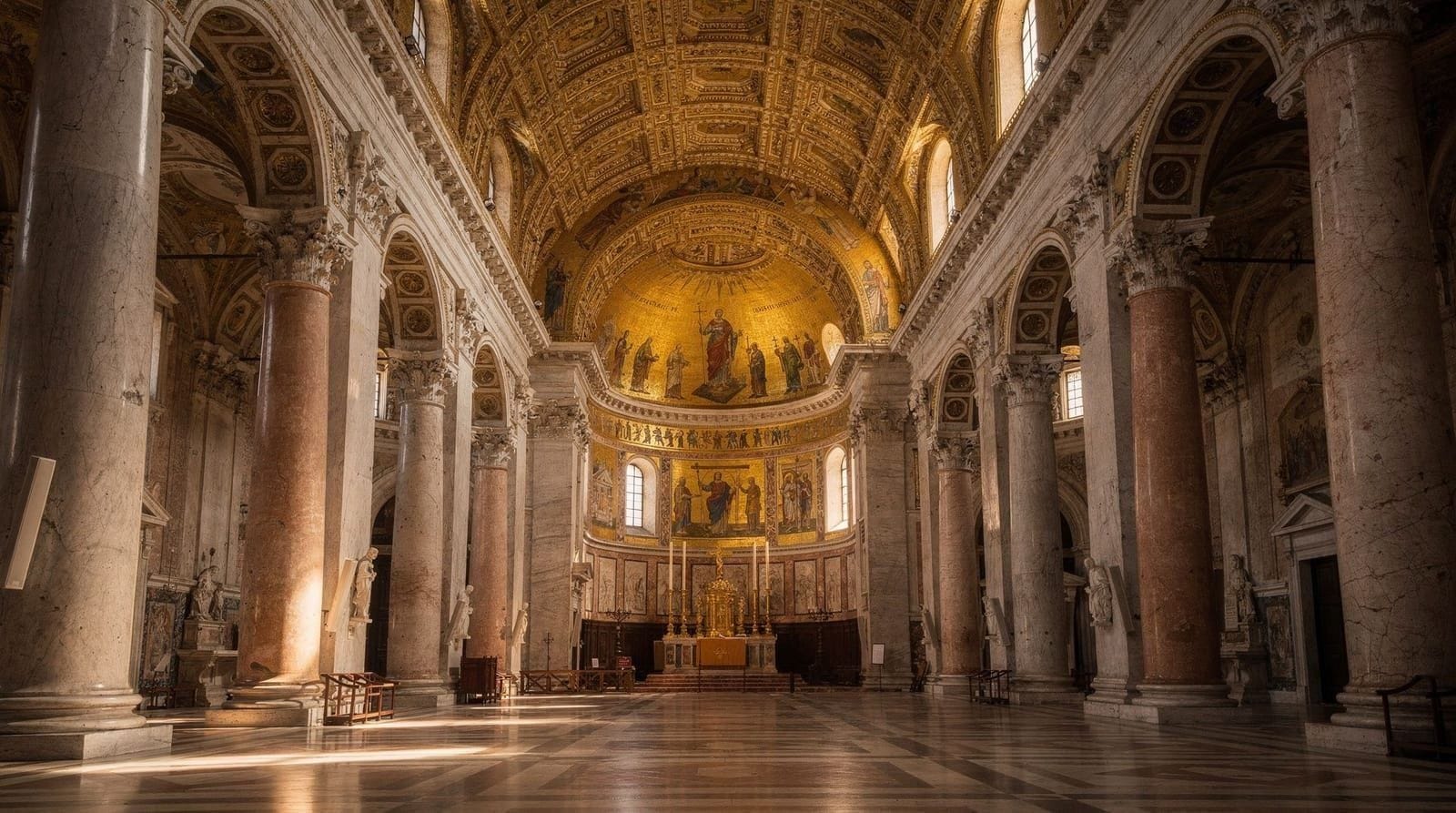
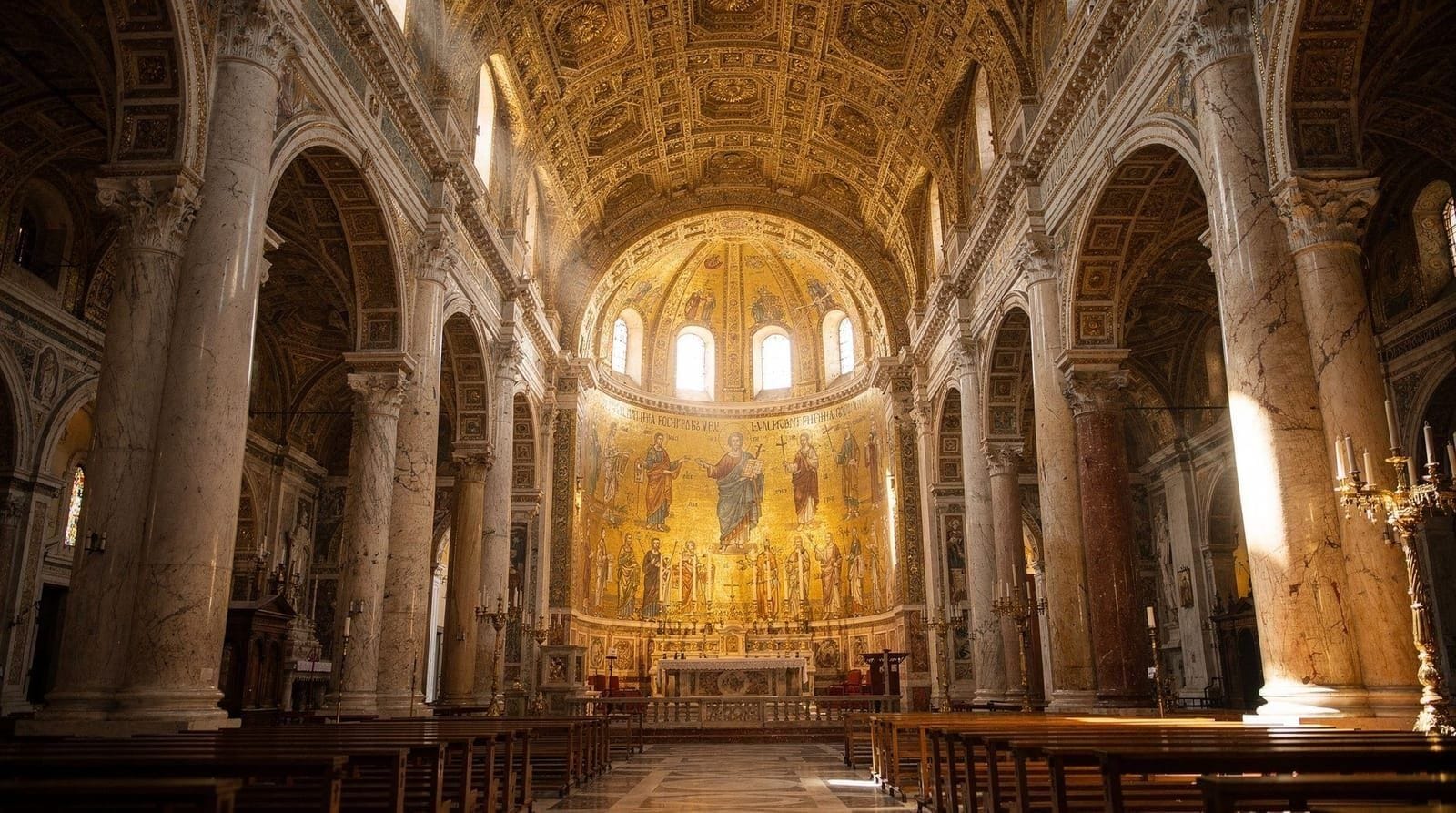
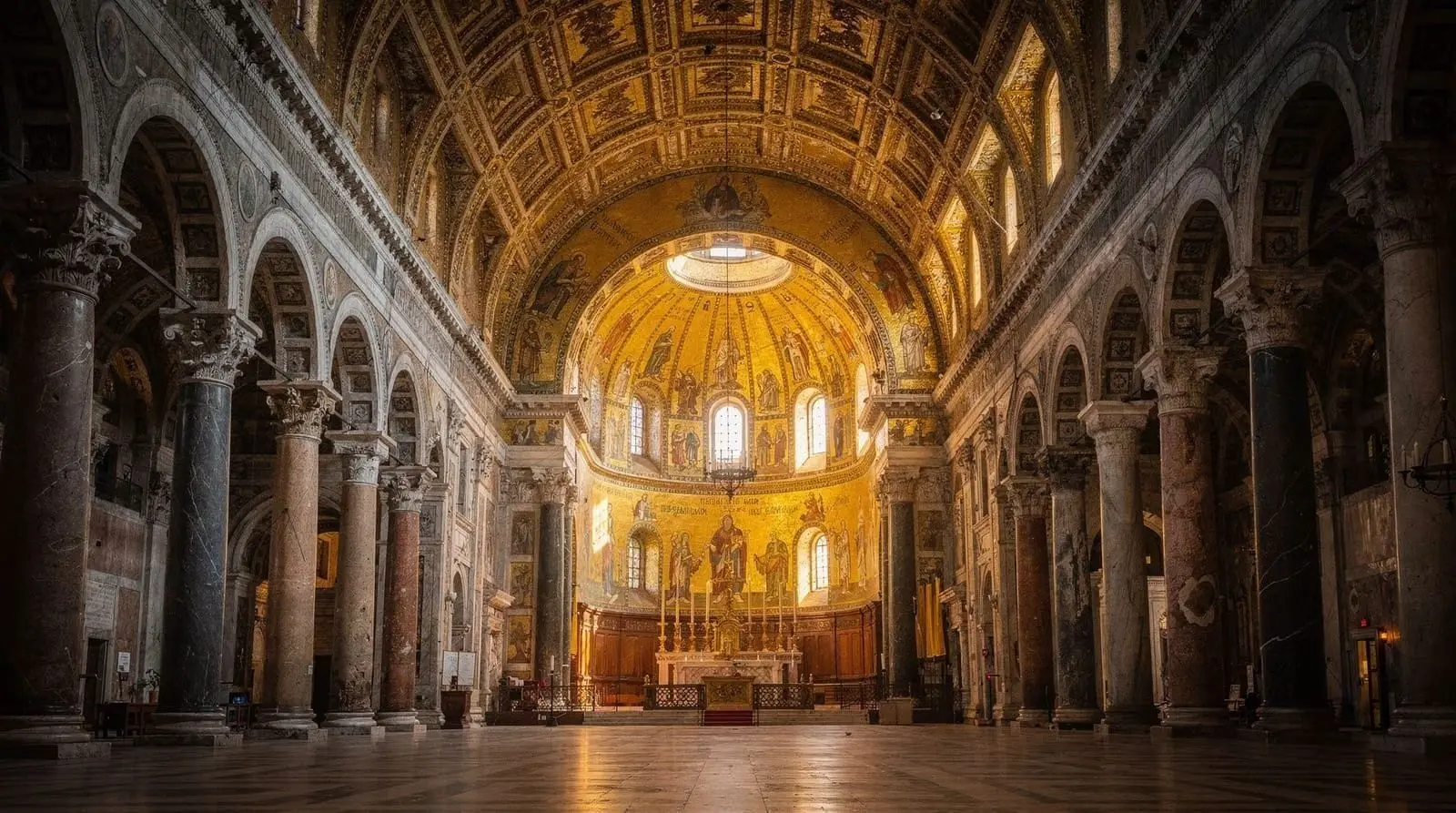
The result is a perfectly preserved Romanesque basilica — low, wide, with a nave and two aisles, marble screens (Cosmatesque work, some reused from the lower church), and an apse. The scale is intimate compared to the great papal basilicas, which makes the art more approachable.
The apse mosaic
The 12th-century apse mosaic is one of the most richly detailed in Rome — a complex symbolic composition centred on the Crucifixion, from which an enormous acanthus scroll (representing the Tree of Life) grows, filled with figures, animals, and scenes of both sacred and everyday life. The deer drinking from streams at the base reference Psalm 42. The white doves on the cross-arms are the Apostles. The peacocks (symbols of immortality) flank the composition.
What makes this mosaic unusual — and why many art historians consider it one of the finest in Rome — is the density and variety of the imagery. Unlike the formal, hierarchical compositions of most apse mosaics (which present Christ or the Virgin in static majesty), this mosaic is alive with observed detail: birds picking at grapes, boats on a river, monks and labourers going about ordinary tasks. The combination of high theology and observed street life in a single composition is quintessentially Roman.
Insert coins for the lighting system (€1 coins).
The Cosmatesque floor and screens
The marble floor of the 12th-century basilica is inlaid Cosmatesque work — geometric intarsia patterns of colored marble, porphyry, and serpentine in the style developed by the Cosmati family of Roman marble-workers in the 12th–13th centuries. The schola cantorum (choir enclosure) screens are reused from the 4th-century basilica below — you are standing next to marble carved in the 400s CE while looking at a 12th-century mosaic above.
The frescos in the lower nave
Several early medieval frescoes survive on the nave walls (largely covered during 12th-century reconstruction but partially visible). Most remarkable: a fresco scene of the Legend of Sisinnius (early 11th century), which contains the oldest surviving written example of a vulgar word in Italian — a workman tells a colleague using a word that is still recognizable today to pick up his end of a stone. It is linguistically significant and frequently cited in histories of Italian language.
Level 2: the 4th-century basilica (€10 underground ticket)
Descending
Buy a ticket from the desk inside the main basilica entrance (typically no queue even in high season). A staircase on the right side of the nave descends into the lower level — the air noticeably cooler, the light dimmer, the sense of compression increasing.
You emerge into a full-sized early Christian basilica. The walls stand to a height of several metres. The nave is clearly identifiable. Frescoes — remarkably vivid given their age — cover sections of wall.
The frescoes
The 4th–11th century frescoes in the lower basilica are the primary reason art historians visit. Several cycles survive in fragmentary but legible form:
The Legend of Saint Clement (9th–11th century): Episodes from the martyrdom of Clement I, showing the saint thrown into the Black Sea with an anchor (the traditional account of his martyrdom) and the miraculous preservation of his tomb. The narrative painting style is direct and expressive — this is pre-Romanesque medieval Christian art at a significant level of quality.
The Ascension of Christ (8th–9th century): A fragmentary but striking composition showing Christ ascending to heaven in a mandorla, flanked by angels and apostles.
The Miracle of Saint Alexis (11th century): A later addition showing an Eastern Christian legend. The survival of multiple fresco cycles in the same space allows you to watch the stylistic evolution of early medieval painting across roughly three centuries.
The frescoes are not in pristine condition — this is a medieval church that served as a foundation for 900 years before being excavated. But their survival is remarkable, and the context (in situ, in a real church, visible in the actual setting) gives them a power no museum reproduction can replicate.
The relic niche
In the apse of the 4th-century basilica is a niche that originally housed the relics of Saint Clement and Saint Ignatius of Antioch — transferred from the catacombs in the 9th century by the scholar-missionaries Saints Cyril and Methodius, who spent time at San Clemente before their mission to the Slavs. The relics were later moved to the upper basilica when it was constructed; the niche is empty but historically significant.
Rome catacombs and underground tour — combines the San Clemente underground experience with the catacombs of the Appian Way, covering Rome’s most significant subterranean archaeology in sequence.Level 3: the 1st-century Roman building (included in underground ticket)
The Mithraic temple
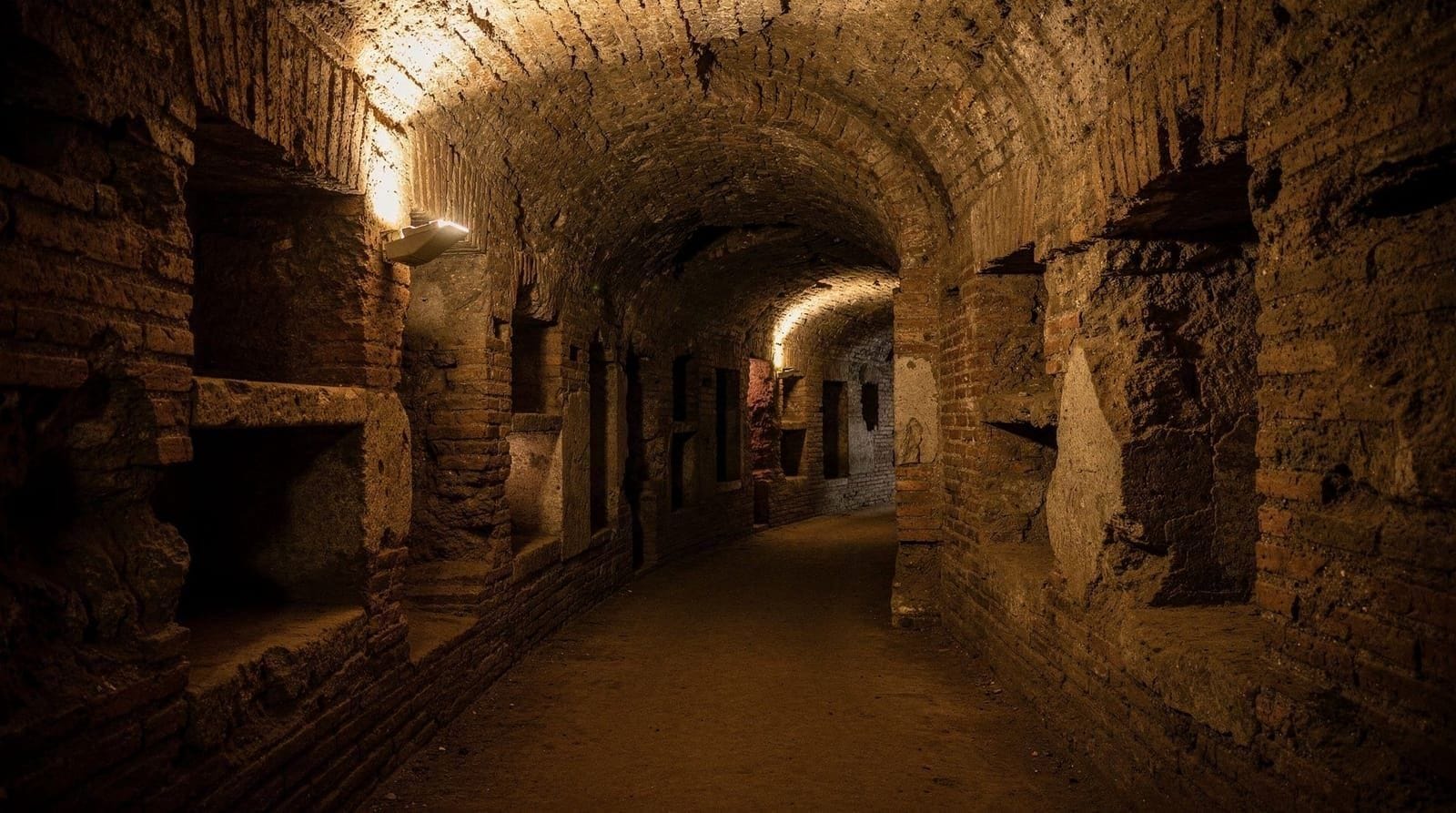
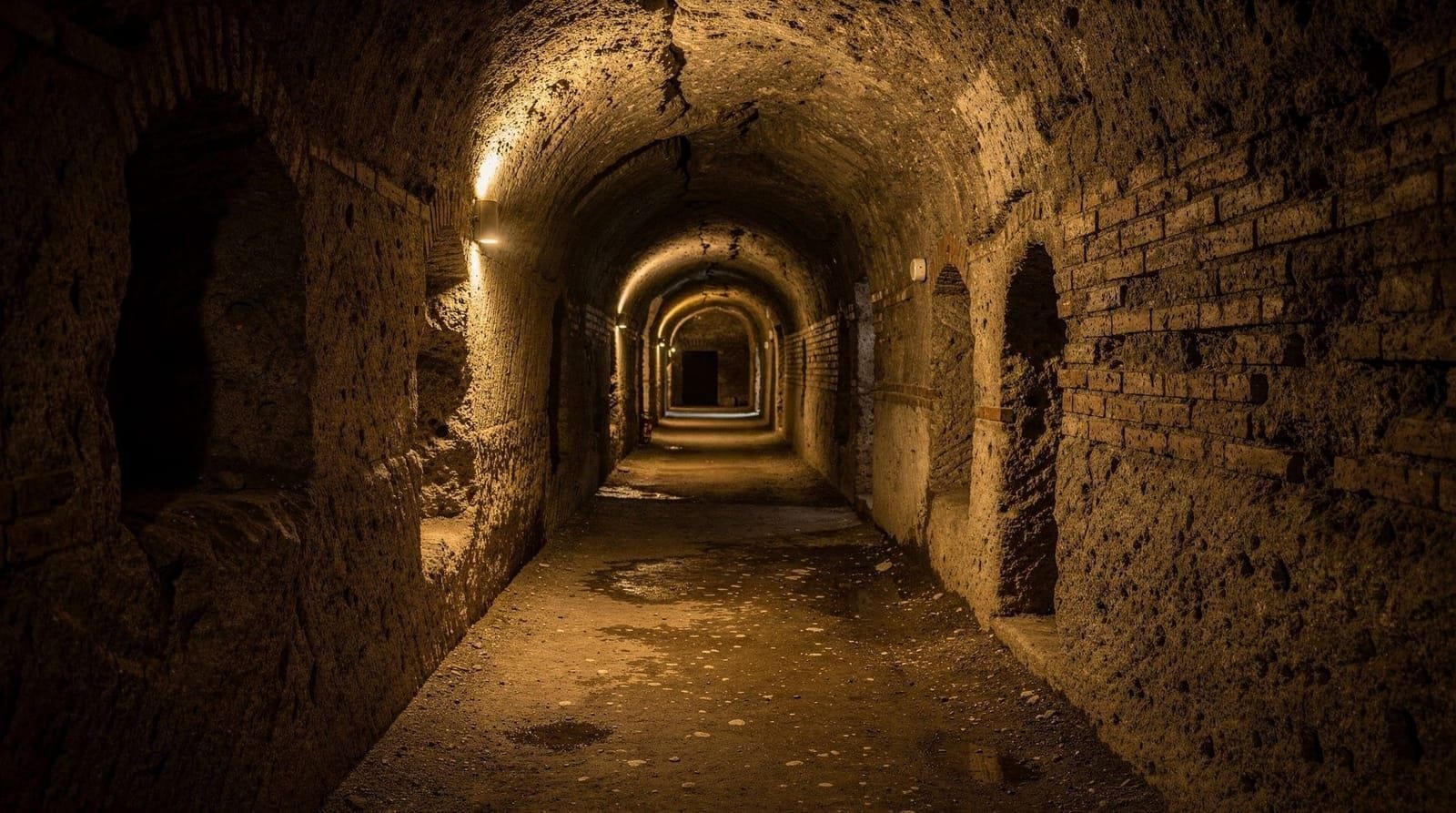
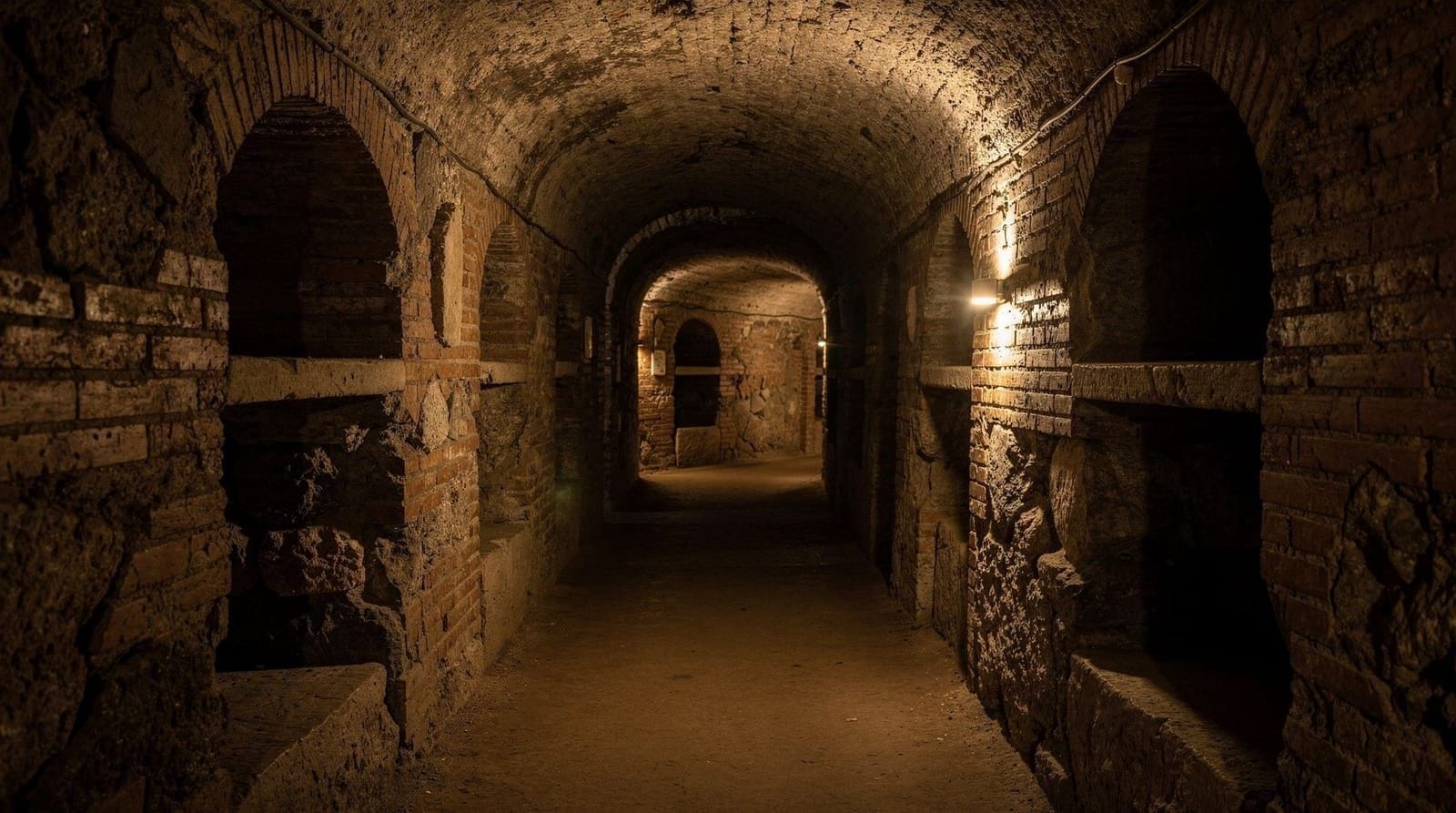
The lowest accessible level is approximately 20 metres below the current street level — the depth of Rome’s two millennia of building. This level preserves parts of a 1st-century CE Roman apartment building (insula) and a Mithraic temple (mithraeum) inserted into its interior around 100–200 CE.
The mithraeum is one of the best-preserved in Rome. The worship space is long and narrow, flanked by stone benches where initiates would recline for ritual meals — a central feature of Mithraic worship, which was an exclusively male mystery religion with strong military appeal. At the far end, the central altar carries a relief of Mithras slaying the bull (the tauroctony) — the foundational image of the religion.
Mithraism was the primary competitor of Christianity for Roman converts in the 1st–3rd centuries. Both religions involved initiation rites, a sacred meal, a focus on redemption and afterlife, and the veneration of a savior figure. The religion collapsed rapidly after Christianity became the state religion in 380 CE. By building a Christian basilica directly above a mithraeum — on the same site, in the same neighbourhood — the early Christians were making a point about religious succession that could not have been lost on anyone familiar with the city. Our Mithraeum of Rome guide covers the other surviving Mithraic sites across the city, including a second one under the Baths of Caracalla, if the San Clemente example leaves you wanting more.
Running water
One of the sensory surprises of the lowest level: you can hear running water. An underground stream still flows through the foundations of the Roman building — the same water that has flowed through this hill for two millennia. The Dominicans who own and administer the church pump the water out constantly to prevent flooding of the lower levels.
The architecture of the insula
Beyond the mithraeum, the excavated rooms of the 1st-century apartment building are visible — brick walls in excellent condition, doorways, windows, the structural elements of a Roman commercial and residential building of the early Imperial period. The scale is domestic; you can walk through rooms that were once ordinary living and working spaces.
Best time to visit and crowd levels
San Clemente rarely feels crowded, even in high season, because it sits slightly off the main Colosseum-to-Forum tourist artery and charges a modest ticket most visitors don’t budget time for. The busiest window is late morning (10:00–12:00), when Colosseum-area day-trippers spill over after their timed entry slots. Arriving right at 09:00 opening, or in the mid-afternoon after 15:00, usually means having entire rooms of the underground to yourself. The one hard constraint is the midday closure: both the ticket desk and the underground shut at 12:30 sharp and reopen at 15:00, so a visit squeezed in at 12:00 risks being cut short mid-basilica. Sundays are more restricted (12:15–18:00 only, reflecting the active parish schedule), so a weekday visit gives more flexibility if your itinerary allows it.
Practical information
Address: Via Labicana 95 (also Via San Giovanni in Laterano), 00184 Roma.
Hours: Monday–Saturday 09:00–12:30 and 15:00–18:00; Sunday 12:15–18:00. These hours are enforced; the underground closes strictly at 12:30 and 18:00.
Entry: Upper basilica free. Underground levels €10, purchased at the internal ticket desk.
Getting there: 5 minutes’ walk from the Colosseum. Metro B to Colosseo, exit on Via Sacra side, walk south and east on Via Labicana. Bus 53, 85, 87, 117 all stop nearby.
Photography: Permitted in the upper basilica and the underground levels (no flash in the lower frescoes areas).
Time to allow: 30 minutes for the upper basilica; 45–60 minutes for the underground tour; 75–90 minutes for a thorough visit.
Dress code: Standard church dress code — shoulders and knees covered.
San Clemente vs Rome’s other underground visits
San Clemente is one of several layered or subterranean experiences in Rome, and each answers a different curiosity. Here is how they compare:
| Site | What you see | Time needed | Booking |
|---|---|---|---|
| San Clemente | Basilica over church over Roman house & Mithraic temple | 75–90 min | Walk-in, pay inside |
| Capuchin Crypt (guide) | Chapels decorated with monks’ bones | 20–30 min | Walk-in ticket |
| Domus Aurea (guide) | Nero’s ruined underground palace, VR reconstruction | 75 min, guided only | Advance booking essential |
| Appian Way catacombs (guide) | Early Christian burial tunnels | 45–60 min, guided only | Advance booking recommended |
If you can fit only one, San Clemente rewards curiosity about how Rome layers its own history without requiring advance planning — the Domus Aurea and the catacombs both need a booked guided slot. For booking approaches to the Colosseum itself, which pairs naturally with a San Clemente visit, see our Colosseum tickets guide.
Combining San Clemente with other sites
San Clemente sits in the Celio district, between the Colosseum and San Giovanni in Laterano. Natural combinations:
With the Colosseum: Most visitors to the Colosseum area pass within 5 minutes of San Clemente. The two make a coherent half-day: Colosseum in the morning (book in advance), San Clemente in the early afternoon before the midday closure becomes an issue. See our Colosseum guide.
With San Giovanni in Laterano: A 15-minute walk east leads to the Cathedral of Rome. A Colosseum + San Clemente + San Giovanni in Laterano day is one of the most historically dense single days possible in Rome — 2,000 years from the 1st-century Mithraeum to the 17th-century Borromini nave of the Lateran. See our St John Lateran guide.
For underground Rome enthusiasts: San Clemente is the starting point of a broader underground Rome itinerary that can include the Capuchin Crypt, the Circus of Nero beneath St. Peter’s (Vatican Grottoes), and the catacombs of the Appian Way. For a comparative overview of Rome’s underground experiences, see our Rome catacombs and underground guide.
Capuchin Crypts and Catacombs tour — extends the underground Rome experience started at San Clemente to the Appian Way catacombs and the Capuchin bone chapel, covering the city’s most dramatic subterranean sites.Why San Clemente matters
San Clemente is not the most visited church in Rome, nor the largest, nor the most baroque-spectacular. It is, however, the one that most directly answers the question that underlies almost all Roman tourism: what does it actually mean that this city has been continuously inhabited and continuously built upon for more than two thousand years?
Standing in the 1st-century mithraeum — hearing water running beneath the floor, knowing that directly above your head is a 4th-century Christian basilica and above that a 12th-century church where Mass will be celebrated this afternoon — the answer becomes concrete. Rome is not a museum of successive civilizations; it is a place where successive civilizations pressed down on each other, built over each other’s ruins, and left each layer partially intact.
For the full context of Rome’s layered religious history, see our history and culture guide and our overview of Rome’s churches and free art.
Frequently asked questions about San Clemente: three churches stacked across 2,000 years
How much does it cost to visit San Clemente?
What are the opening hours for San Clemente?
How do I get to San Clemente?
What is the Mithraic temple in San Clemente?
Who was Saint Clement?
Is San Clemente suitable for children?
How does San Clemente compare to Rome's other underground sites?
Top experiences
Bookable activities with verified prices and instant confirmation on GetYourGuide.