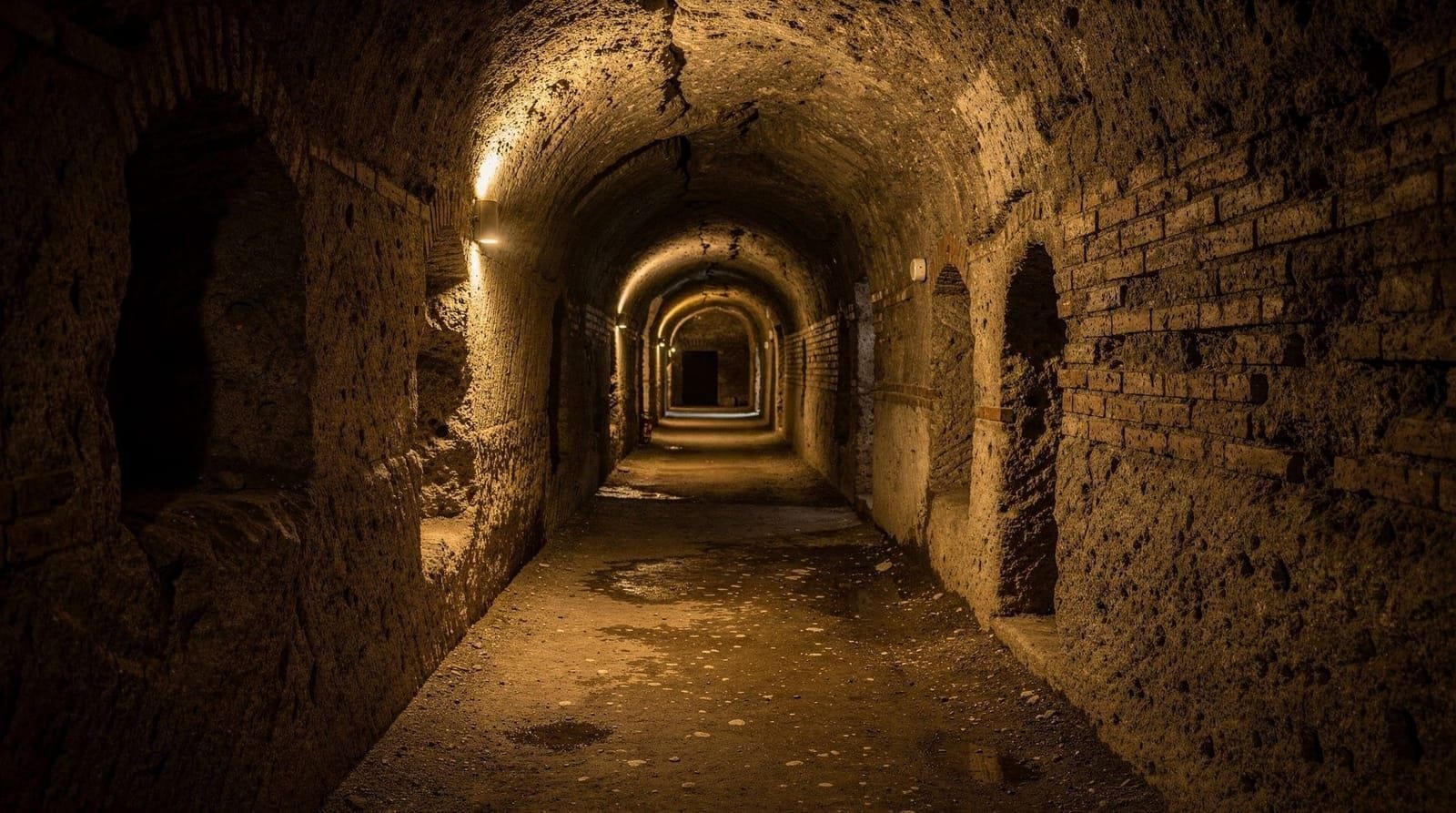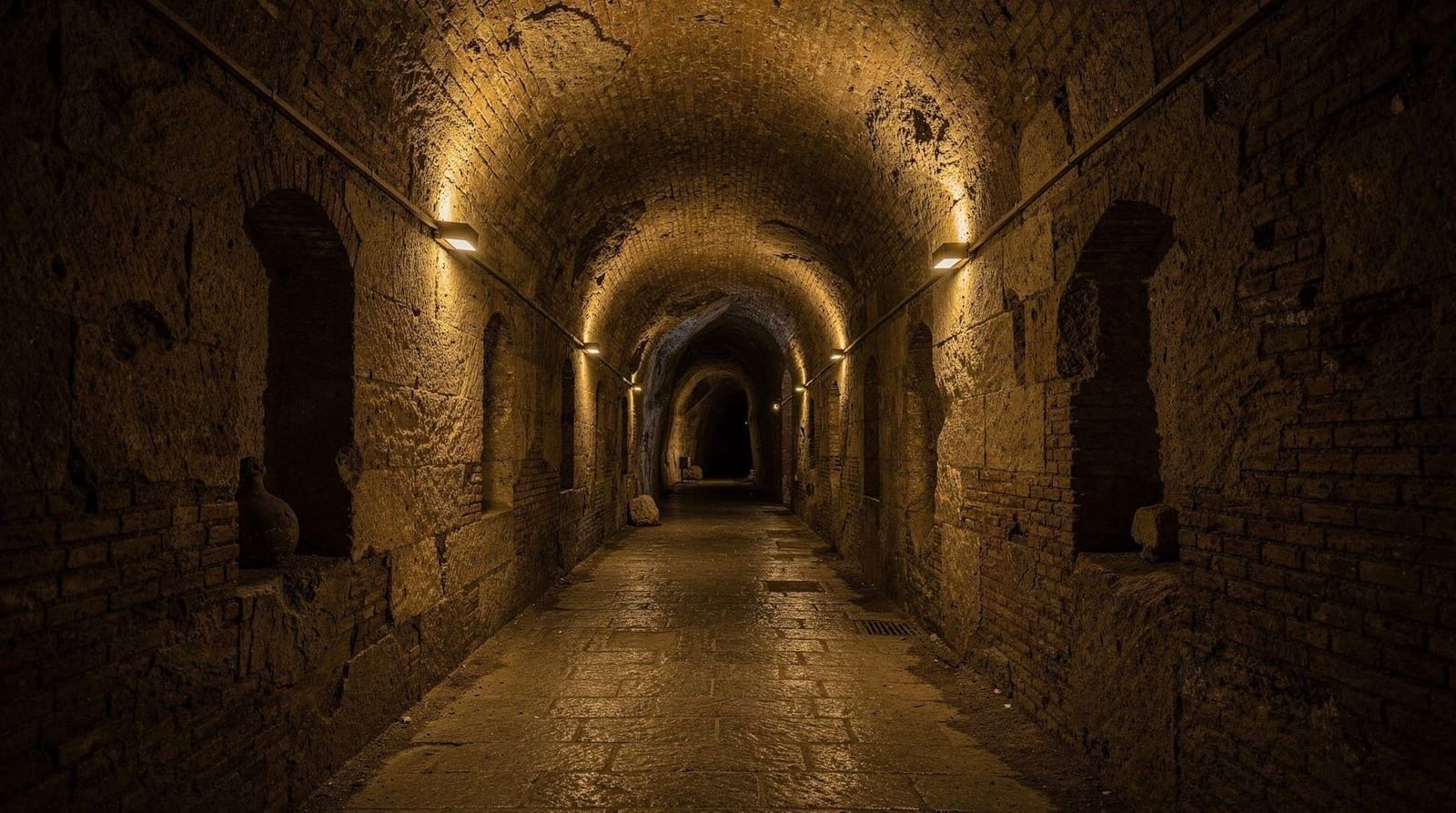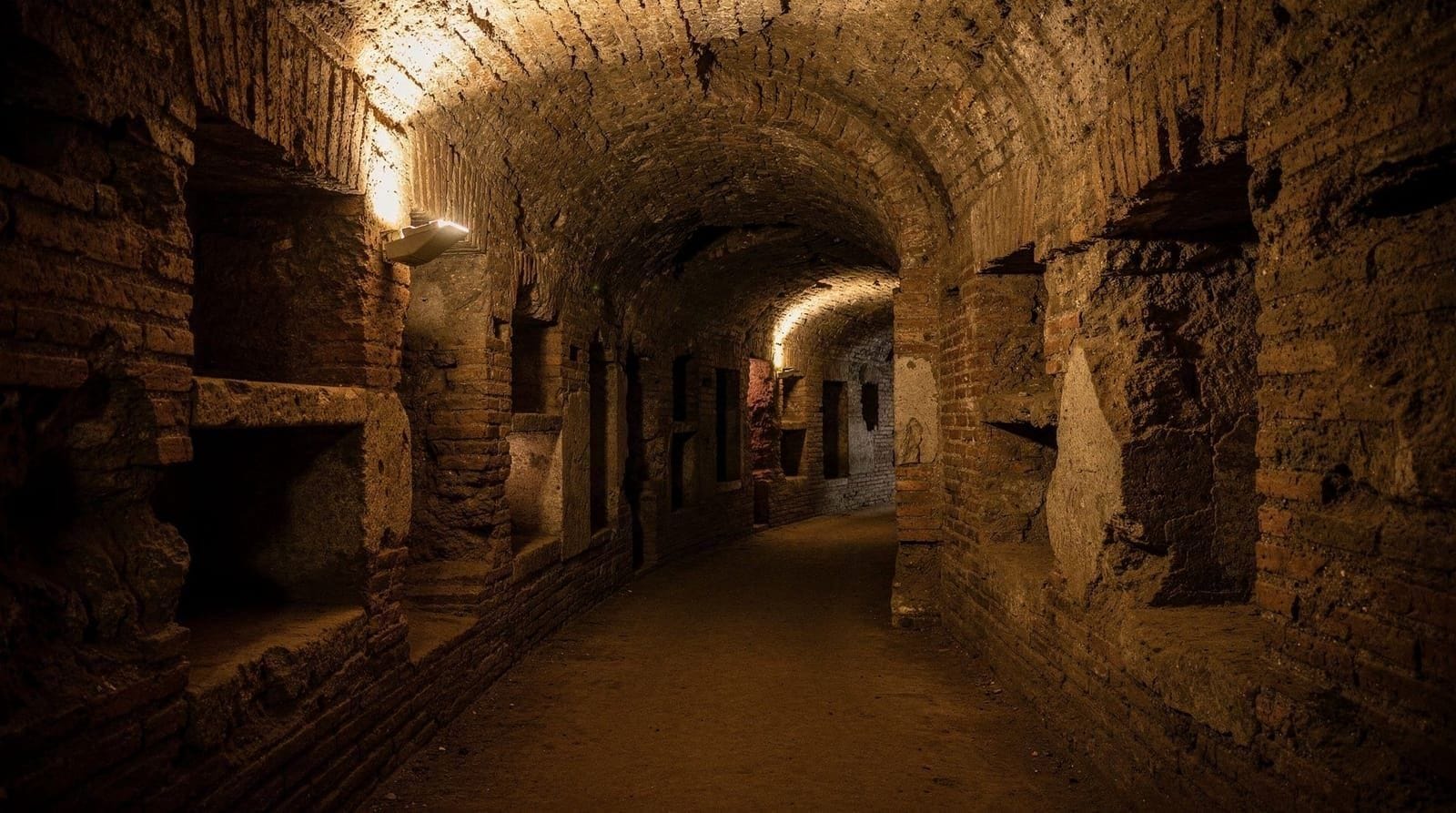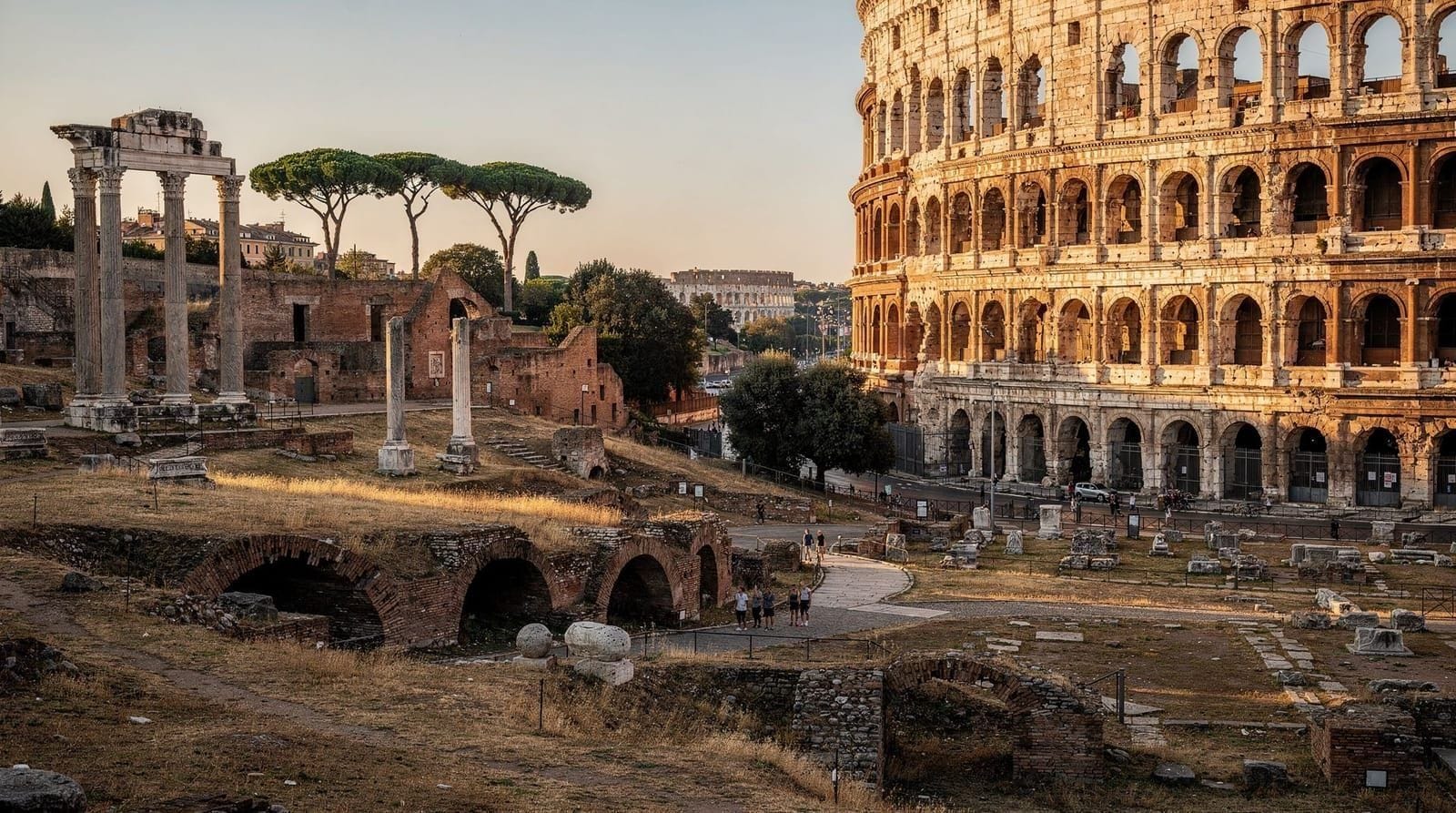
Domus Romane at Palazzo Valentini: Roman houses brought to life
Rome: Catacombs Tour & Tiber River Boat Hop on Hop Off
What is Domus Romane at Palazzo Valentini and why visit it?
Discovered in 2007 during renovation works, the Domus Romane are the remains of two large Roman patrician houses from the 1st-4th centuries CE, beneath the Palazzo Valentini near Trajan's Column. A sophisticated multimedia system projects reconstructed interiors — mosaics, painted walls, furnishings — onto the original foundations as you walk above them on glass walkways. Advance booking is required and slots fill up quickly.
A discovery beneath an administrative building
In 2005, the Province of Rome began renovating the Palazzo Valentini — a 16th-century administrative building adjacent to Trajan’s Column — to create new offices. Beneath the building’s foundations, archaeologists encountered something unexpected: two large Roman domus (patrician houses) in an extraordinary state of preservation, with intact mosaic floors, wall frescoes, hypocaust heating systems, and an elaborate bath suite.
Archaeological works and site development ran until 2010, when the Domus Romane opened to the public as a permanent exhibition. Unlike most Roman archaeological discoveries, which are typically integrated into existing open sites or displayed behind barriers, the Palazzo Valentini team made a different decision: to use cutting-edge projection technology to reconstruct the houses’ original appearance in light and sound, while visitors walk above the actual ruins on glass walkways.
The result is one of the most technologically sophisticated archaeological visitor experiences in Italy — and one of the more genuinely illuminating ways to understand how wealthy Romans lived, as distinct from how they built temples and amphitheatres.
| Where | Piazza Venezia, beside Trajan’s Column |
| Cost | around €12 adult, reduced for children/Roma Pass |
| Time needed | 60–75 minutes |
| Booking | advance booking required — walk-up rarely available |
| Best paired with | Trajan’s Column, Capitoline Museums, Roman Forum |
The discovery: what was found
The two houses discovered beneath Palazzo Valentini date from the late 1st to the 4th centuries CE, with evidence of continuous occupation and modification across that period. They appear to have been aristocratic residences — the scale, materials, and location (within walking distance of the Roman Forum) all indicate ownership by high-status families.
House 1: the larger domus
The first house is the more extensively preserved. Key features:
Mosaic floors: Several rooms have intact or near-intact mosaic floors with geometric and floral designs. The quality of the tesserae (mosaic tiles) — including marble, glass, and semi-precious stone inserts — indicates significant expenditure. One room has a polychrome carpet mosaic that is among the finest examples of domestic mosaic work visible in Rome.
The baths complex: A private bath suite with a frigidarium (cold room), tepidarium (warm room), and caldarium (hot room) is preserved with substantial wall and floor surfaces intact. The hypocaust system — the raised floor through which hot air circulated from an external furnace — is visible and explained in detail during the tour. Private baths in a domestic setting were a luxury reserved for the genuinely wealthy; most Romans used public bath houses.
Painted walls: Fresco fragments survive on several walls, showing the decorative schemes of different periods of the house. The tour’s projection system reconstructs these painted interiors in full, showing what the rooms would have looked like in colour and furnishing.
House 2: the partial remains
The second house, less completely preserved, contributes additional mosaic sections and structural evidence for the development of the site across the Roman period. The projection system addresses both houses, and the tour moves between them via the glass walkways.
The multimedia experience: how it works
The Domus Romane is not a standard archaeological tour. The core technology is a combination of:
Floor projections: Images of the reconstructed mosaic floors — based on the existing fragments and comparative evidence from other Roman sites — are projected downward onto the actual ruins. As you walk along the glass walkway above the foundations, the rooms below appear as they would have when inhabited, lit from within.
Wall projections: On the preserved and reconstructed wall surfaces, painted decoration is projected in its reconstructed form, matching what art-historical evidence suggests the walls would have looked like.
Ambient sound and narration: A spoken commentary (in English or Italian, depending on your tour slot) accompanies the visual experience, explaining the function of each room, the lifestyle of the residents, and the archaeological interpretation of what was found.
3D reconstructions: At certain points, full three-dimensional reconstructed scenes are projected or displayed — showing servants working, household routines, the bath routine in animated form. These sequences are more accessible for visitors with no prior knowledge of Roman domestic architecture.
The overall effect is immersive without being dishonest — the technology distinguishes clearly between what was actually found and what is interpretive reconstruction. The tour is well-designed and does not overstate its conclusions.
What you actually learn here
The value of the Domus Romane is specific. It answers questions that are surprisingly hard to answer elsewhere in Rome:
How did a wealthy Roman house actually look from the inside? The Forum and Colosseum tell you about public life; Domus Romane tells you about private life. The reconstructed rooms — triclinium (dining room), cubiculum (bedroom), atrium, tablinum (study/reception) — show the spatial organization of a Roman aristocratic household in practice.
How did underfloor heating work? The hypocaust system at the Domus Romane is one of the clearest preserved examples in Rome, and the explanation during the tour is unusually accessible. The engineering — channels, tile spacers, furnace location — is visible in physical detail.
How did mosaic floors get made? The preserved floor sections, seen from the glass walkway directly above, allow a close-up view of tesserae arrangement and design that museum displays of lifted mosaics do not replicate.
What did wealthy Romans spend money on? The physical evidence of the bath suite, the mosaic quality, the spatial extent of the house — all calibrate understanding of Roman wealth and its material expressions more concretely than written accounts alone.
Practical information for 2026
Address: Piazza Venezia (entrance from the Palazzo Valentini courtyard), near the Column of Trajan
Getting there: On foot from the Roman Forum area (10 minutes’ walk), Piazza Venezia tram stop (several lines), or the Colosseo metro station (15 minutes’ walk). Parking is not recommended — Piazza Venezia is a major traffic hub and the ZTL zone is active in the central area.
Booking: Advance booking is required. Walk-up availability is very limited and not reliable. Book through the official website or through tour operators. English-language tours should be specified when booking.
Hours: Tuesday-Sunday, 09:30-18:30 (last tour approximately 17:30). Closed Mondays.
Tickets: Standard adult approximately 12 EUR. Reduced for children and Roma Pass holders. Tours run approximately every 30-45 minutes.
Duration: 60-75 minutes for the guided tour.
Photography: Permitted during the tour — the projection-lit ruins photograph well.
Accessibility: The Palazzo Valentini has lift access to the underground level. The glass walkways are level. This is one of the more accessible underground Rome sites.
Combining Domus Romane with the Trajan’s Column area
The Domus Romane is ideally positioned for combining with several of Rome’s most significant ancient sites:
Trajan’s Column: Directly outside the Palazzo Valentini. The column commemorates Trajan’s Dacian campaigns (101-106 CE), and the inhabitants of the houses beneath you would have been contemporaries of the column’s construction. See the Roman Forum guide for the broader context of the Imperial Fora.
The Capitoline Museums: 10 minutes’ walk. The Capitoline collection includes the original equestrian statue of Marcus Aurelius, ancient Roman portrait sculptures, and the Capitoline Wolf — all directly relevant to understanding the culture of the domus residents. See the Capitoline Museums guide.
The Roman Forum and Palatine Hill: 15 minutes’ walk from the Palazzo Valentini to the main Forum entrance. A combined visit — Domus Romane in the morning, Forum and Palatine in the afternoon — makes for a richly layered ancient Rome day.
Rome catacombs tour with Tiber River boat hop-on-hop-off — combines underground Rome with a flexible river transport option across the city.The context: how Romans actually lived
Most Rome itineraries concentrate on what Romans built for show — the Forum, the Colosseum, the temples. The domestic architecture of Roman daily life is harder to access; much of it was demolished, buried, or built over in later periods. The catacombs give you one kind of private world; the Domus Romane give you another.
The houses beneath Palazzo Valentini are not unique archaeological finds — dozens of Roman domus have been excavated across the city. But most are not open to visitors, or are accessible only as excavated foundations without the interpretive layer that makes the domestic spaces legible.
Understanding how a wealthy Roman family lived — the spatial hierarchy of the house, the centrality of the atrium as social gathering space, the private devotion to the Lares in the household shrine, the separation of service spaces from reception spaces — transforms how you read the rest of ancient Rome. The Forum’s law courts and temples and rostra were the stage on which the men who owned these houses performed their public roles. The domus was where they went home.
For the complete picture of ancient Rome’s stratified layers, see the underground Rome overview. For a broader historical context, the Rome history guide and Roman Empire explained provide narrative background.
Domus Romane vs other Rome underground experiences
| Experience | What it shows | Time | Multimedia level |
|---|---|---|---|
| Domus Romane | Wealthy domestic life, mosaics, baths | 60–75 min | High — full projection reconstruction |
| Basilica San Clemente | Layered church over Mithraic temple over Roman house | 45–60 min | Low — original fabric only |
| Domus Aurea | Nero’s imperial palace, fresco | 90–120 min | Medium — VR add-on available |
| Catacombs | Early Christian burial tunnels | 60–90 min | None — guided walk only |
If you only have time for one underground site beyond the Colosseum, Domus Romane is the most accessible for visitors without prior Roman history background, precisely because the projection technology does the interpretive work for you. For a fabric-first, no-multimedia alternative, Basilica San Clemente’s underground layers reward visitors who prefer reading original stone over reconstructed projections.
Best time of day and season to visit
Because the entire experience takes place underground and relies on projected light rather than natural illumination, Domus Romane is one of the few Rome sites genuinely unaffected by weather or time of day — a useful option for a rainy afternoon or the hottest hours of a summer day when outdoor sites like the Forum become uncomfortable. Morning slots (09:30–11:00) tend to have smaller groups and a calmer pace; midday and early afternoon slots are busier with tour groups arriving after visiting Trajan’s Column. In winter, the site is a good indoor alternative when short daylight hours compress your outdoor sightseeing window. There is no meaningful seasonal advantage the way there is for the Forum or Palatine Hill — any time of year delivers the same experience.
Booking tips and avoiding disappointment
Because group sizes are small and tours run on a fixed schedule, Domus Romane sells out further ahead than many visitors expect for a lesser-known site. If you are visiting between April and October, book at least a week ahead rather than assuming you can walk up after seeing Trajan’s Column. If your preferred slot is full, check for a same-day cancellation the morning of your visit — cancellations do occur, especially for weekday slots. Arrive 10 minutes before your slot; tours depart on time and latecomers are not always accommodated on a fully booked departure.
Is Domus Romane worth the price of admission?
The honest answer is: yes, with the caveat that it is not for every type of visitor.
If you are primarily interested in architectural spectacle and physical grandeur, the Colosseum, the Pantheon, and the Forum will satisfy you more. The Domus Romane’s ruins, in isolation from the multimedia system, are modest — foundations, floors, a preserved bath room. It is the interpretation that makes them compelling.
If you want to understand Roman domestic life, or if you are travelling with older children (8+) who will engage with the multimedia presentation, or if you have already covered the major monuments and want to go deeper into the texture of ancient Rome — the Domus Romane is one of the most genuinely informative archaeological experiences in the city.
It is also one of the most honest: the technology is used to illuminate the actual evidence, not to create an illusion. You leave knowing more about real Roman daily life than when you arrived. In a city where many “experiences” are primarily spectacle, that is worth noting.
For comparisons with other underground sites, see underground Rome tours compared.
What the Domus Romane tell us about Roman urban density
One of the most striking revelations of the Palazzo Valentini excavation is the sheer proximity of the houses to the Roman Forum and the Imperial Fora. The residents of these domus lived within a few hundred metres of the most important public spaces in the Roman world. Senators and administrators who walked the Forum on official business came home to mosaic floors, private baths, and painted triclinia essentially across the street.
This density — wealthy private residences packed immediately adjacent to monumental public architecture — is characteristic of Rome and contrasts significantly with modern urban planning assumptions. There was no residential suburb in the modern sense; the elite lived in the same noisy, dense fabric as everyone else, separated by walls rather than distance.
The archaeological evidence from the Palazzo Valentini houses reinforces this picture. The bath suite, while private, is relatively compact compared to the vast public thermal complexes nearby (the Baths of Diocletian, Baths of Caracalla) — but it was the equivalent of having a gym in your apartment in a city where the public gyms were Olympic in scale. The domestic baths expressed both wealth and a preference for privacy that the public baths, for all their social importance, could not offer.
The modifications visible across the different phases of occupation — rooms divided, added, repurposed — also tell a story about Roman property continuity. The same site, owned and modified by successive patrician families across three centuries, shows patterns of inherited wealth and property that would be recognizable in any property market.
Visitors sometimes assume that a discovery made only two decades ago, beneath a functioning government building, must be a minor footnote compared to sites excavated over centuries. In practice, the opposite is often true: because the Palazzo Valentini houses were sealed beneath later construction rather than exposed to weather and looting for a millennium, the preservation of mosaic colour, wall plaster, and structural detail is unusually good for a Roman domestic site. Archaeologists have been able to date renovation phases with more precision here than at many longer-known domus, because the sequence of building layers was undisturbed until the 2005 works began.
These are the details that transform Palazzo Valentini from a novelty into genuine historical illumination. The Capitoline Museums and the National Roman Museum provide complementary collections of domestic objects — statuary, household goods, decorative arts — that the Domus Romane’s architectural shells implicitly reference.
For placing the Domus Romane in a full day of ancient Rome exploration, the ancient Rome in one day itinerary provides a framework that incorporates the major Forum-area sites alongside the Palazzo Valentini.
Frequently asked questions about Domus Romane at Palazzo Valentini: Roman houses brought to life
How do I book tickets for Domus Romane?
How much does Domus Romane cost?
Where is Palazzo Valentini?
Is Domus Romane suitable for children?
What language is the Domus Romane tour in?
How does Domus Romane compare to a standard archaeological site?
Top experiences
Bookable activities with verified prices and instant confirmation on GetYourGuide.