Roman mythology in the city: gods, temples and legends you can still see
Rome: Guided Tour of Colosseum, Roman Forum & Palatine Hill
Where can visitors see Roman mythology made visible in Rome today?
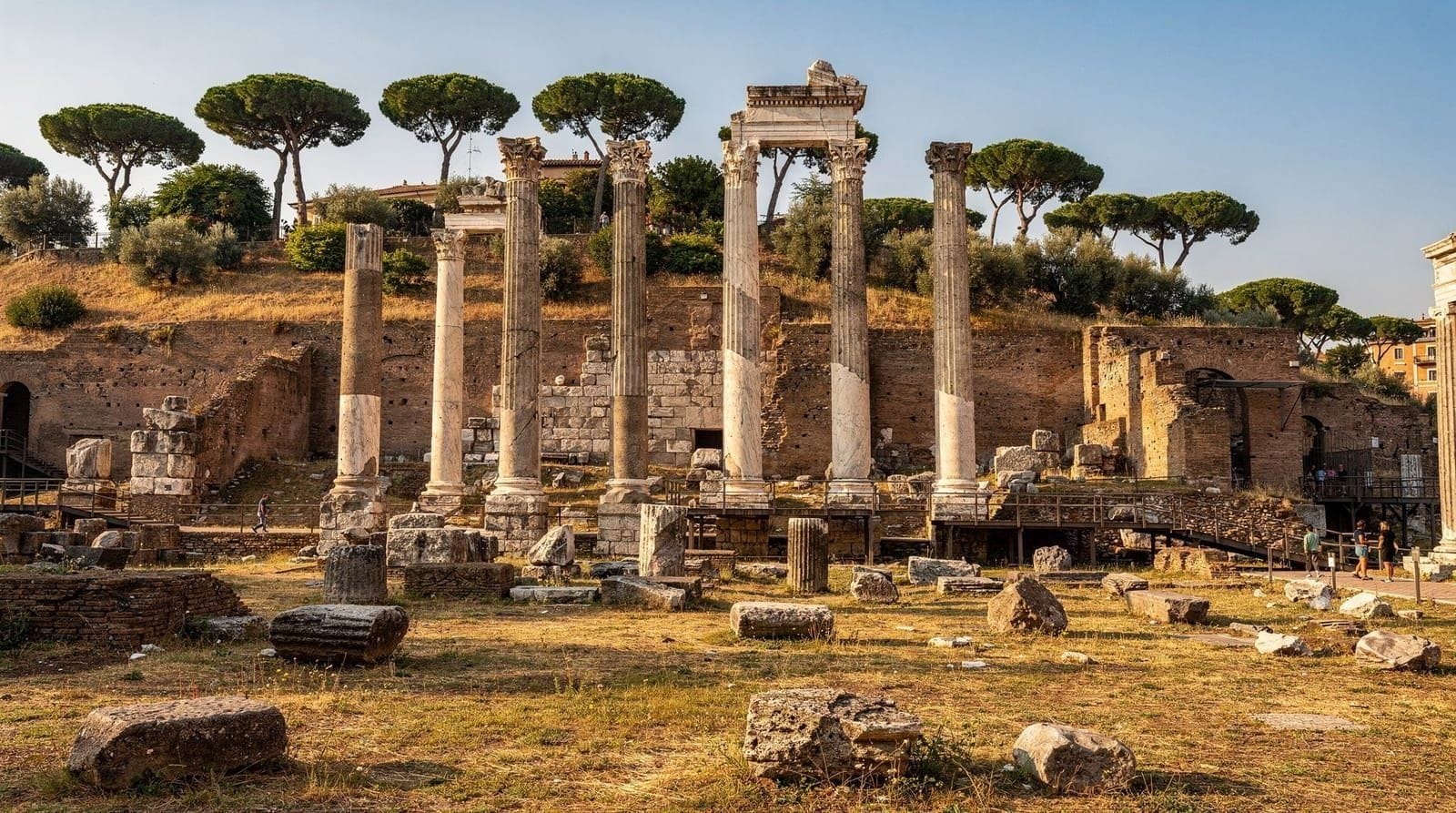
The most directly mythological sites include: the Pantheon (temple to all the gods, still standing); the Temple of Saturn in the Roman Forum (one of Rome's oldest temples); the Temple of Vesta and House of the Vestals (sacred flame of Rome's guardian goddess); the Capitoline Hill (temple of Jupiter Optimus Maximus stood here); the Lupercal cave on the Palatine Hill (birthplace of Rome per legend, under investigation); Castel Sant'Angelo (built as the Mausoleum of Hadrian, who was deified); and the Ara Pacis (shows Roman gods in the state's self-presentation). Roman mythology also permeates the Baroque fountains — Bernini's Fontana del Tritone shows Poseidon's son directly.
The gods you can still find in Rome
Roman religion did not disappear entirely when Christianity displaced it. The names of the planets, the days of the week (in Romance languages: lunedì from Luna, martedì from Mars, mercoledì from Mercurio, giovedì from Giove-Jupiter, venerdì from Venus), and the months of the year carry the old pantheon into daily language. The Pantheon — temple to all the gods — still stands. Baroque fountains show Triton, Neptune’s son, blowing his conch shell on the streets of an ostensibly Catholic city.
This guide maps the mythological layer of Rome: where the old religion was practised, what sites survive, and how the myths shaped the city’s self-image from the Republic through the present.
| Where | Pantheon, Roman Forum, Capitoline Hill, Palatine Hill, Baroque fountains |
| Cost | Free (Pantheon, fountains) to €18 combined ticket (Forum/Palatine) |
| Time needed | A half-day to cover the core mythological sites on foot |
| Best starting point | Pantheon, then the Roman Forum |
| Don’t miss | The Trevi Fountain’s Neptune at dusk or early morning |
The founding myth: Romulus, Remus and the she-wolf
Rome’s origin myth is both foundational and politically convenient. In the standard version, as told by Livy and Ovid among others, the twin brothers Romulus and Remus were born to the vestal virgin Rhea Silvia and the god Mars. Exposed on the Tiber by their great-uncle Amulius (who feared their claim to the throne of Alba Longa), they were rescued — in the canonical version — by a she-wolf who suckled them at the Lupercal cave on the Palatine Hill. A shepherd named Faustulus found them and raised them. They grew up, overthrew Amulius, founded Rome, and Romulus killed Remus in a dispute about the new city’s walls.
The political usefulness of this myth is obvious: divine parentage (Mars) explains Rome’s martial character; the Tiber rescue validates Rome’s geographic location; the killing of Remus establishes Rome’s foundational violence and the absolute authority of its first ruler. The myth was believed, at varying levels of literalism, throughout the Republic and Empire.
The Capitoline Wolf — the bronze sculpture of the she-wolf — is in the Capitoline Museums and is one of Rome’s most iconic images. The dating of the original bronze has been debated; some scholars date it to the 5th century BCE, others to the medieval period. The suckling twins were added in the Renaissance, probably by Antonio Pollaiuolo.
The Lupercal cave on the Palatine Hill remains archaeologically active. A cavity identified in 2007 beneath the hill’s southwest slope may be the actual cave; it contains a mosaic ceiling and shell and marble decorations that suggest a cult site. It is not currently open to the public, but its existence as a real location (not merely literary invention) is consistent with the site’s antiquity as a place of religious practice.
Every year on 15 February, the festival of Lupercalia was celebrated — young male priests (Luperci) sacrificed a goat and a dog at the Lupercal, smeared their foreheads with the blood mixed with milk, then ran naked around the Palatine Hill striking women with strips of the goat’s skin (believed to promote fertility). The festival survived long after Christianity’s adoption — it was finally suppressed in 494 CE, when Pope Gelasius I replaced it (arguably) with the Feast of the Purification of Mary.
Jupiter and the Capitoline Hill
The Capitoline Hill was Rome’s most sacred high point. At its summit stood the Temple of Jupiter Optimus Maximus (Jupiter Best and Greatest) — the state’s primary temple, rebuilt multiple times after fires, the destination of triumphal processions returning from successful military campaigns. A Roman general’s triumph ended here, with sacrifice at Jupiter’s altar.
The original temple is entirely gone — its foundations were excavated in the 15th–16th centuries, and the Palazzo dei Senatori now stands roughly over the site. However, the Capitoline Museums contain extensive material from the Capitoline cult, including several colossal statues of Jupiter and the extraordinary bronze hand from a statue of Constantine that was once displayed in the Forum of Trajan (and had comparable divine connotations).
The word “capital” derives from Capitolium — the Capitoline Hill — demonstrating how thoroughly Roman administrative and religious vocabulary permeated Western civilisation.
What to see: The Capitoline Museums, including the Palazzo Nuovo with its collection of Roman sculpture (the Capitoline Venus, the Capitoline Wolf, the Hall of Emperors), and the Tabularium with its views over the Forum. See the full Capitoline Hill guide.
The Pantheon: all the gods under one dome
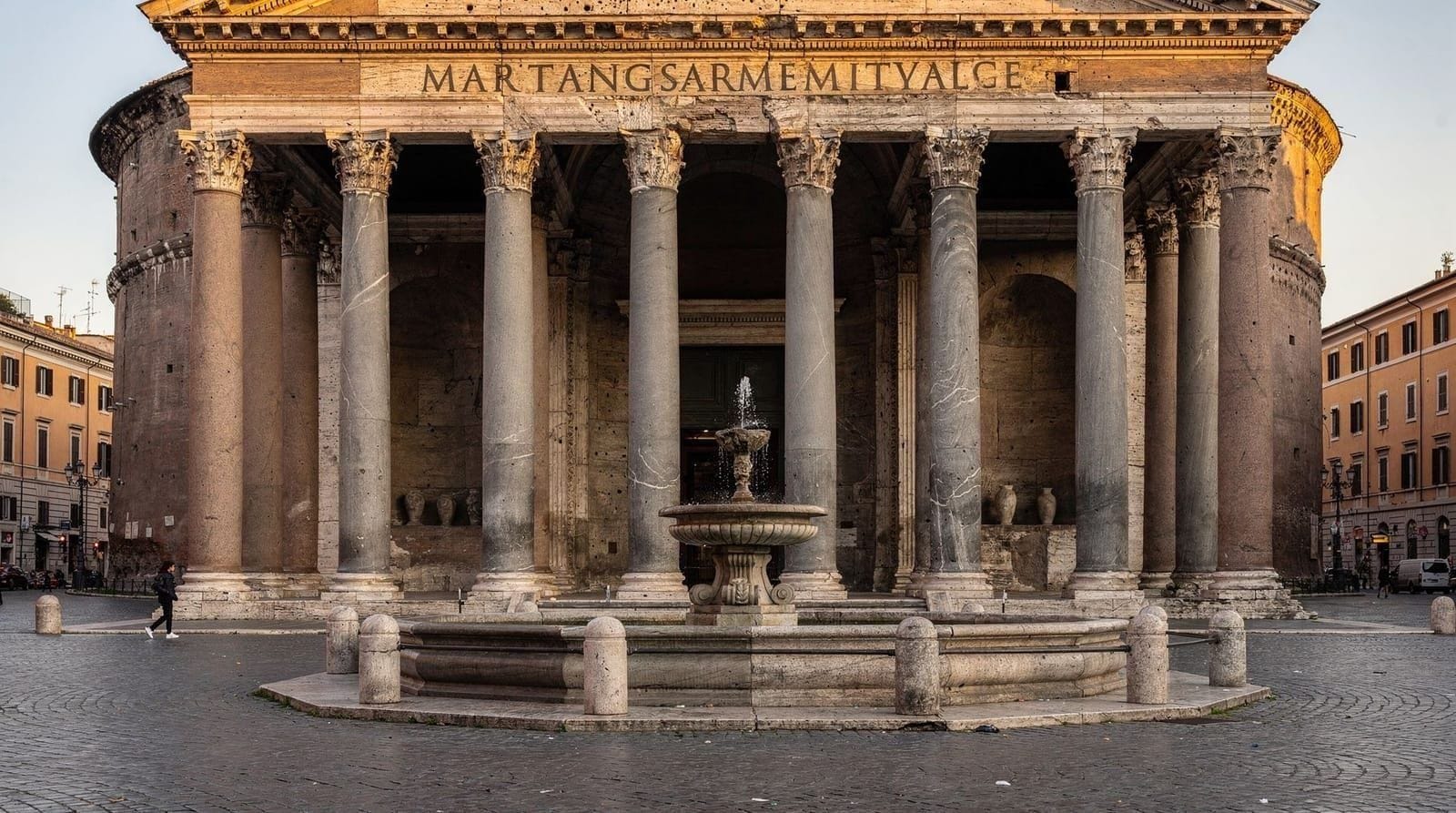
The Pantheon — the building whose name means “for all the gods” — is the best-preserved ancient Roman temple and the building most directly available to visitors as a mythological site. The current structure was built by Hadrian around 125 CE, replacing an earlier temple built by Marcus Agrippa in 27–25 BCE.
The interior is extraordinary in its mathematics: the dome’s diameter equals the distance from floor to ceiling (43.3 metres), so a perfect sphere could be inscribed within the building. The coffered dome converges to the oculus — a 9-metre open eye at the top, the building’s only light source. On 21 April (the traditional date of Rome’s founding), the noon sun shines directly through the oculus onto the entrance door — whether this was intentional is debated but consistent with the building’s precise geometry.
Which gods were worshipped here is not entirely clear. The name implies a general divine dedication. The building was consecrated to the Virgin Mary and Christian martyrs in 609 CE by Pope Boniface IV — the conversion that preserved it. Raphael is buried here, as are two Italian kings.
The Pantheon guided tour with entry ticket covers the building’s extraordinary geometry and its history as both pagan temple and Christian church — the most intellectually rewarding way to visit Rome’s best-preserved ancient structure.Vesta and the eternal flame
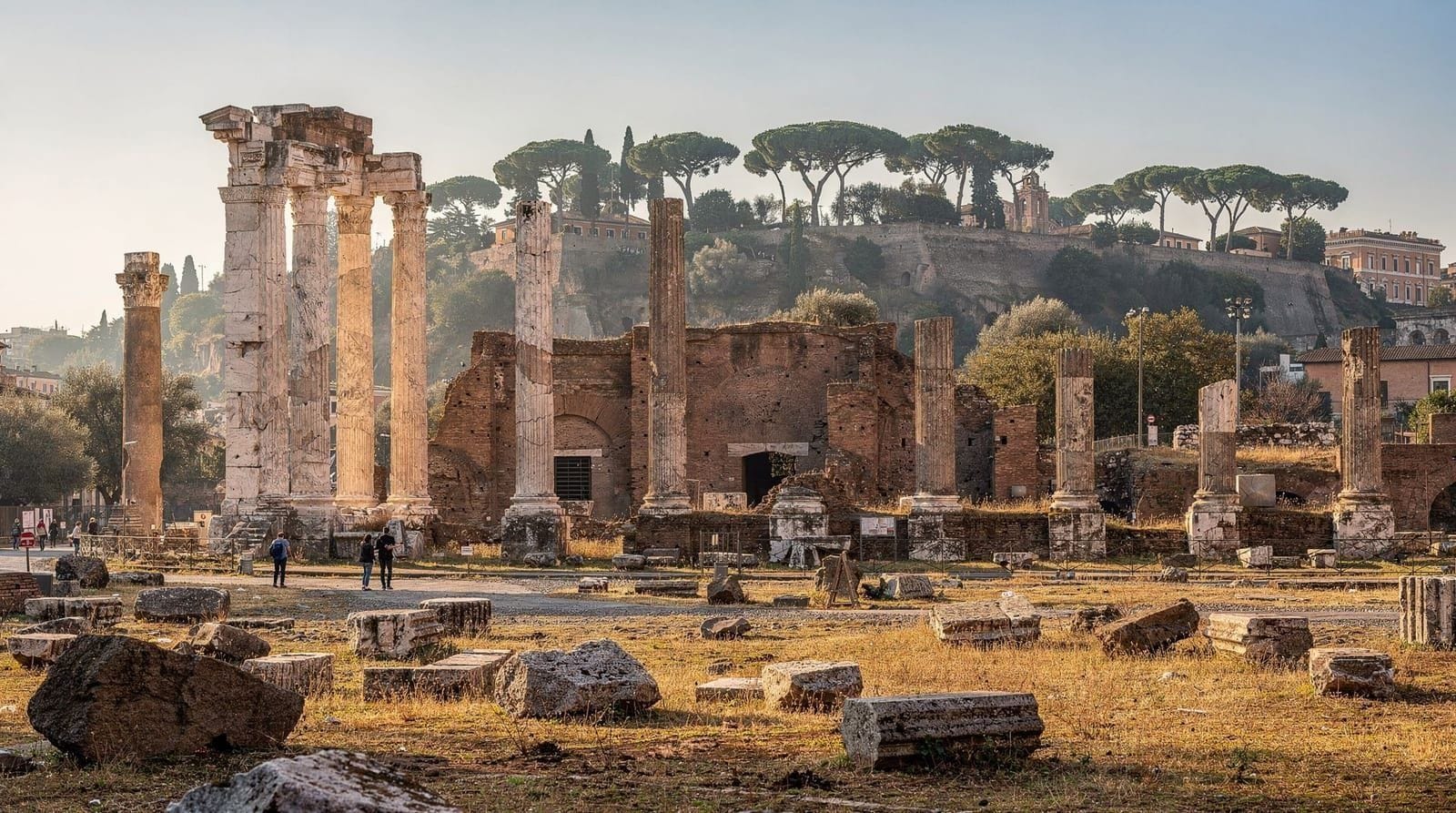
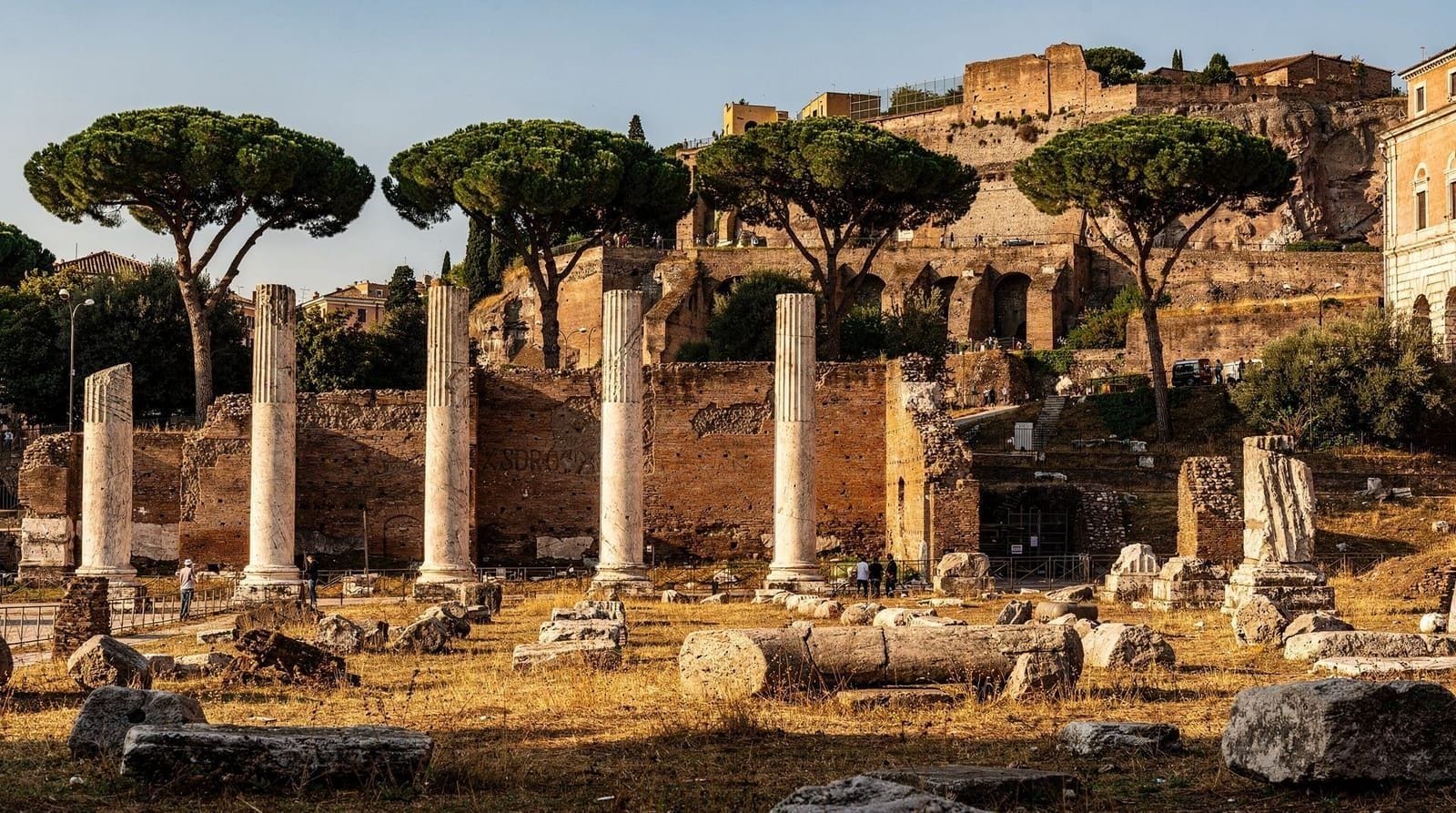
The Temple of Vesta in the Roman Forum was the physical centre of Rome’s religious identity. Vesta was the goddess of the hearth — by extension, the domestic and civic health of Rome. The sacred flame in her circular temple was kept burning continuously for over 1,000 years by the Vestal Virgins, six women chosen between ages 6 and 10 from patrician families and serving 30-year terms.
The theological significance of the flame was not metaphorical. Romans genuinely believed Rome’s safety was bound to its continuity. When the flame was accidentally extinguished — as it occasionally was — the responsible Vestal was flogged by the Chief Pontiff. A Vestal who broke her vow of chastity was buried alive in the Campus Sceleratus (Field of Wickedness) near the Colline Gate — the punishment was burial rather than execution because Roman law forbade shedding a Vestal’s blood.
The Temple of Vesta (rebuilt after fire in its current form around 191 CE) is still partially standing in the Forum. Three columns remain of the circular colonnade. Adjacent is the Atrium Vestae — the Vestals’ residence, now an atmospheric garden with a central pool reflecting the surviving columns. The headless statues of former Vestals line the garden paths.
The Vestals’ extraordinary privileges — they could free condemned prisoners they encountered on the road, they had reserved seats at gladiatorial games, their wills were valid without legal guardian, they were immune from the restrictions that applied to other Roman women — reflect the cult’s importance to the Roman state.
Mars and the military tradition
Mars — identified with the Greek Ares but with a distinctly Roman character — was the second god in the Roman pantheon after Jupiter. While Ares was feared as a destructive force in Greek tradition, Mars was honoured as Rome’s divine ancestor and patron of its military.
The Campus Martius (Field of Mars) — the large flat area north of the ancient city, now Rome’s most densely built historic district — was named for Mars and served as Rome’s military training ground, voting ground, and location for the army to assemble before campaigns. The Ara Pacis (Altar of Peace), built under Augustus, is located near the original Campus Martius and shows Mars on its relief panels as a divine ancestor of the Roman state.
The Forum of Augustus, partially visible from Via dei Fori Imperiali, contained the Temple of Mars Ultor (Mars the Avenger) — built by Augustus in fulfilment of a vow before the Battle of Philippi, where he avenged Caesar’s assassination. Three standing columns of this temple are visible from street level.
Soldiers departing on campaigns made offerings to Mars. Military standards were kept in his temples. The month of March bears his name. The military triumph ended at Jupiter’s temple on the Capitoline but was dedicated to Mars throughout its procession.
Venus, Aeneas and Rome’s divine ancestry
Venus was Rome’s divine ancestress through the Trojan hero Aeneas — son of Anchises and Venus, survivor of Troy, founder of the Trojan line that led to Romulus and Remus. The Aeneid, Virgil’s imperial epic written under Augustus, codified this lineage. Julius Caesar claimed descent from Venus through Aeneas and built the Temple of Venus Genetrix (Venus the Mother) in his Forum.
The Forum of Julius Caesar, partially excavated alongside Via dei Fori Imperiali, contains the reconstructed columns of the Temple of Venus Genetrix — built in fulfilment of a vow Caesar made before the Battle of Pharsalus in 48 BCE. The temple housed a statue of Venus and, controversially, a golden statue of Cleopatra — Caesar’s lover.
Venus Genetrix represented Rome’s divine maternal origin. In the Capitoline Museums, the Capitoline Venus (a Roman copy of a Greek original) is one of the most famous Roman sculpture collections’ centerpieces — the goddess depicted emerging from her bath, a standard Hellenistic pose that the Romans reproduced in enormous numbers for both religious and decorative purposes.
Neptune and the Baroque water mythology
Ancient Roman water management was explicitly religious. The aqueducts were engineering projects but also divine gifts. Neptune (Greek Poseidon) was the sea god, but Roman water religion extended to freshwater sources, springs and rivers — each had its genius loci (local divine spirit).
The Trevi Fountain, Rome’s most visited water landmark, displays a triumphant Neptune at its centre — the work of Nicola Salvi (completed 1762), financed by Pope Clement XII. Neptune stands in a shell chariot drawn by sea horses, flanked by allegorical figures of Abundance and Health. The fountain marks the terminal point of the ancient Aqua Virgo aqueduct, built under Augustus in 19 BCE — the same aqueduct that still supplies the Trevi today.
Bernini’s Fontana del Tritone in Piazza Barberini (1643) depicts Triton, Neptune’s son, kneeling on a shell supported by four dolphins, blowing a conch shell from which water spouts. Bernini’s Fontana dei Quattro Fiumi in Piazza Navona (1651) personifies the four great rivers of the known world — the Nile, Ganges, Danube and Rio de la Plata — as giant mythological figures, each with attributes signifying their character.
The Rome by Night walking tour visits the Trevi Fountain, Piazza Navona and the Pantheon — the three sites where Roman water mythology and Baroque religious imagery intersect most dramatically.Mercury, Janus and the divine calendar
Mercury (Greek Hermes) as god of commerce, travel and communication permeated Roman daily life without requiring elaborate monuments. Herms — squared stone pillars topped with a head of Hermes/Mercury — stood at crossroads and boundaries throughout the Roman world. Rome’s first month, January, takes its name from Janus — the two-faced god of transitions, beginnings and doorways, who had no Greek equivalent and is considered an authentically Latin deity. The month of February derives from Februum, a purification rite. April may derive from a root related to Aphrodite/Venus.
The Roman calendar was itself a mythological document, with each month named for a deity or religious observance, and specific days marked as fas (permitted for legal and religious business) or nefas (forbidden). The Calendar of Filocalus from 354 CE — a late antique document — shows how densely the Roman year was populated with divine festivals.
Janus deserves particular attention because he has no Greek counterpart and is considered a genuinely native Roman invention — a god of doorways, beginnings and transitions, depicted with two faces looking in opposite directions. The doors of his small temple in the Forum were symbolically opened in wartime and closed in peacetime; Augustus made a point of closing them multiple times during his reign as propaganda for the peace (Pax Romana) his rule had supposedly brought. Few visitors realise that the first month of the modern calendar — and by extension the very structure of the year most of the world uses — carries this specifically Roman theological idea forward into the present without any translation needed.
How mythology shapes the Rome you visit
The Roman mythology that most visitors encounter is layered: ancient myth in the temple remains, revived myth in Renaissance and Baroque art and architecture, and neo-classical mythology in 19th-century monumental sculpture.
Understanding that the Trevi Fountain’s Neptune is not a random decorative choice but a continuation of Rome’s long identification of its water system with divine power — that the Pantheon’s dome and oculus reproduce a cosmological model of heaven — that the Temple of Vesta’s eternal flame and the Vestals’ extraordinary social privileges encoded theological claims about Rome’s divine protection — all of this transforms the experience of walking through a city where mythology is not historical decoration but the original structural logic of the place.
For the historical context that embedded this mythology in Rome’s political and social life, see the Rome history guide and the Roman Empire explained. For the practical ancient Rome circuit, the ancient Rome in one day guide connects the mythological sites into a manageable itinerary.
The guided Colosseum, Forum and Palatine tour covers the mythological geography of ancient Rome — the Lupercal on the Palatine, the Temple of Vesta in the Forum, the triumphal procession routes that connected them.A self-guided mythology walk
A practical route linking the sites above without excessive backtracking: start at the Pantheon (Jupiter’s dedication to all the gods, Hadrian’s dome), walk 10 minutes to Piazza Navona for Bernini’s river-god fountain, then continue toward the Roman Forum for the Temple of Vesta and Temple of Saturn, climbing to the Palatine Hill for the Lupercal area and the view over the valley where Romulus and Remus’s legend is set. Finish at the Capitoline Hill for the Capitoline Wolf sculpture itself. The full walk, done unhurried with time inside the paid sites, takes a good half-day and covers Jupiter, Neptune, Vesta, Mars and the Romulus-and-Remus foundation myth in a single loop.
Deified emperors: when mortals became gods
Roman mythology did not stop at the traditional pantheon — it absorbed the emperors themselves. Apotheosis, the formal deification of a deceased emperor by Senate decree, turned Augustus, Claudius, Vespasian, Trajan and many others into official gods with their own temples and priesthoods. Hadrian’s mausoleum, now Castel Sant’Angelo, reflects this — built as the tomb of a man who would, in Roman terms, become divine at death. The practice gives an odd double meaning to many Imperial-era ruins: they were built partly as functional civic or funerary structures, and partly as machinery for manufacturing living or posthumous divinity, a detail that’s easy to miss without knowing the mythological framework behind it.
Frequently asked questions about Roman mythology in the city: gods, temples and legends you can still see
What is the difference between Roman and Greek mythology?
What happened to Roman religion after Christianity became dominant?
Was Roman religion actually believed or was it purely civic performance?
Can you visit the Lupercal cave?
What role did Roman mythology play in imperial propaganda?
Which single site best sums up Roman mythology for a visitor with limited time?
Are there any active pagan religious practices in Rome today?
Top experiences
Bookable activities with verified prices and instant confirmation on GetYourGuide.