Rome on film: locations from La Dolce Vita to The Great Beauty
Rome by Night: 3-Hour Guided Walking Tour
Duration: 3 hours
What are the most iconic Rome film locations a visitor can see?
The most visited film locations are: the Trevi Fountain (Anita Ekberg's scene in La Dolce Vita; also Roman Holiday); the Spanish Steps (Roman Holiday's opening; numerous later films); Via Veneto (La Dolce Vita's paparazzi scenes); the Colosseum and Roman Forum (Gladiator, Ben-Hur); the Villa Borghese park (The Great Beauty, Roman Holiday); and Trastevere (used as a backdrop in dozens of Italian films). Cinecittà studios, where many classic productions were shot, offers regular guided tours.
| Most iconic scene | Trevi Fountain, La Dolce Vita (1960) |
| Best free location walk | Spanish Steps → Trevi → Via Veneto (Roman Holiday + La Dolce Vita) |
| Studio visit | Cinecittà, Metro A, guided tours available |
| Best time to shoot photos | Before 08:00 or after 21:00 at the major sites |
| Cost | All locations are free to view; Cinecittà tour and Bocca della Verità entry are paid |
The city that invented itself through cinema
No city has been filmed more obsessively — or more productively — than Rome. From the early 20th century through the present, Rome has functioned simultaneously as a real city and as cinema’s ideal location for stories about beauty, decadence, ruins, pleasure, spiritual crisis and the weight of history.
This guide covers the major films and their actual locations — where to stand to recreate a scene, what the location looks like today compared to when it was filmed, and the broader cinematic tradition that made Rome an essential element of global film culture.
Cinecittà: Rome’s film factory
Any discussion of Rome on film begins with Cinecittà, the vast studio complex built on the Via Tuscolana in Rome’s southeastern suburbs in 1937. Mussolini’s government funded the studios — the name means “cinema city” — as part of a programme to build an Italian film industry as a cultural and propaganda tool. The motto “Cinema is the most powerful weapon” (attributed to Mussolini) gave the project its explicit ideological framing.
Cinecittà survived the Second World War (it was used as a refugee camp briefly after liberation) and was transformed in the postwar period into something quite different from its origins: the base of operations for Italian neorealist cinema, then for the American blockbusters that defined “Hollywood on the Tiber,” and finally for the art-cinema directors — primarily Fellini — who made it synonymous with personal, visionary filmmaking.
Hollywood on the Tiber (1950–1965): American studios relocated major productions to Cinecittà because Italian skilled labour was cheaper than in Hollywood, the Italian government offered favourable tax terms, and Rome’s ancient buildings and warm climate provided ready-made production value. The list of productions includes:
- Quo Vadis (1951, Mervyn LeRoy) — one of the first American blockbusters to use Cinecittà’s facilities, with elaborate ancient Rome sets
- Roman Holiday (1953, William Wyler) — uniquely shot on location throughout Rome rather than on studio sets
- Ben-Hur (1959, William Wyler) — the famous chariot race filmed on a purpose-built track at Cinecittà, consuming a large portion of the studio’s outdoor space
- Cleopatra (1963, Joseph L. Mankiewicz) — the most expensive film ever made at that point, which began at Pinewood in England, transferred to Cinecittà when the lead actress Elizabeth Taylor fell ill in London, and exceeded its budget so catastrophically that it nearly destroyed 20th Century Fox
Cinecittà today offers public guided tours and a museum dedicated to this history. The back lots include recreated ancient Rome streets — essentially permanent sets originally built for various productions and maintained since. The Metro A Cinecittà stop makes it accessible from central Rome.
Federico Fellini and the mythology of Via Veneto
Federico Fellini (1920–1993) is the single filmmaker most responsible for Rome’s cinematic identity. Raised in Rimini and shaped by the neorealist tradition, Fellini moved to Rome as a young man and made the city his permanent subject — not the monumental Rome of ruins and churches but the social, sensual, melancholy and sometimes grotesque Rome of its 20th-century inhabitants.
La Dolce Vita (1960) is the foundational document of Rome’s cinematic mythology. The film follows journalist Marcello (Marcello Mastroianni) across seven episodes over several weeks, each centering on a different aspect of the Roman high life that Fellini observed around Via Veneto in the late 1950s.
Via Veneto — the wide, sweeping boulevard connecting Piazza Barberini to Villa Borghese — was in the late 1950s the epicenter of Rome’s celebrity culture. The paparazzi (the word derives from the name of Mastroianni’s photographer companion Paparazzo in the film) photographed film stars, aristocrats and international socialites at the cafes and clubs along this street. Fellini’s film documented and mythologised this world even as it was passing.
Via Veneto today is a legitimate street of embassies, large hotels and cafes, somewhat faded from its 1950s glamour but instantly recognisable from the film. The Café de Paris — one of the paparazzi cafes in the film — still operates at number 90. The Capuchin Crypt, whose bones and memento mori Fellini would have passed on his way to the street, is around the corner.
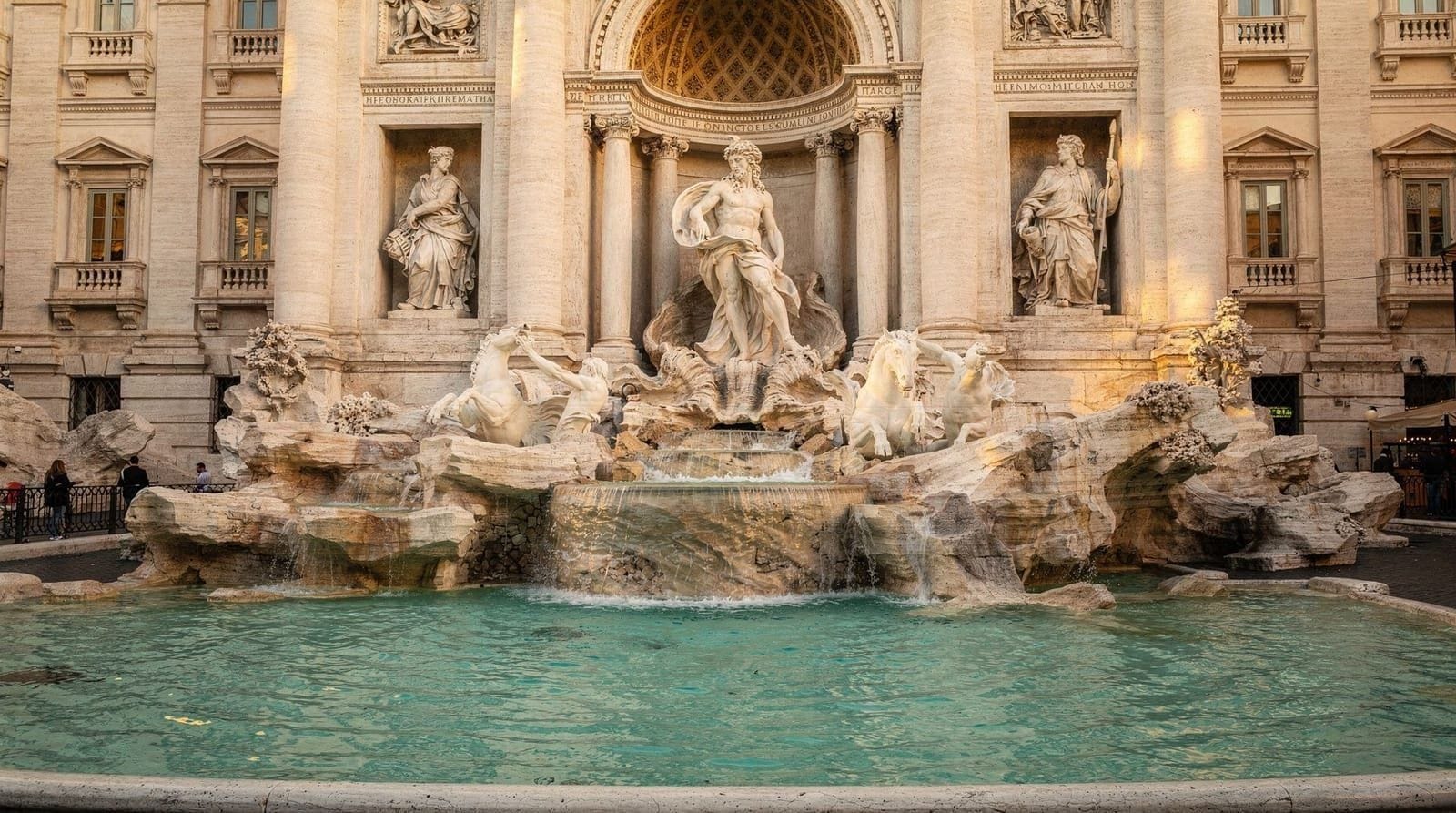
The Trevi Fountain sequence in La Dolce Vita is the film’s most iconic image: Anita Ekberg, in a strapless black gown, wading into the fountain at 3am and calling “Marcello… come here.” The scene was shot on location over several nights in autumn 1959 after the fountain area was cleared of the public. The water temperature was cold; Ekberg had the benefit of physical robustness that her co-star lacked. The sequence’s combination of beauty, abandon and underlying melancholy — Marcello watches but cannot truly join her world — became the film’s emotional signature.
For visitors today, the Trevi Fountain is one of Rome’s most crowded spots. The space that appears dreamlike in the film’s night scenes is, during the day, so densely packed that it requires some patience to appreciate. Early morning (before 8am) or late evening (after 10pm) approaches something of the film’s atmosphere.
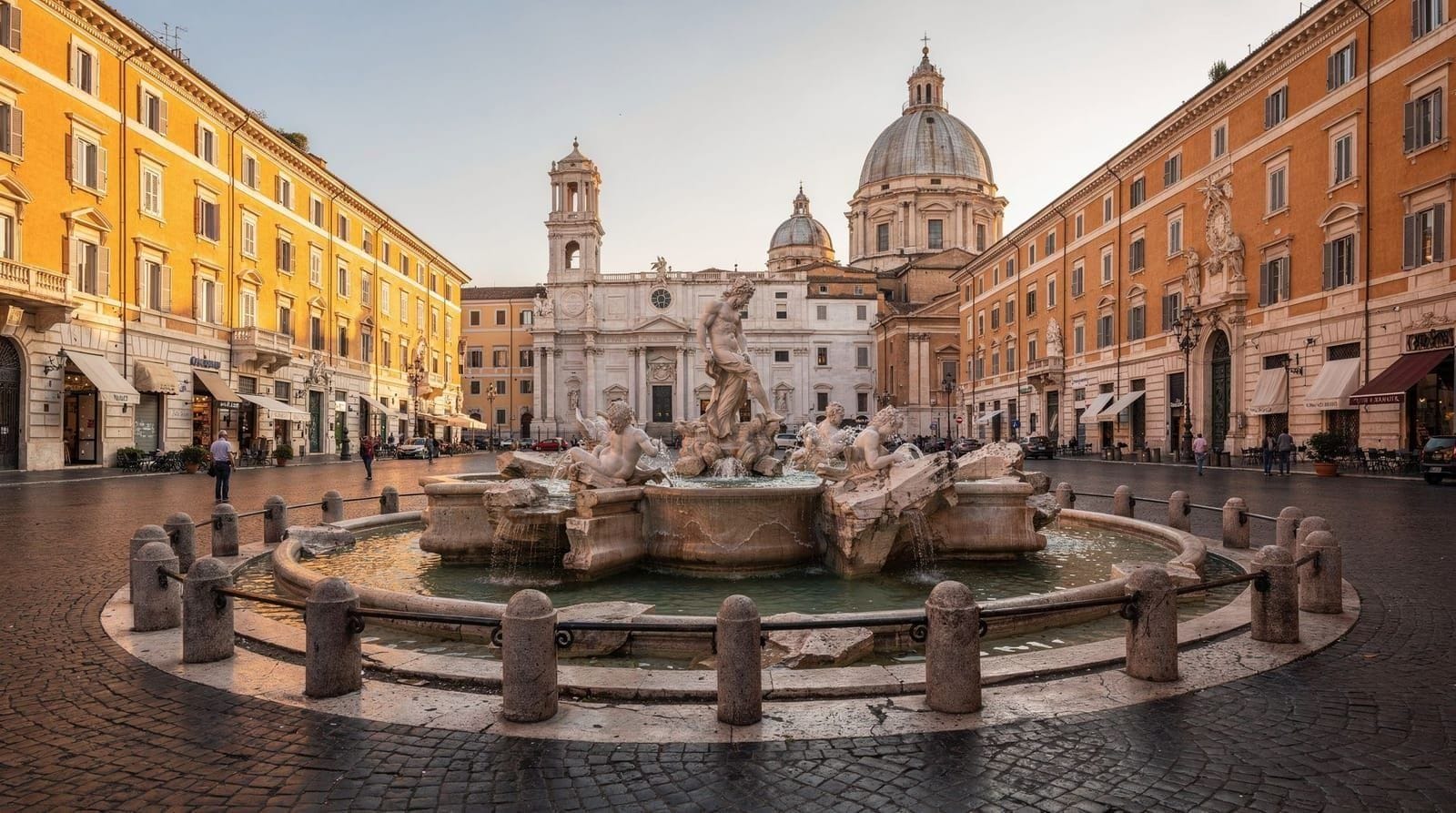
Rome by Night — the 3-hour guided walking tour covers the Trevi Fountain, Piazza Navona and the Pantheon in the evening, when the crowds thin and the city recovers something of its cinematic scale.Roman Holiday (1953): Hepburn’s Rome as travel inspiration
William Wyler’s Roman Holiday starring Audrey Hepburn and Gregory Peck was unusual in its era for being shot entirely on location in Rome rather than on studio sets. This decision gave the film an extraordinary documentary freshness and simultaneously created a template for romantic tourism in Rome that persists in visitor imagination.
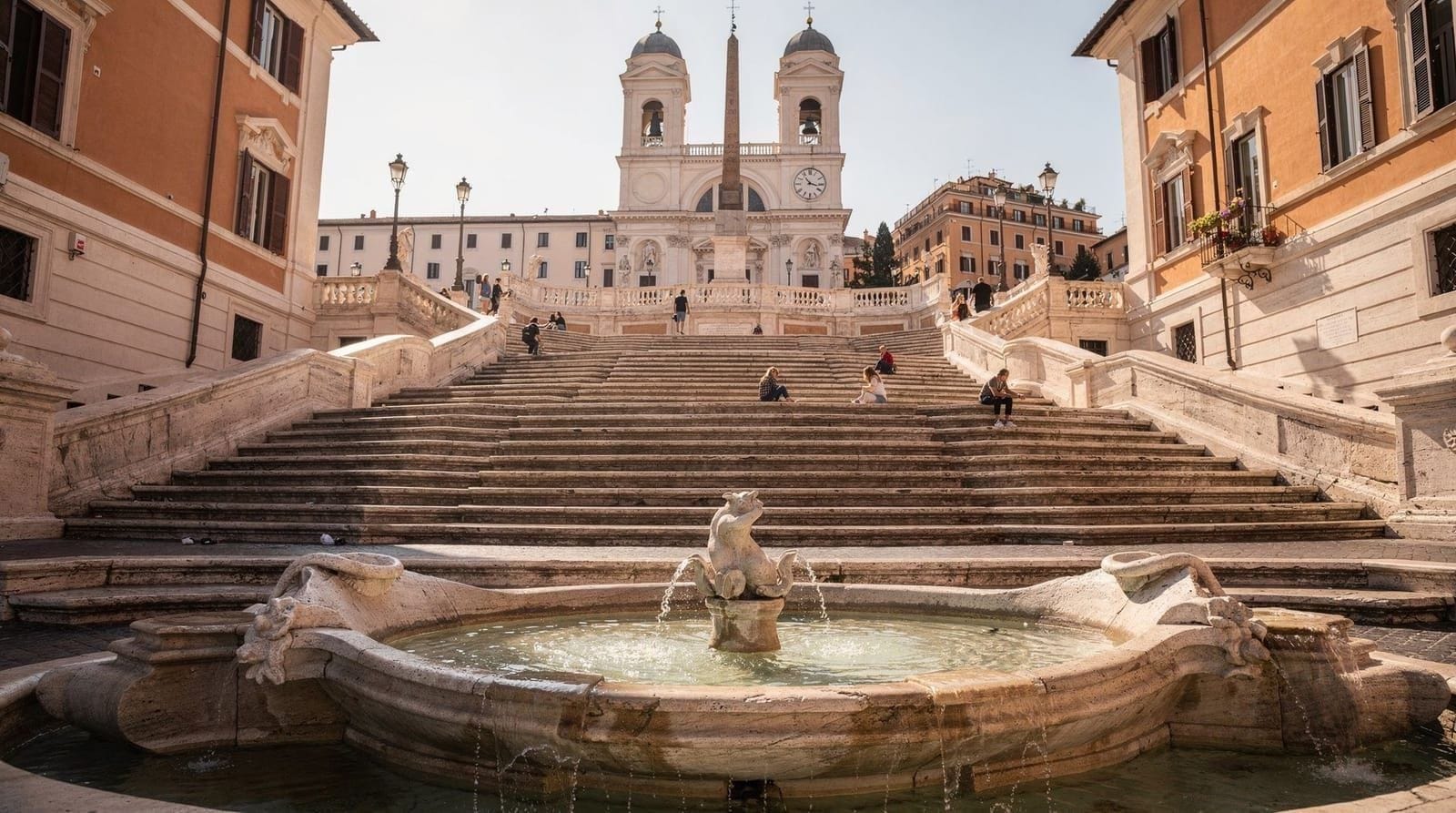
The Spanish Steps appear in the film’s famous opening sequence — Hepburn’s Princess Ann sits on the steps eating gelato, still in her formal dress, increasingly dishevelled. The Spanish Steps remain one of Rome’s most recognised landmarks and are still associated, however anachronistically, with this scene. Note that eating on the steps is now prohibited and carries fines up to 400 EUR — a rule that postdates the film by decades.
The Bocca della Verità (Mouth of Truth) — the large marble mask mounted in the portico of Santa Maria in Cosmedin near the Circus Maximus — features in the film’s most memorable comic sequence. The medieval folklore that the mask will bite off the hand of a liar is the setup for Peck’s character pretending his arm is being devoured. Today, queues form daily to replicate the scene. The actual Bocca is in the side portico of the church; entry to the interior is separate and usually uncrowded.
Via Margutta, where Peck’s character has his studio apartment, is a narrow pedestrian street one block from the Spanish Steps in the Tridente neighbourhood, historically associated with artists’ studios and gallery spaces. Many of the buildings retain their early-20th-century character and the street is one of Rome’s more atmospheric. A plaque near the entrance notes the film connection.
Castel Sant’Angelo appears as a backdrop during the Vespa sequence — the film’s most kinetic section, with Hepburn and Peck navigating the city on an Urlaub Vespa through streets that are now largely closed to private traffic. The Castel’s profile, rising above the Tiber, is used as one of several “establishing shots” that ground the film’s fantasy in verifiable reality.
The Great Beauty (2013): Sorrentino’s elegy for Rome
Paolo Sorrentino’s La Grande Bellezza (The Great Beauty, 2013) is the film that most directly carries Fellini’s inheritance into the present — both in its subject matter (the Roman high life and its discontents, seen from late middle age) and in its explicit formal homage to La Dolce Vita.
The film opens on a Japanese tourist being so overwhelmed by the beauty of a Rome sunset that he collapses and dies — an extreme version of Stendhal Syndrome, the documented physiological response to intense aesthetic experience. This opening tone — of beauty so extreme it can kill — runs through the film.
Key locations:
The opening party terrace: The birthday party of protagonist Jep Gambardella (Toni Servillo) is filmed on a rooftop terrace with a spectacular Colosseum view. The specific location used combines the Villa Medici’s terrace on the Pincian Hill with other locations in editing — the continuous view of the Colosseum from that angle is a cinematic construction, but the Villa Medici terrace (accessible on occasional public events) is real and the view toward the Borghese gardens and beyond is genuinely extraordinary.
The Gianicolo: The large park on the Janiculum Hill above Trastevere features in several contemplative sequences. The panorama from the Gianicolo terrace — with the dome of St. Peter’s visible and the entire city spread below — is one of Rome’s finest views and is completely free.
Villa Borghese gardens: The meandering park on the Pincian Hill appears in both The Great Beauty and Roman Holiday, and has been a film location since the early Italian cinema. The gardens are free to enter; the Borghese Gallery inside requires advance booking.
Trastevere streets: Multiple night sequences show Trastevere’s narrow medieval streets, which function in the film as a kind of labyrinthine unconscious of the city. The neighbourhood retains its distinctive character despite heavy tourist pressure; see the Trastevere guide for the best approach.
A golf cart tour of Rome covers the major film locations across the city — an efficient way to orient yourself to the physical spaces of classic films without walking the full distances.Gladiator and the ancient Rome of cinema
Ridley Scott’s Gladiator (2000) is the most watched film set in ancient Rome by recent generations. Shot partly in Malta and Morocco, the Colosseum sequences used a combination of the actual exterior (the establishing shots), physical set construction, and digital extension for the interior crowd scenes. The film’s Rome — oppressive, scale-overwhelming, richly detailed — draws on decades of academic and archaeological research but also on the tradition of Italian “peplum” (sword-and-sandal) films from the 1950s and 1960s.
The Colosseum itself, when you stand in it, is both smaller and larger than the film suggests — smaller because the seating areas are largely absent (stripped over centuries), larger because the original cavea rose to 57 metres. The Colosseum guided tour includes discussion of how the structure actually worked as a performance space, which is considerably more interesting than the film’s version.
Ben-Hur (1959) remains the spectacle benchmark. The chariot race sequence, filmed on a purpose-built track at Cinecittà, involved 15,000 extras, 78 horses, and a production scale that required the largest set ever constructed to that point. The second remake (2016) replicated the sequence digitally with considerably less impact — a lesson that the original demonstrated: physical scale, physical risk, and physical reality translate to the screen differently than computer generation.
Italian neorealism: a different Rome
The tradition of Italian neorealist cinema — Roberto Rossellini’s Rome Open City (Roma Città Aperta, 1945), Vittorio De Sica’s Bicycle Thieves (Ladri di Biciclette, 1948), Luchino Visconti’s Bellissima (1951) — documented a Rome quite different from the tourist city of ruins and fountains.
Rossellini shot Rome Open City in the immediate aftermath of Nazi occupation, using actual streets and buildings barely repaired from wartime damage, with an emotional rawness that the neorealist movement would codify into a style. The film’s locations — the Pigneto neighbourhood, the Gestapo headquarters on Via Tasso (now a museum to the Italian resistance) — are in the eastern suburbs of Rome, largely outside the tourist circuit.
The Museum of Via Tasso (Via Tasso 145, in the Celio neighbourhood near the Colosseum) occupies the actual building used as Gestapo headquarters during the occupation. It is small, sober and genuinely moving — one of Rome’s most honest confrontations with 20th-century history, rarely visited by tourists who haven’t specifically sought it out.
Quick reference: locations, films and how to visit
| Location | Film(s) | Neighbourhood | Visit |
|---|---|---|---|
| Trevi Fountain | La Dolce Vita, Roman Holiday | Centro Storico | Free, best before 08:00 |
| Spanish Steps | Roman Holiday | Tridente | Free; no sitting/eating on steps |
| Via Veneto | La Dolce Vita | Ludovisi | Free, walk the length |
| Bocca della Verità | Roman Holiday | near Circus Maximus | Free (mask); church interior separate |
| Cinecittà studios | Quo Vadis, Ben-Hur, Cleopatra | EUR | Paid guided tour, Metro A |
| Villa Borghese gardens | The Great Beauty, Roman Holiday | Pincio/Borghese | Free; gallery inside is paid |
| Gianicolo terrace | The Great Beauty | Trastevere/Janiculum | Free |
| Colosseum | Gladiator, Ben-Hur | Celio | Paid ticket required |
A practical film-locations walking route
For visitors who want to combine several locations in one outing without a car or tour: start at the Spanish Steps in the morning (Roman Holiday), walk down to Via Veneto for the La Dolce Vita atmosphere, continue to the Trevi Fountain (arrive early to beat the crowds that gather by mid-morning), then head south to the Bocca della Verità near the Circus Maximus. This covers three of Rome’s most referenced films in roughly 3–4 hours of walking, entirely free except for the Fellini-associated Café de Paris if you stop for a coffee on Via Veneto. The Rome fountains trail guide covers a complementary route through the same baroque fountains with more detail on their design history.
Contemporary Rome on screen
Rome continues to attract international productions. The To Rome with Love (2012, Woody Allen) anthology film used multiple Rome locations — the Piazza del Campidoglio, the Sant’Angelo Bridge, multiple neighbourhood streets — though to considerably less artistic impact than Fellini’s use of the same city.
The television production The Young Pope and its sequel The New Pope (Paolo Sorrentino for HBO/Sky, 2016–2020) shot extensively within and around Vatican City, using both the actual Papal Gardens (accessible on limited Vatican tours) and studio recreations for interior sequences.
The Netflix series The Romanoffs included a Rome-set episode. Various Mission: Impossible instalments have used the city’s streets, including a now-famous sequence filmed in part on the rooftop of the Vittoriano monument. Ridley Scott’s House of Gucci (2021) used Rome locations for scenes depicting the fashion house’s Italian headquarters, alongside Milan settings, contributing to a wave of renewed interest in the city’s connection to luxury fashion cinema following Fellini’s own fascination with couture in La Dolce Vita.
Streaming productions have generally been more willing than theatrical releases to shoot extensively on real Roman streets rather than studio recreations, partly because location fees and permitting have become more standardised and accessible since the 2010s — a shift from the Cinecittà-centric production model of the mid-20th century.
For visitors interested in the full intersection of Rome’s geography and cultural history, the Rome history guide provides the context that makes both ancient monuments and 20th-century films legible. The photography guide covers the specific locations and times of day that recreate the cinematic quality that draws filmmakers back to Rome repeatedly.
The Ancient Rome and Colosseum guided tour covers the filming locations of Gladiator and the historical reality behind Hollywood’s most-watched ancient Rome — with expert commentary on what the films got right and wrong.Frequently asked questions about Rome on film: locations from La Dolce Vita to The Great Beauty
Was the Trevi Fountain scene in La Dolce Vita really shot at the Trevi Fountain?
What was 'Hollywood on the Tiber' and when was Rome's film golden age?
Can visitors tour Cinecittà studios?
Where was Roman Holiday filmed?
What is The Great Beauty about and which Rome locations does it use?
Can I do a self-guided film locations walk in one day?
Is Cinecittà worth visiting if I'm not a serious film fan?
Top experiences
Bookable activities with verified prices and instant confirmation on GetYourGuide.