Rome etiquette and customs: how not to look like a tourist
Rome by Night: 3-Hour Guided Walking Tour
Duration: 3 hours
What are the most important etiquette rules for visiting Rome?
The most critical rules: dress modestly for churches (shoulders and knees covered — always, not optionally); don't drink the coffee at the bar standing up if you want to sit (you'll pay double); pay the coperto (cover charge, 1–3 EUR per person) at restaurants — it's normal, not a scam; fill your water bottle at nasoni (free cast-iron fountains throughout the city); and never take a cab that approaches you at the airport or railway station — use licensed white taxis or pre-booked services.
What Romans actually notice
Rome welcomes tens of millions of visitors every year. Most navigate the city without incident. A meaningful number cause friction — not through malice, but through straightforward ignorance of how things work here. This guide covers the customs, codes and small behaviours that separate an informed visitor from a confused one.
None of this is judgmental. Rome is unfamiliar to most first-time visitors, and the customs listed here are not always obvious. But knowing them in advance makes the city significantly more navigable and the encounters with locals significantly more pleasant.
| Dress code | Shoulders and knees covered for all churches and the Vatican |
| Tipping | Not mandatory; 5–10% for good service is generous |
| Coperto | €1–3/person restaurant cover charge — normal, not a scam |
| Water | Free at any nasone (cast-iron street fountain) |
| Photos on monument steps | Prohibited on Spanish Steps/Trevi; fines up to €400 |
Church dress codes: the most enforced rule
If you visit Rome and enter any Catholic church — and you should, many contain extraordinary art — you need to cover your shoulders and knees. This rule applies to men and women. It is not a suggestion.
At the Vatican, enforcement is active: staff at the entry to St. Peter’s Basilica and the Vatican Museums check compliance and turn away or redirect visitors who don’t meet the standard. Disposable paper cover-ups are sold at nearby kiosks — you will not be left stranded — but buying a mediocre polyester wrap at inflated prices outside the Basilica is avoidable.
The practical solution: carry a scarf or light cotton wrap that can cover shoulders and lap when needed. A sarong, a large pashmina, or even a lightweight long-sleeved shirt tied around the waist all work. This weighs almost nothing and eliminates the problem entirely.
The rule applies everywhere, not just the Vatican:
- Santa Maria Maggiore (enforced by staff)
- San Giovanni in Laterano (enforced)
- San Clemente (enforced)
- San Luigi dei Francesi (Caravaggio paintings — enforced)
- Santa Maria del Popolo (enforced)
- Virtually any church in Rome with a guardian at the door
Churches without staff may be more relaxed in practice, but the rule remains in force in principle.
Café and bar culture: how ordering actually works
Italian bars operate on a two-tier pricing system that confuses visitors regularly.
Al banco (at the bar): You go to the counter, order, receive your drink, drink it standing up, and pay. This is the local default for espresso — quick, efficient, typically 1.10–1.20 EUR for a coffee.
Al tavolo (at a table): A server takes your order, brings it to you, and you pay at the end. This costs significantly more — sometimes double — because you are paying for the table, the service, the atmosphere and the right to sit as long as you like. This is not a rip-off; it is a different product. Knowing which you want prevents confusion.
Never sit at a bar’s outdoor terrace, be served coffee, and then try to pay the counter price. It does not work that way and creates awkward scenes.
Additional coffee customs:
- “Un caffè” = espresso. If you want something longer and milder, say “caffè americano” or “caffè lungo.”
- Cappuccino and cornetto (croissant) is the canonical Italian breakfast — acceptable until 11:00 or so. Ordering a cappuccino at 3pm will get you the drink but also a degree of sotto voce commentary from the older barista.
- Coffee in Rome is cheap. A standing espresso at around 1.10–1.20 EUR, a cappuccino at 1.30–1.60 EUR. If you are paying 3.50 EUR for an espresso, you are at a tourist-facing establishment near a major sight and are being charged tourist prices.
- Do not ask for soy, oat or almond milk at a traditional Roman bar. Many now stock alternatives, but the traditional bar does not, and asking at the wrong bar produces a certain look.
Restaurants: the coperto, tipping and reservations
The coperto: Every traditional Roman restaurant charges a coperto — a cover charge listed on the menu, typically 1.50–3.00 EUR per person. This covers the bread basket, the table linen, and a contribution to general service costs. It is standard and legitimate. Pay it without complaint. If it is not listed on the menu and appears on your bill, you can reasonably question it.
Tipping: Italy has no strong tipping culture at restaurants. Rounding up the bill slightly or leaving a couple of euros is appreciated and becoming more common. Five to ten percent for genuinely good service is generous. You are not obligated to leave anything. Do not feel culturally obligated to leave 15–20% as you might in North America.
Service charges: Some restaurants in very tourist-heavy areas add a “servizio incluso” or service charge to the bill — this should be stated on the menu. If it is there, it replaces rather than supplements tipping.
Reservations: In the Centro Storico and popular restaurant districts, book ahead for dinner — especially for restaurants that are not primarily tourist-facing. Romans eat dinner late (20:00–22:00). Attempting to book for 19:00 will often get you a table at a tourist restaurant; going at 20:30 gets you into places locals actually use.
The tourist menu trap: Restaurants near the Colosseum, Trevi Fountain and Spanish Steps that display laminated picture menus with a “tourist menu” option for 10–15 EUR are targeting visitors who want familiar food quickly. The food is typically mediocre. Walking two or three streets away from these concentrations and eating at a place without picture menus significantly improves quality for similar or lower prices.
A golf cart city tour covers Rome’s main landmarks and neighbourhoods efficiently — useful orientation for first-time visitors navigating the city’s layout for the first time.Water: drink the nasoni
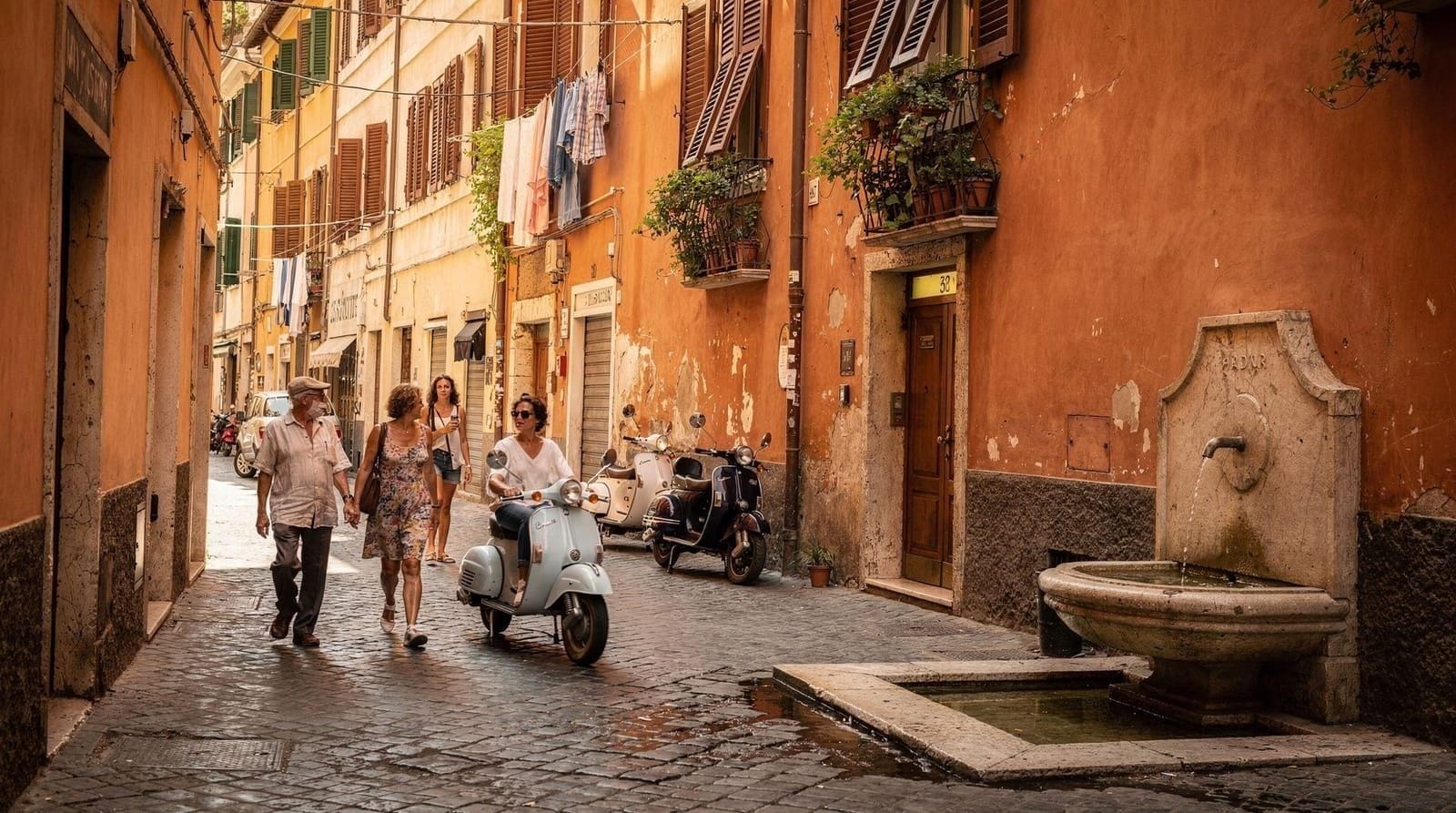
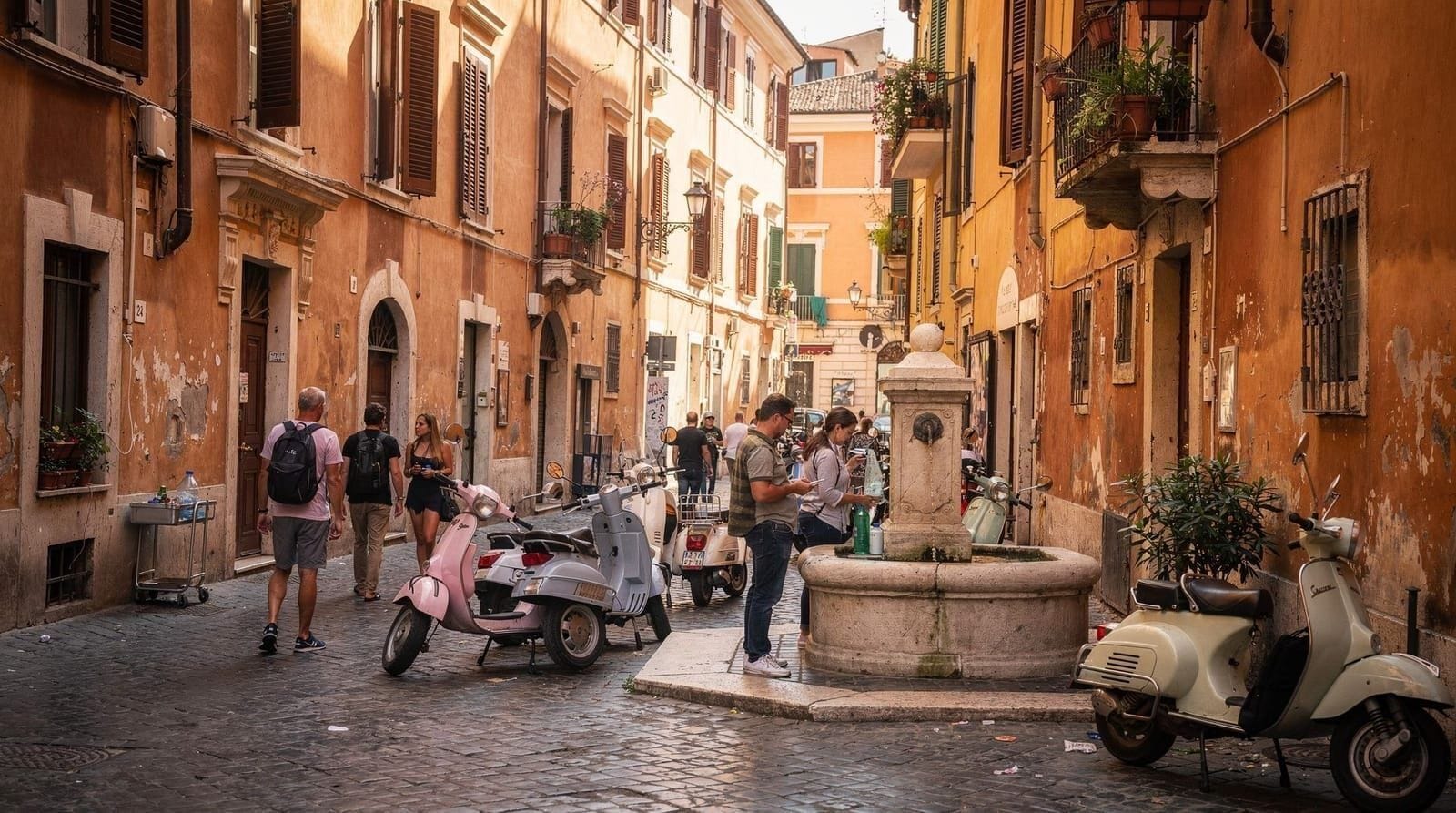
Rome has approximately 2,500 nasoni — small cast-iron drinking fountains distributed throughout the city, running continuously. The name means “big noses” in Roman dialect, for the curved spout. The water is from the same aqueduct system (updated and modernised) that supplied the ancient city — clean, cold, tested regularly and excellent.
Do not pay for bottled water at a café or restaurant if you are simply thirsty while walking. Fill a reusable bottle at the nearest nasone. They are on virtually every major street in the Centro Storico, at the entrances to most major sights, and in public parks. A small map of nasoni locations is available from the ACEA (the city water utility) and various tourist apps.
One technique: cover the main spout hole with a finger while the water is running, and a thin upward jet emerges for easy drinking without a bottle.
Transport: taxis and the ZTL
Taxis: Use only official white taxis with the Rome SPQR insignia on the door and a meter. Do not accept rides from anyone who approaches you at Fiumicino, Ciampino or Termini station offering a “private taxi.” These are unlicensed services that charge arbitrary inflated prices and have no regulatory protection.
Official taxis have fixed fares from both airports: 55 EUR from Fiumicino (FCO) to anywhere within the Aurelian Walls; roughly 40 EUR from Ciampino (CIA). Insist on the fixed fare at the start of the journey. The meter is used for trips within the city.
Taxi drivers are allowed to charge supplements for luggage (typically 1–1.50 EUR per large bag), for nighttime travel, and for Sundays and holidays. These are posted on a tariff card inside the cab. The standard metered fare within central Rome for a 2–3 km journey is typically 10–14 EUR.
The ZTL (Zona a Traffico Limitato): Rome’s historic centre is divided into restricted traffic zones monitored by cameras. Cameras record the licence plates of cars entering the ZTL without authorisation, and fines (84–335 EUR) are issued automatically — often appearing weeks later on the credit card of the person who rented the car. Your rental company will add an administrative fee on top of the fine.
The Rome ZTL guide covers this in detail, but the summary is simple: if you are staying in a hotel within the historic centre, confirm your hotel’s ZTL authorisation procedure before driving in. If you are not staying within the ZTL, park outside it and take public transport. The Rome metro, bus and tram network covers all major visitor areas adequately.
Scams: what to watch for in 2026
Pickpocketing has increased significantly in Rome in recent years — statistics show a 68% rise in reported incidents between 2022 and 2025. The highest-risk areas are the Metro A line (Termini to Ottaviano), the Termini railway station, and buses 40 and 64 (which run between the Vatican and Termini). Use a money belt or hidden pouch in these areas, or leave most cash and cards at your accommodation.
Common scams:
- Fake gladiators at the Colosseum: Costume-clad individuals near the Colosseum offer photos and then demand 10–20 EUR. If you engage, you are committed. Simply decline and walk past.
- Bracelet men near tourist sights: Someone approaches, begins tying a friendship bracelet on your wrist and then demands payment. Do not extend your arm. Keep walking.
- Rose sellers in restaurants: A seller places a rose on your table and moves on. If you touch the flower, they return and demand payment. Leave the rose untouched.
- “Free” tour with donation pressure: Some tour operators offer “free” tours and then organise extreme social pressure for minimum donations of 20–30 EUR per person at the end. Perfectly reasonable to tip a genuinely good free tour guide; perfectly reasonable to decline or give less.
Gestures, personal space and public behaviour
Italians talk with their hands more than most nationalities, and Romans are no exception — this is expressive, not aggressive, and worth simply enjoying rather than imitating badly. Physical greetings between friends (a cheek-kiss, right then left) are common among Italians but not expected from tourists meeting locals for the first time; a handshake or a warm “piacere” (pleasure to meet you) is entirely sufficient. Personal space in queues and on public transport is noticeably smaller than in the UK, Germany or North America — standing closer than you’re used to on the Metro A or B is normal, not an invasion.
Volume: Roman conversation, especially at family tables and among friends, is often louder than northern European visitors expect. This is not an argument; it’s simply how the conversation is conducted. Do not intervene or look alarmed.
Smoking: Smoking is banned inside all restaurants, bars and public buildings, but common on outdoor terraces and streets. Do not assume an outdoor café table is smoke-free.
Shopping and market etiquette
At Rome’s markets — Campo de’ Fiori in the morning, or the more locals-oriented Mercato di Testaccio — handling produce without buying is mildly discouraged; ask before you pick something up, particularly delicate fruit. Bargaining is not customary at food markets (unlike some other Mediterranean cultures) but is sometimes possible at flea markets like Porta Portese, where a polite offer 10–20% below the asking price is acceptable, especially late in the day.
In small boutiques, a greeting on entry (“Buongiorno”) is expected before browsing — walking in silently and straight to the merchandise reads as brusque. Shop staff in family-run stores may follow you attentively; this is customer service, not suspicion.
Riposo: Many smaller family-run shops (though not most restaurants, tourist-facing stores or chains) close for a midday riposo, typically 13:00–15:30 or 16:00. This is more common outside the immediate historic centre — in Monti’s older shops, Testaccio and the outer neighbourhoods — and worth checking if you have a specific small shop in mind. Department stores, supermarkets and chain retailers stay open through the day.
Religious occasions and public holidays
Rome’s identity as a Catholic capital means religious calendar events affect daily life more visibly than in most cities. On major feast days (Ferragosto on 15 August, Christmas, Easter), many family-run restaurants and shops close entirely, while tourist-facing establishments near major sights generally stay open. If a papal audience or Mass coincides with your visit to St. Peter’s Square, expect security screening and crowd management that can add 30–60 minutes to your visit — check the Vatican’s public schedule before planning a Square visit around a specific morning.
Queue etiquette and time awareness
Romans are not especially queue-conscious by northern European standards. At bus stops, café counters and informal ticket windows, pushing gradually forward is culturally normal. At official museum ticketing booths and formal queues with barriers, standard queue etiquette applies.
Booking timed entries: For the Colosseum, Vatican Museums and Borghese Gallery, timed entry slots must be booked in advance — in peak season, weeks in advance. Arriving without a reservation and expecting to buy a ticket on the day is the most common source of visitor frustration in Rome. The Rome skip-the-line tickets guide covers booking strategies for all major sites.
Language: a little goes a long way
English is widely spoken in tourist areas, hotels, most restaurants and major sights. You can navigate Rome entirely in English without difficulty.
That said, a few words of Italian significantly improve small interactions:
- “Buongiorno” (good morning, until about 13:00) / “Buonasera” (good evening) — always greet staff when entering a shop or bar
- “Per favore” (please) / “Grazie” (thank you)
- “Il conto, per favore” (the bill, please) — at restaurants
- “Dov’è…” (where is…) — useful for asking directions
Attempting Italian, even imperfectly, is appreciated. Approaching someone with “Do you speak English?” while already in English is technically fine but slightly abrupt by Italian standards — a “Scusi…” first smooths the interaction.
The Rome by Night walking tour is guided entirely in English and covers the Centro Storico — an excellent introduction to the city’s layout and culture for newly arrived visitors.Practical summary: the quick reference
| Situation | What to do |
|---|---|
| Entering a church | Cover shoulders and knees; always |
| Ordering coffee quickly | Order at the bar (al banco) |
| Paying for coffee at a table | Pay table price, don’t compare to bar price |
| Restaurant bill with coperto | Pay it — it’s legitimate |
| Tipping at restaurants | Not required; 5–10% for good service is generous |
| Drinking water | Use the nasoni (free, clean) |
| Taxis from Fiumicino | Fixed fare 55 EUR to central Rome |
| Taxis from Ciampino | Fixed fare ~40 EUR |
| Anyone offering “free” bracelet | Keep walking, hands in pockets |
| Anyone in costume at Colosseum | Smile, keep moving |
| Eating on Spanish Steps | Prohibited; fines up to 400 EUR |
| Driving into Centro Storico | ZTL fines unless your hotel has arranged authorisation |
For the broader picture of what to avoid and where the tourist traps concentrate, see the Rome tourist traps guide and the Rome scams guide.
Frequently asked questions about Rome etiquette and customs: how not to look like a tourist
Do I have to tip in Rome?
What is the coperto charge and is it a scam?
What is the dress code for the Vatican and churches?
Is it acceptable to eat while walking in Rome?
What should I know about Italian coffee culture?
Are there fines for certain tourist behaviours in Rome?
Is it rude to speak loudly or use my hands a lot when talking in Rome?
Can I bargain at Rome's markets?
Top experiences
Bookable activities with verified prices and instant confirmation on GetYourGuide.