Rome's biggest tourist traps (and what to do instead)
Rome by Night: 3-Hour Guided Walking Tour
Duration: 3 hours
What are Rome's biggest tourist traps?
The worst traps are restaurants within 50 metres of Trevi Fountain and Piazza Navona (coperto 3 € plus double prices), fake gladiators near the Colosseum demanding 20-30 € for a photo, hop-on hop-off buses that skip the Colosseum, overpriced taxi rides from unlicensed drivers, and guided tours sold by touts at inflated prices. Booking all tickets before arrival eliminates 80% of the financial damage.
What Rome actually costs vs what it charges tourists
Rome has a split economy. Locals pay 1.20 € for an espresso at a neighbourhood bar. Tourists pay 3.50 € for the same coffee on a café terrace facing the Colosseum. Both prices exist simultaneously, a few hundred metres apart. The gap is not a secret — it is built into the geography of tourist Rome.
Understanding which traps to avoid is not about being cheap. It is about not funding a machine that extracts money from people precisely because they do not know any better. This guide is blunt about what to skip, why, and what to do instead.
| Worst zones | Trevi Fountain, Piazza Navona, Colosseum entrance approach |
| Typical markup | 2–4x local price for food, drinks and souvenirs |
| Biggest single saving | Booking Colosseum/Vatican tickets direct instead of from a tout or reseller |
| Safe distance rule | Walk 5–10 minutes away from any major monument for honest prices |
| Best defence | Book ahead, carry cash for nasoni water instead, ignore unprompted approaches |
The restaurant geography of Rome
Rome’s worst dining trap is invisible on a menu: the coperto. This is a per-person cover charge, legally permitted in Italy, that appears at the bottom of your bill. In tourist-facing restaurants near Trevi Fountain, Piazza Navona, and Campo de’ Fiori, it runs 2-4 € per person — before you have eaten a single thing. Combined with inflated menu prices (carbonara for 22 €, pizza for 18 €, house wine for 15 € a carafe), a meal for two near these squares can cost 80-100 € for food that costs 35-40 € everywhere else.
The specific areas to avoid for food: within two blocks of Trevi Fountain in any direction, the entire porticoed edge of Piazza Navona, restaurants on Via della Conciliazione (the main approach to the Vatican), and anything with a picture menu in a prominent display case near Campo de’ Fiori.
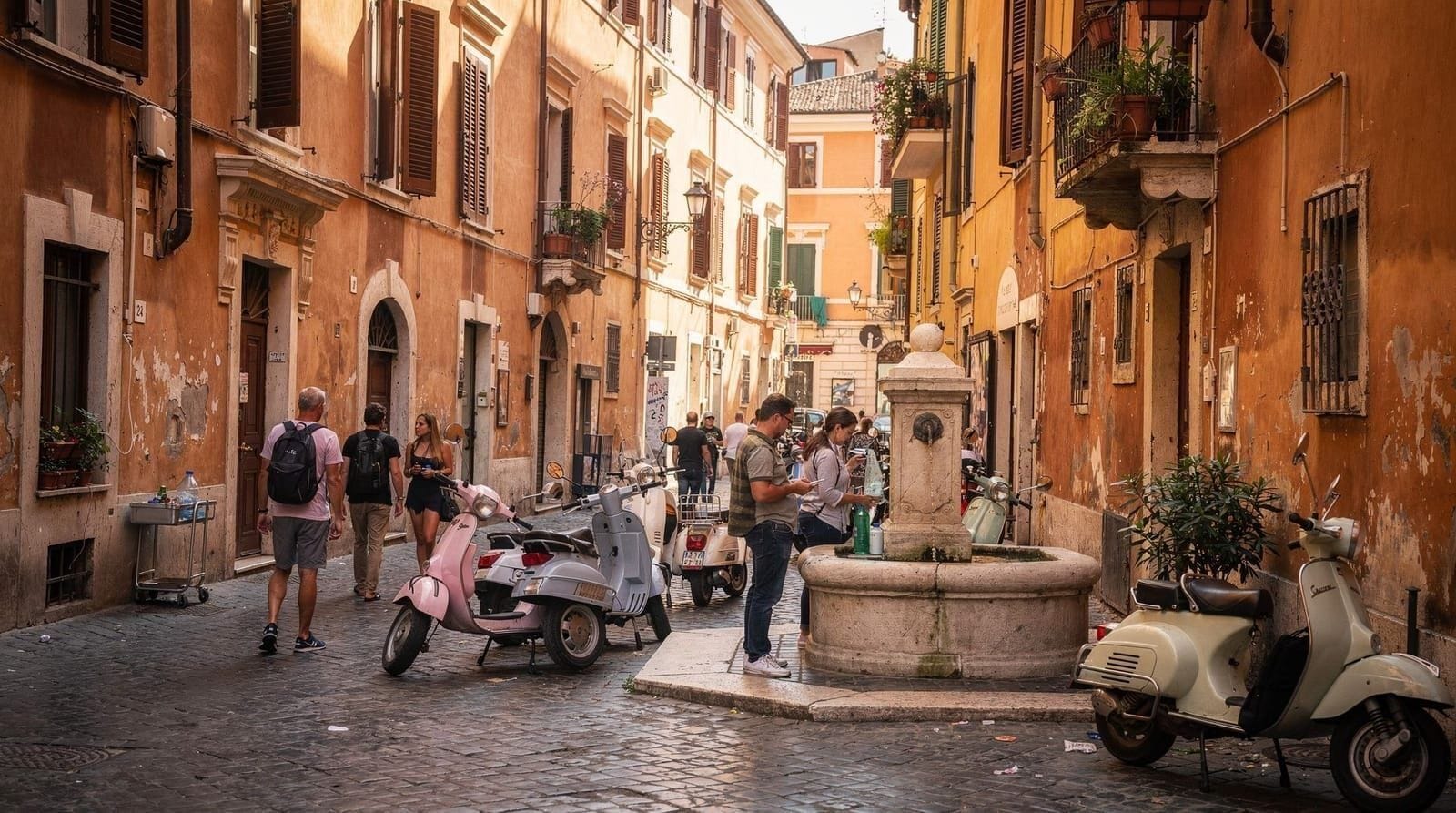
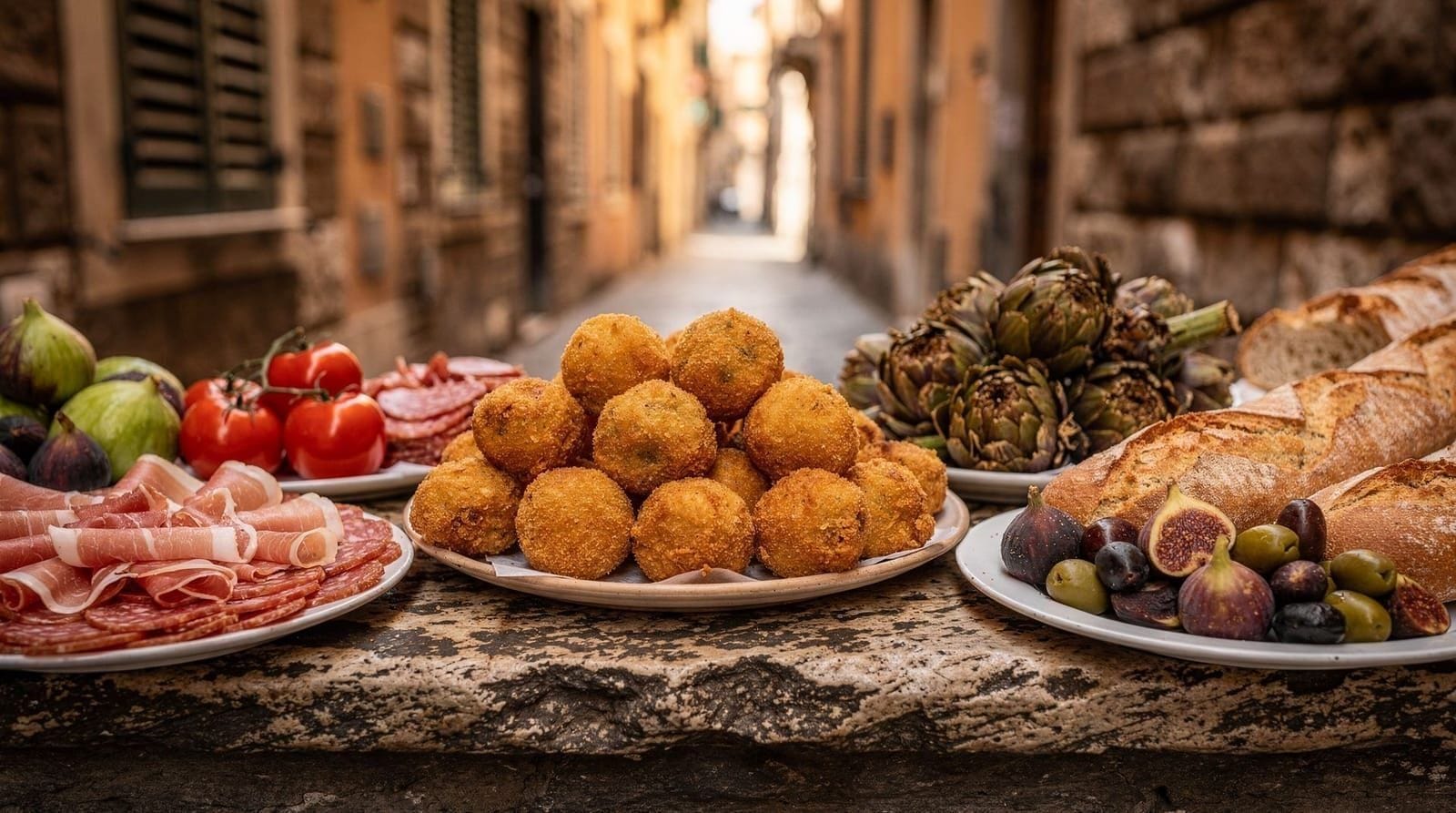
Where to eat instead: Testaccio is Rome’s traditional working-class food neighbourhood, still largely untouristy. Testaccio has a covered market (Mercato di Testaccio) where local lunch spots sell supplì, artichokes, and Roman classics at honest prices. In the centre, move away from the squares: a street back from Navona, toward Via dei Coronari or Via del Governo Vecchio, prices normalise. In Prati (near the Vatican), Via Cola di Rienzo has local bars and rosticcerias serving lunch for 8-12 €.
The coperto is not inherently a scam — it is a stated charge. The issue is restaurants that apply a large coperto AND inflate prices AND are strategically positioned to catch tourists who do not comparison-shop. See our full guide to where to eat in Rome for specific street-by-street recommendations.
The gladiator and costumed character ecosystem
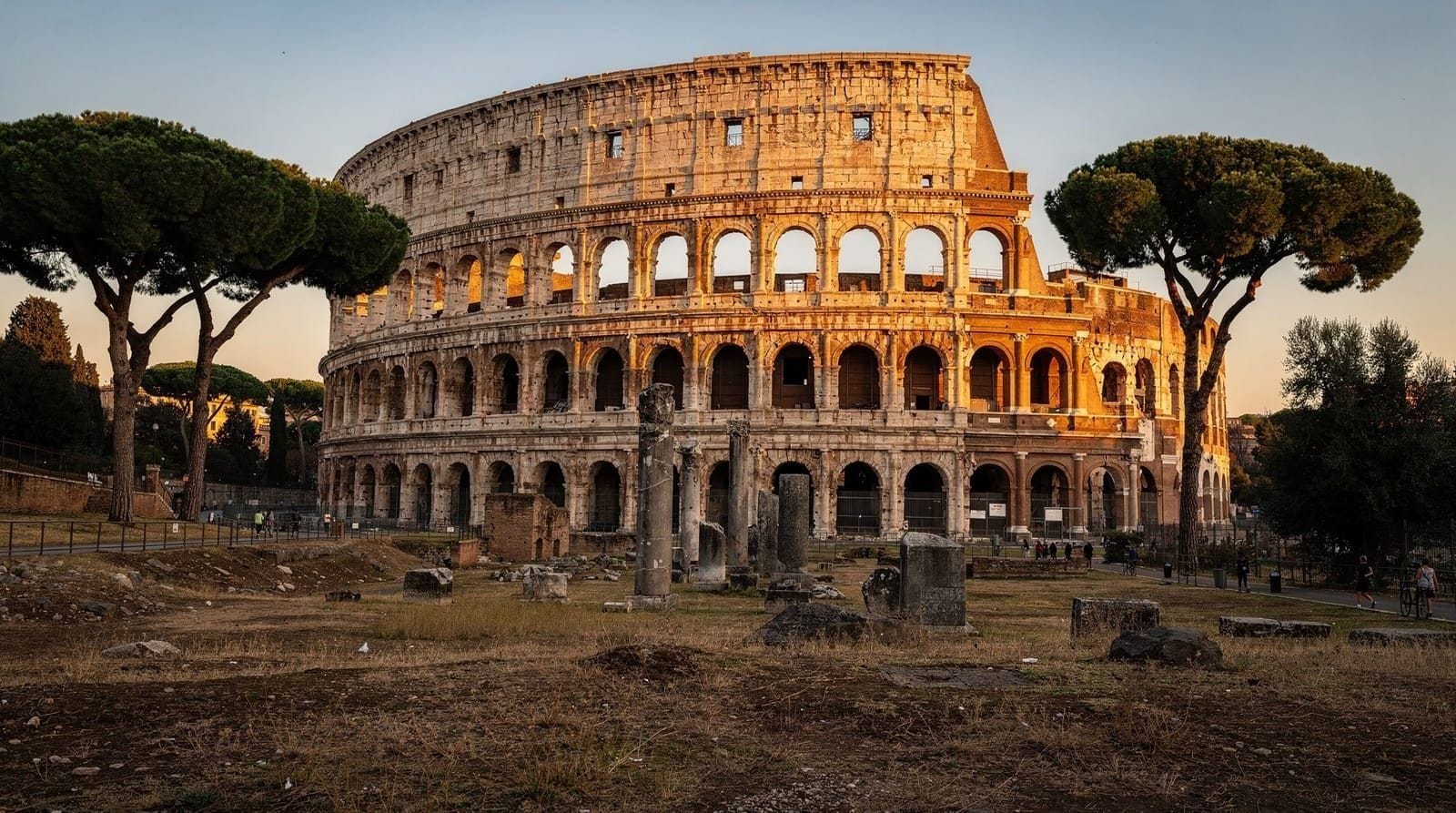
The area around the Colosseum’s main entrance, and to a lesser extent near the Roman Forum and Trevi Fountain, has a permanent population of costumed performers: centurions, gladiators, occasionally historical figures. They exist solely to extract money from tourists via photo opportunities.
The economics are straightforward: a person in a rented costume can earn 200-400 € per day from photos if 30-40 tourists pay 10-20 € each. The performance is deliberately ambiguous — they do not state a price upfront, they initiate the interaction, and once you have a photo on their phone (which they have taken) the social contract becomes murky.
The correct response: walk past without engaging. If you want a photo with a costumed character as a genuine souvenir, the legitimate Gladiator School experience near the Appian Way offers a structured activity where prices are clearly stated in advance and the experience is worth the money.
There are also fake monks near the Vatican who approach tourists with “blessings” before requesting donations. Authorised Catholic collections do not occur on the street near St. Peter’s Square.
The Trevi Fountain area trap
The Trevi Fountain itself is free to visit and spectacular. The trap is everything around it.
Bars and gelaterie on the streets immediately approaching the fountain mark up aggressively on the assumption that you will buy before or after visiting. A gelato on Via della Muratte or Via del Lavatore routinely costs 4-6 € for a small cup. The same quality (often better) gelato costs 2.50-3.50 € in Monti or Trastevere.
The fountain also has its own crowd trap: at 11:00-16:00, it is so densely packed with tour groups that the experience is more like a cattle pen than a monument. The best time to visit is before 08:00 or after 22:00, when it is dramatically lit and genuinely beautiful. See our guide on how to avoid the crowds in Rome for a full breakdown of timing strategies.
Taxi and transport traps
Rome has a fixed-fare taxi system from Fiumicino Airport (FCO) to the city centre: 55 €, all inclusive. If a driver quotes a different price — by meter or otherwise — they are breaking the law. The correct response is to ask for the fixed rate or take a different cab.
From Ciampino Airport (CIA), the fixed fare to the city centre is 40 €. The Terravision and SIT Bus Shuttle coaches to Termini cost around 6 €.
Inside the city, unmetered taxi quotes to tourists are illegal. All legitimate Rome taxis use the meter. Surge pricing is not a legal concept in Roman taxis — the meter starts from a flat call charge and advances by distance. Radio taxis (calling a company by phone or app — try ItTaxi or Uber Black) are marginally safer than flagging on the street.
The hop-on hop-off bus: see the FAQ above. Worth mentioning that bus sellers sometimes operate at inflated prices if you buy from a tout on the street rather than online. The legitimate operators — City Sightseeing and Big Bus — both have websites where tickets are cheaper. See our guide to getting around Rome for a comparison of all transport options.
Museum and attraction ticket traps
The skip-the-line fake promise: Dozens of websites advertise “skip-the-line” Colosseum or Vatican tickets. Many are legitimate resellers providing a real service. Some are not. The Colosseum’s official booking system (coopculture.it) already includes a timed entry — there is no separate skip-the-line tier. What you are paying for with a reseller is the convenience of someone else having done the booking. That service is worth something, but not 30-40 € above the official price.
The Roma Pass calculation: The Roma Pass is promoted heavily at Fiumicino Airport and in tourist areas. At 52 € for 72 hours, it includes free entry to your first two museums and unlimited metro/bus. It sounds logical until you do the maths: two museum entries are typically 30-35 € combined, leaving only 17 € of transport value to make it pay. A 72-hour metro pass costs 18 €. The pass often does not save money for typical tourist itineraries. Our Roma Pass honest assessment runs the numbers properly.
Borghese Gallery no-shows: The Borghese Gallery enforces strict 180-person-per-2-hour slot limits. If you arrive without a booking, you will not get in regardless of anything a tout tells you. Book directly at tosc.it/borghese at least 10 days ahead. Our Borghese booking guide covers the exact process.
A licensed guided tour of the Colosseum, Roman Forum and Palatine Hill — timed entry included, no queue manipulation needed, price transparent before booking.The souvenir price trap
Souvenir shops within visual range of any major monument in Rome apply a tourist premium of roughly 200-400%. A small bottle of “authentic” olive oil near the Vatican costs 12-18 € for a product available at any Carrefour or Conad supermarket for 4-6 €. Plastic gladiator helmets near the Colosseum run 15-25 €. Leather goods marketed as “genuine Italian leather” on the approach to Campo de’ Fiori are often imported.
If you want genuine Roman food products to bring home, buy them at a proper food shop (alimentari) away from the monuments: Via dei Banchi Vecchi in the Centro Storico, or any supermarket with a quality section. If you want leather goods, the Porta Portese flea market in Trastevere on Sunday mornings has a mix of genuine and tourist items — inspect carefully and negotiate.
Water and coffee traps
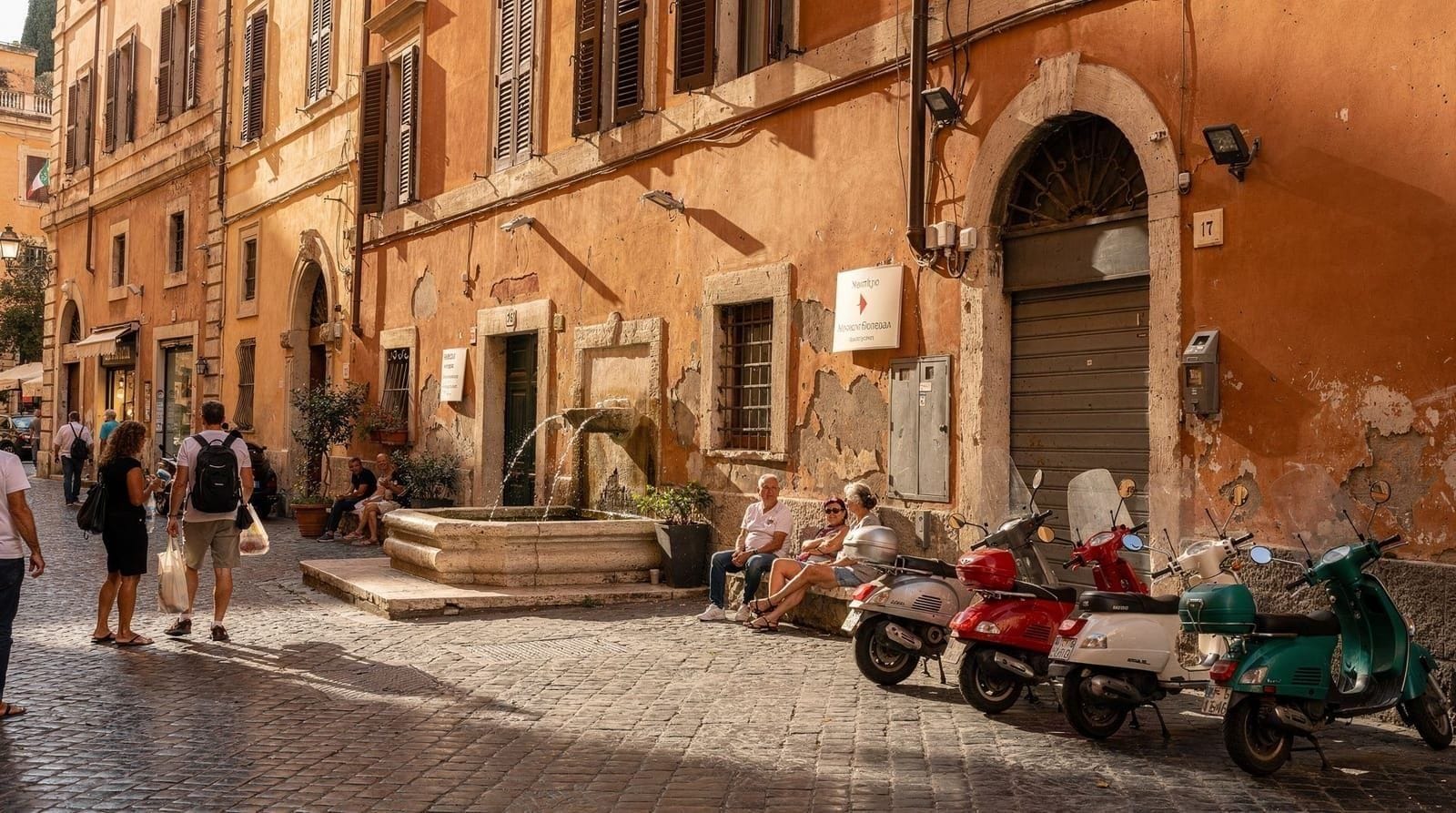
Rome has over 2,500 nasoni — small nose-shaped drinking fountains throughout the city providing free, cold, clean potable water year-round. Using these eliminates a daily spend of 8-15 € on bottled water. Maps of nasoni locations are available on the ACEA (Rome’s water utility) website. The water tastes identical to the bottled product because it comes from the same Apennine mountain springs.
Sitting down to drink coffee in a tourist-facing café is a persistent drain. At any non-tourist-adjacent bar, an espresso costs 1-1.20 € drunk standing at the counter. Sitting adds a terrace surcharge of 2-4 € more. The coffee is the same. Italian bar culture is stand-at-the-counter; reserving seating for extended stays is the logical approach.
The “free” guided walk trap
Legitimate free walking tours (tip-based) operate throughout Rome and can be excellent. The trap is different: in heavily touristed zones near Trevi and Navona, individuals offer free guided walks that end at a shop, restaurant, or gallery where the guide earns commission on your purchases. This is not illegal — it is just a sales funnel wearing a tour guide’s hat.
Genuine free tours advertise clearly on dedicated websites (like GuruWalk or Sandemans). They start at a fixed public location, have a specific stated route, and end without a commercial stop. If someone approaches you on the street offering a free tour spontaneously, decline.
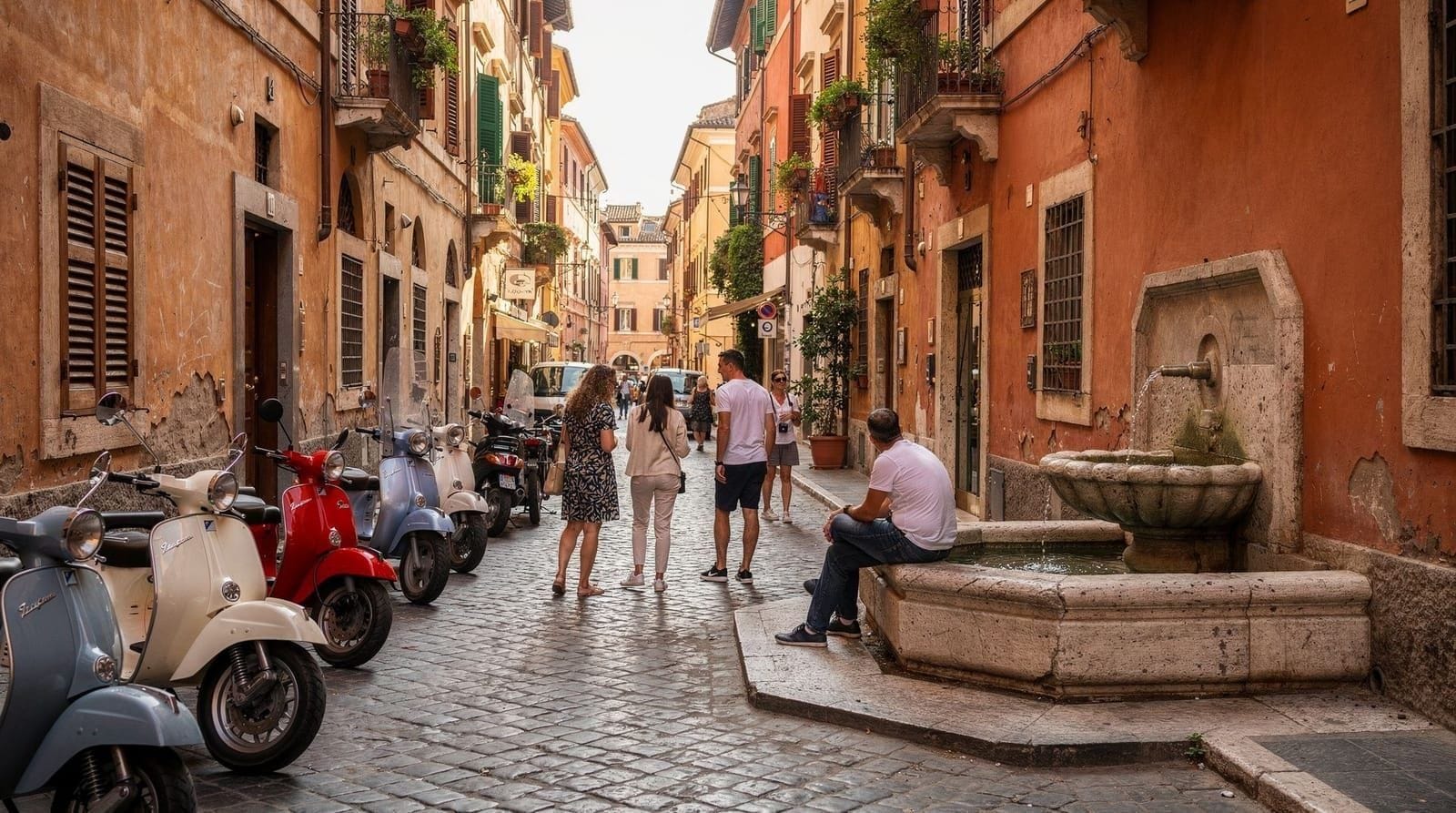
The Trastevere Secret Food Tour is a properly organised group experience in a neighbourhood where food is genuinely good — prices are stated upfront, no hard sells, no coperto surprises.What is actually worth doing
Naming traps without naming alternatives is its own kind of uselessness. Rome’s genuine value is extraordinary and largely cheap or free:
The Appian Way on a Sunday morning (when it is closed to cars) is one of the most atmospheric walks in Italy. Free. The Capitoline Hill terrace overlooking the Roman Forum is free. The church of San Luigi dei Francesi (near Navona) houses three Caravaggio paintings and is free to enter. The Borghese Gardens are a magnificent public park, entirely free. The keyhole view of St. Peter’s Dome on Aventino Hill — one of Rome’s most famous views — costs nothing.
The pattern is clear: Rome’s free offerings are often more memorable than its overpriced ones. Our free things to do in Rome guide has 25 specific options that require zero budget.
The evening walking tour of Rome covers the fountain squares and historic centre without the midday tourist density — guides who know what they are talking about, at a fair price.Currency exchange and SIM card rip-offs
Two traps that have nothing to do with monuments still drain a surprising amount of a first-time visitor’s budget. Currency exchange booths clustered around Termini station, Trevi Fountain, and the Vatican advertise “no commission” or “0% fees,” but the poor exchange rate is baked into the quoted figure — typically 8-12% worse than a normal debit card withdrawal at a bank ATM. The fix is simple: withdraw from an ATM attached to an actual Italian bank branch rather than a standalone tourist-area machine, and always decline the “pay in your home currency” (dynamic currency conversion) prompt, which is worse every time.
SIM cards follow the same pattern. Kiosks in the arrivals halls at Fiumicino and Ciampino sell tourist SIMs for 25-40 € with modest data allowances, while an Italian carrier’s own shop in the city centre sells more data for 10-15 €. An eSIM bought before departure usually beats both if you need connectivity the moment you land; if you can wait an hour, skip the airport kiosk entirely.
Overrated versus genuinely underrated
Part of avoiding tourist traps is recalibrating which “must-see” sights are worth the queue and which are not. Some of Rome’s most heavily marketed experiences — certain rooftop bars with mediocre food riding on the view, or “immersive” projection experiences with no real historical content — trade on reputation rather than substance. Meanwhile genuinely excellent, less-hyped experiences sit a short walk away at a fraction of the price or wait. Our Rome overrated vs underrated guide names names on both sides, which pairs well with this page: this guide tells you what to avoid paying for, that one tells you what to prioritise instead with your freed-up time and budget.
Trap-by-trap: cost of falling for it vs the honest alternative
| Trap | Typical cost if you fall for it | Honest alternative | Alternative cost |
|---|---|---|---|
| Piazza Navona / Trevi restaurant | 40–50 € per person | Testaccio or Prati trattoria, a few streets back | 12–18 € per person |
| Gladiator photo op | 15–30 € per person, cash | Structured Gladiator School experience with stated pricing | Fixed price shown before booking |
| Tourist-area gelato | 4–6 € for a small cup | Monti or Trastevere gelateria | 2.50–3.50 € |
| Reseller Colosseum ticket | 45–70 € | coopculture.it official booking | 20 € (plus optional guide) |
| Currency exchange booth | 8–12% below market rate | Bank-branch ATM withdrawal | Standard card exchange rate |
| Airport SIM kiosk | 25–40 € | eSIM pre-purchase or city-centre carrier shop | 10–15 € |
| Bottled water on the street | 8–15 €/day | Free nasoni fountains citywide | 0 € |
The calendar trap
Arriving at the wrong time is its own trap, though not a commercial one. July and August in Rome are brutal: 32-38°C, maximum tourist density, many Romans on holiday (so local restaurants are closed), and monuments requiring queues in full sun. The city technically runs year-round, but if you have flexibility, late September through October and April through May are when Rome is at its best — good weather, manageable crowds, lower hotel prices.
Easter is a particular warning: the week before and after Easter, Rome is packed with Italian domestic tourists and international pilgrims. Hotel prices double or treble. Every monument has extended queues. If you cannot avoid Easter, book literally everything — accommodation, Colosseum, Vatican — four to six weeks ahead.
See our best time to visit Rome guide for a month-by-month breakdown.
Frequently asked questions about Rome's biggest tourist traps (and what to do instead)
Are restaurants near tourist attractions always a rip-off in Rome?
What is the gladiator photo scam exactly?
Is the hop-on hop-off bus worth it in Rome?
Are the Roma Pass and Omnia Card worth buying?
What is the bracelet scam near the Pantheon?
Is free entry on the first Sunday of the month a good deal?
Are official-looking ticket websites near monuments actually official?
What is the most dangerous zone for pickpockets in Rome?
Is it a rip-off to exchange currency near the main tourist sights?
Are airport SIM card kiosks worth using?
Top experiences
Bookable activities with verified prices and instant confirmation on GetYourGuide.