Rome on a budget: how to see the city cheaply without missing the point
Rome: Trastevere Secret Food Tour
How much does Rome cost per day on a tight budget?
A genuinely budget day in Rome is achievable for 60-80 € including accommodation (hostel or budget hotel), food (market lunch, street food dinner), transport (day pass 7 €), and one paid attraction. Stretching to 100-120 € per day covers mid-range accommodation plus two paid attractions with decent meals. Most tourist spending overruns happen at restaurants near monuments and on tours booked on arrival — both avoidable.
What budget travel in Rome actually means
| Tight daily budget | around 60-80 € (hostel/budget room, market food, day transport pass, one attraction) |
| Comfortable budget | around 100-120 € (mid-range room, two attractions, sit-down dinners) |
| Best value ticket | Colosseum + Forum + Palatine combined, 18 € |
| Skip | Roma Pass on most 3-day trips; hop-on hop-off bus |
| Book ahead | Borghese Gallery, Vatican timed entry — both sell out |
Budget travel in Rome is not backpacker misery tourism. It is the difference between knowing the city and not knowing it. The tourists paying 25 € for a pasta carbonara on Piazza Navona and the tourists paying 10 € for the same quality dish on Via dei Salumi in Prati are eating in the same city, at the same hour, with the same ingredients. One knows where to go and one does not.
This guide gives you the specific information — not platitudes about cooking your own food or staying outside the city centre (both of which are false economies for a short visit to Rome).
Real daily costs in 2026
Rome’s costs are highly variable depending entirely on which version of the city you access. These are realistic 2026 figures:
Accommodation:
- Hostel dorm: 25-40 € per night (Monti and Testaccio neighbourhoods have good options)
- Budget private room (guesthouse or B&B): 60-90 € per night
- Mid-range hotel: 120-180 € per night
- Higher-end: 200 € and above
Transport:
- Single metro/bus ticket: 1.50 €, valid 100 minutes
- Day pass (BIT giornaliero): 7 €
- 48-hour pass: 12.50 €
- 72-hour pass: 18 €
- Leonardo Express (Fiumicino to Termini): 14 € one way; book online same price
- Airport taxi (Fiumicino): 55 € fixed rate (shared among all passengers)
Food and drink, per day:
- Coffee at counter: 1.20 € × 2 = 2.40 €
- Market or rosticceria lunch: 6-10 €
- Afternoon supplì or pizza al taglio: 3-4 €
- Neighbourhood restaurant dinner with wine carafe: 18-25 €
- Bottled water (avoid — use nasoni instead): 0 €
Total food budget: 30-40 € per day eating genuinely well.
Paid attractions (major):
- Colosseum + Forum + Palatine: 18 € (plus 2 € booking fee online)
- Vatican Museums + Sistine Chapel: 17-20 € (timed entry)
- Borghese Gallery: 17 € (advance booking essential)
- Pantheon: 5 €
- Castel Sant’Angelo: 15 €
Where to eat cheaply and well
The geographic rule is simple: the closer to a major monument, the higher the price for the same quality of food. Move two to five streets in any direction from any tourist concentration and prices normalise.
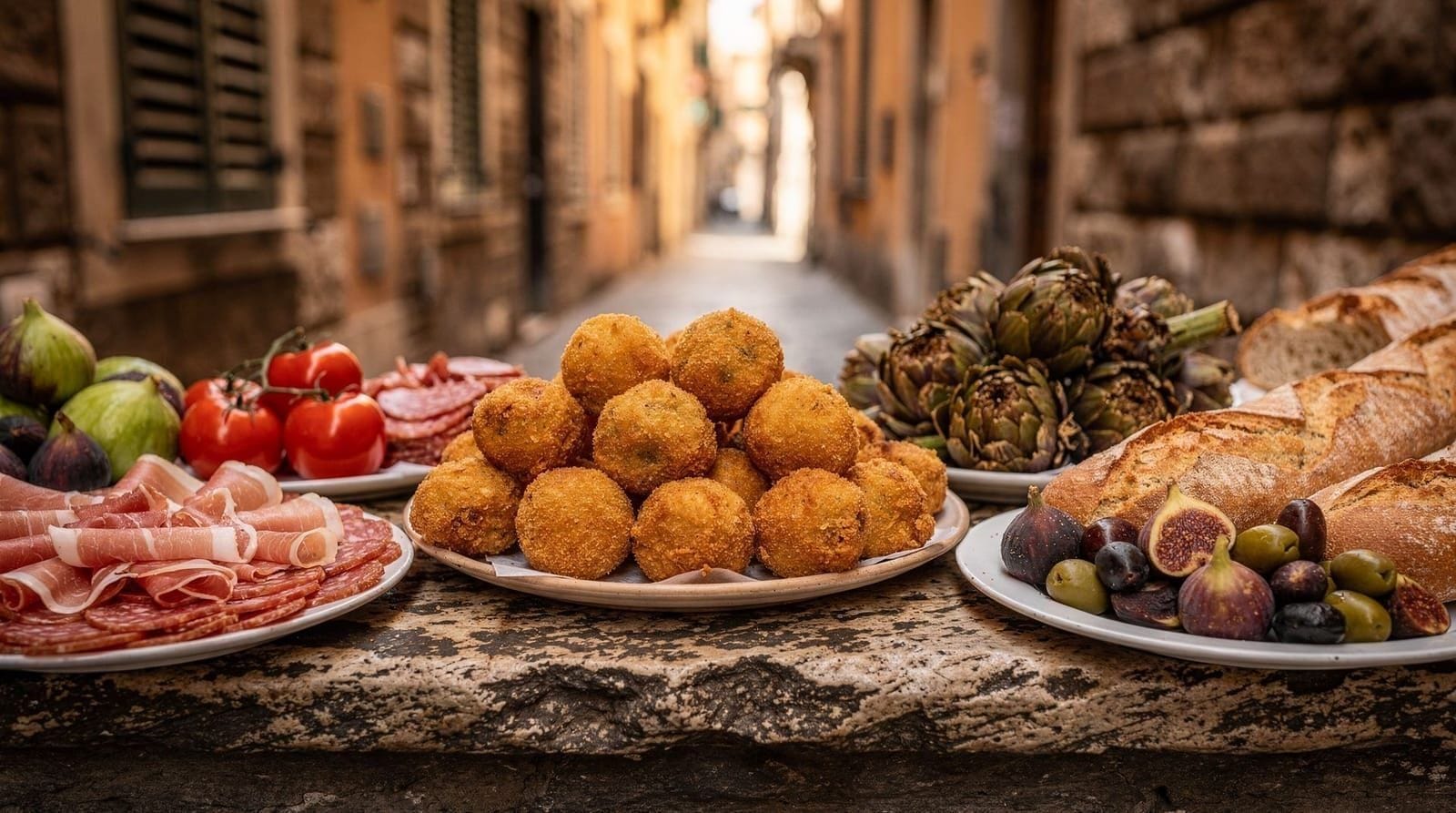
Testaccio is the structural answer to cheap eating in Rome. The Mercato di Testaccio (Via Galvani, open Monday to Saturday, morning until around 14:00) is where Romans from all over the city come for food. Market stalls sell prepared food: supplì (fried rice balls, 1.50 € each), artichokes, pasta dishes, sandwiches. Stand-up lunch for 6-8 €. See our Testaccio food guide.
Rosticcerias and tavole calde are Rome’s answer to lunch. Rosticcerias sell roasted meats and sides by weight; tavole calde are warm self-service counters with daily specials. Neither concept is tourist-oriented. A full plate with two sides runs 7-10 €. Find them on working-class streets: Via Ostiense, Via Nomentana, Via Tiburtina — or in the covered market of Testaccio.
Pizza al taglio (pizza by the slice, sold by weight) is Rome’s most reliable cheap food. A proper slice of Roman-style pizza (thin, rectangles cut from a baking tray) costs 3-4 € for a satisfying portion. Quality ranges from mediocre to extraordinary. The markers of quality: a queue of locals, the pizza is rotating fresh (not sitting out for hours), and the selection changes throughout the day. Via della Croce in Monti has good options; Roscioli Caffe near Campo de’ Fiori is excellent but slightly touristy and slightly expensive.
Neighbourhood trattorias away from monuments: Look for places with:
- A handwritten menu specials board (changes daily — actual cooking)
- No picture menu in a display case at the entrance
- Tables at 50% Italian occupancy minimum
- A coperto of 1.50 € or less
Specifically: Trastevere one street back from Santa Maria in Trastevere square (not the square-facing restaurants). Monti around Via del Boschetto. Prati on Via Candia and Via Cola di Rienzo. San Lorenzo (the student neighbourhood east of the centre).
Gelato: Proper gelato shows itself. Good indicators: gelato stored in covered metal pots (not piled into garish mounds), a shorter flavour menu (fewer flavours = made fresh more frequently), and prices under 3.50 € for a small. Avoid anywhere with mountains of fluorescent gelato visible from 20 metres — it is filled with additives and air.
Transport: what to buy and what not to buy
The Rome metro has three lines. Line A connects the major tourist sites: Termini (train station), Repubblica, Barberini (Trevi Fountain), Spagna (Spanish Steps), Ottaviano (Vatican). Line B connects Termini to the Colosseum (Colosseo stop). Line C is a newer suburban route with limited tourist relevance.
A day pass (7 €) covers unlimited metro, tram, and bus. If you are visiting two or more paid attractions in a day (which typically means two different metro journeys), a day pass is immediately better value than individual tickets.
Do not rent a car in Rome. The ZTL (Zone a Traffico Limitato) cameras operate throughout the historic centre. Any car (including rental cars) entering a ZTL zone receives an automatic fine of 84-335 € that the rental company will deduct from your deposit. The ZTL exists specifically to deter non-resident cars from entering the centre. Public transport covers the entire city effectively. See our Rome driving ZTL warning guide.
The hop-on hop-off bus costs 25-30 € for a 24-hour ticket. For the same 25 €, a 72-hour metro pass (18 €) covers all your transport for three days. Unless you have mobility needs or are specifically doing an orientation tour, the hop-on hop-off is not value-for-money transport.
Which paid attractions are worth the money
The Colosseum and Forum (18 € combined) is the single best-value cultural ticket in Rome. You get three distinct ancient sites on one ticket, the history is genuinely extraordinary, and with a guided tour or thorough self-preparation (see our Roman Forum guide), the depth is remarkable.
The Vatican Museums and Sistine Chapel (17-20 €) is objectively worth it. The content — the Raphael Rooms, the map gallery, the Sistine Chapel ceiling — is world-class. The issue is crowd management, not price. Book early morning entry.
The Borghese Gallery (17 €) is among the best galleries for its size in Europe. Non-negotiable booking requirement (minimum 7-10 days ahead). The physical experience of seeing Bernini sculptures in the rooms they were made for is one of the most memorable art encounters possible in Rome.
The Pantheon (5 €) is brief but correct. The oculus and the spatial perfection of the rotunda take 30-45 minutes but justify the minor cost.
Sites that are pleasant but skippable on a budget: Castel Sant’Angelo (15 €, primarily for the exterior view and the interior’s castle architecture — fine but not essential if you are budget-constrained), the Ara Pacis (9 €, beautiful but very specific in its appeal), and any combination pass that bundles things you would not visit separately.
The Catacombs and Appian Way tour covers underground early-Christian history at a price that includes guide and transport — genuine value for the content delivered.Free Rome: the full toolkit
Our free things to do in Rome guide covers this in detail. The summary for budget planning:
- All major basilicas (San Giovanni in Laterano, Santa Maria Maggiore, St. Peter’s Basilica interior) are free
- Three significant Caravaggio churches are free (San Luigi dei Francesi, Santa Maria del Popolo, Sant’Agostino)
- Borghese Gardens: entirely free public park
- Gianicolo Hill viewpoint: free
- Capitoline Hill terrace: free
- Aventino keyhole and Rose Garden: free
- Appian Way walk (Sunday mornings, car-free): free
- All nasoni drinking water: free
- Piazza Navona, Campo de’ Fiori, all piazzas: free
The first Sunday of each month gives free national museum entry — but the queues at the Colosseum on free Sunday often exceed two hours. Read the Rome free entry days guide for how to use this effectively.
Seasonal budget variance
Costs are not flat across the year. Accommodation prices swing the most: expect to pay 30-50% more for the same hostel bed or budget room in April-May and September-October (Rome’s shoulder-season sweet spot for weather) compared with January-February or the hottest weeks of August, when demand drops. Attraction prices are fixed year-round, but queue-avoidance value goes up in peak season — a skip-the-line ticket that felt optional in February becomes close to essential in June, when standard-entry queues at the Colosseum or Vatican can run past an hour. Booking accommodation for the shoulder seasons 2-3 months ahead captures the best rates before they rise.
Accommodation strategy
Staying in Monti (between the Colosseum and Termini) or Testaccio puts you within walking distance of the Colosseum and on direct metro lines to everything else. Both neighbourhoods have a genuine local character and budget accommodation options that are not in tourist traps.
The central hotel premium — paying extra to be 200 metres from the Pantheon — is rarely justified if you are on a budget. The metro is efficient enough that a 15-minute commute from a slightly peripheral neighbourhood saves significant money.
Avoid hotels near Termini station specifically. The station area (Esquilino and surroundings) has the highest density of poor-quality budget hotels, higher-than-average pickpocket risk, and an unappealing streetscape. The budget saving rarely compensates.
Avoiding the invisible costs
The financial drain on Rome visits comes from:
-
Restaurants near monuments — budgeting 20 € for dinner and spending 45 € because you sat down at the wrong place. Prevention: know your restaurant options in advance.
-
Bottled water — spending 1.50 € every 90 minutes because you are hot and the shop is there. Prevention: reusable bottle and nasoni.
-
Taxis for trips the metro covers — particularly the Colosseum to the Vatican (metro B to Termini, change, metro A to Ottaviano: 15 minutes, 1.50 €). Prevention: understand the metro map before you go.
-
Day-of tour booking — paying tout prices instead of advance GYG prices. Prevention: book all tours before travelling.
-
Coffee sitting down — paying 3-4 times the standing price over multiple days. Prevention: stand at the counter.
The 3-day budget breakdown
Sample budget for 3 days in Rome, per person, excluding flights:
| Item | Cost |
|---|---|
| Accommodation (2 nights hostel or 3 nights budget) | 90-120 € |
| Transport (3 day passes) | 21 € |
| Colosseum + Forum + Palatine | 20 € |
| Vatican Museums | 20 € |
| One other paid attraction (Borghese or Pantheon) | 17-18 € |
| Food and drink (market lunches + neighbourhood dinners) | 90-110 € |
| Incidentals | 20-30 € |
| Total | 278-339 € |
This is a full Rome experience — not reduced or compromised. The version that costs 600 € for the same trip adds tourist-facing restaurant bills, book-on-the-day tour surcharges, and accommodation in the wrong location.
A food tour in Trastevere is genuinely worth it as a budget allocation — you get 4 hours of neighbourhood knowledge and multiple food tastings included in one price, which works out to better value than equivalent individual spending on mediocre tourist food.Budget by trip length
Costs do not scale perfectly linearly — the first day carries fixed costs (airport transfer, orientation) that later days do not repeat.
| Trip length | Realistic total budget (excl. flights) | Notes |
|---|---|---|
| 1 day | 50-70 € | One attraction, no accommodation, airport transfer if same-day |
| 3 days | 278-339 € | See the full breakdown below; the most efficient length for cost-per-day |
| 5 days | 420-520 € | Add a day trip (Ostia Antica or Tivoli, both cheap by regional train) |
| 7 days | 600-750 € | Diminishing marginal cost per day once accommodation is booked longer-term |
For the 5-7 day range, one or two day trips fit naturally into a budget itinerary — Ostia Antica costs little more than a metro-plus-train ticket, and Tivoli is similarly affordable by regional train. See best day trips from Rome for the full comparison.
Budget mistakes specific to first-timers
First-time visitors lose money in patterns that repeat trip after trip. Beyond the invisible costs above, a few first-timer-specific traps: booking the Roma Pass before checking whether it actually saves money for your itinerary (rarely does, see the Roma Pass guide); assuming every neighbourhood restaurant is a rip-off because one near the Trevi Fountain was — the fix is knowing which streets to trust, covered in the Rome tourist traps guide; and treating the Rome metro as intimidating and defaulting to taxis, when in reality the three-line system is simple once you’ve used it twice.
If you are combining budget travel with a short trip, the Rome on a budget 3-day itinerary sequences the neighbourhoods and attractions in this guide into a day-by-day plan, and the Rome for first-timers guide covers the planning basics that apply regardless of budget.
The budget travel mindset in Rome
The fundamental principle is that Rome’s best experiences — its churches, piazzas, fountains, gardens, viewpoints, street life — are not behind paywalls. What costs money are the highlights of the ancient world (Colosseum, Vatican) and the exceptional galleries (Borghese). These are worth budgeting for. Everything else rewards the traveller who is willing to walk two streets away from the obvious, drink standing at the bar, and fill their water bottle at the fountain on the corner.
Frequently asked questions about Rome on a budget: how to see the city cheaply without missing the point
What is the cheapest way to eat well in Rome?
Which Rome attractions are genuinely worth the ticket price?
Is it possible to do Rome in 3 days for under 300 € total excluding flights?
Is the Roma Pass worth buying on a budget?
What does coffee cost in Rome and how do I avoid tourist prices?
What are the cheapest good wines in Rome?
Top experiences
Bookable activities with verified prices and instant confirmation on GetYourGuide.