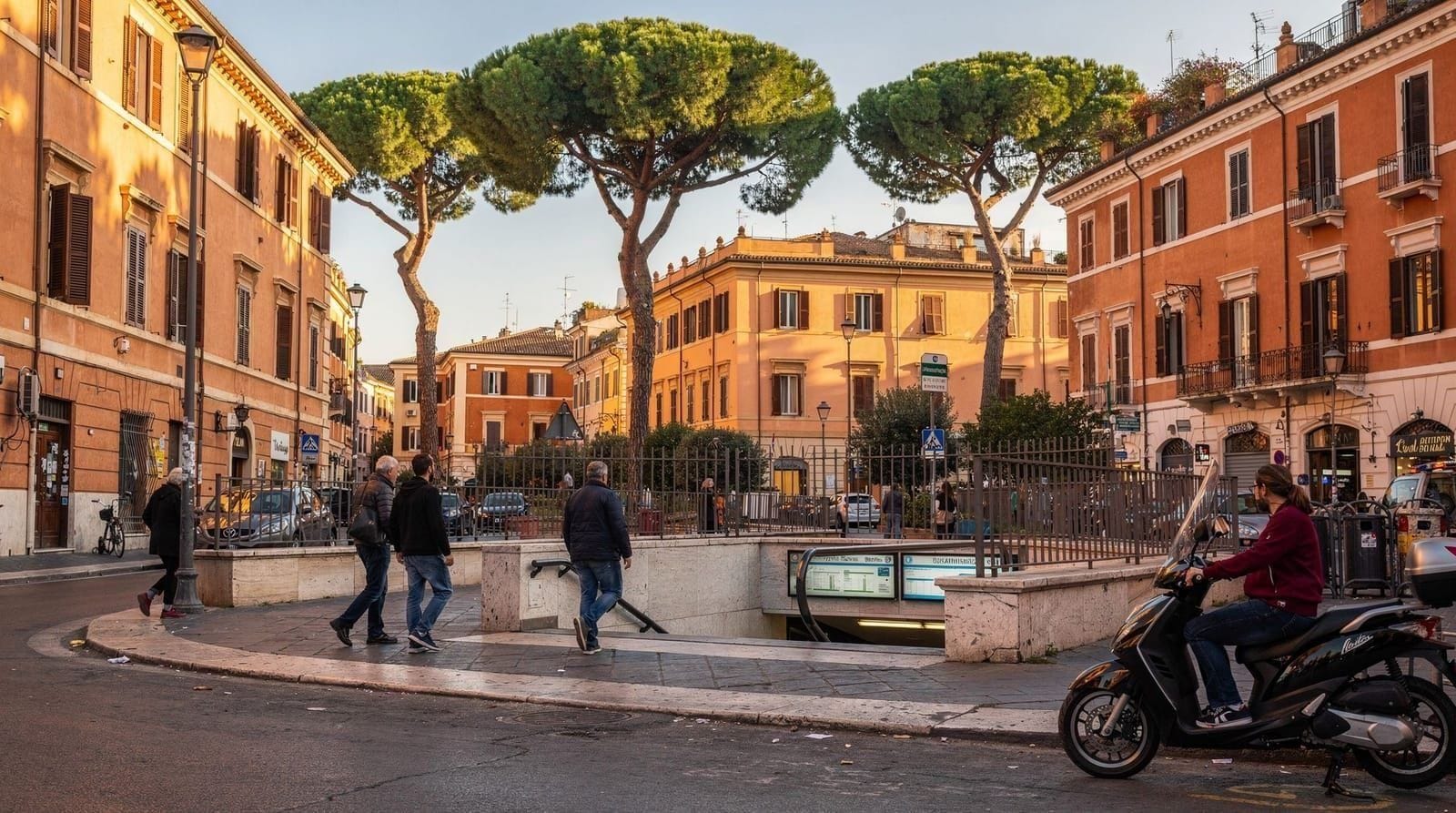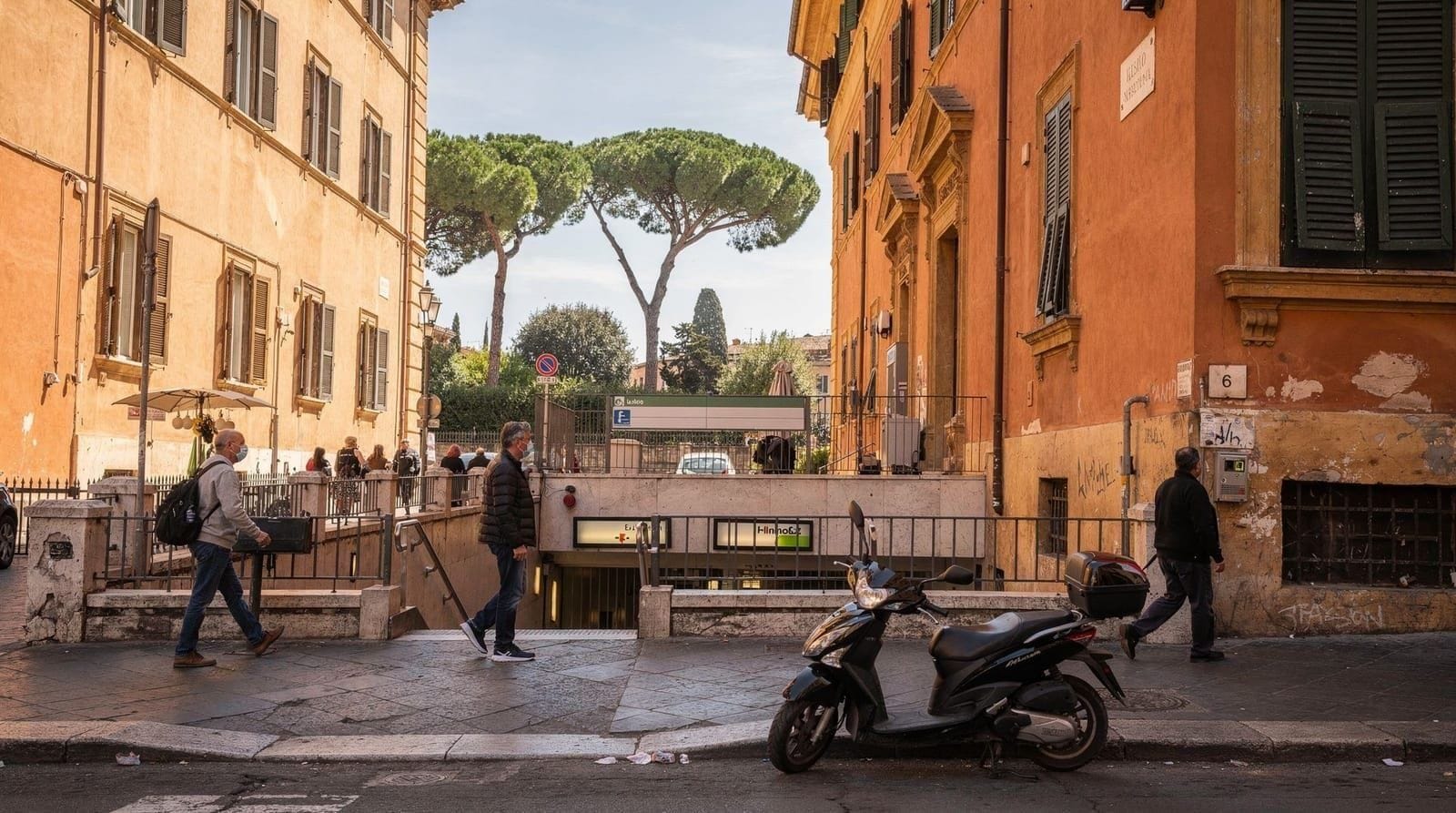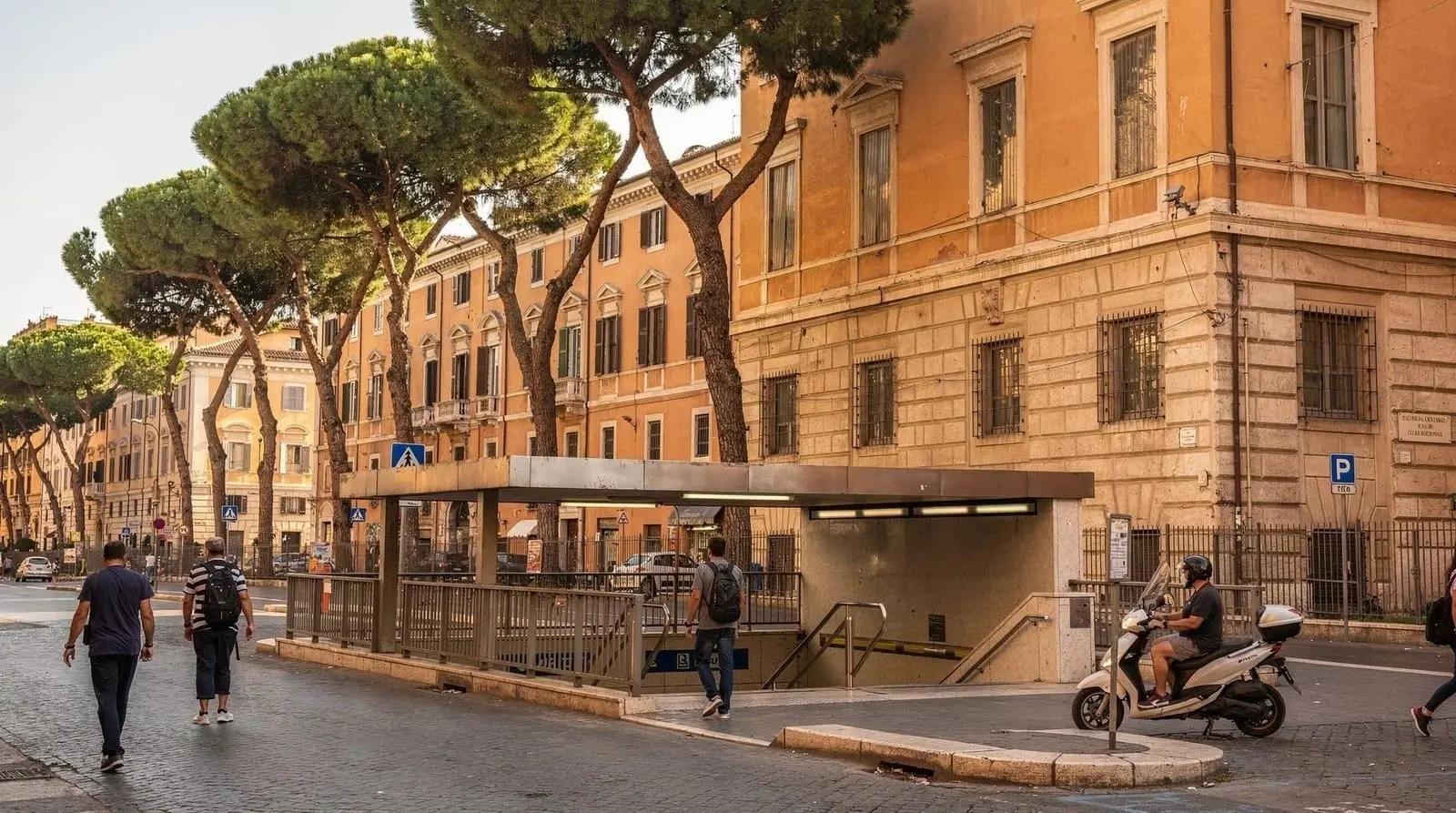
Getting around Rome — your complete transport guide
Rome: City Sightseeing Hop-on Hop-off Bus with Audioguide
What is the best way to get around Rome?
Walking is the default for the historic centre — most major sights are within 20–30 minutes of each other on foot. For longer distances, Metro lines A and B are fast and cheap (€1.50/ride). Avoid renting a car inside the city; ZTL camera fines of €84–335 are automatic and billed to your credit card via the rental agency.
Rome is best explored on foot — with strategic metro use
Rome’s historic centre is compact enough that walking is not just pleasant — it is often faster than any other mode of transport. The distance from the Colosseum to the Trevi Fountain is around 1.5 km. From Piazza Navona to the Pantheon: less than 5 minutes. From the Vatican to Castel Sant’Angelo: a 10-minute stroll along the river. If your accommodation is centrally located, you can realistically reach most of the top sights without using any public transport at all.
That said, Rome is not a small city. The full urban area stretches for kilometres, and there will be moments — after a long afternoon of sightseeing, or when you need to cross from Trastevere to the Vatican district at speed — when the metro, bus or a taxi becomes useful. The key is understanding which options work well and which ones to avoid.
This guide covers every practical transport method: metro, bus, tram, taxi, ride-hailing, airport connections, and the single most important warning for drivers — the ZTL camera system that has cost tourists hundreds of euros in automatic fines.
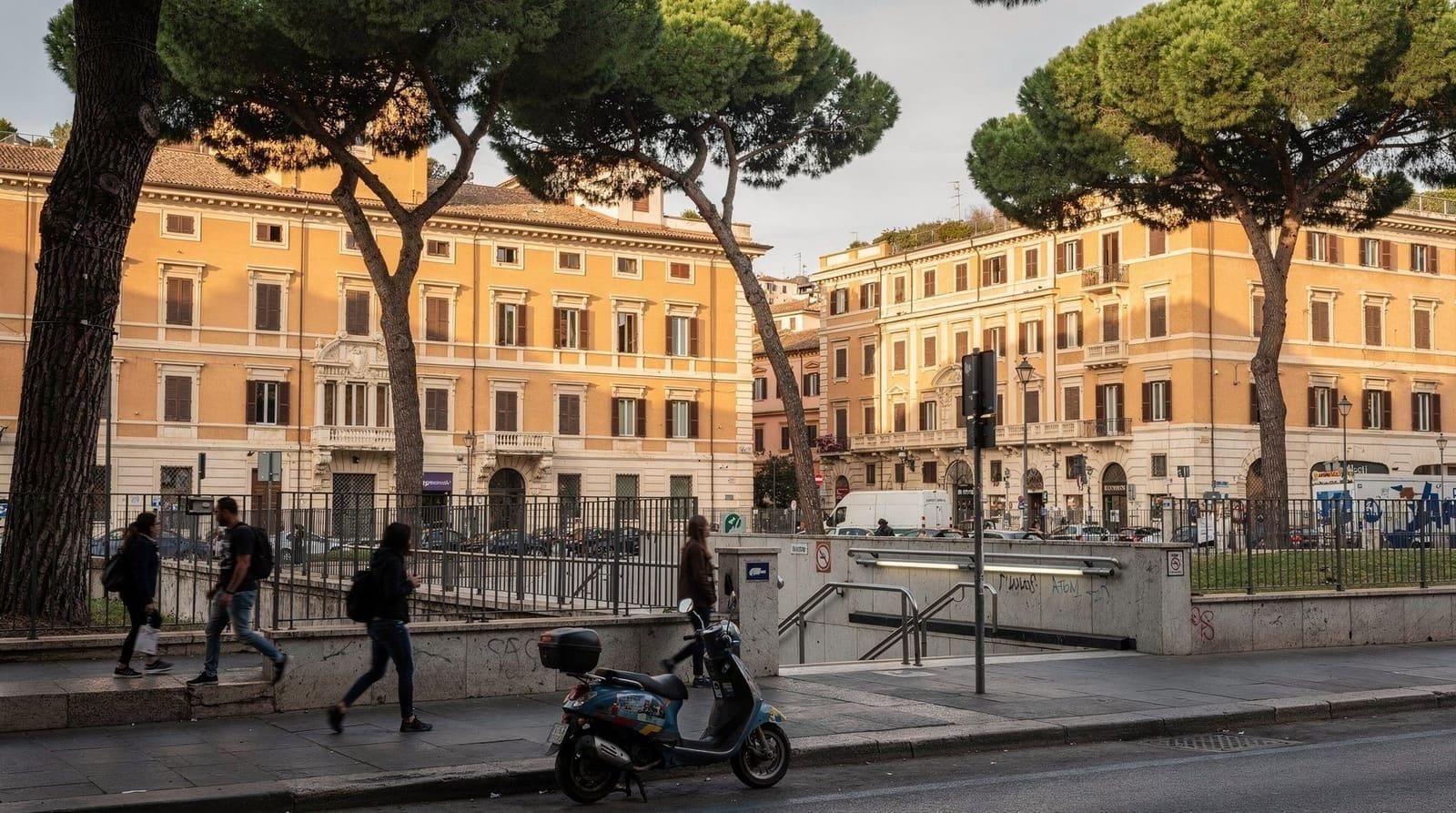
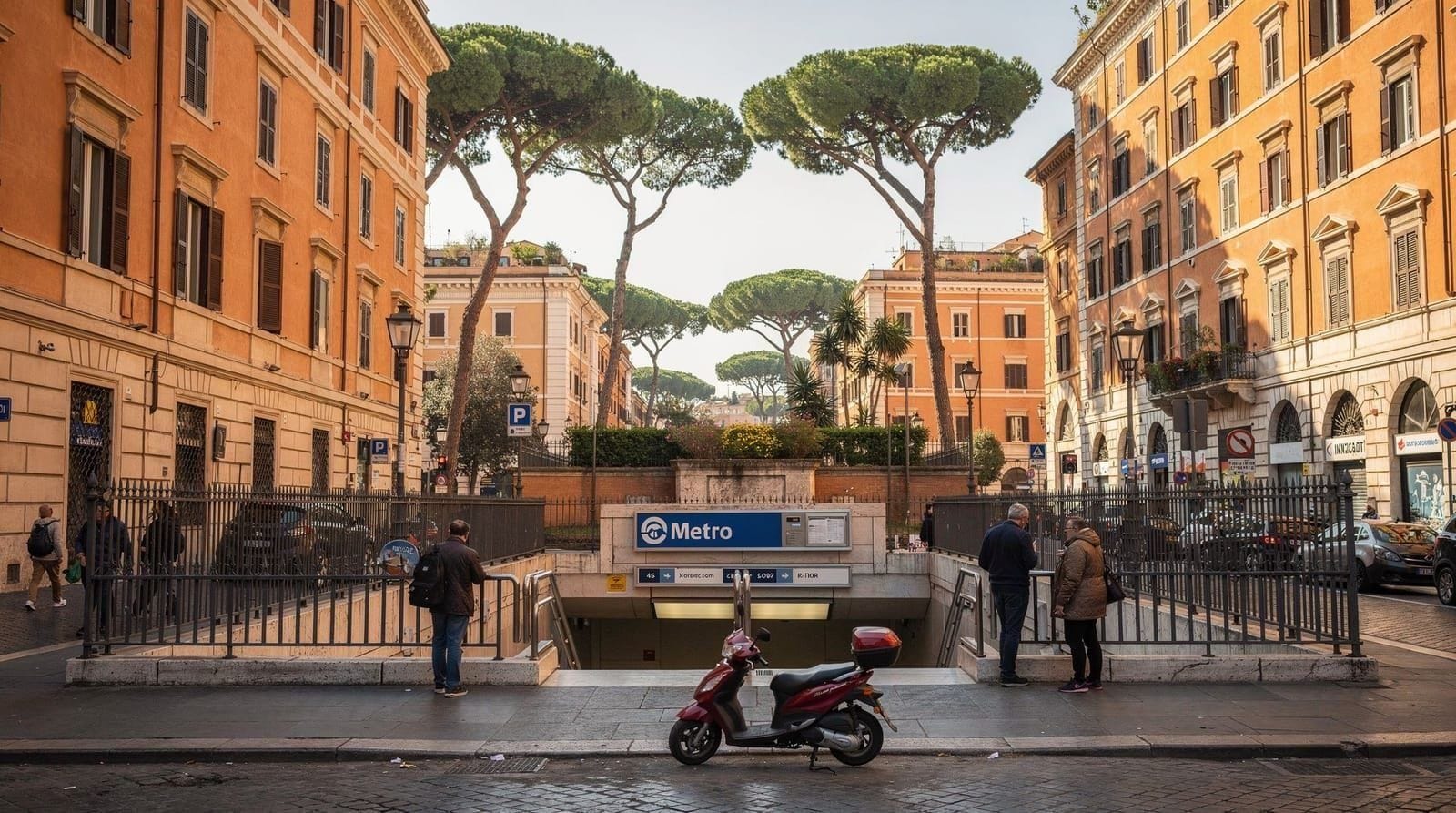
The Rome metro: lines A, B and C
Rome’s metro is not the most extensive network in Europe, but lines A and B are genuinely useful for tourists.
Line A (orange) runs from Battistini in the west through the city centre to Anagnina in the southeast. Key stops for visitors:
- Ottaviano — closest to the Vatican (500 m to the entrance)
- Lepanto — also useful for the Vatican/Prati area
- Spagna — Spanish Steps (exit right onto the steps)
- Barberini — Trevi Fountain (10 min walk) and Piazza Barberini
- Repubblica — near Santa Maria degli Angeli and Termini
- Termini — main hub connecting lines A and B
Line B (blue) branches at Bologna. Key stops:
- Colosseo — the Colosseum (directly below the arena, a 2-minute walk)
- Circo Massimo — Circus Maximus, Aventino, Mouth of Truth
- Piramide — Testaccio, Ostiense station for the Ostia Antica rail connection
- Termini — transfers to Line A, regional trains, buses
Line C (green) is the newest line and runs through the eastern suburbs. Its central terminus is currently at San Giovanni on Line A, making it useful for accessing the newer eastern districts but less relevant for the classic tourist circuit. The central extension towards Piazza Venezia is still under construction as of 2026.
Practical Metro Tips
- Validate your ticket at the turnstile barrier before boarding — not at the door. Inspectors check inside the carriage.
- Services run approximately 05:30–23:30 Sunday to Thursday, and until 01:30 on Friday and Saturday nights.
- Platforms can get very warm in summer — carry water, especially on lines A and B which see the most crowding.
- The Termini interchange between lines A and B involves a reasonably long underground walk — allow 5 minutes for a cross-platform transfer.
Buses and trams: useful but slow
Rome’s surface transport network is run by ATAC and covers the entire city. The same €1.50 BIT ticket covers bus, tram, metro and urban rail within Rome — validate as you board.
What works for tourists:
- Bus 23/280: runs from Testaccio/Piramide along the Tiber to the Vatican — less crowded than buses 40 or 64 and avoids the interior of Trastevere
- Tram 8: Largo Argentina to Trastevere and beyond — excellent for that specific journey
- Bus 492: connects Termini, Piazza Navona area (Rinascimento), and Piazza Risorgimento (Vatican)
- Bus C3: Colosseum area, Testaccio, Lungotevere — an underrated circular route
What to know about buses 40 and 64: These two lines are the most famous tourist routes — both run from Termini to the Vatican along Via Nazionale and then through the centre. They are also notorious for pickpockets. If you do use them, keep your bag in front and avoid the crowded rear section. Peak hours are especially high-risk.
Night buses (lines prefixed N) take over after the metro closes. Night bus N1 approximates Line A; N2 approximates Line B. Frequency drops to every 30 minutes or more.
Taxis: flat fares and official cabs only
Rome taxis are officially white with a “TAXI” sign on the roof, a taximeter, and “SPQR” insignia. Only use official metered taxis — unlicensed touts at the airport and main stations charge 2–3 times the legal rate and have no recourse if you dispute the fare.
Key flat fares (set July 2024):
- Fiumicino airport (FCO) to within the Aurelian Walls: €55 (up to 4 pax + luggage)
- Ciampino airport (CIA) to within the Aurelian Walls: €40 (up to 4 pax + luggage)
- Civitavecchia cruise port to Rome centre: metered (~€130–180 depending on traffic) — a shared shuttle or bus is more economical
Flagging a taxi: Taxis queue at official stands (e.g., Termini, Largo Argentina, Piazza Venezia, Piazza di Spagna) or can be hailed on the street (less reliable). App booking via itTaxi or Free Now (formerly MyTaxi) is reliable — the app shows the licence plate and driver details, and the fare runs on the standard meter.
What to avoid: Touts approaching you with “taxi? taxi?” outside Termini or the airports. Unofficial car services parked at arrivals. These are sometimes called “abusivi” (unlicensed drivers) — incidents of overcharging are common.
Night surcharges (after 22:00) and Sunday/holiday surcharges apply on top of the meter — this is legal and normal, not a scam. Large luggage and extra passengers within the legal limit should not add to the flat airport rates.
Ride-hailing apps: Uber operates in Rome, but only in “UberBlack” or “UberX” configurations that dispatch licensed drivers at prices comparable to (sometimes higher than) a standard taxi — there is no cheap Uber equivalent here as in some other cities. Free Now functions as a straightforward taxi-hailing app rather than a separate ride-hailing network, and is generally the more reliable choice for a guaranteed licensed driver with upfront route information.
Tourist transport passes
ATAC day passes (2025 rates):
- 24h: €8.50
- 48h: €15
- 72h: €22
- 7-day CIS: €29
All cover unlimited metro, bus and tram within Rome.
Roma Pass:
- 72h: €52 (2 free entries at participating museums + transport)
- 48h: €32 (1 free entry + transport)
The Roma Pass is worth buying if you plan to visit 2+ paid attractions (beyond the Colosseum/Vatican, which need separate bookings anyway) and use public transport regularly. Do the arithmetic before buying — if your main sights are free-entry churches and one major ticketed attraction, individual tickets often cost less.
Important: Even if you hold a Roma Pass, you must still book a timed entry slot separately on the Colosseo official ticketing site for the Colosseum. The Pass covers the admission cost but does not guarantee or book your slot. Slots fill weeks in advance.
Hop-on hop-off buses
Hop-on hop-off buses are genuinely useful for visitors who want a narrated orientation tour, have limited walking ability, or are staying for only 24–48 hours. The main operators — City Sightseeing, Big Bus and the panoramic 3-route service — all run circuits covering the Colosseum, Vatican, Villa Borghese, Piazza Venezia, Testaccio and Trastevere.
Rome City Sightseeing hop-on hop-offFor visitors wanting more coverage, the panoramic 3-route option adds outer circuits:
Rome panoramic hop-on hop-off — 3 routesKeep realistic expectations: Rome traffic is chaotic, and buses can run significantly behind schedule, especially in summer or during events. Treat them as a sightseeing tool with audio commentary rather than a reliable rapid-transit alternative.
The ZTL zone: why you should not drive in Rome
This deserves its own section because it costs tourists real money every year.
The Zona Traffico Limitato (ZTL) is Rome’s camera-enforced restricted driving zone covering most of the historic centre. There are over 250 cameras monitoring entry points. If your vehicle passes a camera without an active permit, you receive a fine.
Key ZTL hours for the Centro Storico:
- Monday–Friday: 06:30–18:00
- Saturday: 14:00–18:00
- Sunday: no restriction (in most areas)
Other ZTL zones (Trastevere, Monti, San Lorenzo, Campo Marzio) have their own hours, often including evenings and weekends. GPS navigation systems — including Google Maps — do not reliably warn you when you are entering a ZTL zone. Many tourists drive in confidently following GPS directions and receive multiple fines without ever seeing a restriction sign clearly.
Fines: €84–€335 per camera entry (the exact amount depends on the zone and whether it is a first or repeated offence). Rental companies settle these automatically with the municipality and charge your credit card — often weeks or months later, sometimes with an additional “administration fee” of €25–50 per notice.
The verdict: do not rent a car for city sightseeing in Rome. The metro, buses, taxis and walking are sufficient. If you want a car for a rural day-trip to Castelli Romani, Civita di Bagnoregio or the Tuscia, pick it up from a suburban rental depot outside the ZTL — not from an airport desk if you plan to drive directly into the centre.
For full details on ZTL zones and fines, see the dedicated guide: Rome driving and ZTL warning.
Getting from FCO (Fiumicino) airport to Rome
Fiumicino is Rome’s main international airport, located ~30 km southwest of the city.
Leonardo Express: Direct non-stop train from FCO Terminal 1/2/3 to Roma Termini. Journey time: 32 minutes. Frequency: every 15 minutes. Price: €14 booked online, €15 at the station. This is the fastest and most hassle-free option — no stops, no transfers, platform 24 at Termini.
Shuttle bus (Terravision, SIT, Schiaffini): Multiple operators run coaches to Termini and sometimes Tiburtina. Journey time: 50–60 minutes (traffic-dependent). Price: €6–7 one way, ~€13 return. Good value for solo travellers with time to spare; less comfortable for families with large luggage.
Flat-rate taxi: €55 for up to 4 passengers with luggage, to any address within the Aurelian Walls. Use only white licensed taxis from the official taxi stand outside arrivals. For destinations outside the Walls (e.g., Parioli, EUR), the meter applies after a drop.
Private transfer: Pre-booked services are available through the GYG network and direct apps. More expensive than a taxi but useful for groups, late night arrivals or when you want someone holding a sign.
Regional trains: FL1 line from FCO stops at several intermediary stations (Trastevere, Ostiense, Tiburtina) and is cheaper (€8 from FCO to Trastevere/Tiburtina) — but requires knowing which station to alight at. Valid for visitors staying near those stations.
For the complete breakdown, see the Fiumicino airport to Rome guide.
FCO options compared:
| Option | Time | Cost | Best for |
|---|---|---|---|
| Leonardo Express | 32 min | €14–15 | Speed, no transfers, arriving near Termini |
| Shuttle bus | 50–60 min | €6–7 | Budget travellers, flexible timing |
| Flat-rate taxi | 40–60 min | €55 (up to 4 pax) | Groups, late arrivals, heavy luggage |
| Regional FL1 train | 30–45 min | ~€8 | Staying near Trastevere/Ostiense/Tiburtina |
| Private transfer | 40–60 min | €60–90+ | Comfort, named driver, no queue |
Getting from CIA (Ciampino) airport to Rome
Ciampino is Rome’s secondary airport, used by most low-cost carriers (Ryanair, Wizz Air, EasyJet). It sits ~15 km southeast of the centre.
Shuttle bus to Termini: The most practical option. Terravision and SIT buses take 35–45 minutes and cost around €6. Services are timed to flight arrivals; book in advance for the best price.
Flat-rate taxi: €40 for up to 4 passengers with luggage to within the Aurelian Walls. The Ciampino flat fare is lower than FCO because of the shorter distance.
Public bus + metro: Local ATAC bus 520 runs to Anagnina (Metro Line A terminus) — but takes 30+ minutes on a slow bus and requires luggage handling, then a metro journey. Only practical if you have one small bag and want to avoid shuttle fares.
For the full comparison, see the Ciampino airport to Rome guide.
Day-trip trains from Roma Termini
One of Rome’s great advantages as a base: high-speed rail connections make several iconic destinations reachable as genuine day-trips.
Key services from Roma Termini:
- Naples (Napoli Centrale): 1h10–1h15, from €14.90 on Italo or €18–33 on Trenitalia Frecciarossa. Book ahead for cheap seats — base fares fill fast.
- Florence (Firenze SMN): 1h30, from €19.90–€35. Feasible as a day-trip but genuinely better as an overnight.
- Pompeii: Frecciarossa to Napoli Centrale (1h15), then Circumvesuviana regional train to Pompei Scavi (30 min). Total ~2h10 each way.
- Orvieto: Direct regional train from Termini, under 90 minutes. An easy and underrated day-trip.
- Tivoli: Regional train from Tiburtina station, ~40–60 minutes, ~€4. Or regional bus from Ponte Mammolo.
- Ostia Antica: Metro B to Piramide/Magliana, then Roma–Lido regional train — covered by a standard ATAC ticket or day pass.
For detailed train routes and booking tips, see the trains from Rome for day-trips guide.
Walking and cycling
For the Centro Storico, walking is almost always the best option. Distances are short, streets are designed for pedestrians (many are paved in flat sanpietrini cobblestones), and the density of things to see means you want to walk slowly, not rush between metro stops.
Cobblestones: Rome’s sanpietrini (small basalt blocks) are beautiful but uneven. Avoid wheeled suitcases on the main tourist streets — they are exhausting and noisy. Flat, rubber-soled shoes are essential; high heels are genuinely inadvisable.
Cycling: Rome is increasingly cycle-friendly, with dedicated lanes along the Tiber embankment and some wider streets. Shared e-bike schemes (Lime, Bird) are available. However, the historic centre’s traffic and narrow streets make cycling intimidating for visitors; the Appian Way is the best cycling route — car-free on Sundays. Beyond the Appian Way, the Villa Borghese park paths and the Tiber embankment cycle lane between Ponte Milvio and Ponte Marconi are the two other genuinely relaxed places to ride without contending with traffic.
Luggage on arrival day: If you’re arriving with large suitcases and staying in the historic centre, factor cobblestones into your route choice — a taxi to the door is usually worth the cost on day one, even for otherwise budget-conscious travellers, since many centro storico streets are pedestrian-only and a taxi can only get you to the nearest accessible point regardless.
Electric golf cart and e-bike tours offer a comfortable middle ground between walking and taxi for visitors who want to cover ground without public transport:
Rome electric golf cart highlights tourE-scooters: Shared e-scooter schemes (Lime, Bird, Dott) are widely available via app, with parking corrals marked in the centre. They are a fast way to cover mid-range distances, but Rome’s cobblestones make for a genuinely bumpy ride, and the ZTL and pedestrian-only zones still apply — check the app map before riding through Piazza Navona or similar squares, where scooters are often banned or speed-limited.
Getting around late at night
Rome’s nightlife runs later than its public transport network is built for. The metro closes at 23:30 (Sunday–Thursday) or 01:30 (Friday–Saturday), after which night buses (N-prefix) take over on reduced frequency — expect to wait 20–30 minutes between services, and check the current route map since night lines shift periodically. For a direct trip home after a late dinner in Trastevere or an evening in Monti, a taxi from an official rank or a booking app is usually faster and more predictable than piecing together a night bus route. If you’re staying near a Line A or B station and heading home before 23:30, the metro remains the cheapest option even late in the evening.
Transport at a glance: which option for which situation
| Situation | Best option |
|---|---|
| Colosseum to Vatican | Metro (Line B to Termini → Line A to Ottaviano) ~25 min |
| Termini to Trevi Fountain | Walk (15 min) or taxi |
| Airport late at night | Pre-booked taxi (flat rate) |
| Castelli Romani day-trip | Train from Termini to Frascati |
| Pompeii day-trip | High-speed Frecciarossa + Circumvesuviana |
| Trastevere to Pantheon | Tram 8 to Largo Argentina, walk 5 min |
| Full-day sightseeing, mobility issues | Hop-on hop-off day pass |
| Rural Tuscany/Umbria day-trip | Train + tour, or rental car from suburban depot |
Key transport numbers and apps
- ATAC (buses/trams/metro): 060608 or atac.roma.it
- itTaxi app: official Rome taxi booking (same meter rates)
- Free Now app: taxi booking, also covers licensed Rome cabs
- Trenitalia: trenitalia.com (regional + high-speed trains)
- Italo: italotreno.it (high-speed trains, often cheaper than Trenitalia)
- Emergency / lost property: ATAC lost property on 060608
For context on planning your days around Rome’s transport network, see the Rome itinerary planning guide and how many days to spend in Rome.
Getting around with reduced mobility or a stroller
Rome is more manageable than its cobblestones suggest, but it takes planning. Metro line A and B stations have lifts at most (not all) stops — check ATAC’s accessibility map before relying on a specific station, since some historic-centre stops (notably Barberini and Spagna) have had lift outages in the past. Buses are generally low-floor and easier than the metro for wheelchair users, though boarding assistance is not guaranteed at every stop. Sanpietrini cobblestones are the real obstacle for wheels of any kind — Via del Corso, Via Nazionale and the Lungotevere pavements are smoother alternatives to the narrow lanes of the historic core. Taxis are a practical fallback for shorter, direct hops when cobblestones or lift outages make the alternative impractical. For a fuller site-by-site breakdown of accessible entrances and step-free routes, see our accessible Rome guide.
Frequently asked questions about Getting around Rome — your complete transport
How much does a single metro ticket cost in Rome?
Is it safe to take the metro in Rome?
Can I use a Roma Pass on public transport?
What is the cheapest way from Fiumicino airport to Rome centre?
Are there trams in Rome?
Do I need a car to get around Rome?
How do I get from Ciampino airport to Rome?
Which bus lines are most useful for tourists?
Top experiences
Bookable activities with verified prices and instant confirmation on GetYourGuide.