Rome scams to avoid: fake gladiators, bracelets, taxis and more
Rome: Guided Tour of Colosseum, Roman Forum & Palatine Hill
What are the most common scams in Rome right now?
The five you are most likely to encounter: costumed gladiators at the Colosseum demanding 15-30 € for a forced photo, bracelet sellers near the Pantheon and Spanish Steps, inflated restaurant bills with hidden coperto, unlicensed taxi drivers at Termini and the airports charging double the fixed rates, and fake charity collectors near St. Peter's Square. None are violent — all target inattentive tourists.
Rome is not uniquely dangerous — but it is specifically set up
Rome sees around 35 million tourists annually. That is an enormous market for anyone trying to extract money through information asymmetry. Rome’s scams are not random crime — they are structured, repeat-location operations that have been running for years and work because tourists are in an unfamiliar environment, often jet-lagged, and briefly unable to price-check anything.
Understanding the mechanics of each scam is the best prevention. None of the below requires paranoia or defensive hostility. It requires recognising a pattern before it completes.
| Most common | Gladiator photo demand (€15-30), bracelet sellers (€5-10) |
| Most costly | Unlicensed airport taxi (€80-120 vs €55 fixed rate) |
| Highest pickpocket risk | Metro Line A (Termini–Ottaviano), buses 64 and 40 |
| Never pay | Second-hand Vatican or Colosseum tickets, street “police” wallet checks |
| If overcharged | Ask for an itemised bill (conto) — you can refuse undisplayed charges |
The gladiator photo operation at the Colosseum
This is Rome’s most photographed scam, literally. Costumed centurions and gladiators, sometimes in pairs, position themselves on the approach to the Colosseum’s main entrance — typically on the paved area in front and on Via Sacra. They hold plastic swords and shields, look photogenic against the monument, and make eye contact with passing tourists.
The mechanics: they initiate a pose with you, sometimes physically guiding you into position. A colleague takes the photo. Then a price is stated — 15-30 € per person in cash. Declining after the photo is taken is met with aggressive persistence: blocking, surrounding, extended demands. The amounts escalate if you show reluctance.
This is technically legal in Italy (it is a street performance) and the police will not intervene except in cases of physical contact.
Prevention: walk past the Colosseum entrance approach without engaging. No eye contact, no slowing down, no half-responses to overtures. If you want a photo of yourself near the Colosseum, take it from the far side of the road, away from the performer concentration.
The performers also occasionally appear near the Roman Forum entrance and, less commonly, near Trevi Fountain. The same approach applies everywhere.
Bracelet and rosemary sellers
Near the Pantheon, Spanish Steps, and Trevi Fountain, men of various nationalities approach tourists and — before consent is given — begin tying a friendship bracelet or rosemary sprig onto the tourist’s wrist. Once attached, payment is demanded, typically 5-10 €. If you refuse, they call others over and crowd around you.
The prevention is physical: walk with purpose and both hands in your pockets or occupied. If one is approached, step back immediately before contact. If one is already tied on, you can remove it yourself and walk away — no payment was agreed and no service was rendered.
The rosemary variant is slightly different: a bundle is pressed into your hand and you are told it is a “gift from the church” or a “blessing.” It is not. The same declination applies: do not accept items pressed into your hands near monuments.
Pickpockets: the real financial threat
Pickpocketing in Rome is significantly more financially serious than any of the above, because amounts can be large (entire wallets, phones) and prevention requires habits rather than single decisions.
High-risk zones in 2026:
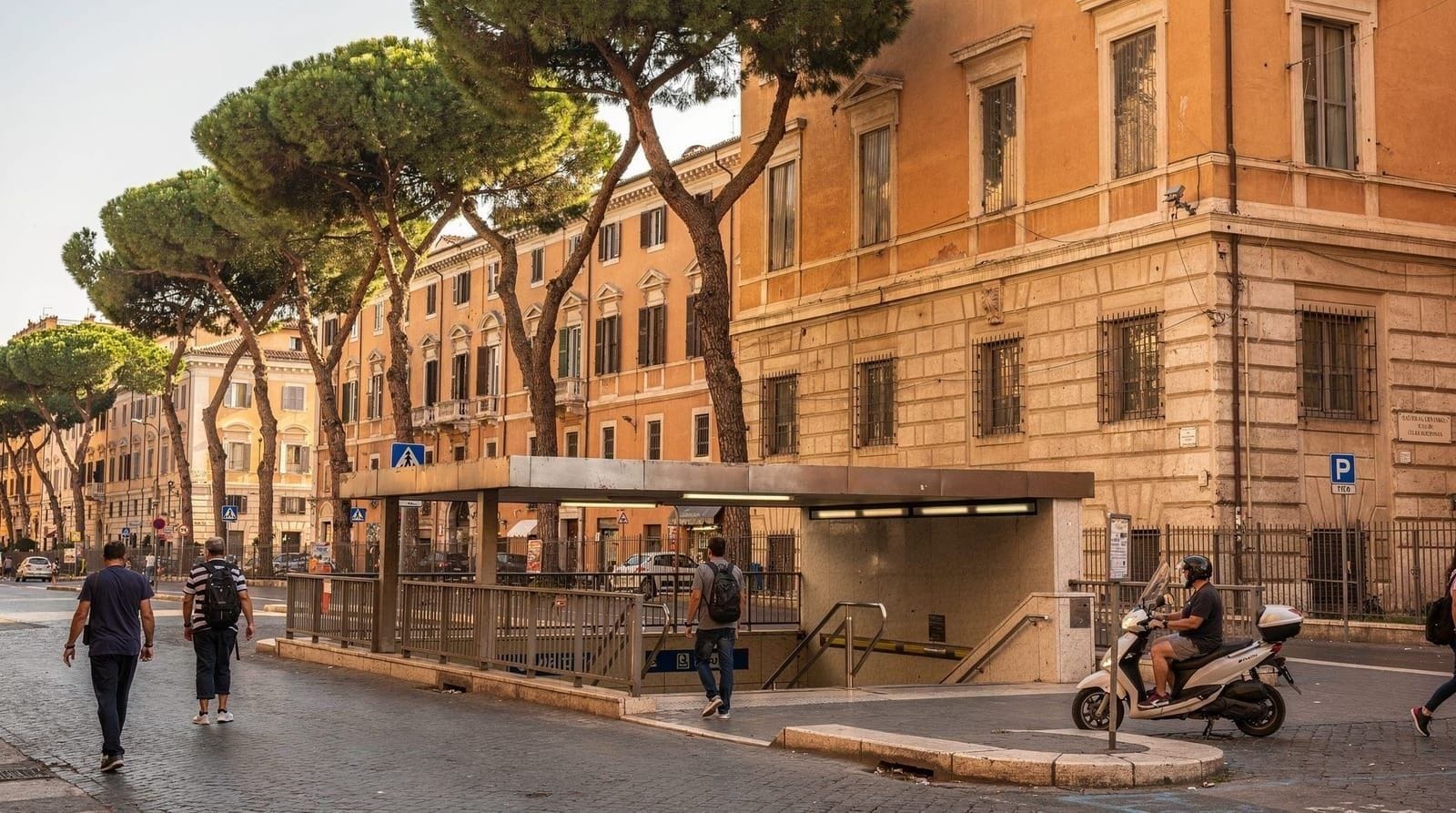
- Metro Line A, particularly the section between Termini and Ottaviano (the Vatican direction). Pickpocket teams operate specifically at rush-hour crush points. Keep phones and wallets in front pockets or interior zip pockets.
- Bus 64 and bus 40, both running from Termini to the Vatican. These buses are specifically targeted because they carry obvious tourists with luggage and camera bags.
- Termini station itself — the main hall and the subway station below.
- Around the Trevi Fountain during peak hour (11:00-16:00), when the crowd is densest.
Tactics used: one person distracts (drops something, asks for directions, points at something), accomplice extracts wallet or phone. The “map held in front of you” distraction. The “friendly stranger offering to take your photo” who then walks away with your phone.
Countermeasures: money belt or neck wallet for cash and backup cards. Keep only one day’s cash in accessible pockets. Phone with a wrist loop. Copy of passport scanned to email. The vast majority of pickpocketing incidents are reported only because tourists had everything in one place.
Restaurant bill manipulation
Three specific practices occur in tourist-heavy eating areas:
The unstated coperto: Italian restaurants can legally charge a cover charge (coperto) per person. In tourist areas near Trevi, Navona, and Campo de’ Fiori, this runs 2-4 € per person. The coperto must be stated on the menu (Italian law). If it is not on the menu, you can refuse to pay it. Check the menu for coperto before sitting down.
The pane e coperto combined: Some restaurants charge separately for bread brought automatically to the table (pane, 1-2 € per person) in addition to coperto. Neither is mandatory if you decline. A polite “no bread, please” at the start of the meal prevents this charge.
The unlisted special: A waiter verbally describes a daily special without stating the price. The dish arrives and is charged at 25-35 €. Italian consumer law requires prices to be available. Ask the price of any special before ordering.
Where this specifically happens: Via della Croce near the Spanish Steps, any restaurant with a terrace facing the Colosseum, the tourist-facing restaurants on Piazza della Rotonda facing the Pantheon, and the elevated-price zone extending roughly 200 metres around Trevi. See our where to eat in Rome guide for specific alternatives.
The airport taxi ruse
Fiumicino Airport (FCO) has a fixed taxi rate to the city centre of 55 € — all-inclusive, any destination within the Aurelian Walls. This rate applies regardless of traffic, time of day, or number of passengers. It is prominently displayed at the taxi ranks.
The scam operates at arrivals: individuals in civilian clothing (occasionally in pseudo-uniform) approach arriving passengers before they reach the official taxi rank, offering “taxi service” for 80-120 €. These are unlicensed drivers. The taxis themselves may be ordinary cars rather than the official white licensed cabs.
The official taxi rank at Fiumicino is outside the terminal on the arrivals level. Official cabs are white, have the Rome city crest on the door, and a taxi sign on the roof. If you are approached inside the terminal by someone offering a taxi, decline regardless of price.
At Ciampino Airport (CIA), the fixed fare to the city centre is 40 €. The Terravision and SIT Bus shuttle coaches cost approximately 6 € and drop at Termini.
The City Sightseeing hop-on hop-off bus is the legitimate operator — booking online at the published price avoids the tout surcharge of 5-15 € common at street-side sellers.Fake charity collectors near the Vatican
Near St. Peter’s Square and along Via della Conciliazione (the main approach), individuals in clerical-looking clothing approach tourists with clipboards collecting for charitable causes. They may carry printed brochures from organisations with plausible names.
The Vatican does not conduct authorised street collections. Catholic charitable organisations do not solicit donations at knifepoint from tourists. If someone approaches you with a clipboard near St. Peter’s, decline politely and continue walking. Do not provide personal details, signatures, or money.
The too-helpful stranger
This one operates in public transport and near station exits: a helpful stranger notices your luggage or map, begins giving directions, guides you to a specific hotel, restaurant, or attraction and then expects payment for the “guiding service” — or the hotel turns out to be over-priced and the stranger earns commission from it.
The variant near bars: a well-dressed local strikes up conversation with a solo traveller, invites them to a nearby bar, orders rounds, and disappears when the bill arrives — leaving the tourist to pay wildly inflated prices (sometimes 100-200 €) for drinks at an establishment that is operating a clip-joint. This operates mainly near Termini and, rarely, near Pigneto.
Prevention: use hotel recommendations from independent review sites, not from strangers who approached you. If a bar has no visible price list, ask for one before ordering.
Fake police officers
Rare but worth knowing: individuals in police-looking clothing approach tourists claiming to be undercover officers investigating drug or currency scam activity. They ask to examine wallets or passports. Real police do not do this. Real officers carry official photo ID and conduct any investigation at a police station.
If approached by anyone claiming police authority and asking to examine your wallet, ask to see their official ID card (tessera di riconoscimento). Do not hand over your wallet or passport. If in doubt, ask to be taken to the nearest Carabinieri station.
Avoiding tour booking overcharges
The legitimate overcharge (not a fraud, just bad value) is common near every major monument: individuals near the Colosseum, Vatican, and Pantheon sell legitimate guided tours at inflated prices. The tours run as described. The Colosseum tour you buy from a tout for 80 € is available on GetYourGuide for 40-55 € with exactly the same access level and often better guides.
The rule: book all tours from home, before travelling, through established platforms. GYG provides buyer protection and licensed guides. See our Colosseum tickets guide for the verified booking process for Rome’s main sites.
Booking the Colosseum, Roman Forum and Palatine guided tour through a verified operator before arrival costs around half what the same experience costs from a tout on the day.Day-of ticket scams
Specific to Vatican Museums: second-hand Vatican tickets are invalid. Vatican tickets are nominative — the name on the ticket must match your passport. Someone selling a Vatican ticket outside the entrance is either selling a stolen ticket (which will not work), a ticket in their own name (which will not work), or a counterfeit (obviously useless). There is no legitimate second-hand market for Vatican tickets.
For the Colosseum, timed-entry tickets also have some nominative elements. The Borghese Gallery explicitly requires your name on the reservation at booking. Any street seller offering these tickets is selling something that will not work.
An evening walking tour of Rome’s historic centre — the safest time of day for crowds, honest pricing, no surprises.All the main scams compared
| Scam | Where it happens | Typical cost if caught out | Prevention |
|---|---|---|---|
| Gladiator photo | Colosseum approach, Roman Forum entrance | €15-30 per person | Walk past without eye contact |
| Bracelet/rosemary | Pantheon, Spanish Steps, Trevi | €5-10 | Keep hands occupied, don’t accept items |
| Unlicensed taxi | Fiumicino, Ciampino, Termini | €80-120 vs €55/€40 fixed | Use only the official rank, white cars |
| Restaurant coperto/specials | Near Trevi, Navona, Campo de’ Fiori | €10-35 extra | Check menu for prices before sitting |
| Fake charity clipboard | Via della Conciliazione, St. Peter’s Square | Variable, cash | Decline politely, keep walking |
| Tout tour tickets | Colosseum, Vatican, Pantheon entrances | 2x online price | Book on GYG or official sites in advance |
| Fake police wallet check | Anywhere touristed | Theft of cash/cards | Ask for tessera di riconoscimento, refuse to hand over wallet |
| Pickpocketing | Metro Line A, buses 64/40, Termini | Full wallet/phone value | Front pockets, money belt, situational awareness |
This complements the specific commercial overcharging (not deception, just bad value) covered in the Rome tourist traps guide — that guide covers restaurants and shops that are legal but poor value, while this page covers situations designed to deceive.
Getting around without becoming a target
Most scam exposure happens in transit — at the airport, on the metro, or hailing a taxi outside the official rank. The getting around Rome guide and the dedicated Rome taxi guide and Rome metro guide cover the legitimate options in detail, including exact fixed fares and ticket types, so you know immediately when a price or a claim doesn’t match reality. If you are new to the city, the Rome for first-timers guide bundles this scam-avoidance context with the rest of first-visit planning, and avoiding Rome’s crowds covers the queue-related pressure points (like the Colosseum approach) where touts and performers concentrate.
Practical summary: the Rome anti-scam checklist
Before leaving home:
- Book Colosseum tickets on coopculture.it
- Book Vatican tickets on museivaticani.va
- Book Borghese Gallery on tosc.it/borghese
- Book any tours on GetYourGuide at stated prices
On arrival:
- Take only licensed white taxis from the official rank
- Keep phone and wallet in front pockets on the metro and bus 64
- Walk past Colosseum-area costumed performers without engaging
- Keep hands occupied near the Pantheon and Spanish Steps
In restaurants:
- Check the menu for coperto before sitting
- Ask the price of specials before ordering
- Decline bread if you do not want the charge
The overwhelming majority of visits to Rome involve zero scam contact. The city is not hostile. The attractions are worth the trip. This guide exists because the specific situations above are predictable and avoidable, not because Rome is dangerous.
What to do if you have been targeted
If approached by gladiators and feeling pressured: You can say “No, grazie” firmly and continue walking. You do not owe an explanation. If someone has taken a photograph on their phone and demands payment, you have not agreed to anything and are not legally obligated to pay for an unsolicited service.
If a bracelet has been tied to your wrist: You can remove it. Take it off, place it on a nearby surface, and walk away. You have not requested or agreed to a service and have no legal obligation to pay for one.
If you have been given a rose or similar item: Same principle. Return it or place it down. No obligation was created by someone pressing an item into your hand.
If you are overcharged at a restaurant: In Italy, the bill (conto) must itemise charges. Ask for a written bill and point to any item you did not agree to. You can refuse to pay for bread you did not order, or for coperto that was not on the displayed menu. In practice, most restaurants will remove disputed items rather than create a confrontation.
If your pocket has been picked: Report immediately to the nearest Carabinieri station or tourist police (Polizia Municipale). File a report (denuncia) — you will need this for any insurance claim. Cards should be cancelled immediately via your bank’s emergency number. Contact your embassy if your passport was taken.
The mental model for Rome
Rome’s scam ecosystem exists because millions of visitors arrive in an unfamiliar city, briefly disoriented, with spending money and limited local knowledge. The same psychological mechanisms that make you polite at home — not wanting to seem rude, feeling obligated when given something, trusting apparent authority — are precisely what these operations target.
The defence is simple: complete transactions are intentional, initiated by you, at agreed prices, with businesses you have chosen. An unsolicited gift is not a gift. A photo taken without negotiating a price first does not create a payment obligation. A person claiming to be something they are not has no authority over your wallet.
Rome is a city of extraordinary beauty, history, and culture. The scam operations that run in tourist areas are a thin overlay on a genuinely welcoming city. Do not let this guide make you anxious about visiting — use it to walk through Rome with the same confident awareness you would apply in any major world city.
See also our broader guide on Rome’s biggest tourist traps for the commercial (as opposed to deceptive) forms of overcharging, and our Rome on a budget guide for how to manage costs effectively across the full trip.
Frequently asked questions about Rome scams to avoid: fake gladiators, bracelets, taxis and more
Are Rome scams violent or dangerous?
What should I do if I have already been scammed?
Are taxi meters compulsory in Rome?
Is it safe to buy tour tickets from people near monuments?
What is the menu without prices scam?
Are metro ticket inspectors legitimate?
What is the rose scam?
Top experiences
Bookable activities with verified prices and instant confirmation on GetYourGuide.