San Clemente underground: a mithraeum beneath a basilica
Rome: Catacombs and Capuchin Crypt Guided Tour with Transfer
What is underground at the Basilica of San Clemente?
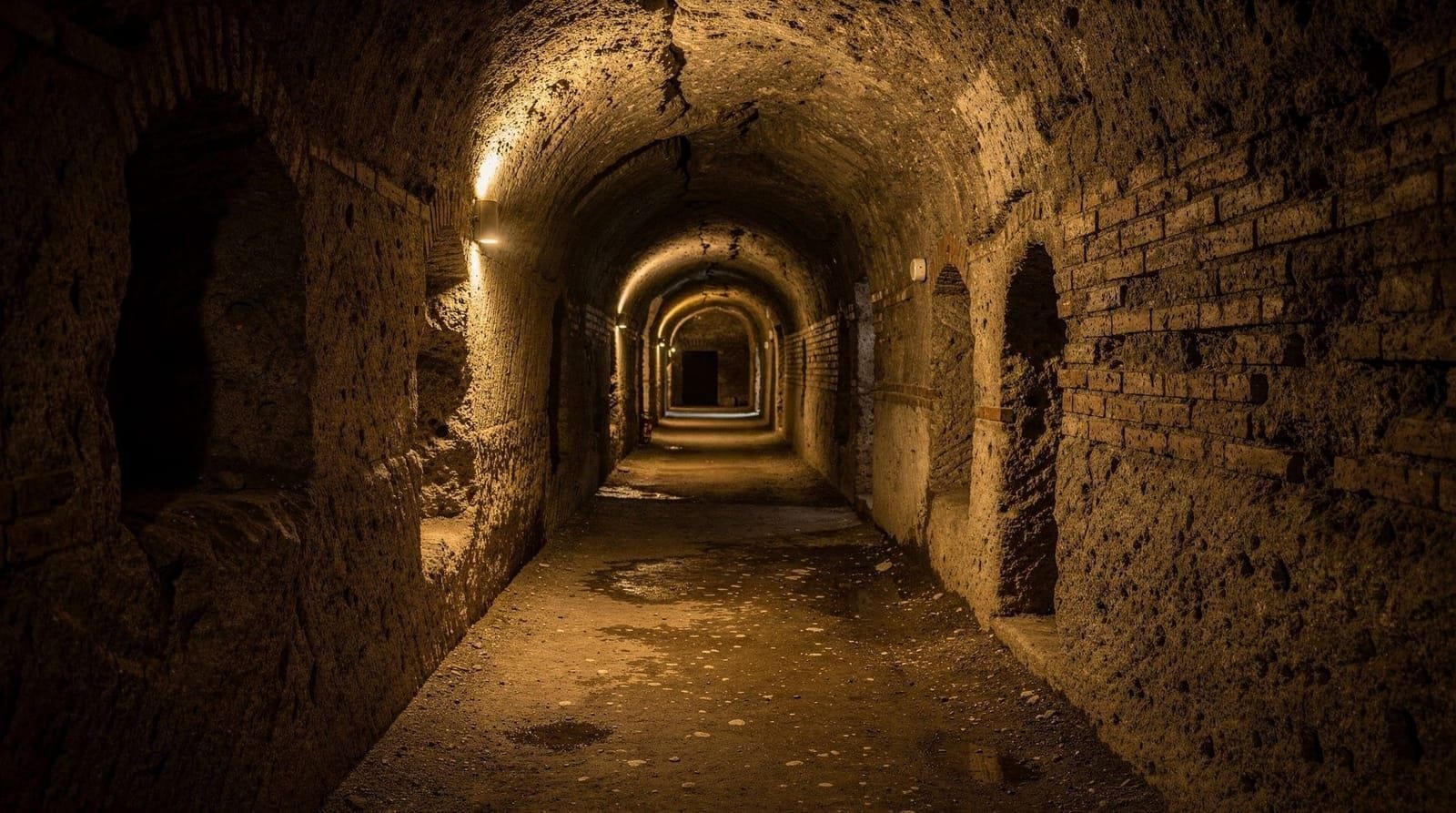
Three distinct archaeological levels: the current 12th-century basilica at street level, a 4th-century lower basilica preserved beneath it, and at the deepest level a 2nd-century mithraeum — a Roman cult room dedicated to the Persian mystery deity Mithras. The descent takes you through roughly 1,000 years of religious history in about 20 metres. Allow 60-90 minutes for the full visit.
The building that shows you what Rome actually is
The Basilica of San Clemente does something that no other site in Rome can quite replicate. It shows you — physically, in the space of a single visit — the layered nature of the city in a way that is impossible to misunderstand. You walk into a functioning medieval church. You go through a door in the side aisle, pay a small fee, and descend. You find yourself in an earlier church. You descend again. You find yourself in a pagan temple.
The feeling is not theatrical. It is archaeological and, for many visitors, quietly overwhelming. Three distinct religious communities, spread across a thousand years, all in the same vertical space. The medieval Christians did not know about the mithraeum below them; the 4th-century Christians did not know how completely their church would be buried; the followers of Mithras did not know that the religion above them would eventually suppress theirs. Each layer was built in ignorance of what would come, and preserved in ignorance of what was below.
This is what Rome actually is. Not a city of monuments but a city of sediment.
| Where | Via Labicana 95, Celio — 200m east of the Colosseum |
| Cost | Upper basilica free; underground zone around €10 |
| Time needed | 60–90 minutes for the full site |
| Getting there | 10-minute walk from Colosseo metro (Line B) |
| Booking | No advance booking required, walk-in only |
| Accessibility | Stairs only — not accessible for wheelchair users |
| Level | Era | What to see | Time |
|---|---|---|---|
| Upper basilica | 12th century | Cosmatesque floor, apse mosaic, schola cantorum | 20–30 min |
| Lower basilica | 4th century | St. Clement and Sisinnius fresco cycles | 20–30 min |
| Mithraeum | 2nd century | Tauroctony relief, triclinia, underground stream | 20–30 min |
The upper basilica: 12th century
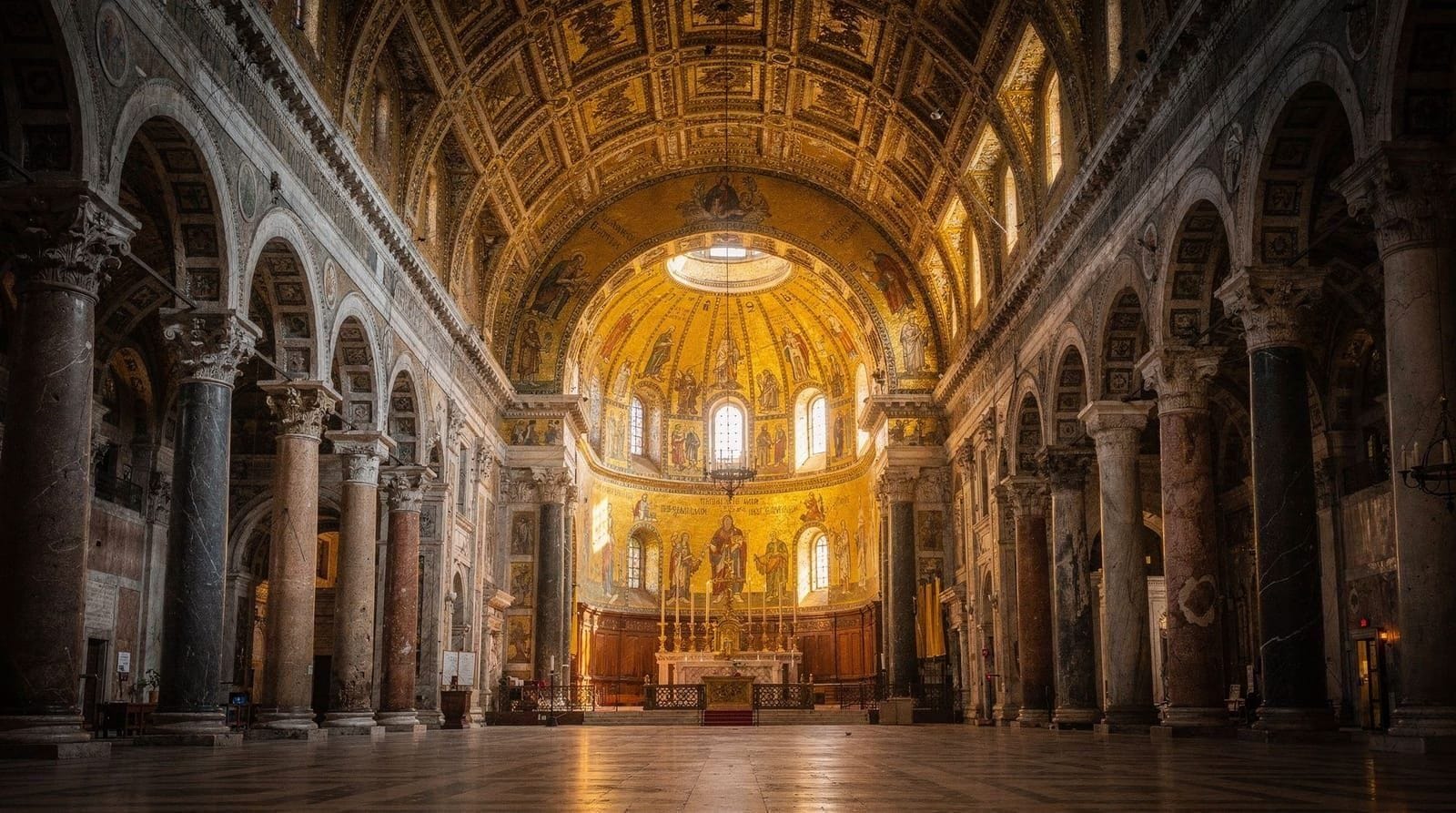
The current Basilica of San Clemente was consecrated in 1128, following the reconstruction of an earlier church that was destroyed during the Norman sack of Rome in 1084. It is administered by the Irish Dominican order, which has held the church since the 17th century.
The upper basilica is worth significant time before the descent. Several features are outstanding:
The Cosmatesque floor
The Cosmatesque floor mosaic is one of the finest surviving examples of this distinctly Roman medieval art form — geometric interlocking patterns of marble, porphyry, and serpentine stone, cut and arranged by specialist craftsmen (the Cosmati family gave their name to the style). The floor dates from the 12th century and covers the entire nave and choir. It has been partially restored but retains substantial original sections.
The schola cantorum (choir enclosure)
Unusually, San Clemente preserves a schola cantorum — the enclosed choir area used by monks for chanting — in near-intact condition. The marble screens date from the 6th century and were salvaged from the lower church during the 12th-century reconstruction. The ambos (reading platforms) and candlestick bases are among the finest Early Medieval liturgical furnishings still in situ in Rome.
The apse mosaic
The 12th-century triumphal arch and apse mosaic is spectacular. The central image shows the Crucifixion as a Tree of Life — the cross sprouting into a vast vine with 72 different scenes incorporated into the tendrils. Twelve doves sit on the cross itself; peacocks flank the base; rivers of paradise flow from the foot. The gold ground is typical of Byzantine-influenced medieval mosaic work; the iconographic program is unusually complex even by Roman standards.
The Caravaggio connection
A lesser-known chapel in the left aisle contains an early copy of Caravaggio’s St. Francis in Meditation — part of the rich Franciscan/Carmelite devotional culture connected to the Caravaggio trail across Rome. For the complete route of Caravaggio works, see the Caravaggio trail Rome guide.
The lower basilica: 4th century
Through the door in the right aisle, a staircase descends approximately 4 metres to the floor of the original Basilica of San Clemente, built in the 4th century — almost certainly on the site of an early Christian prayer house (titulus) that predates it.
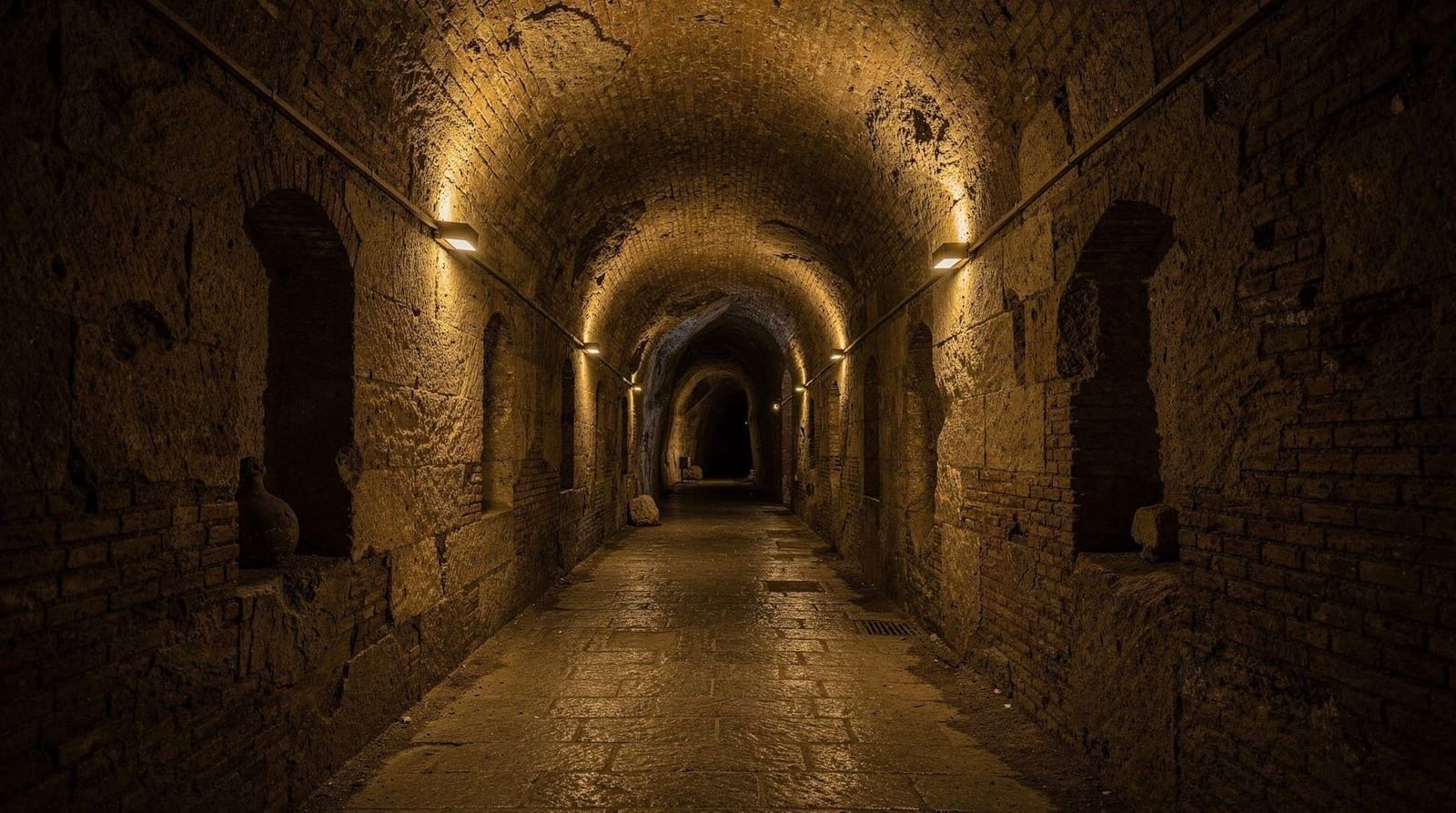
The lower basilica is substantial: a full three-aisled basilica plan preserved under the medieval structure, with the apse at the east end and the nave stretching back toward the entry. The space is dimly lit and has the atmosphere of a crypt — which it effectively is, preserved intact by the rubble fill used to level the floor for the 12th-century reconstruction.
The frescoes of the lower basilica
The lower basilica contains fresco cycles of exceptional importance, even in their damaged and fragmentary state. Two narrative programs survive:
The Legend of St. Clement: A cycle depicting scenes from the life of the early bishop and martyr Clement, including his exile to Crimea and his death by drowning with an anchor tied around his neck. These frescoes are from the 9th-11th century range, painted during the active use of the lower church.
The Legend of Sisinnius: One of the most remarkable early medieval frescoes anywhere. A Roman official named Sisinnius, shown attempting to arrest the Bishop of Clement, is struck blind. In a confusion, he orders his servants to drag away the bishop — but they drag a column instead, not realizing their mistake. The fresco includes speech bubbles with captions: the inscription “Fili dele pute, traite!” (“Sons of bitches, pull!”) is written above Sisinnius — one of the earliest surviving examples of Italian vernacular language, predating Dante’s Italian by several centuries. The linguistic historians who study this text treat it as significant evidence in the evolution of Latin into the Romance languages.
The mithraeum: 2nd century
A second descent, another 4-5 metres, brings you to the deepest accessible level — the Roman structures from the 2nd century CE that predate the Christian use of the site.
The mithraeum itself
The mithraeum at San Clemente is one of the best-preserved cult rooms of the Mithraic religion in Rome. It dates from the late 2nd or early 3rd century CE, the period of maximum Mithraic popularity.
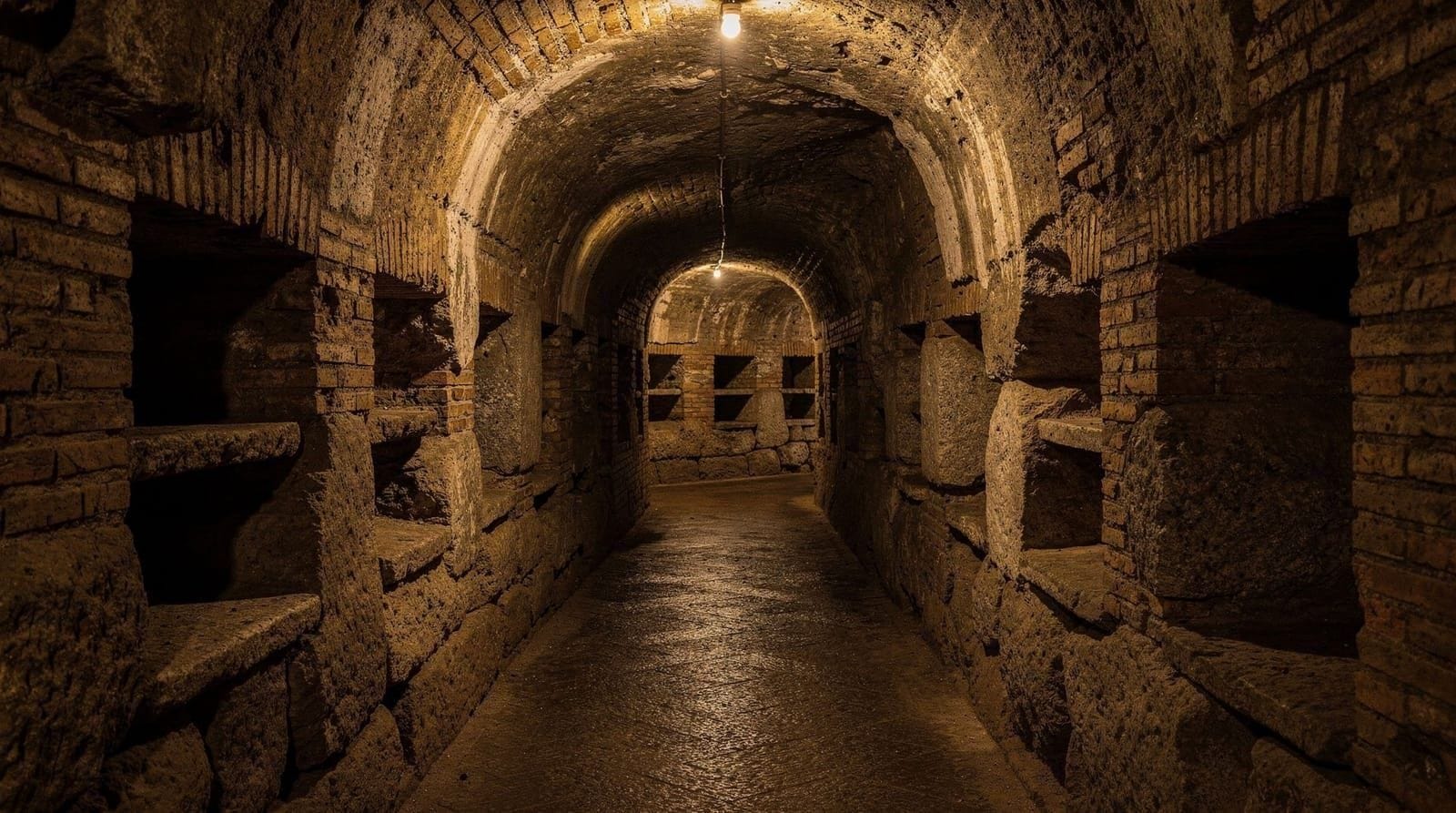
The room is long and narrow — characteristic of the cave-like shape all mithraea imitated, evoking the cave in which Mithras slew the primordial bull. Along both long walls are the stone triclinia — low stone couches on which initiates reclined for communal meals, a central ritual of the cult. In the apse at the far end, where the presiding figure would have sat facing the entry, is a bas-relief of the tauroctony: Mithras in his Phrygian cap, plunging a knife into the bull while a dog and snake leap upward, a scorpion attacks the bull’s testicles, and a raven sits above. The cosmic and astrological symbolism of this scene is still debated in scholarship — each element appears to represent a celestial body or constellation, and the killing of the bull may encode a ritual myth of the night sky.
The tauroctony at San Clemente is not the finest in Rome — the one at the Capitoline Museums is larger and more detailed — but its setting is unmatched. You see it at the end of the original cult room, in roughly the physical context in which it was originally viewed.
The Roman building around the mithraeum
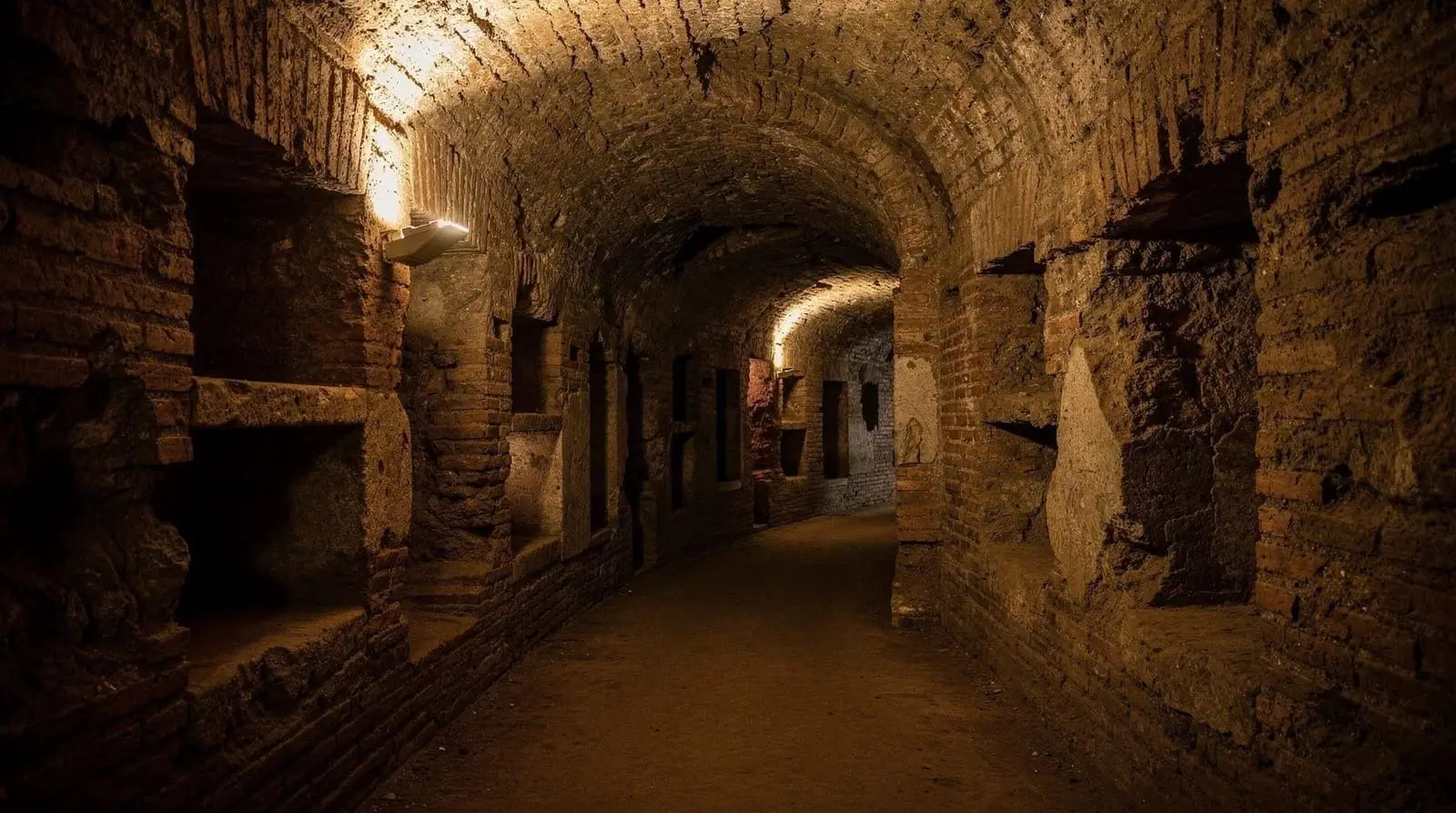
The mithraeum is installed within a larger Roman building that preceded it. The nature of this building — whether it was a private residence, an imperial mint, or a public structure — is debated. Large opus reticulatum walls (the distinctive diamond-pattern Roman construction) are visible in several sections. The spaces around and beside the mithraeum hint at a larger complex that extends beyond what is currently accessible.
The underground stream
In the corridors near the mithraeum, the sound of flowing water becomes audible — sometimes clearly, sometimes as a distant murmur. This is an ancient Roman drainage channel, still carrying water more than 1,800 years after it was built. The engineering of Roman water management was sufficiently robust that it continues to function under a medieval basilica in a modern city.
Catacombs and underground Rome guided tour including San Clemente — combines the Appian Way catacombs with the multilayered San Clemente site in one excursion.How the lower levels were rediscovered
For centuries after the 12th-century reconstruction, nobody visiting San Clemente knew that an entire earlier basilica lay beneath the floor, let alone a pagan mithraeum beneath that. The rediscovery began in the 1850s, when the Irish Dominican prior Father Joseph Mullooly, intrigued by inconsistencies in the building’s history, began excavating beneath the current church. Over several decades of digging — much of it self-funded and carried out with the basic tools of the period — Mullooly and his successors uncovered the full 4th-century basilica and, deeper still, the Roman structures including the mithraeum. The excavation is still considered a model of 19th-century ecclesiastical archaeology, and the Irish Dominican community has continued to administer and study the site ever since, which is part of why the ticketing and presentation feel more personal and less institutional than at Rome’s larger state-run museums.
Visiting San Clemente: practical information for 2026
Address: Via Labicana 95, Celio (approximately 200 metres east of the Colosseum)
Getting there: 10 minutes’ walk from the Colosseo metro station (Line B). The basilica is a natural extension of a Colosseum visit — the walk between them takes you along Via Sacra at the edge of the Forum zone.
Upper basilica (free): Open daily 09:00-18:00 (Sundays 12:00-18:00). No entry fee.
Underground archaeological zone: Open daily 09:00-12:30 and 15:00-18:00 (Sundays 12:00-18:00). Entry 10 EUR adults, 5 EUR concessions. Payable at the desk inside the basilica.
Photography: Permitted in the upper basilica (no flash). Restrictions on photography in the lower basilica vary — check with the on-site staff. The mithraeum and lower levels generally allow quiet photography without flash.
Temperature: The underground levels stay noticeably cooler than street level year-round — a welcome relief in Rome’s summer heat, and worth bringing a light layer for in winter, when the stone corridors can feel genuinely cold.
Duration: 60-90 minutes for the full site (upper basilica + lower basilica + mithraeum).
Best time to visit: Weekday mornings shortly after the 09:00 opening are the quietest — San Clemente is popular with organised tour groups by mid-morning, and the confined mithraeum level feels noticeably different with ten people in it versus thirty. Sunday visits are limited by the later 12:00 opening for both the basilica and the underground zone, so plan accordingly if Sunday is your only available day.
Guided vs independent: The site is entirely navigable independently with the excellent English-language information panels at each level, but a guide adds real value here specifically because the theological and archaeological context (the Sisinnius fresco’s linguistic significance, the Mithraic iconography) is dense and easy to walk past without explanation.
Accessibility: The descent to the underground levels is by stone staircase with no lift. Not accessible for wheelchair users or those who cannot manage stairs. The upper basilica is accessible via a step-free entrance.
Combining San Clemente with the Colosseum area
San Clemente is one of the most easily combined underground sites with standard Rome sightseeing. Its proximity to the Colosseum makes it a natural half-day pairing:
Morning Colosseum + afternoon San Clemente: After the Colosseum visit (2-3 hours), walk east along Via Labicana to San Clemente. The contrast between Rome’s greatest public spectacle and its most archaeologically intimate private space makes for a richly textured day.
San Clemente + other Celio sites: The Celio neighbourhood contains several other interesting early Christian sites — the Basilica dei Quattro Coronati (with its early medieval frescoes) and the Oratories of St. John is a short walk. See the Celio and Colosseum district destination guide for the neighbourhood context.
San Clemente + a full ancient Rome day: If you are building San Clemente into a broader one-day ancient Rome plan alongside the Colosseum, Forum and Palatine, see our ancient Rome in one day guide and the Colosseum, Forum and Palatine guide for how the timing fits together. For other atmospheric, less-visited churches worth the same kind of quiet attention, see our Rome’s hidden churches guide.
San Clemente + Appian Way catacombs: These two represent the richest combination for serious early Christian archaeology in Rome. They are in different directions from the centre — plan them as separate half-day excursions. For a combined tour that includes both, tour operators run options that include San Clemente in the same itinerary as the Appian Way sites.
Why San Clemente matters
In most accounts of Rome’s sights, San Clemente is listed as a secondary attraction — notable but not essential. This underestimates it significantly.
The Colosseum tells you about Roman imperial power and spectacle. The Vatican tells you about the institutional Church at its most monumental. San Clemente tells you something that neither of those sites can: how continuity actually works in a city of this age. The same small plot of land has been the site of a pagan dwelling, a Mithraic cult room, an early Christian meeting house, a 4th-century basilica, and a 12th-century basilica — each built in physical ignorance of what lay beneath, each using and modifying the same ground.
The history of Rome, compressed into one address.
For the full context of underground Rome’s sites and how they relate to one another, see the flagship underground guide. For an introduction to the Mithraic cult specifically, including other accessible mithraeum sites, see the mithraeum Rome guide.
Skip-the-line English catacombs tour — for the Appian Way sites, to combine with a self-guided visit to San Clemente on the same day.Frequently asked questions about San Clemente underground: a mithraeum beneath a basilica
How do you get into the underground levels at San Clemente?
How much does it cost to visit San Clemente's underground?
Can you hear running water underground at San Clemente?
What is a mithraeum?
Is San Clemente the same as the San Clemente in the catacombs tour?
How long should I spend at San Clemente's underground?
Is San Clemente underground suitable for claustrophobic visitors?
Top experiences
Bookable activities with verified prices and instant confirmation on GetYourGuide.