Rome's churches: Caravaggios, mosaics and free masterpieces
Trevi, Pantheon & Spanish Steps Guided English Walking Tour
Which Rome churches have the best free art?
San Luigi dei Francesi (three Caravaggio canvases), Santa Maria del Popolo (two more Caravaggios plus a Raphael), Sant'Agostino (a third Caravaggio), and Santa Maria Maggiore (extraordinary 5th-century mosaics) are the top four. All are free to enter; San Luigi and Santa Maria del Popolo have coin-operated lighting. Bring €1 coins.
Rome’s greatest secret: priceless art behind ordinary doors
Vatican Museums: €20+, queues stretching 90 minutes. Borghese Gallery: €20 plus a mandatory reservation placed weeks in advance. Capitoline Museums: €16. All superb. All requiring planning and money.
Then there are the churches. Walk through any unremarkable-looking door in the historic center and you might find a Caravaggio painted in 1600, positioned exactly where the artist intended it — the afternoon light falling on the canvas from a window the priest never thought to cover. No queue. No ticket. No audioguide patter. Just you and one of the most radical paintings in Western art history, close enough to see the brushwork.
This guide covers the full picture: the best churches for specific masterpieces, the practical realities of visiting, and honest advice on what is actually worth your time versus what the guidebooks have turned into pilgrimage duties.
| Cost | Free (San Clemente underground and Palazzo Valentini charge €10–13) |
| Time needed | 2–3 hours for the core Caravaggio trail |
| Booking | None — walk in during opening hours |
| Dress code | Shoulders and knees covered, all genders, strictly enforced |
| Best time | Morning (09:30–11:30) before tour groups and midday closures |
The ground rules: what to know before you go
Dress code is non-negotiable. Shoulders and knees covered for all visitors. This is enforced at all major basilicas — stewards turn people away at the door, daily, without negotiation. A lightweight scarf weighing 50 grams solves the problem instantly. Keep one in your daypack from the moment you land.
Bring €1 coins. Many art churches have coin-operated lighting for the major chapels. San Luigi dei Francesi, Santa Maria del Popolo, Santa Maria in Trastevere all use them. Without coins, you are squinting at masterpieces in low ambient light. Ten €1 coins in your pocket transforms the experience.
Most churches close at midday. Roughly 12:00–15:30, smaller churches often shut completely. The four papal basilicas (St. Peter’s, San Giovanni in Laterano, Santa Maria Maggiore, San Paolo fuori le Mura) tend not to close at midday, but verify current hours. Arriving at 12:15 to find locked doors is a genuinely common frustration.
Photography is generally permitted without flash. Video is allowed. Some specific chapels (particularly those with ticketed areas) prohibit photography — signs are posted.
Mass services happen daily. During Mass, the main nave is reserved for worshippers. Side chapels may still be accessible. An inadvertent interruption of a funeral Mass is awkward for everyone. Check the church notice board at the entrance for the day’s schedule.
The Caravaggio churches: a complete picture
Caravaggio (Michelangelo Merisi, 1571–1610) revolutionized European painting by rejecting idealized Renaissance figures in favour of real people — labourers, drinkers, ordinary Romans from the streets of the city — placed in scenes of intense drama and bathed in sharp chiaroscuro light. He lived and worked in Rome from 1592 until 1606, when a killing forced him to flee. In those fourteen years he painted most of his greatest works.
Unlike most of his contemporaries, Caravaggio painted primarily for churches, not princely collections. Which means many of his finest works are still in the churches they were made for, exactly where he intended them, free to view.
San Luigi dei Francesi — the Caravaggio triptych
This is the essential Caravaggio church. The French national church in Rome sits a two-minute walk from the Piazza Navona, and its fifth chapel on the left (Contarelli Chapel) contains three large canvases depicting the life of Saint Matthew, painted between 1599 and 1602.
The Calling of Saint Matthew shows the moment Christ summons the tax collector at a table of gamblers and merchants. Caravaggio painted it as if it is happening in a Roman tavern — the figures are dressed in contemporary 1600s clothing, the light cuts across the dark room from the right. Matthew points to himself with a gesture of incredulous recognition. The painting’s modernity — its insistence on treating a biblical event as a human, visceral moment — scandalized contemporary viewers and influenced three centuries of subsequent painting.
The Martyrdom of Saint Matthew (left wall): the execution of the saint by a swordsman, with Caravaggio himself as a witness in the background right — a self-portrait in paint.
Saint Matthew and the Angel (altarpiece): the evangelist being guided to write his gospel by an angel. The first version was rejected by the church authorities as insufficiently dignified; Caravaggio painted a second, more decorous version. The rejected original burned in Berlin during World War II.
San Luigi opens from 09:30 and closes at midday. Afternoon hours resume around 14:30. The coin-operated lighting is essential — coins operate for about 3 minutes each.
Santa Maria del Popolo — two Caravaggios plus a Raphael chapel
The church of Santa Maria del Popolo at the northern end of the Via del Corso, beside the city gate through which travellers from the north traditionally entered Rome, contains two Caravaggio masterpieces in the Cerasi Chapel (first chapel on the left of the main altar):
The Conversion of Saint Paul shows Paul flat on his back beneath his horse immediately after the Damascus Road experience — a moment that would normally be depicted with heavenly light and dramatic gesture. Caravaggio paints a man lying on the ground, arms spread, while a horse stands placidly over him and a groom steadies it. The entire drama is internal; the painting is almost quiet.
The Crucifixion of Saint Peter: four workers straining to lift the cross on which the elderly apostle has been nailed. No celestial fanfare, no heavenly observers — just the physical effort of a brutal execution, painted with the documentary realism of Caravaggio’s mature style.
Also in Santa Maria del Popolo: the Chigi Chapel, designed by Raphael (the paintings completed by Sebastiano del Piombo), and remarkable 15th-century frescoes throughout. The overall quality of art in this single church justifies a dedicated 30-minute visit.
Open approximately 07:00–12:30 and 15:00–19:00.
Sant’Agostino — the Madonna dei Pellegrini
Five minutes’ walk from San Luigi dei Francesi, the church of Sant’Agostino contains Caravaggio’s Madonna dei Pellegrini (Madonna of the Pilgrims, 1604–1606) in the first chapel on the left. The Virgin Mary stands in a doorway, the Christ Child on her arm, barefoot — her feet dirty from walking — while two elderly pilgrims kneel before her, their feet also dirty, their clothing worn. The painting caused a scandal when unveiled: the Madonna was too ordinary, the pilgrims too poor and unwashed for a church altarpiece.
The same church contains Raphael’s Isaiah fresco (1512) on a pier near the front — a work influenced by Michelangelo’s Sistine Chapel figures and visible for free. Sant’Agostino is easy to miss on tourist maps; it is worth making the slight detour.
The mosaic churches: Rome’s golden art
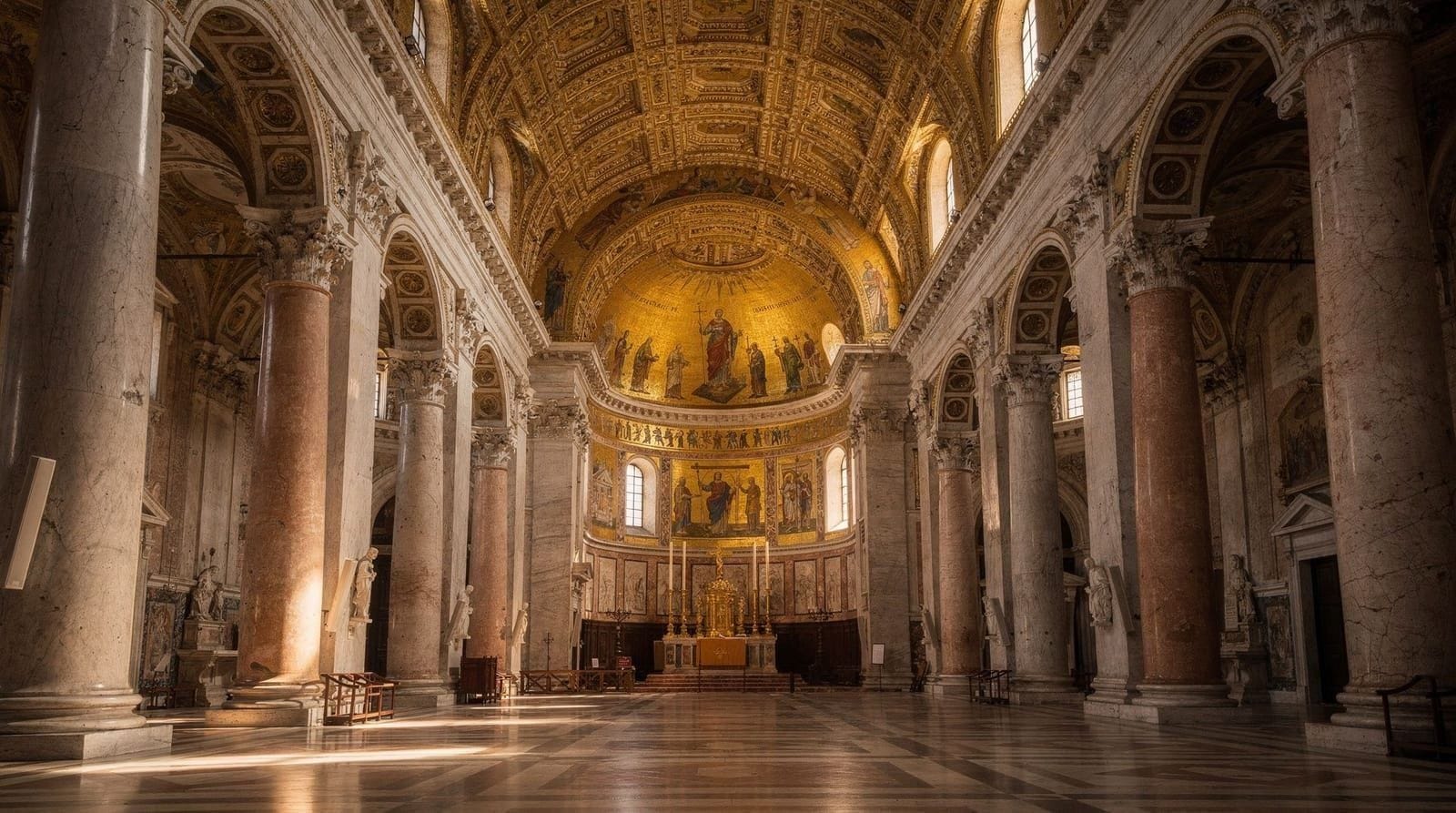
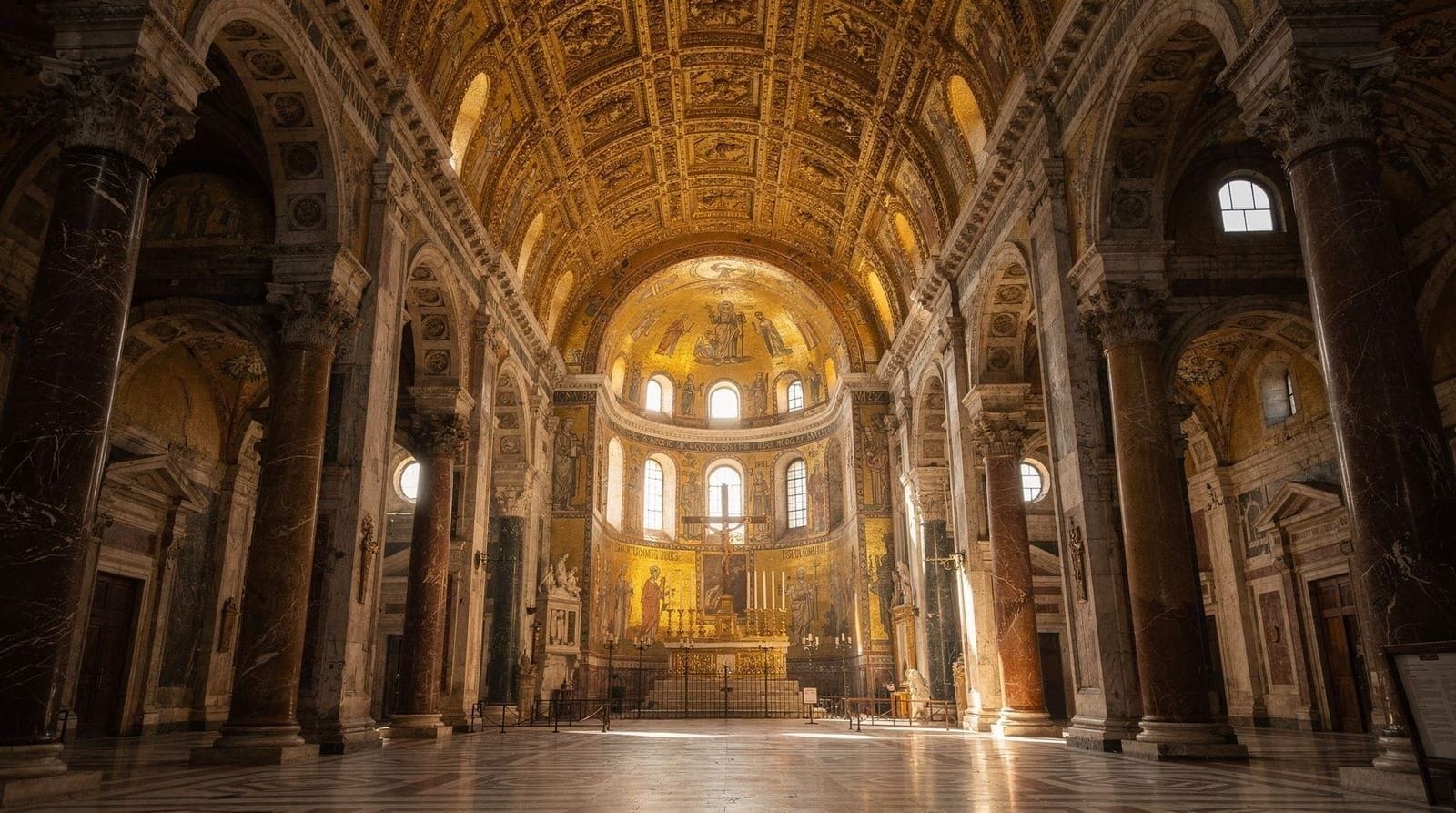
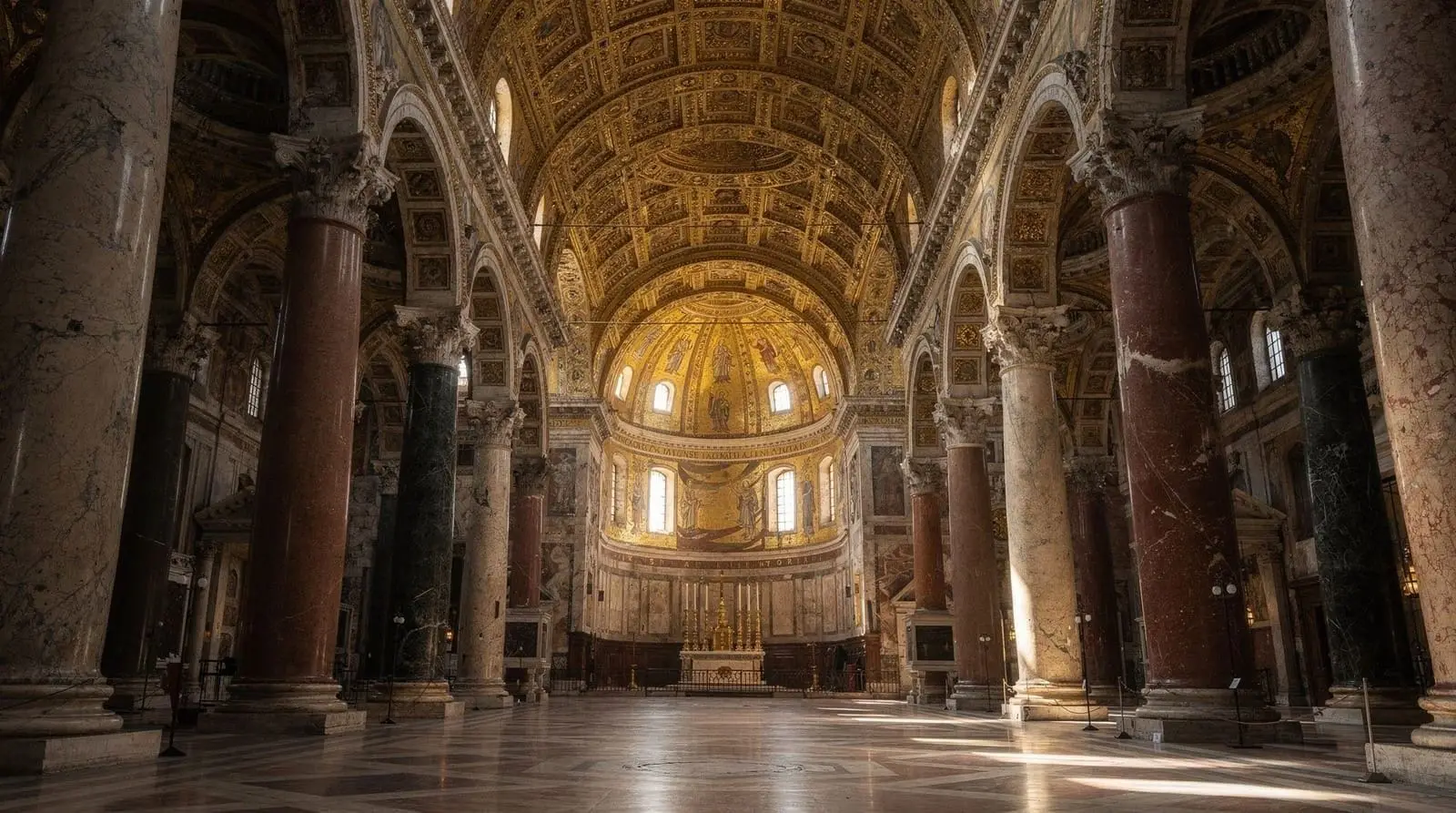
Rome has the finest collection of early Christian mosaics outside of Ravenna, and most are visible free in churches.
Santa Maria Maggiore — 5th-century nave mosaics
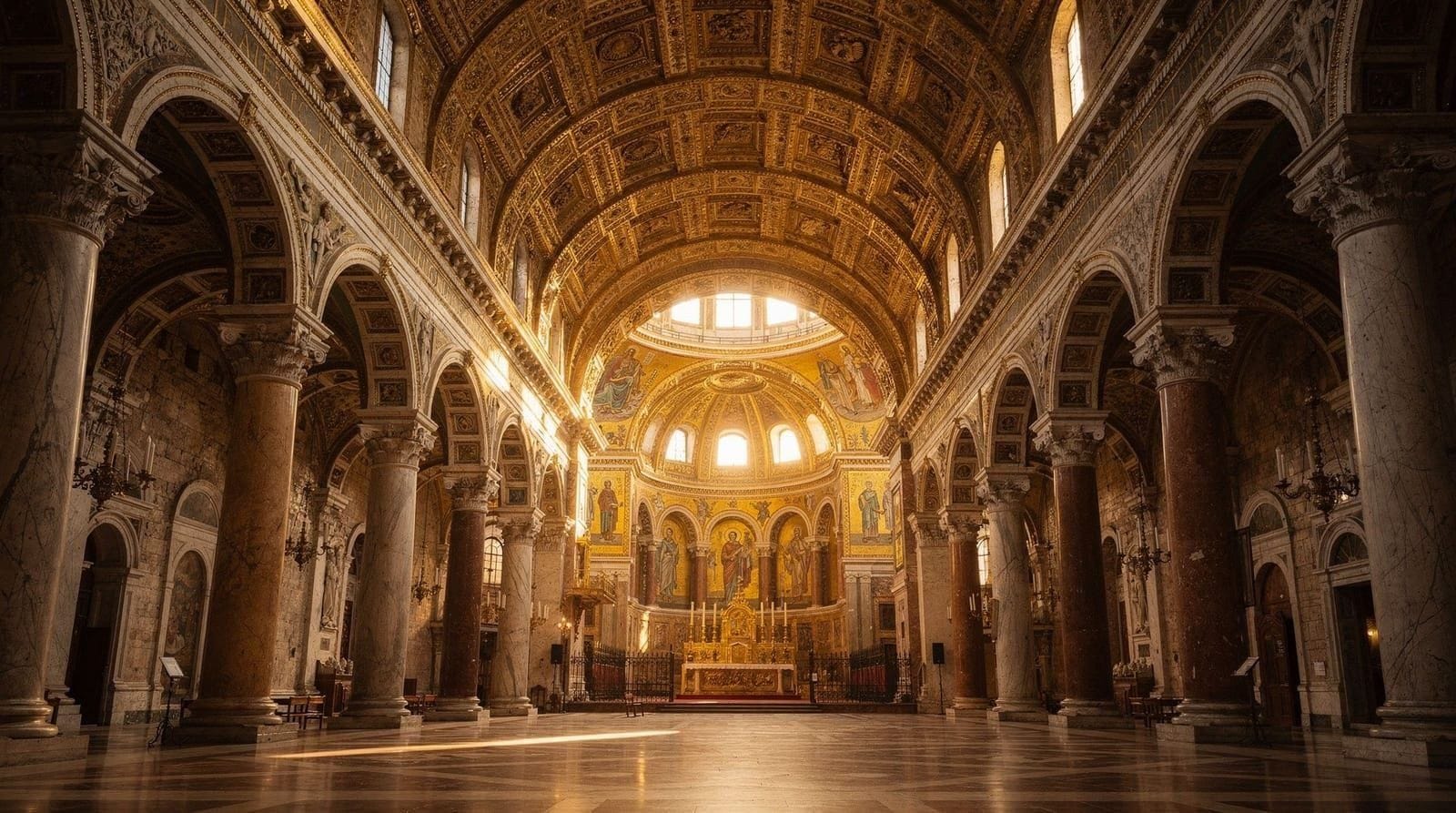
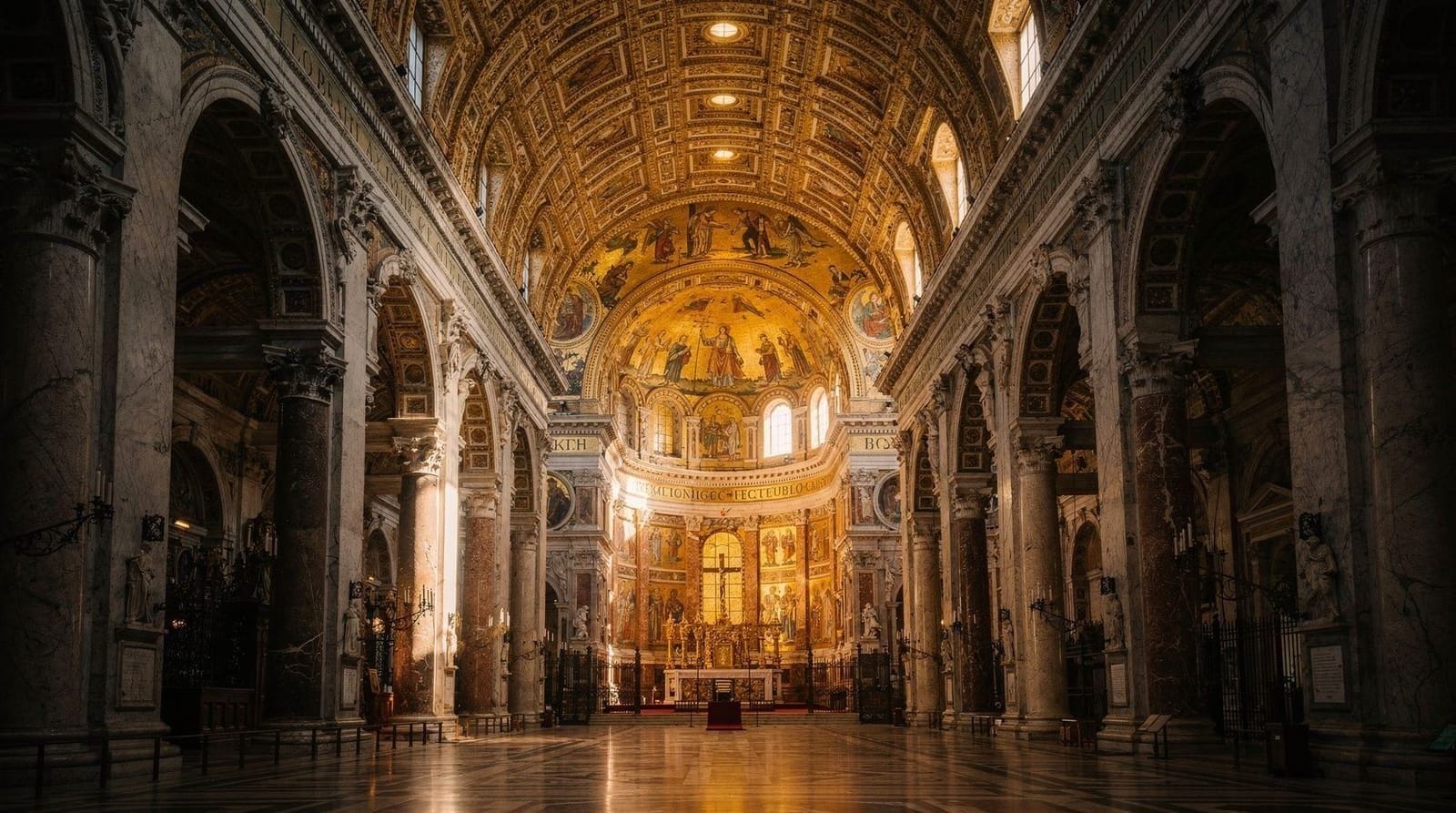
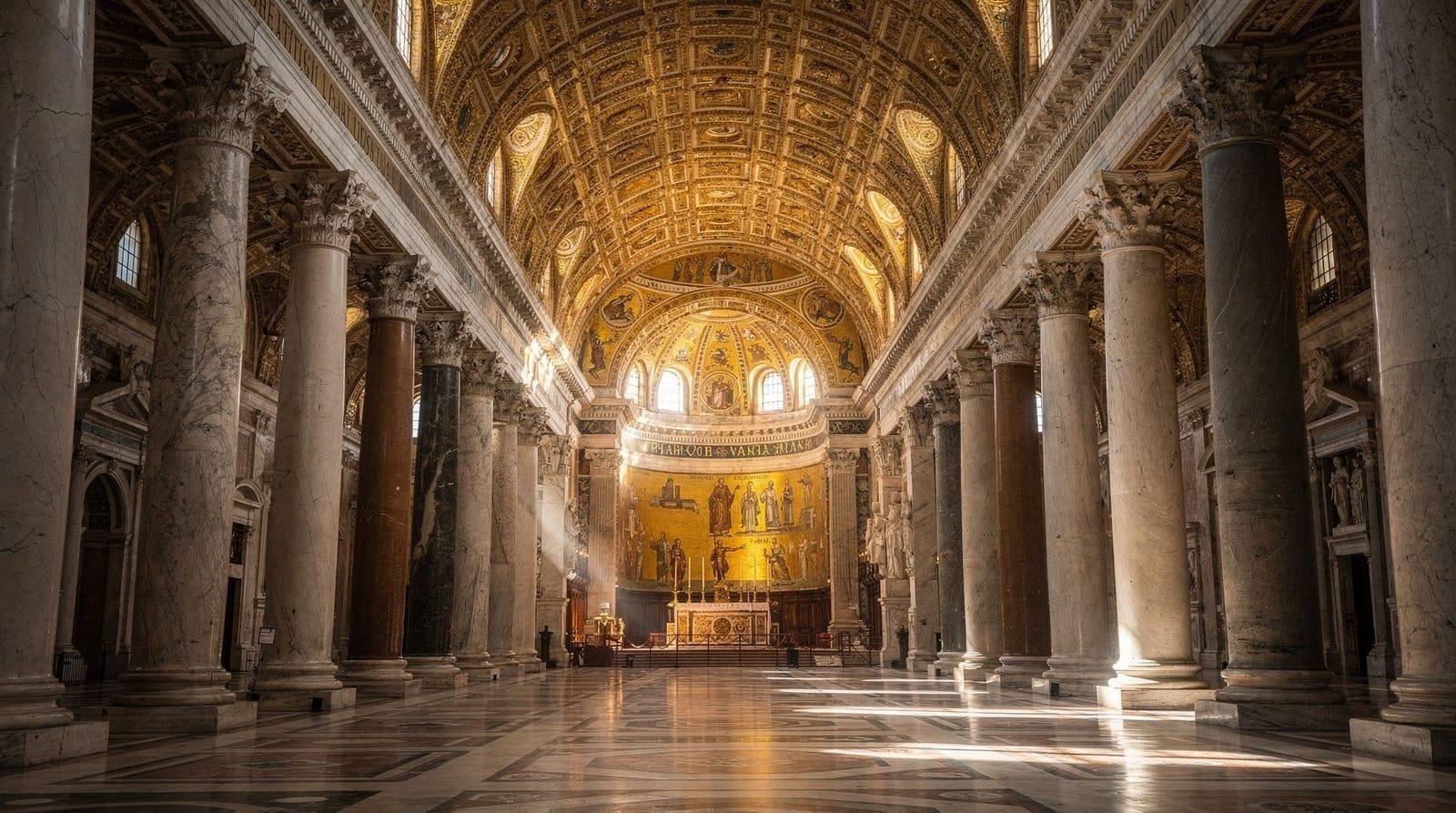
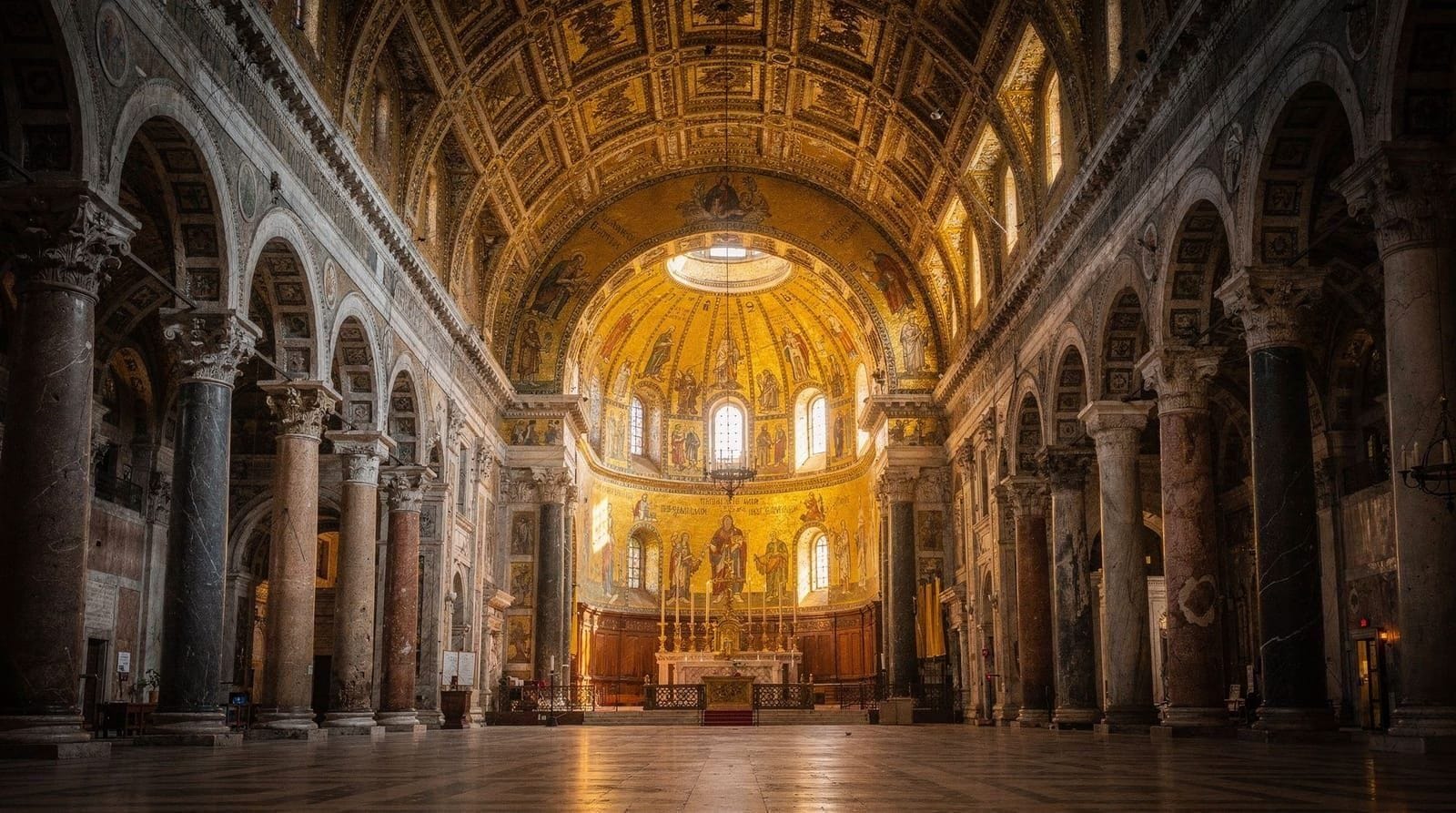
The papal basilica of Santa Maria Maggiore on the Esquiline Hill contains the oldest and most complete set of narrative mosaic panels in Rome — 36 scenes from the Old Testament dating from around 432–440 CE, under Pope Sixtus III. They run along both sides of the nave above the columns in small horizontal panels, depicting the stories of Abraham, Jacob, Moses, and Joshua with the flatness and directness of late antique art.
The apse mosaic — Christ in Majesty — is 13th-century, added during the restoration of the basilica. The Coronation of the Virgin scene is one of the most reproduced images of medieval Roman art.
Entry is free. The basilica does not close at midday.
For the full story of this extraordinary church, see our Santa Maria Maggiore guide.
Santa Maria in Trastevere — golden Byzantine mosaics
The 12th-century apse mosaic of Santa Maria in Trastevere is among the most spectacular in Rome: golden tessera on a vast scale, the Virgin enthroned beside Christ in a Byzantine composition that influenced the entire development of central Italian painting. The panels below (by Pietro Cavallini, 1291) are considered the most important precursors of Giotto’s revolutionary naturalism.
The church occupies the central piazza of Trastevere, which is a reason to visit the neighbourhood anyway. Coin-operated lighting helps with the apse.
Santi Cosma e Damiano — 6th-century apse
This early Byzantine mosaic (526–530 CE) in the Roman Forum complex is startling in its quality: Christ descending on clouds against a fiery red sky, flanked by Apostles and the two physician-saints Cosmas and Damian in Roman imperial robes. Access is from Via dei Fori Imperiali, independent of the paid archaeological zone.
Santa Prassede — the Zeno Chapel
A small church near Santa Maria Maggiore hiding one of Rome’s most extraordinary spaces: the Chapel of San Zenone, built by Pope Paschal I around 817 CE, lined floor to ceiling with Byzantine mosaics so densely applied the room seems to glow. It is called the “Garden of Paradise” by Roman sources. The chapel is accessed through the main church; a small fee may be charged for the chapel specifically.
See our dedicated Rome mosaics guide for the complete picture.
The great basilicas: context and what to see
St. Peter’s Basilica — the exception to the “free” rule
St. Peter’s Basilica is free to enter, but in practice it is not a free Caravaggio visit — it is one of the most visited buildings on earth, with queues of 30–90 minutes to enter through security (separate from the Vatican Museums queue) and mandatory dress code enforcement. The artistic contents justify the wait for first-time visitors: Michelangelo’s Pietà (1499, visible behind glass), Bernini’s bronze baldachin over the papal altar, and the vast interior itself. The dome climb (€8 by stairs, €10 by lift) is excellent and deserves a separate visit.
Do not attempt St. Peter’s as a spontaneous “quick stop.” Plan 1.5–2 hours minimum including the queue.
For the dome, underground Vatican Grottoes, and practical entry advice, see our St. Peter’s Basilica guide.
Walking tour of central Rome’s highlights — passes near San Luigi dei Francesi, Sant’Agostino, and Santa Maria del Popolo for an overview of the Caravaggio trail.San Giovanni in Laterano — Rome’s actual cathedral
Most visitors to Rome do not realize that St. Peter’s is not the city’s cathedral — it is the pope’s private church as head of the Vatican state. The Cathedral of Rome is San Giovanni in Laterano (St. John Lateran), a 30-minute walk or short bus ride from the Colosseum in the Lateran neighbourhood. Free entry, no significant queues, and architecturally extraordinary — a Borromini baroque interior of the 1640s over a building that has been the Bishop of Rome’s seat since the 4th century.
Adjacent to the basilica are the Holy Stairs (Scala Santa), where pilgrims climb on their knees in penitence — a medieval practice that continues actively today. The experience of watching contemporary pilgrims climb the stairs is one of the most genuinely moving religious encounters in Rome, available to all visitors regardless of faith.
Full coverage: St John Lateran guide.
The four papal basilicas: an overview
Rome’s four papal basilicas (St. Peter’s, San Giovanni in Laterano, Santa Maria Maggiore, San Paolo fuori le Mura) represent the four major pilgrimage churches of the city — a tradition dating from medieval Rome’s role as the center of Latin Christianity. All four are free to enter; none are in the same neighbourhood. Visiting all four on foot in a single day is technically possible but exhausting; most visitors prioritize two per day.
For a complete guide to all four with recommended routes and what to see at each, see our four papal basilicas guide.
Hidden churches worth the detour
San Pietro in Vincoli
Primarily famous for Michelangelo’s statue of Moses (1515) — one of the most powerful single works of sculpture in Rome — this church near the Colosseum is often overlooked. Moses was intended as part of a monumental tomb for Pope Julius II that was never completed; the figure is accompanied by only two other finished statues from the planned project. The statue’s horns (a traditional iconographic feature based on a mistranslation of the Hebrew word for “rays”) are visible and frequently photographed.
Santa Maria sopra Minerva
The only Gothic church in central Rome, tucked behind the Pantheon. Contains Fra Angelico’s tomb (near the entrance), Michelangelo’s statue Christ Carrying the Cross (1521, in the sanctuary), and the Cappella Carafa with Filippino Lippi frescoes (1490s). Unexpectedly rich for a church most visitors walk past.
Sant’Ignazio di Loyola
The ceiling fresco by Andrea Pozzo (1688–1694) is one of the most technically astonishing illusionistic paintings in Rome: a flat ceiling painted to simulate a soaring barrel-vaulted space with a Jesuit college extending into the sky. Stand on the marble disc marked on the floor of the nave for the illusion to work perfectly. There is also a false dome — a flat disc of painted canvas that reads as a three-dimensional dome from the correct viewpoint.
Free; no coins needed (the fresco is the ceiling itself).
For a curated tour of churches the crowds miss, see our hidden churches guide.
Practical visiting strategy
The morning church circuit
The most efficient approach to Rome’s church art: start at 09:30 when San Luigi dei Francesi opens, see the Caravaggios (15 minutes maximum per chapel visit), walk five minutes to Sant’Agostino (open from 07:30), then continue to the Pantheon area and onward. By 11:30, you can reach Santa Maria del Popolo via taxi or walk through the historic centre.
Morning light in the churches is often better than afternoon — natural light enters the nave windows in ways that artificial lighting cannot replicate.
Coin strategy
Buy €5 in €1 coins at any bank or tobacconist (tabaccheria) before starting. The lighting machines typically dispense 2–3 minutes of illumination per coin. For a chapel like the Contarelli at San Luigi dei Francesi — with three canvases to study — put in three coins sequentially rather than waiting for the timer to lapse and the lights to go off mid-painting.
Midday gap
Use the 12:00–15:00 closures strategically: lunch, a piazza rest, or visit the Capitoline Museums or Doria Pamphilj Gallery (open through midday). Return to smaller churches after 15:30.
Avoiding tourist rush
St. Peter’s (Vatican area) and Santa Maria Maggiore attract the largest crowds. Both are manageable early morning or on weekday afternoons. San Luigi dei Francesi sees tourist queues primarily from 10:30–13:00; arrive at opening or after 15:00 for a quieter experience.
Vatican Museums and Sistine Chapel entry ticket — essential if your church art itinerary includes the Vatican’s extraordinary collections alongside Rome’s free church masterpieces.Beyond free: the charged underground churches
Several of Rome’s most extraordinary church experiences require a small fee — typically €5–12 — for access to underground levels or specific archaeological zones.
San Clemente (near the Colosseum) is the most spectacular: three layers stacked beneath the current 12th-century basilica — a 4th-century church beneath, and a 1st-century Roman house and Mithraic temple beneath that. The paid underground tour (€10) is one of the most remarkable archaeological experiences in Rome. The upper basilica with its 12th-century apse mosaic is free. Full coverage: San Clemente basilica guide.
Santa Cecilia in Trastevere has a crypt and 9th-century confessio; the church itself is free. A small fee accesses the monastic choir with Cavallini’s remarkable Last Judgment fresco (1293).
Visiting Rome’s churches during Jubilee 2026
The Jubilee Year drew roughly 33 million visitors to Rome through January 2026, and the elevated demand has not fully subsided in its wake — particularly around the four papal basilicas, which sit at the centre of official Jubilee pilgrimage routes. Practical effects worth planning around in 2026:
Longer basilica queues: St. Peter’s Basilica security queues, already 30–90 minutes in a normal year, can extend further around Jubilee-related events and on weekends. Early morning (before 08:00) remains the most reliable way to avoid the worst of it.
Occasional closures for ceremonies: All four papal basilicas host periodic Jubilee-related liturgical events that can close sections to visitors with little public notice. If a specific church or chapel is essential to your visit, check the basilica’s own website the morning of your visit rather than relying on general opening hours.
The smaller Caravaggio and mosaic churches are largely unaffected: San Luigi dei Francesi, Santa Maria del Popolo, Sant’Agostino and Santa Prassede are not part of the official Jubilee ceremonial circuit and continue to operate on normal hours with normal (low) visitor numbers — in fact, a good reason to prioritise them if the papal basilicas are behaving unpredictably on your travel dates.
Rome’s churches and the non-religious visitor
Rome’s churches were built over nearly two thousand years, by people with dramatically different ideas about what a church should be and do. An early Christian basilica like Santa Sabina (5th century) on the Aventine Hill has nothing architecturally in common with the Baroque extravagance of Il Gesù (late 16th century) or the restrained neoclassicism of a 19th-century redecoration. Visiting them as art-historical and architectural objects — regardless of personal religious commitment — is entirely legitimate and widely practised.
The art in Rome’s churches represents, in aggregate, approximately a thousand years of continuous artistic production. Nothing survives this completely anywhere else. An afternoon in three or four well-chosen churches costs nothing, requires no advance planning, and delivers encounters with original masterworks that many visitors report as the most memorable experiences of their Rome trips.
For a complete itinerary combining the Caravaggio trail with Rome’s other free art, see our free things to do in Rome guide. For a broader overview of all major art sites including paid options, see our museums and galleries guide.
The churches are not the consolation prize for visitors who ran out of time or money for the Vatican Museums. For Caravaggio, for mosaics, for Bernini side chapels, for the atmospheric reality of a working religious building filled with fifteen centuries of accumulated devotion and art — the churches are often the main event.
Frequently asked questions about Rome's churches: Caravaggios, mosaics and free masterpieces
Are Rome's churches really free to enter?
Where are the Caravaggio paintings in Rome's churches?
Do I need to book to visit Rome's churches?
What is the dress code for Rome's churches?
What are the opening hours for Rome's churches?
Which church has the best mosaics in Rome?
Can I visit churches during Mass?
Is Rome's church art as good as museum art?
Are Rome's churches busier because of Jubilee 2026?
Top experiences
Bookable activities with verified prices and instant confirmation on GetYourGuide.