St John Lateran: the cathedral of Rome and the Holy Stairs
Rome: Spanish Steps, Trevi, Navona and Pantheon Sunset Tour
Duration: 2 hours
Is St John Lateran worth visiting?
Yes — it is Rome's actual cathedral and one of the most historically important buildings in the city. The 17th-century Borromini interior is architecturally magnificent, the medieval cloister is among the best in Rome, and the Holy Stairs (Scala Santa) across the road offer one of Rome's most genuinely moving religious experiences. Free entry to the basilica, approximately €3 for the cloister, free to climb the Holy Stairs.
Rome’s actual cathedral
| Where | Piazza di San Giovanni in Laterano, 2 km SE of the Colosseum |
| Cost | Free (basilica, Holy Stairs); ~€3 for the cloister |
| Time needed | 45–60 min basilica; ~2 hours for the full complex |
| Getting there | Metro A to San Giovanni |
| Best time | Weekday mornings — almost never crowded |
Most visitors to Rome do not know this: St. Peter’s Basilica is not the cathedral of Rome. It is the pope’s private basilica as head of the Vatican City State — the spiritual center of world Catholicism, yes, but not the seat of the Bishop of Rome.
The Cathedral of Rome is San Giovanni in Laterano, and it holds the title “Mother and Head of All Churches of Rome and the World” (Omnium urbis et orbis ecclesiarum mater et caput). Since the 4th century, this has been the principal church of the Roman diocese, the building where Rome’s bishop sits on the cathedra (the bishop’s chair that gives “cathedral” its name) and presides over the liturgical life of the city.
It is older in its continuous use than St. Peter’s. It is more important in Church law. And on a typical Wednesday morning, while 15,000 people queue outside the Vatican, approximately 300 are visiting the Lateran.
St John Lateran vs St. Peter’s: a quick comparison
| St John Lateran | St. Peter’s Basilica | |
|---|---|---|
| Official role | Cathedral of Rome (Bishop’s seat) | Pope’s basilica, Vatican City State |
| Age of first building | c. 318–324 CE | Similar era, rebuilt in the 16th–17th centuries |
| Crowds | Light, almost never a queue | Very high, security queue common |
| Cost | Free | Free (dome climb and Vatican Museums cost extra) |
| Signature feature | Borromini nave, Holy Stairs across the road | Michelangelo’s dome and Pietà |
Both are worth visiting, but if time is limited and you want architectural grandeur without the queue, the Lateran delivers most of the “major Roman basilica” experience at a fraction of the crowd — see our St. Peter’s Basilica guide for the comparison in the other direction.
The site and its history
The Lateran area was imperial property — a palace complex of the Laterani family, confiscated by the emperor and used as imperial residence — until Emperor Constantine I donated it to the Bishop of Rome around 313–318 CE as a gift following his victory at the Milvian Bridge. The donation included the Lateran Palace and funds to build the first basilica.
The first basilica on this site dates from approximately 318–324 CE — contemporary with, or slightly earlier than, the first St. Peter’s Basilica — making the Lateran the oldest continuously active cathedral in the Western world. The current building is a Baroque rebuilding (1646–1650 by Francesco Borromini), but it occupies the same ground as Constantine’s original, and some elements of earlier buildings survive in the foundation levels and transepts.
The Lateran was the center of papal power for a thousand years — from Constantine’s donation until the Avignon papacy (1309–1377), when the popes relocated to France and the Lateran Palace fell into disrepair. When the papacy returned to Rome in 1377, the Lateran Palace was effectively uninhabitable, and the Vatican became the permanent papal residence. But the Lateran remained — and remains — the Cathedral.
The synods and councils
Between the 4th and 13th centuries, five major councils of the Church were held at the Lateran (known as the Lateran Councils). The Fourth Lateran Council of 1215, convened by Pope Innocent III, was arguably the most important: it defined transubstantiation (the doctrine that the Eucharist is literally the body and blood of Christ), mandated annual confession for Catholics, and established the theological and disciplinary framework of the medieval Church. The church where these world-shaping decisions were made is free to enter and almost never crowded.
The exterior and Borromini’s interior
The facade
The 18th-century facade (Alessandro Galilei, 1735) faces the Piazza San Giovanni in Laterano with a central portico and a row of 15 colossal statues along the roofline — Christ flanked by Doctors of the Church, visible for hundreds of metres across the open square. The scale is deliberate: this is the Cathedral of Rome, and its exterior makes a civic statement.
The obelisk in the piazza is the tallest ancient obelisk in Rome — originally from the Temple of Amun at Karnak in Egypt, brought to Rome by Emperor Constantius II in 357 CE to stand in the Circus Maximus, and moved to its current position by Sixtus V in 1588. At 45.7 metres, it exceeds the Vatican obelisk (25 metres) substantially. It is easy to miss entirely if you approach the basilica from a side street rather than crossing the open piazza — worth pausing at the square’s centre for the full view of facade, obelisk, and the papal loggia together.
Borromini’s nave (1646–1650)
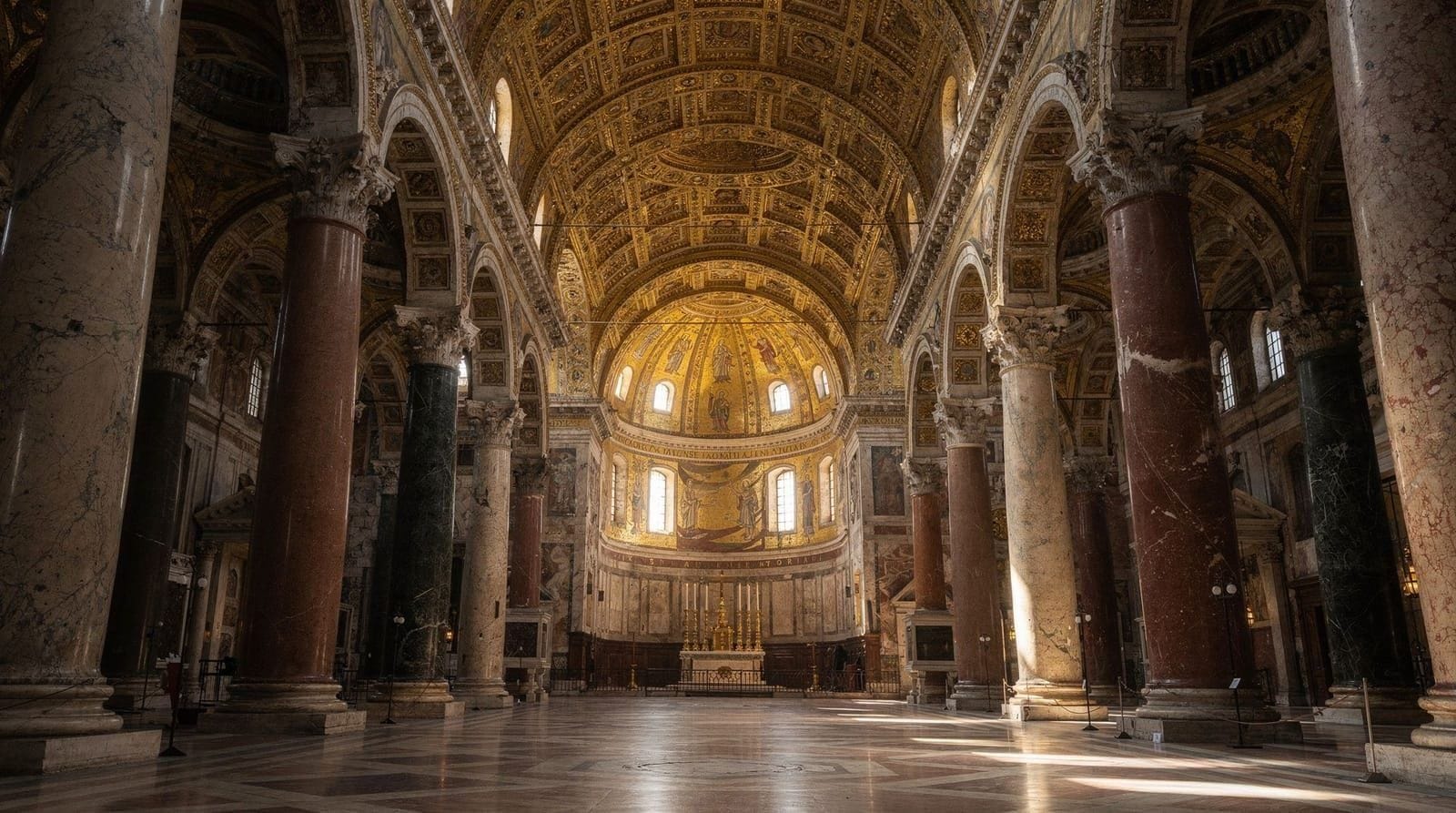
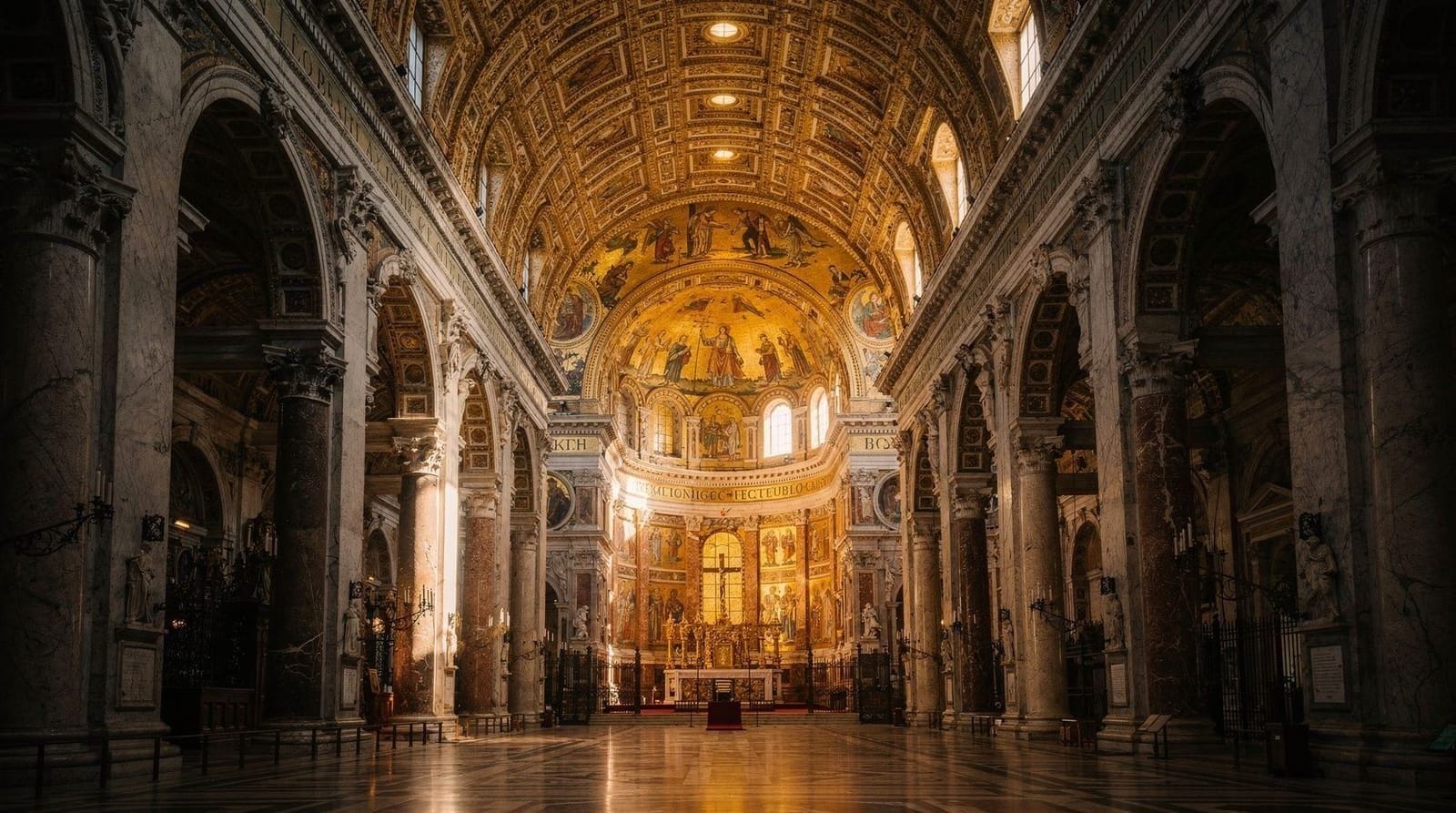
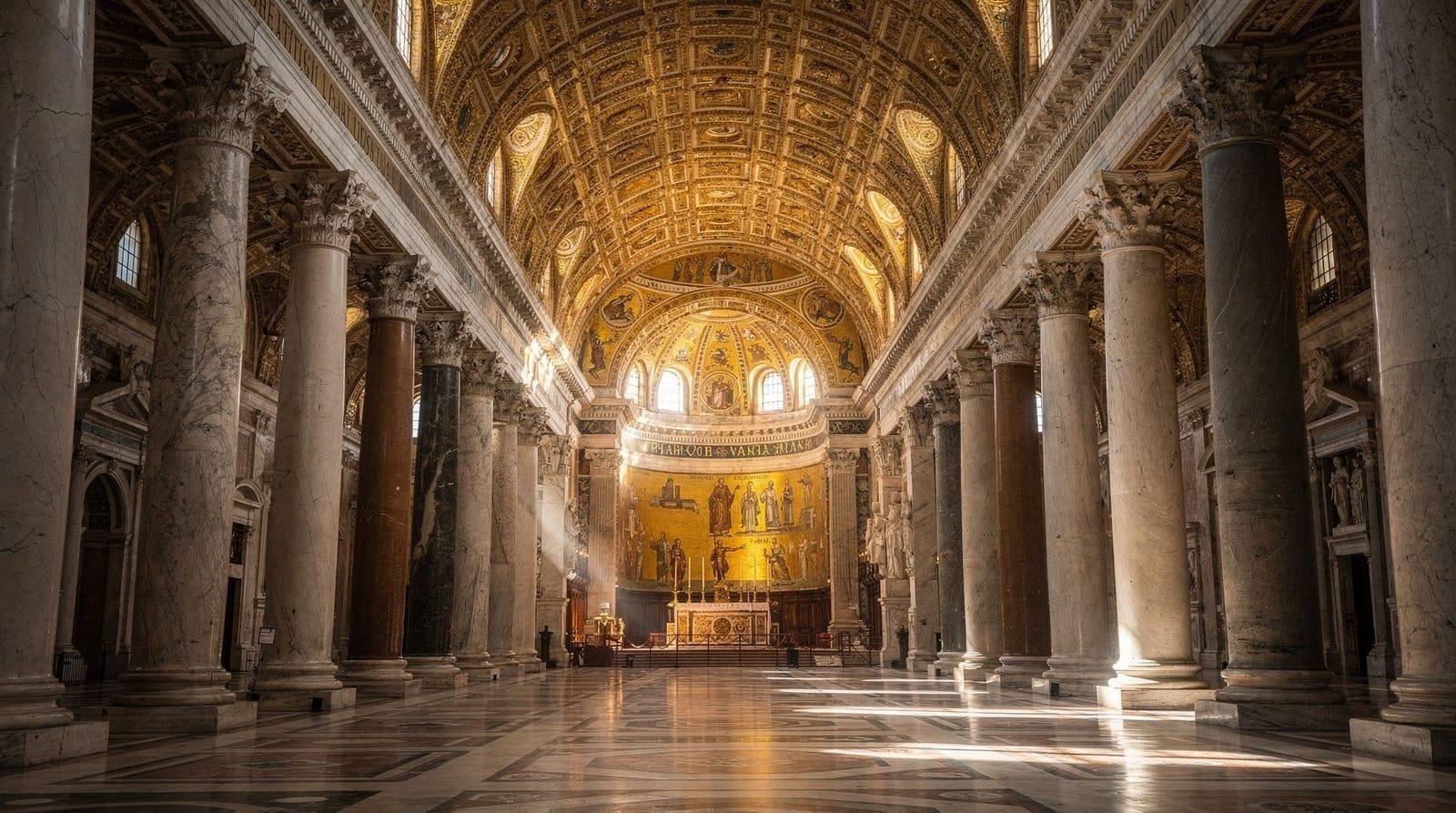
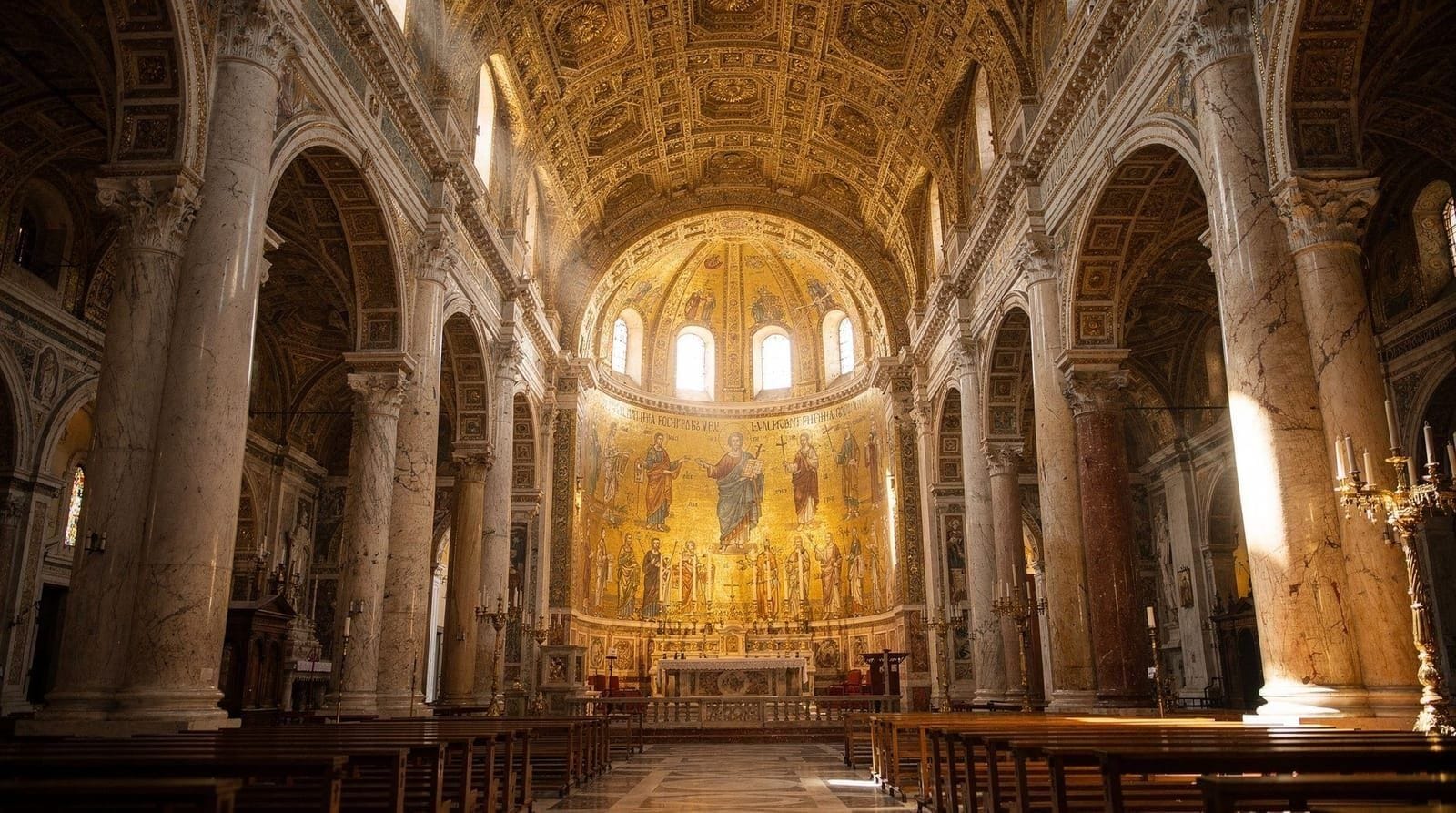
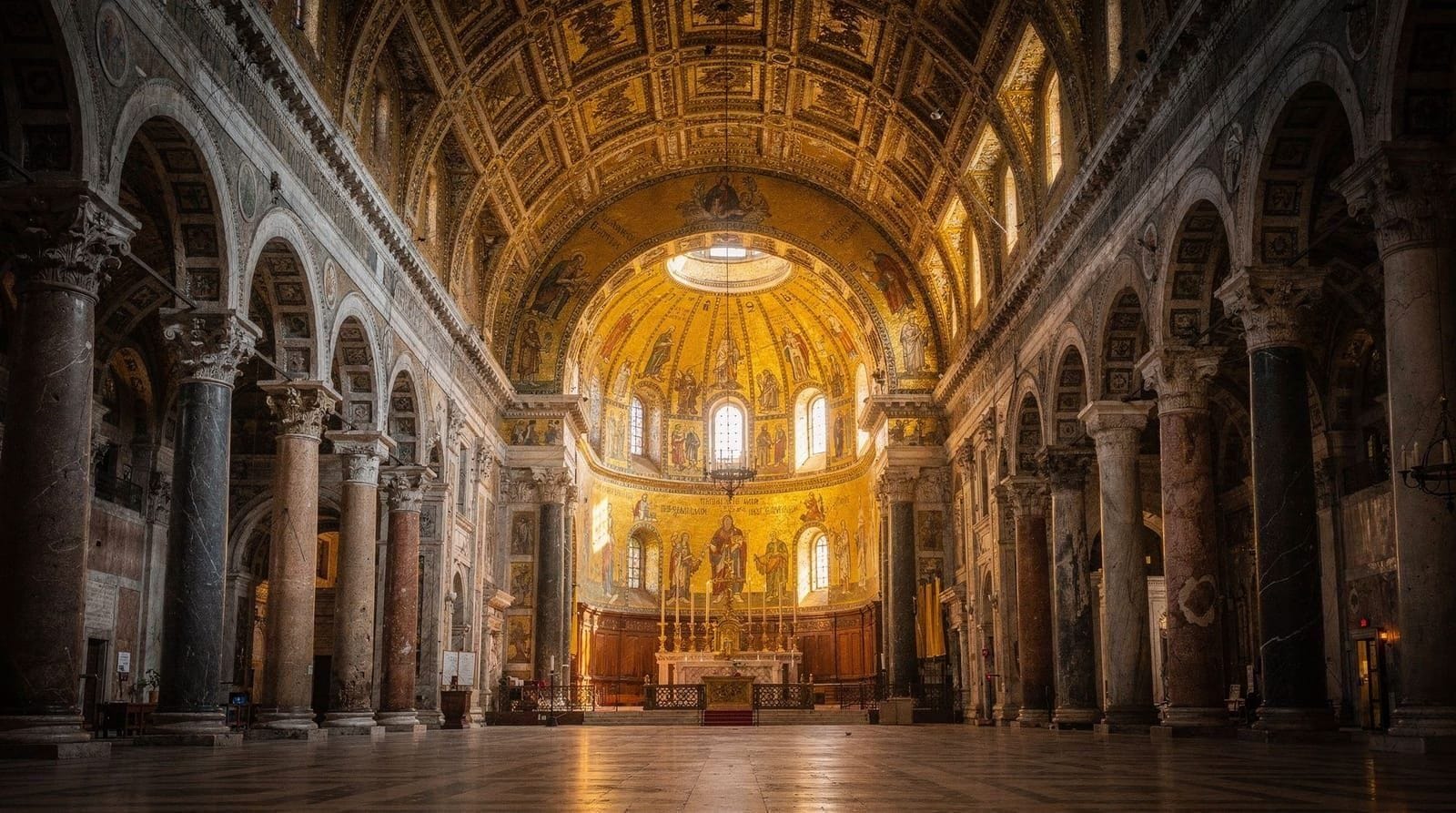
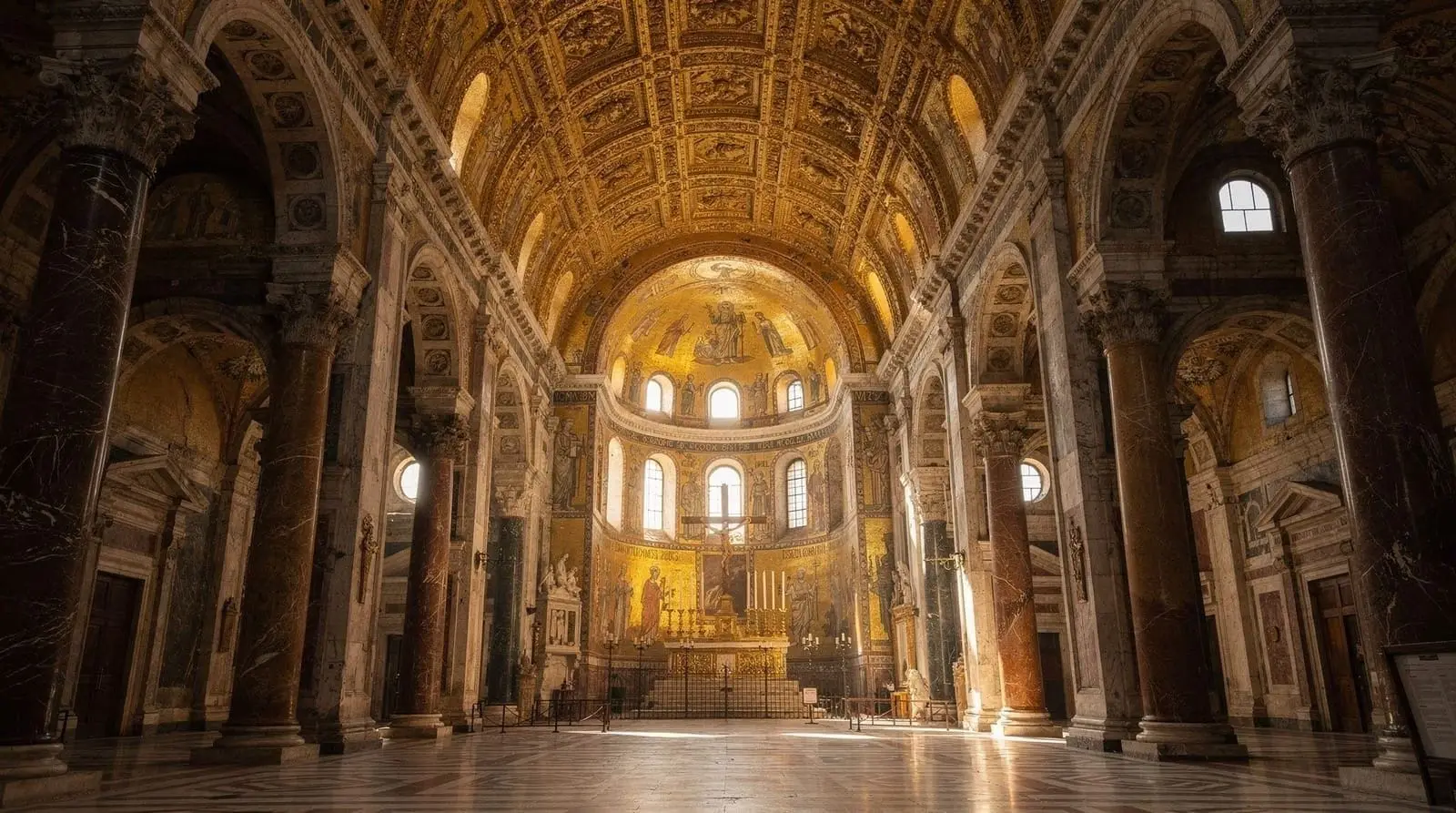
The interior transformation commissioned by Pope Innocent X for the Jubilee of 1650 is one of Borromini’s largest completed works. Working within the constraints of an existing medieval structure, Borromini unified the five-aisle basilica by designing a series of paired pilasters and arched niches that created a continuous rhythm down the nave, simultaneously hiding the old pillar bases and creating a new, unified spatial reading.
The effect is different from the usual Roman Baroque. Borromini’s architectural language was personal and geometrically complex; his Lateran nave is more disciplined and less exuberant than, say, Bernini’s work at St. Peter’s or Cortona’s painted ceilings elsewhere. The space is cool, imposing, and immensely long — 130 metres from door to apse — with a coffered wooden ceiling above.
The 18th-century Apostle statues: The 18 niches in the nave walls contain statues of the Twelve Apostles (plus Paul and the four Evangelists) commissioned by Pope Clement XI between 1703 and 1718. Designed by multiple sculptors including Camillo Rusconi and Pietro Monnot, these are among the most accomplished late Baroque sculptural figures in Rome. The individuality of each figure — posed in a characteristic attitude with symbolic attribute — rewards close attention.
The papal altar and tabernacle
The Gothic canopied tabernacle above the papal altar (c.1367, attributed to Giovanni di Stefano) contains what the church presents as the skulls of Saints Peter and Paul — relics displayed in golden reliquaries. These relics have been venerated here since at least the 9th century. The tabernacle itself, with its Gothic pinnacles and painted wooden panels, is the most visually distinct medieval element surviving in the current interior.
The apse mosaic
The 13th-century apse mosaic by Jacopo Torriti — the same artist who made the Santa Maria Maggiore apse mosaic of 1295 — shows Christ in a mandorla flanked by figures against a gold ground. The mosaic was substantially restored in the late 13th century and again in the 19th century; the current version follows the medieval composition but is not original tesserae throughout.
The cloister
Accessed from a door on the south side of the nave (small fee, approximately €3), the Lateran cloister was built in 1215–1232 by the Vassalletto family, the same workshop that built the cloister at San Paolo fuori le Mura. The twisted columns — some plain, some carved with reliefs, all inlaid with Cosmatesque mosaic work in gold, green, and red — support pointed arches around a central garden.
Around the walls of the ambulatory, fragments of medieval sculpture, inscriptions, ancient sarcophagi, and architectural elements from the various rebuildings of the basilica are displayed. Among them: a fragment of the tomb of Boniface VIII (Pope during the first Jubilee of 1300), medieval floor tiles, and pieces of 13th-century frescoes from the old Lateran Palace.
The cloister is usually significantly less crowded than the main nave. For anyone interested in medieval art and architecture, it is the quietest and most rewarding part of the complex.
Evening guided walking tour of central Rome — useful orientation for planning a next-day visit to the Lateran and surrounding neighbourhood, which lies just outside the main tourist circuits.The Holy Stairs (Scala Santa)
What they are
Directly across the road from the basilica, the Scala Santa complex houses 28 marble steps claimed to be the stairs Christ ascended in Pontius Pilate’s praetorium in Jerusalem before the Crucifixion — brought to Rome by St. Helena (Constantine’s mother) around 326 CE. The steps are now encased in wooden boards to protect the marble from further wear; pilgrims climb them on their knees and can see the marble through small glass windows.
The tradition of ascending the stairs on one’s knees dates from the medieval period and is associated with a plenary indulgence. Martin Luther, visiting Rome in 1510 as a young Augustinian friar, climbed the Holy Stairs on his knees and reportedly had a crisis of doubt midway (“the just shall live by faith”) — an episode sometimes cited as a step toward his later break with Rome.
Contemporary pilgrims climb the stairs in significant numbers — not in thousands, but in dozens on any ordinary weekday. The experience of watching real people making this devotional act — young, old, in business clothes, in pilgrimage gear, in religious habits — in 2026 is one of the most immediate encounters with living religious practice available to any visitor in Rome.
The complex
The Scala Santa building also contains the Sancta Sanctorum (the Holy of Holies) — the private papal chapel of medieval popes, no longer accessible through the stairs but viewable from a grille at the top. It contains the Acheiropoieton — an icon of Christ “not made by human hands” (a very ancient image considered miraculous), still venerated but no longer publicly accessible.
Lateral staircases allow access without kneeling for visitors who wish to visit the top chapel without the devotional ritual.
Access: Free. The Scala Santa building is open approximately 06:30–13:00 and 15:00–19:00.
What to expect if you climb
Climbing the Holy Stairs on your knees is genuinely physically demanding — 28 steps is more than it sounds when done kneeling, and most visitors take 10–15 minutes to ascend at a respectful, unhurried pace. You do not need to be Catholic or religious to climb; a mix of tourists, curious visitors and devout pilgrims share the stairs, and no one checks your beliefs at the door. Wear trousers or a longer skirt if kneeling, since bare knees on marble-adjacent wood for an extended period is uncomfortable. Silence and a contemplative pace are expected — this is treated as an active devotional space, not a photo opportunity, and photography during the ascent is generally discouraged out of respect for those praying.
The Baptistry of San Giovanni
Just north of the basilica stands the Baptistry of San Giovanni in Laterano — the oldest standing baptistry in Rome and one of the oldest in the world, dating in its current form to Pope Sixtus III (432–440 CE), built on foundations of a 4th-century original under Constantine. This is the baptistry that served the Cathedral of Rome for over a millennium, before baptistries were routinely attached to individual parishes.
The octagonal structure (eight sides symbolizing the eighth day of creation, the day of resurrection) became the template for Christian baptistry architecture throughout the Western world. Inside: 5th-century mosaics in the ambulatory chapels, Cosmatesque floor, and ancient columns from the original construction.
Access: Free, separate entrance from the basilica.
Accessibility
The basilica’s main entrance is level with the piazza and the nave floor is flat, making the core visit manageable for wheelchair users and visitors with limited mobility. The cloister, however, is reached by a few steps down from the nave and has an uneven medieval floor in places, which can be difficult without assistance. The Holy Stairs complex across the road has lateral staircases for visitors who are not kneeling, but these are still stairs with no lift alternative for reaching the upper Sancta Sanctorum viewing grille. If mobility is a concern, the basilica and baptistry alone still make a complete and worthwhile visit without the cloister or the stairs.
Practical visitor information
Address: Piazza di San Giovanni in Laterano 4, 00184 Roma.
Hours: Basilica approximately 07:00–18:30 daily. Cloister approximately 09:00–18:00 (small fee). Holy Stairs approximately 06:30–13:00 and 15:00–19:00.
Entry: Basilica free. Cloister approximately €3. Holy Stairs free.
Getting there: Metro A to San Giovanni (direct, approximately 7 minutes from Termini). Bus 3, 16, 81, 85, 87.
Photography: Permitted in the basilica (no flash during Mass). Check signage in specific chapels.
Dress code: Standard Roman church requirements — shoulders and knees covered.
Time required: 45–60 minutes for the basilica; add 20–30 minutes for the cloister; 20 minutes for the Holy Stairs complex.
Rome evening tour of the historic centre — a complement to a daytime Lateran visit, covering the opposite end of the city’s major church and monument circuit.Combining the Lateran with nearby sites
Santa Maria Maggiore: 10 minutes’ walk northwest. The two papal basilicas form a natural pairing. See our Santa Maria Maggiore guide.
San Clemente: 15 minutes’ walk west, near the Colosseum. One of Rome’s most extraordinary church experiences — three layers of archaeology beneath a free 12th-century basilica. See our San Clemente guide.
The Colosseum: 25 minutes’ walk or a short bus ride. The complete ancient Rome circuit — Colosseum, Roman Forum, then Lateran hill churches — makes one of Rome’s best full days. See our Colosseum guide.
Via Appia Antica: About 2 kilometres south of the Lateran. The ancient Appian Way begins in this area (from the Porta San Sebastiano). See our Appian Way guide.
For the full context of Rome’s major basilicas, see our four papal basilicas guide and the overview of Rome’s churches, Caravaggios, and free art.
Frequently asked questions about St John Lateran: the cathedral of Rome and the Holy Stairs
What is the difference between St John Lateran and St. Peter's?
Are the Holy Stairs (Scala Santa) real?
How do I get to St John Lateran?
How long does St John Lateran take to visit?
What is the cloister of St John Lateran?
What does Borromini's interior of St John Lateran look like?
What happened to the Lateran Palace?
Is St John Lateran busy compared to St. Peter's?
Top experiences
Bookable activities with verified prices and instant confirmation on GetYourGuide.