Rome's most photogenic spots (and how to shoot them without the crowds)
Rome: City Highlights Golf Cart Tour with Local Guide
How do I photograph Rome's iconic spots without crowds?
Arrive 30–60 minutes before sunrise at the Trevi Fountain, Piazza Navona and Ponte Sant'Angelo — these are genuinely empty at 05:30–06:30 in summer. The Aventine keyhole queue is short (under 10 minutes) even at peak times. The Pantheon interior is least crowded at opening (09:00). Via Piccolomini and Ponte Sisto are overlooked entirely. For the Colosseum exterior, early weekday mornings give 20–30 minutes of good light before tour groups arrive in force by 09:00.
The gap between what gets shared and what’s actually possible
Scroll through Rome photography on any social platform and you will find two kinds of images. The first kind shows famous landmarks in diffuse, crowd-free golden light — compositions that look effortless and inevitable. The second kind shows the same landmarks surrounded by tour groups, competing for space with selfie sticks, shot in the flat light of a midday sun. The difference between these two categories is almost entirely a matter of timing and — for a handful of spots — local knowledge about angles that the bulk of tourists never discover.
This guide rates each major photogenic spot in Rome on two scales: visual impact (what the location can actually look like in good conditions) and crowd difficulty (how hard it is to get a clean shot without strangers in frame). It then gives the specific strategy for each.
| Cost | Free for most spots; €5-16 for interior/terrace access |
| Best general window | First hour of daylight, any season |
| Best months | April-May and October |
| Gear priority | A tripod-free fast lens beats extra gadgets for dawn light |
| Booking | Only needed for Pantheon, Castel Sant’Angelo, Vittoriano |
| Spot | Visual impact | Crowd difficulty | Best window |
|---|---|---|---|
| Trevi Fountain | 10/10 | 8/10 | Before 06:00 (summer) |
| Piazza Navona | 9/10 | 7/10 | 06:30-08:00 |
| Ponte Sant’Angelo | 9/10 | 6/10 | Dawn or blue hour |
| Colosseum exterior | 9/10 | 8/10 | Before 07:30 |
| Pantheon interior | 9/10 | 6/10 | 09:00 opening |
| Spanish Steps (April) | 8/10 (9/10 in bloom) | 7-9/10 | 07:00, azalea weeks |
| Aventine keyhole | 8/10 | 4/10 | 09:30-11:00 |
| Trastevere alleys | 8/10 | 5/10 | Golden hour or before 09:00 |
| Via Piccolomini | 8/10 | 1/10 | 07:30-09:00, any day |
| Castel Sant’Angelo terrace | 8/10 | 5/10 | Late afternoon |
| Monti streets | 7/10 | 3/10 | Late afternoon |
Trevi Fountain — visual impact: 10/10, crowd difficulty: 8/10
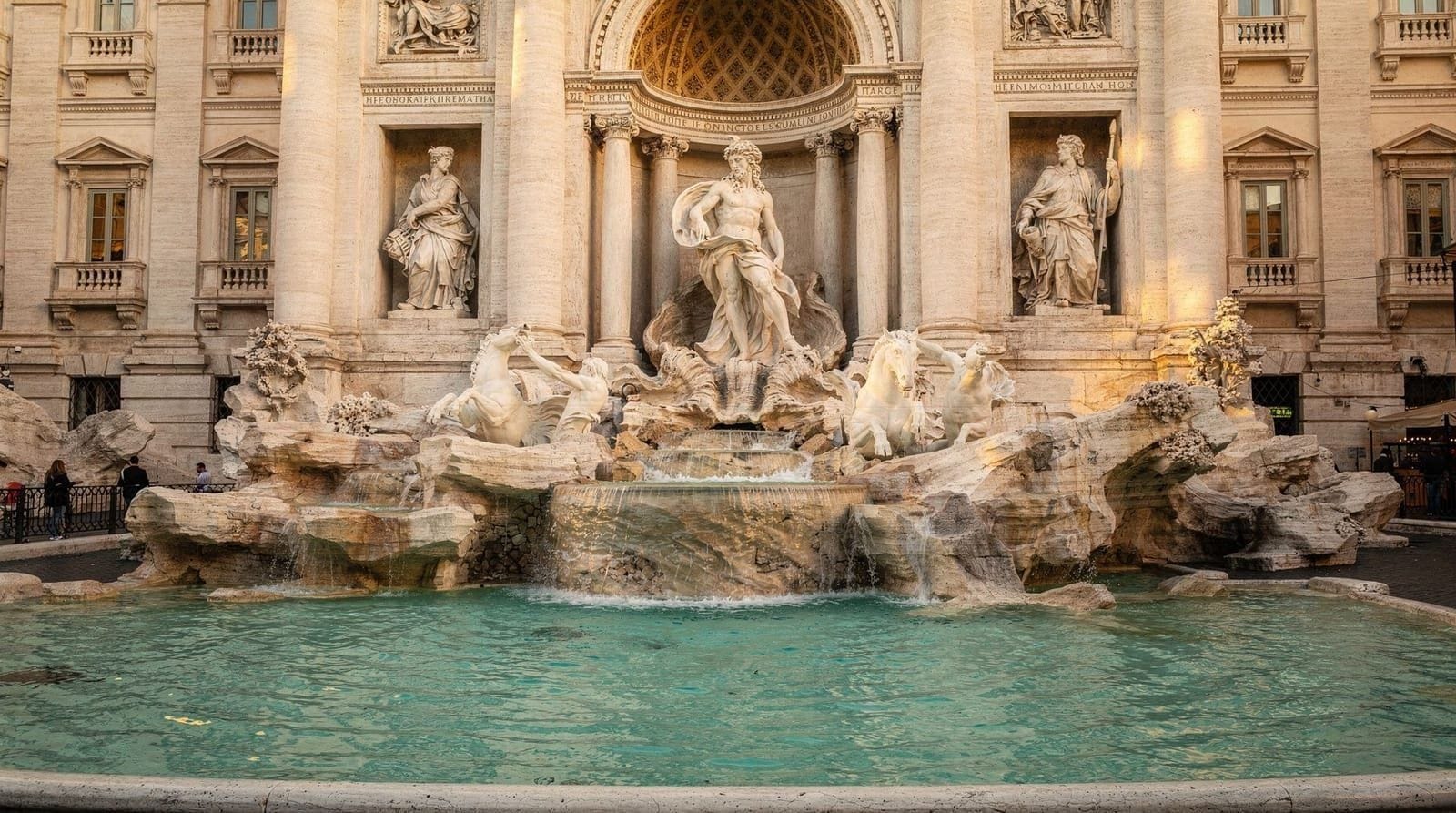
The Trevi Fountain is Rome’s most photogenic monument and its most impossible one. The Baroque facade of Palazzo Poli forms the backdrop; Neptune on his shell-chariot surges forward from the central arch; the pool shimmers pale green. The composition is inherently powerful, and no amount of tourist infrastructure fully diminishes it.
Strategy: the only reliable window for a crowd-free shot is pre-dawn. Arrive by 05:30 in summer (June–August) or 06:30 in shoulder season. The fountain is illuminated by powerful floodlights through the night, so the artificial lighting against the dawn sky gives an exposure balance that is actually preferable to harsh daylight — the warm pool light and cool dawn sky work beautifully together. At 05:30 on a summer morning you may share the piazza with two or three other photographers and a handful of people walking home from late nights.
By 07:30 in summer the early risers begin arriving. By 09:00 the tour groups have started. By 11:00 you cannot get within three metres of the pool edge without someone in your frame.
Blue hour (20–30 minutes after sunset, roughly 21:00–21:30 in summer) is the premium evening option. The pool and facade are lit against a deep blue sky in a way that daylight never produces. Expect crowds — the piazza is packed in the evenings — but with a long lens (70–200mm equivalent) and patience, you can isolate sections of the facade and sculpture without wide-angle crowd shots. Claim a position at the raised area to the right of the main viewing steps.
See our Trevi Fountain guide for the full history and visitor logistics.
Piazza Navona — visual impact: 9/10, crowd difficulty: 7/10
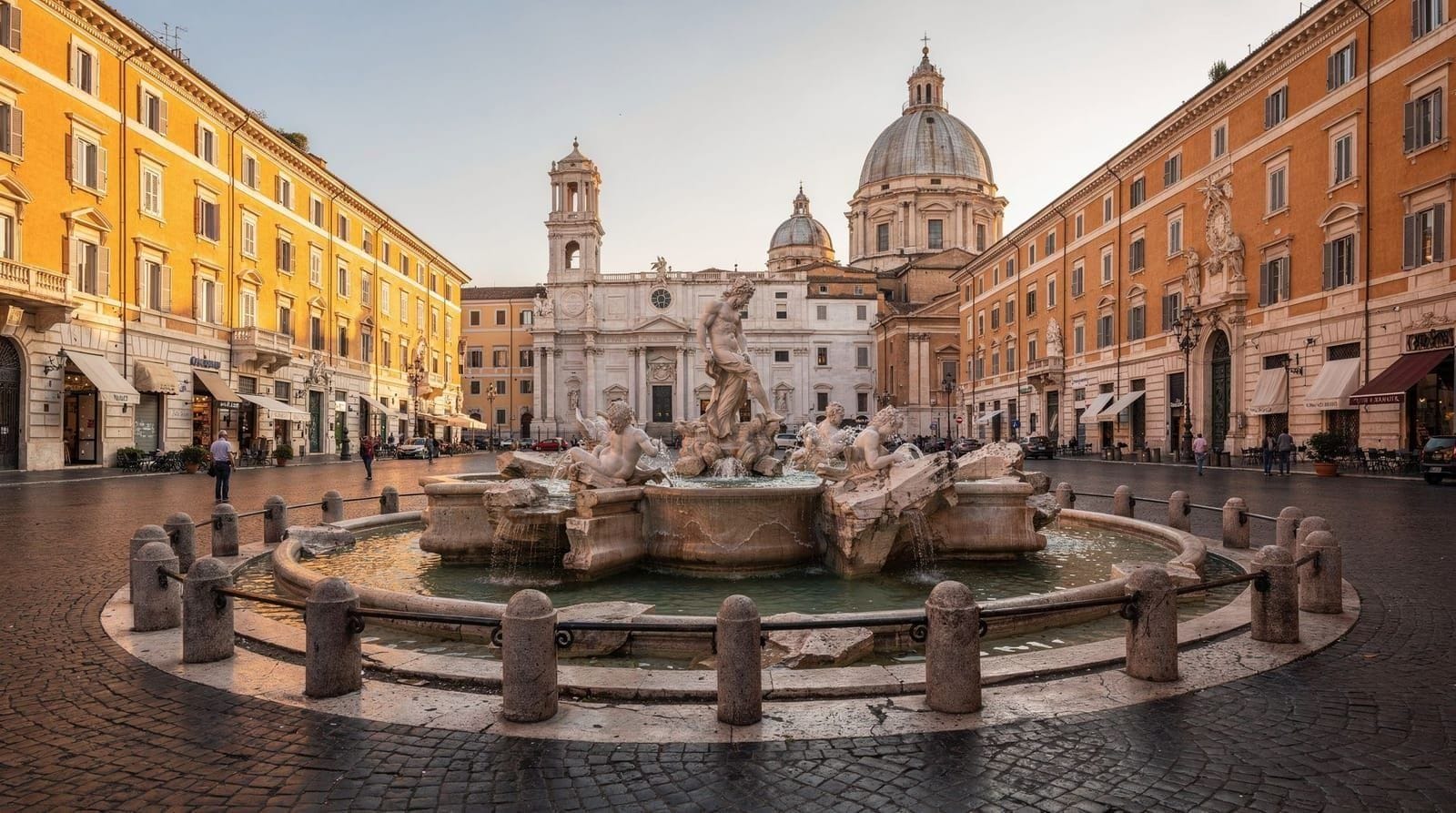
Piazza Navona is built on the footprint of Domitian’s stadium — the oval shape is original. Bernini’s Fountain of the Four Rivers at the centre is the main subject: four massive figures representing the four great rivers of the known world (Nile, Ganges, Danube, Plate) holding up an Egyptian obelisk. The scale and drama of the sculpture, with the facade of Sant’Agnese in Agone as a backdrop, is one of the most complete Baroque compositions in Europe.
Strategy: unlike the Trevi Fountain, Navona is a large open piazza that genuinely empties out in the early morning. At 06:30–08:00 the piazza is usually clear of chairs (the café furniture is stacked or chained), and the fountain is illuminated from below. The Fountain of the Four Rivers faces south, which means the ideal morning light falls on the north-facing side of the figures from around 09:00 onward — for pure light quality, mid-morning is actually better than dawn, but you will have more people. Pre-dawn gives emptiness at the cost of dramatic side light.
The Piazza Navona guide covers the fountain in detail — knowing which figure represents which river improves your selective framing significantly.
Ponte Sant’Angelo — visual impact: 9/10, crowd difficulty: 6/10
The 10 angel sculptures on Ponte Sant’Angelo — Bernini designed two of them personally, the rest by his pupils — are among the most graceful monumental sculptures in Rome. Each angel holds an instrument of Christ’s Passion. The bridge faces east-west, making dawn (warm light on the Castel Sant’Angelo from the east) and dusk (backlit angels against a glowing western sky) the premium times.
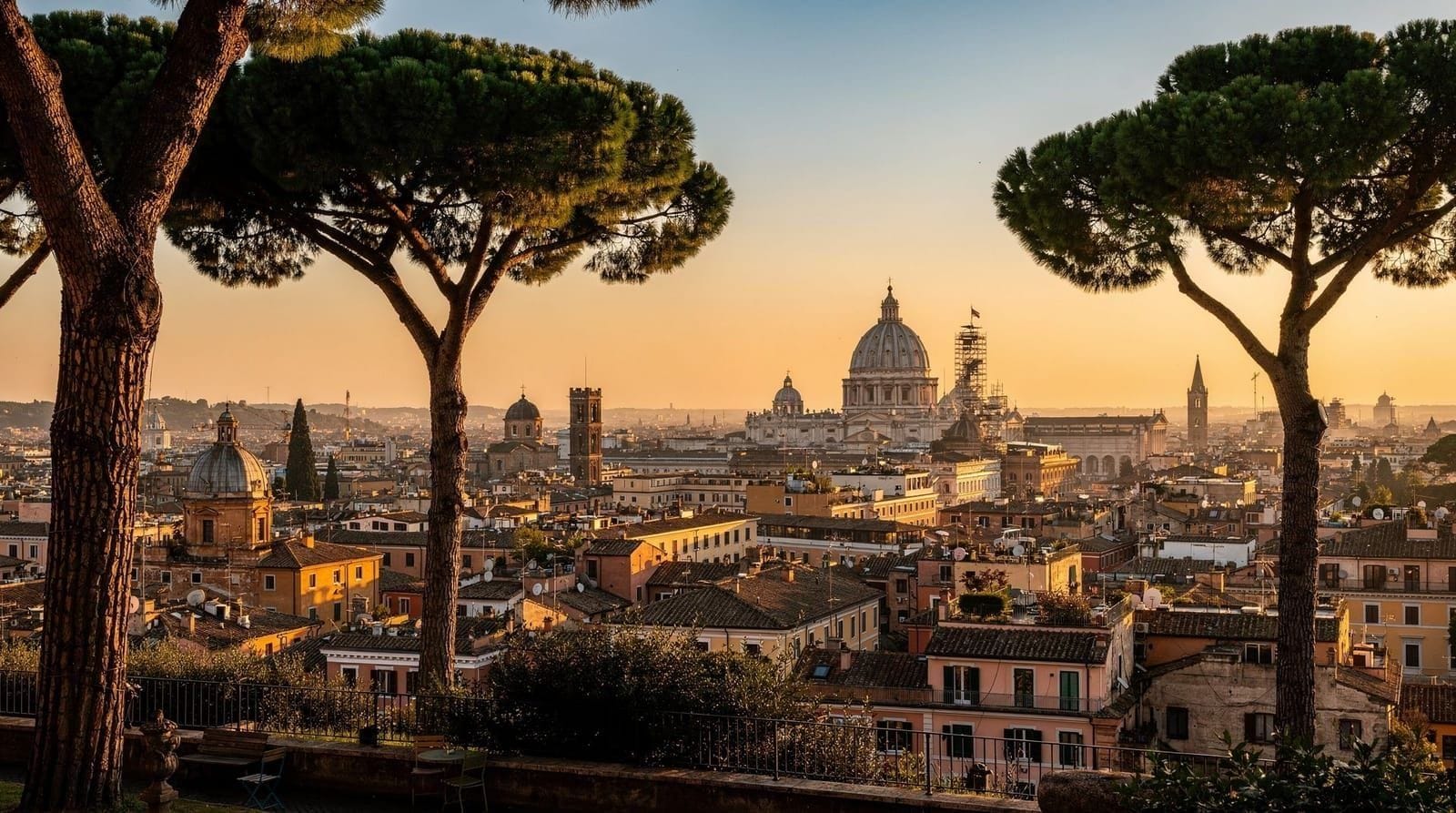
Strategy: dawn is the easier option for crowd management. At 05:30–06:30 in summer the bridge is nearly empty. The combination of the night floodlighting still active on the Castel Sant’Angelo, the pink dawn sky behind it, and the angel silhouettes in the middle ground makes for images that cannot be replicated at any other hour. Position yourself at the south end of the bridge looking north — the Castel is directly ahead, the dome of St. Peter’s visible above its roofline, and the angels line the approach.
At blue hour the bridge is busy but the images are extraordinary. A long lens from the riverbank below (Lungotevere dei Tebaldi on the south side) gives a compressed view of the bridge and Castel without tourist foot traffic visible.
Aventine keyhole and Giardino degli Aranci — visual impact: 8/10, crowd difficulty: 4/10
The Knights of Malta keyhole (Piazza dei Cavalieri di Malta) is Rome’s most satisfying hidden gem — not because it is unknown (it is listed in every travel guide) but because it delivers completely on the promise every time. The precisely framed dome of St. Peter’s through a hedge tunnel is genuinely remarkable and takes about 30 seconds to experience. The queue is usually 5–15 people maximum.
Strategy: arrive at 09:30–11:00 for the best light on the dome (mid-morning south light illuminates the facade well). The queue moves continuously. The Giardino degli Aranci 100 metres away has a terrace with an open eastern view toward the Circus Maximus — best at sunrise or early morning. In April the orange blossom makes it extraordinary.
See the Aventino neighborhood guide for the full circuit including the Basilica di Santa Sabina, which has 5th-century wooden doors and an interior of remarkable austerity.
Spanish Steps with azaleas — visual impact: 8/10, crowd difficulty: 7/10 (normal season), 9/10 (April with azaleas)
The Spanish Steps are impressive at any time but they are genuinely spectacular for approximately three weeks in April when 250 terracotta pots of pink azaleas line every step from bottom to top. The contrast of vivid pink blossom against the travertine stone steps, the twin towers of Trinità dei Monti above, and the rooftops of the Prati and Pincio behind makes for images that are reproducible in no other month.
Strategy: arrive by 07:00 during the azalea period — the steps are empty, the blooms are fresh, and the morning light falls gently from the east on the church towers above. By 09:30 on a weekend morning during azalea season, the steps are crowded. The azaleas are installed typically in the second and third weeks of April (exact dates vary year by year); check local Rome event listings for the specific installation date.
At other times of year, the steps photograph well from below in morning light (07:30–09:30) when the church faces are warm and the steps are relatively uncrowded. See the Spanish Steps guide for full visitor logistics.
Trastevere’s alleys and Santa Maria in Trastevere — visual impact: 8/10, crowd difficulty: 5/10
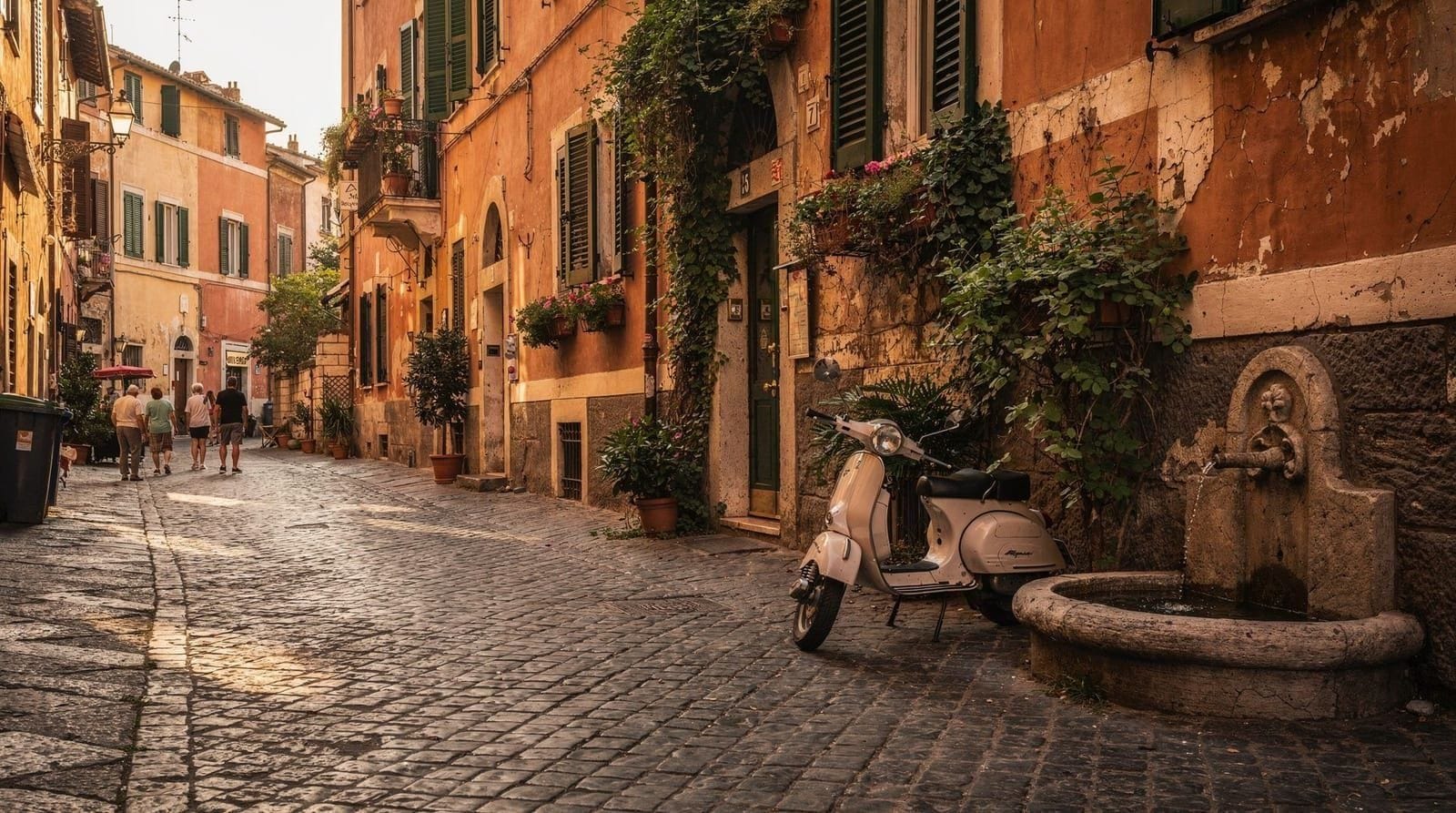
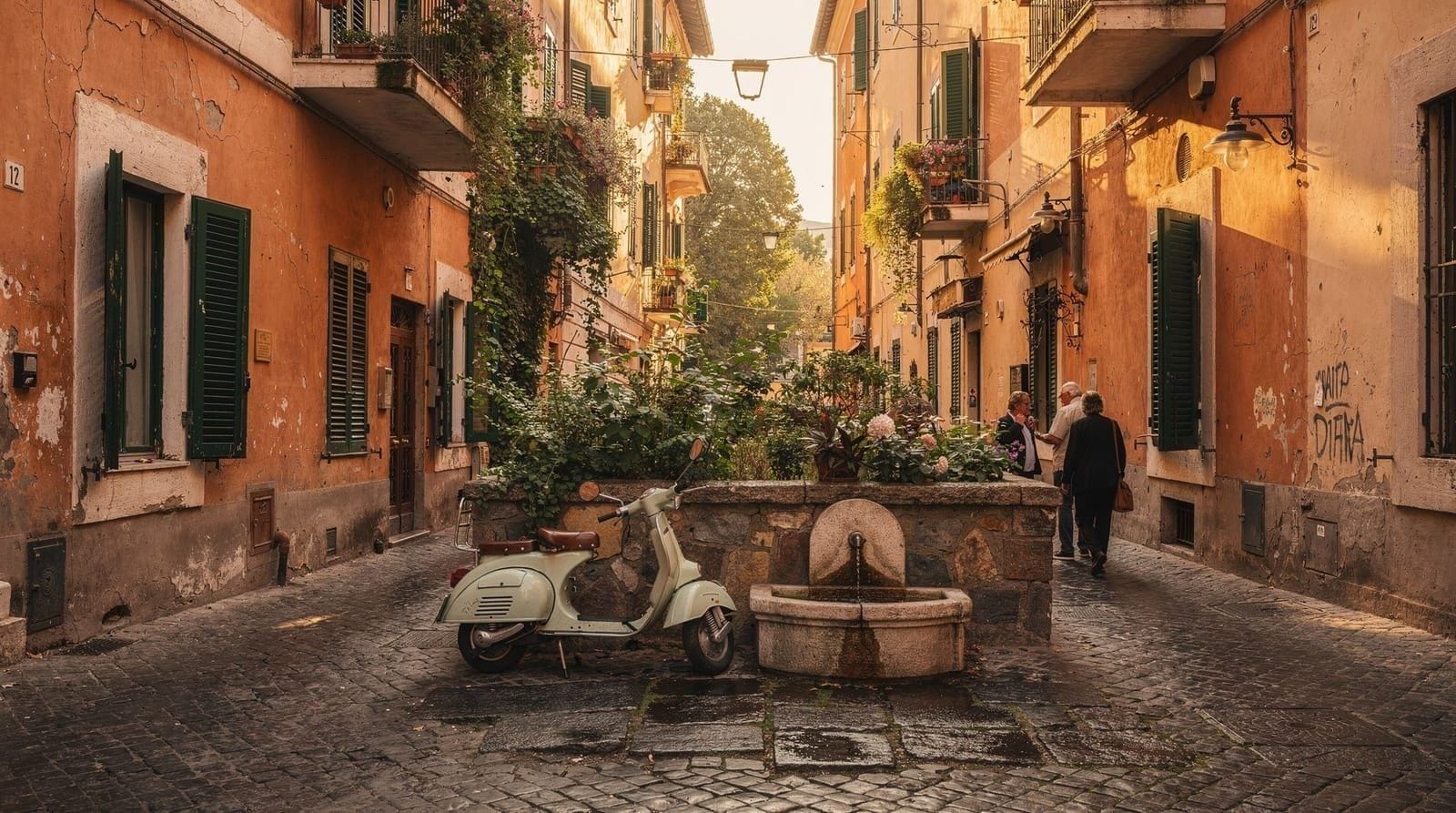
Trastevere is the neighbourhood that looks like central casting’s idea of Rome: cobbled alleys, ochre walls streaked with age, geraniums on wrought iron balconies, Vespas parked against ancient doorways. In the late afternoon golden hour, the light enters the east-west alleys from the side and makes every texture glow.
The Piazza di Santa Maria in Trastevere, centred on the basilica of the same name, is the photographic centrepiece of the neighbourhood — the illuminated golden mosaic facade of the basilica (12th–14th century), the octagonal fountain in the piazza, and the surrounding cafés and trattorias make a complete composition.
Strategy: golden hour is the premium time — roughly 18:00–19:30 in summer, 15:30–17:00 in autumn. For empty alleys, go before 09:00 on any morning; in winter (November–February) you can often photograph the entire neighbourhood in peace at any hour before 10:00. The Trastevere neighborhood guide breaks down specific alleys and secondary streets worth seeking out.
A golf cart city highlights tour with a local guide that covers the major photogenic spots in sequence — useful for understanding the spatial relationships between locations and scoping the best positions before a dedicated photography session at dawn or dusk.Colosseum — visual impact: 9/10, crowd difficulty: 8/10
The Colosseum exterior at dawn, from the area below the Arch of Constantine on the west side, is Rome’s most powerful architectural photograph. The scale of the structure in early morning light — the travertine warming to amber, the three tiers of arcades casting diagonal shadows — is genuinely overwhelming. The problem is that the area around the Colosseum fills with tour groups by 09:00 and reaches peak density by 10:30–11:00.
Strategy: arrive at or before 07:30 in summer for approximately 30–60 minutes of good light with manageable crowds. The best exterior position is from the Via Sacra end looking northeast — this angle shows two complete tiers of arcades with the Arch of Titus in the background. A secondary option is from the Caelian Hill side (south), looking north — this eliminates the tourist infrastructure that clutters the western approach.
For the Colosseum guide with full ticket and access information, see our dedicated page.
Pantheon oculus — visual impact: 9/10, crowd difficulty: 6/10
The Pantheon’s interior is one of the most geometrically perfect spaces in the world — a hemisphere of exactly the diameter of the space below it (43.3 metres both across and to the apex), with the single unglazed circular oculus as the only light source in the original design. The oculus shot — looking straight up at the circular opening against the sky — is the defining interior photography moment in Rome.
Strategy: visit at opening (09:00) on a weekday when capacity is lowest. The oculus light beam (visible when the sun’s angle sends direct light through the opening) occurs at approximately 10:30–12:00 depending on season. For the pure oculus shot without crowds in the frame, arrive at 09:00 and move immediately to the centre of the nave for the symmetrical upward shot — in the first 30 minutes of opening there is often enough space to photograph without strangers in the frame. Entry requires a timed ticket (€5).
Via Piccolomini optical illusion — visual impact: 8/10, crowd difficulty: 1/10
This is the location in Rome with the highest ratio of visual impact to tourist awareness. Via Piccolomini is a tree-lined road that descends from the Gianicolo toward the Vatican district. Due to the road’s geometry and alignment, walking away from St. Peter’s dome causes it to appear to grow larger — the dome fills more and more of the frame as you move away from it. Walking toward it, the dome appears to shrink. The effect is striking and counterintuitive.
For photography: from the far (east) end of the road, a telephoto lens (85–200mm equivalent) compresses the perspective and exaggerates the dome’s apparent size relative to the converging tree-lined road. A car moving away from the dome makes the scale relationship clearest. At 07:30–09:00 on a weekday the road is quiet enough that you can set up a position at the far end without significant traffic. No ticket, no queue, no crowds at virtually any hour.
See our Centro Storico guide for how to navigate from this area to the Vatican and Prati neighbourhood.
Monti neighbourhood: street and detail photography — visual impact: 7/10, crowd difficulty: 3/10
Monti is Rome’s coolest neighbourhood for street photography — a dense cluster of 19th-century streets between the Esquiline and the Imperial Fora, with independent boutiques, wine bars, and a genuinely local character that survives despite growing tourist interest. The photographic texture is rich: Via dei Serpenti, Via del Boschetto, and the side streets around Piazza della Madonna dei Monti give excellent wall textures, street life, and architectural fragments.
The Piazza della Madonna dei Monti itself — centred on a Giacomo della Porta fountain — is one of Rome’s most photogenic secondary piazzas, frequented by locals sitting on the fountain edges rather than tourists. In the late afternoon golden hour, the south-facing houses warm beautifully. See our Monti neighborhood guide for a walking route.
A Vespa sidecar tour of Rome’s highlights that reaches the Gianicolo and Pincio panoramic areas efficiently — giving the aerial context that makes the street-level photography in Trastevere and Monti more comprehensible.Castel Sant’Angelo terraces — visual impact: 8/10, crowd difficulty: 5/10
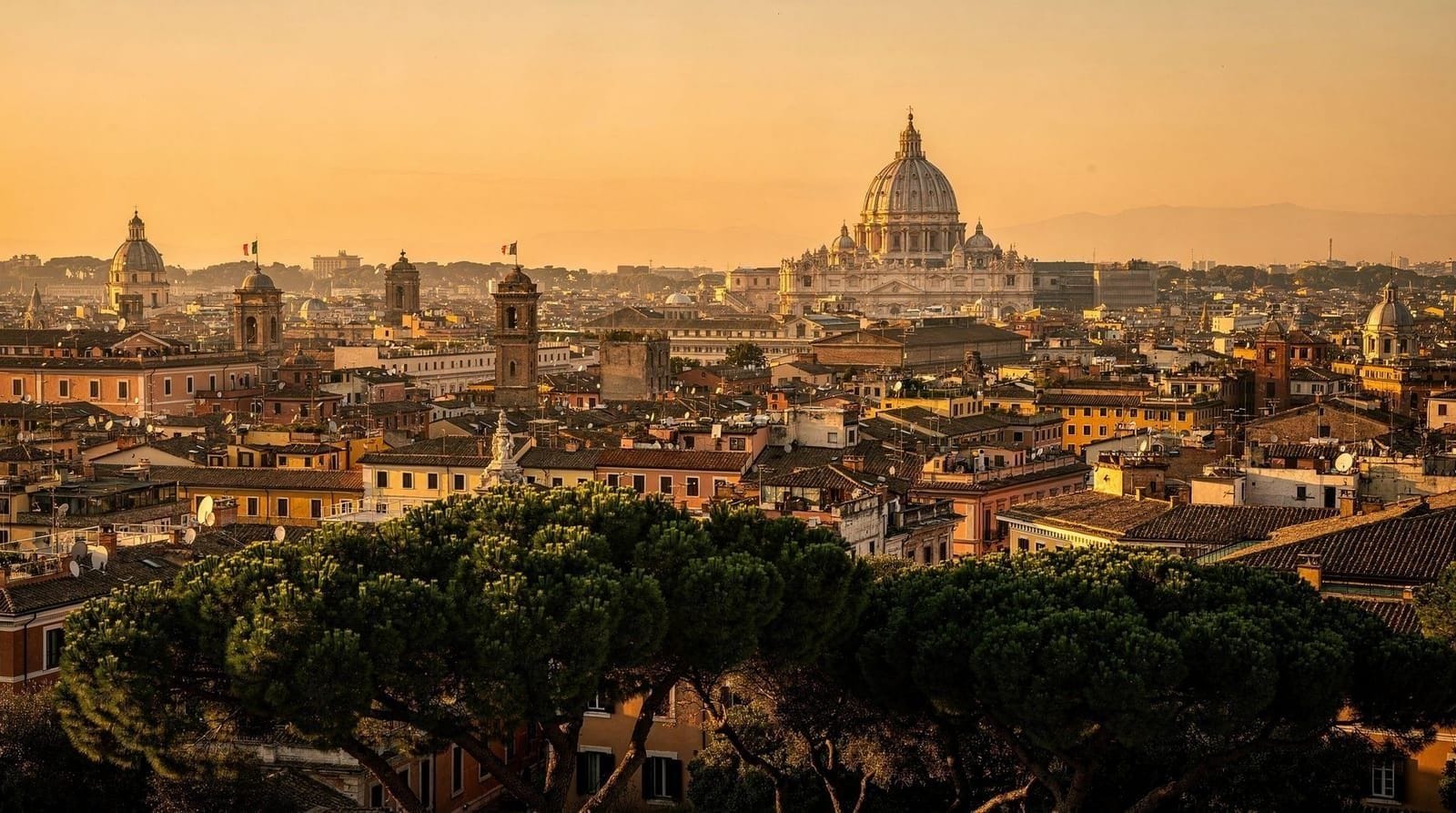
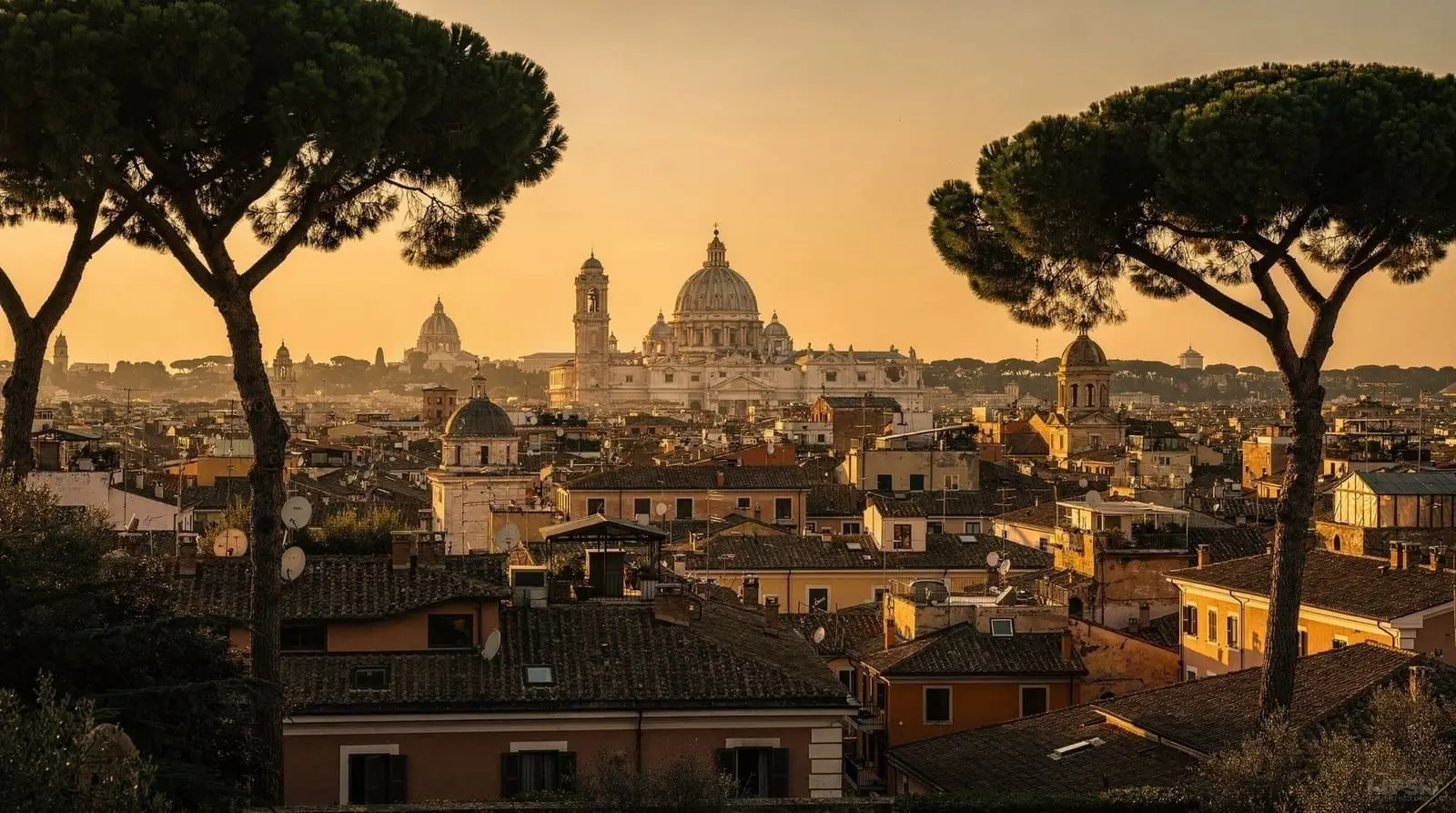
Castel Sant’Angelo’s external terraces, accessible with the entry ticket (€16 or included in some city passes), offer 360-degree views of Rome from the cylindrical mass of Hadrian’s Mausoleum. The view of Ponte Sant’Angelo directly below — looking down at the angel sculptures from above — is a perspective almost no photograph captures because it requires the entry ticket. The dome of St. Peter’s, just 600 metres away, appears massive from this angle.
The terrace photographs best in the late afternoon when the western light falls on the bridge and the Tiber below. Opening hours vary by season; check the official site. The Castel Sant’Angelo guide has full access and ticket information.
Practical notes for crowd avoidance in 2026
The Jubilee 2025 legacy continues to drive elevated visitor numbers into 2026 — Rome’s major sites are busier than their pre-pandemic norms. The single most effective strategy for all photogenic spots is to use the first hour of daylight. This is not a minor improvement in crowd levels; it is categorical. The difference between a photograph taken at 06:30 and one taken at 10:30 at the Trevi Fountain is the difference between having the frame entirely to yourself and managing an obstacle course.
Secondary strategy: Tuesday through Thursday mornings are consistently less crowded than weekends and Mondays (the weekends drive Monday congestion at major sites from visitors extending their stay). Wednesday morning in October is perhaps the optimal Rome photography window of the year.
For evening photography, the Rome aperitivo and nightlife guide covers which areas transition from sunset photography into good evening light — Trastevere, Monti and the Prati neighbourhood around Castel Sant’Angelo all have excellent early evening energy with the photographic day extending into aperitivo hour.
Building a one-morning photo route
If you have a single dawn to work with rather than several mornings spread across a trip, the spots above cluster efficiently by geography. Starting at the Trevi Fountain at 05:45, you can walk to Piazza Navona (12 minutes) by 06:15, then to Ponte Sant’Angelo (8 minutes) by 06:35, arriving with time to spare before the earliest risers appear around 07:00. This three-stop route covers the three highest-impact, highest-difficulty spots on the list in a single 90-minute window, using the one resource — pre-dawn darkness — that no amount of money or planning can otherwise buy back later in the day. The best photo spots in Rome guide has a longer version of this route extended to a full sunrise-to-midday circuit.
Photographers with only one morning should prioritise Trevi and Navona over the Colosseum — the Colosseum’s best light is genuinely later (07:00-07:30 as the sun clears the Caelian Hill) and does not compete for the same pre-dawn window, so it can be scheduled as a separate, less time-pressured outing.
Weather and light conditions worth planning around
Rome’s photographic conditions vary more with weather than most visitors expect. A slightly overcast morning — thin high cloud rather than heavy grey — is often better than a perfectly clear sky for the Trevi Fountain and Pantheon interior, since it softens the contrast between deep shadow and bright highlight that direct sun creates in narrow piazzas. After rain, the Centro Storico’s polished sanpietrini cobblestones produce genuine reflections of facades and fountains that are unavailable in dry conditions — worth checking the forecast the night before and adjusting plans to shoot Piazza Navona or the Pantheon piazza specifically the morning after rain rather than skipping photography because of it. Wind is the one condition that consistently hurts results, particularly at the Aventine keyhole and Giardino degli Aranci, where gusts disturb the hedge framing and tree branches in ways that are difficult to compose around.
Phone photography versus a dedicated camera
Most of the strategies above work identically well with a modern smartphone as with a dedicated camera — timing and positioning matter far more than equipment for every spot on this list except the long-lens blue-hour shots at the Trevi Fountain and Ponte Sant’Angelo, where physical compression of distant elements genuinely benefits from a longer lens than most phones offer natively. For the majority of spots — Piazza Navona, the Pantheon oculus, Via Piccolomini, Trastevere’s alleys — a phone’s computational low-light modes handle the pre-dawn conditions well, and the smaller, more discreet setup is actually an advantage in the tighter alleys of Trastevere and Monti, where a visible camera and lens draw more attention from passers-by than a phone does.
Frequently asked questions about Rome's most photogenic spots (and how to shoot them without the crowds)
What is the most photogenic spot in Rome that tourists miss?
What time should I visit the Trevi Fountain for the best photos?
Can I photograph inside Trastevere's alleys without tourists?
Are Rome's photo spots better in a specific season?
What is the Ponte Sisto and why is it photogenic?
Is the view from the Vittoriano roof worth the entry fee for photography?
What are the best hidden photo spots in Monti?
Top experiences
Bookable activities with verified prices and instant confirmation on GetYourGuide.