Palazzo Barberini: Caravaggio, Raphael and a baroque palace
Rome: Borghese Gallery Skip-the-Line Entry Ticket
Is Palazzo Barberini worth visiting in Rome?
Yes, strongly. Palazzo Barberini is one of Rome's underrated masterpiece collections — Caravaggio's Judith Beheading Holofernes, Raphael's La Fornarina, Holbein's portrait of Henry VIII, and Pietro da Cortona's ceiling fresco in the Gran Salone are all here, in a palatial setting far less crowded than the Vatican or Capitoline Museums. The standard ticket is €12 and the visit takes 90–120 minutes. If you are interested in baroque painting, do not miss this.
Rome’s underrated masterpiece collection
If you asked most visitors leaving Rome which museums they regretted skipping, Palazzo Barberini would be near the top of the list. It contains Caravaggio’s Judith Beheading Holofernes. It contains Raphael’s La Fornarina. It contains a ceiling fresco by Pietro da Cortona that is one of the defining works of the Italian Baroque. It is housed in a palace designed by Bernini and Borromini.
And yet most visitors never go, because the Colosseum, Vatican, and Borghese Gallery are already filling the itinerary.
This guide makes the case for fitting it in — and explains what you will see when you do.
| Where | Via delle Quattro Fontane 13, 5 min from Trevi Fountain |
| Cost | Around €12, reductions for EU 18–25 and over-65 |
| Time needed | 90–120 minutes |
| Crowds | Consistently light, even in peak season |
| Don’t miss | Caravaggio’s Judith, the Cortona ceiling |
The palace: a crash course
The Barberini family were one of the great Roman dynasties of the 17th century. Maffeo Barberini became Pope Urban VIII in 1623, and the family’s patronage — of architecture, art, and political power — reached its apex in the following decades. The palace on Via delle Quattro Fontane was begun in 1627 as a statement of that power.
The commission passed through three hands. Carlo Maderno, the architect who had completed the facade of St. Peter’s, began the project. When he died in 1629, Gian Lorenzo Bernini — the dominant artistic force of 17th-century Rome — took over, with his younger rival Francesco Borromini working under him. The result is a building that bears the marks of all three architects and is significantly enriched by the creative tension between Bernini and Borromini.
The most instructive place to feel this tension is at the entrance level. To the left: Bernini’s monumental rectangular staircase, broad and processional, designed to impress ascending guests. To the right: Borromini’s oval staircase, a tighter, more inventive geometry that turns a practical circulation element into an architectural event. They are 50 metres apart and could not be more different in approach. The Bernini staircase says authority; the Borromini staircase says brilliance.
What to see: the key works
Gran Salone: Pietro da Cortona’s ceiling
The central hall of the piano nobile is one of the most overwhelming interior spaces in Rome that is not inside a church or the Vatican. Pietro da Cortona painted the ceiling fresco between 1633 and 1639, and it depicts the Triumph of Divine Providence — an allegory in which divine will endorses the Barberini papacy, represented by the family’s three-bee crest being carried toward the heavens by personifications of the cardinal virtues.
The illusionistic painting extends the architectural space upward into a fictive sky populated with figures, clouds, and architectural elements — a technique (trompe-l’oeil) developed in the High Renaissance and brought to its baroque apogee here. The sheer acreage of ceiling, the complexity of the compositional programme, and the technical accomplishment of the perspective are staggering.
Stand in the centre of the room and look up for at least five minutes. It is not possible to understand this space from a photograph.
Caravaggio: Judith Beheading Holofernes
Painted around 1598–99, this is one of Caravaggio’s most theatrically accomplished works. Judith, the Jewish widow who saved her people by seducing and decapitating the Assyrian general Holofernes, is shown in the act — her expression combining concentration and a trace of revulsion. The Caravaggesque use of darkness and concentrated light (chiaroscuro) isolates the three figures — Judith, her elderly maid, and the dying Holofernes — against an essentially black background.
The painting’s power comes partly from its refusal of idealisation. Judith is not a heroine figure from a distance; she is a young woman doing something terrible and necessary at close range. Holofernes is not merely dying; he is being worked at, actively. The biological reality of the act is not softened.
For context on Caravaggio in Rome, our Caravaggio trail guide covers all the significant works across multiple locations in the city — the Palazzo Barberini painting is one of the most important.
Raphael: La Fornarina
Painted around 1520 — the final year of Raphael’s life — La Fornarina is a portrait of his mistress Margherita Luti (the nickname “fornarina” means baker’s daughter). The figure looks directly at the viewer with a combination of intimacy and self-possession that is quite different from most Renaissance portraiture, which tends toward idealization or narrative. This is a private image made with great technical care.
The painting’s identification with Raphael’s own mistress is documented (after Raphael’s death, Margherita entered a convent and registered under the name “Margherita di Francesco Luti”) and adds a biographical dimension that visitors tend to respond to. It is smaller than you expect, and more striking.
Holbein: Portrait of Henry VIII
Henry VIII’s recognisable pose — wide stance, hands on hips, expression of controlled arrogance — was established by Holbein’s 1537–39 full-length portrait (now lost in the original) and exists in multiple copies. The version at Palazzo Barberini (c.1540) is one of the most significant surviving versions, a half-length portrait that captures the king’s physical presence with Holbein’s characteristic precision.
That this portrait of the English king is in a Roman papal family’s palace carries a certain historical irony that the original patrons almost certainly did not intend.
Other highlights
The collection covers painting from the 12th through 18th centuries, with particular strengths in the 16th–17th century Italian and northern European schools. Other works worth seeking out:
- Guido Reni’s Beatrice Cenci (c.1662): Long identified as a portrait of the young Roman noblewoman executed in 1599 for killing her abusive father — now disputed on historical grounds, but still one of the most emotionally affecting portraits in the collection.
- Filippino Lippi’s Annunciation: An accomplished late 15th-century panel painting.
- Tintoretto’s Christ and the Adulteress: A characteristically theatrical composition.
- The Barberini Corridor of drawings and prints: For visitors interested in graphic work, the collection includes material that contextualises the oil paintings.
The building as museum experience
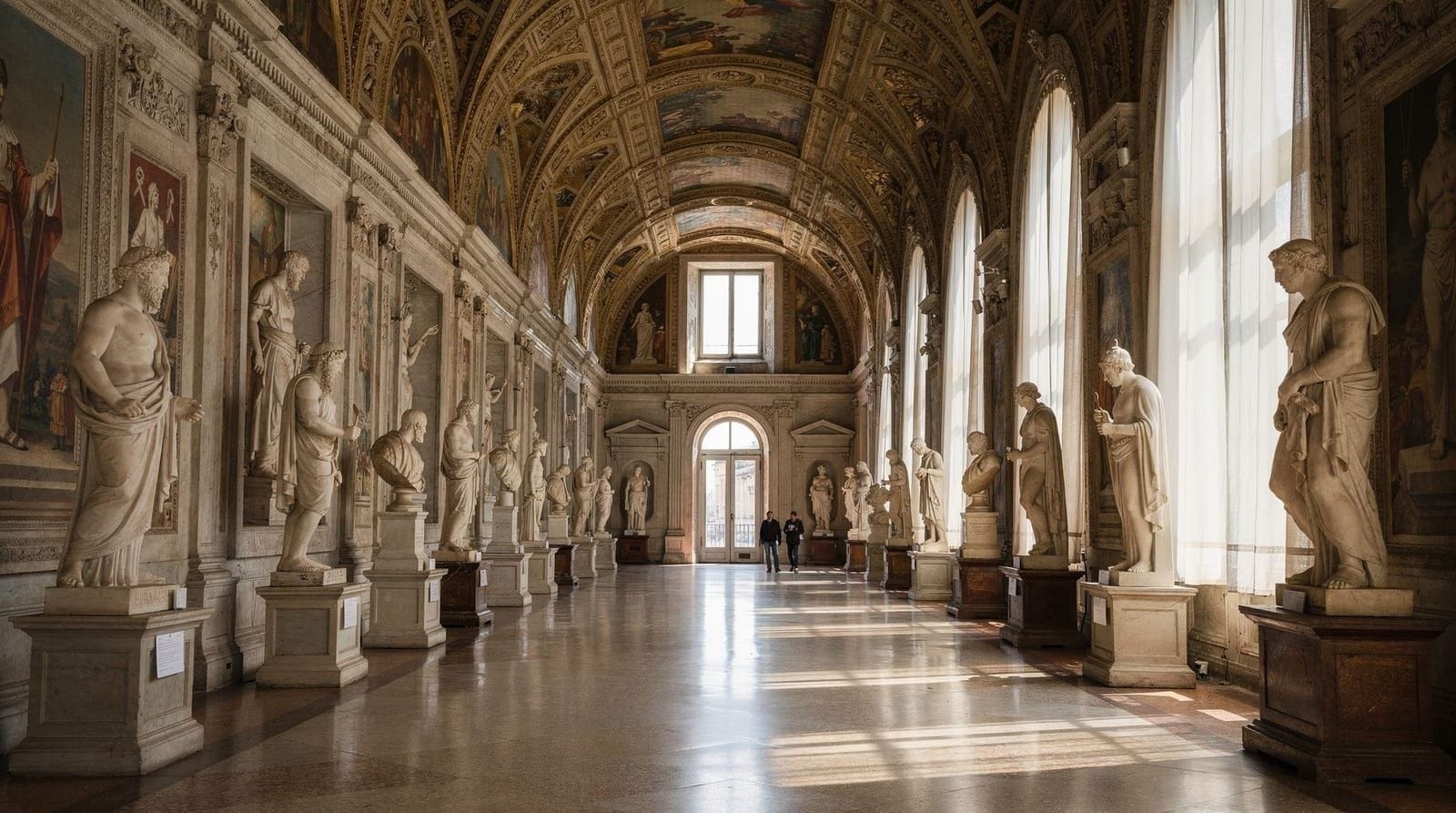
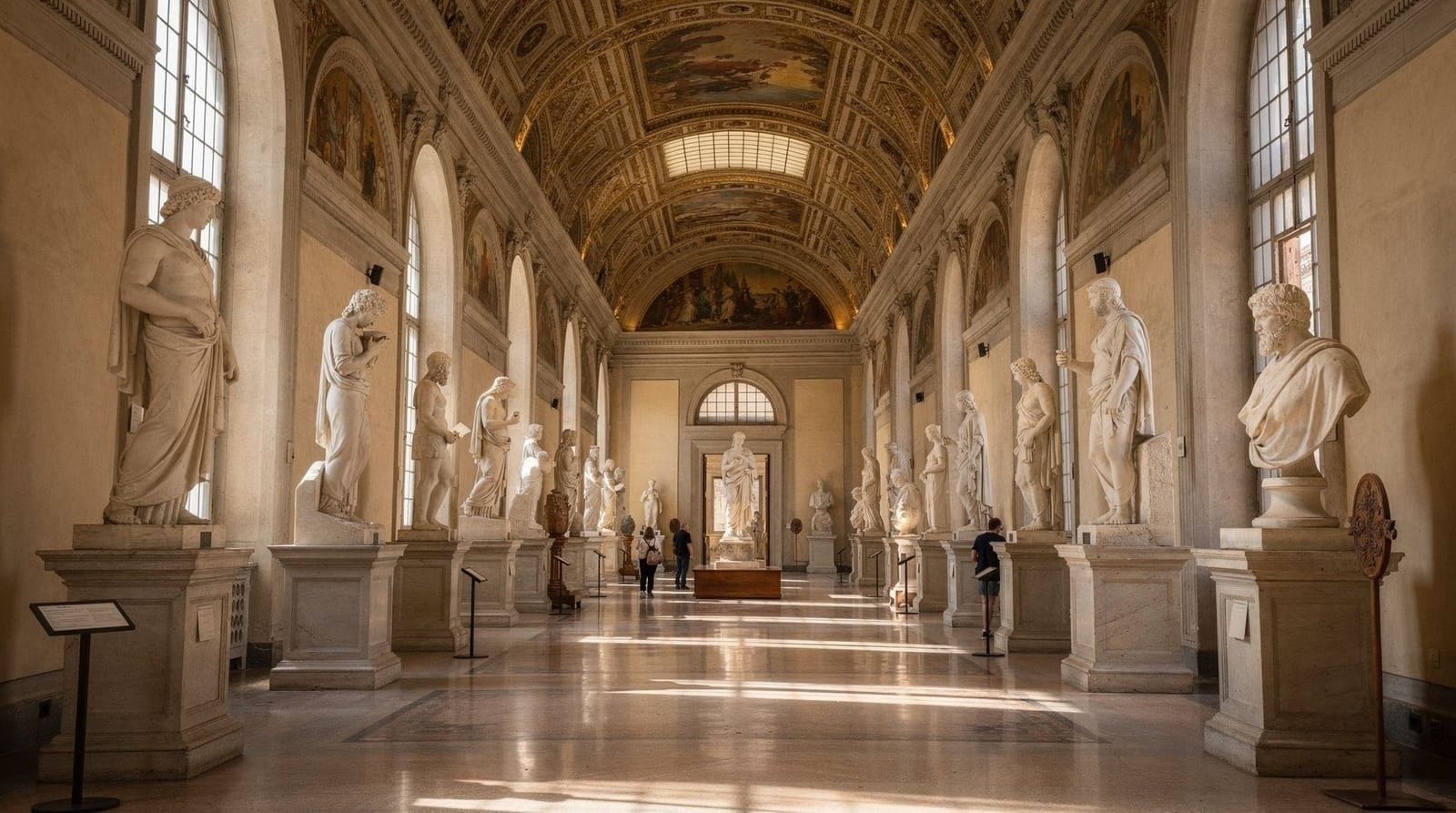
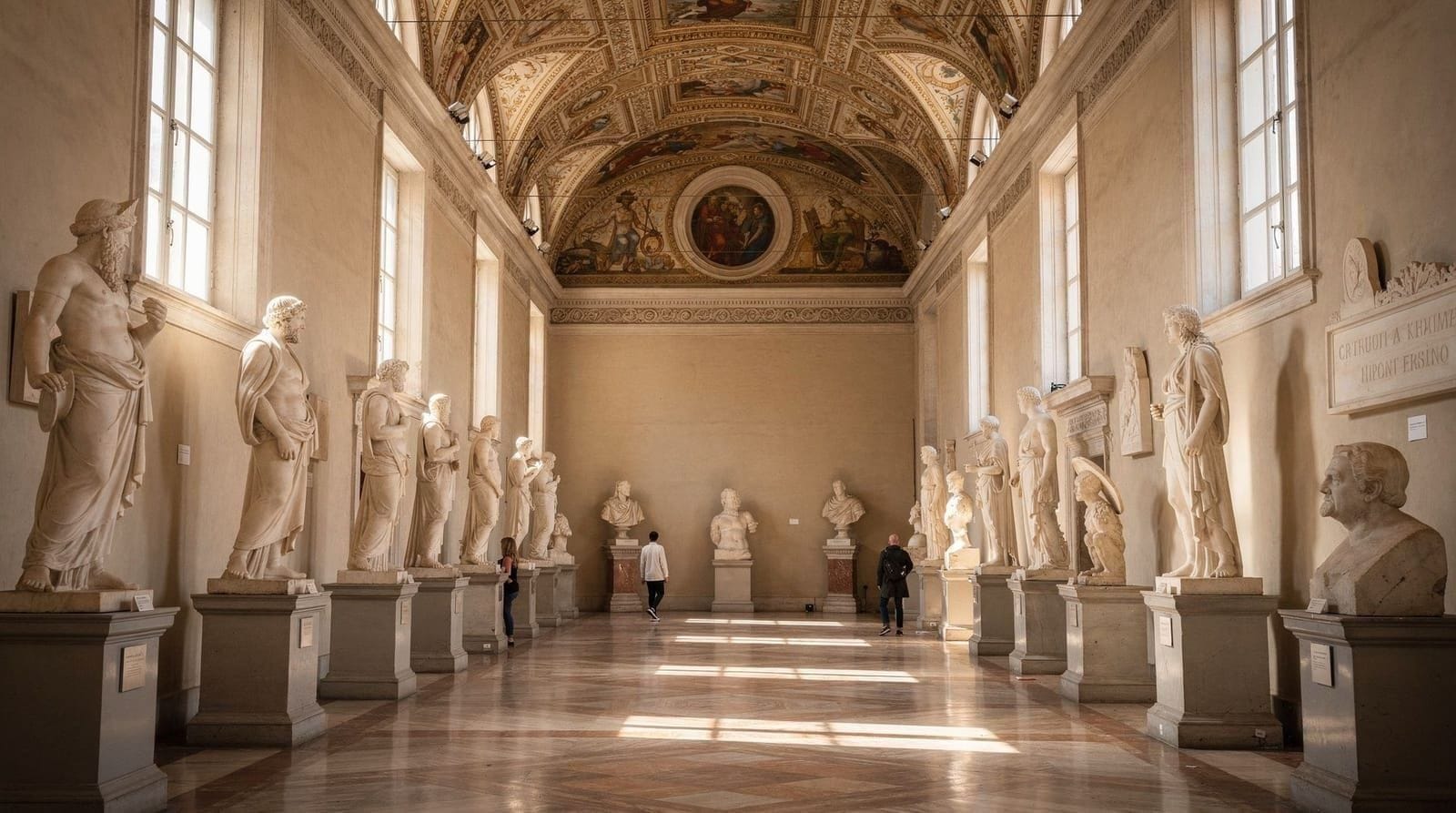
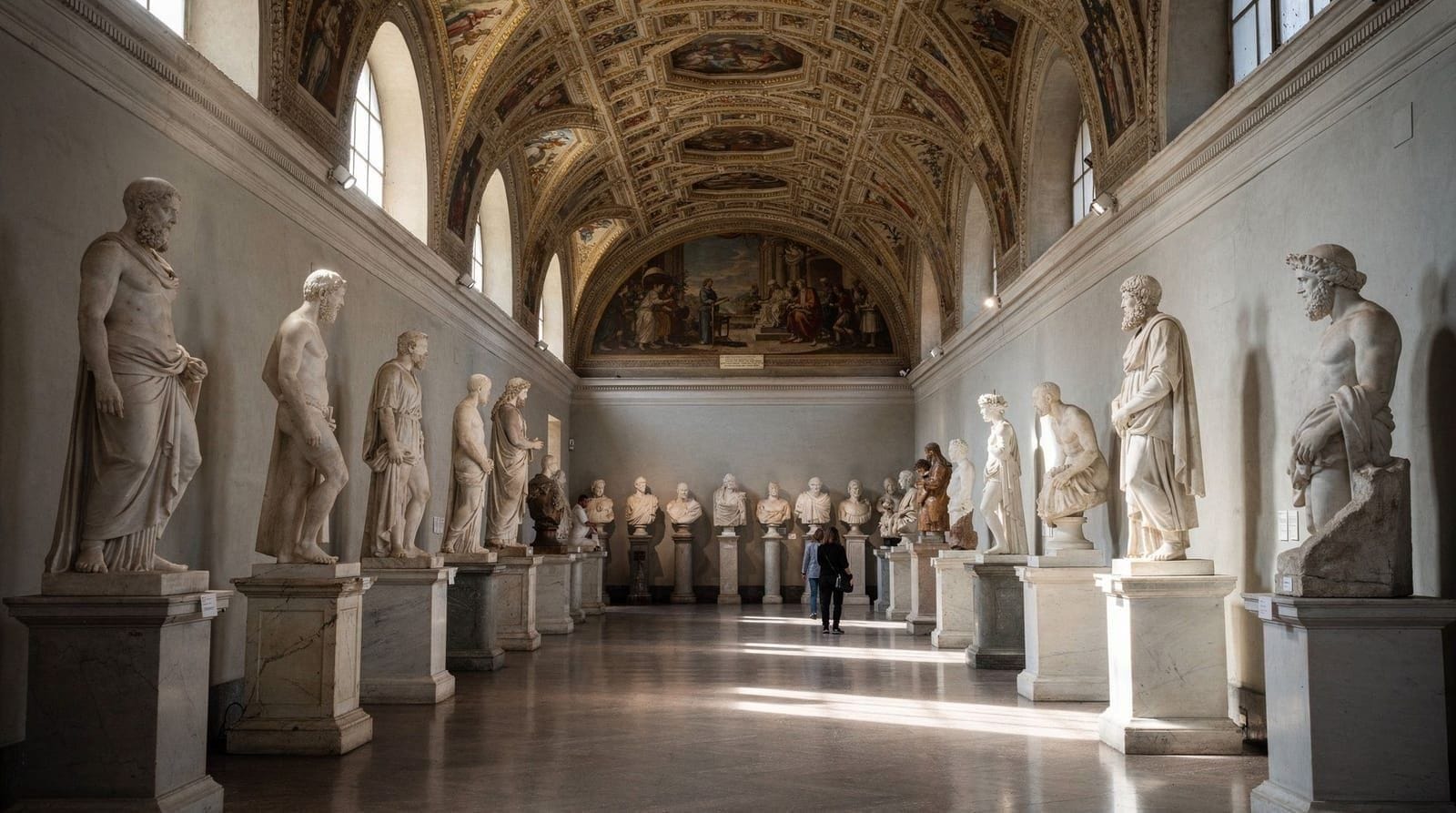
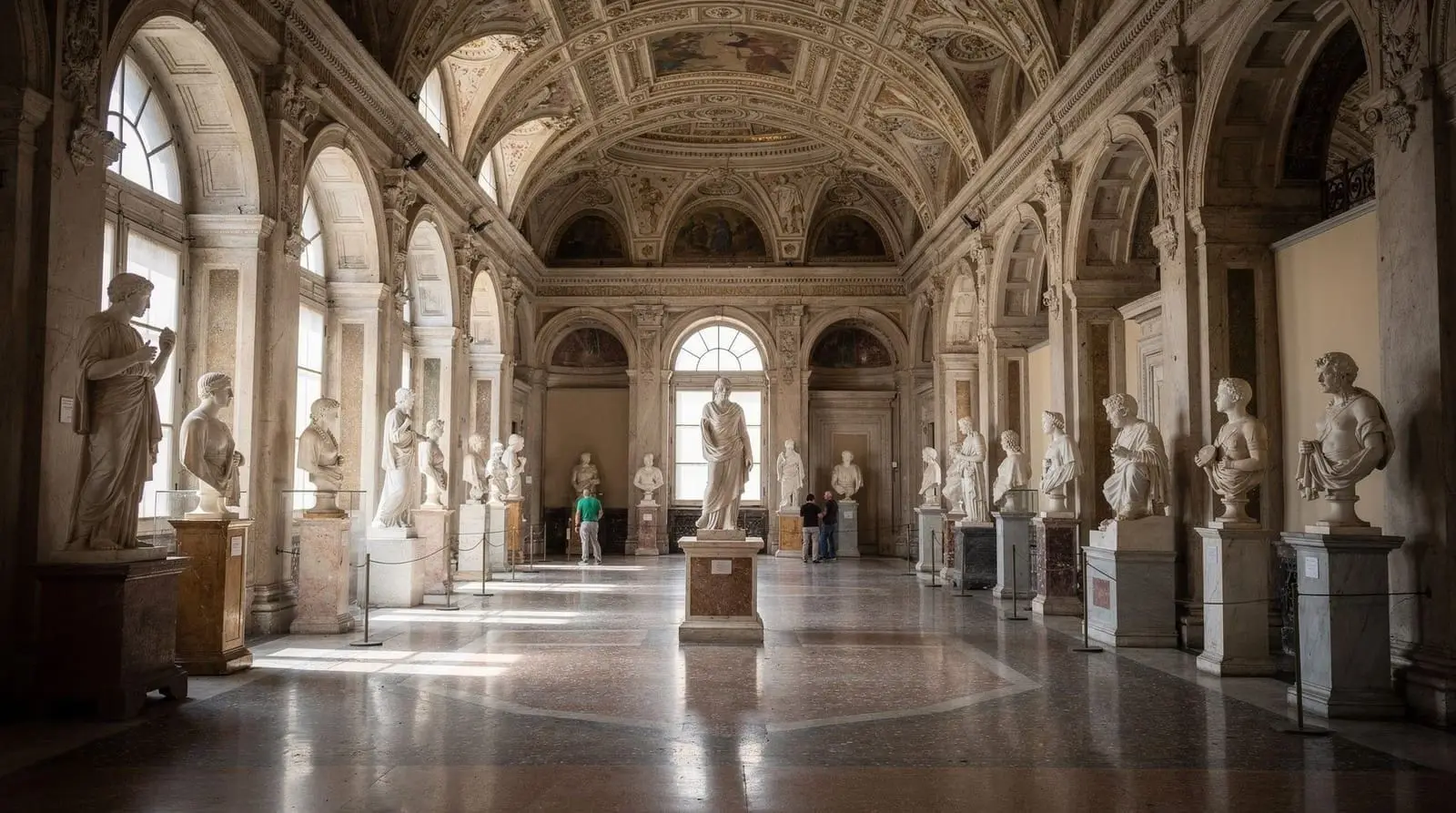
Palazzo Barberini is a functioning palace-museum — the experience of moving through the rooms includes the architecture, the ceiling heights, the windows giving onto Rome, and the domestic scale of some of the smaller galleries. This is different from purpose-built museum environments and requires a slightly different attentiveness.
Some rooms are large and processional; others are intimate and cabinet-like. The hanging of paintings on room walls (rather than the white-walled gallery convention of modern museums) is more historically appropriate and sometimes more visually compelling, but it also means that some works are harder to see clearly due to light angles.
The gardens (when accessible from the ticket desk) offer a moment of outdoor calm and a view toward the Quirinal Hill.
Suggested route through the collection
A logical route for a first-time visit runs roughly as follows. Start on the piano nobile with the Gran Salone — arrive here early in your visit while you have full attention to give the ceiling, rather than saving it for the end when museum fatigue sets in. From there, move through the adjoining rooms toward the Caravaggio gallery, giving Judith Beheading Holofernes the five to ten minutes it needs rather than a passing glance. The Raphael and Holbein portraits sit in nearby rooms and reward a slower pace than the large processional halls. Finish with a walk down whichever staircase you did not use to enter — if you came up via Bernini’s grand stair, descend via Borromini’s oval one, or vice versa, so you experience both without doubling back.
Visitors with limited time (under an hour) should prioritise, in order: the Gran Salone ceiling, the Caravaggio, and the two staircases. Everything else — the Reni, the Lippi, the Tintoretto, the drawings corridor — is genuinely excellent but optional if time is the binding constraint.
A note on families and quieter visits
Because Palazzo Barberini is so much less crowded than the Vatican or Colosseum, it is a genuinely good option for families who want a museum experience without the stress of dense crowds and long queues. Children tend to respond well to the scale of the Gran Salone (a ceiling that seems to open onto the sky is an easy thing to find impressive at any age) and to the theatrical drama of the Caravaggio, even before they understand its full context. The relatively small footprint of the essential rooms — you can see the highlights in well under two hours — makes it more forgiving for shorter attention spans than a full Vatican Museums visit.
For visitors prioritising a quiet, contemplative museum experience over a checklist of famous names, Palazzo Barberini is arguably Rome’s best option among institutions of this caliber. Few other collections in the city let you stand alone in front of a Caravaggio.
Practical information for 2026
Address: Via delle Quattro Fontane 13, Rome.
Hours: Tuesday–Sunday 10:00–18:00 (last admission 17:00). Closed Mondays.
Tickets: €12 standard adult, as described in the FAQ. Book online for a guaranteed timeslot; walk-in is usually possible but may involve a short wait in peak season.
Combined ticket: €15 covers Palazzo Barberini and Palazzo Corsini (in Trastevere), valid for 10 days. Palazzo Corsini has a smaller collection but is worth knowing about if you are thorough.
Getting there: 5 minutes’ walk from the Trevi Fountain; 10 minutes from the Barberini Metro stop (Line A). Bus 40, 60, 62, and 64 pass on Via Nazionale, a 5-minute walk away.
Audio guide: Available at the ticket desk (€5). The key rooms — Gran Salone and the Caravaggio gallery — are well served by the audio guide. For the rest of the collection, the in-room text is adequate.
Combining Palazzo Barberini with other sights
The museum’s location near the Trevi Fountain and the Quirinal Hill makes several natural combinations:
Trevi Fountain: 5 minutes’ walk west on Via del Tritone. If you have not yet visited, it is logical to combine these. See our Trevi Fountain guide for managing the crowds.
Quattro Fontane: The intersection immediately outside the palace has four 17th-century fountains representing the rivers Tiber and Arno and the goddesses Juno and Felicitas. These are small but characteristic of Rome’s baroque public decorative programme.
San Carlo alle Quattro Fontane: Fifty metres from the palace entrance, Borromini’s extraordinary small church (1638–1641) is one of the most inventive pieces of architecture in Rome — an oval interior packed into a tiny site. Free to enter; check opening hours.
Borghese Gallery: Accessible by foot (25 minutes) or taxi. Given the Borghese’s strict booking requirements, this requires advance planning. See the Borghese Gallery guide and our Borghese booking guide.
For the full picture of Rome’s painting collections and how to choose between them, see our best museums in Rome guide.
The Borghese Gallery is Palazzo Barberini’s great artistic companion — together they form the definitive survey of baroque art in Rome. Book the Borghese well in advance.Why this museum stays undervisited
Palazzo Barberini’s relative obscurity in the tourist circuit is a combination of factors: it lacks the brand-name recognition of the Vatican or Colosseum; it has no GYG mass-tour ecosystem built around it; and the Centro Storico has enough competing attractions that many visitors never make it up to the Quirinal Hill.
This is good news for you. On a busy Rome day in April or October, you can walk into Palazzo Barberini, stand in front of Caravaggio’s Judith with three other people in the room, and take your time. That experience is difficult to replicate at the Vatican or even the Capitoline Museums.
It is €12, 90 minutes, and contains some of the finest painting in Rome. Go.
For more on Caravaggio’s work in Rome’s churches and collections, the Rome basilicas and Caravaggio guide maps his key works across the city.
Practical information for 2026
Address: Via delle Quattro Fontane 13, Rome.
Hours: Tuesday–Sunday 10:00–18:00 (last admission 17:00). Closed Mondays.
Ticket price: €12 standard adult. Reductions for EU citizens aged 18–25 (€2) and EU citizens over 65 (€5). Under-18s free. Free first Sunday of the month.
Combined ticket: €15 for Palazzo Barberini plus Palazzo Corsini (valid 10 days). The Corsini in Trastevere holds a smaller collection but is architecturally beautiful — worth pairing if you are thorough.
Booking: Walk-in is almost always possible, but booking online (€1 surcharge) guarantees entry without any wait. In peak season, occasional short queues form at the ticket desk in the morning.
Getting there: Metro A to Barberini, then 5 minutes’ walk up Via delle Quattro Fontane. Bus 40, 60, 62, 64 on Via Nazionale, or bus 116 to Via del Tritone. Trevi Fountain is 5 minutes’ walk west.
Photography: Permitted without flash throughout the museum.
Accessibility: The main entrance on Via delle Quattro Fontane has step-free access via lift; most of the principal rooms are accessible. The courtyard and some secondary rooms have steps. Ask at the ticket desk for the current accessibility map.
Languages: The in-room text panels are in Italian and English. The audio guide (€5 at the desk) is available in English and provides good context for the major works.
Time of visit: Midweek mornings are quietest. The museum rarely feels crowded even in peak season compared to Rome’s headline attractions — this is one of the pleasant surprises of the visit.
For planning your museum days in Rome more broadly, the best museums in Rome guide gives a ranked overview of all the major institutions and helps allocate limited time sensibly. And for the full picture of where to stay in the city while making these museum visits easy, see our best areas to stay in Rome guide.
Where Palazzo Barberini sits among Rome’s other collections
Rome’s painting and sculpture museums each specialise in a different period or theme, and understanding where Palazzo Barberini fits helps decide how to sequence a multi-museum trip. The Capitoline Museums and National Roman Museum are the city’s essential stops for antiquity — sculpture, portraiture, and ancient painting. Palazzo Barberini and the Doria Pamphilj Gallery pick up the story from the Renaissance through the Baroque, with private aristocratic collecting as the connecting theme. If your interest is specifically Caravaggio, treat Palazzo Barberini as one stop on a wider circuit — the Caravaggio trail guide and Rome basilicas and Caravaggio guide map every significant work across the city’s churches and museums.
For a first-time visitor with three days in Rome, Palazzo Barberini fits naturally into a Centro Storico or Quirinal-area day rather than requiring a dedicated museum day of its own — see our Rome in 3 days overview for how museum visits typically slot around the headline ancient and Vatican sites, and our Centro Storico guide for what else sits within easy walking distance. The wider Rome neighborhoods overview is useful if you’re deciding where to base yourself relative to the Quirinal Hill museums.
Frequently asked questions about Palazzo Barberini: Caravaggio, Raphael and a baroque palace
What are the must-see works at Palazzo Barberini?
How much does Palazzo Barberini cost?
Where is Palazzo Barberini?
How long does Palazzo Barberini take?
Who designed Palazzo Barberini?
Is Palazzo Barberini crowded?
Can you see the Barberini gardens?
Top experiences
Bookable activities with verified prices and instant confirmation on GetYourGuide.