Civitavecchia Cruise Port: One Day in Rome
Rome: Guided Tour of Colosseum, Roman Forum & Palatine Hill
Quick answer: Trains run from Civitavecchia station to Roma San Pietro and Roma Termini in 50-80 minutes, costing €5-7 each way. Buy return tickets before you leave the station. Be back in Civitavecchia at least 90 minutes before all-aboard. With a 7am-10pm port window, you have a workable day in Rome — but only if you plan it in advance and choose two or three things rather than trying to do everything.
| Where | Civitavecchia station → Roma San Pietro or Roma Termini |
| Cost | Around €5-7 per person each way by regional train |
| Time needed | Full port day (7am-10pm typical window) |
| Getting there | Regional train, 50-80 minutes depending on destination station |
| Buffer | Minimum 90 minutes back at the pier before all-aboard |
A cruise day in Rome is one of the more logistically demanding things you can attempt. The distance is real (80 km), the city is large, the queues at the major sights are genuine, and the cost of missing the ship is your problem. This guide is honest about what is possible and what is not.
The good news: a well-planned Rome day from a cruise ship is entirely achievable and deeply rewarding. The bad news: it requires advance booking for every major attraction, a firm schedule, and the willingness to skip things.
Route A vs Route B at a glance
| Route A: Vatican | Route B: Ancient Rome | |
|---|---|---|
| Best for | Art and religious history first-timers | Ancient history, ruins |
| Anchor sight | Vatican Museums + Sistine Chapel | Colosseum, Forum, Palatine |
| Arrival station | Roma San Pietro | Roma Termini |
| Realistic extras | St. Peter’s, Prati lunch, Castel Sant’Angelo | Forum walk, Pantheon, centro storico |
| Walking load | Moderate | Moderate-high (more transit between sights) |
Both routes assume a single pre-booked timed entry as the anchor and treat everything else as optional depending on your remaining hours. Do not try to combine both routes in one day unless your port day exceeds 12 hours — the transit time between the Vatican side and the Colosseum side alone eats 30-40 minutes each way on the metro.
The logistics first
Civitavecchia to Rome: the train
The train is the right way to get to Rome from Civitavecchia. It is faster than a taxi in traffic, more reliable than a private transfer in peak season, and considerably cheaper than either.
From Civitavecchia station (a 10-minute walk from most pier berths, or a €5-8 shuttle bus or taxi), regional trains run to Roma San Pietro (a station near the Vatican, convenient if that is your first stop) and Roma Termini (the main station, central for everything else). Journey time is 50-65 minutes to San Pietro and 65-80 minutes to Termini depending on the service. Trains run approximately every 30-60 minutes; check the Trenitalia website or app for the exact timetable on your specific day. One-way tickets cost €5-7; buy a return ticket at the station before you leave.
What to know about all-aboard
Your ship’s all-aboard time is not a suggestion. If you are not on the gangway when the ship leaves, the ship leaves without you, and catching it at the next port is entirely your expense and logistical problem. Build a minimum 90-minute buffer between your planned departure from Rome and your ship’s all-aboard time. Two hours is safer. The trains are reliable, but Italian rail can delay; a buffer accounts for a 20-minute delay without catastrophe.
If your all-aboard is 6pm, you need to be at Civitavecchia station by 4:00-4:30pm. That means leaving Rome by 3:00-3:30pm at the latest.
Shore excursion vs independent
The ship will sell you a guided shore excursion to Rome. These are typically more expensive than going independently, they operate in larger groups, and they control your time in ways that may not suit your preferences. The advantage is that the ship waits for its own excursion buses — if a shore excursion is delayed, the ship’s departure adjusts. If you go independently and a train is delayed, the ship does not wait.
The calculation depends on your risk tolerance, the value of your time, and whether you would rather save money or certainty. A pre-booked guided tour that handles transport and timed entry tickets is a reasonable middle ground.
Route option A: the Vatican (best for history and art)
This option prioritises the Vatican — the world’s most concentrated collection of Western art — and the surrounding neighborhoods.
8:00am: depart Civitavecchia
Take the 8:00-8:30am train to Roma San Pietro. Arrive around 9:00-9:30am. San Pietro station is a 15-minute walk from the Vatican Museums entrance.
9:30am-12:30pm: Vatican Museums and Sistine Chapel
Pre-booked entry is not optional here. Walk-up queues at the Vatican regularly reach 90-120 minutes in peak season, which simply does not fit a cruise day. Buy skip-the-line tickets or a guided tour with included entry before your ship departs.
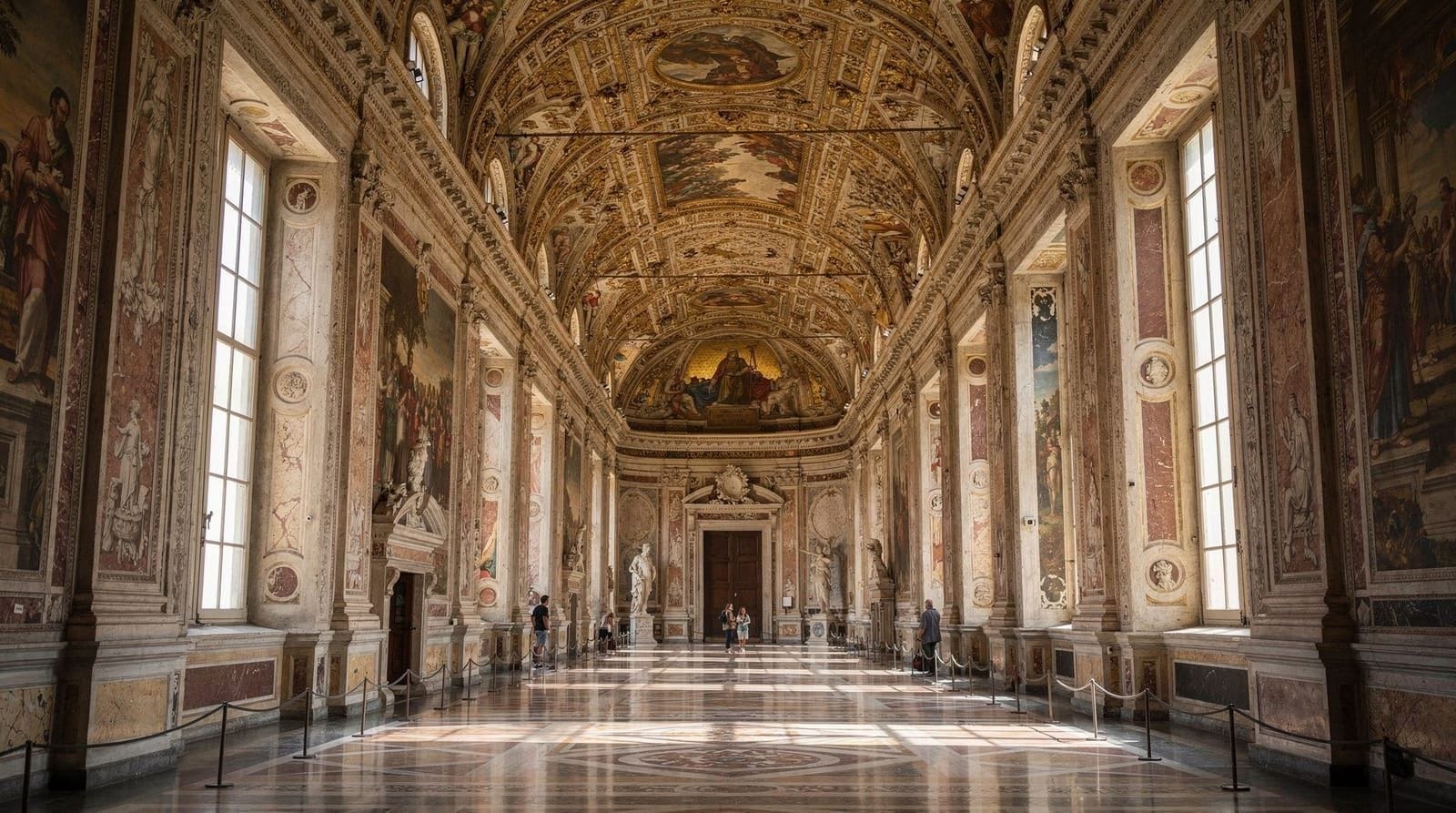
Vatican Museums and Sistine Chapel skip-the-line entryThe route through the museums is one-way: Gallery of Maps, Raphael Rooms (the School of Athens is here), Sistine Chapel. Allow two to three hours. The Sistine Chapel is the climax — Michelangelo’s ceiling frescoes (1508-1512) above and his Last Judgement (1536-1541) on the altar wall. It is genuinely extraordinary, and it is worth the journey.
12:30pm: St. Peter’s Basilica (free)
Exit the museums and walk directly to St. Peter’s Basilica — free to enter, ten minutes from the museum exit. The interior is one of the largest in the world and contains Michelangelo’s Pietà (now behind glass but still visible), Bernini’s immense bronze baldachin over the papal altar, and the brass marker on the floor showing the relative lengths of the world’s major cathedrals (most are shorter than St. Peter’s; all of them are shorter by some distance). Allow 45 minutes. Skip the dome climb today — the queue takes time you do not have.
1:30pm: lunch in Prati
Prati is the neighborhood immediately east of the Vatican: good mid-range restaurants, reliable gelato, no tourist surcharge on the scale of the Vatican’s tourist zone. Lunch here takes 45-60 minutes.
2:30pm: Castel Sant’Angelo (optional)
If time allows, Castel Sant’Angelo — the cylindrical former mausoleum of Hadrian — is 15 minutes from Prati on foot and offers excellent views back toward St. Peter’s from its ramparts. Allow 90 minutes. This works only if your all-aboard time is 8pm or later.
3:00-3:30pm: depart for Civitavecchia
Walk to Roma San Pietro station (15 minutes) and take the regional train back. Arrive Civitavecchia 50-65 minutes later.
Route option B: Ancient Rome and the centro storico
This option prioritises the Colosseum and the historic center over the Vatican.
7:30am: depart Civitavecchia
Take the earliest convenient train to Roma Termini. Arrive 8:30-9:00am.
9:00am-12:00pm: Colosseum and Roman Forum
The Colosseum requires a pre-booked timed ticket. The named reservation system means you must book a specific time slot in advance — without one, you cannot enter (the walk-up queue is now for ticket collection only, not entry). Book at coopculture.it or through a guided tour that includes entry.
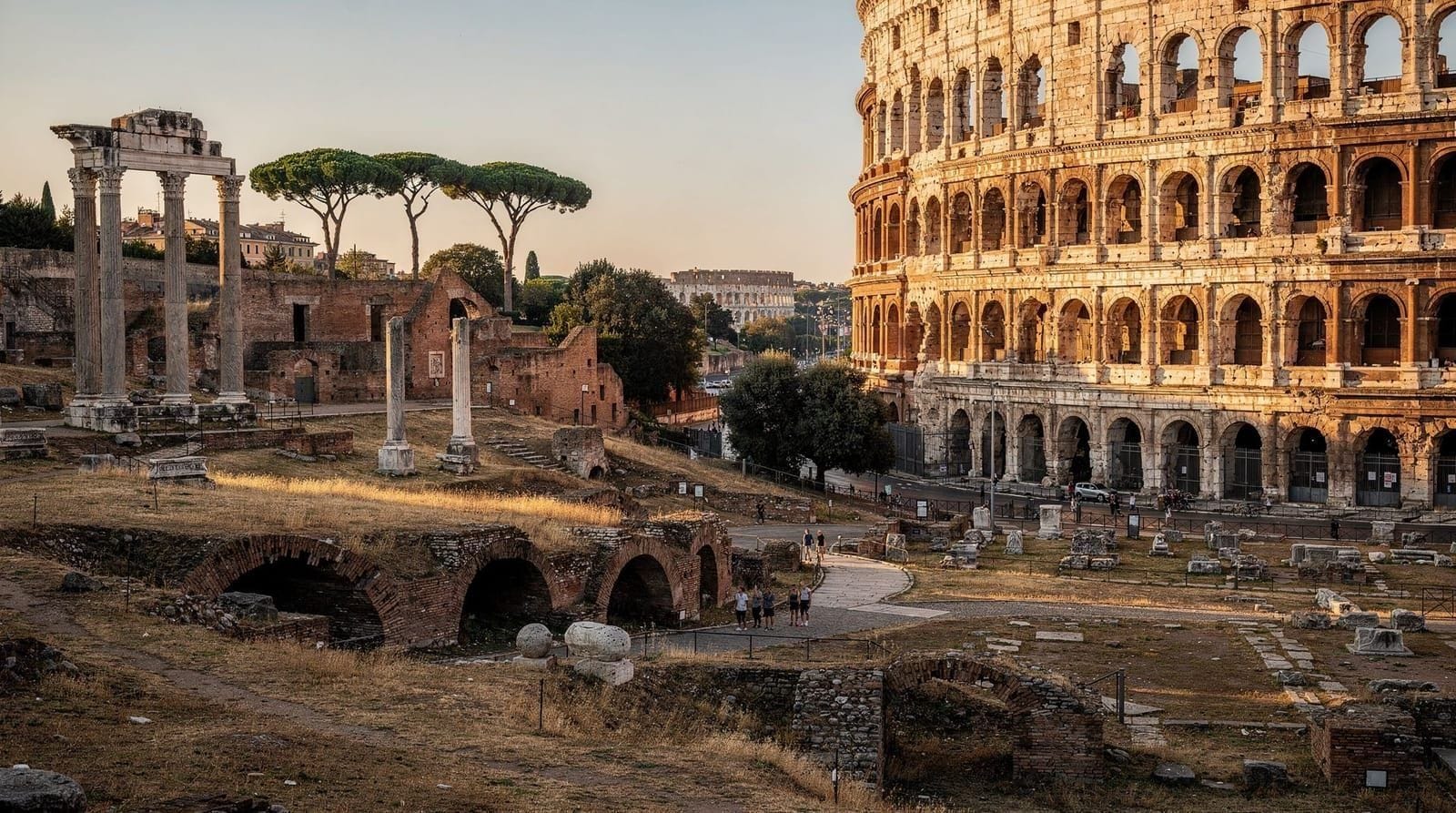
Colosseum, Roman Forum and Palatine Hill guided tourThe standard ticket covers the Colosseum, the Roman Forum, and Palatine Hill. With a full morning, you can do all three: the Colosseum interior with a guide (45-60 minutes), then the Forum (allow 60-90 minutes, including the Arch of Titus, the Via Sacra, the Temple of Saturn), then a walk up Palatine Hill for the aerial view. This is the world’s largest surviving amphitheatre — it held 50,000-80,000 spectators — and it is as impressive in person as the photographs suggest.
12:00pm: quick lunch near the Forum
The restaurants immediately around the Colosseum are overpriced and underqualified. Walk five minutes toward Monti for better options.
1:00-3:00pm: centro storico highlights
Take the metro (Line B from Colosseo, change at Termini for Line A, exit Spagna or Barberini) or a taxi to the centro storico. Two hours allows the Pantheon (pre-book online, €5 entry), a walk through Piazza Navona, and a pass by the Trevi Fountain. These three sights are within 10 minutes’ walk of each other.
Pantheon guided tour with skip-the-line entryThe Pantheon (built in its current form by Hadrian, 118-125 CE) is the best-preserved ancient building in the world. The concrete dome — 43.3 metres in diameter, the same as the height of the building — still has the largest unreinforced concrete dome ever built. The oculus at the top is the only light source and creates a moving column of light through the day. It is ten minutes from Piazza Navona and worth every minute of your time.
3:00pm: depart from Termini
Take the regional train from Termini back to Civitavecchia. Arrive 65-80 minutes later, well within your buffer.
What to realistically skip
The Borghese Gallery: 2-hour timed slots that sell out 10-14 days ahead. Not feasible unless pre-booked months in advance, and the time constraint makes it stressful.
The Vatican dome climb: 45-minute queue, 463 steps. Skip it today.
Trastevere: Beautiful but 20 minutes by taxi from the centro storico, and the streets are narrow enough to slow you down. Keep it for a return trip.
The catacombs: A half-day excursion to the Appian Way requires 3-4 hours minimum. Not compatible with a cruise day schedule.
Walking everywhere: Rome is larger than it looks on a map. Use the metro (Line A for the Vatican and the centro storico; Line B for the Colosseum) and taxis freely. A taxi from Termini to the Vatican is €15-20 and saves 40 minutes of transit time.
Practical notes
Avoid the tourist traps: Men offering gladiator photo opportunities around the Colosseum are paid photo-ops, typically €5-10 per photo, and aggressively pursued. Decline and keep walking. Vendors near the Trevi Fountain offering roses or selfie sticks expect payment after you accept; do not accept. Read more about Rome scams to avoid.
Water: Rome has over 2,500 working drinking fountains (nasoni) — the small iron tap fountains on street corners — with clean, cold water. You do not need to buy bottled water.
Dress code: Both the Vatican and Rome’s major basilicas require covered shoulders and knees. Pack a scarf or light layer. Women in shorts will be refused entry; men too.
Cash: Most attractions are card-only now, but small cafés, market stalls, and some restaurant cover charges prefer or require cash. Bring €50 in cash.
Mobile data: Italian SIM cards are cheap and useful; alternatively, most cruise ships have port Wi-Fi packages. Google Maps works offline if you download the Rome map before leaving the ship.
The Jubilee year: 2025-2026 is a Catholic Jubilee Year. Pilgrim and tourist numbers in Rome are elevated; queues and accommodation prices are higher than in non-Jubilee years. Pre-booking is more important than usual.
Return timing: Check the train back carefully on the Trenitalia app (or at the station information board). If your train is delayed, go to the information desk immediately — staff can advise on alternatives and connections to avoid missing your ship.
If you’ve already done a cruise day in Rome before
Repeat cruise visitors who have already covered the Vatican or the Colosseum have other options worth considering instead of repeating a route. Rome’s hidden churches — San Luigi dei Francesi, Sant’Agostino, Santa Maria del Popolo — hold six Caravaggio paintings between them, are free, close together in the centro storico, and see none of the queues of the headline sights; a return visitor can cover all three in 90 minutes. Alternatively, Trastevere style neighbourhood wandering (skip it on a first cruise day, as noted above) becomes the better choice on a second or third visit once the marquee sights are done. Compare this against the fuller one day in Rome itinerary, which assumes you’re starting from a hotel in the city rather than a ship, and has a slightly different timing logic as a result.
A note on ship-organised vs independent tours
The ship’s own Rome shore excursions will typically include return coach transfers, a guided city tour, and often a lunch stop. They are significantly more expensive than going independently — expect €80-150 per person versus €30-40 total for train tickets and attraction entry — but they come with one crucial guarantee: the ship waits for its own excursions. If the coach is delayed, the departure time adjusts. If your independent train is delayed, it does not.
For a traveler who finds logistics stressful, or who is visiting Rome for the first time without prior knowledge of the city, the peace of mind from a ship excursion may be worth the premium. For a confident traveler who books in advance and builds in the required buffer, independent is significantly cheaper and gives you more flexibility about what to see.
The middle ground — a pre-booked private or small-group guided tour in Rome that is independent of the ship, combining skip-the-line access with expert commentary — often delivers the best combination. These tours typically handle transport from and to Roma Termini station, handle entry tickets, and run to a fixed schedule that is easy to manage against your ship’s timetable.
The one-day Rome decision
Be honest with yourself about what one day in Rome can deliver. You will not see the Vatican and the Colosseum and the Pantheon and the Trevi Fountain and the Borghese Gallery in a single day — not without giving each of them a fraction of the time they deserve. Pick two or three things and do them well. The Vatican Museums and St. Peter’s is a full half-day. The Colosseum, Forum, and Palatine is another. The Pantheon and the centro storico on foot for two hours is a third, smaller experience. Choose based on what genuinely matters to you.
The one reliable regret from a cruise day in Rome is not “I didn’t see enough.” It is “I queued for two hours and didn’t see anything.” Pre-book every entry ticket before your ship leaves its previous port. That single step is the difference between a good day and a frustrating one.
If your ship is in Civitavecchia for two days, consider splitting the agenda: ancient Rome on day one, Vatican on day two. With the pressure reduced, both are considerably more enjoyable. If you’re arriving by air rather than by ship for a similar time-limited visit, the logic is comparable but the buffer is different — see getting from Fiumicino to Rome for that version of the calculation.
FAQ
Can I do both the Vatican and the Colosseum in one cruise day? Not comfortably. Each deserves a half-day on its own, and the transit between the Vatican side of the river and the Colosseum side costs 30-40 minutes each way by metro. Pick one as your anchor (Route A or Route B above) and treat the other as a reason to return, rather than compressing both into a single rushed day.
What happens if my train back to Civitavecchia is delayed? Go straight to the station information desk — staff can advise on the next available connection. This is exactly why the 90-minute (ideally two-hour) buffer before all-aboard exists: a single 20-30 minute delay should not put your return at risk if you’ve built the buffer in. Missing the ship is entirely your responsibility and expense, so treat the buffer as non-negotiable, not a nice-to-have.
Is a ship-organised shore excursion worth the extra cost? It depends on your risk tolerance. The ship waits for its own excursion buses if they’re delayed; it will not wait for you if your independent train runs late. For a first-time visitor or anyone who finds transit logistics stressful, the premium (roughly €80-150 per person versus €30-40 independently) buys genuine peace of mind. Confident planners who pre-book entry tickets and respect the buffer do fine independently.
Top experiences
Bookable activities with verified prices and instant confirmation on GetYourGuide.