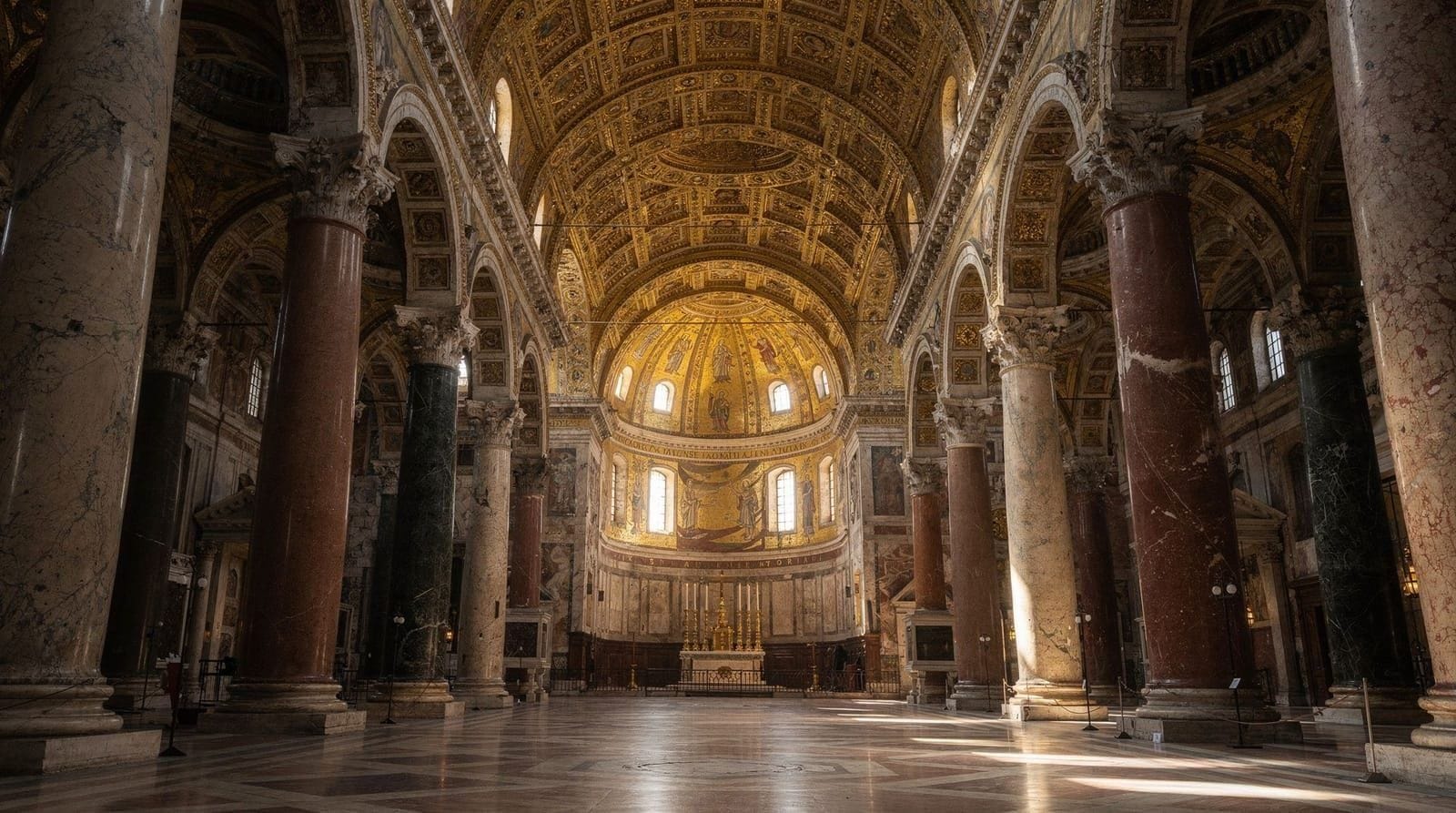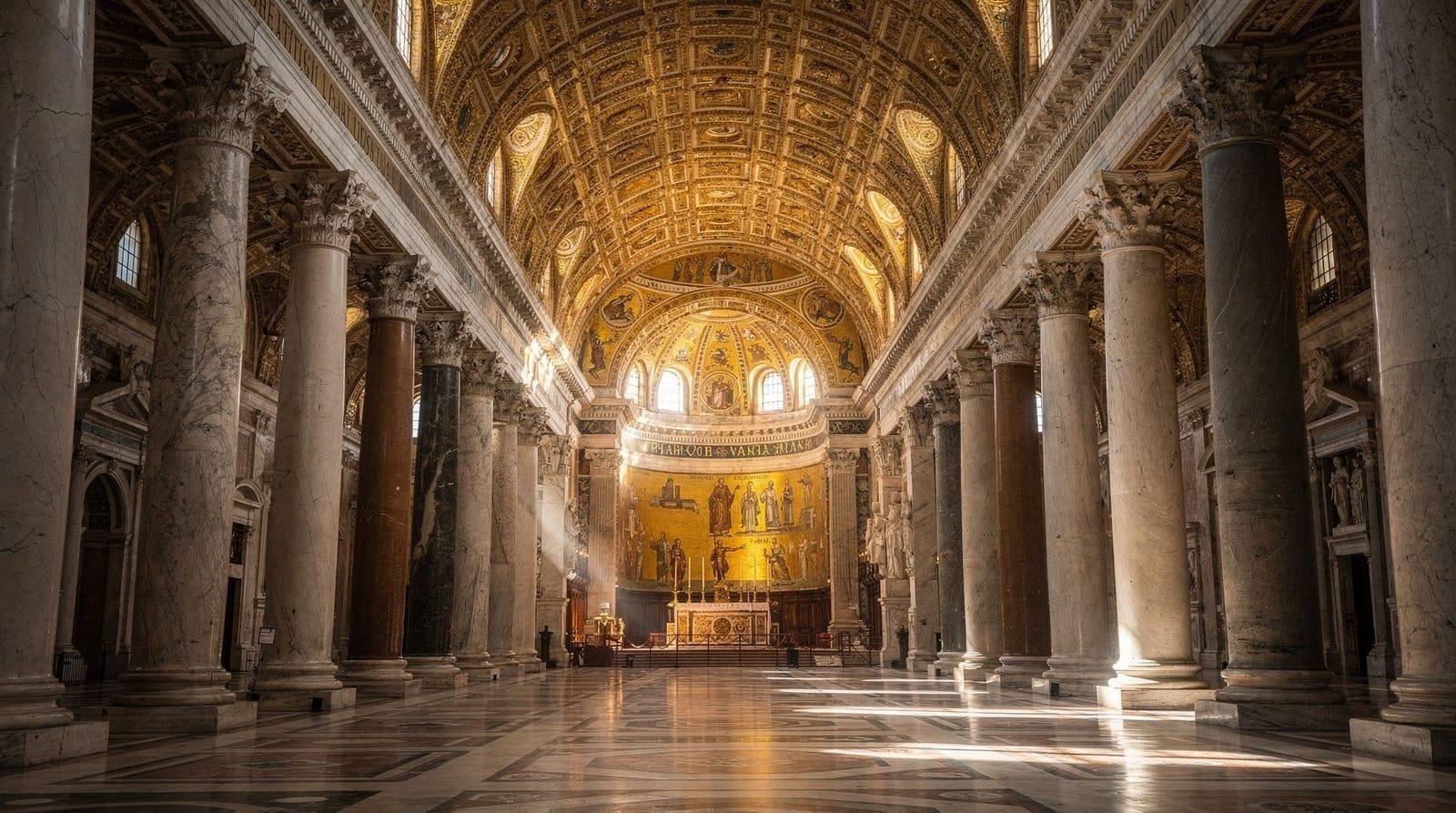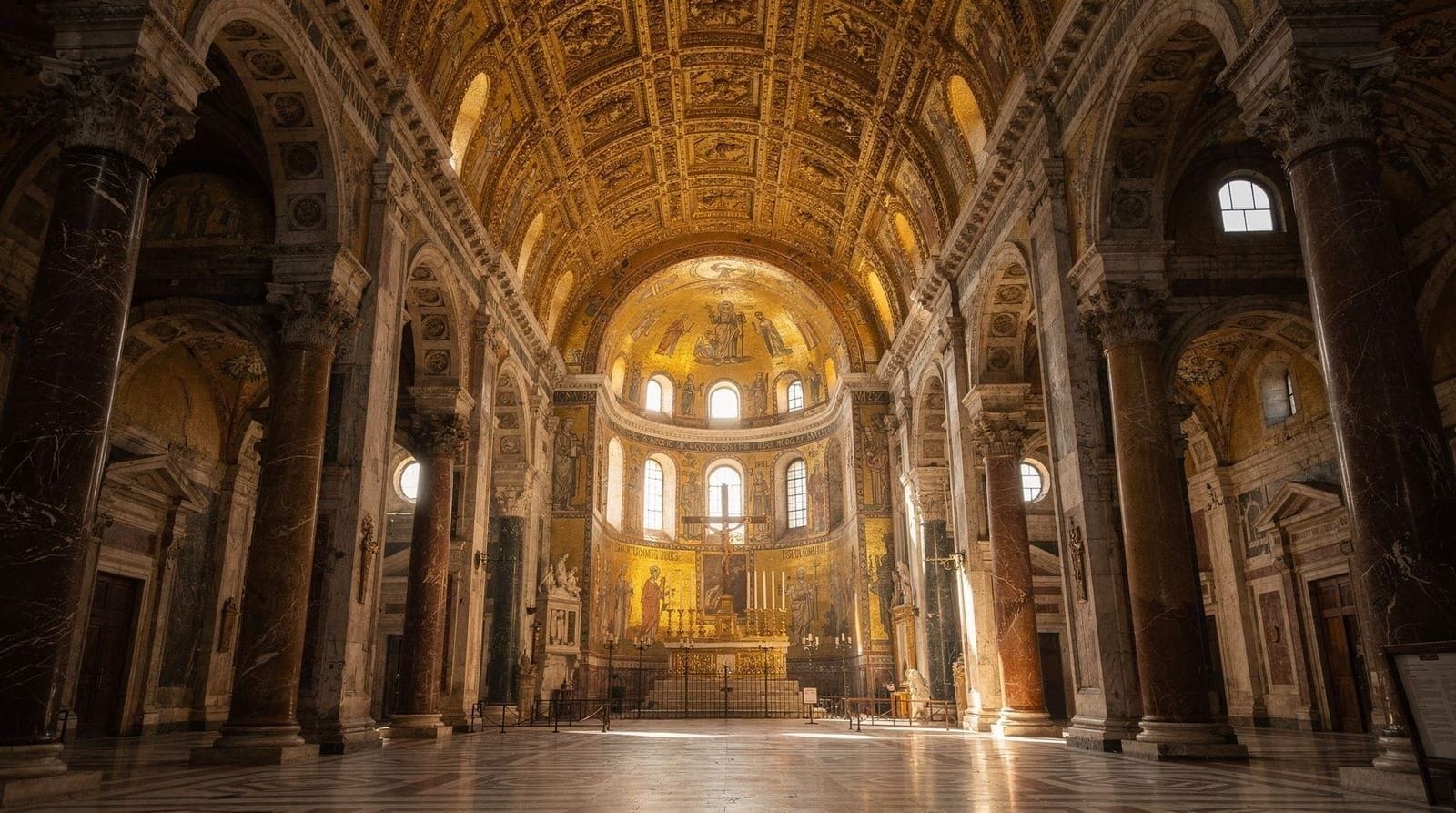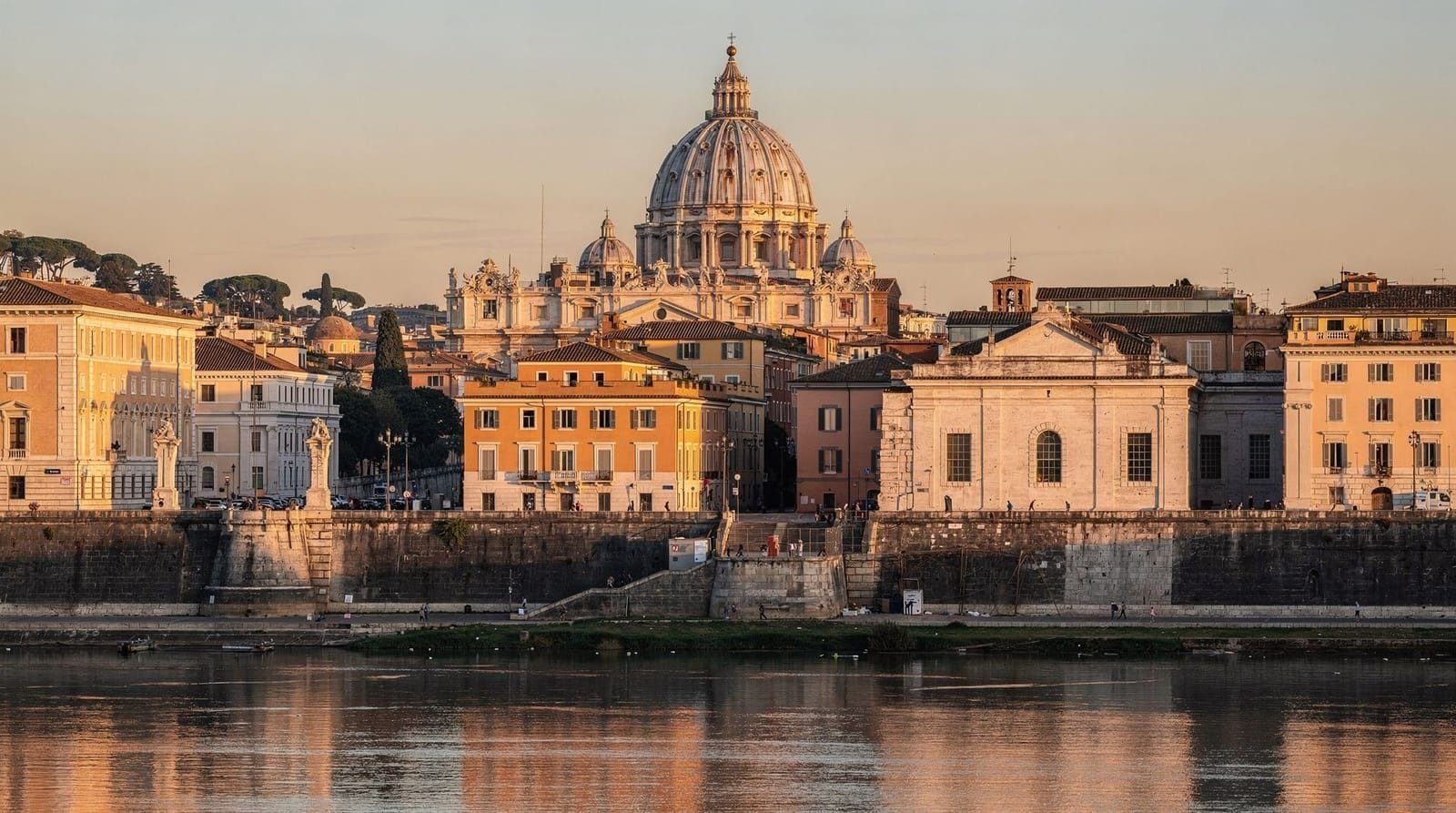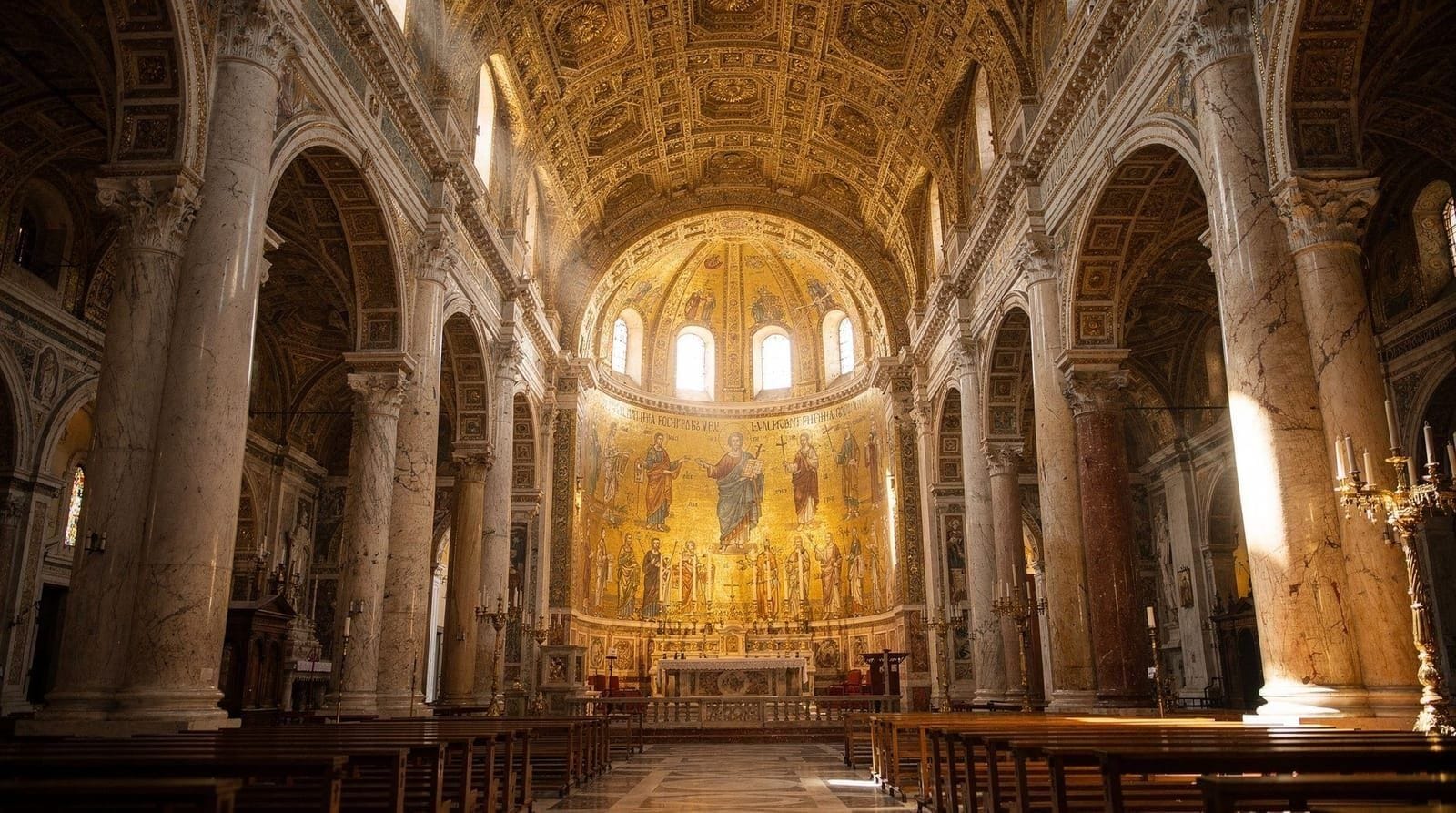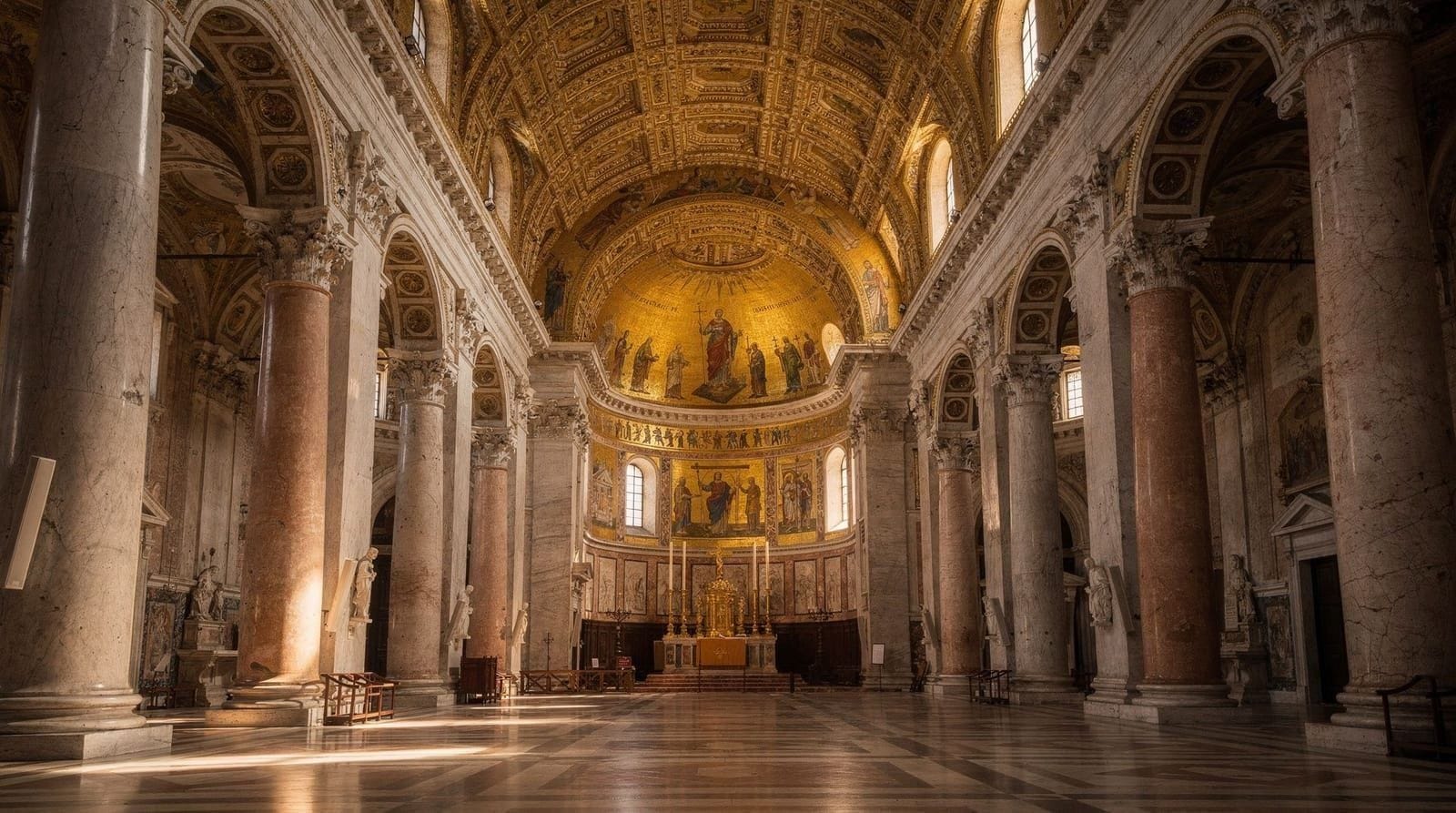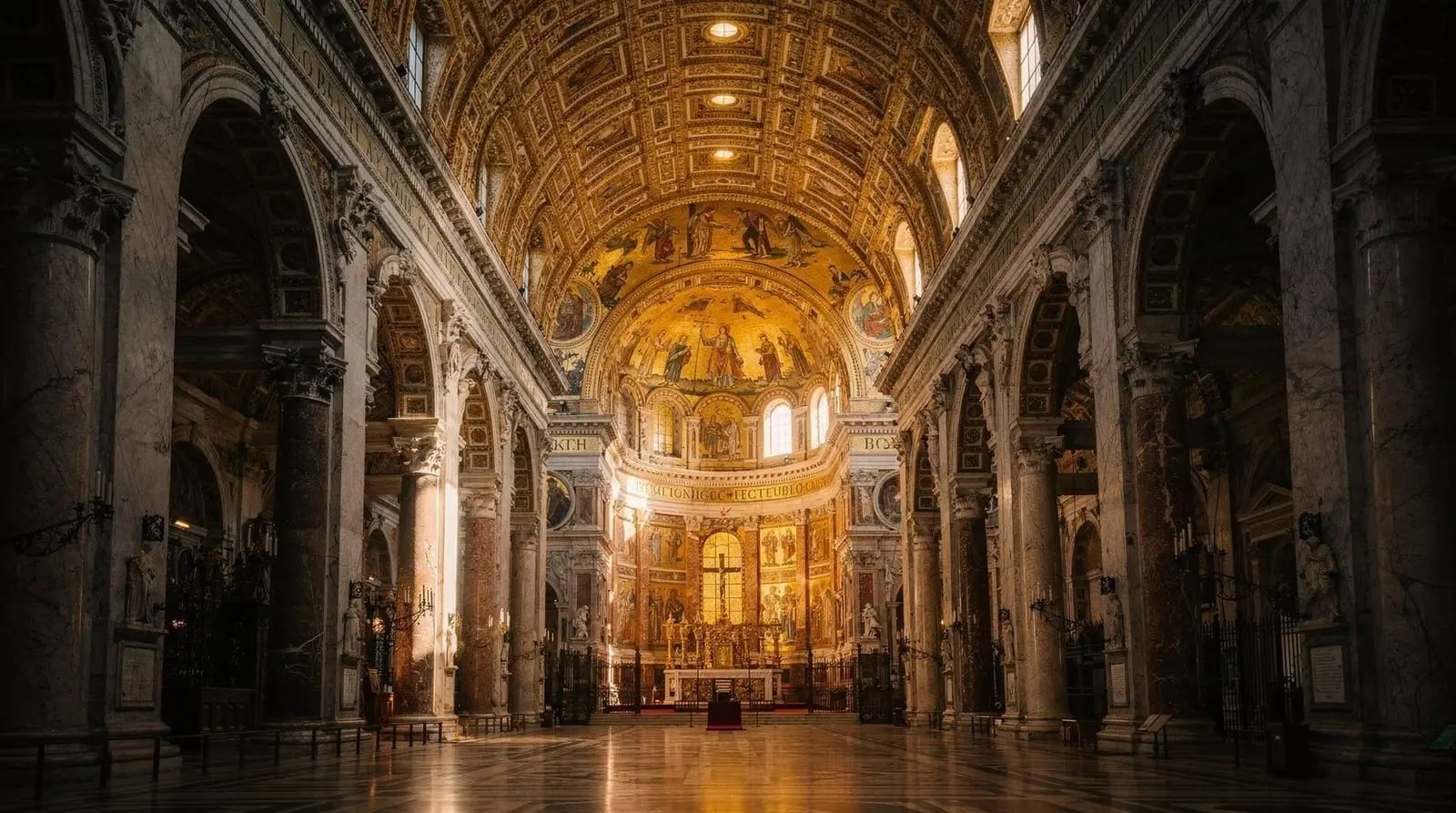
The four papal basilicas of Rome: a complete guide
Rome: Spanish Steps, Trevi, Navona and Pantheon Sunset Tour
Duration: 2 hours
What are the four papal basilicas of Rome?
St. Peter's Basilica (Vatican), San Giovanni in Laterano (Lateran), Santa Maria Maggiore (Esquiline Hill), and San Paolo fuori le Mura (south of the centre). All four are free to enter. They are Rome's four principal pilgrimage churches, traditionally visited by pilgrims in a single day on foot — the medieval Jubilee circuit.
Rome’s four great churches: why they matter
Rome has approximately 900 churches. Four of them occupy a category apart. The four papal basilicas — St. Peter’s, San Giovanni in Laterano, Santa Maria Maggiore, and San Paolo fuori le Mura — are the major basilicas of the Catholic Church worldwide, not just of Rome. Each stands on a site considered foundational to Roman Christianity, each received direct papal patronage across nearly two millennia, and each is free to enter.
The pilgrimage tradition of visiting all four dates to the first Jubilee of 1300, declared by Pope Boniface VIII. By visiting all four and confessing, pilgrims received a plenary indulgence — a full remission of the temporal punishment for sin. Hundreds of thousands of medieval and Renaissance pilgrims walked the circuit on foot in a single day, a route of roughly 15 kilometres through what was then a sparsely populated city. That same circuit remained the spiritual core of the 2025 Jubilee, when millions of modern pilgrims followed it.
For a contemporary visitor without theological motivations, the four basilicas represent an unmatched survey of 1,700 years of Christian architecture and art — from the 4th-century foundations of Constantine to Baroque reconstructions of the 17th century — all free.
| Entry | Free for all four; add-ons like the dome climb cost extra |
| Time needed | 30–90 min each; a full circuit is a demanding full day |
| Dress code | Shoulders and knees covered, enforced at every entrance |
| Getting between them | Walkable in the traditional order, or ~8km using public transport |
| Furthest from centre | San Paolo fuori le Mura — Metro Line B, ~12 min from Termini |
Comparing the four basilicas at a glance
| Basilica | Signature feature | Time needed | Getting there |
|---|---|---|---|
| St. Peter’s | Michelangelo’s Pietà, the dome | 60–90 min + queue | Vatican, Metro A Ottaviano |
| San Giovanni in Laterano | Borromini’s nave, Holy Stairs | 45–60 min | Metro A/San Giovanni |
| Santa Maria Maggiore | 5th-century nave mosaics | 30–45 min | Near Termini |
| San Paolo fuori le Mura | Papal portrait frieze, Paul’s tomb | 30–45 min | Metro B, ~12 min from Termini |
St. Peter’s Basilica (Basilica di San Pietro in Vaticano)
The building and its history
The current basilica was built over approximately 120 years (construction 1506–1626), replacing an earlier Constantinian basilica of the 4th century that had itself been built over the site of the Apostle Peter’s martyrdom and burial. Multiple architects contributed to its evolution: Bramante proposed the initial design, Raphael briefly oversaw the project, Antonio da Sangallo the Younger redesigned it substantially, and Michelangelo (from 1546, age 71) redesigned the dome and the eastern end. Carlo Maderno extended the nave and built the baroque facade (completed 1612). Bernini designed the colonnade of St. Peter’s Square (1656–1667).
The result is a building that is simultaneously the product of many competing visions and, somehow, one of the most coherent large spaces in world architecture.
What to see inside
Michelangelo’s Pietà (1498–1499, first chapel on the right): The 23-year-old sculptor’s most celebrated work — Mary holding the body of Christ immediately after the deposition from the cross. It is behind glass since an attack in 1972 but still visible in extraordinary detail. The marble surface, famously, appears almost soft. This is typically the first major work visitors encounter upon entering; budget 10 minutes here.
Bernini’s baldachin (1623–1634): The 29-metre bronze canopy over the papal altar and the tomb of St. Peter is the largest bronze object in the world. Bernini made it using bronze stripped from the Pantheon’s portico ceiling — a despoliation memorably criticized by Pasquino (one of Rome’s “talking statues”) with the line attributed to Pasquino or Pasqualino: “What the barbarians did not do, the Barberini did.” (Pope Urban VIII was Maffeo Barberini.) It is visible from the entrance but best appreciated from beneath.
Michelangelo’s dome: The structural and aesthetic crown of the building — 136 metres to the top of the external lantern. Climb or take the lift to the drum level (€8 stairs, €10 lift) for views over Rome that no other vantage point quite matches. The interior mosaic decoration of the dome dates from the 16th–17th centuries.
The Vatican Grottoes (free, separate queue): The level beneath the current basilica preserves remains of the previous Constantinian building and the tombs of multiple popes. Access is from inside the basilica near the exit — follow signs. No photography in parts of the grottoes; expect 20–30 minutes.
Practical information
Entry to the basilica itself is free but requires passing through security, with queues typically running 30–90 minutes from the St. Peter’s Square entrance. Visitors to the Vatican Museums who exit via the Sistine Chapel can sometimes access St. Peter’s from the internal entrance, bypassing the external queue — confirm this route is available when booking Vatican Museums tickets.
Dress code enforced. No tanks tops, shorts, or bare shoulders. The dress code check happens in the security queue itself; arriving underdressed means leaving the queue entirely.
Mass times vary; a schedule is posted at the basilica’s official website. Major papal audiences (Wednesday mornings) do not require tickets but do require registration via the Prefecture of the Pontifical Household.
For full coverage, see our St. Peter’s Basilica guide.
Vatican Museums, Sistine Chapel and St. Peter’s Basilica guided tour — combines all three in sequence with skip-the-line access, the most efficient way to cover the Vatican complex.San Giovanni in Laterano (St. John Lateran)
The mother church of all churches
The full title of this church is “The Most Holy Savior and Saints John the Baptist and the Evangelist at the Lateran,” which hints at its complexity. San Giovanni in Laterano is the Cathedral of Rome — the seat of the Bishop of Rome (the Pope) — and by Catholic doctrine the “mother church” of all Catholic churches in the world. It is, in formal terms, more important than St. Peter’s, which is technically the pope’s private basilica as head of the Vatican state.
The church’s history begins with Constantine I, who donated the Lateran Palace (previously an imperial property) to the Bishop of Rome around 313–318 CE and built the first basilica on the site. The building has been repeatedly rebuilt after fires and earthquakes. The current interior largely dates from 1646–1650, when Borromini completely remodelled it for the Jubilee of 1650 — one of the greatest Baroque architectural projects in Rome.
What to see
Borromini’s interior (1646–1650): Borromini transformed the old basilica into a unified Baroque nave flanked by enormous pilasters housing large niches with statues of the Apostles. The effect is imposing and somewhat cold compared to the more theatrical Baroque of nearby churches, but the spatial drama is considerable.
The apse mosaic (late 13th century, restored 19th century): A glittering Christ between the Virgin and saints fills the apse. The original was commissioned by Pope Nicholas IV in 1291; the current version is a 19th-century restoration that preserved the main compositional elements but is not the original tesserae.
The cloister (small fee, approximately €3): Adjacent to the basilica, built in 1215–1232, with twisted Cosmatesque columns inlaid with Cosmati mosaic work. One of the finest intact medieval cloisters in Rome and often uncrowded. Highly recommended for those interested in medieval art.
Papal relics and the Sancta Sanctorum: The Lateran complex originally housed the most important relic collection in Rome — the heads of Saints Peter and Paul, the Ark of the Covenant fragments, the table of the Last Supper (a fragment, allegedly). Most relics were distributed elsewhere over the centuries, but the Sancta Sanctorum (the pope’s private chapel, formerly inaccessible) can now be visited by prior appointment.
The Holy Stairs (Scala Santa)
Directly across the road from the basilica is the Scala Santa complex, housing 28 marble steps believed to be the stairs Christ ascended at Pontius Pilate’s palace in Jerusalem — brought to Rome by Helena, mother of Constantine I, in the 4th century. Pilgrims have climbed these stairs on their knees in prayer since the Middle Ages. A bypass staircase is available for non-devotional visitors. The experience of watching contemporary pilgrims making this act of devotion is one of the most unexpectedly moving encounters in Rome — more viscerally religious in its reality than almost any museum display of religious art.
Full coverage: St John Lateran guide.
Santa Maria Maggiore (Basilica of Saint Mary Major)
The oldest complete church in Rome
Santa Maria Maggiore, on the Esquiline Hill near Termini station, is the oldest church in Rome of which the original interior substantially survives. The nave structure and the extraordinary mosaic programme date from approximately 432–440 CE, the pontificate of Sixtus III — within a generation of Christianity becoming the state religion of the Roman Empire.
The legend of its foundation is the miracle of the snow: the Virgin appeared to a Roman nobleman and to Pope Liberius (352–366 CE) on the same night, instructing them to build a church on the site where snow would fall the next morning in August. Snow fell on the Esquiline Hill (an otherwise rare event in Rome’s summer), and the church was built. The miracle is commemorated annually on 5 August by a shower of white rose petals from the coffered ceiling.
What to see
The 5th-century nave mosaics: Running along both sides of the nave above the columns, 36 panels depicting Old Testament scenes from the reigns of Abraham, Jacob, Moses, and Joshua. These are the oldest surviving large-scale narrative mosaics in any Christian building. Their style — flat, frontal, direct — belongs to the late antique tradition moving toward the Byzantine, and has nothing of the Renaissance naturalism of the churches built a millennium later. The contrast makes them more striking, not less.
The 13th-century apse mosaics (by Jacopo Torriti, 1295): Christ and the Virgin enthroned in a swirling composition of golden tesserae, surrounded by angels and saints. Commissioned by Pope Nicholas IV — the same pope who commissioned the Lateran apse mosaic. Torriti’s Santa Maria Maggiore version is the finer work.
The Sistine Chapel (not the famous one): Pope Sixtus V built a transept chapel on the right in 1585–1590, designed by Domenico Fontana, which contains his own tomb and the Chapel of the Holy Crib — housing a relic claimed to be wood from the manger in Bethlehem. This private papal chapel is lavishly decorated and free to view.
The coffered ceiling: The gold-leaf coffered nave ceiling, attributed to Giuliano da Sangallo, was gilded with gold allegedly brought from the Americas by Columbus — donated by Ferdinand and Isabella of Spain to Pope Alexander VI, and used here around 1493. True or not, the ceiling is remarkable.
Full coverage: Santa Maria Maggiore guide.
San Paolo fuori le Mura (St. Paul Outside the Walls)
The largest church in Rome after St. Peter’s
San Paolo fuori le Mura stands about 1.5 kilometres south of the Aurelian Walls along the Via Ostiense — outside the walls of ancient and medieval Rome, built over the burial site of the Apostle Paul. The current structure dates largely from a 19th-century restoration following a catastrophic fire in 1823 that destroyed most of the ancient basilica.
This history creates a paradox: San Paolo is both a site of extraordinary antiquity (Paul’s tomb beneath the altar, the site of Constantine’s 4th-century basilica) and largely a 19th-century building. Visitors who expect the patina and layers of the other papal basilicas sometimes feel let down by the interior’s uniformity. Those who approach it for what it is — a masterpiece of 19th-century neoclassical church architecture on an ancient site — are better rewarded.
What to see
The nave: The rebuilt nave is enormous — 130 metres long, 80 metres wide — with 80 granite columns lining it. The scale is more immediately impressive than any of the other papal basilicas except St. Peter’s. The clerestory windows are of alabaster (onyx), giving the interior a warm, golden light unlike anything in Rome.
The papal portrait mosaic frieze: Around the nave, above the columns, a continuous mosaic frieze depicts the portraits of all 265 popes from Peter to the present. When a pope dies, his portrait is added by candlelight; a medieval prophecy holds that when all the spaces are filled, the world will end. Currently approximately 30 spaces remain.
Paul’s tomb: Beneath the altar, Paul’s tomb (confirmed by archaeological excavation in 2009 — the marble slab is original 4th century) is visible through a circular opening. A white marble sarcophagus bearing the inscription “Paulo Apostolo Mart” (Paul, Apostle, Martyr) was identified as almost certainly genuine.
The cloister: Adjacent to the basilica, the 13th-century Cosmatesque cloister is comparable in quality to the Lateran cloister and often less crowded. A small fee applies (approximately €5). Highly recommended.
Getting there
San Paolo fuori le Mura is the most remote of the four papal basilicas. Metro Line B to Basilica San Paolo (direct, approximately 12 minutes from Termini) is the most convenient approach. Bus 23 from the Lungotevere also stops nearby. Allow the extra time — the out-of-centre location means most visitors see San Paolo as a dedicated half-morning or half-afternoon visit rather than combining it with the other three.
Photography and quiet moments
All four basilicas permit photography without flash in the main nave, though some side chapels and treasuries restrict it — signage varies and is worth checking on arrival rather than assuming a blanket rule. Beyond the practicalities, each basilica has a specific time of day when it is genuinely quiet enough to sit and absorb the space rather than navigate around tour groups. At St. Peter’s, this is the first 30 minutes after the doors open, before the day’s Vatican Museums crowds filter through. At Santa Maria Maggiore, weekday mid-afternoons are consistently calm. San Giovanni in Laterano and San Paolo fuori le Mura are rarely crowded at any time, which is part of why visitors who prioritise atmosphere over headline status often prefer them to St. Peter’s. If you value a few minutes of genuine quiet in a working church rather than a monument under siege by tour groups, build your basilica visits around these windows rather than treating all four as interchangeable stops on a checklist.
The Jubilee circuit: visiting all four
The traditional Jubilee pilgrim’s route visits all four in sequence, typically starting at St. Peter’s and finishing at San Paolo fuori le Mura or San Giovanni in Laterano. For a contemporary visitor, this makes an absorbing full day if timed carefully:
- Morning (08:30): San Pietro — arrive early to beat security queues
- Mid-morning (11:00): Walk or take a bus to Santa Maria Maggiore (30 minutes on foot or 10 by bus/taxi)
- Late morning (12:30): San Giovanni in Laterano (10 minutes on foot from Santa Maria Maggiore) — include the Holy Stairs across the road
- Lunch in the Lateran area
- Afternoon (15:00): Metro or bus to San Paolo fuori le Mura
This itinerary covers approximately 15–17 kilometres of walking if done entirely on foot (the original pilgrim’s route); using public transport between basilicas reduces this to perhaps 8 kilometres.
Families and visitors with limited mobility should not feel obligated to attempt all four in sequence. A more realistic adaptation splits the circuit across two days: St. Peter’s and Santa Maria Maggiore on one day (both manageable with a slower pace and rest stops), San Giovanni in Laterano and San Paolo fuori le Mura on another. This halves the walking distance per day and avoids the fatigue that undermines appreciation of the later basilicas on a rushed single-day attempt.
Evening guided walking tour of central Rome — a good complement to a day spent at the four basilicas, covering the historic centre’s piazzas and fountains in the cooler evening hours.What the four basilicas share
Each of the four papal basilicas contains:
- A holy door (Porta Santa), bricked up except during Jubilee years, when the pope ceremonially opens it to grant access to pilgrims
- A papal altar over a major relic (typically an apostle’s tomb or significant relics)
- A cloister or treasury (usually requiring a small fee)
- A confessio — the sunken area in front of the altar that allows the faithful to pray directly over the tomb of the church’s patron
These structural features are not accidents — they reflect the common function of all four as major pilgrim churches. Understanding this structure makes each visit more legible: you are walking through a specific type of building designed for a specific liturgical and devotional purpose, repeated in four variants across the city.
For a broader survey of Rome’s church art including the Caravaggio chapels and smaller churches not covered here, see our Rome basilicas and Caravaggio guide.
Who should attempt all four, and who should skip some
Attempting all four basilicas in one day is a genuinely demanding undertaking, physically and logistically, and is not necessary to appreciate any of them individually. If you have limited time in Rome, prioritise St. Peter’s (unmatched scale and art) and either Santa Maria Maggiore (closest to Termini, least crowded, oldest mosaics) or San Giovanni in Laterano (the Holy Stairs experience is genuinely unlike anything else in Rome). San Paolo fuori le Mura rewards visitors with a specific interest in early Christian archaeology or the papal portrait tradition, but its distance from the centre makes it the first to cut if your schedule is tight. For a broader itinerary that places these basilicas within a wider Rome visit, see Rome for first-timers and popes and papacy in Rome for the historical throughline connecting all four sites.
Frequently asked questions about The four papal basilicas of Rome: a complete
Are all four papal basilicas free to enter?
Can I visit all four papal basilicas in one day?
Which papal basilica is the most important?
What is the dress code for the papal basilicas?
How long does each papal basilica take to visit?
What is the history of the four papal basilicas?
Top experiences
Bookable activities with verified prices and instant confirmation on GetYourGuide.