Santa Maria Maggiore: Rome's greatest Marian basilica
Trevi, Pantheon & Spanish Steps Guided English Walking Tour
Is Santa Maria Maggiore worth visiting?
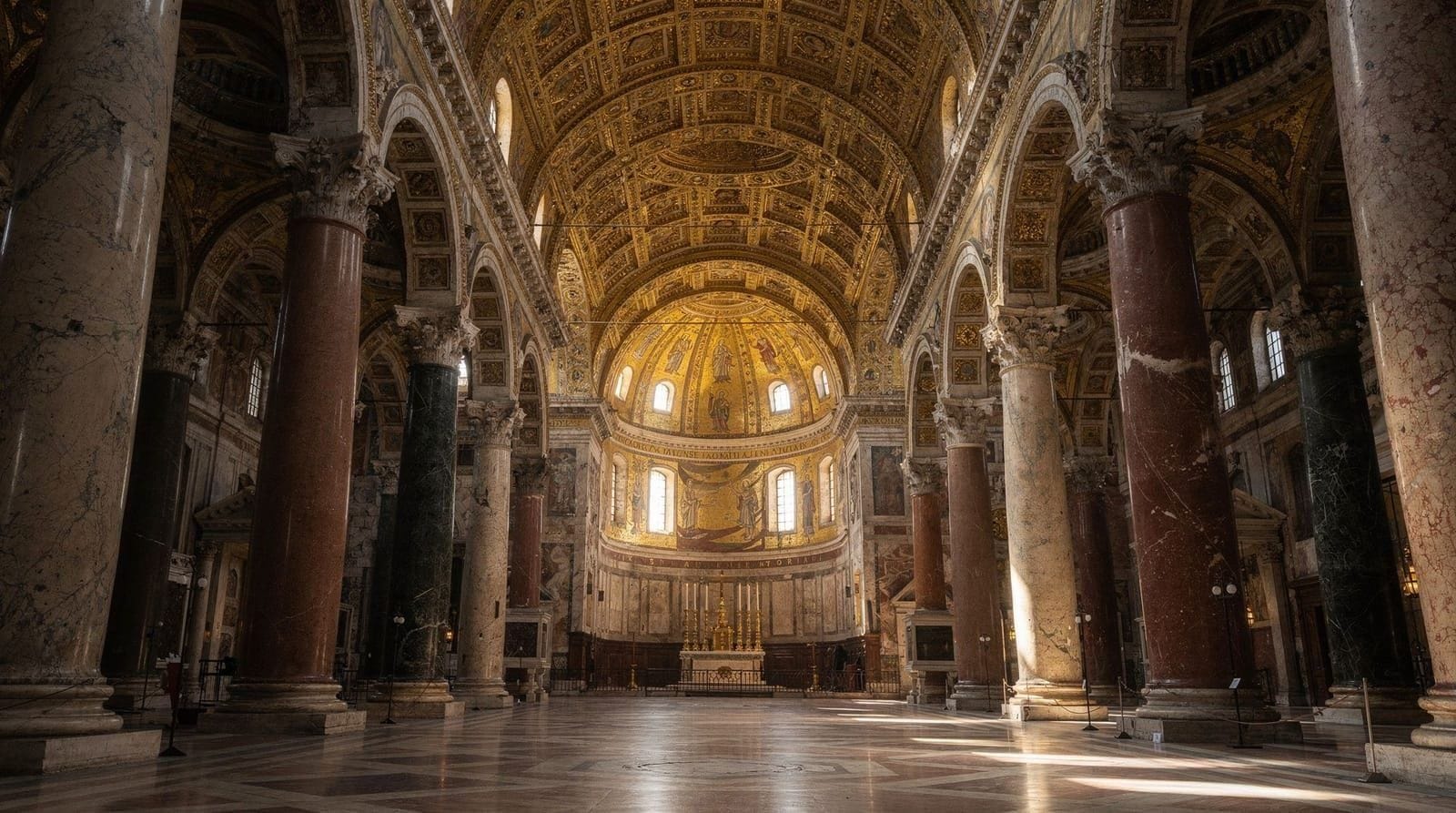
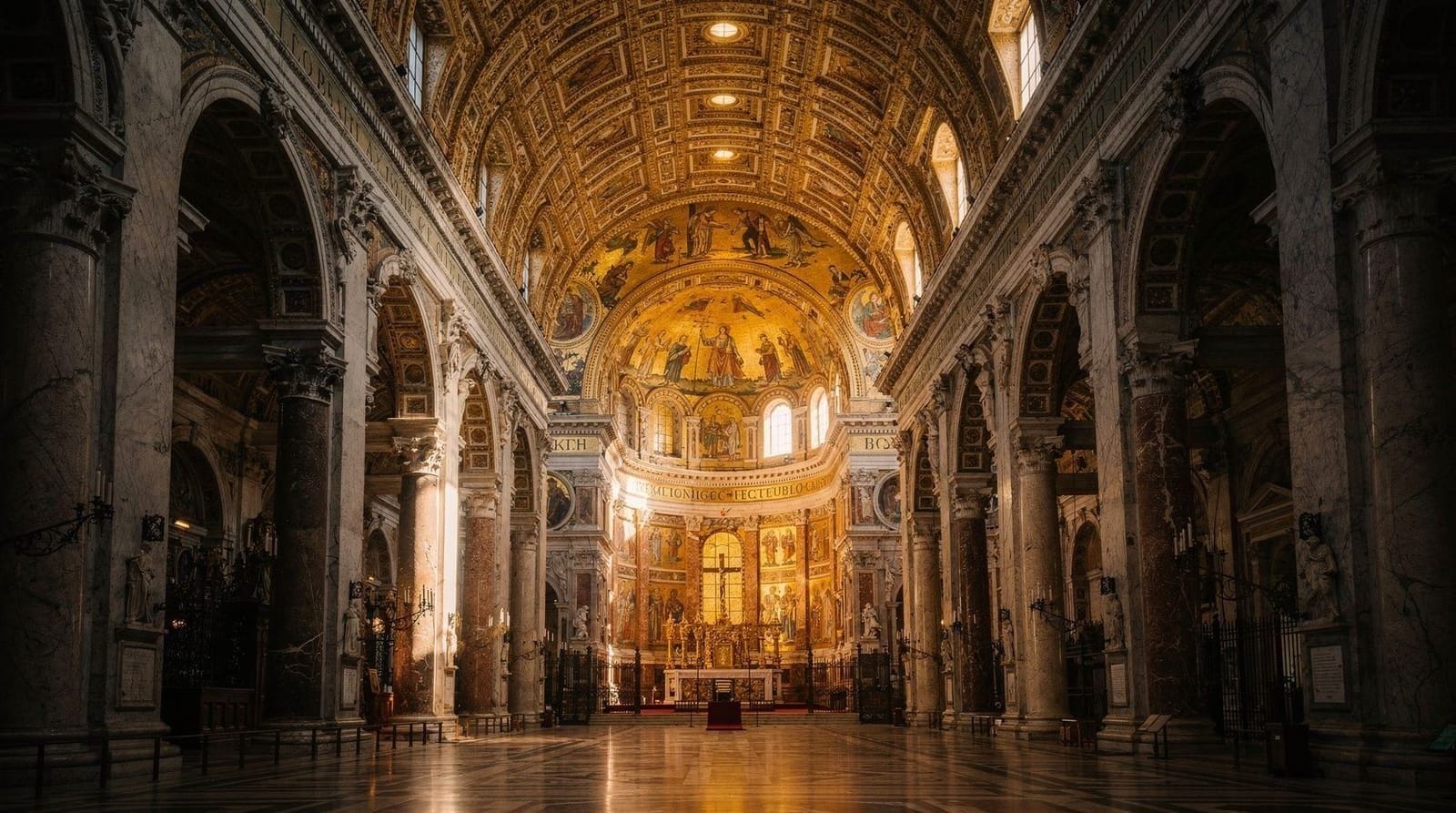
Yes — it is one of Rome's most undervisited major basilicas. The 5th-century nave mosaics are the oldest in any surviving Christian building, the 13th-century apse mosaic is spectacular, and the ceiling was gilded with gold allegedly brought from the Americas by Columbus. Free entry, no significant queues, and no midday closure. A 30–40 minute visit is sufficient for most visitors.
The church most visitors walk past
| Where | Piazza di Santa Maria Maggiore, Esquilino — 10 min walk from Termini |
| Cost | Free (main basilica) |
| Time needed | 30–40 minutes |
| Getting there | Metro A or B to Termini, then walk |
| Best time | Weekday mornings before 10:00; no midday closure |
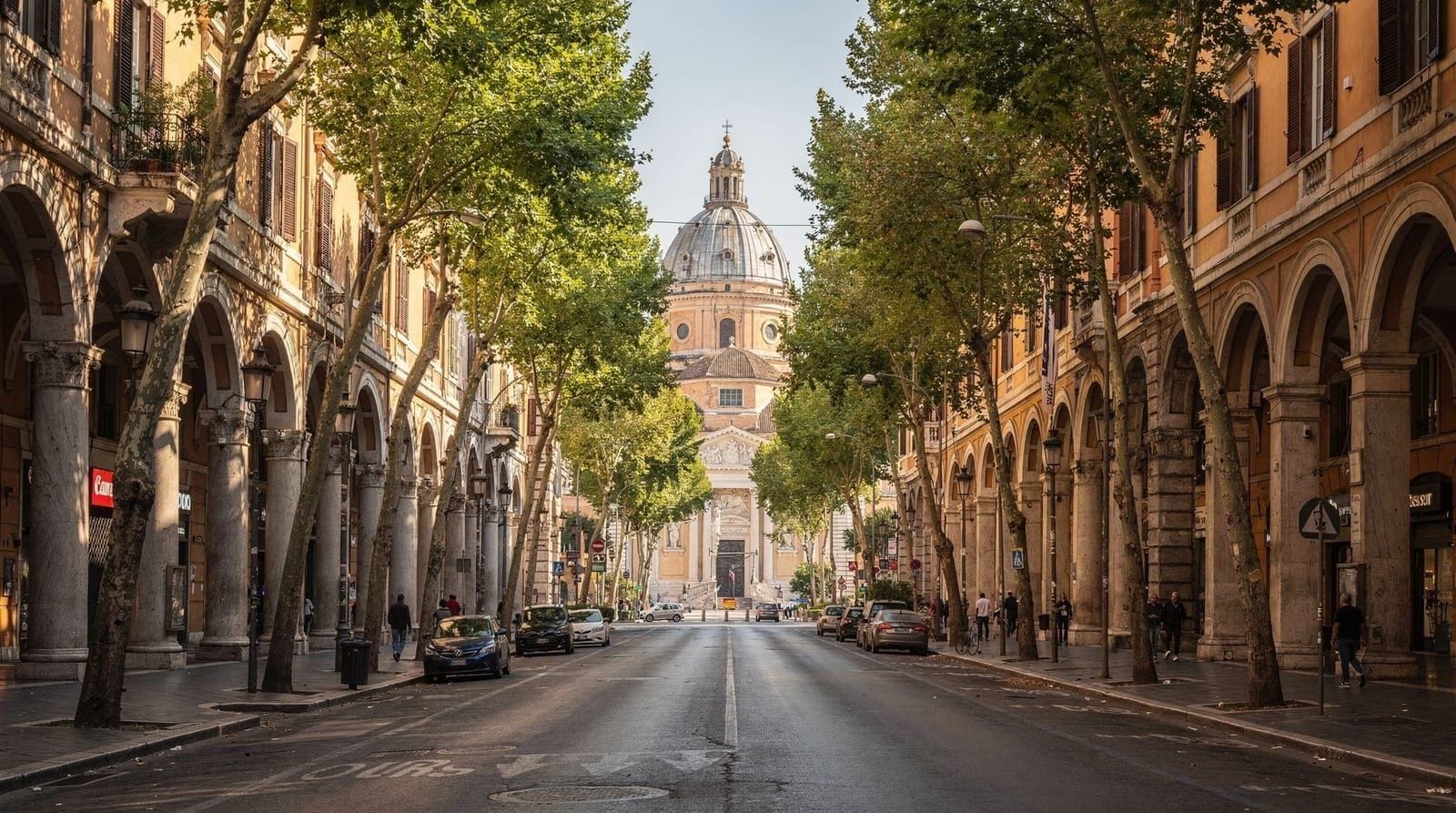
Santa Maria Maggiore sits on the Esquiline Hill just north of Termini station. Most visitors pass it on the bus or glance at it from a taxi and keep going — it is not in the same gravitational orbit as the Colosseum, Vatican, or Trevi Fountain. That is a significant mistake.
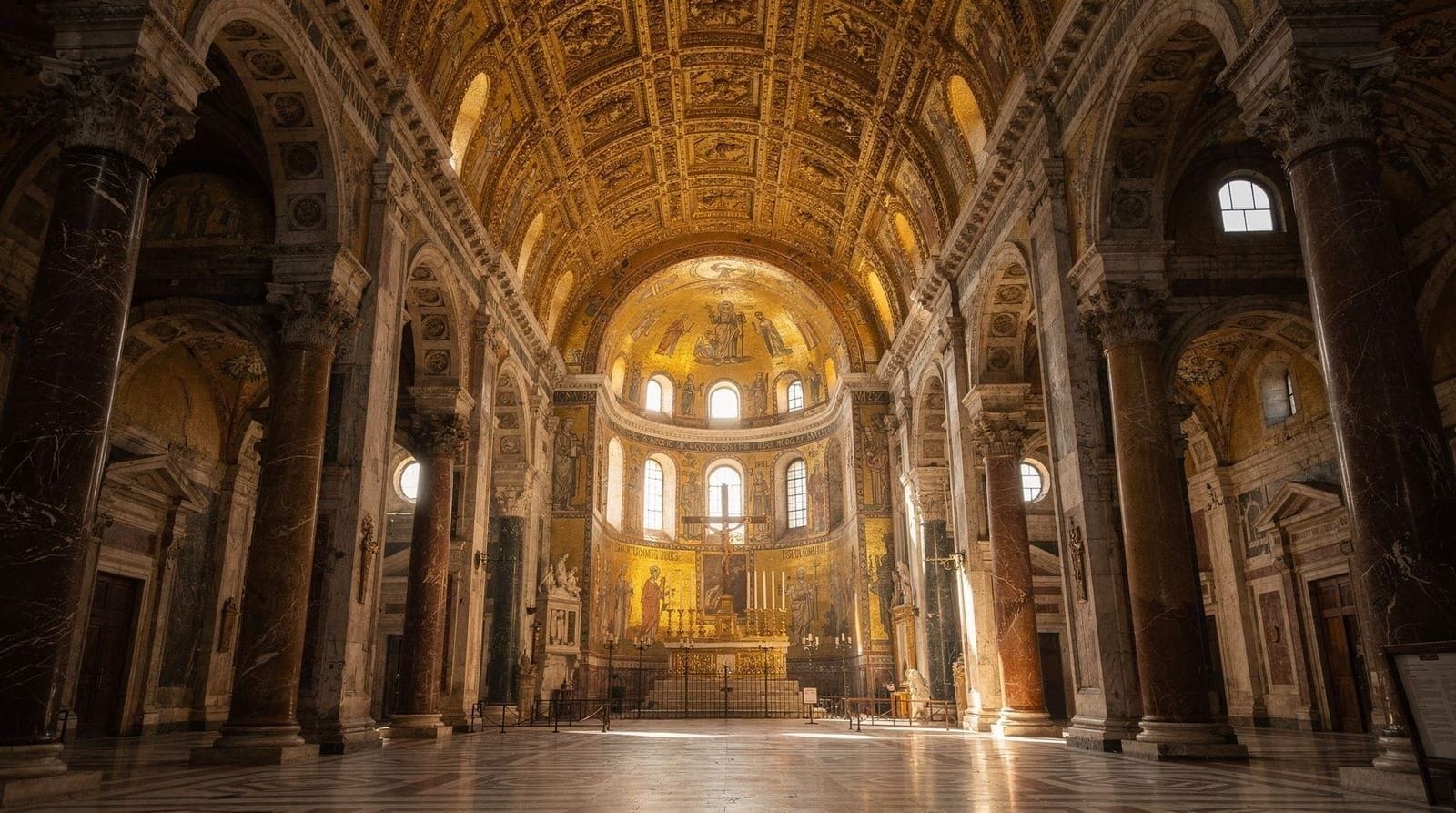
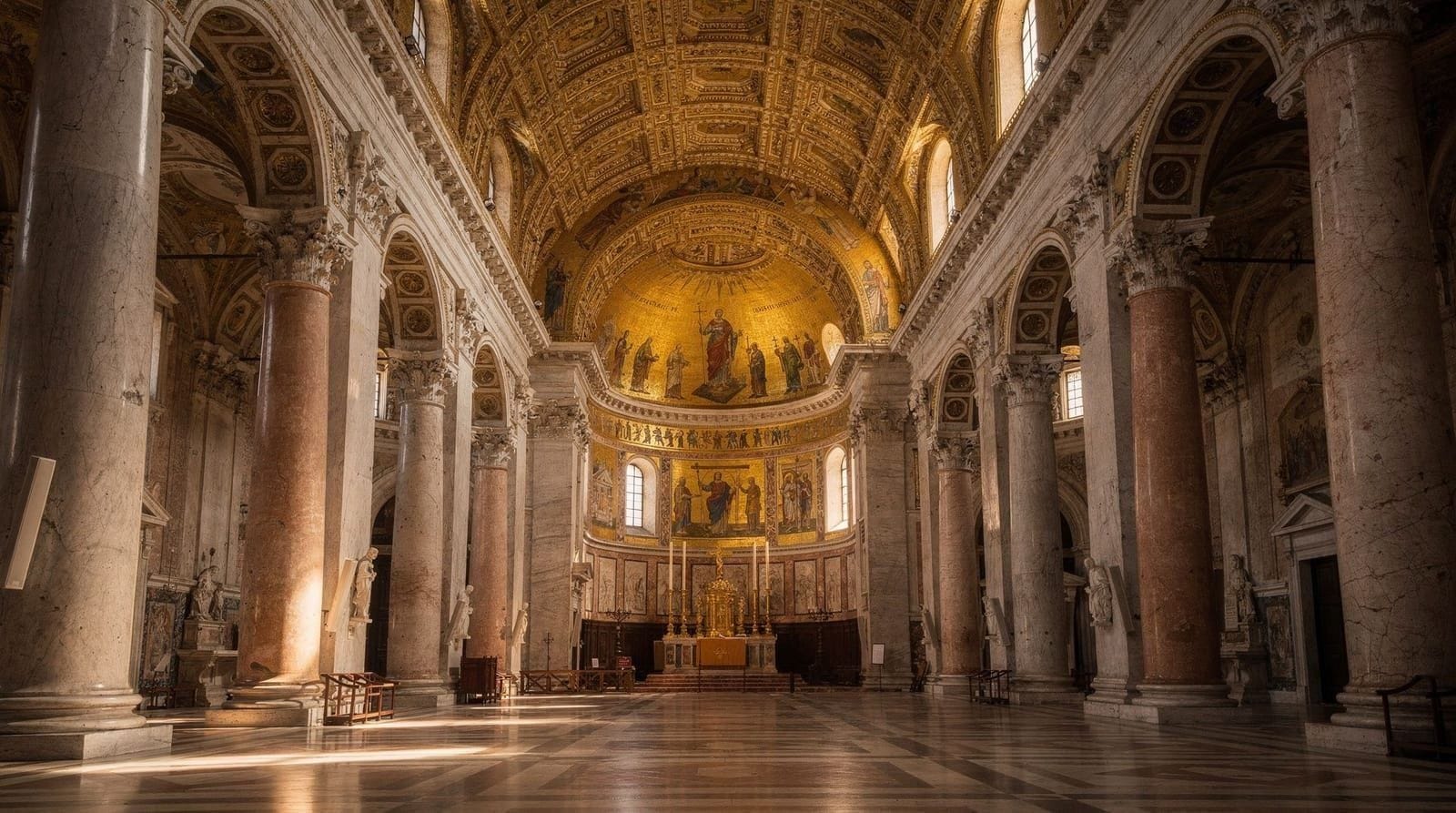
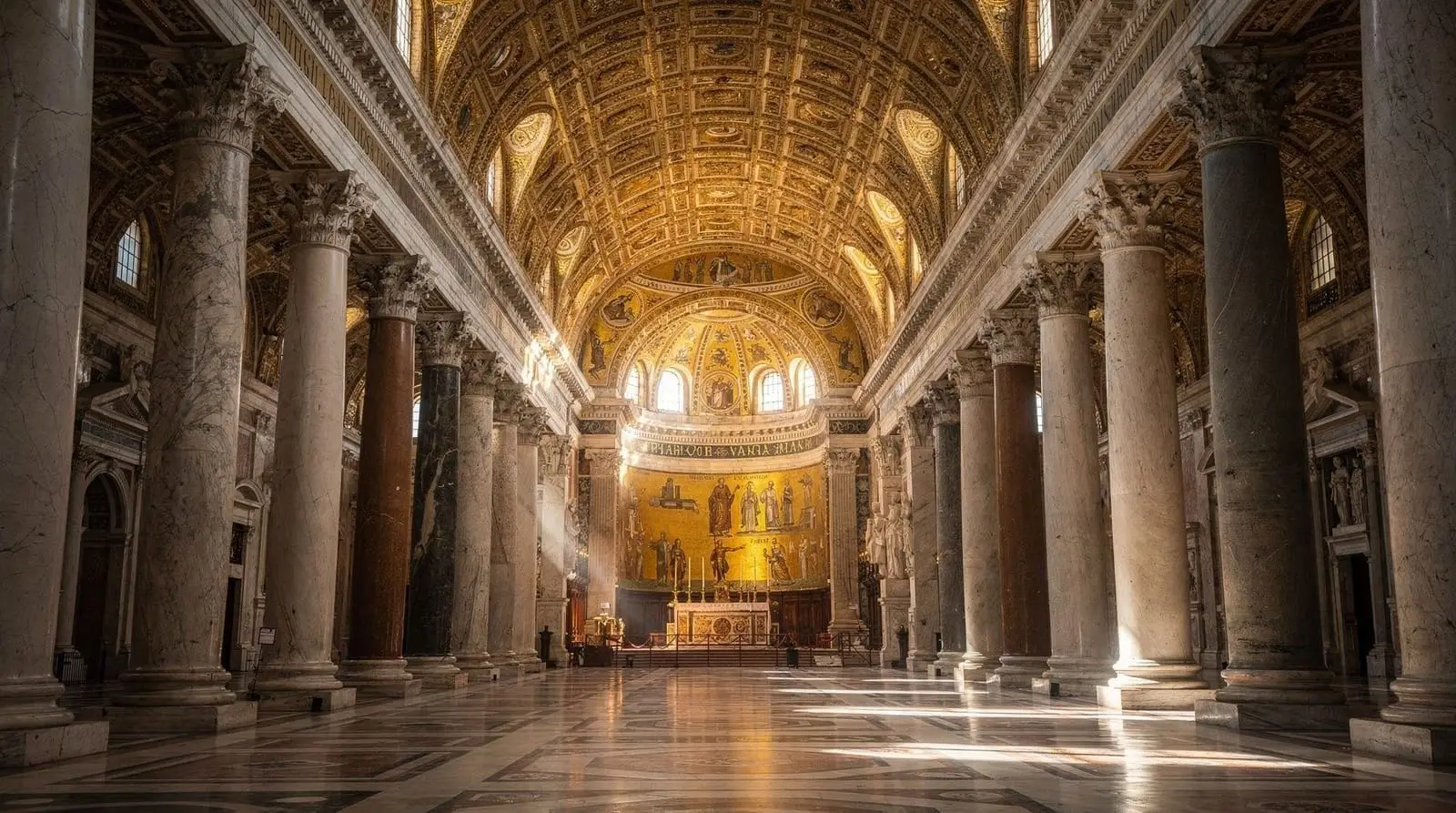
Inside this basilica is a mosaic programme that predates Ravenna’s famous mosaics, predates the Byzantine Empire’s conversion of Italy, and survives more completely than any comparable early Christian decorative programme anywhere in the world. The nave panels were installed around 432–440 CE — within roughly a century of Rome accepting Christianity as the official state religion, while the Western Roman Empire was in the final stages of collapse. Standing beneath them is one of the oldest encounters with Christian art available to any visitor in Europe.
The ceiling above those mosaics was gilded in the late 15th century using gold that may — according to tradition handed down through multiple sources — have been the first shipment of gold from the Americas, donated to Pope Alexander VI by Ferdinand and Isabella of Spain in 1493 following Columbus’s return.
Entry is free. The queue on a typical weekday is zero.
History: a church built on a miracle
The founding legend of Santa Maria Maggiore involves what Romans call the “Miracle of the Snow.” Pope Liberius (352–366 CE) and a wealthy Roman nobleman named Giovanni Patrizio both experienced a vision on the same night — 4–5 August — in which the Virgin appeared and instructed them to build a church on the Esquiline Hill where snow would fall the following morning. On 5 August, allegedly, snow fell on that spot — an event of moderate meteorological plausibility (Roman summer thunderstorms occasionally produce brief hail that locals historically called snow) but accepted as miraculous in medieval tradition.
The feast commemorating this event — Our Lady of the Snows, 5 August — is still observed in the basilica today. On that date, at the conclusion of Mass, white rose petals fall from the ceiling through a circular opening above the altar — 20 kilograms of petals, representing the snowfall. The effect is remarkable; if you happen to be in Rome on 5 August, this is worth experiencing.
The actual basilica whose remains survive dates from Pope Sixtus III (432–440 CE), who built the current nave and commissioned its mosaic programme immediately after the Council of Ephesus (431 CE) affirmed the title “Mother of God” (Theotokos) for the Virgin Mary. Santa Maria Maggiore was effectively a theological statement in built form — the dedication to Mary and the Old Testament programme in the nave affirming the doctrinal position that had just been controversially established at the council.
The church has been substantially modified in almost every subsequent century: medieval additions, Renaissance work on the Borghese and Sixtine Chapels in the 16th–17th centuries, 18th-century facade, and 19th-century restorations. But the core nave — the columns, the entablature, and the mosaic panels above — survives from Sixtus III’s 5th-century building.
The 5th-century nave mosaics
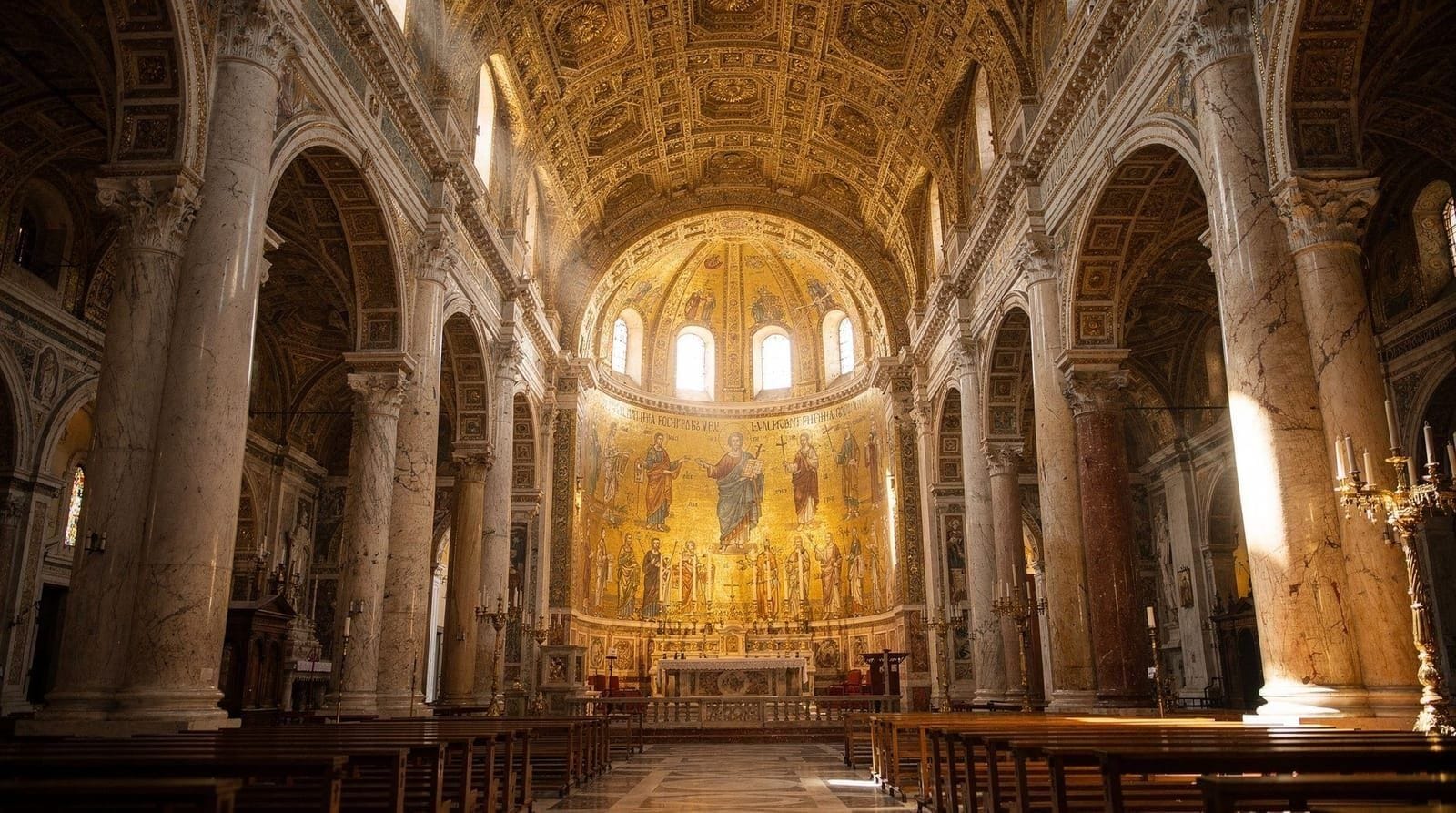
The most historically significant art in the basilica — and arguably the most historically significant Christian mosaics in Rome — runs along both walls of the nave in small horizontal panels above the 40 Ionic columns. These 36 surviving panels (originally there were more) were completed around 432–440 CE and depict episodes from the Old Testament.
What to look for
The style is late antique — that is, the figures are recognizable as people, with some naturalistic detail, but they are composed on a flat gold or blue ground without the spatial illusionism of classical Roman painting or the rigidity of fully developed Byzantine abstraction. The phase is transitional: you can see the classical world winding down and the Byzantine world assembling itself in the same image.
Left nave panels (north side): Scenes from the life of Abraham, Jacob, and Joseph. Look for the panel showing Abraham’s meeting with the three angels (a scene traditionally interpreted as an early appearance of the Trinity) — the rendering of the three identical figures with different expressive gestures is particularly fine.
Right nave panels (south side): Scenes from the life of Moses and Joshua. The Joshua panels are the most dramatic — the crossing of the Jordan, the miracle of Jericho — with extensive architectural backgrounds that show the persistence of Roman illusionistic technique in a transitional moment.
Practical viewing
The panels are approximately 15 metres above floor level. Binoculars — or, if you have them, a zoom camera — help enormously. Many visitors miss the panels entirely because they are looking at the floor and the apse. Walk slowly down both sides of the nave looking up, and stop at each panel for the composition to resolve itself.
The ambient light is better in the morning (south-facing windows). Afternoon can make the north nave panels harder to read.
The 13th-century apse mosaic
The apse at the east end of the basilica was remosaiced in 1295 by Jacopo Torriti under commission from Pope Nicholas IV (the same pope who commissioned the Lateran apse mosaic). Torriti’s programme is significantly more elaborate than the 5th-century nave panels — a full Coronation of the Virgin, the most elaborate formal statement of Marian theology in Rome’s mosaic tradition.
The central scene shows Christ crowning the Virgin while they are seated side by side on a throne — a composition asserting the Virgin’s co-regency with her Son that was theologically unusual for its period and reflects the intense Franciscan Marian devotion of Nicholas IV’s papacy. Surrounding figures include angels, apostles, and the pope himself kneeling at the lower left.
The background uses vast quantities of gold tesserae arranged in acanthus scrolls that fill the apse with a warm luminosity even in modest ambient light. The quality of the workmanship — Torriti was the leading Roman mosaicist of the late 13th century — is exceptional.
On the triumphal arch between the nave and the apse, earlier 5th-century mosaics survive (from Sixtus III’s programme): scenes from the Infancy narrative including the Annunciation, Adoration of the Magi, and Presentation in the Temple. These are in the same late antique style as the nave panels but more formally composed, appropriate to the ceremonial importance of the arch.
The Holy Door and the papacy
As one of Rome’s four major basilicas, Santa Maria Maggiore has its own Holy Door (Porta Santa), opened by the pope only during Jubilee years and otherwise sealed. Pilgrims completing the traditional four-basilica circuit pass through all four Holy Doors as an act of devotion — our Rome Jubilee 2025–2026 guide explains the current Jubilee’s practicalities, including how the doors work outside a formal Jubilee visit. The basilica’s dynastic chapels also reflect centuries of papal patronage and rivalry; for the broader story of how successive popes shaped Rome’s churches and skyline, see our popes and papacy guide.
The gilded ceiling
The coffered wooden ceiling of the nave — visible above the 5th-century mosaic panels — was installed in the late 15th century and gilded under Pope Alexander VI (Borgia pope, 1492–1503). The specific tradition connecting it to Columbus’s gold: Ferdinand and Isabella, as sponsors of Columbus’s 1492 voyage and recipients of the Papal Bull Inter Caetera granting Spain rights to the Americas, sent the first significant gold shipment to Alexander VI in 1493. This gold was allegedly used to gild the Santa Maria Maggiore ceiling.
The story appears in multiple 16th-century sources, though documentary proof is elusive. Whether the ceiling gold came from the Americas or not, the timing and context are historically plausible. The ceiling itself is a masterpiece of Renaissance woodwork regardless of its gilding’s provenance — 40 metres long, deeply coffered, with the Borgia arms visible in the central panels.
The chapels: Sistine and Borghese
The two transept chapels of Santa Maria Maggiore were built by competing papal dynasties in the late 16th and early 17th centuries, creating a rare double-chapel arms race.
The Sixtine Chapel (right transept)
Pope Sixtus V commissioned this chapel from Domenico Fontana in 1585 as his own funerary monument. The name “Sistine Chapel” — attached by Americans to the Vatican’s famous painted ceiling — properly belongs here as well, though this chapel is far less famous.
The interior is elaborate: colored marble, stucco reliefs, large frescoes of the Nativity and Adoration (attributed to Cigoli and Passignano), and two tomb monuments flanking the altar — Sixtus V on the left, Pius V on the right.
The Chapel of the Holy Crib (a small shrine in the lower level): Houses what is claimed to be five planks of wood from the manger in Bethlehem, brought to Rome in the 7th century. Whether authentic or not, this is a relic venerated for over 1,300 years and represents one of the most important pilgrimage destinations in the basilica. The Infant Jesus statue above the reliquary is carried annually in a Christmas Eve procession.
The Borghese Chapel (left transept)
Commissioned by Pope Paul V (Borghese family) and completed in 1611 by Flaminio Ponzio. The design mirrors the Sixtine Chapel across the transept — another example of papal dynastic competition expressed in architecture.
The main reason to visit: the altarpiece contains the Salus Populi Romani icon, a Byzantine painting traditionally attributed to the Apostle Luke (in reality a Byzantine work of the 12th–13th centuries), deeply venerated across centuries as a miracle-working image of the Virgin. Several popes have had this specific icon carried in procession during plague, war, or crisis. Pope Francis placed a copy in the Vatican Apostolic Palace. The original is here, visible behind glass in the chapel.
Walking tour of central Rome including the Piazza Navona and historic centre — complements a Santa Maria Maggiore visit with the city’s main squares and fountains.Accessibility and visiting with limited mobility
Santa Maria Maggiore is one of the more accessible major basilicas in Rome. The main entrance on Piazza di Santa Maria Maggiore is level or has a short ramp, and the nave floor is flat marble throughout, with no steps between the entrance and the apse. The Sistine and Borghese Chapels are reached via a short step up in places, and the Loggia delle Benedizioni (upper-level mosaics, where accessible) requires stairs and is not wheelchair-friendly. Accessible restrooms are limited; the nearest reliable option is at Termini station, ten minutes away. Because the basilica has no midday closure and rarely has queues, it is an easier stop than most for visitors who need to pace a day around rest breaks.
Practical visitor information
Address: Piazza di Santa Maria Maggiore, 00185 Roma.
Opening hours: Daily 07:00–19:00, no midday closure. Mass is celebrated multiple times daily; a schedule is posted at the entrance. The basilica is fully open to visitors except during active Mass celebrations.
Entry: Free for the main basilica. The Loggia delle Benedizioni (upper-level medieval mosaic fragments) and certain specific areas may require a separate ticket — check on arrival.
Dress code: Shoulders and knees covered. Enforced at the entrance.
Getting there: Metro A to Termini (10 minutes’ walk) or Metro B to Termini. Bus routes 14, 16, 70, and many others stop nearby. From the Colosseum, it is a 15-minute walk northwest or a short taxi.
Photography: Permitted throughout the main basilica without flash.
Best time to visit: Weekday mornings before 10:00 are quiet. The 5 August celebrations (rose petal shower) are a once-in-a-visit experience for those in Rome in early August.
Combining Santa Maria Maggiore with nearby sites
San Giovanni in Laterano is a 10-minute walk east — the two form a natural pairing as papal basilicas. See our St John Lateran guide.
The Colosseum, Roman Forum, and Palatine Hill are approximately 20 minutes on foot to the southwest. The combination of Santa Maria Maggiore and the ancient site is a coherent half-day: early morning at the basilica (free), then the paid archaeological site. See our Colosseum guide.
Santa Prassede is three minutes’ walk away on Via Santa Prassede, just south of the basilica. This tiny church has a Byzantine mosaic chapel (the Cappella di San Zenone, c.817 CE) that rivals anything in the four papal basilicas for intensity. It is often entirely empty. A small fee may apply for the chapel specifically. A must-see for mosaic enthusiasts and one of the hidden churches of Rome most first-time visitors never hear about — see our Rome mosaics guide for the full picture.
Santa Maria Maggiore vs the other papal basilicas
If you are deciding how to divide limited time among Rome’s four major basilicas, here is a quick comparison:
| Basilica | Standout feature | Time needed | Crowds |
|---|---|---|---|
| Santa Maria Maggiore | Oldest original interior (5th century) | 30–40 min | Low |
| St. Peter’s | Scale, Michelangelo’s Pietà, the dome | 90+ min, security queue | Very high |
| San Giovanni in Laterano | Cathedral of Rome, Borromini nave | 45–60 min | Moderate |
| San Paolo fuori le Mura | Serene medieval cloister, mosaic portraits of every pope | 45–60 min | Low |
See the full four papal basilicas guide for a suggested route linking all four in a day or two.
Esquilino and Termini neighbourhood: The area around Santa Maria Maggiore is the Esquilino district — one of Rome’s most multicultural neighbourhoods, with excellent ethnic restaurants and a lively covered market (Piazza Vittorio Emanuele II). Often overlooked in favour of more central areas but worth exploring for 30–60 minutes around the basilica visit.
Vatican Museums and Sistine Chapel entry — if combining the Marian basilica theme with the Vatican complex, pre-booked entry is essential to avoid losing hours in queue.What Santa Maria Maggiore represents
Most visitors who come to Rome think of its great art as residing in museums: the Vatican Museums, the Capitoline, the Borghese. The experience of Santa Maria Maggiore is a reminder that Rome’s deepest artistic layers are embedded in living buildings — buildings where Mass has been celebrated continuously since the 5th century, where the same mosaic panels that Sixtus III commissioned to celebrate the Council of Ephesus are visible from the same nave floor where medieval pilgrims prayed after walking from Germany or France.
The city’s art is not archived. It is in use. Santa Maria Maggiore is one of the clearest demonstrations of that fact, and it is free. Unlike a museum, there is no “last entry” pressure and no ticket to plan around — you can fold in a 30-minute visit on the way to or from Termini station with essentially zero logistical cost, which makes it one of the easiest high-value additions to any Rome itinerary, first-time or repeat.
For the complete picture of Rome’s church masterpieces, see our four papal basilicas guide and the overview guide to Rome’s churches, Caravaggios and mosaics.
Frequently asked questions about Santa Maria Maggiore: Rome's greatest Marian basilica
What are the famous mosaics in Santa Maria Maggiore?
What are the opening hours for Santa Maria Maggiore?
How do I get to Santa Maria Maggiore?
What is the legend of Santa Maria Maggiore's founding?
What is in the Sistine Chapel at Santa Maria Maggiore?
Is Santa Maria Maggiore one of the four papal basilicas?
How does Santa Maria Maggiore compare to the other three papal basilicas?
Top experiences
Bookable activities with verified prices and instant confirmation on GetYourGuide.