St. Peter's Basilica — the complete visitor guide
Rome: Guided Tour of St. Peter's Basilica with Dome Climb
Is St. Peter's Basilica free to enter?
Yes — entry to St. Peter's Basilica is free. However, the dome climb costs €8 (stairs) or €10 (elevator partway), and the papal tombs/grottoes cost €5. Security queues can reach 45–90 minutes in peak hours. Book a guided tour or arrive before 08:00 to minimise waiting.
The most visited church in the world — and how to see it without the chaos
St. Peter’s Basilica is the largest church on Earth: 218 metres long, 136 metres to the top of Michelangelo’s dome, with an interior that can accommodate 20,000 people. It is also free to enter — a fact that creates one of the longest queues in Rome, peaking at 45–90 minutes in the high-season midday window.
The good news: this queue is almost entirely avoidable with timing, and the Basilica itself is genuinely overwhelming in scale and craftsmanship. This guide tells you what to prioritise, when to go, and what the entry process actually involves.
| Where | Piazza San Pietro, Vatican City |
| Cost | Free entry; dome climb €8–€10; grottoes €5 |
| Time needed | 1–1.5 hours for the Basilica; add 45 min for the dome |
| Getting there | Metro A to Ottaviano–San Pietro, then a 10-min walk |
| Best time | Before 08:30 or after 17:00 to avoid the security queue |
Entry logistics: what to know before you queue
Free entry to the Basilica
St. Peter’s Basilica charges no admission fee. Security screening (metal detectors, bag X-ray) is required for everyone. The queue for this screening is what creates the wait — not a ticketing bottleneck.
Peak queue times: 09:30–14:30 on any day; 30–90 minutes. Shorter queue times: Before 08:30, after 17:00, Wednesday mornings (many visitors are at the Papal Audience).
Entering from the Vatican Museums
If you hold a Vatican Museums ticket, the Sistine Chapel has a direct exit that deposits you inside St. Peter’s, bypassing the external entrance queue entirely. This is the practical advantage of combining the two visits.
Guided tour of St. Peter’s Basilica with dome climbDress code enforcement
The Vatican enforces the dress code strictly at the Basilica entrance. Guards at the gate check every visitor. People in shorts above the knee, sleeveless tops, or low-cut clothing are turned away. Hundreds of visitors are refused entry daily.
Practical solution: carry a large scarf. In 10 seconds you can cover shoulders and tie it around your waist over shorts. Lightweight scarves pack flat in any bag. Do not leave this to chance in summer.
What to see inside: the key works
Michelangelo’s Pietà (right nave, ground floor)
Completed in 1499 when Michelangelo was 24 years old. Mary holds the body of Christ across her lap — the scale is smaller than expected, but the technical execution (the draping of fabric, the expression of grief) is extraordinary. Now behind bulletproof glass since a 1972 attack. This is typically the first stop; do not rush past it.
Bernini’s baldachin (under the dome)
The towering bronze canopy over the papal altar is 29 metres high — as tall as a 9-storey building. Commissioned by Pope Urban VIII in 1623, the bronze was controversially stripped from the Pantheon’s portico (giving rise to the Roman quip: “What the barbarians didn’t do, the Barberini did”). The four spiral columns are among the most recognisable elements of Baroque Rome.
Michelangelo’s dome (from inside)
From below, the dome mosaic reads: “TU ES PETRUS ET SUPER HANC PETRAM AEDIFICABO ECCLESIAM MEAM” — “You are Peter and upon this rock I will build my Church.” At 42 metres in diameter, the dome’s interior scale can only be appreciated once you stand at the base of the baldachin and look up.
Papal grottoes (beneath the Basilica, €5)
The crypt beneath the altar contains the tombs of multiple popes including John Paul II, John Paul I, and Paul VI, as well as sections of the original Constantinian Basilica. Entry is via a staircase near the baldachin. Worth 30 minutes if this period of Catholic history interests you.
Transfiguration mosaic (apse)
At the far end of the Basilica, the large mosaic above the altar is a reproduction of Raphael’s Transfiguration, the original of which is in the Vatican Museums’ Pinacoteca. The mosaic quality is so high that most visitors assume it is a painting.
Bernini’s Throne of St. Peter (Gloria, apse)
Above the altar, an elaborate gilt reliquary encases what is said to be the wooden throne of St. Peter — though historians date the chair to the 9th century. The sunburst of golden rays and angels around the oval window is one of Bernini’s most theatrical effects.
The dome climb: stairs vs elevator
St. Peter’s Basilica dome climb and crypts guided tourElevator + stairs (€10)
The elevator travels from the Basilica roof to the interior drum of the dome (at the level of the mosaics). From there, you face approximately 320 steps — first a wide curving staircase, then a narrow, slightly tilted spiral that follows the curve of the dome itself (the walls lean inward noticeably). Some people find this section claustrophobic.
Full stairs (€8)
551 steps in total from street level. The staircase begins wider and becomes progressively narrower. The entire climb takes 30–45 minutes. Save €2, burn a few more calories.
The view from the top (136 metres)
The terrace at the top of the lantern provides a 360-degree view over St. Peter’s Square, Vatican City, and Rome. On clear days you can see the Alban Hills to the southeast. The view is genuinely exceptional and worth the climb for anyone who does not have mobility constraints.
Queues for the dome: The dome has its own queue at the Basilica roof level. Mornings are shorter; afternoons can reach 20–30 minutes.
Choosing stairs vs elevator: a quick comparison
| Elevator + stairs (€10) | Full stairs (€8) | |
|---|---|---|
| Steps involved | ~320 (from the roof level) | 551 (from street level) |
| Time | 20–30 minutes | 30–45 minutes |
| Best for | Limited fitness, tight schedule | Budget visitors, avoiding the elevator queue |
| Claustrophobia risk | Same narrow spiral near the top either way | Same narrow spiral near the top either way |
Both routes converge on the same narrow, tilted spiral staircase near the top — the elevator only skips the lower, wider section. If you are prone to claustrophobia, the climb itself (not which option you choose) is the main factor to weigh, more detail on our dedicated dome climb guide.
St. Peter’s Square: what to see before entering
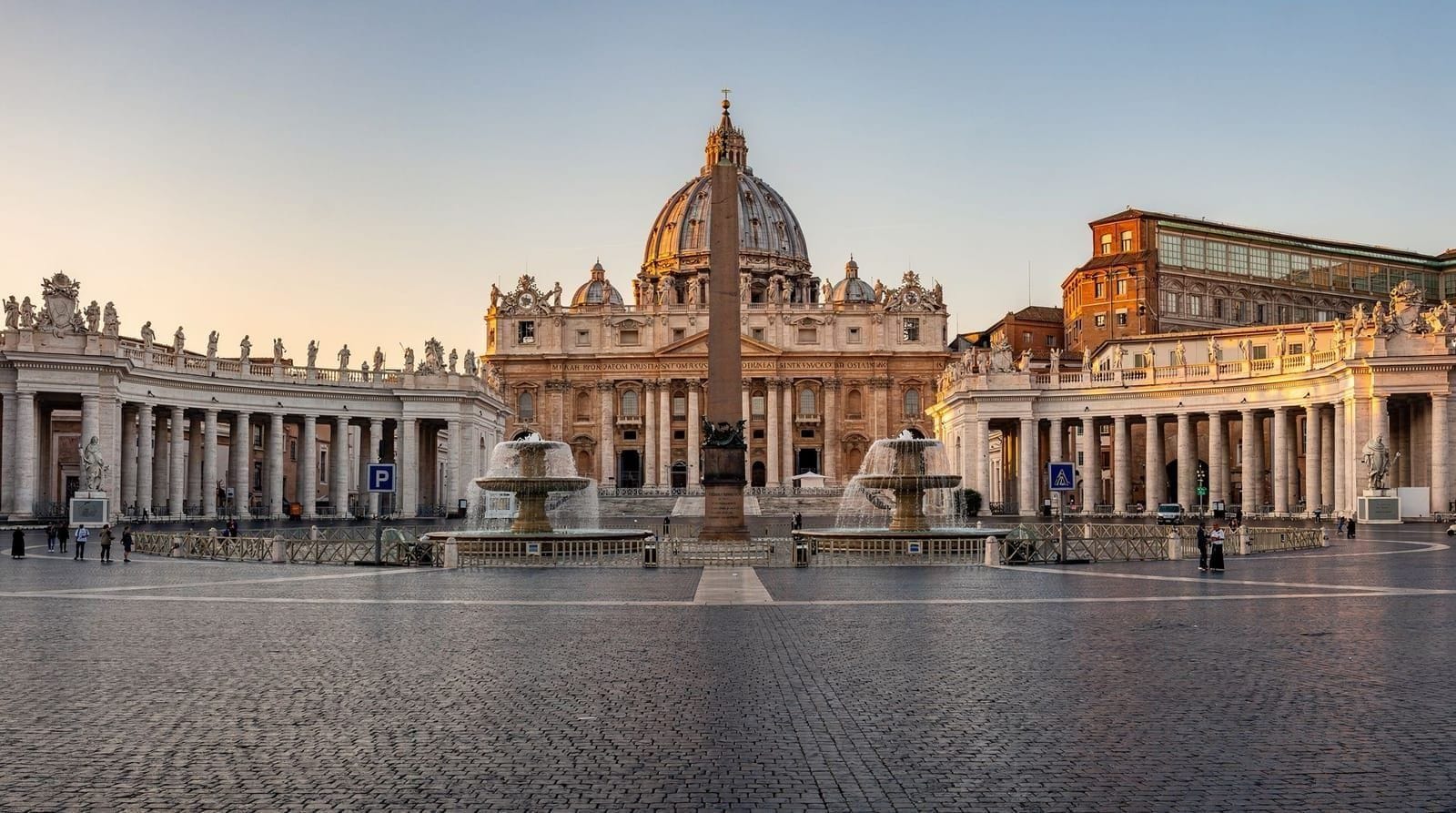
St. Peter’s Square (Piazza San Pietro) was designed by Bernini in 1656–1667. The colonnade consists of 284 columns and 140 statues of saints arranged in two sweeping arms that Bernini described as the “motherly arms of the church” embracing the faithful.
The obelisk at the centre is Egyptian, brought to Rome in 37 AD by Emperor Caligula. It is one of the few obelisks in Rome that was never toppled.
Two fountains mark a mathematical relationship with the colonnade: stand on either of the porphyry discs set in the pavement (marked “Centro del Colonnato”) and the four rows of columns visually merge into one.
Wednesday mornings: If the Pope is in Rome, he addresses the crowd from the window above St. Peter’s Square at noon on Sundays, and Papal Audiences are held on Wednesdays. Security perimeter restrictions apply around these events.
For a dedicated look at the square’s design and the best viewpoints, see our St. Peter’s Square guide.
Guided tours: worth it or not?
For the Basilica alone, a guided tour is less essential than it is for the Vatican Museums — the interior is more legible without specialist knowledge. However, a guide adds significant value for the dome (identifying landmarks from the top), the grottoes (papal tomb context), and the Pietà (technical detail).
Best use case: A combined tour of Basilica + dome + grottoes covers all three components in a structured 2-hour format and is more efficient than managing the queues for each separately.
Combining St. Peter’s with the Vatican Museums
The most common combination is Vatican Museums (morning, 3–4 hours) → exit through Sistine Chapel into Basilica → St. Peter’s and dome (afternoon).
Timing note: Vatican Museums entry ends at 16:00 (last entry); Basilica closes at 18:00–19:00. Allow a 30-minute buffer between finishing the museums and climbing the dome, as the dome has an earlier last-entry time.
See the Vatican Museums guide for booking and timing the museums portion, and our Sistine Chapel guide for what to prioritise inside before you exit into the Basilica.
What the guidebooks don’t mention
Noise during Mass: The Basilica holds Mass daily (multiple services). During Mass, visitor circulation is restricted to the side naves; the main nave is reserved for worshippers. If you visit on a Sunday or during a special liturgical period (Holy Week, Christmas), verify Mass times in advance.
The acoustic problem: The Basilica is so large that sound reflects unpredictably. Group guides use earpieces, but even so, it is hard to hear at moderate distances. Stand close to your guide in the interior.
Air conditioning: There is none. The marble floor and thick stone walls keep the interior cooler than outside, but in July and August midday temperatures inside can be uncomfortable (30°C+). Early morning visits are cooler.
The official Vatican Museums entrance and the Basilica are on opposite sides of the complex. The Museums entrance is on the north side (Viale Vaticano); the Basilica entrance is on the east side (Piazza San Pietro). Allow 15 minutes to walk between them.
What most first-timers skip entirely: The sacristy museum (Museo Storico Artistico) beside the Basilica houses a small but excellent collection of liturgical objects, papal vestments, and reliquaries, and is included in some combined tickets but often overlooked. Similarly, the small crypt exhibit near the grottoes entrance explaining the excavation of the necropolis beneath the Basilica gives useful context most visitors walk straight past on their way to the tombs themselves. Neither takes more than 15–20 minutes but both add real depth for visitors who have already seen the headline works.
Frequently asked questions about St. Peter’s Basilica
Can I attend Mass at St. Peter’s Basilica?
Yes — Masses are open to the public. Weekend Mass times include 09:00, 10:30, 12:00, 17:00 (Saturday: 17:00 only). The main Sunday Mass at 10:30 is the most elaborate. No ticket required.
Is St. Peter’s Basilica the same as the Vatican Museums?
No — they are separate. The Vatican Museums (including the Sistine Chapel) require a paid ticket. St. Peter’s Basilica is free. However, they are adjacent, and a ticket to the Vatican Museums includes a direct-exit route into the Basilica.
What is the best way to photograph St. Peter’s Square from above?
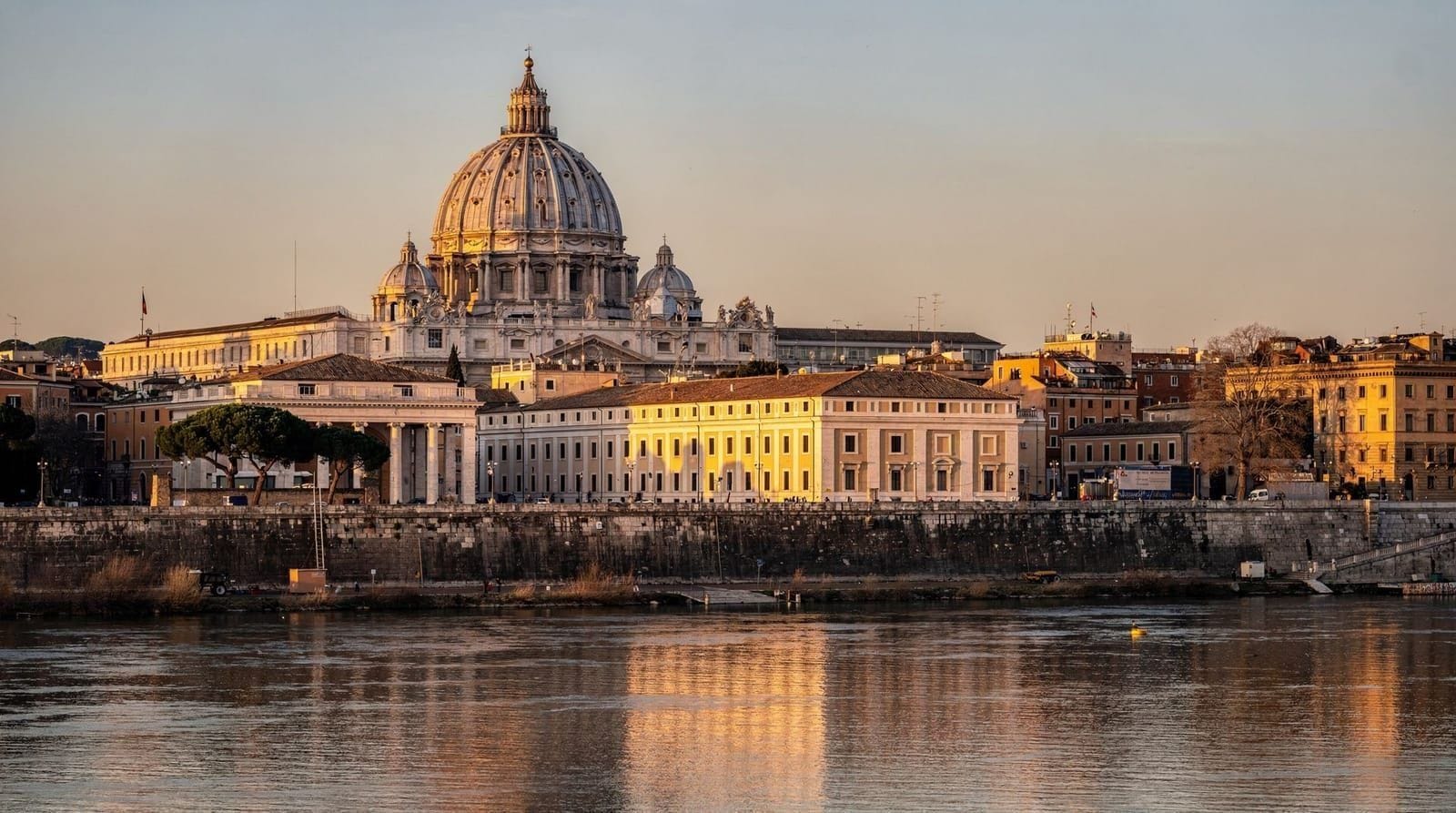
From the top of the dome, looking down at the colonnade and square. Alternatively, the terrace of Castel Sant’Angelo (15 minutes east by foot) offers a straight-line view of the square with the Basilica dome behind it. The best photo spots in Rome guide has more options.
Are strollers allowed inside St. Peter’s Basilica?
Strollers are allowed but impractical in the main crowd flows. A baby carrier is more manageable for families with infants. The dome is not accessible with strollers due to the staircase. See the Vatican with kids guide for more details.
How do I get to St. Peter’s Basilica by public transport?
Metro Line A to Ottaviano–San Pietro (10-minute walk to the square). Bus routes 23, 40, 62, 64 stop near the square. The 40 and 64 from Termini are convenient but notorious pickpocket routes — use a cross-body bag.
Is the Basilica accessible for wheelchair users?
The ground floor is fully accessible. The dome is not wheelchair accessible. Accessible parking and dedicated entry are available — contact the Vatican Secretariat in advance for arrangements.
Should I visit the Vatican Museums or the dress code guide first?
If this is your first Vatican visit, read our Vatican dress code guide and skip-the-line tickets guide before you go — both cover mistakes that cause visitors to lose an hour or more at the entrance. The dress code in particular catches out visitors who assume “just the Basilica, not the Museums” means a more relaxed standard; it does not.
How does St. Peter’s compare to Rome’s other major basilicas?
St. Peter’s is by far the largest and most visited, but it is not the Cathedral of Rome — that title belongs to San Giovanni in Laterano. Santa Maria Maggiore and San Paolo fuori le Mura complete the set of four papal basilicas. See our four papal basilicas guide for how to see all four, and expect St. Peter’s to require by far the most queueing time of the group.
The Basilica’s dimensions and what they mean in practice
St. Peter’s Basilica is the world’s largest church by interior floor area: approximately 15,160 square metres. The nave is 58 metres wide. Visitors who underestimate the scale typically realise their error when they stand next to the foot of the baldachin and look back toward the entrance 200 metres away.
The scale creates an acoustic paradox: with 20,000 people capacity, the Basilica can feel intimate in small groups and overwhelming in crowds — the volume absorbs noise differently depending on where you stand. Near the baldachin in the centre, the sound of crowd murmur is diffused. Near the entrance, the collective noise concentrates.
One practical implication: Do not try to rush through the Basilica. The distance from the entrance to the apse and back is 400+ metres of walking; a visit that tries to cover the whole interior in 30 minutes is a logistically exhausting exercise in not really seeing anything. Allow 1–1.5 hours for a relaxed visit to the major works.
Comfortable footwear matters more here than almost anywhere else in Rome: between the security queue, the length of the nave, and an optional dome climb of several hundred steps, a full Basilica visit can easily involve two hours on your feet or on stairs. Visitors who plan the Basilica as a quick 20-minute stop between other sights are consistently surprised by how much walking and standing it actually requires.
The history of the Basilica: old St. Peter’s and what was lost
The current Basilica replaced the original 4th-century Constantinian Basilica, built over the site of St. Peter’s tomb around 320 AD. The old basilica stood for 1,200 years before Pope Julius II made the decision to demolish it in 1506 — one of the most controversial decisions in the history of the Church.
The demolition was not universally praised. Critics pointed out that the old basilica contained centuries of papal tombs, the finest early Christian mosaics in Rome, and connections to the apostolic age that the new building could never replicate. The architect who designed the new Basilica — first Bramante (who died 1514), then Giuliano da Sangallo, then Raphael (who died 1520), then Antonio da Sangallo the Younger, then Michelangelo — inherited an increasingly complicated design problem as each generation revised the previous one’s plans.
What was preserved: Some of the old Basilica’s decorative elements were incorporated or recreated in the new building. The bronze doors on the main entrance (the central portal) are the original doors of the old Basilica, cast in the 1430s by Antonio Filarete. Look carefully at them on entry — they show scenes from the lives of Saints Peter and Paul and the pontificate of Eugenius IV.
The papal grottoes and old Basilica fragments: Excavations beneath the current Basilica floor revealed not only papal tombs but sections of the old Basilica’s foundations and, controversially, evidence of a 1st-century necropolis containing a tomb identified by the Vatican as St. Peter’s. These can be partially visited via the papal grottoes and the Vatican Necropolis tour (the latter requires separate booking and is limited to very small groups; see museivaticani.va for availability).
The Basilica after dark: evening entrance and atmosphere
The Basilica is sometimes overlooked as an evening destination because most visitor guides focus on daytime logistics. But the Basilica’s lighting programme in the evening transforms the interior dramatically.
The interior lighting is designed to emphasise the golden mosaics, particularly in the apse. The Bernini baldachin’s gilded surfaces catch the artificial light differently from daylight — the warmth increases and the visual weight of the bronze shifts from imposing to luminous.
The security queue for evening entry (after approximately 17:30) is typically under 15 minutes versus the 45–90 minute midday peak. The visitor volume is perhaps 20% of the midday crowd.
Practical note: Evening entry to the Basilica does not include dome access (dome closes before the Basilica). For evening dome visits, check the dome’s specific closure time on the Vatican website — it varies seasonally and is typically around 17:00–18:00.
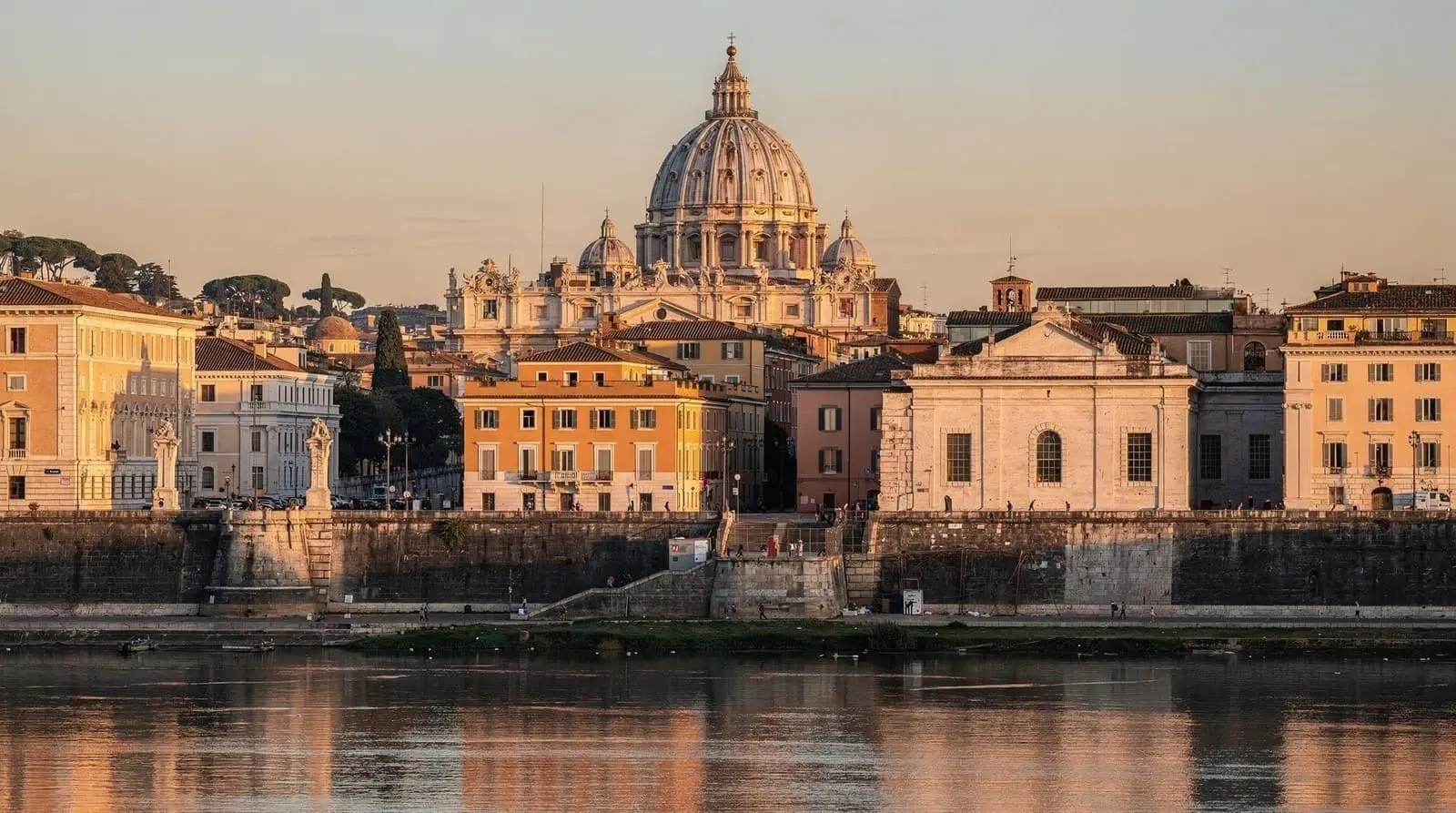
The combination of evening Basilica visit + evening walk along the Tiber to Castel Sant’Angelo is one of Rome’s best low-cost experiences, requiring no booking and costing nothing but the time.
Top experiences
Bookable activities with verified prices and instant confirmation on GetYourGuide.