EUR
EUR: Rome's Mussolini-era modernist district. Palazzo della Civiltà Italiana, Lake EUR, museums, and how to get here by metro. Honest visitor guide.
Rome: Hop-On Hop-Off Panoramic Bus Ticket - Access 3 Routes
Quick facts
- Metro
- Line B — EUR Fermi or EUR Palasport (30 min from Termini)
- Palazzo della Civiltà
- Free exterior; interior by appointment (Fendi HQ)
- Museo della Civiltà Romana
- Under renovation 2024–2026; check current status
- Lake EUR
- Free; rowboat hire ~€10/h; jogging and cycling path around perimeter
- Distance from centre
- ~8 km south of Termini; 15–18 min on metro
- Best time
- Weekday mornings for architecture; weekends for the lake and park feel
EUR (Esposizione Universale Roma) is the most architecturally unusual neighbourhood in Rome, and probably the least-visited by international tourists — which makes it worth knowing about. Mussolini planned it as the site of a 1942 World’s Fair to showcase Fascist Italy to the world. The war cancelled the fair. The district was built anyway, completed in the 1950s and 1960s, and is today a functioning government, business and residential quarter of about 80,000 residents. Its grid of wide boulevards, rationalist buildings, formal lakes, and white travertine structures occupies a plateau 8 km south of the historic centre — architecturally coherent, strangely calm, and genuinely unlike anywhere else in Europe.
What EUR actually looks like
The district is best understood as a thought experiment: what would Rome look like if built by a dictatorship using the formal vocabulary of Roman antiquity stripped of all ornament and rescaled to intimidate? The answer is a city of broad, travertine-clad buildings with regular arcades, axial avenues, and symmetrical perspectives. It should feel oppressive. In practice it feels more curious than threatening — partly because the post-war residential construction softened the grandiosity, and partly because the lake, parks, and active street life give the whole area a liveable quality.
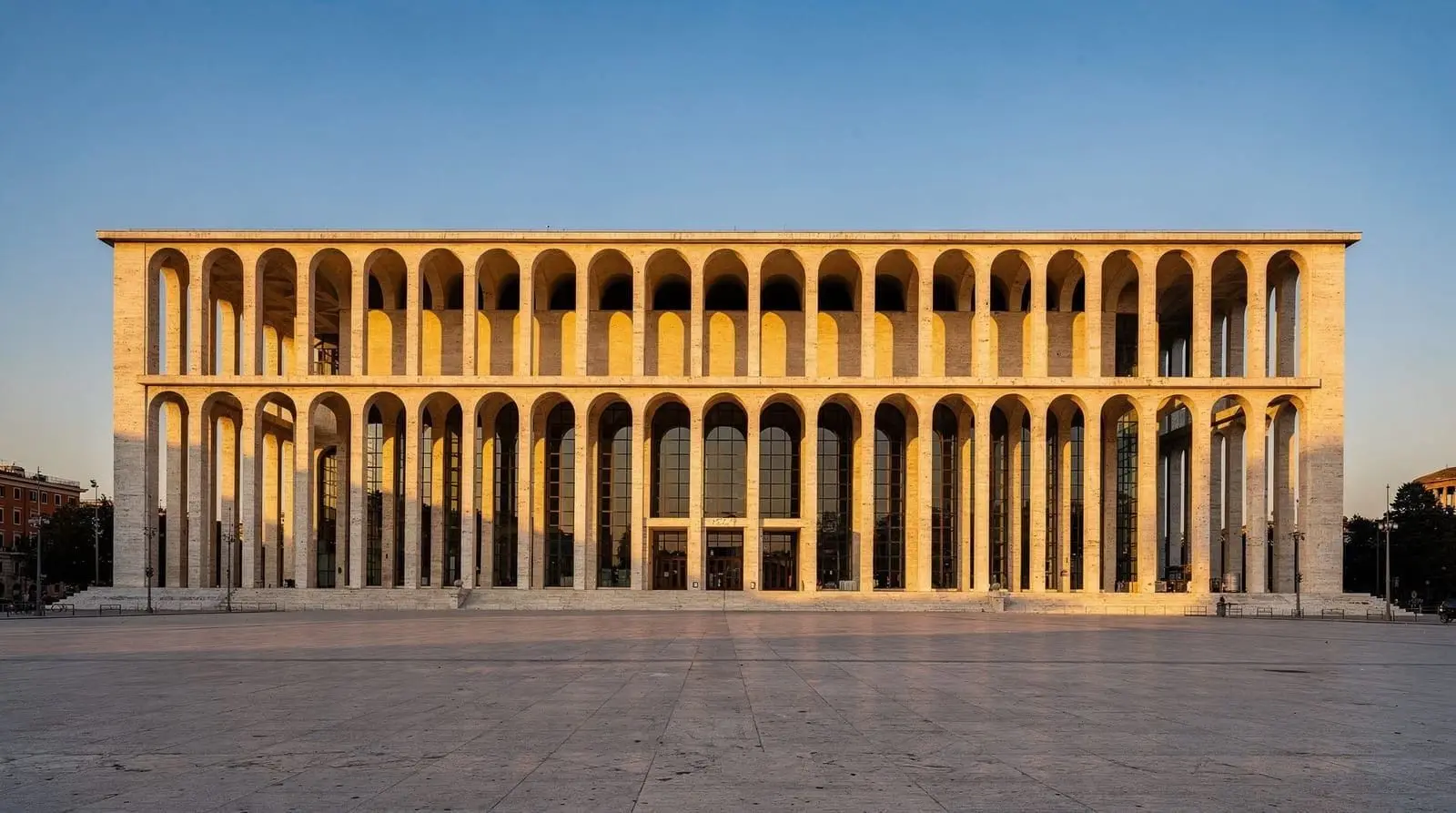
Palazzo della Civiltà Italiana (Square Colosseum): The emblematic building of EUR and one of the most photographed modernist structures in the world — a six-storey rectangular block with 54 identical arches on each face, deliberately echoing the Colosseum’s arcade rhythm. Designed by La Padula, Romano, and Guerrini; construction started 1938. The exterior is freely accessible at all times; the interior is currently the Rome headquarters of Fendi (since 2015) and can only be visited by appointment through Fendi’s cultural programme. The building is most photogenic in early morning or late afternoon light.
Museo della Civiltà Romana: A huge collection of scale models of ancient Rome, plaster casts of Trajan’s Column reliefs, and ancient Roman urban planning models — valuable for understanding what the city looked like at its height. However, this museum has been under extensive renovation since 2024; confirm current opening status before planning a visit. Check the Musei di Roma website.
Palazzo dei Congressi: A curved marble conference centre by Adalberto Libera (1938–54) with an extraordinarily pure rationalist interior. Still used as a conference venue; occasionally hosts exhibitions.
Museo Nazionale Preistorico Etnografico Luigi Pigorini: The national prehistoric and ethnographic collection — one of the largest in Italy. Stone Age tools, Bronze Age artefacts, pre-Columbian objects. Genuinely interesting but under-attended. Open Tue–Sun, €8 entry.
Lake EUR (Lago dell’EUR): An artificial ornamental lake at the centre of the district, about 1 km long, surrounded by a tree-lined promenade. Rowing boats available for hire (~€10/hour). The lake is used daily by local joggers, cyclists, and families — it is a genuine local park, not a tourist attraction.
Getting to EUR from central Rome
Metro Line B: The most direct route. From Termini, take direction “Laurentina”; EUR Fermi stop is 7 stops (about 18 minutes); EUR Palasport is one stop before. The Palazzo della Civiltà is about 10 minutes on foot from EUR Fermi, or a short bus ride.
From the Colosseum/Celio area: Take Metro B from Colosseo stop directly south to EUR Fermi (4 stops, ~10 minutes). This makes EUR a natural add-on after a morning at the Celio & Colosseum district.
Bus 714: Runs from Termini station directly to EUR along the western spine of the district.
Driving: EUR is outside the ZTL restricted zone, so a car is technically usable. Parking is available in several surface lots and garages. That said, metro is significantly faster and avoids the issue of navigating back into the centre.
Bike or e-bike: Possible via Via Ostiense or Via Laurentina. The route is urban cycling — not scenic — but EUR’s internal layout is very cycling-friendly once you arrive (wide, flat, low traffic).
Architecture walk: a practical 2-hour route
Start at EUR Palasport metro and walk south on Viale dell’Astronomia. You immediately see the wide axial perspectives of the rationalist grid. Turn right onto Viale della Civiltà del Lavoro; the Palazzo della Civiltà Italiana rises at the end of this axis. Circle the building — all four sides have the same grid of arches; the effect changes with light direction. The inscription reads: “A nation of poets, artists, heroes, saints, thinkers, scientists, navigators, and wanderers.”
From there, walk north-east on Viale dell’Arte toward the Palazzo dei Congressi and the artificial lake. The Viale Europa arcade of ministry buildings has a consistent height and material palette that shows the planning logic of the district. Continue to the lake, circle it, and return via Viale della Civiltà Romana to EUR Fermi metro.
Total walk: approximately 5–6 km, 90–120 minutes depending on pace. Flat throughout — EUR is one of the most accessible-terrain areas of Rome.
Rome panoramic hop-on hop-off — 3 routes covering EUR and central RomeDining in EUR
EUR’s restaurant scene is aimed at local office workers and residents, not at tourists. This is generally an advantage: prices are reasonable, quality is honest.
Il Fungo (Viale Europa 2): The landmark restaurant of EUR — a mushroom-shaped concrete tower from the 1960s, originally designed as a water tower. Good views over the district; Italian cuisine at mid-range prices (€18–25 per main). More architecture experience than culinary destination.
Ristorante La Barca (Viale Oceano Indiano 4): An old-school Roman trattoria serving the local government and business crowd. Pasta all’amatriciana, saltimbocca, grilled meats. Lunch €14–18. Closed Sundays.
Piazza dei Navigatori bars: Several bar-cafes on this square near EUR Palasport serve espresso at bar prices (€1.30) and serve panino and tramezzino for lunch.
For a longer meal: Testaccio is 5 km north by metro — the authentic Roman food neighbourhood — and is worth the short metro hop for an evening meal with context.
Coffee stops within the architecture walk: There’s no need to plan a separate coffee detour — bars cluster naturally around EUR Fermi and EUR Palasport metro entrances, and a mid-walk espresso break costs the same standing-bar price (€1.20–1.50) as anywhere else in Rome, without the tourist-zone markup you’d pay near the Trevi Fountain or Piazza Navona.
Honest assessment: is EUR worth visiting?
EUR is a deliberate and fascinating architectural experiment. It is not a tourist attraction in the conventional sense — there is no single monument that draws visitors as the Colosseum does. The Palazzo della Civiltà is exceptional; the rest of the district requires architectural curiosity to engage with.
The case FOR visiting: you will have it almost entirely to yourself; the architecture is unique in Europe; the lake and park are genuinely pleasant; it takes 40 minutes of metro time and costs nothing.
The case AGAINST: without an interest in 20th-century architecture or urban planning, the area can feel blank and slightly sterile. If your Rome trip is 3 days and focused on ancient history and food, EUR is not a priority.
For repeat visitors, architecture enthusiasts, or anyone tired of tourist-dense central Rome, EUR is a quietly rewarding detour. For first-time visitors with limited days: save it for a second trip.
Photography in EUR
EUR is one of the most photogenic modernist environments in Europe. Best shots:
- Palazzo della Civiltà Italiana — best in early morning (golden hour) or late afternoon; the uniform arches on all four facades reward a slow walk around. Bring a wide-angle lens.
- The axial perspectives of Viale della Civiltà del Lavoro (with the Palazzo at the end) are classic architectural photography.
- Lake EUR reflections — still water on calm mornings reflects the rationalist buildings.
- Underground EUR: the EUR Fermi metro station itself is a dramatic example of modernist infrastructure. The 1956 station hall is worth photographing before exiting.
See best photo spots in Rome for a broader city-wide photography guide.
The history of EUR: from World’s Fair to suburb
The story of EUR begins in 1935 when Mussolini announced that Rome would host the 1942 World’s Fair — the 20th anniversary of the Fascist revolution. The site chosen was an undeveloped plateau 8 km south of the historic centre. Architect Marcello Piacentini was given overall direction; individual buildings were assigned to the leading architects of Italian Rationalism, including Adalberto Libera, Giovanni Guerrini, Ernesto La Padula, Mario Romano, and Luigi Moretti.
The design brief was to create a third Rome — following ancient Rome (first Rome) and Renaissance/Baroque Rome (second Rome). This third Rome was to express the power and aesthetics of the Fascist state through architecture that synthesised Roman classical forms with modernist rationalism. No ornament, no columns, no curves — but the proportions, the axes, the white travertine facing, and the arcaded facades should all echo Rome’s ancient heritage at a scale appropriate to an empire.
Construction began in 1936. By 1940, the major buildings were structurally complete. In September 1939, World War II began in Europe. The 1942 Fair was cancelled. Mussolini’s government briefly discussed using the completed buildings for other purposes; the war made everything moot. When Allied forces entered Rome in June 1944, EUR was an abandoned building site.
Post-war completion: The Italian government resumed EUR’s development in the late 1940s and 1950s, completing the district as a mixed commercial, governmental, and residential area. Several public ministries relocated here. In 1960, the Olympic Games came to Rome, and several EUR venues hosted events — the lake was the rowing course, the Palazzo dello Sport (designed by Pier Luigi Nervi, a dramatic dome structure on the eastern edge of the district) hosted basketball. The subway extension of Metro B reached EUR in 1955.
Today EUR is home to approximately 80,000 residents and several thousand office workers. Several major Italian companies (ENI, the state oil company; various ministry headquarters) have offices here. The mixture of formal 1930s–50s rationalism, post-war residential construction, modern glass office towers, and ordinary Italian suburban life makes EUR architecturally complex in ways that photographs rarely convey.
The buildings beyond the Square Colosseum
Most visitors who know EUR know the Palazzo della Civiltà Italiana. The district contains a dozen other buildings of genuine architectural interest:
Palazzo della Civiltà del Lavoro (the Square Colosseum): Already described above — the emblematic structure. Designed 1937–38, inaugurated 1940. Fendi HQ since 2015.
Palazzo dei Congressi (Viale Shakespeare/Via Ciro il Grande): Adalberto Libera’s conference centre (1938–54) is architecturally the most sophisticated building in EUR. The approach — through a broad colonnade — and the main hall with its perfect curved ceiling and rational daylight system are classic high modernism. Still used as a conference venue.
Palazzo dello Sport (Piazzale dello Sport): Pier Luigi Nervi’s domed sports hall (1957–60), built for the Olympics. The concrete dome — spanning 100 metres with prefabricated ribbed concrete Y-shaped columns supporting its rim — is a structural engineering masterpiece. One of the finest examples of Italian modernist architecture of any period.
Museo Nazionale Preistorico Etnografico Luigi Pigorini (Viale Lincoln 1): The national prehistoric and ethnographic collection. Building is a standard rationalist block; the collection is excellent and largely unseen by tourists — stone tools from the Italian Mesolithic through Bronze Age, pre-Columbian Americas, African and Pacific ethnographic material. Open Tue–Sun, €8.
Museo dell’Alto Medioevo: Medieval artefacts from the 5th–10th centuries. Small, specialised, rarely visited. Worth 45 minutes if the period interests you.
Palazzo dell’ENI (Viale Pasteur): The headquarters of Italy’s state oil company — a 1960s modernist tower by Luigi Moretti, commissioned when ENI was at the peak of its industrial ambition under Enrico Mattei. The building’s materiality and proportion are different from the 1930s rationalist buildings; seeing both together illustrates how Italian modernism evolved across three decades.
Getting around EUR: practical navigation
EUR is laid out on a strict grid with broad boulevards — easy to navigate by foot within the core district. Walking from EUR Fermi metro to the Palazzo della Civiltà takes about 10 minutes north along Viale della Civiltà del Lavoro. The lake is 15 minutes east of EUR Palasport metro.
Hiring a bike: EUR’s flat streets and lake perimeter path make cycling unusually pleasant by Rome standards. Bike rental via app-based services (Helbiz, Bit Mobility) operates in the district. Useful for covering the distance between the Palazzo della Civiltà and the Palazzo dello Sport efficiently.
Combining with a longer Rome trip: EUR fits naturally into a longer, less rushed Rome itinerary rather than a tight 3-day first visit — it works well as a half-day slotted into a 7-day itinerary with day trips alongside other Lazio excursions, since it shares the same “worth it with more time” logic as the region’s day trips. For a first, short visit, prioritise the standard central sights instead and treat EUR as a reason to come back.
Bus within EUR: Several ATAC bus routes serve internal EUR destinations. Useful for reaching the Palazzo dello Sport area from the main metro axis.
EUR vs. other quiet Rome escapes
EUR is one of several districts recommended for visitors seeking a break from central Rome’s crowds — but it’s a different kind of quiet from the others.
| EUR | Aventino | Testaccio | |
|---|---|---|---|
| Character | Fascist-era rationalist architecture, modern suburb | Leafy residential hill, ancient history | Working-class food neighbourhood |
| Terrain | Flat, wide boulevards | Hilly, quiet lanes | Flat, urban |
| Main draw | Palazzo della Civiltà Italiana, Lake EUR | Aventine Keyhole, Orange Garden | Markets, trattorias, nightlife |
| Distance from centre | ~8 km south (metro) | Adjacent to Circus Maximus | Adjacent to Aventine |
| Best for | Architecture enthusiasts | Views and a peaceful walk | Food and evening atmosphere |
If your interest is specifically in unusual, under-visited architecture, EUR has no real competitor in Rome. For a broader sense of which Rome neighbourhoods reward a detour and which are overhyped, see Rome’s hidden gems and the more contrarian Rome overrated and underrated — both discuss EUR alongside other under-the-radar districts. The Rome neighborhoods overview is the best starting point if you’re still deciding how to divide your time across the city as a whole.
Frequently asked questions about EUR
What does EUR stand for?
Esposizione Universale Roma — “Rome Universal Exposition.” The name referred to the planned 1942 World’s Fair that never happened due to World War II. The acronym stuck as the name of the neighbourhood.
Can I visit the inside of the Square Colosseum?
The Palazzo della Civiltà Italiana is Fendi’s Rome headquarters. The exterior is freely accessible at all times. Interior visits are by appointment through Fendi’s cultural programme — contact them directly or check their website. No casual walk-in access.
How long does a visit to EUR take?
A focused architecture walk takes 90–120 minutes. Add the Pigorini museum and you need 2.5–3 hours. A relaxed half-day including the lake and a lunch break is the most comfortable approach.
Is EUR accessible for visitors with mobility limitations?
EUR is one of Rome’s most accessible areas: the streets are flat, broad, and smooth (unlike the cobblestone historic centre). The metro stations have lifts (verify current functionality at EUR Fermi before visiting). The lake path is paved and flat. See accessible Rome guide for the full city-wide picture.
Is EUR safe?
Yes. EUR is a functioning middle-class residential and business district — ordinary, calm, low crime. It lacks the pickpocket-heavy crowds of central Rome and Termini. It is perfectly safe at any time of day.
Should I visit EUR or the Aventine Hill for a quiet break from crowds?
They offer different kinds of quiet — Aventino is a hilly, leafy residential neighbourhood with the famous Keyhole view, while EUR is a flat, architecturally unusual planned district with no real equivalent elsewhere in Rome. Choose Aventino for a scenic walk close to the centre; choose EUR specifically for the rationalist architecture experience.
Is EUR one of Rome’s underrated neighbourhoods?
Among people interested in 20th-century history and architecture, yes — it’s consistently cited alongside other under-the-radar districts in guides to Rome’s hidden gems. For visitors without that specific interest, it’s honestly a lower priority than the neighbourhoods covered in Rome’s overrated and underrated sights closer to the centre.
Top experiences
Bookable activities with verified prices and instant confirmation on GetYourGuide.