Aventino & Circus Maximus
Aventino: Rome's quietest hill with the Knights of Malta Keyhole, Circus Maximus, Orange Garden, and peaceful basilicas. A perfect half-day escape.
Rome: E-Bike Tour of the Seven Hills
Duration: 3 hours
Quick facts
- Metro
- Line B — Circo Massimo (10 min walk to Aventine Keyhole)
- Character
- Tranquil, leafy, residential — Rome's quietest hill
- Circus Maximus
- Free entry; free concerts and events
- Best for
- Peaceful walks, views, repeat visitors
- Keyhole view
- Piazza dei Cavalieri di Malta — queue of 5–10 min, free
The Aventine Hill (Aventino in Italian) is Rome’s quietest major neighborhood. It has no metro stop directly on it. It has no famous museum. It does not appear on most tourist itineraries — which is precisely why it rewards a visit. The streets are wide, the traffic is light, the architecture is varied and interesting, and the views are some of the city’s best. It is a neighborhood that repeat visitors discover, usually wondering why they waited so long.
The neighborhood sits on Rome’s southernmost inhabited hill, above Testaccio and the Tiber. The ancient Aventine was the hill of the plebs, politically distinct from the patrician Palatine across the valley. Today it is residential and reasonably affluent, with embassies, large villas, religious institutions, and a population that uses the area as a genuine living space rather than a staging ground for tourism.
The Aventine Keyhole
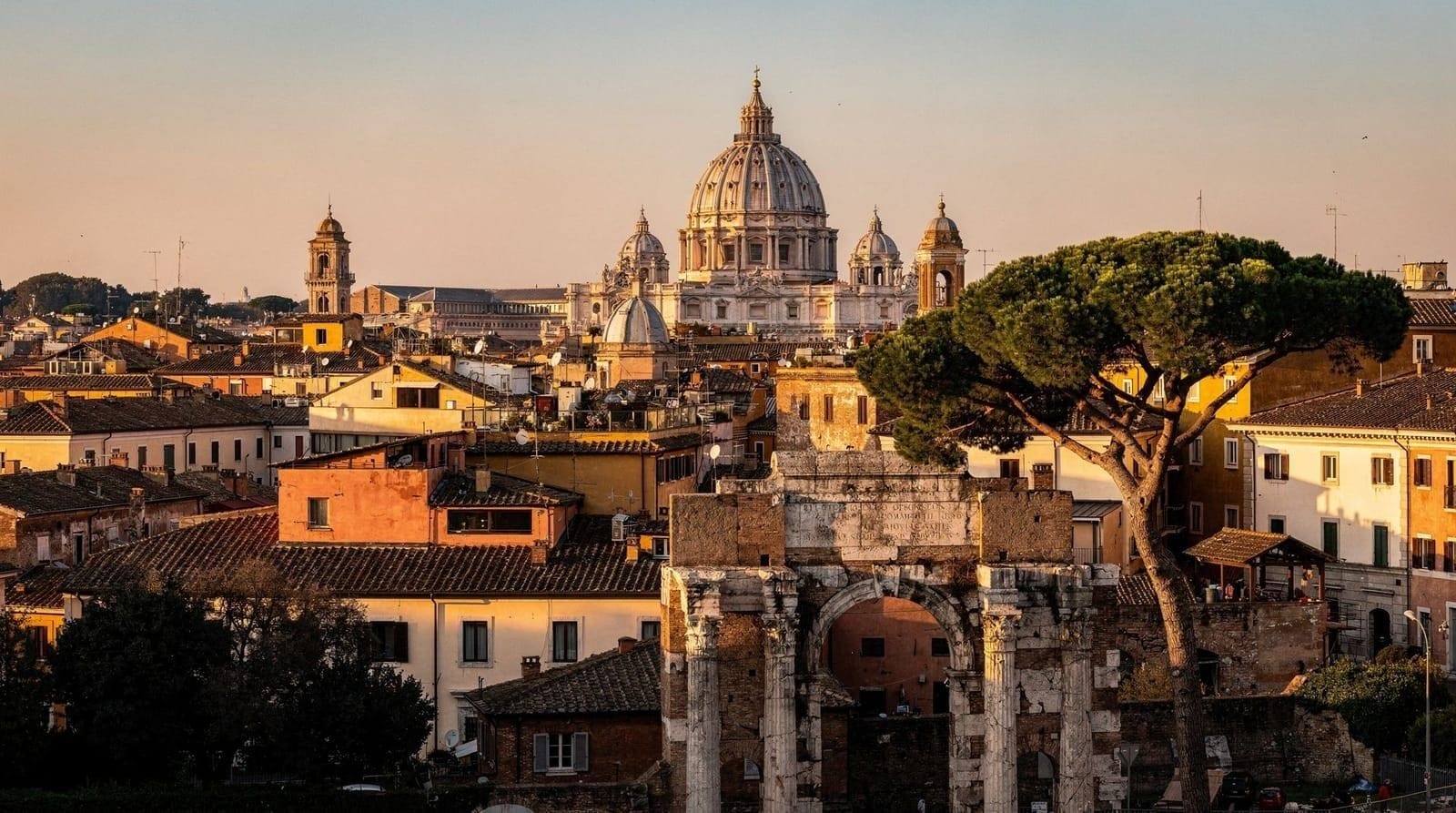
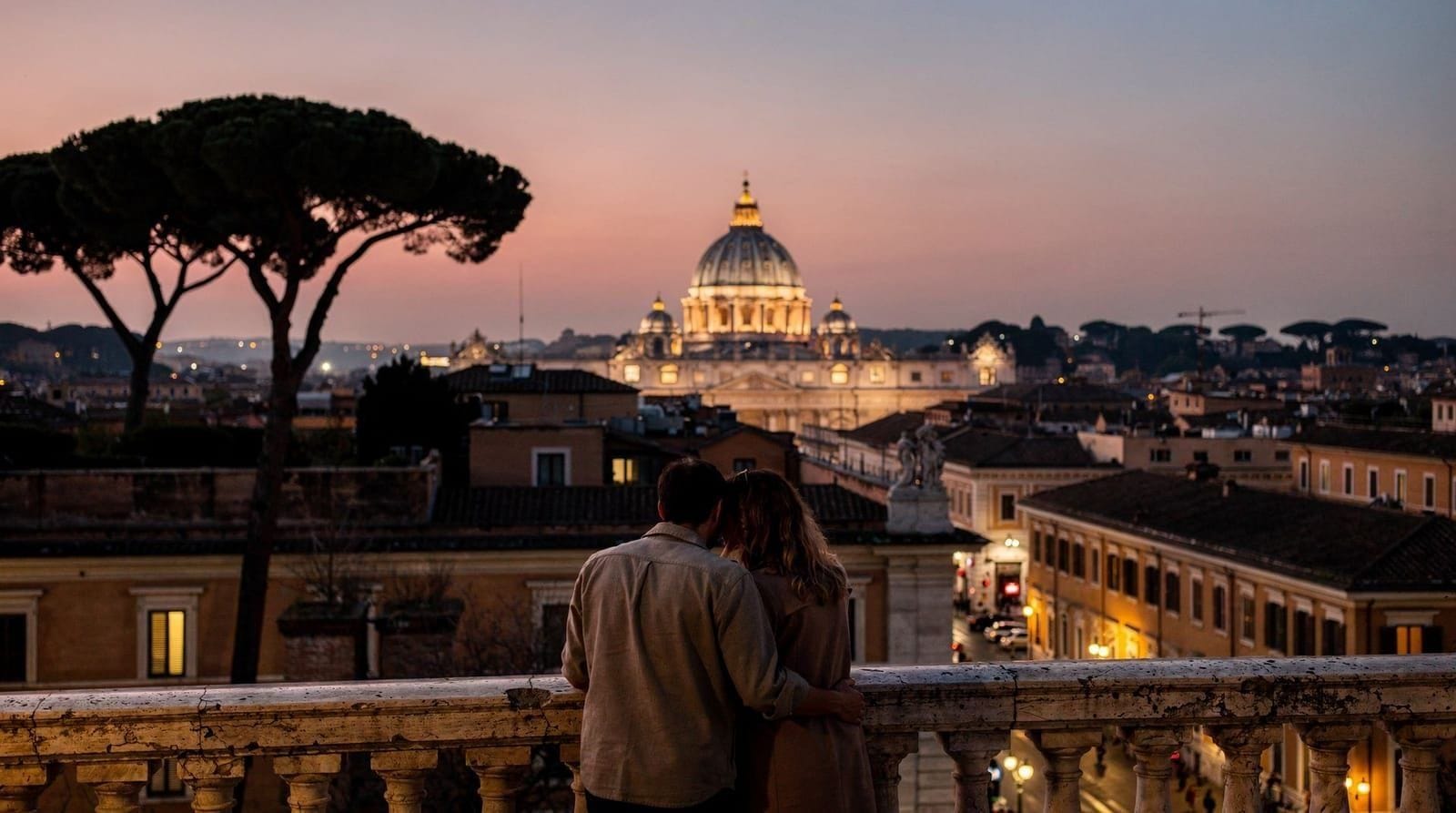
The most famous single view in Rome is not from a hilltop or a terrace — it is through a keyhole. The piazza in front of the Priory of the Knights of Malta (Piazza dei Cavalieri di Malta, designed by Giambattista Piranesi in 1765) has a bronze keyhole in its green gate. When you look through it, a perfectly framed, accidentally perfect view of St. Peter’s dome appears at the end of a corridor of clipped green hedges.
The optical trick is architectural — the garden allée was designed to align precisely with the dome. When the Santa Maria della Pietas’ tall trees are properly trimmed, three different sovereign territories are visible simultaneously: Italy, the Knights of Malta priory, and Vatican City. The dome appears closer than it is.
Practical: There is usually a short queue (5–15 people) at any given time, moving steadily. No admission charge. No photography restriction. The queue is typically 5–10 minutes at most — except in peak tourist season on weekends when it can build to 20–30 minutes. Morning arrival (before 9 am) means almost no queue. The piazza is on via di Santa Sabina at the top of the hill.
See Keyhole Aventine view for full background on the history and best times.
Giardino degli Aranci (Orange Garden)
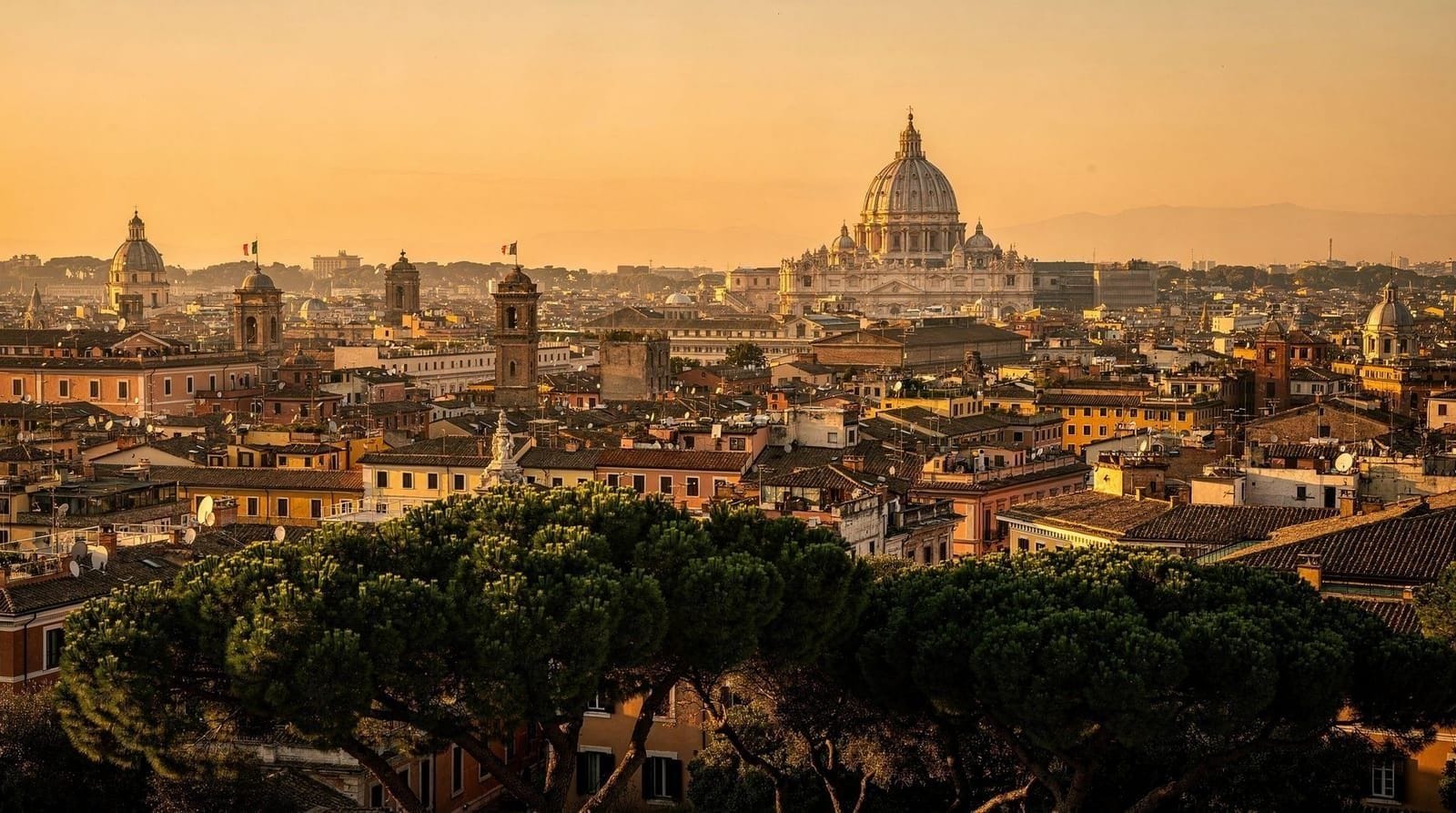
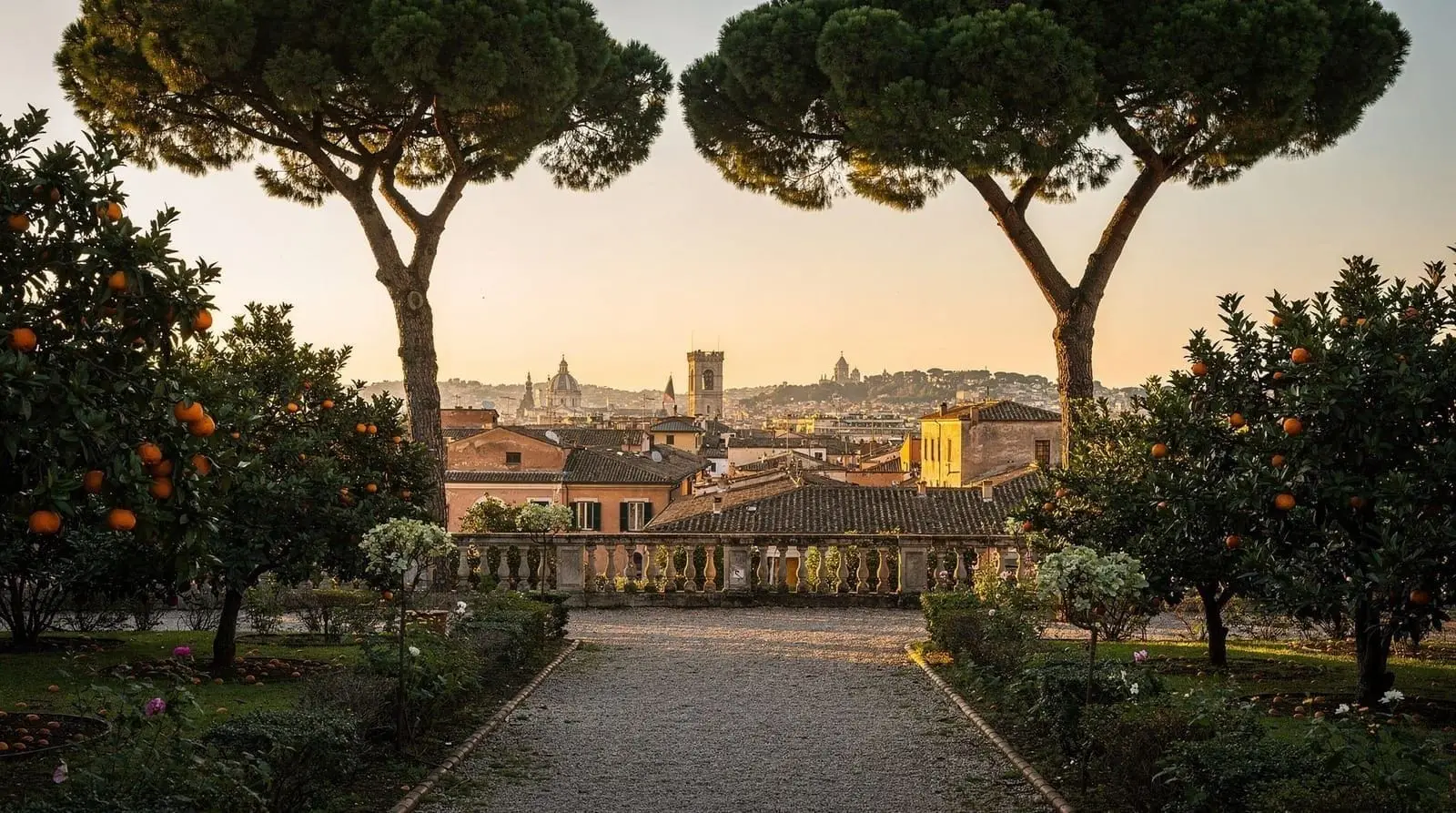
Directly adjacent to the Knights of Malta priory, the Orange Garden (Parco Savello, also called Giardino degli Aranci) is one of Rome’s most pleasant green spaces. It sits at the edge of the Aventine Hill and offers panoramic views south toward the Tiber and Trastevere, with the Janiculum hill in the background.
The garden has bitter orange trees (aranci amari), rose beds, a small café, benches, and a genuinely peaceful atmosphere that is absent from most central Roman spaces. It is popular with Roman families on Sunday mornings. Entry is free.
Best time: Afternoon light (3–6 pm) is excellent for the view south and west. At sunset, the terrace can be crowded with people seeking the view — still worth it.
Basilica di Santa Sabina
One of Rome’s great early Christian basilicas, Santa Sabina was built between 422–432 CE and survives largely intact, making it one of the oldest churches in Rome that looks genuinely ancient rather than Baroque-renovated. The wooden doors at the entrance include what may be the earliest depiction of the Crucifixion in Christian art — a small carved panel, often overlooked.
The interior is austere and beautiful: a nave lined with 24 original Corinthian columns taken from a pagan temple, thin alabaster windows that glow orange in the afternoon, and almost no applied decoration except for the original mosaic inscription above the entrance arch. It is free to enter and usually quiet.
Entry: Free. Open daily (closed for midday riposo from roughly 12:30–3:30 pm).
Circus Maximus
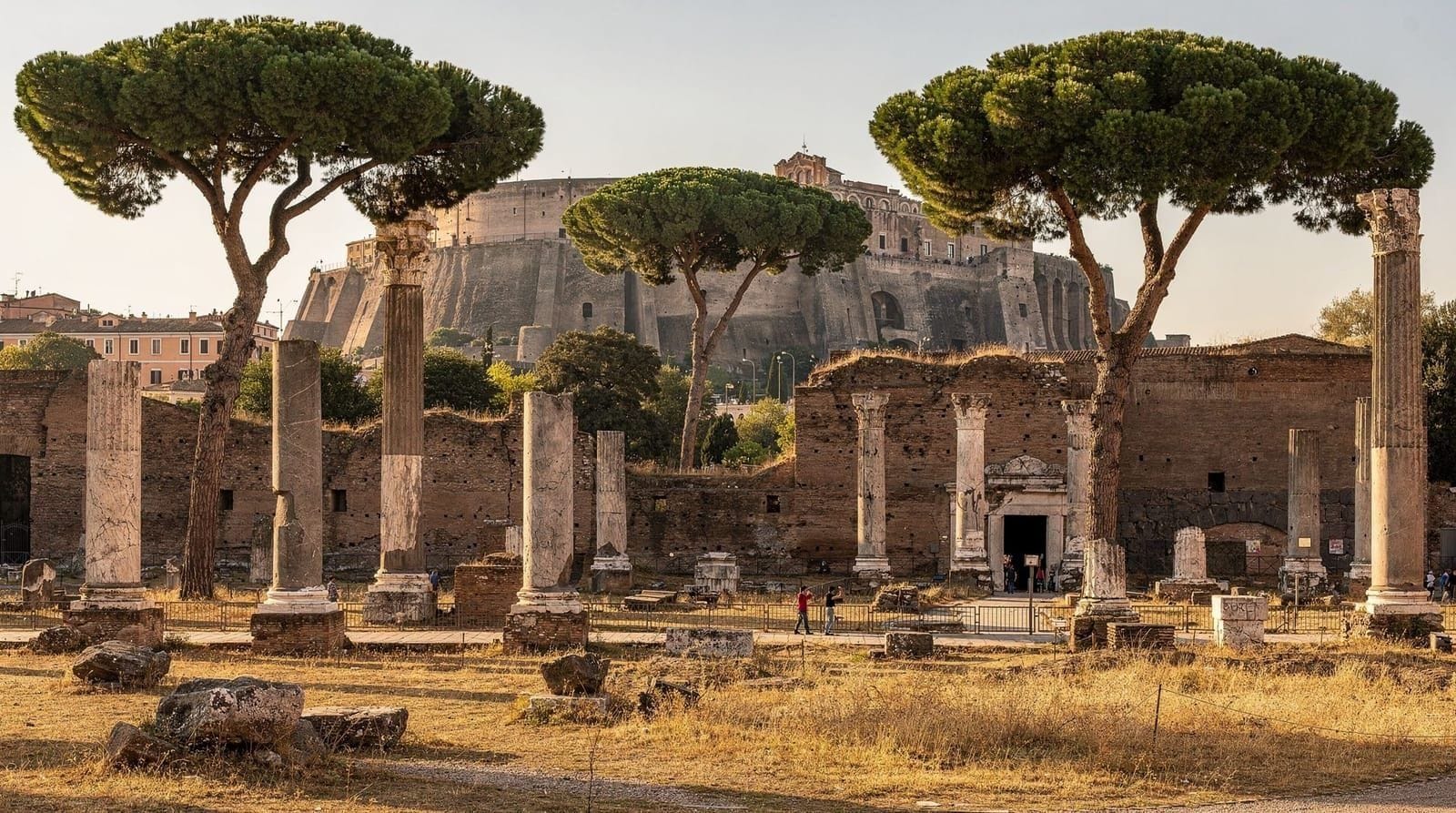
The Circo Massimo is a large open oval at the foot of the Aventine and Palatine hills — the ancient race track that held 250,000 spectators and was the largest entertainment venue in ancient Rome. The track (600 metres long) is free to walk through. There are interpretive panels and some excavated infrastructure, but the main impression is scale: the oval is enormous, and the hills on either side (Aventine and Palatine) frame it exactly as they did in antiquity.
Museum: A new Circus Maximus museum and experience center opened inside the reconstructed southern end in recent years, with multimedia exhibits on Roman chariot racing. Entry is separate and charged — check current prices (approximately €8–10). The outdoor ruins are always accessible for free.
Events: Circus Maximus hosts large outdoor concerts and events (Roma Tre Ore music festival, May 1st Concertone, etc.) that draw 70,000–100,000 people. These are entirely genuine Roman events — not tourist spectacles — and if your visit coincides with one, worth attending.
Practical connection: The Circo Massimo metro stop (Line B) is at the bottom of the Aventine, 5 minutes from the Circus Maximus and 10 minutes’ walk from the Keyhole.
Sant’Alessio and the lesser-known Aventine churches
The Aventine has a cluster of religious buildings in its quiet streets that repay a slow walk:
- Sant’Alessio all’Aventino (via di Sant’Alessio) — a medieval church with a crypt and significant relics; often open and always quiet.
- Sant’Anselmo all’Aventino — a Benedictine monastery church with Gregorian chant on Sunday mornings (chant schedule varies; check current program). The atmosphere of a Gregorian mass in this setting is genuinely moving.
- San Saba (piazza Gian Lorenzo Bernini, slightly further south) — an early medieval basilica with important ancient Roman sculpture incorporated into the portico; almost never crowded.
Exploring by bike or golf cart
An e-bike tour covering Rome’s seven hills passes through the Aventine, Testaccio, and Circus Maximus area before climbing other hills — a good way to cover more ground than is practical on foot while staying oriented. An electric golf cart tour of Rome’s highlights is a good option for visitors with mobility considerations or those who want an efficient overview before deciding where to spend more time on foot.
Combining Aventino in your itinerary
Best half-day circuit: Start at Circo Massimo metro stop (Line B). Walk up via di San Teodoro through the base of the Palatine to via della Greca, then up the Aventine hill to Santa Sabina (30 min, with views opening as you climb). Visit Santa Sabina. Walk to the Keyhole and Orange Garden (10 min). Spend 30–45 min there. Walk down toward Testaccio (15 min on foot) for lunch. Total: 3–4 hours.
Combined with Testaccio (full day): Testaccio market (9–11 am) → lunch at a trattoria → walk up to Aventino for afternoon (Keyhole, Orange Garden, churches). Return via Circo Massimo metro.
Combined with Trastevere (full day): Morning in Trastevere (Piazza Santa Maria, Villa Farnesina, Santa Cecilia) → walk along via della Lungaretta south toward the Tiber → cross to Testaccio → up to Aventino. This is a strenuous but rewarding day.
For the complete planning view, see Rome in 3 days and Rome off the beaten path 3 days.
Where to eat near Aventino
The Aventine itself is almost entirely residential with minimal restaurants. The food is immediately below in Testaccio, which has more trattorias and market food per square metre than anywhere else in central Rome. Dropping down the hill to eat in Testaccio and returning for afternoon walks is the natural pattern.
On the Aventine itself:
- There is a café in the Orange Garden for coffee and snacks.
- Via di Santa Sabina has a handful of local bars and small cafés.
- For serious eating, Testaccio (15 min on foot) or the Lungotevere below.
The Gianicolo: the view from above
The Gianicolo hill (Janiculum) directly above Trastevere — accessible on foot via via Garibaldi or via Carini — offers the best panoramic view of Rome’s skyline from within the city. It is technically not one of the seven ancient hills (the Gianicolo was always outside the original city boundary) but it overlooks all of them.
The terrace at the top is free. The equestrian statue of Giuseppe Garibaldi (1895, the largest equestrian monument in Italy) faces north over the city he fought to unify. At noon daily, a cannon fires a blank round from the Gianicolo — a tradition since 1847, originally to synchronize the bells of Rome’s churches. It is audible across the city and children find it memorable.
Below the main terrace, the Fontana dell’Acqua Paola (via Garibaldi) is a large Baroque fountain using water from the ancient Trajan aqueduct, restored by Paul V in 1612. The arched facade of granite and marble is modeled loosely on a triumphal arch; the fountain discharges into a large basin. It has no admission charge and is generally uncrowded.
Practical: Walk up from Trastevere via via Garibaldi in about 20 minutes (moderately steep). Or take bus 870 from Trastevere. The walk back down via the steps (Scalea del Tamburino) is faster.
The ancient Aventine: myth and history
The Aventine Hill has a specific place in Roman mythology and history that is worth understanding before visiting.
In the myth of Rome’s founding, Romulus and Remus stood on different hills to take the auspices (observe bird omens) that would determine who had the gods’ favor to found the city. Romulus stood on the Palatine; Remus stood on the Aventine. The gods sent 12 vultures to Romulus, 6 to Remus. Romulus won; Rome was built on the Palatine. The Aventine was literally the losing hill from before the city’s founding.
In the historical Republic, the Aventine was the plebeian hill — the political home of the populist tribunes, the site of the lex Icilia de Aventino publicando (456 BCE) which distributed Aventine land to the poor. The hill carried this plebeian identity for centuries.
In the Fascist period, “seceding to the Aventine” became a political phrase meaning principled withdrawal from an illegitimate parliament — a reference to the ancient Aventine Secession (494 BCE) when the Roman plebs withdrew from the city to the Aventine in a strike action. The Italian Socialist and Catholic parties who refused to participate in the Fascist parliament after the 1924 Matteotti murder were called the “Aventine Secession.”
This history makes the Aventine’s current identity — quiet, leafy, slightly withdrawn from the rest of Rome — seem fitting.
Santa Sabina and the oldest Crucifix
The wooden doors of Santa Sabina (the original 5th-century doors, preserved in situ — extraordinary survival for late antique woodwork) have 18 carved panels depicting biblical scenes. The panel in the upper left-hand corner is usually identified as the oldest surviving artistic representation of the Crucifixion. It is small (about 20cm), schematic, and not immediately obvious — Christ and two thieves are shown in front of a building rather than on individual crosses. It predates all other known depictions by decades.
The question of how the Crucifixion was represented (or not represented) in early Christianity — given the social stigma of crucifixion as a slave’s death — is a genuinely interesting art-historical problem. Santa Sabina’s door panel is a primary document in that discussion.
Photography on the Aventine
The best photo spots on and around the Aventine:
- The Keyhole at dawn — approximately 7 am on a clear day gives the best light for the dome view.
- Orange Garden terrace at sunset — facing west over Trastevere and the Gianicolo.
- Fontana dell’Acqua Paola on the Gianicolo — the fountain facade in the afternoon light.
- Circus Maximus from the Palatine end — the full length of the oval is most apparent from the western end near the metro stop.
The Aventine has less photographic fame than, say, the rooftops overlooking the Colosseum in Monti, but the keyhole view is one of the most sought-after single frames in Rome.
Rome’s best free viewpoints compared
The Aventine area sits at the centre of a cluster of Rome’s best free viewpoints. Here’s how the main options compare, so you can prioritise if time is short.
| Viewpoint | View | Crowd level | Effort |
|---|---|---|---|
| Aventine Keyhole | Framed, single-point St. Peter’s dome | Short queue, worse on weekend afternoons | Minimal — flat piazza |
| Orange Garden terrace | Wide panorama south/west over Trastevere | Moderate, busiest at sunset | Minimal — a few steps |
| Gianicolo terrace | Full city skyline, widest panorama | Low–moderate, spread over a large terrace | Moderate — 20-min uphill walk |
| Pincio / Villa Borghese terrace | Piazza del Popolo and northern skyline | Moderate | Minimal |
If you only have time for one, the Keyhole is the most distinctive (nowhere else gives that exact framed effect) and the fastest to experience — in and out in under 10 minutes. The Gianicolo rewards the extra walk with the single best overall city panorama, and pairs naturally with a Trastevere morning. The Orange Garden sits between the two: less unique than the Keyhole, less commanding than the Gianicolo, but the most pleasant place to actually sit down for twenty minutes.
San Saba: the Aventine’s quieter southern half
Most visitors treat San Saba as an afterthought to the main Keyhole/Orange Garden circuit, but the neighbourhood around the Basilica di San Saba is worth a deliberate detour if you have the extra 30–45 minutes. It sits on a separate, smaller rise south of the main Aventine, reached by a set of covered medieval steps (Clivo di Rocca Savella-adjacent) that feel closer to a provincial Italian town than central Rome.
The basilica itself dates to the 10th century on earlier foundations, with a portico incorporating fragments of ancient Roman sculpture and inscriptions — spolia reused so casually that it’s easy to walk past a genuine 2,000-year-old carved relief without noticing. Inside, a Cosmatesque floor and a fresco cycle depicting scenes from both the Old and New Testament reward a slow look. The church is almost never crowded, even when the Keyhole queue is at its longest ten minutes away.
The residential streets around San Saba (Rome’s first purpose-built “garden suburb,” laid out in the early 20th century) are worth a short wander for anyone interested in how Rome expanded outside its ancient walls — small villas, quiet gardens, none of it aimed at tourism at all.
Frequently asked questions about Aventino & Circus Maximus
What is the Aventine Keyhole and why is it famous?
A bronze keyhole in the gate of the Knights of Malta Priory that frames a perfect view of St. Peter’s dome at the end of a garden corridor. It works as an optical alignment through three jurisdictions (Italy, the Knights’ territory, Vatican City). It is free, requires no booking, and takes about 2 minutes to experience. See Keyhole Aventine view for history and context.
Is Circus Maximus worth visiting?
The outdoor ruins are free and worth a 30-minute visit to understand scale. The indoor experience center is optional and charged. For ancient Rome sightseeing priorities, the Colosseum and Forum rank higher; Circus Maximus is a supplement for those with extra time.
When does the Orange Garden’s rose section bloom?
Roughly April and May. The roses are at peak bloom in late April–mid May. The garden is worth visiting year-round for the view and the orange trees, but spring is the most spectacular.
Is the Aventine neighborhood good for staying?
Quiet, pleasant, and safe — but with limited accommodation options and slightly inconvenient metro access (no station on the hill itself, nearest is Circo Massimo on Line B). It works as a base if you specifically want a residential, non-touristy neighborhood. Most first-time visitors are better placed in Monti or Trastevere.
How do I get to the Aventine Keyhole by public transport?
Metro Line B to Circo Massimo. From the exit, walk up via di Valle Murcia and then climb the Aventine hill via the rose garden steps or via dei Publici — about 15 minutes on foot. A slight uphill walk but not demanding.
Does Santa Sabina require booking or tickets?
No. Santa Sabina is a functioning church and entry is free. It closes for midday hours (roughly 12:30–3:30 pm) so plan your visit for the morning or late afternoon. Mass schedules may temporarily close parts of the church.
Is the Aventine Keyhole or the Gianicolo the better view?
They’re not really substitutes — the Keyhole is a single framed shot of St. Peter’s dome and takes minutes; the Gianicolo is a full panoramic terrace requiring a 20-minute uphill walk from Trastevere. With limited time, do the Keyhole; with a free afternoon, do both, since they’re a manageable walk apart via Testaccio and the river.
Is San Saba worth the extra detour on the Aventine?
Yes if you have 30–45 minutes to spare and want a genuinely quiet stop — it sees a fraction of the Keyhole’s foot traffic and the basilica’s reused ancient sculpture and Cosmatesque floor are worth the short walk. Skip it if your visit is already tight, since the Keyhole, Orange Garden and Santa Sabina cover the essential Aventine experience on their own.
Top experiences
Bookable activities with verified prices and instant confirmation on GetYourGuide.