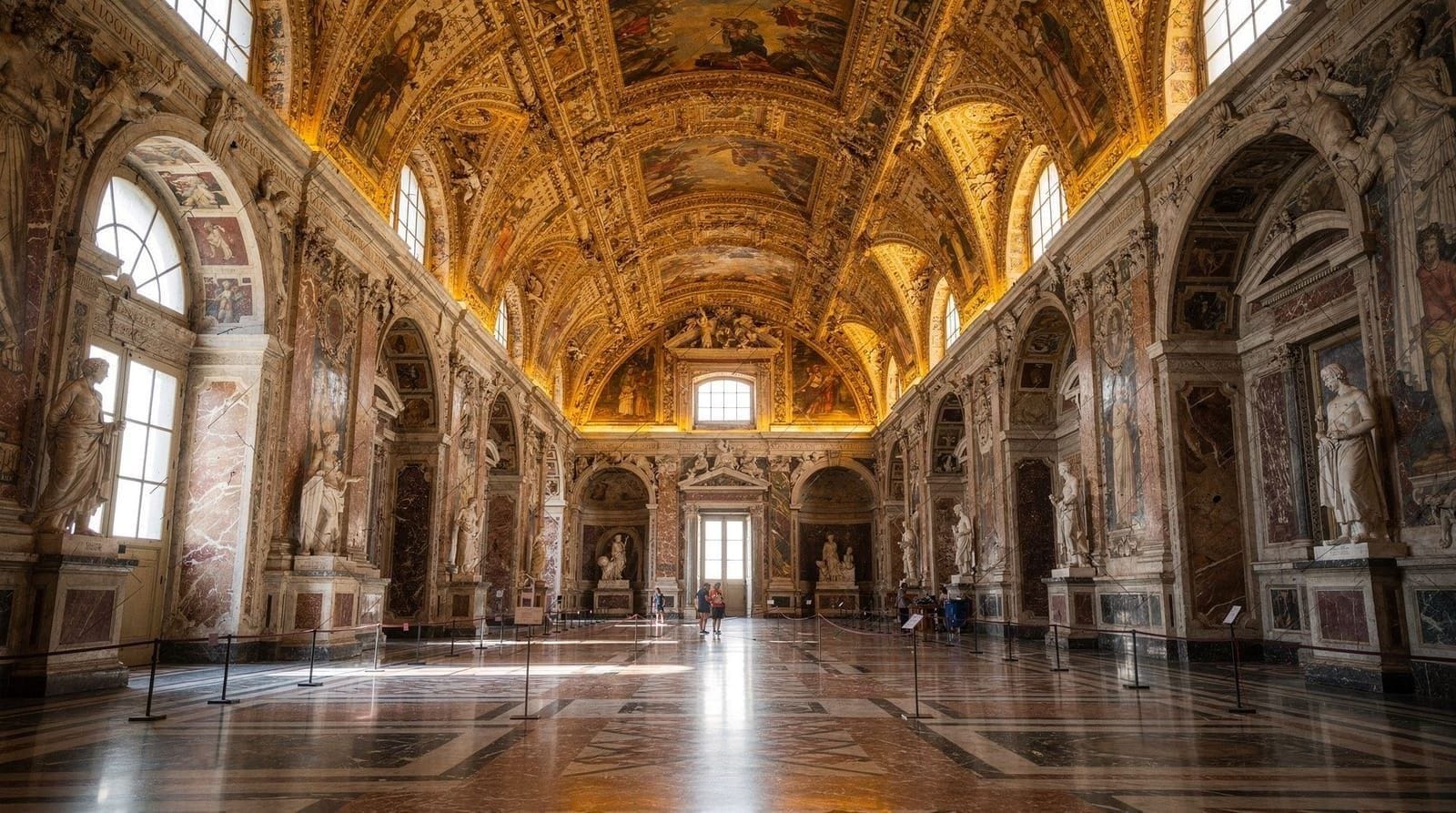
Vatican dress code rules — exactly what to wear and what gets you turned away
Vatican Museums, Sistine Chapel & St. Peter's Basilica Tour
What is the Vatican dress code?
Shoulders and knees must be covered for all visitors — men and women — at St. Peter's Basilica, the Vatican Museums, and all Vatican sites. Sleeveless tops, shorts above the knee, low-cut clothing, and bare midriffs are not allowed. Security enforces this strictly; hundreds of visitors are turned away daily. Pack a scarf or light layer to cover up quickly in summer.
Why the Vatican dress code is enforced so strictly
St. Peter’s Basilica and the Vatican Museums are active places of worship and official Church premises. The dress code is a religious modesty requirement, not an aesthetic preference. The Vatican applies it uniformly and without exceptions — tour groups, individual travellers, children, and dignitaries are all subject to the same rules.
The practical consequence: Vatican security turns away between several hundred and several thousand visitors per day during peak season. Some are turned away at the last moment after queuing for hours. Some have pre-booked expensive guided tours and lose their place while finding a cover-up. All of this is completely avoidable.
This guide tells you exactly what the rules are and how to comply in under 30 seconds.
| Covered | Shoulders, knees, midriff — for everyone |
| Not allowed | Sleeveless tops, above-knee shorts/skirts, crop tops |
| Fastest fix | A large lightweight scarf (60x150cm+) |
| Enforced at | St. Peter’s Basilica entrance and Vatican Museums gate |
| Applies to | All Vatican sites, plus most Roman churches |
The exact rules: what is and is not permitted
What is required
- Shoulders covered — sleeveless tops, tank tops, and off-shoulder clothing are not permitted
- Knees covered — shorts, skirts, and dresses must extend to at least the knee
- Midriff covered — crop tops and clothing that exposes the stomach are not permitted
- No low-cut necklines — modest neckline required (not formally defined, but “obviously revealing” is the standard applied)
What is specifically not allowed
- Sleeveless or strappy tops, even with a bra strap visible
- Shorts of any kind that do not reach the knee
- Mini skirts or short dresses (above the knee)
- Crop tops or clothing that exposes the stomach
- Visible underwear
- Men’s hats inside the Basilica (rule for inside only; hats are fine outside)
- Bare feet (sandals that cover the top of the foot are generally fine)
What is fine
- Long trousers, jeans, or chinos (any length, as long as they cover the knee while standing)
- Ankle-length maxi dresses and skirts
- Lightweight shirts and blouses covering the shoulder
- Modest swimwear worn underneath if fully covered by appropriate clothing
- Sandals (as long as the foot is not entirely bare — flip-flops are generally accepted)
- Religious headwear (hijab, kippah, etc.) — always permitted
The fastest fix: the scarf method
The single most practical item to bring to the Vatican is a large, lightweight scarf (at least 60 x 150 cm).
For women: A scarf can simultaneously cover bare shoulders (draped over them) and cover a short skirt or shorts (wrapped around the waist as a makeshift sarong). This takes 10 seconds.
For men: A scarf draped around bare shoulders covers a tank top or muscle shirt. For shorts, a scarf wrap works less well — lightweight harem pants or thin zip-off trousers are more practical.
Material: Lightweight cotton or rayon scarves pack flat and weigh almost nothing. A €5–€10 scarf purchased before your trip eliminates all dress code anxiety for the entire Rome holiday — the same code applies at most Roman basilicas, including the four papal basilicas.
Summer-specific strategy
In July and August, Rome temperatures reach 32–38°C. Visitors naturally gravitate toward minimal clothing. The Vatican does not adjust its rules for heat.
Practical summer approach:
- Wear lightweight long trousers (linen, harem-style, or zip-off trousers) rather than shorts
- Carry a scarf for shoulder cover in your day bag
- Visit in the early morning (08:00–10:00) when temperatures are 25–28°C rather than 35°C at midday
- Book early-morning Vatican tours to finish before peak heat
What does not work:
- Planning to “tie something around” on arrival — there is nothing to tie around
- Assuming you can borrow a cover-up inside — there is no such service
- Relying on vendors outside — they are sometimes there, sometimes not, and the queue at their stalls adds time
The summer heat is the most common reason visitors fail the dress code. The Vatican’s most heavily attended months are July and August; the dress code is unchanged.
See the Rome in summer guide for broader heat-management strategies.
The same rules apply to other churches
The Vatican dress code is not unique to the Vatican. All major Roman churches — including the Pantheon, the four papal basilicas, Santa Maria Maggiore, San Giovanni in Laterano, and most smaller churches — have the same modesty requirements.
If you are covering yourself for the Vatican, you are covered for every church in Rome. A scarf in your bag for the entire trip is the practical solution.
What happens if you fail the dress code
At St. Peter’s Basilica
The security check at the Basilica entrance visually checks all visitors. If your clothing does not comply, you are politely told the reason and turned away. You must:
- Go to a vendor outside (not always present) and buy a cover-up
- Return to your hotel or bag-storage to change
- Rejoin the queue (which may have grown significantly)
There is no partial entry, no holding area, and no exceptions.
At the Vatican Museums
The ticket verification gate includes a visual dress check. Visitors turned away here have additionally lost their timed-entry slot in many cases. Some operators will rebook you; others do not.
If you paid for a guided tour: Your group leaves without you unless you can find a cover-up within the narrow window of your entry time. This is a genuinely stressful situation that happens regularly and is entirely preventable.
Dress code for guided tours: extra considerations
Most reputable tour operators remind clients about the dress code in their booking confirmation. If yours does not, check before arrival. For families with children, ensure all family members comply — a group cannot enter if any member fails the check.
Vatican Museums, Sistine Chapel & St. Peter’s — small-group guided tourThis matters slightly more for guided tours than independent visits, since a fixed-time entry with a group means less flexibility to fix a wardrobe problem on the spot. Our Vatican Museums and Sistine Chapel guide and St. Peter’s Basilica guide cover what to expect once you’re inside — worth reading alongside this one so dress code planning happens before you leave the hotel, not at the security line. If you’re weighing timed-entry vs skip-the-line options, our Vatican skip-the-line tickets guide explains how those tickets interact with entry timing.
Common misconceptions
“I’ll be fine in shorts with a scarf around my waist.” If the shorts are above the knee, a waist wrap is required. Below the knee, shorts are fine on their own. The scarf must actually cover the knee area, not just be decorative.
“It’s not a problem in the Museums, only the Basilica.” Both venues enforce the code. The Museums check is sometimes less strict than the Basilica but cannot be relied on — enforcement varies by guard and by crowd density. Assume both check.
“Tank tops are fine if I buy something at the entrance.” There is no purchase option at the entrance. You must have a cover-up with you or buy one outside before entering the queue.
“They don’t enforce it on children.” They do. Children are held to the same standard.
Frequently asked questions about the Vatican dress code
Can I wear a dress to the Vatican?
Yes — provided it covers your shoulders and extends to at least the knee. A sleeveless sundress alone is not acceptable; add a scarf or jacket over the shoulders.
Are flip-flops allowed at the Vatican?
Generally yes — flip-flops cover the foot and are not explicitly prohibited. However, footwear rules are not formally published; practical enforcement focuses on significant exposure. Sandals that leave the top of the foot largely uncovered (very minimal thong sandals) may occasionally be questioned, but this is rare.
Do I need to cover my head?
No — head covering is not required at the Vatican (unlike some mosques and some Orthodox churches). Men must remove hats once inside St. Peter’s Basilica. Women with religious headwear (hijab, etc.) may keep it on.
Are leggings acceptable?
Leggings are generally accepted as they cover the legs. However, very thin or sheer leggings that effectively show through to skin may be questioned. Opaque leggings under a short skirt satisfy the knee-coverage requirement. When in doubt, layer a skirt or scarf over leggings.
What about gym or athletic wear?
Athletic shorts (above the knee) are not permitted. Athletic leggings are generally fine. Running shirts without sleeves are not permitted. A lightweight athletic cover-up worn over athletic clothes satisfies the requirement.
Does the dress code apply to the Vatican Gardens?
Yes — the Vatican Gardens are still Vatican City property and the same dress code applies.
Does the dress code apply to children?
Yes, in principle, though enforcement in practice is generally more relaxed for very young children. Older children and teenagers are held to the same standard as adults. For a family trip, it’s simplest to apply the same rule to everyone — see our Vatican with kids guide for broader family-visit planning beyond just clothing.
Will the dress code affect my photos inside St. Peter’s Basilica?
Not directly, but it shapes what everyone around you is wearing, which is part of why photos inside the Basilica tend to look more formal than photos at, say, the Trevi Fountain. If you’re planning a specific photo, appropriate dress also avoids the awkward possibility of being asked to leave mid-visit.
Dress code for men: the specific challenges
Men face a more specific set of dress code failures than women, primarily because typical warm-weather male tourist clothing (shorts + tank top / sleeveless shirt) violates both the knee and shoulder rules simultaneously.
Shorts: If they end above the knee, they are not permitted. Cargo shorts, board shorts, and most athletic shorts are in this category. Shorts that extend to or below the knee — some walking shorts, Bermuda-style shorts — are accepted.
Sleeveless tops: Tank tops, athletic vests, and muscle shirts are not permitted. A standard T-shirt with short sleeves satisfies the shoulder requirement.
Hats inside: Men must remove hats inside St. Peter’s Basilica. Caps, baseball caps, and brimmed hats must come off at the entrance. This rule does not apply outside in the square or in the Vatican Museums galleries.
Practical summer outfit for men: Lightweight linen or chino trousers (knee-length or below) plus a short-sleeve shirt. This satisfies both requirements, is comfortable in heat, and packs easily. Alternatively, zip-off trousers that convert between shorts and long trousers are a practical travel item — wear shorts in the street, convert to long at the Vatican entrance in 30 seconds.
Dress code for women: nuances
The rules for women are broader but the practical challenges are different. Summer female tourist wear — sundresses, strappy tops, shorts — frequently violates one or both requirements.
Sundresses: A full-length sundress that covers the knee and has cap sleeves or a wide strap satisfies the rules. A short sundress or one with thin spaghetti straps does not. The scarf solution (over shoulders + around waist) handles both.
Shorts: As with men — must extend to the knee.
Bikini tops or swimwear worn as a top: Not permitted, even if covered partially.
The scarf solution for women: A single large scarf (approximately 60 x 160 cm) can simultaneously:
- Drape over shoulders to cover a sleeveless top
- Tie at the waist as a sarong over shorts that end above the knee
- Wrap as a headscarf if desired (not required)
This one item in a day bag eliminates every dress code concern for every church in Rome — the Vatican and every other basilica on the four papal basilicas route.
Why the dress code exists: the religious context
The Vatican dress code is not arbitrary formality or aesthetic control. It reflects a practice of religious modesty rooted in Catholic tradition and shared across most major world religions in their sacred spaces.
In Islamic mosques, Buddhist temples, Hindu mandirs, and Jewish synagogues, visitors are also expected to cover themselves as a mark of respect. The specific requirements vary, but the underlying principle — that a sacred space calls for a different standard of behaviour and presentation than a beach or shopping street — is universal.
The Vatican enforces this more strictly than many other Catholic churches because St. Peter’s and the Vatican Museums receive 6 million visitors annually. Without systematic enforcement, the modesty standard would effectively collapse in the tourist traffic volume. The guards who turn away visitors are not being pedantic; they are maintaining a standard that the institution holds consistently important.
Understanding this context makes the dress code feel less like a bureaucratic requirement and more like what it is: an invitation to approach a historically significant sacred space with some thought.
What to pack: the minimal Vatican wardrobe
For a Rome trip in summer (June–August) that includes the Vatican:
Minimum kit:
- 1 large scarf (doubles as shoulder cover and knee cover)
- Lightweight long trousers or below-knee shorts for Vatican days
- Standard short-sleeve T-shirts or shirts
Better kit:
- Lightweight linen or breathable fabric trousers (not jeans in July heat)
- A button-up short-sleeve shirt (more formal than a T-shirt; often slightly cooler in the heat for men)
- Maxi dress or long skirt for women (covers knees automatically; add shoulder cover only)
Avoid bringing:
- Shorts as your only bottom option in Rome — impractical for the Vatican and several other major churches
- Entirely sleeveless wardrobe for Vatican day
Pair this with your timing plan — an early-morning entry (see our Vatican best time to visit guide) is cooler, which makes dress code compliance easier to live with in summer since you’re not standing in a queue at 35°C in full-length trousers.
The Rome summer guide has broader packing advice: Rome in summer heat.
Dress code mistakes that catch out first-time visitors specifically
First-time Rome visitors fail the dress code more often than repeat visitors, largely because they under-research before packing. The most common pattern: arriving straight from a beach stop (Amalfi Coast, Sicily) with a suitcase full of resort wear and no long trousers or covered-shoulder tops at all. If your Rome trip follows a beach leg, pack at least one Vatican-compliant outfit separately so it’s not buried under swimwear. Our broader Rome first-timer mistakes guide covers this pattern alongside other planning gaps that catch first-time visitors, and the Rome etiquette and customs guide puts the dress code in the context of Rome’s other unwritten social rules — useful if the Vatican is your first stop and you want to understand the city’s norms before you arrive.
Top experiences
Bookable activities with verified prices and instant confirmation on GetYourGuide.