Tivoli vs Ostia Antica: which day trip is better?
From Rome: Villa d'Este and Hadrian's Villa Tivoli Day Tour
Should I do a day trip to Tivoli or Ostia Antica?
Tivoli for gardens, fountains, and imperial palaces — it is the more spectacular visual experience. Ostia Antica for Roman ruins in depth, without the Colosseum crowds — it rewards visitors who want archaeology over aesthetics. If you can do one: Tivoli for casual visitors, Ostia Antica for history enthusiasts. Both are under 1.5 hours from Rome, and both reward a full day.
Two of Rome’s best day trips, compared honestly
Ask any long-term Rome resident which day trips they recommend to visitors with limited time, and Tivoli and Ostia Antica will consistently appear together. Both are accessible from Rome without a car. Both are relatively uncrowded compared to the Colosseum or Vatican. Both are UNESCO-recognised (Tivoli’s two villas are jointly inscribed on the World Heritage List; Ostia Antica sits within the broader protected zone of the Roman cultural landscape). And both offer something the city’s headline sites cannot: space, relative quiet, and an unhurried encounter with Roman history.
But they are not interchangeable. Tivoli is gardens and palaces and Renaissance water engineering. Ostia Antica is street-level Roman urbanism — baths, warehouses, bars, an amphitheatre, a synagogue, and mosaics still in situ on floors where Romans walked. Choosing between them depends entirely on what you want from a day outside the city.
| Tivoli | Ostia Antica | |
|---|---|---|
| Distance from Rome | 30 km east | 25 km southwest |
| Travel time (train) | around 55–70 min + short bus | around 30 min, station at the gate |
| Time needed on site | full day for both villas | half-day to full day |
| Cost (independent) | roughly €28–30 pp | roughly €15 pp |
| Best for | gardens, fountains, visual drama | Roman street life, archaeology depth |
| Combine with | Tivoli town lunch | Lido di Ostia beach |
Tivoli: what you are actually going to see
Tivoli sits in the Sabine Hills, 30 km east of Rome at the edge of the Apennine foothills. The town itself is pleasant — a small Italian hillside town with a genuine local life — but the two UNESCO-listed sites on either side of it are the reasons to make the journey.
Villa d’Este
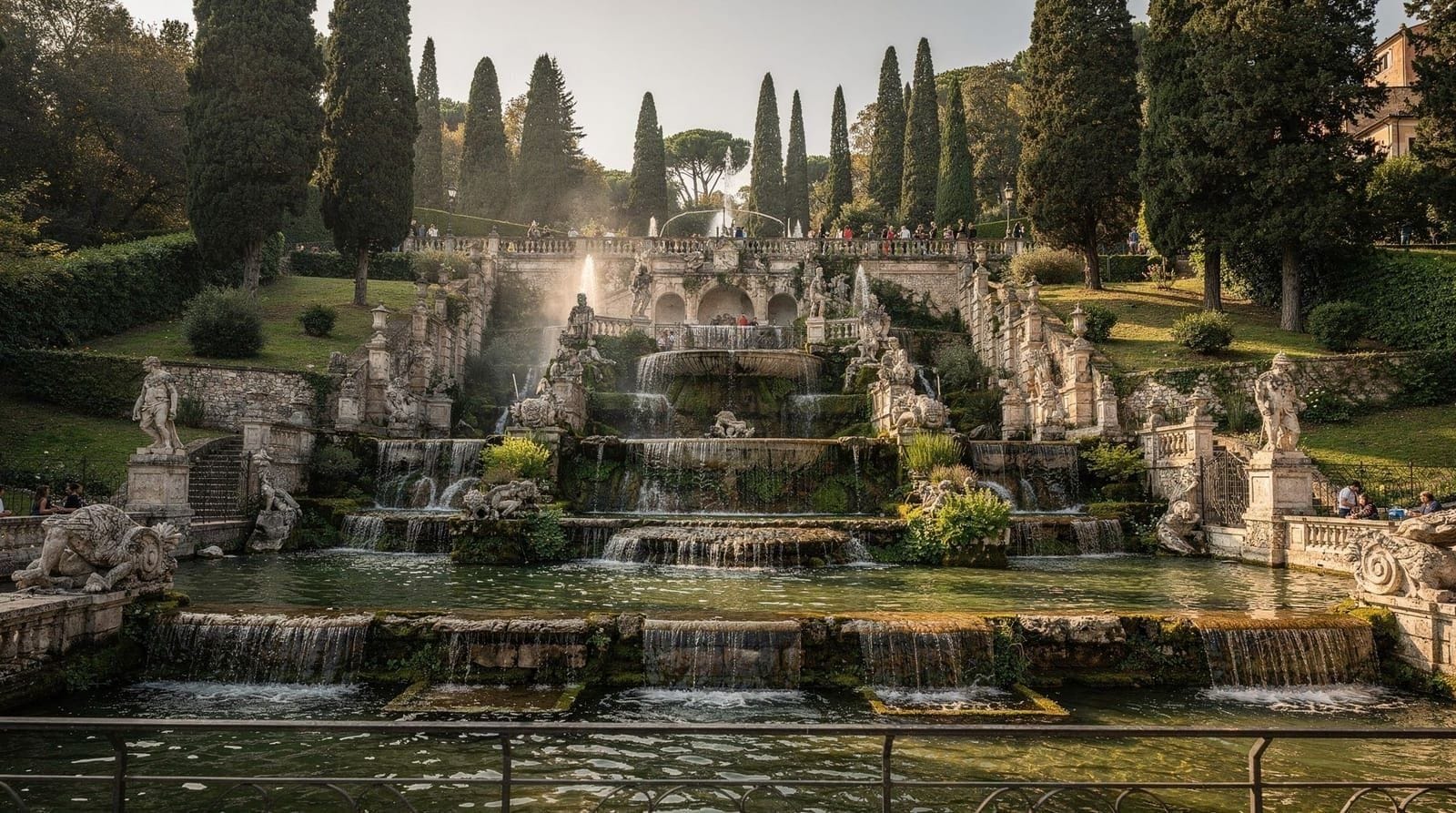
Villa d’Este is one of the most extraordinary gardens in Europe and the definitive Italian Renaissance garden. Built from 1550 for Cardinal Ippolito II d’Este (son of Alfonso d’Este and Lucrezia Borgia), it was intended as a statement of personal power and aesthetic ambition that would outshine anything in Rome. It succeeded.
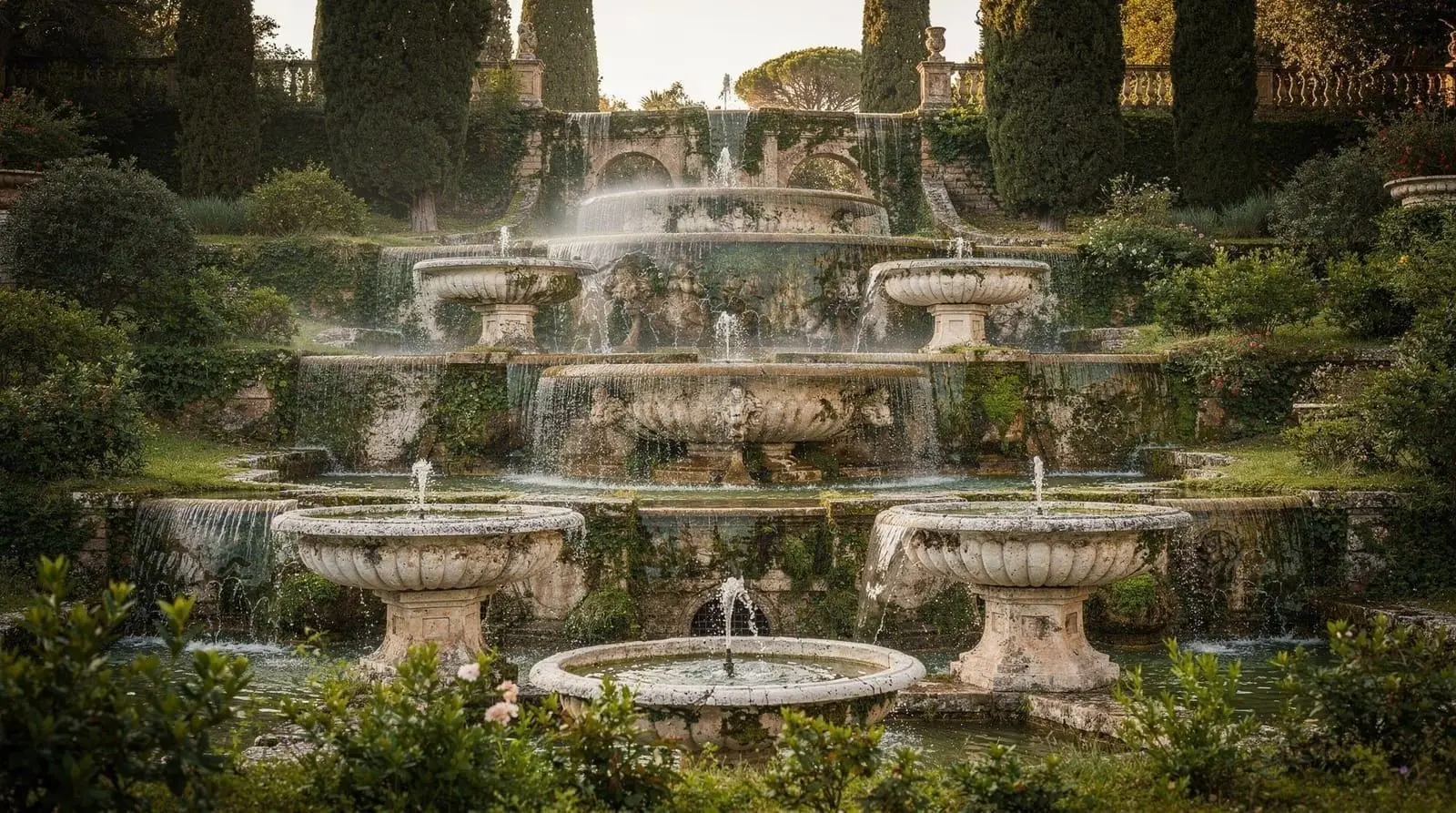
The garden is built on a steep hillside descending from the Cardinal’s villa, using a hydraulic system of channels and pipes fed entirely by gravity from the Aniene river above. This system powers over 500 fountains, including the Fontana dell’Organo (the organ fountain, which uses water pressure to drive a mechanical organ — performances at 10:30, 12:30, 14:30, and 16:30), the Cento Fontane (an avenue of a hundred jets carved as eagle heads, obelisks, and barques), and the Ovato Fountain, where water cascades through an artificial grotto below an oval pool. The engineering, designed in the 1560s by Pirro Ligorio, is genuinely astonishing — no pumps, no electricity, just water pressure and gravity.
Allow 2–3 hours at Villa d’Este. The garden covers roughly 4.5 hectares of steeply terraced hillside. Wear comfortable shoes and be prepared for steps. Entry approximately €10 adult; free on the first Sunday of the month (crowded).
Hadrian’s Villa (Villa Adriana)
Six kilometres from Villa d’Este and accessible by bus (CAT bus no. 4 from Tivoli bus terminal, 20 minutes), Hadrian’s Villa is a completely different experience — not a garden but a vast imperial complex of roughly 120 hectares, larger than the entire ancient city of Pompeii.
Built by Emperor Hadrian between 118–138 CE as his retirement palace outside Rome, the villa was an architectural anthology of the places Hadrian admired during his extensive travels throughout the empire. It contained reproductions or evocations of Greek and Egyptian structures: the Canopus, a rectangular canal surrounded by a colonnade inspired by the Egyptian sanctuary of Serapis at Alexandria; the Maritime Theatre, a circular island retreat accessible only by a rotating wooden bridge (reconstructed from ancient hinges found in the moat); the Piazza d’Oro, an elaborate reception area with a complex octagonal vestibule that anticipates Byzantine architecture; the Poikile, a vast rectangular garden inspired by the Stoa Poikile in Athens.
What remains is impressive in scale even in its ruined state. Many of the original sculptures from the villa — including famous pieces now in the Vatican Museums, the Capitoline Museums, and collections across Europe — were excavated here in the 18th century by Cardinal Albani and later by Napoleon’s agents. Entry approximately €12 adult; museum included.
Allow 2–3 hours at Villa Adriana. Wear sun protection and comfortable walking shoes — the site is mostly open-air with limited shade.
Day trip from Rome covering both Villa d’Este and Hadrian’s Villa with guided commentary and transport between sites — the most efficient way to see both in one dayOstia Antica: what you are actually going to see
Ostia Antica is Rome’s ancient port city, 25 km southwest at the mouth of the Tiber where it reaches the Tyrrhenian Sea. The site was Rome’s commercial gateway from roughly the 4th century BCE onward, handling the grain imports from Egypt and North Africa that fed a city population of over a million at the empire’s peak.
Unlike Pompeii (preserved by a single volcanic event), Ostia was abandoned gradually over the 4th–6th centuries CE as the harbour silted up and the population declined. Medieval builders quarried much of the stone for building materials in the region. What remains is substantial — approximately 34 hectares of excavated urban archaeology — but less dramatically preserved. The site rewards visitors who want to piece together a picture of Roman daily life from partial evidence rather than a cinematic intact ruin.
What to see at Ostia Antica
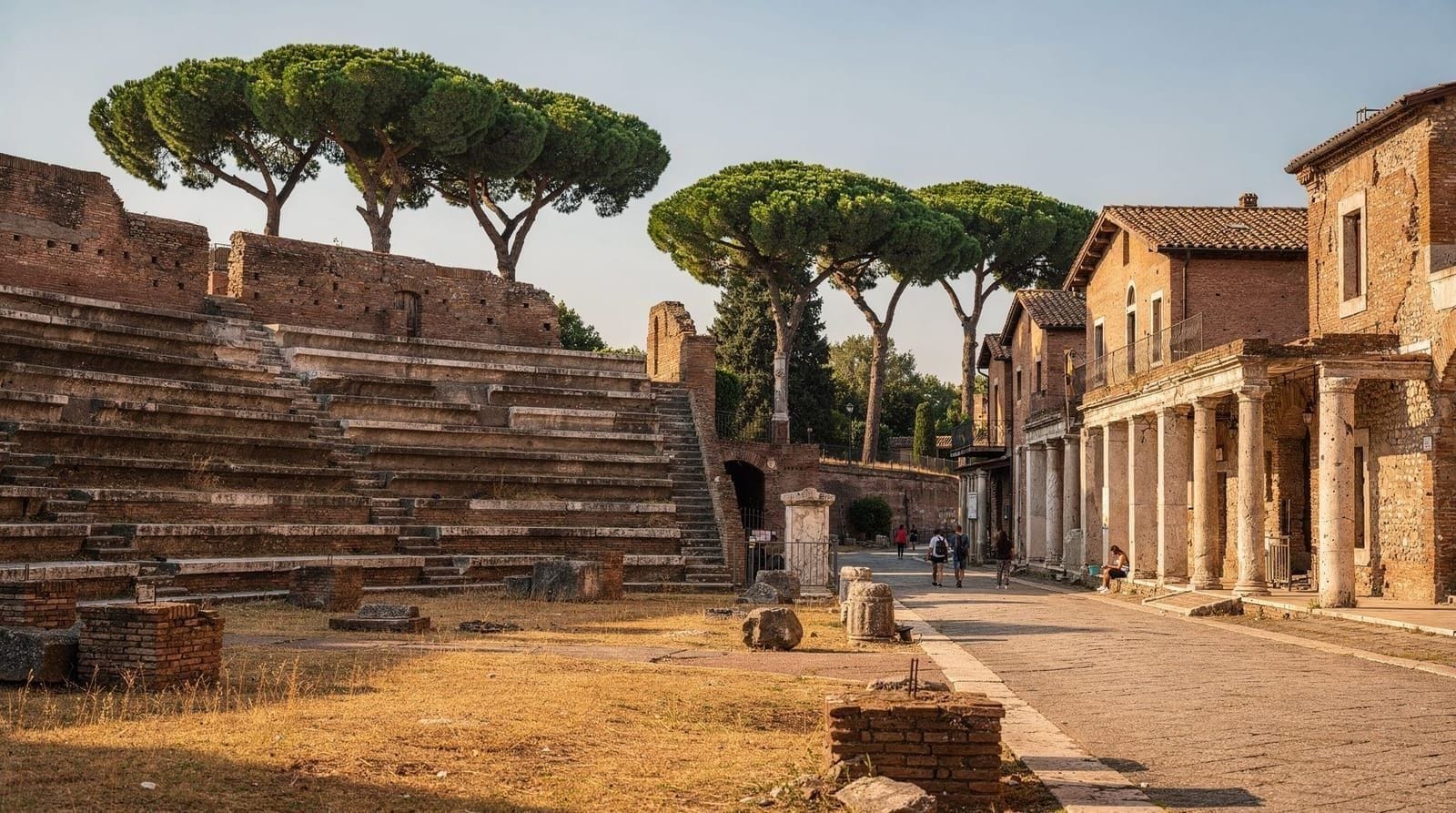
Decumanus Maximus: The main east–west street of the Roman town, approximately 1 kilometre long. Most of the major monuments are accessible from it or visible from it.
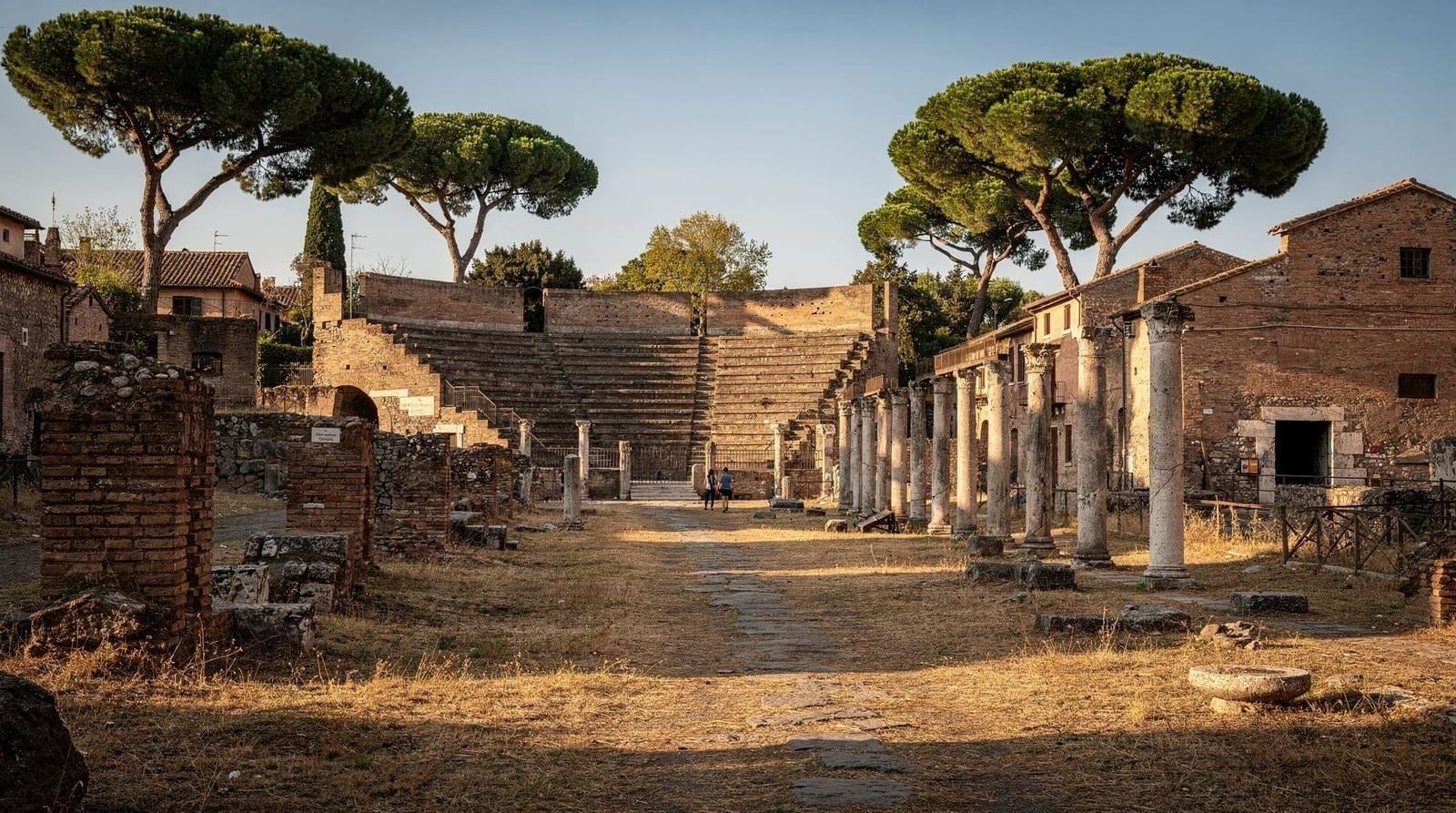
Theatre of Ostia: A 2nd-century CE theatre rebuilt by Septimius Severus seating approximately 4,000, currently used for summer classical performances. The adjacent Piazzale delle Corporazioni (Square of the Guilds) contains excellent black-and-white floor mosaics depicting the trade guilds of the port — ships, dolphins, elephants (African traders), grain measures. These mosaics were in their original location when excavated and remain there; you are standing where Roman merchants stood.
Baths of Neptune: One of several bath complexes in the city, with an exceptionally well-preserved floor mosaic of Neptune driving a sea chariot, surrounded by sea creatures. Roman baths were social institutions as much as hygienic ones — the Ostia baths were the public gathering point of their neighbourhoods.
Forum and Capitolium: The civic heart of the city, with the Capitolium temple (dedicated to Jupiter, Juno, and Minerva, as per standard Roman practice) still partially standing to considerable height. The forum’s travertine paving is intact in sections.
Insulae (apartment blocks): Multi-storey apartment buildings showing how ordinary Romans actually lived. These are far better preserved at Ostia than anywhere else, because Pompeii’s residents were largely middle-class homeowners with single-floor houses; Ostia’s population lived in Roman-era high-rise tenements of 3–4 floors.
The Synagogue: In the southern part of the site, one of the oldest synagogues discovered in the Western world (1st–4th century CE), with a marble-and-mosaic interior. A reminder that ancient Rome’s ports were multi-ethnic, multi-religious communities.
The site museum (included in the €12 entry ticket) displays mosaics, sculpture, and everyday objects removed from the site for preservation — funerary portraits, kitchen equipment, business records carved in marble.
Ostia Antica guided half-day tour by train from Rome — covers the key structures with a local guide, leaving your afternoon free for the beach or RomeDirect comparison: the key factors
Transport from Rome: Ostia Antica wins decisively. The Roma–Lido railway from Roma Ostiense takes 30 minutes, runs every 15 minutes, and costs €1.50 one way (or included in an ATAC day pass). The station is a 100-metre walk from the site entrance. For Tivoli, the regional train from Roma Tiburtina takes 55 minutes, then requires a CAT bus (15 minutes) to the Villa d’Este entrance. Alternatively, organised tours from Rome handle the transport to both villas. The Tivoli journey is manageable but more complex.
Visual impact: Tivoli wins clearly. Five hundred fountains cascading down a hillside, a 120-hectare imperial palace, and a hilltop medieval town overlooking the Roman Campagna — these are visually spectacular. Ostia Antica’s ruins are extensive but fragmentary; it requires imaginative engagement with partial evidence rather than delivering instant visual gratification.
Archaeological depth: Ostia Antica wins on immersive Roman urban archaeology. The site shows how a complete Roman port city functioned at street level — commerce, bathing, worship, apartment life — in a way that the Roman Forum’s more ceremonial layout does not. Tivoli shows imperial luxury; Ostia Antica shows how ordinary Romans lived and worked.
Time required: Both benefit from a full day, but Ostia Antica can be done meaningfully as a half-day (3–4 hours on site), leaving time for lunch and the modern Lido di Ostia beach (10 minutes further on the same train). Tivoli cannot be done properly as a half-day if you want to see both villas — the two sites are 6 km apart and require separate entry tickets.
Cost: Ostia Antica: €12 entry, €3 return transport, total approximately €15 per person. Tivoli: €10 Villa d’Este + €12 Villa Adriana + transport (€3.50 by train and bus, or €50–70 for an organised tour). Total independently approximately €28–30, by organised tour €70–90. Ostia Antica is significantly cheaper.
Crowds: Both are far less crowded than the Colosseum or Vatican. Villa d’Este is more visited than Ostia Antica — on a July weekend, Villa d’Este can feel congested in the main fountain areas, though the upper garden terraces are emptier. Ostia Antica on a weekday in September is close to deserted. Both sites offer a qualitative escape from the central Rome tourist mass.
Verdict: which should you choose?
Choose Tivoli if: You want visual beauty, Renaissance gardens, fountains, and imperial grandeur on a scale that photographs spectacularly. You are travelling with companions who are not archaeology enthusiasts. You want a more scenic hillside setting with a pleasant lunch in an Italian town. You have a full day and want to cover both UNESCO villas.
Choose Ostia Antica if: You are genuinely interested in Roman archaeology and want to explore a complete Roman city without Pompeii’s 3-hour travel time and crowds. You are pressed for time and can get meaningful value from a half-day. You want to combine the ruins with a beach afternoon — the modern Lido di Ostia beach is 10 minutes further on the same train.
Do both if you have a week in Rome. Tivoli and Ostia Antica are complementary experiences that require different amounts of time and reward entirely different aspects of a Roman visit. Tivoli on a day when you want beauty and spectacle; Ostia Antica on a morning that pairs well with a relaxed beach afternoon.
For detailed transport logistics for both, see our day trips by train from Rome guide. For the complete range of options around Rome, see best day trips from Rome.
Getting there independently: transport details
Tivoli
From Roma Tiburtina station (Metro B, Tiburtina stop): take the regional train toward Avezzano or Pescara — Tivoli is approximately 55 minutes, cost €2.60–2.90 (buy from the Trenitalia machines, validate before boarding). Trains run roughly every 30–60 minutes throughout the day. From Tivoli station, the CAT bus no. 4 goes to Villa d’Este (15 minutes, included in an ATAC day pass or €1.50 separate). For Hadrian’s Villa, the same CAT bus no. 4 continues to Villa Adriana stop, or you can take a taxi from Villa d’Este town centre (€10–12).
Alternatively, organised tours (€55–75 per person) depart from Termini or from Campo de’ Fiori and include transport between both villas plus a licensed guide. The guide adds value at Hadrian’s Villa in particular, where the layout of the 120-hectare site is harder to interpret independently.
Ostia Antica
From Roma Ostiense station (Metro B, Piramide stop, then short walk or direct access) or Porta San Paolo station (directly connected to Metro B Piramide): the Roma–Lido railway to Ostia Antica station takes approximately 30 minutes. Trains run every 15 minutes during the day. The cost is €1.50 one way on an ATAC single ticket (or use an ATAC day pass). The Ostia Antica site entrance is a 100-metre walk from the station platform.
Note: the Roma–Lido railway is a separate suburban railway line, not metro line B, though the Piramide/Porta San Paolo interchange makes the connection seamless. Tickets are purchased at the ATAC machines or using the MaaS Roma app.
Practical details for 2026
Villa d’Este opening hours: Generally 08:30–18:30 in summer, shorter in winter. Check villadestetivoli.info for specific seasonal hours. Timed entry tickets at €10 adult (€2 booking fee if pre-bought online). Free on the first Sunday of each month (crowded).
Hadrian’s Villa opening hours: 09:00–19:00 in summer (last entry 18:00), shorter in winter. Entry €12 adult. The site museum is included. Covered picnic areas are available near the main entrance — packing a lunch is a good option since the on-site café is limited.
Ostia Antica opening hours: 09:00 to approximately one hour before sunset. Entry €12 adult. The site museum (Museo Ostiense) is included and worth 30–45 minutes after your walk through the ruins. Pre-booking not required but tickets can be bought at ostiaantica.beniculturali.it to avoid the entrance queue.
Weather considerations: Both sites are heavily outdoor. In summer (June–September), both sites require sun protection, water, and ideally an early morning start. Hadrian’s Villa has limited shade over its 120 hectares; Ostia Antica’s tree-lined Decumanus Maximus provides better cover. Both are excellent in spring (April–May) and autumn (September–October), when temperatures are ideal and crowds are thinner. In winter, both sites are quiet and atmospheric under grey skies, though shorter opening hours reduce the available time.
Combining with a beach afternoon (Ostia Antica only): The modern resort town of Lido di Ostia is 10 minutes further on the same Roma–Lido railway line (one or two more stops, no additional ticket required). The beach is a municipal public beach supplemented by paid beach clubs (lidos, from €10–20 for a lounger). The water quality has improved significantly in recent years and the beach is popular with Romans for weekend swimming. This combination — Ostia Antica ruins in the morning, Lido beach in the afternoon — is one of the most satisfying half-day/half-day splits available from Rome.
When to visit each site: seasonal considerations
Tivoli in spring (April–May): The gardens of Villa d’Este are spectacular when the wisteria is in bloom (late April) and the rose gardens are at their peak (mid-May). The fountains at Villa d’Este are operational throughout the season. Hadrian’s Villa is at its most pleasant in mild spring temperatures — ideal for the outdoor walking the site requires.
Tivoli in summer (June–September): Both sites are open and fully operational, but Villa Adriana in July–August can feel punishing in full sun. Start early (Villa Adriana opens at 09:00) and plan to finish by 13:00, then have lunch in Tivoli town in the shade. Villa d’Este is more manageable because the fountain mist provides cooling. Summer weekends at Villa d’Este can be crowded — weekday visits are recommended.
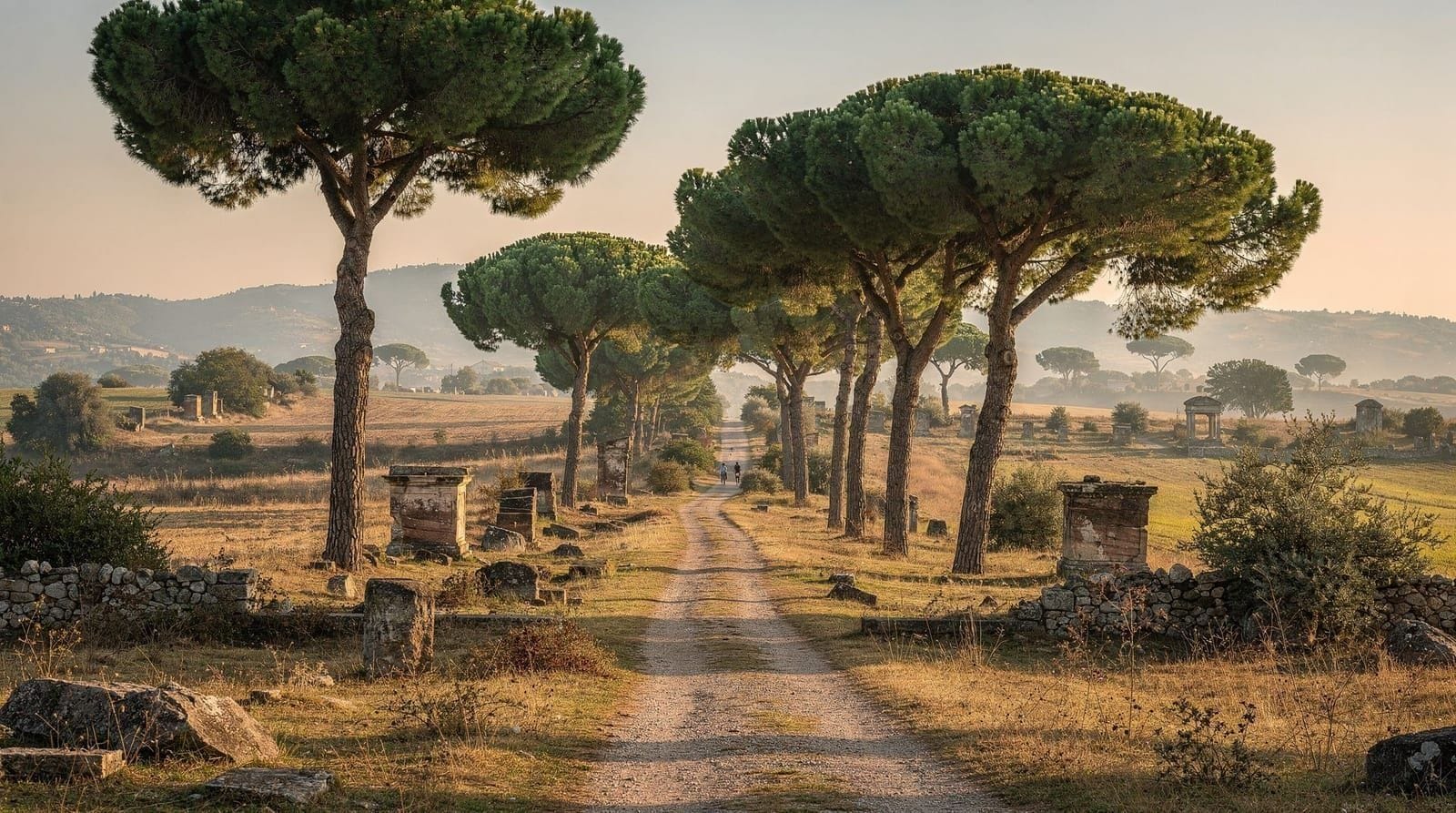
Ostia Antica in summer: The site’s tree-lined main street (Decumanus Maximus) provides better shade than either Tivoli site. Still hot in July–August, but the pine trees and cypresses planted during 19th-century excavations make it more bearable. Start by 09:00 and aim to be back on the train by 13:00 for maximum comfort.
Both sites in autumn (September–October): The optimal time for both. Cooler temperatures (20–26°C), thinner crowds, and the long afternoon light that makes outdoor archaeology particularly beautiful. October in the Tivoli hills has excellent clarity and the deciduous trees of Hadrian’s Villa’s Canopus area turn gold.
Both sites in winter (November–March): Both are open with reduced hours but far fewer visitors. Tivoli’s fountains are partially reduced in winter months (water conservation); the basic water features remain active but the organ fountain’s display schedule is limited. Ostia Antica in winter has excellent atmosphere — the ruins in grey winter light feel genuinely ancient in a way summer visits with coach parties cannot replicate.
Accessibility considerations
Neither site is fully step-free. Villa d’Este is built on a steep terraced hillside with many staircases between fountain levels — a lift exists but only connects a few levels, and wheelchair users typically see the upper gardens rather than the full descent. Hadrian’s Villa is flatter and more manageable, with gravel paths that are passable with assistance, though some structures (the Maritime Theatre island, parts of the Canopus) are not reachable by wheelchair. Ostia Antica is the more accessible of the two overall: the Decumanus Maximus and many side streets are level compacted gravel or ancient paving, though some buildings require a step up and the site is large enough that a mobility scooter or wheelchair with a companion is advisable for covering the full 34 hectares. If accessibility is a priority, Ostia Antica’s flatter layout and shorter travel time make it the easier choice; for Tivoli, plan for Hadrian’s Villa over Villa d’Este.
Fitting either trip into a longer Rome stay
If you are following a 3-day Rome itinerary, fit in only one of these two day trips — trying both alongside the Colosseum, Vatican, and centro storico in three days leaves no room to actually enjoy Rome itself. On a 7-day Rome-with-day-trips itinerary, both fit comfortably, usually with Tivoli earlier in the week (fresher legs for the hillside walking) and Ostia Antica later, paired with a beach afternoon as a lower-key day. If ancient Roman archaeology is the main draw of your trip, read our Ostia Antica vs Pompeii comparison as well — the choice between those two follows a similar logic of accessibility versus visual drama. And if you are still deciding between an independent train trip and a guided minibus tour for either site, our train vs tour day trips guide breaks down the trade-offs in cost and convenience.
Local tip: avoid the Monday trap
Villa d’Este and the Ostia Antica site museum both close on some Mondays for maintenance in the low season — always check the official calendars before a Monday visit, since a wasted train trip is the single most common complaint from readers who skipped this step. Hadrian’s Villa stays open on Mondays year-round, so a Monday works better for that half of a Tivoli day than for Villa d’Este.
Frequently asked questions about Tivoli vs Ostia Antica: which day trip is better?
How far are Tivoli and Ostia Antica from Rome?
How long should I spend at each site?
Which site has better food options nearby?
Is Ostia Antica better than Pompeii?
Which is better for children?
Can I visit Tivoli and Ostia Antica on the same trip to Rome?
Do I need to book tickets in advance for Tivoli or Ostia Antica?
Top experiences
Bookable activities with verified prices and instant confirmation on GetYourGuide.