St. Peter's Square — history, design, and practical visitor guide
Rome: Guided Tour of St. Peter's Basilica with Dome Climb
What makes St. Peter's Square special?
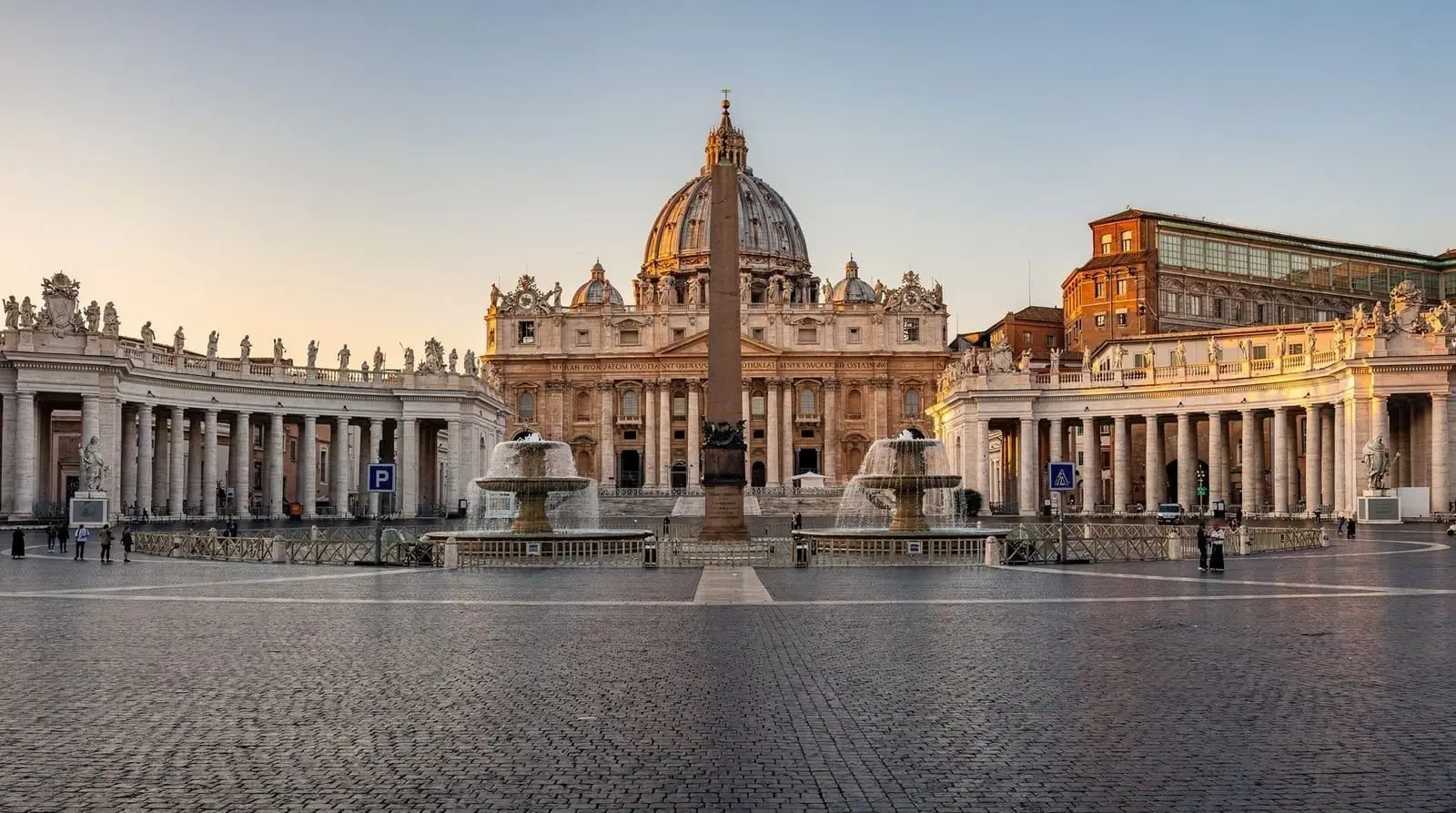
Designed by Bernini between 1656 and 1667, the elliptical colonnade of 284 columns and 140 statues creates one of the most theatrical entrance spaces in architecture. The square is free to enter at all times (with occasional security closures for papal events). The best viewpoints are from the dome of St. Peter's above, or from the early-morning light before crowds arrive around 09:00.
What Bernini built — and why it works
| Where | Vatican City, at the west end of Via della Conciliazione |
| Cost | Free (security queue only for Basilica entry) |
| Time needed | 30 minutes for the square alone; longer with events |
| Getting there | Metro A to Ottaviano–San Pietro, then a 10-min walk |
| Best time | Before 08:30, or evenings after 19:00 |
Before Bernini’s colonnade, St. Peter’s Square was a shapeless open area in front of the Basilica. Pope Alexander VII commissioned Bernini in 1656 to create a space that could accommodate large crowds for papal blessings and processions, while also providing a dramatic approach to the Basilica facade.
Bernini’s solution was an elliptical colonnade — two sweeping curved arms, each four columns deep, forming an oval enclosure that draws visitors forward while simultaneously framing the dome. He described it as “the motherly arms of the church” reaching out to welcome the faithful and correct the heretics.
The geometry is precise: the colonnade consists of 284 Doric columns arranged in four rows, supporting an entablature bearing 140 statues of saints (each approximately 3.2 metres tall). From outside the colonnade, the four rows of columns appear to merge into one — a perspective trick that Bernini designed intentionally. Two porphyry discs set into the pavement mark the focal points of the ellipses from which this effect works perfectly.
St. Peter’s Basilica guided tour with dome climb — the complete Vatican experienceThe Egyptian obelisk: older than Rome
The granite obelisk at the centre of the square was quarried in Aswan, Egypt, and brought to Rome in 37 AD by Emperor Caligula for his circus on the Janiculum Hill. It was moved to its current position in 1586 by Pope Sixtus V — a feat of Renaissance engineering requiring 900 workers, 140 horses, and 47 cranes over 13 months.
The obelisk is 25.5 metres tall and weighs approximately 320 tonnes. Unlike most obelisks in Rome (which fell and were re-erected), this one was never toppled — it stood continuously for nearly 2,000 years, making it one of the few ancient monuments in Rome with unbroken standing history.
At the base, a bronze sphere contains relics of the True Cross. A bronze cross at the top was added during the 1586 installation.
The two fountains
Two baroque fountains symmetrically bracket the obelisk. The right (south) fountain was designed by Carlo Maderno in 1614; the left (north) fountain was added by Bernini in 1677 to complete the symmetry. Both draw water from the Acqua Paola aqueduct and are functional, not merely decorative — the water is safe to touch.
The fountains serve as visual anchors that balance the obelisk compositionally and scale the foreground for photographs.
Seasonal crowds: a quick reference
| Time of year | Crowd level | Notes |
|---|---|---|
| January–February | Low | Quietest months; mornings can be nearly empty |
| March–May | Rising | Easter week is a major exception — extremely high |
| June–August | High | Peak tourist season, hot midday sun |
| September–October | Moderate-high | Warm, slightly less crowded than summer |
| November | Low-moderate | Quiet outside any specific events |
| December | High | Christmas and Jubilee-related events draw large crowds |
Outside these general patterns, any date with a scheduled papal event (Angelus, Wednesday audience, canonisation, major feast day) will be markedly busier than the seasonal average suggests — always worth checking the Vatican’s calendar if you want the square at its calmest.
Papal events in St. Peter’s Square
Sunday Angelus
Every Sunday at noon (when the Pope is in Rome), the Pope appears at the window of his apartment in the Apostolic Palace (second floor, second window from the right of the facade) and addresses the crowd. This is informal — a brief address and the recitation of the Angelus prayer. No ticket required. Crowds range from 5,000 to 50,000+ depending on season and occasion.
Papal Audience (Wednesday mornings)
General audiences are held on Wednesday mornings, either in the square (April–September) or in the Paul VI Audience Hall (October–March). Tickets are free but must be requested through the Prefecture of the Papal Household (prenotazioni.segreteria@scv.va) with advance notice. Some tour operators handle ticket requests as part of a Rome tour package.
The audience is a crowd event (10,000–100,000 people) — not an intimate experience. The Pope speaks briefly in several languages and gives a blessing. For Catholic visitors, it is a significant spiritual experience; for others, it is a logistically demanding way to see a distant figure from a crowd.
Easter and Christmas
The crowds at Easter (Urbi et Orbi blessing from the Basilica balcony) and Christmas are among the largest in Rome. The square holds approximately 300,000 people at maximum density. Arrive several hours early to be anywhere near the front. Security perimeters are established; access to the Basilica is restricted.
Best times and viewpoints
Early morning (before 08:30)
The square empties at night and in the early morning. Before 08:30 on a weekday, you may have large sections of the square essentially to yourself — a contrast to the midday crowds that can reach 30,000–50,000 people in high season.
The light is also best in the morning: the Basilica facade faces east, so it catches direct morning sunlight. By midday the facade is in shade and the square is in harsh overhead light.
From the dome
The view directly down onto the colonnade from the dome terrace at 136 metres is the definitive bird’s-eye perspective. The elliptical geometry of the square is only fully legible from above — from ground level the curved colonnade does not read as an oval. The dome climb guide has full practical details.
From the colonnade itself
Walking through the colonnade (the covered walkway between the columns) is free and often overlooked. The four-row depth creates a perspective that changes constantly as you walk through it — a different visual experience from the open square.
From Via della Conciliazione
The straight boulevard connecting Castel Sant’Angelo to the square was created by Mussolini in 1936, demolishing the medieval Borgo neighbourhood. Architectural historians debate whether this destroyed or enhanced the spatial experience. The practical effect: you now see the dome from the street before entering the square, spoiling Bernini’s intended reveal.
Bernini’s original intent: From the medieval Borgo streets, you would emerge into the colonnade through a narrow passage, and the dome and facade would appear suddenly. Via della Conciliazione eliminates this compression effect. Bernini designed the square for the surprise.
The Passetto di Borgo: the escape route above your head
The covered elevated walkway visible running along the right (north) side of the square, parallel to Via della Conciliazione, is the Passetto di Borgo — a 13th-century fortified corridor connecting the Vatican to Castel Sant’Angelo. Popes used it as an escape route during military attacks; Pope Clement VII fled through it in 1527 during the Sack of Rome, reaching the safety of Castel Sant’Angelo while his Swiss Guards were massacred in the square below.
The Passetto is not open to general visitors, though Castel Sant’Angelo occasionally offers guided access to sections of it. It is visible from the street and most clearly from the castle’s upper terraces.
Pickpocket warning
St. Peter’s Square is one of Rome’s busiest tourist areas and receives its share of opportunistic theft. The areas to be most careful:
- The approach along Via della Conciliazione (buses 40/64 arrive here — highest-risk buses in Rome)
- The security queue at the Basilica entrance (long wait, stationary, crowded)
- During crowd events (Angelus, papal audience) when density is highest
Use a cross-body bag carried in front. Nothing in back pockets or outer jacket pockets. Street vendors selling counterfeit goods or aggressive “guide” services near the security queue are best politely ignored — official Vatican staff wear visible identification and do not approach visitors unsolicited to sell tours or skip-the-line access.
Accessibility notes
St. Peter’s Square is largely flat cobblestone, which makes it navigable for wheelchair users and strollers, though the cobbles themselves can be uneven and slow-going compared to smooth pavement. The security screening area at the Basilica entrance has accessible lanes, and staff will generally direct visitors with mobility needs to a shorter queue on request. The colonnade’s covered walkway is also flat and step-free throughout. Where accessibility breaks down is beyond the square itself: the dome climb is stairs-only, and the Vatican Museums involve some walking distance between sections. For a fuller picture of what’s manageable and what isn’t across the whole Vatican complex, see our accessible Rome guide.
Combining St. Peter’s Square with the rest of the Vatican
St. Peter’s Square is the natural starting and ending point for a Vatican day.
Morning sequence: Arrive in the square at 07:30–08:00 before crowds build. Walk through Bernini’s colonnade. Enter the Vatican Museums at 08:00 via the north entrance (15-minute walk from the square, along the Vatican wall). Visit Museums and our Sistine Chapel guide territory (3 hours). Exit directly into the Basilica (1 hour). Climb the dome (1 hour). Return to the square for a final look in afternoon light. Our Vatican best time to visit guide has the full timing logic behind this sequence.
For the Angelus: If your Rome visit includes a Sunday, the noon Angelus is free and takes 20 minutes. Arrive by 11:30 to be in the main section of the square. Combine with a morning visit to the Castel Sant’Angelo and Prati for lunch.
St. Peter’s dome, Basilica, and Vatican catacombs — combined guided tourFrequently asked questions about St. Peter’s Square
Is St. Peter’s Square free to enter?
Yes — the square is always free and open. There are no ticketing requirements. Security screening is only required for entering the Basilica itself.
What is the best photo spot for St. Peter’s Square?
The dome terrace at 136 metres offers the best overhead view of the square’s elliptical geometry. On the ground level, the porphyry discs on the pavement (focal points of the colonnade ellipses) offer the perspective trick of four column rows merging into one. For the facade with dome, Via della Conciliazione from 200–400 metres back gives a clean full view.
When is St. Peter’s Square most crowded?
Peak hours are 10:00–14:00 daily. Wednesday mornings (Papal Audience) and Sunday noons (Angelus) are especially dense. Easter and Christmas are maximum capacity. Low season (January–February) mornings can be notably quiet.
Can I walk through the colonnade?
Yes — the covered walkway between the Doric columns is open and free. Walking through it is worth doing, especially in the early morning or evening when it is quieter.
What is the Papal Audience hall and how is it different from the square?
The Paul VI Audience Hall (built 1971, designed by Pier Luigi Nervi) seats 8,000 people and is used for Wednesday audiences in winter months. Admission requires the same ticket from the Prefecture. The hall’s interior architecture — a vast curved concrete space with stained glass — is architecturally significant and worth noting separately from the historic square.
Is St. Peter’s Square good for a romantic evening visit?
Yes — the evening square, largely emptied of daytime crowds and floodlit dramatically, is one of the more romantic free experiences in Rome, particularly combined with a walk along Via della Conciliazione or the Tiber nearby. See our romantic things to do in Rome guide for how it fits alongside other evening ideas.
Is St. Peter’s Square suitable for young children?
Generally yes at quieter times — the open space is easy to navigate with a stroller and there’s plenty of room to move. Avoid bringing very young children during peak midday crowds or major papal events, when density and noise can be overwhelming. See the Vatican with kids guide for broader family planning around the whole Vatican visit.
Evening in St. Peter’s Square: the best time to visit without crowds
Between 19:00 and 21:00, St. Peter’s Square sees a fraction of its daytime visitor volume. The Basilica closes at 18:00–19:00 (depending on season), which pushes the visiting crowd away. What remains is a mix of Roman residents on evening walks, people attending evening Mass, and a smaller number of tourists who have specifically come to see the square at night.
At this hour, the square’s theatrical qualities are most apparent. The floodlighting on the colonnade creates strong shadow lines on the columns; the dome is lit from below; the fountains and obelisk are outlined against a darkening sky. The Via della Conciliazione — the broad avenue leading to the square — becomes one of the better evening walks in Rome.
Evening access is not advertised but is never restricted except during specific papal events. It is simply not mentioned in most visitor guides, which focus on daytime schedules and ticketing logistics. The square in the evening offers a genuinely different quality of experience with a fraction of the logistical friction.
Practical tip: If you are staying in Prati or Trastevere, an evening walk to St. Peter’s Square costs nothing and requires no planning. Walk through the colonnade, sit on the steps near a fountain, look at the dome in the evening light. This is the experience Bernini actually designed the space for — not the daytime tourist processing machine it operates as between 09:00 and 18:00. Bring a light jacket even in summer, since the open square catches a breeze off the Tiber that can feel noticeably cooler after dark than the surrounding streets.
The square in context: how it changed the approach to Rome
Before 1936, arriving at St. Peter’s from central Rome meant navigating the Borgo Vecchio — a medieval quarter of narrow streets, low buildings, and sudden enclosed piazzas. The approach was deliberately compressed: streets closed in, views were blocked, and then suddenly the colonnade opened in front of you. Bernini’s theatrical instinct depended on the contrast between constriction and expansion.
Mussolini demolished the Borgo Vecchio to build Via della Conciliazione as part of the Lateran Treaty celebrations (1929–1936). The boulevard was completed in 1950 for the Holy Year. The result is architecturally debated: the broad straight avenue gives tourists a conventional panoramic approach, but eliminates the dramatic compression-and-release sequence Bernini designed.
The Italian architectural historian Paolo Portoghesi described the demolition as “the urbanistic crime of the century” for Rome. Others argue Via della Conciliazione created a dignified processional route appropriate to Vatican ceremonial use. Both arguments have merit; neither changes the current reality.
For visitors today, the practical consequence is simple: you approach the square with its dome visible from 600 metres away. The experience Bernini intended — emergence from darkness into light — is available only in photographs of medieval Rome.
The Swiss Guard: the world’s oldest active military corps
The Pontifical Swiss Guard has protected the pope since 1506. They are stationed at the entrances to the Vatican (including the Bronze Door at the right side of St. Peter’s Square) and are identifiable by their Renaissance-era striped uniform, designed (according to tradition but disputed by historians) based on Michelangelo’s colours.
The real historical design of the uniform dates from the early 20th century, not the Renaissance. The current blue-yellow-orange stripes were formalised under Pope Pius X (1914). The halberds the guards carry are functional ceremonial weapons, not purely decorative. Photographing the guards is permitted and common, but treat it as you would photographing any working security personnel — a respectful distance and no attempts to provoke a reaction for a photo are expected, even though the guards themselves are generally used to tourist attention.
Guard duty at the Vatican is a standing military commitment for Swiss Catholic males; service is 2–3 years minimum. The corps numbers approximately 135 members. They are simultaneously ceremonial guards, the pope’s personal protection, and Vatican security staff. For the wider story of how the papacy shaped Vatican City and Rome more broadly, see our popes and papacy guide.
The 6 May commemoration of the 1527 Sack of Rome (when 147 Swiss Guards died defending Pope Clement VII’s escape route) is observed annually with a swearing-in ceremony for new guards — one of the Vatican’s more unusual ceremonial events and occasionally accessible to visitors by arrangement.
The practical walking tour of St. Peter’s Square: a sequence
Rather than simply standing in the middle and looking around, the following sequence extracts the most from the square’s design.
Step 1 — Enter from Via della Conciliazione (the broad street from Castel Sant’Angelo). Note the broad view of the dome and facade from 400+ metres. This is the view Mussolini created; it is dramatic but not what Bernini intended.
Step 2 — Walk toward the colonnade and enter it from the side. The covered walkway between the columns is free and mostly ignored by tourists rushing to the Basilica entrance. Walk through it at a slow pace — the four rows of columns create a constantly shifting perspective as you move, which is part of Bernini’s design intention.
Step 3 — Find the porphyry disc on the left side of the oval pavement. A small engraved disc, approximately 30 cm in diameter, is set in the cobblestones off-centre in the oval. Stand on it and look at the colonnade: the four rows of columns merge visually into one. The same trick works from the matching disc on the right side. This perspective illusion is one of the most satisfying architectural jokes in Rome and takes 2 minutes.
Step 4 — Walk to the centre of the oval near the obelisk. Look back at the Basilica facade from here. The facade is often dismissed as bland compared to the dome — correct at first glance, but Maderno’s facade creates the horizontal screen that makes Michelangelo’s dome visible from the square itself. Without the wide facade, the dome would be hidden by the drum when viewed from the square.
Step 5 — Circle the obelisk. Read the inscriptions on the base (in Latin). The original Egyptian hieroglyphics on the obelisk shaft are genuine 1st-century BC inscriptions — there are no hieroglyphics on this obelisk because it was made for a Roman circus, not an Egyptian temple. The blank shaft is the tell.
Step 6 — Walk toward the Basilica entrance but stop at the steps. Look up at the 140 statues on the colonnade from immediately below them. Each figure is 3.2 metres tall — the scale visible from here is different from the distant view.
This sequence takes approximately 30 minutes and covers the square’s major elements in a way that standalone photography does not. For more framing ideas beyond this walk, our best photo spots in Rome guide and sunrise and sunset spots guide both cover St. Peter’s Square among the city’s top locations.
Top experiences
Bookable activities with verified prices and instant confirmation on GetYourGuide.