Pompeii from Rome: how to do it right in a day
Pompeii Day Trip from Rome by High-Speed Train & Guided Tour
How do you get from Rome to Pompeii by train?
Frecciarossa or Italo from Roma Termini to Napoli Centrale (1h10–1h15, from €14.90 advance), then the Circumvesuviana regional train to Pompei Scavi-Villa dei Misteri (35 minutes, about €2.80). Total journey around 2h10. Leave Rome by 07:30 to arrive at the site by 10:00 and have 5 hours before the last return.
The most dramatic ancient site in the world — and how to get there
Pompeii is like nothing else. Not because of the intellectual weight of Roman history, which you can get at the Forum, but because of the physical immediacy of what a volcanic eruption preserved: a Roman city frozen mid-morning on 24 August 79 CE, with the food still in the pots, the paintings still on the walls, and the people caught in postures of flight. Walking these streets does something to you that no amount of museum visits quite prepares you for.
From Rome, Pompeii is about 2h10 each way by a combination of high-speed train and regional rail. It is a long day. It is also, if you go prepared, one of the best day trips available anywhere in Italy.
This guide gives you the logistics to do it properly.
| Distance from Rome | About 240km, roughly 2h10 door to door |
| Cost | Around €55–80/person independent, €80–130 guided |
| Time needed | Full day (leave 07:00–07:30, back by 20:00–21:00) |
| Getting there | High-speed train to Naples, then Circumvesuviana to Pompei Scavi |
| Best time | April–June or September–October, arriving at opening |
The journey in detail
Step 1: Rome Termini to Naples (1h10–1h15)
Which train: Frecciarossa (Trenitalia) or Italo high-speed trains. Both are excellent; Frecciarossa is more frequent (up to 2 per hour in peak hours). Journey time is 1h07–1h15 depending on service.
Fares: Advance booking is essential for good prices. Book 2–4 weeks ahead on trenitalia.com or italotreno.it and you will find fares from €14.90 one way. Book the day before and you may pay €35–50+. There is no walk-up discount at the station.
Departure: Aim to catch the 07:00–07:30 train from Roma Termini. This gets you to Naples by 08:15–08:45, leaving time to catch the Circumvesuviana and arrive at Pompeii by 10:00.
Seat reservation is included in the high-speed train ticket. You are guaranteed a seat; no need to stand.
Step 2: Naples Centrale to Pompei Scavi (35 minutes)
Which train: The Circumvesuviana, a regional railway operating on the Napoli–Sorrento line. It is a different train from the high-speed Frecciarossa; you will need to walk from the main Napoli Centrale platforms to the Circumvesuviana lower level (signposted within the station).
Ticket: Purchase at the Circumvesuviana ticket windows in Napoli Centrale. Ask for Pompei Scavi-Villa dei Misteri on the Sorrento line. The fare is approximately €2.80 each way. There is no online advance booking for Circumvesuviana — buy at the station.
The stop: Get off at Pompei Scavi-Villa dei Misteri — not Pompei FS (a different station near the modern town, much further from the ruins). The Scavi entrance is a 3-minute walk from the Circumvesuviana station.
Important: The Circumvesuviana is a regional commuter train, not a tourist service. It is often crowded and has had some pickpocket incidents; keep bags in front of you, particularly between Naples and Pompeii.
Step 3: Returning to Rome
Last usable train from Pompei Scavi: To catch a comfortable high-speed train back and be in Rome by 20:00, aim to leave Pompeii by 15:30–16:00. The Circumvesuviana back to Naples takes 35 minutes; factor in a 20-minute walk to the Circumvesuviana platform at Napoli Centrale. High-speed trains from Naples to Rome run frequently in the late afternoon — book your return journey before you travel.
Booking Pompeii entry tickets
Book at pompeiisites.org — the official Parco Archeologico di Pompei ticketing site. Do not buy from third-party resellers; you pay more and receive the same ticket.
Entry prices: €18 full price. €2 for EU citizens aged 18–25. Free entry on the first Sunday of each month — very crowded, not recommended.
Timed entry: Pompeii uses timed entry slots at 30-minute intervals. Choose a slot corresponding to your expected arrival (typically 09:00–10:30 for a day trip from Rome). You can stay as long as the site is open after your entry slot.
Do not skip booking. In peak season (April–October), walk-up queues at Pompeii can be 45–90 minutes. Pre-booked tickets have a separate, much shorter queue.
What to see at Pompeii
The site is enormous — 66 hectares open to visitors across a 170-hectare ancient city. You cannot see everything in a day. What follows is the essential route.
The Forum
Enter through the Porta Marina (sea gate — no longer near the sea, which has receded 2km). The Forum opens immediately: a large rectangular space flanked by the Temple of Jupiter (north), the Basilica (law courts, southwest), the Building of Eumachia (textile merchants’ guild, east), and the macellum (food market, northeast). This is where civic and commercial life converged. The Forum at Pompeii gives a clearer sense of the function of Roman public space than the Roman Forum in Rome, which is too ruined to read without expert guidance.
Via dell’Abbondanza
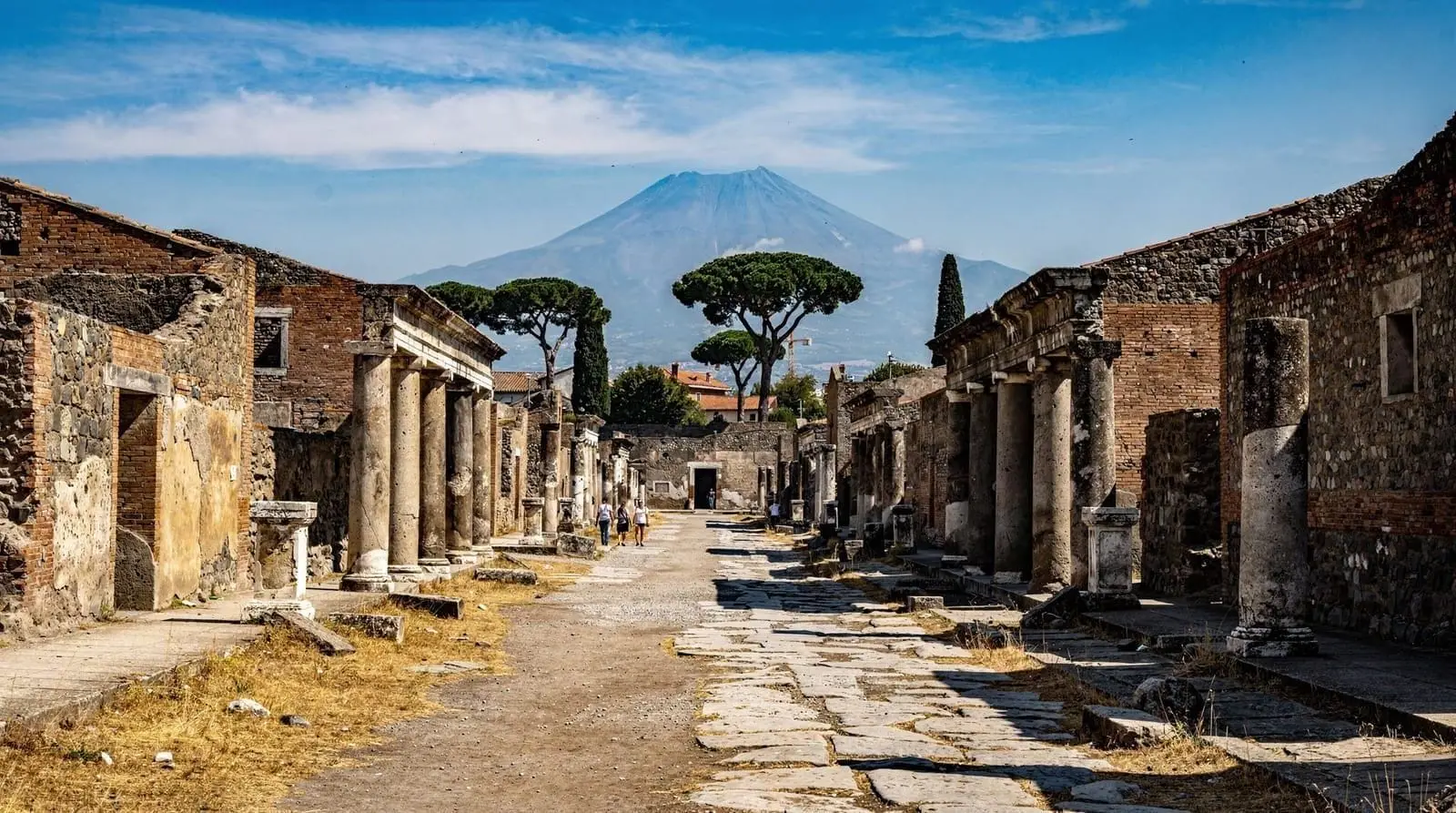
The main commercial street of Pompeii, running east from the Forum across the width of the city. The streetscape is remarkably intact: raised pavements (to avoid the waste water that flowed in the streets), stepping stones to allow crossing without getting wet, carved electoral endorsements on building facades, painted advertisements for businesses, and the marks of cart wheels worn into the original basalt paving. Walk this street in full and you experience Roman urban life at a visceral, human scale.
The Lupanar (brothel)
On Via Vico del Lupanare, just north of Via dell’Abbondanza. Pompeii’s largest brothel has 10 rooms (5 upstairs, 5 down), stone beds with built-in headrests, and a remarkable series of erotic paintings above each doorway — apparently serving as a menu or guide for clients. It is one of the most visited spots in Pompeii; arrive early to avoid queues at the door.
The House of the Faun
One of the grandest private houses in Pompeii, occupying an entire city block. Named for the small bronze dancing faun in the central fountain basin (a cast; the original is in Naples). The floor mosaics — including the famous Alexander Mosaic showing the Battle of Issus (again, a cast; the original in Naples) — are extraordinary. The sheer scale of the house (3,000 square metres) conveys Roman aristocratic wealth clearly.
The House of the Tragic Poet
Famous for the threshold mosaic “Cave Canem” (Beware of the Dog) — one of the most reproduced images from antiquity. The house is modest in size (the theatrical name is ironic) but the mosaics are excellent.
The Amphitheatre
Walk the full length of Via dell’Abbondanza to reach the amphitheatre at the eastern end — the oldest surviving Roman amphitheatre in the world (built around 70 BCE). It held 20,000 spectators, used the slope of the city wall as seating support on one side, and hosted gladiatorial games. Standing in the arena floor and looking up at the tiered seating gives a powerful sense of scale.
The plaster casts
Pompeii’s most famous images — the casts of human bodies frozen in the positions in which they died — are scattered across the site. The main display is in the Garden of the Fugitives (Orto dei Fuggiaschi) near the Nocera Gate at the southeast. Here, a group of 13 people — adults, children, and an unborn child — are displayed in a garden enclosure in the positions they were found. The technique (pioneered by archaeologist Giuseppe Fiorelli in 1863, who poured plaster into the cavities left in the hardened ash by decomposed bodies) produces figures that are simultaneously archaeological artefacts and something far more disturbing.
Guided tour vs. independent visit
Independent visit (train plus self-guided) costs approximately €55–80 per person depending on train fare. You get complete flexibility. The main challenges: the site is large and hard to navigate without a map; the historical context that makes sense of what you are looking at requires a guide or very thorough preparation. See the train vs tour day trips comparison for a broader analysis of when each approach works best.
Organised tour from Rome (coach or high-speed train, guide, entry included) costs approximately €80–130 per person. The benefits: expert commentary, logistics handled, skip-the-line entry, and a guide who knows which of the 40 “House of…” buildings is worth entering. For first-time visitors to Pompeii, the guided option is genuinely worth the extra cost.
Pompeii day trip from Rome by high-speed train — guided tour with entry included, leaving Termini in the morningSummer survival guide
Pompeii in July and August is intense. The dark basalt street paving absorbs and radiates heat; summer temperatures regularly reach 32–38°C; the site has minimal shade outside of the covered houses; and the tourist volume is at its peak.
If you visit in summer:
- Arrive at 09:00 opening, before the heat builds
- Carry 2 litres of water per person (water fountain near the Forum entrance)
- A hat is not optional — it is essential
- Retreat to the covered atrium sections of houses at midday
- Leave by 13:00–13:30 if possible
Alternatively: Pompeii in October, November, March, or early April is dramatically better. Comfortable temperatures, far fewer visitors, and clearer air that makes Vesuvius visible in profile from inside the site.
Pompeii by season
| Season | Temperature | Crowds | Notes |
|---|---|---|---|
| Dec–Feb | Cool, 8–14°C | Low | Some rain; ash paths can turn muddy |
| Mar–Apr | Mild, 14–20°C | Moderate | Good light, Vesuvius often visible |
| May–Jun | Warm, 22–28°C | Rising fast | Book entry a week ahead |
| Jul–Aug | Hot, 32–38°C | Peak | Follow the summer survival tips above |
| Sep–Oct | Warm, 22–27°C | Moderate | Best overall balance of comfort and crowds |
| Nov | Cool, 12–17°C | Low | Shorter days; leave Rome slightly earlier |
Eating near Pompeii
Inside the archaeological park there is a single self-service cafeteria near the Forum Baths — fine for a quick sandwich but not memorable. Most visitors eat either before entering (there are simple bars and pizzerias around Pompei Scavi station) or afterwards in Naples, saving the good meal for the Neapolitan pizza the city is famous for. If you are pairing Pompeii with Naples in the same day, holding off on lunch until Naples is usually the better call — a proper Neapolitan pizza margherita costs around €6–9 and is worth the wait. Carrying a couple of filled rolls and fruit into the site is entirely acceptable and saves time if you want to maximise hours among the ruins rather than hunting for food.
Accessibility at the site
Pompeii is a working archaeological excavation, not a paved museum, and this shows in the terrain: original basalt paving is uneven, stepping stones across streets are a trip hazard for unsteady walkers, and many houses have raised thresholds. The Parco Archeologico publishes an accessible route covering the Forum, Via dell’Abbondanza, and several major houses with ramps and firmer paths — ask for the map at the entrance or check pompeiisites.org before you go. Wheelchair and pushchair users should expect a slower, more limited visit than the full route described above, though the flattest, most rewarding stretch (Forum to the Amphitheatre along the main street) is largely manageable.
Combining Pompeii with Naples or Vesuvius
Pompeii plus Naples: Logistically simple — you pass through Naples on the way to Pompeii. Do Pompeii in the morning and Naples (specifically the National Archaeological Museum, which holds all the most important Pompeii artefacts including the Alexander Mosaic and the secret room of erotic art) in the late afternoon. Then take the evening high-speed train home. A genuinely excellent double.
Pompeii plus Vesuvius: Feasible but requires an early start and precise planning. Leave Rome at 06:30, be at Pompeii by 09:00, spend 3.5 hours, take the bus from Pompeii to the Vesuvius visitor centre (approximately 50 minutes), hike the crater (1 hour return), take the bus back to Pompei Scavi station, then train to Naples and home. Arrives back in Rome by 21:00–22:00. An exhausting but memorable day.
See the Naples from Rome guide for the full guide on combining both cities.
Pompeii and Mount Vesuvius day trip from Rome — guided tour covering both sitesPractical checklist
- Book Pompeii entry in advance at pompeiisites.org (€18 full price, timed entry). See Rome skip-the-line tickets guide for context on advance booking culture.
- Book return high-speed train at trenitalia.com or italotreno.it (book 2–4 weeks ahead for best fares). See trains from Rome day trips for the full booking guide.
- Departure from Rome: aim for 07:00–07:30 train to arrive at site by 10:00
- Circumvesuviana ticket: buy at Napoli Centrale, approximately €2.80 to Pompei Scavi-Villa dei Misteri
- Return departure from Pompeii: 15:30–16:00 to catch comfortable evening train home
- Carry: 2 litres water, hat, sunscreen, good walking shoes
- Audio guide at entrance: approximately €8, available in English, worth it for independent visitors
- Best months: April–June, September–October. See best time to visit Rome for seasonal planning context.
- Related itineraries: Rome–Naples–Pompeii 5 days if you want to base yourself in Naples for a night.
- Destination context: Pompeii and Vesuvius destination page for accommodation, local food, and the broader Campania region.
Frequently asked questions
Is Pompeii safe to visit?
Yes, entirely. The site is well-managed with clear signage, official guides, and regular security. The Circumvesuviana commuter train has some pickpocket activity (keep bags visible and close); the Pompeii site itself has no safety concerns.
How does Pompeii compare to Ostia Antica?
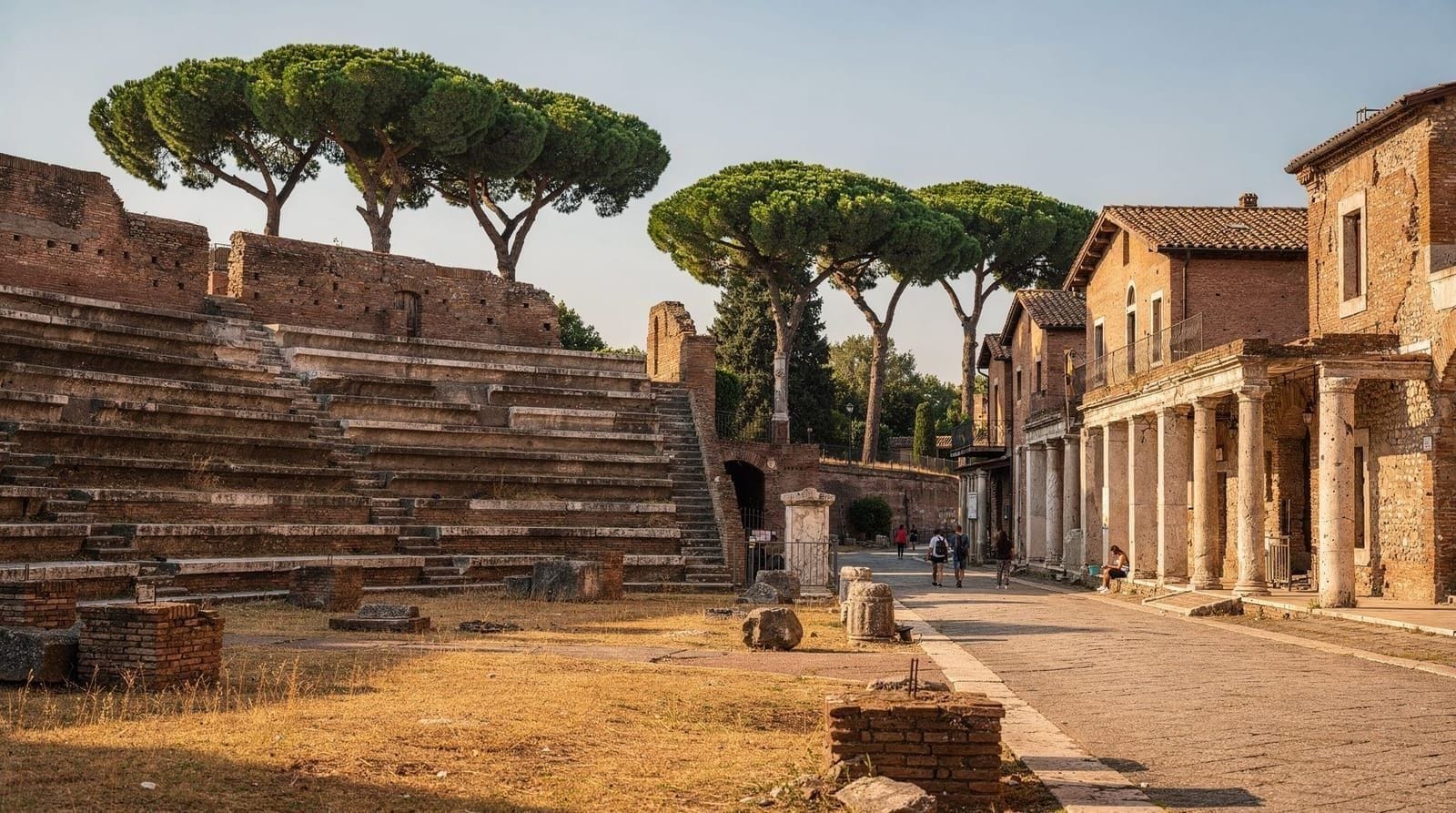
Different scales of experience. Pompeii is larger, more dramatically preserved, and emotionally more powerful — but busier and harder to reach. Ostia Antica is closer to Rome (45 minutes vs 2h10), far less crowded, and shows a different and equally important aspect of Roman life (the commercial port city vs the wealthier resort town). If you have time for both, both are worth doing. See Ostia Antica vs Pompeii for a detailed comparison.
What is the Pompei vs Pompeii spelling?
The modern Italian town is spelled Pompei (one i). The ancient archaeological site and its English-language name uses two i’s: Pompeii. You will see both — just know they refer to the same place.
Can I do Pompeii as a half-day trip?
Not really, and it is not worth trying. The train journey alone eats close to 4.5 hours round trip, so a half-day leaves you 2 hours or less on site — not enough to see the Forum, Via dell’Abbondanza, and one or two houses properly. Budget the full day described in this guide; if time is genuinely tight, a shorter alternative closer to Rome is Ostia Antica, 45 minutes each way.
Is there luggage storage near Pompeii if I’m arriving from a cruise or before a flight?
Not at the Pompei Scavi station itself. If you are day-tripping from Civitavecchia rather than Rome, use the shuttle and luggage services at the port; if travelling from Rome with bags, leave them at your Rome accommodation or at the left-luggage office at Roma Termini before heading out, since Pompeii has no formal storage for visitors.
Top experiences
Bookable activities with verified prices and instant confirmation on GetYourGuide.