Pompeii & Vesuvius
Pompeii is the most important Roman archaeological site outside Rome. 2h30 from Roma Termini by train. How to book tickets, beat crowds, and add Vesuvius.
From Rome: Pompeii Day Trip with Optional Vesuvius and Lunch
Quick facts
- Distance from Rome
- ~240 km southeast
- Train from Roma Termini
- Frecciarossa 1h10–1h15 to Napoli Centrale, then Circumvesuviana 30 min
- Pompeii entry ticket
- €18 standard (online booking strongly recommended)
- Vesuvius entry
- ~€10 crater fee; guide compulsory in summer
- Total day budget
- €60–90 per person (trains + entry + lunch)
The city that stopped in 79 AD
On the morning of 24 August 79 AD, Vesuvius erupted and buried Pompeii under 4–6 metres of volcanic ash and pumice within 18 hours. Around 2,000 people who did not escape in time were killed — their bodies preserved as voids in the solidified ash, later cast in plaster to reveal their final moments. The city they lived in — streets, houses, shops, frescoes, bakeries with loaves still in the ovens — was preserved under that ash with extraordinary completeness.
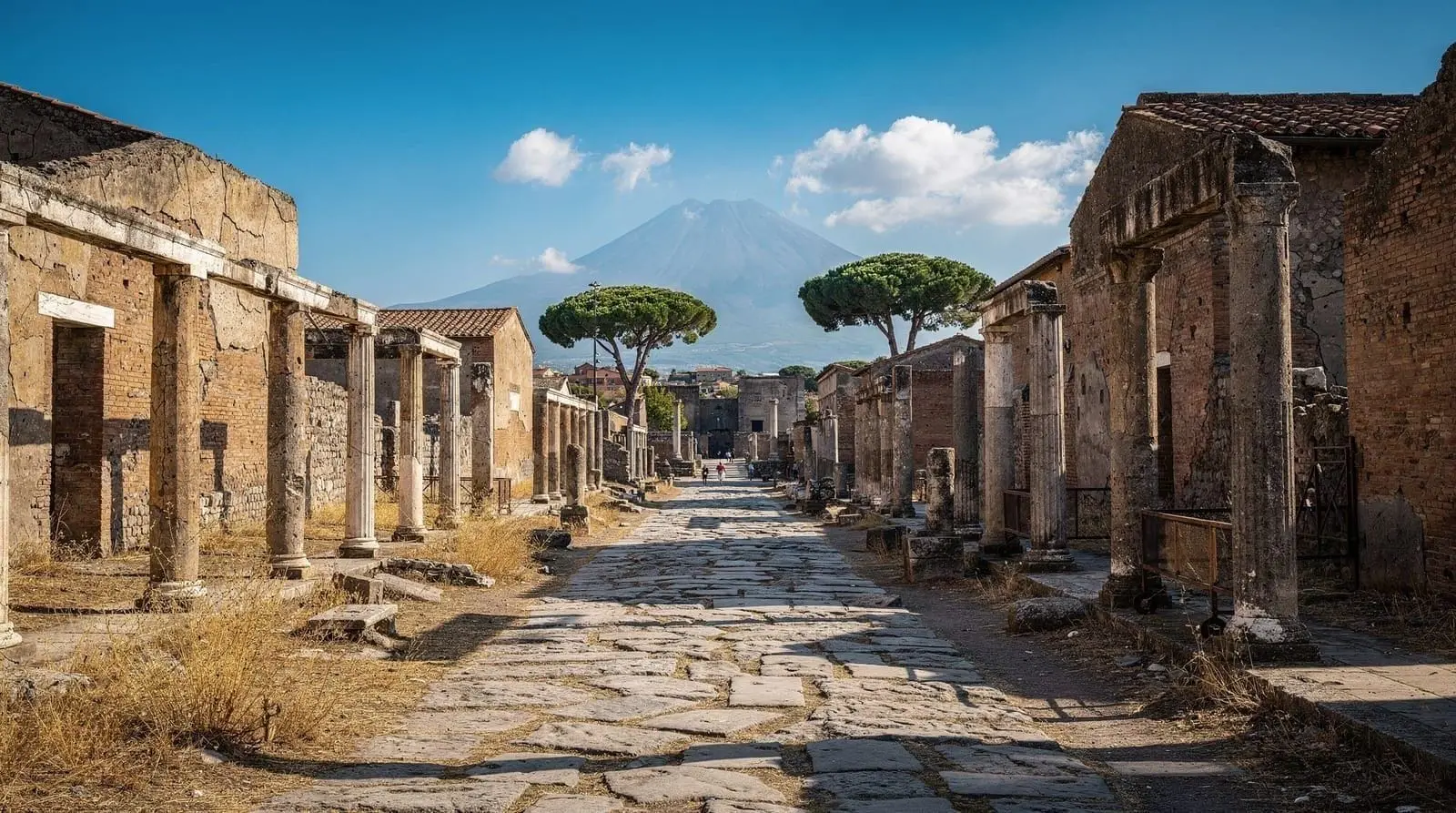
Pompeii is not a ruin in the conventional sense. It is a Roman city. Walking it is unlike anything else in Italy, or arguably in Europe. You see Roman urbanism at street level: stepping stones for pedestrians crossing muddy roads, the ruts worn by cart wheels in basalt paving, political slogans painted on walls, erotic frescos in the brothel, the garden of a wealthy merchant with fountain still intact.
It is one of the most visited archaeological sites in the world (over 4 million visitors per year), and that means logistics matter — get them wrong and you spend more time in queues than in the city. Get them right and you will have one of the most memorable days of any Italy trip.
Getting from Rome to Pompeii
By train (the only practical option for day-trippers)
Step 1 — Rome to Naples: Take the Frecciarossa high-speed train from Roma Termini to Napoli Centrale. Journey time is 1h10–1h15. Fares range from €14.90 upward (Italo) to €18–35 (Trenitalia Frecciarossa) depending on how far in advance you book and which class. Book early — the cheapest fares sell out fast, especially in summer.
Trenitalia and Italo both operate this route; Italo often has slightly cheaper advance fares. Italo trains depart from Roma Termini or Roma Tiburtina (check your specific ticket).
Step 2 — Naples to Pompeii: From Napoli Centrale, take the Circumvesuviana regional train from Napoli Porta Nolana (a short walk or metro ride from Napoli Centrale, or a 15-minute walk). The line runs to Pompei Scavi – Villa dei Misteri station, which is directly next to the Pompeii archaeological site entrance. Journey time: 30–40 minutes. Cost: €2.80 one way.
Important: The Circumvesuviana is an older commuter line, not a tourist train. It is often crowded and, in peak summer, very hot. Keep bags and valuables close — pickpocketing is reported. Trains depart roughly every 30 minutes.
Total journey Rome to Pompeii site entrance: approximately 1h45–2h.
By organized tour from Rome
For travellers who find the train logistics daunting, full-day organized tours from Rome handle all transport, include a licensed guide (important — Pompeii without context is disorienting at scale), and often include skip-the-line entry.
This full-day tour from Rome covers Pompeii and Vesuvius with transport and a licensed guide — the most efficient option for visitors who want to cover both sites without managing train changes. An alternative full-day Pompeii and Vesuvius day trip from Rome, with slightly different timing and group size options.Pompeii: tickets and practical entry
Book your ticket online — non-negotiable
Pompeii entry costs €18 for adults (standard ticket, valid for entry on the booked day). Walk-up tickets are available but the queues can be significant (30–60 minutes in peak season). Online booking is free at the official Pompeii ticketing site (pompeiisites.org) and takes the queue out of the equation. Book at least 2–3 weeks ahead for summer visits.
Combined tickets covering Herculaneum, Stabiae, and other sites in the Pompeii system can be worthwhile if you plan multiple days in Campania, but for a single-day Rome day-trip, the standard Pompeii ticket is sufficient.
What the ticket covers
The standard ticket gives access to the entire Pompeii archaeological area, which covers approximately 44 hectares (about two-thirds of the city has been excavated). You can stay as long as you like during opening hours. Opening times are typically 09:00–19:00 in summer (last entry 17:30) and 09:00–17:00 in winter. Check the official site for current hours.
Using a guide vs. exploring independently
With a guide: A two-hour guided tour covers the key sites (the Forum, the Lupanar/brothel, the House of the Faun, the bakery, the plaster casts) efficiently and gives archaeological context that transforms what you see. Most organized tours from Rome include this.
Independently with an audio guide: The official audio guide (available at the site, or via the “Pompeii Sites” app, approximately €5–8) works well for self-directed exploration. The Pompeii app has route suggestions.
Independently without a guide: Possible but often underwhelmingly flat — many visitors come away having seen ruins without understanding what they walked past. At minimum, read a brief overview before entering.
What to see in Pompeii
The site is large enough to spend an entire day in, but a well-structured 3–4 hour visit covers the highlights:
The Forum: The civic heart of Roman Pompeii, surrounded by temples and public buildings. The Temple of Jupiter at the north end has Vesuvius framed in the background — one of the iconic photographs of southern Italy.
Via dell’Abbondanza: The main commercial street, with shop fronts, election campaign graffiti, and evidence of daily Roman life at street level. The stepping stones raised pedestrians above street-level water and waste; cart ruts are still visible in the basalt paving.
Lupanar (brothel): The city’s official brothel, with stone beds in cubicles and erotic frescoes above each door (the frescoes were almost certainly menus). Queues form at this one — arrive early or last.
House of the Faun: One of Pompeii’s grandest private residences, covering an entire city block. The original “Alexander Mosaic” (showing Alexander the Great defeating Darius) is in Naples’ National Archaeological Museum — but the replica in situ is excellent and the house scale is impressive.
Plaster cast collection: The casts of human and animal bodies preserved by the ash are at several points around the site (notably in the Garden of the Fugitives and the Forum Granary). They are affecting in a way that is hard to anticipate.
Villa of the Mysteries (Villa dei Misteri): Just outside the main city walls, near the train station, this villa has the most intact fresco cycle in Pompeii — a mysterious ritual scene in deep crimson and black that scholars still argue about. Worth the 15-minute detour from the main entrance.
Adding Vesuvius to the day
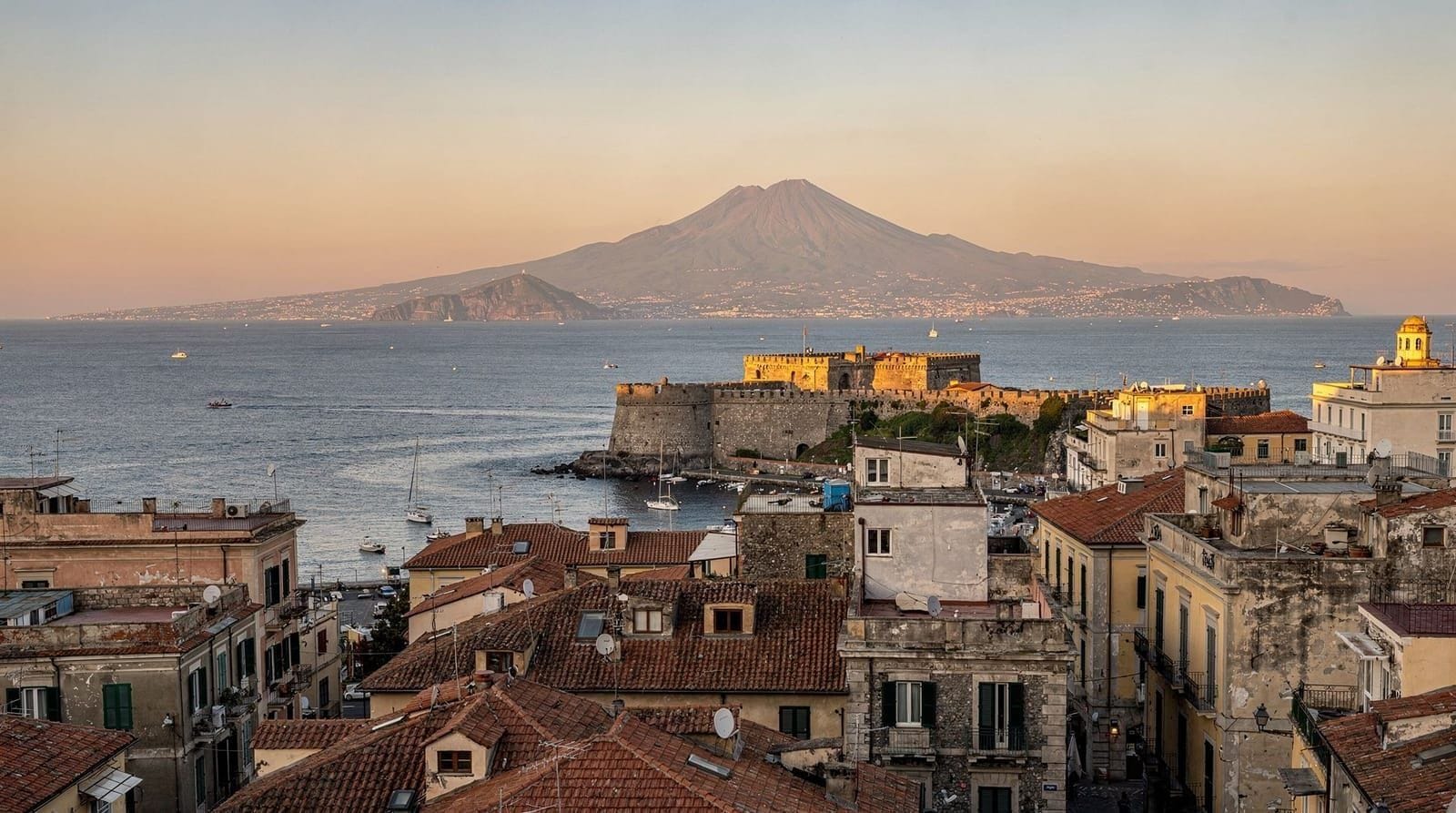
Mount Vesuvius (1,281 m) is 15 km from Pompeii and is entirely viable as an addition to the same day if you manage your time.
Getting to Vesuvius from Pompeii: From Pompeii, take the Circumvesuviana to Ercolano Scavi station (15 minutes), then a shuttle bus up to the crater parking area (~€10 each way for the bus and road toll), then a 30-minute walk to the crater summit.
At the crater: The summit walk from the crater parking is on marked path (~800m, 30 minutes up, 20 minutes down). Entry fee to the crater area: approximately €10. A licensed guide is compulsory during peak summer months (groups form at the summit entrance; this is not a private guide, it is a required accompaniment).
Views from the summit: Pompeii is directly visible below; the Bay of Naples, Naples city, Capri, Sorrento, and on clear days the Amalfi Coast are all visible. It is spectacular.
Time budget: Allow 2 hours total for the Ercolano journey and crater walk. Add this to a Pompeii morning visit (09:00–13:00), with lunch near Ercolano or Pompeii, and you have a full, excellent day.
A Pompeii + Vesuvio day trip with guide and lunch included — useful if you want a fully organized day covering both sites from Rome without managing logistics yourself.Sample day itinerary from Rome
- 07:30: Frecciarossa from Roma Termini (book early fare)
- 08:45: Arrive Napoli Centrale; take metro or walk to Porta Nolana for Circumvesuviana
- 09:30: Arrive Pompei Scavi station; enter the site at 09:00 opening (buy ticket online in advance)
- 09:30–13:00: Explore Pompeii (Forum, Via dell’Abbondanza, Lupanar, House of the Faun, Villa dei Misteri)
- 13:00–14:00: Lunch near Pompeii or back at Ercolano (better food quality in Ercolano restaurants, honestly)
- 14:00: Circumvesuviana to Ercolano Scavi; shuttle bus up Vesuvius
- 15:00–17:00: Vesuvius crater walk and summit (allow 2 hours)
- 17:30: Return to Ercolano Scavi, Circumvesuviana to Napoli Centrale
- 18:30–19:00: Frecciarossa back to Roma Termini
- 20:00–20:30: Back in Rome
A full, rewarding day — and realistic. Do not try to add Naples city sightseeing to this itinerary; it is genuinely too much.
Herculaneum: the better-preserved alternative
Pompeii receives the crowds; Herculaneum (Ercolano) receives the knowledgeable visitors. Both were destroyed by the 79 AD eruption, but in different ways: Pompeii was buried in ash and pumice (preserving two-dimensional layouts but rarely organic materials), while Herculaneum was hit by pyroclastic surges that carbonized organic matter and then buried the town under 20 metres of volcanic rock. The result is extraordinary: wooden furniture, food in pots, scrolls (partially readable), boat hulls, and the skeletons of hundreds of people who sheltered in the port vaults and were killed instantly.
Herculaneum is smaller than Pompeii (only about 20% excavated) but more intensely preserved — a genuinely different kind of visit, not a lesser one. Walls stand to first-floor height; you can walk into houses and see the original wooden floors, painted plaster on walls, mosaic floors, and carbonized roof beams. The Villa dei Papiri (partially accessible) contained the only surviving ancient library of scrolls — still being unrolled and digitally read via multispectral imaging.
Herculaneum station (Ercolano Scavi) is also the Circumvesuviana stop for the Vesuvius shuttle buses, making it a natural combination point. If you have a second day in Campania (i.e., you are staying overnight in Naples or Sorrento), Herculaneum is worth 2 hours of focused attention alongside a Vesuvius ascent.
The wider Pompeii area: Stabiae and Boscoreale
Within 5 km of Pompeii, two additional sites are covered by the combined Pompeii system ticket:
Villa di Stabiae (Castellammare di Stabia): Roman villa complexes on the coastal ridge south of Pompeii, with some of the finest fresco cycles in the system. Less visited than Pompeii — on a quiet Tuesday in October, you may have rooms almost to yourself.
Museo Nazionale di Archeologia di Boscoreale: Houses agricultural equipment and everyday objects from a Roman farmstead buried by the eruption. The silver treasure found here (the “Treasure of Boscoreale”) is now in the Louvre in Paris, but the site context is interesting.
These are specialist interests for most day-trippers from Rome. For a single-day visit, Pompeii alone — done properly — is the right choice.
Honest expectations: what Pompeii is and is not
It is very large. The excavated area covers 44 hectares. You will walk 5–8 km on rough basalt paving. Wear comfortable shoes with ankle support; the stepping stones and road surfaces are genuinely uneven.
Much of it is closed at any given time. Conservation work, funding limitations, and staff logistics mean that individual houses and sections rotate in and out of accessibility. The major sites (Forum, Via dell’Abbondanza, House of the Faun, Lupanar, Villa dei Misteri) are consistently open. Specific houses like the House of the Vettii and the House of Menander open and close — check the official Pompeii site before visiting if a specific house is on your list.
The “plaster casts” are not everywhere. The famous images of cast human figures are moving, but they are concentrated in specific locations (the Garden of the Fugitives, the Forum Granary) rather than scattered throughout the site. Ask staff at the entrance for current locations.
It is genuinely hot in summer. Pompeii is open-air, almost entirely unshaded, and can reach 38 °C in July–August. Stone paving radiates heat. Carry minimum 2 litres of water; wear a hat; plan to visit in the morning and leave by early afternoon if you visit in summer.
The surrounding town of Pompeii (modern city) is not the archaeological site. The modern town of Pompeii (with the pilgrimage basilica) surrounds the site. The archaeological entrance is at Porta Marina (main), Piazza Anfiteatro, and Porta di Stabia. The Circumvesuviana stops at Pompei Scavi – Villa dei Misteri, which is closest to the Porta Marina main entrance.
Pompeii vs Ostia Antica vs Naples: choosing between Rome’s southern day trips
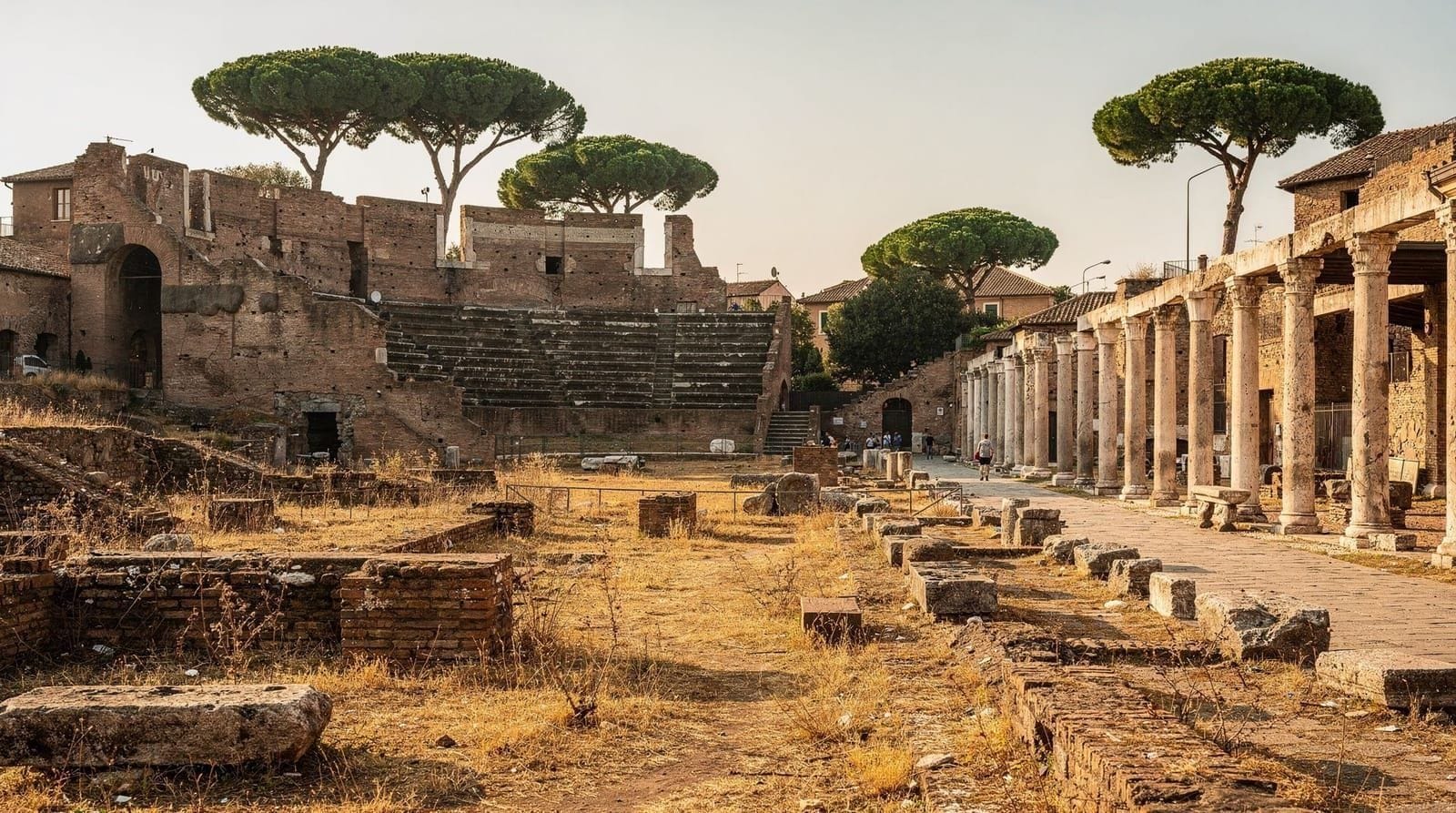
Pompeii shares a train line with two other popular options — Naples and, closer to Rome, Ostia Antica. They’re not really substitutes for each other, but travellers with limited days often need to choose:
| Pompeii | Ostia Antica | Naples | |
|---|---|---|---|
| Travel time from Rome | ~2h each way | ~35 min each way | 1h10–1h15 each way |
| What it delivers | A city frozen by catastrophe | A city that declined gradually, in situ mosaics | A living city — food, art, museums |
| Minimum time needed | Full day | Half day | Half day to full day |
| Physical demands | High — large site, uneven ground, little shade | Moderate — similar terrain, smaller area | Low–moderate — mostly flat street walking |
If your Rome trip is short on days, Ostia Antica delivers a genuinely comparable archaeological experience for a fraction of the travel time. If Pompeii’s specific “frozen in time” drama is what draws you, no substitute quite matches it, and the day-long commitment is worth making once. The Ostia Antica vs Pompeii guide goes deeper on this exact comparison, and the best day trips from Rome guide covers the full shortlist.
Cost is part of the honest picture too. A Pompeii day from Rome runs €90–120 once trains, entry, the Vesuvius add-on and lunch are counted — considerably more than an Ostia Antica half day (a €1.50 local train ticket plus €14–16 entry) and broadly comparable to a full day trip to Naples. If your itinerary already includes several paid day trips, weigh Pompeii’s cost and full-day time commitment against a shorter, cheaper alternative rather than adding it automatically because it’s famous.
Pompeii with mobility considerations
Pompeii is honestly one of the more physically demanding day trips from Rome. The site is large, the ancient basalt paving is uneven, stepping stones require a genuine step up and down at every crossing, and there is minimal shade across most of the 44 hectares. Wheelchair users and visitors with limited mobility can access a reduced but real circuit — the Forum, Via dell’Abbondanza’s main stretch, and some ground-floor houses are on relatively level ground, and the site provides some accessible routes signposted at the entrance. Ask staff at Porta Marina for the current accessible-route map, since specific paths change with ongoing excavation and conservation work. The Vesuvius crater walk is a separate consideration entirely — it involves a genuine uphill hike on loose volcanic gravel and is not realistic for visitors with significant mobility limitations, regardless of how the Pompeii site itself is managed.
For travellers planning a Rome trip around mobility needs more broadly, the accessible Rome guide and the Rome for seniors and mobility guide cover citywide considerations, including which day trips are realistic and which (Pompeii among the more demanding) need extra planning. If the terrain and distances genuinely concern you, a shorter, flatter alternative like Ostia Antica or Tivoli may deliver a more comfortable day without sacrificing the sense of Roman-era history.
Private Pompeii and Vesuvius tour from Rome is worth considering if you want a pace and route tailored to specific mobility needs rather than a fixed group itinerary.
Frequently asked questions about Pompeii and Vesuvius
How do you get from Rome to Pompeii by train?
Take the Frecciarossa or Italo high-speed train from Roma Termini to Napoli Centrale (1h10–1h15, from €14.90 advance fare). Then take the Circumvesuviana from Napoli Porta Nolana to Pompei Scavi station (30–40 minutes, €2.80). Total journey time from Roma Termini to the Pompeii site entrance: approximately 1h45–2h.
Do you need to book Pompeii tickets in advance?
Yes — strongly recommended. Official tickets cost €18 and are bookable online at pompeiisites.org with no booking fee. In summer, walk-up queues can take 30–60 minutes. Book at least 2–3 weeks in advance for July–August. Timed entry is now required; select your preferred entry slot when booking.
Is it worth visiting both Pompeii and Vesuvius in one day from Rome?
Yes, with an early start. Pompeii in the morning (3.5–4 hours), lunch, then Vesuvius in the afternoon via Ercolano — the journey back reaches Rome by 20:00–20:30. It is a long day but entirely feasible. Pompeii alone is also fully worthwhile if you prefer a more relaxed pace.
How much does it cost to visit Pompeii and Vesuvius from Rome?
Approximate costs: Frecciarossa return Rome–Naples €30–50 (book early) + Circumvesuviana return ~€6 + Pompeii entry €18 + Vesuvius shuttle bus ~€10 + crater entry ~€10 + lunch €15–25 = approximately €90–120 per person for the full day. Organized tours from Rome run €80–130 all-in including transport and guide.
Can you visit Pompeii in July or August from Rome?
Yes, but with caveats. July and August temperatures at Pompeii reach 33–38 °C; the site is almost entirely open-air with limited shade. Crowds are at maximum. If you visit in summer: arrive at site opening (09:00), wear a hat, carry 2 litres of water, and plan to leave by 13:00 before the worst heat. Alternatively, visit in spring or autumn when the experience is significantly better.
Should you take an organized tour or go independently to Pompeii from Rome?
Both work. Independent by train is cheaper (approximately €50–70 vs €80–130 for a tour) and gives you complete flexibility on timing. An organized tour from Rome provides transport door-to-door, a licensed guide (which genuinely improves the experience), and skip-the-line entry. If you are visiting Pompeii and Vesuvius together, a tour handles the logistics between the two sites efficiently. If you just want Pompeii at your own pace, the train is excellent.
Is Pompeii or Ostia Antica the better choice if I only have one day trip?
If travel time and crowd levels matter most, Ostia Antica is the easier and faster option at 35 minutes each way. If Pompeii’s specific volcanic-catastrophe story is the draw, no other site substitutes for it. See the comparison table above or the Ostia Antica vs Pompeii guide for a fuller breakdown.
Is Pompeii accessible for visitors with limited mobility?
Partially. The Forum and the main stretch of Via dell’Abbondanza are on relatively level ground, and the site publishes an accessible-route map at the entrance, but much of the ancient paving is uneven and some houses aren’t reachable by wheelchair. The Vesuvius crater walk, if you plan to add it, is a separate and more demanding proposition on loose gravel. See the accessible Rome guide for wider planning.
How much walking is actually involved at Pompeii?
Plan on 5–8 km over the course of a thorough visit, almost entirely on uneven ancient basalt paving with raised stepping-stone crossings at every intersection. This is more physically demanding than most Rome city-centre sightseeing, so pace yourself, take breaks in shade where available, and wear proper closed shoes rather than sandals. Adding Vesuvius on the same day pushes the total distance and effort noticeably higher, which is worth factoring in if you’re already tired from a morning at the ruins.
Top experiences
Bookable activities with verified prices and instant confirmation on GetYourGuide.

From Rome: Pompeii Day Trip with Optional Vesuvius and Lunch
From Rome: Pompeii and Mount Vesuvius Day Trip
Pompeii Day Trip from Rome by High-Speed Train & Guided Tour
From Rome: Pompeii and Vesuvio Guided Day Trip with Lunch
From Rome: Pompeii and Mount Vesuvius Private Tour