Naples from Rome: a day trip to Italy's most intense city
From Rome: Naples and Amalfi Coast Full-Day Trip
How long does the train from Rome to Naples take?
The Frecciarossa or Italo high-speed train from Roma Termini to Napoli Centrale takes 1h07–1h15. Fares start at €14.90 each way if booked in advance (2–4 weeks ahead). Trains run frequently throughout the day, with departures from around 06:00.
The most alive city in Italy — an hour from Rome
Naples is not like other Italian cities. It is louder, faster, more chaotic, more beautiful and more unsettling — sometimes all simultaneously on the same street. It is also the home of pizza, of ragù Napoletano, of the sfogliatella, of the world’s greatest archaeological collection of Roman artefacts, and of a street life so dense and theatrical that you will understand within 30 minutes why Neapolitans are described as a people rather than simply inhabitants of a city.
From Roma Termini, a Frecciarossa gets you to Napoli Centrale in just over an hour. You can be eating Margherita pizza at Sorbillo before most people in Rome have finished their second espresso.
This guide tells you what to do when you get there.
| Getting there | High-speed train, Roma Termini to Napoli Centrale |
| Time needed | Around 1h07–1h15 each way |
| Cost | From around €14.90 one-way if booked ahead |
| Time on the ground | A full day, roughly 09:00–20:00 |
| Best for | Pizza, the MANN museum, Spaccanapoli’s street life |
Getting from Rome to Naples
Train: Frecciarossa (Trenitalia) or Italo high-speed trains run frequently between Roma Termini and Napoli Centrale. Journey time: 1h07–1h15. Trains depart from early morning (06:00+) and run throughout the day.
Fares: Book in advance on trenitalia.com or italotreno.it. Frecciarossa standard fares from approximately €19; Italo sometimes offers fares from €14.90 on the same route. Walk-up fares at the station can be €35–60+. Book 2–4 weeks ahead for the best prices.
Seat reservation: Included in the high-speed ticket price. You are guaranteed a specific seat; no need to stand.
Which service: Both Frecciarossa and Italo arrive at Napoli Centrale. Some Frecciarossa services also stop at Napoli Afragola (edge of the city — not useful for day visitors); make sure your train terminates at Napoli Centrale.
By car: It is possible but not recommended for a day trip. The drive from Rome to Naples via the A1 (Autostrada del Sole) takes 2h15–2h45. Naples traffic and parking are notoriously difficult; the train is unambiguously better.
What to do in Naples in a day
A full day in Naples allows for the National Archaeological Museum plus the historic centre, or the historic centre plus Pompeii. Below is the purely Naples programme.
Morning: Museo Archeologico Nazionale (09:00–12:00)
The National Archaeological Museum (MANN — Museo Archeologico Nazionale di Napoli, Piazza Museo Nazionale 19) is one of the most important museums in the world. It holds the best surviving collection of Greco-Roman artefacts anywhere — and specifically, the most important objects from Pompeii and Herculaneum that were removed from the sites during excavation.
What not to miss:
- The Farnese Collection (ground floor): The Farnese Hercules (massive, extraordinary) and the Farnese Bull (the largest surviving ancient marble sculpture, depicting the death of Dirce) — both brought from Rome in the 16th century. These are among the most important sculptures surviving from antiquity.
- The Pompeii mosaics (mezzanine): Including the Alexander Mosaic from the House of the Faun — a 5.13 by 2.72 metre polychrome mosaic depicting Alexander the Great’s victory over Darius III at the Battle of Issus. More than a million tesserae, probably copied from a 3rd century BCE Hellenistic painting. The single most technically accomplished mosaic to survive from antiquity.
- The Secret Room (Gabinetto Segreto): The collection of erotic art from Pompeii and Herculaneum, locked away from public view for most of its museum history, now open. A frank and historically important documentation of Roman attitudes to sexuality.
- Bronze sculptures from the Villa of the Papyri (Herculaneum): Including the Drunken Faun and the Resting Hermes — extraordinary Hellenistic bronzes.
Entry: €20 full price, €2 reduced (EU 18–25). Closed Tuesdays. Book at museoarcheologiconapoli.it to avoid queues in summer.
Getting there from Napoli Centrale: Metro Line 2 to Piazza Cavour, 3 minutes walk. Or 20-minute walk through the historic centre.
Lunchtime: pizza on Via dei Tribunali (12:00–13:30)
Via dei Tribunali is the historic main axis of the ancient Greek and Roman grid (the Decumanus Maximus of Neapolis). It is also the street with the highest concentration of excellent and iconic pizzerias in Naples.
Antica Pizzeria Sorbillo (No. 32): The most famous — founded 1935, now run by Gino Sorbillo. The Margherita with San Marzano tomatoes and fior di latte from Agerola is the benchmark. Expect a queue of 20–40 minutes at lunch. Arrive at 11:30 to skip it entirely. Budget €8–12 for a pizza.
Di Matteo (No. 94): Slightly less famous but excellent and more casual. Street window for fried pizza (pizza fritta — deep-fried dough with filling, €2–4). Sit-down inside for a classic Margherita.
L’Antica Pizzeria da Michele (Via Cesare Sersale 1, just south of the Tribunali axis): The ascetic option — two pizzas only (Margherita and Marinara), made to the same standard for 140 years. Always busy; the queue moves fast.
Afternoon: Spaccanapoli and the historic centre (13:30–17:00)
After lunch, walk Spaccanapoli from east to west — roughly from Piazza del Gesù Nuovo to the San Gregorio Armeno area.
Piazza del Gesù Nuovo: The 14th-century spire (Guglia dell’Immacolata) and the extraordinary carved lava-stone facade of the church of Gesù Nuovo — the facade is the exterior of a palace that was converted to a church, with its diamond-pointed rustication still intact, giving it the most dramatic and unlikely church facade in Naples.
Santa Chiara: The church and cloister of Santa Chiara. The nave was destroyed by a WWII bombing and rebuilt plainly, but the 18th-century majolica-tiled cloister garden (separate entrance, approximately €6) is one of the most beautiful enclosed spaces in Naples — columns covered in hand-painted Vietri tiles with pastoral and mythological scenes.
San Gregorio Armeno: The street of the presepe (Nativity scene) workshops, where skilled artisans have been making Christmas Nativity figures for over 400 years. The tradition now extends to celebrity and political figures alongside the Holy Family. Even in June, the workshops are open and the craftsmanship is extraordinary. An unusual and very Neapolitan souvenir.
Piazza Bellini: A small square on the northern side of the historic centre, surrounded by outdoor cafes, with ancient Greek city walls exposed at the centre — limestone blocks from the 4th century BCE still visible at the base of an excavated area. Sit here for a coffee and take in the pleasant contrast of ancient archaeology and modern aperitivo culture.
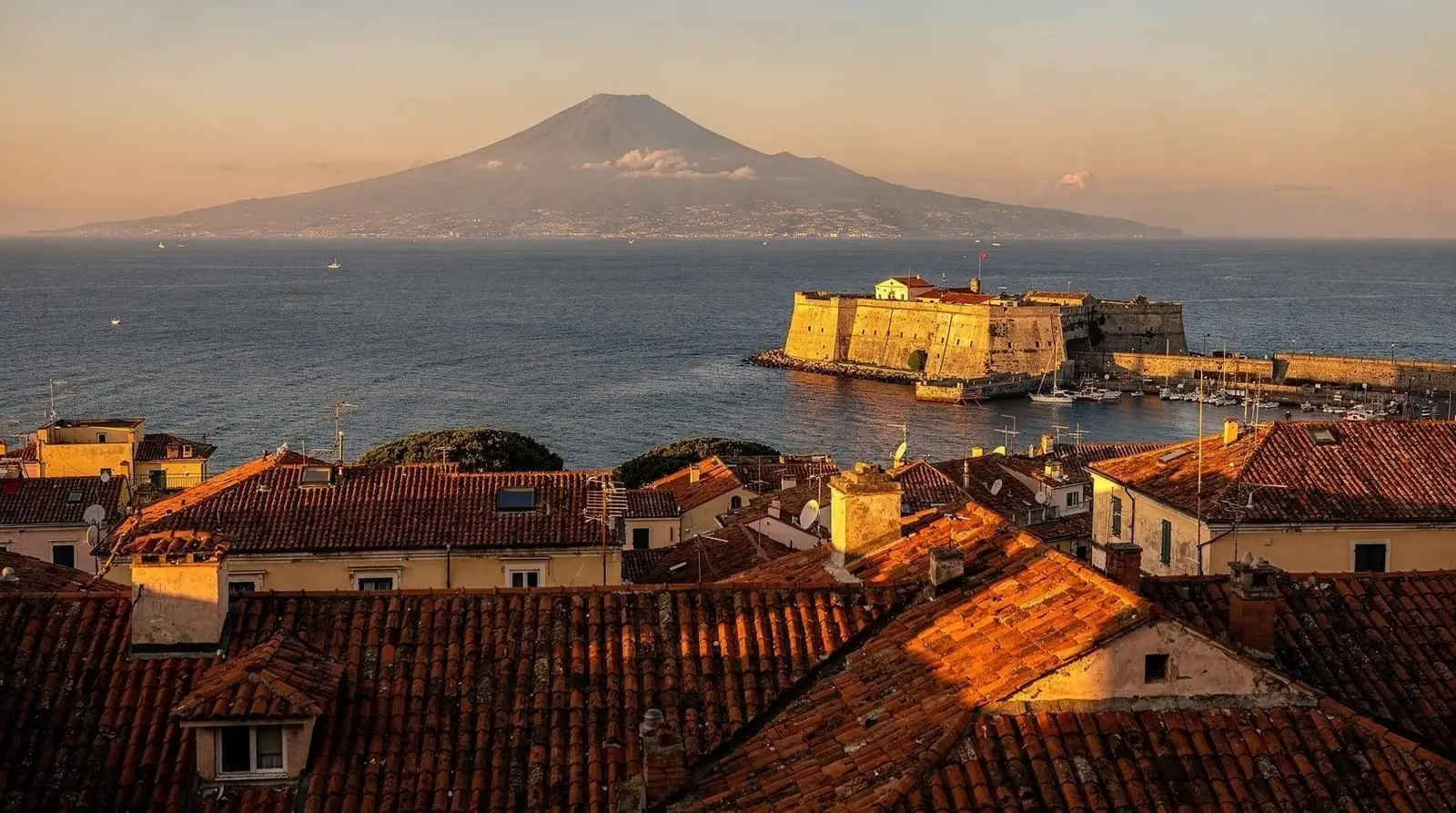
Castel dell’Ovo: Walk south toward the waterfront to end the day at the oldest castle in Naples, jutting into the bay on a former island. The exterior is atmospheric; entry is free. The views of Vesuvius across the Bay of Naples from the castle ramparts are excellent.
Return to Rome
Timing: Last useful trains back to Rome from Napoli Centrale run until about 22:00. Book your return ticket in advance. A 19:00–20:00 departure gets you back in Rome by 21:00–21:15 comfortably. If you want a more relaxed afternoon, a 17:30 departure works well.
Pompeii combined with Naples
For the Pompeii combination, see Pompeii from Rome for the detailed logistics. The most practical sequence for a combined day:
Option A — Museum then ruins: 07:30 train from Rome → reach Naples by 09:00 → MANN until 11:30 → Circumvesuviana to Pompeii (12:15–12:50 arrival) → 3 hours at Pompeii → return to Naples 16:30 → train home.
Option B — Ruins then city: 06:30 train from Rome → reach Naples by 07:45 → Circumvesuviana to Pompeii 08:30 → Pompeii 09:05–13:30 → back to Naples 14:00 → pizza and Spaccanapoli → train home 19:00.
Both options make for a genuinely full day. Option A involves an early start at MANN before the tourist rush; Option B gives more time in Naples in the afternoon.
Full-day trip from Rome to Naples and the Amalfi Coast — guided tour with transport includedTrain vs guided tour
Independent is excellent for Naples. The city is navigable on foot, the pizza restaurants need no guide, and the MANN has good English signage. Buy your train tickets in advance online and you are essentially set.
Guided tours add value in specific situations: If you are combining Naples with Pompeii or the Amalfi Coast, a guided tour with coach transport handles the complexity of multiple connections. A good guide at the MANN transforms the experience significantly — knowing the backstory of individual sculptures and mosaics is not obvious from panel text alone.
Guided day tours from Rome to Naples and Pompeii cost approximately €80–120 per person, including transport, entry, and guide. Tours to Naples plus Amalfi Coast are longer (12–14 hours) and cost €100–140.
Food beyond pizza
Naples’ food culture extends well beyond pizza, though pizza should absolutely be first on the list.
Sfogliatella: The shell-shaped pastry filled with ricotta, citrus peel, and semolina — crisp, flaky, and impossible to eat neatly. The two types are sfogliatella riccia (the shell-shaped layered pastry) and sfogliatella frolla (a shorter pastry version). Buy from pasticcerie along the Tribunali axis; Attanasio near the station is the most famous.
Ragù Napoletano: The slow-cooked Sunday tomato sauce with pork cuts, cooked for 8 hours minimum. The defining dish of Neapolitan Sunday tradition; served with pasta (rigatoni or ziti) in the more formal trattorias.
Fried food (frittura): Naples fries everything — pasta, pizza, calzone, zucchini flowers, mixed fish. Walk along Via Tribunali or the Quartieri Spagnoli and you will smell the friers from 50 metres. Buy from the window for €1–3 per piece.
Espresso: Neapolitan espresso is shorter, stronger, and at a slightly lower temperature than Roman espresso. The bar culture is serious; standing at the bar is the norm. A coffee costs €1–1.20. Do not ask for a to-go cup.
Practical information
- Train Rome–Naples: Frecciarossa/Italo, 1h07–1h15, from €14.90 advance. Book at trenitalia.com or italotreno.it. See trains from Rome day trips for full booking guide.
- MANN entry: €20 full, €2 reduced (EU 18–25). Closed Tuesdays. museoarcheologiconapoli.it.
- Getting around Naples: Metro Line 1 (art stations) and Line 2; on foot for historic centre.
- Safety: Keep bags in front, be aware on crowded streets. The Quartieri Spagnoli is safe during the day; the area around Piazza Garibaldi (station) is best navigated with awareness. See Rome scams to avoid — many of the same awareness principles apply in Naples.
- Best months: October–April (cooler, less crowded). Summer is hot and very busy; July–August can feel overwhelming. See best time to visit Rome for broader seasonal context.
- Pizza budget: €8–15 for a full Margherita at the iconic addresses; sit-down with a beer €12–20.
- Combine with: Pompeii from Rome for a full-day Naples plus Pompeii itinerary.
- Destination page: Naples destination and Pompeii and Vesuvius for extended trip planning.
- Broader itineraries: Rome–Naples–Pompeii 5 days if you want to extend beyond a single day.
- All day trips overview: Best day trips from Rome.
Frequently asked questions
Is Naples worth visiting in a day?
Yes — but know that you are tasting, not experiencing. A day in Naples gives you the MANN, the historic centre, and the pizza. It does not give you the underground Naples (Napoli Sotterranea), the Certosa di San Martino, the Campi Flegrei, or a meaningful encounter with the city’s neighbourhood character. Most people who spend a day in Naples immediately start planning a longer return.
Should I stay overnight in Naples or do it as a day trip?
If Naples is your only destination, a day trip from Rome works well. If you want to combine it with the Amalfi Coast or Capri, a two-night stay in Naples or Sorrento is significantly better — the day-trip combination with Amalfi is mostly transit.
What are the best Metro art stations in Naples?
Naples’ Metro Line 1 has invested heavily in contemporary art installations at its stations. The highlights are Toledo (illuminated depths and seawater imagery, considered one of Europe’s most beautiful Metro stations), Salvator Rosa (mosaics), and Quattro Giornate (space and cosmos theme). Worth a Metro ride in each direction even if you don’t need the transport.
What should I skip if I only have one day?
Napoli Sotterranea (the underground Greco-Roman city beneath the streets) is genuinely worthwhile but requires a booked guided slot of about 90 minutes — it does not fit comfortably alongside the MANN, Pompeii, and Spaccanapoli in a single day without cutting something else. The Certosa di San Martino, high above the city with the best panoramic view of the bay, is also better saved for a return trip with more time. On a first day trip, prioritize the MANN, pizza, and Spaccanapoli over these — they reward a dedicated second visit rather than a rushed add-on.
A realistic budget for the day
Beyond the train fare, a comfortable day in Naples for one person runs approximately €55–85: museum entry (€20, or €2 reduced), two pizza meals or one pizza plus fried street food (€15–25 combined), a coffee or two (€2–3), the Santa Chiara cloister (€6), and Metro fares within Naples (€1.30 per ride, or a day pass around €4.50). Add €15–25 if you want a full sit-down dinner-style lunch with wine rather than street food and pizzeria seating. This is meaningfully cheaper than the equivalent day in Rome’s historic center, and part of why Naples feels like better value even before factoring in the food quality.
Where day-trippers most often go wrong
First-time Naples day-trippers frequently underestimate two things: the walking distances within the historic centre (Spaccanapoli is longer than it looks on a map, and the streets are dense with people, which slows progress) and the value of arriving at the MANN right at opening. Arriving at 09:00 sharp means you see the Farnese Bull and the Alexander Mosaic before tour groups fill the rooms around 10:30–11:00. Combine this with the Sorbillo strategy above (arrive 11:30 to skip the queue) and the whole day flows considerably better than an ad hoc approach.
Top experiences
Bookable activities with verified prices and instant confirmation on GetYourGuide.