Campo de' Fiori market: what's real and what's for tourists
Rome: Trastevere & Campo de Fiori Street Food Walking Tour
Is the Campo de' Fiori market worth visiting?
It depends on your expectations. If you want a photogenic morning market with fresh flowers, seasonal produce and Rome atmosphere, yes — arrive before 9:00 when it's at its best. If you expect an authentic Roman food market with genuine local prices, manage your expectations: roughly half the stalls are now tourist-oriented, selling overpriced spices, souvenir ceramics and generic packaged pasta. The genuine produce vendors are still there and still good, but they are increasingly outnumbered.
What Campo de’ Fiori actually is in 2026
Campo de’ Fiori has been a market for centuries. The name means “field of flowers” — before urbanisation, the area was a meadow outside the city walls. The first market was established in the 15th century; it has operated continuously, in various forms, ever since.
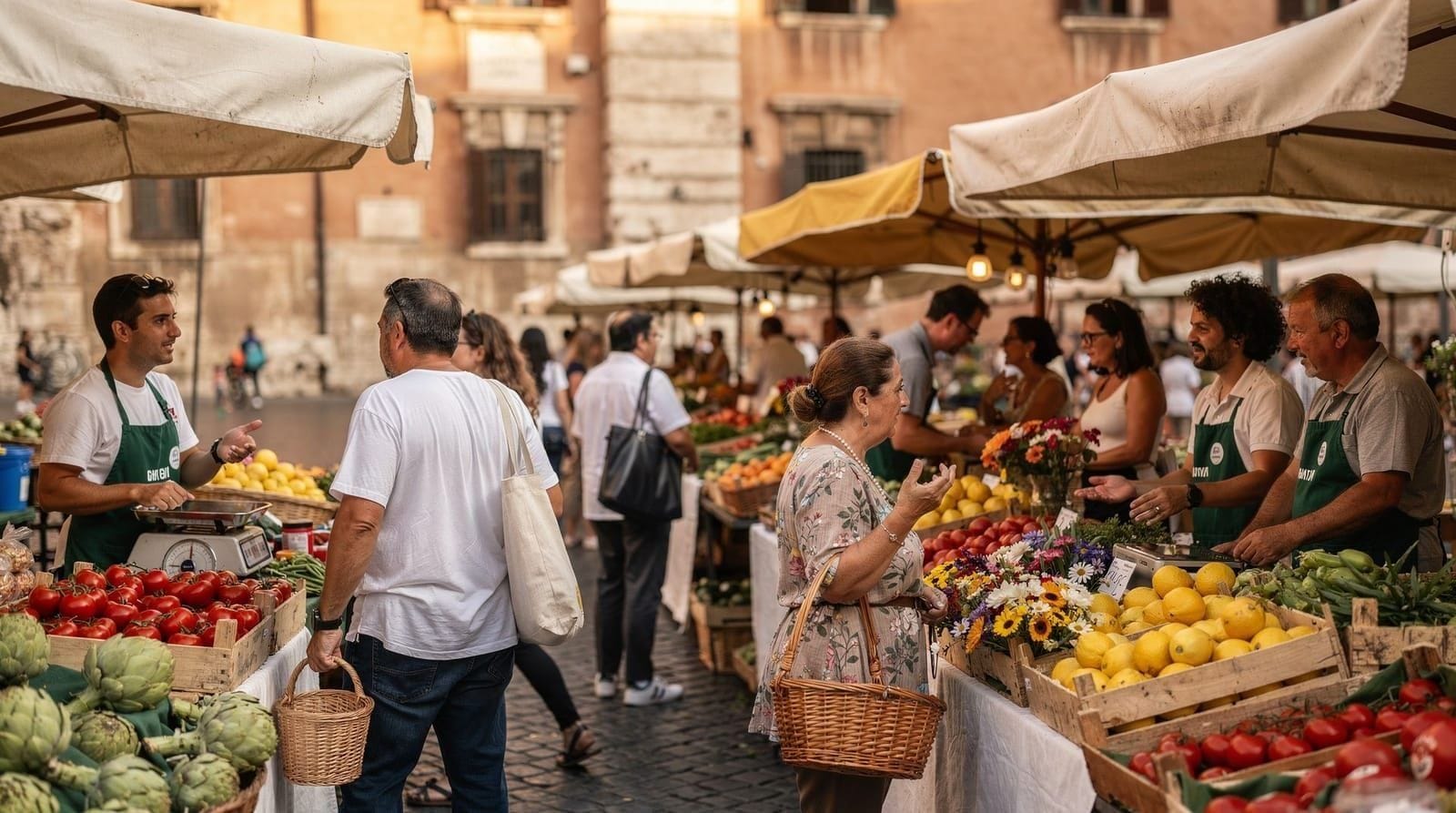
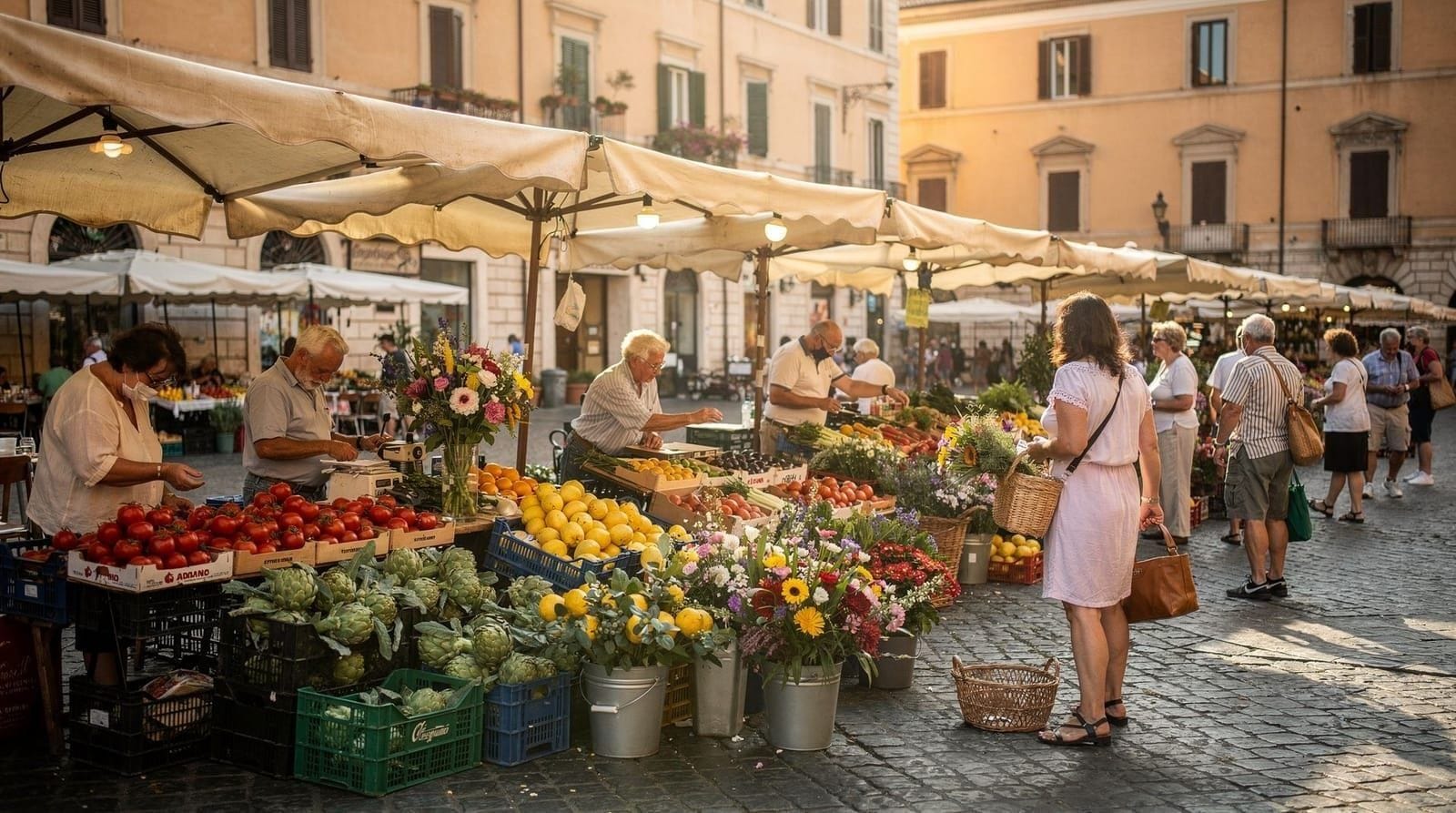
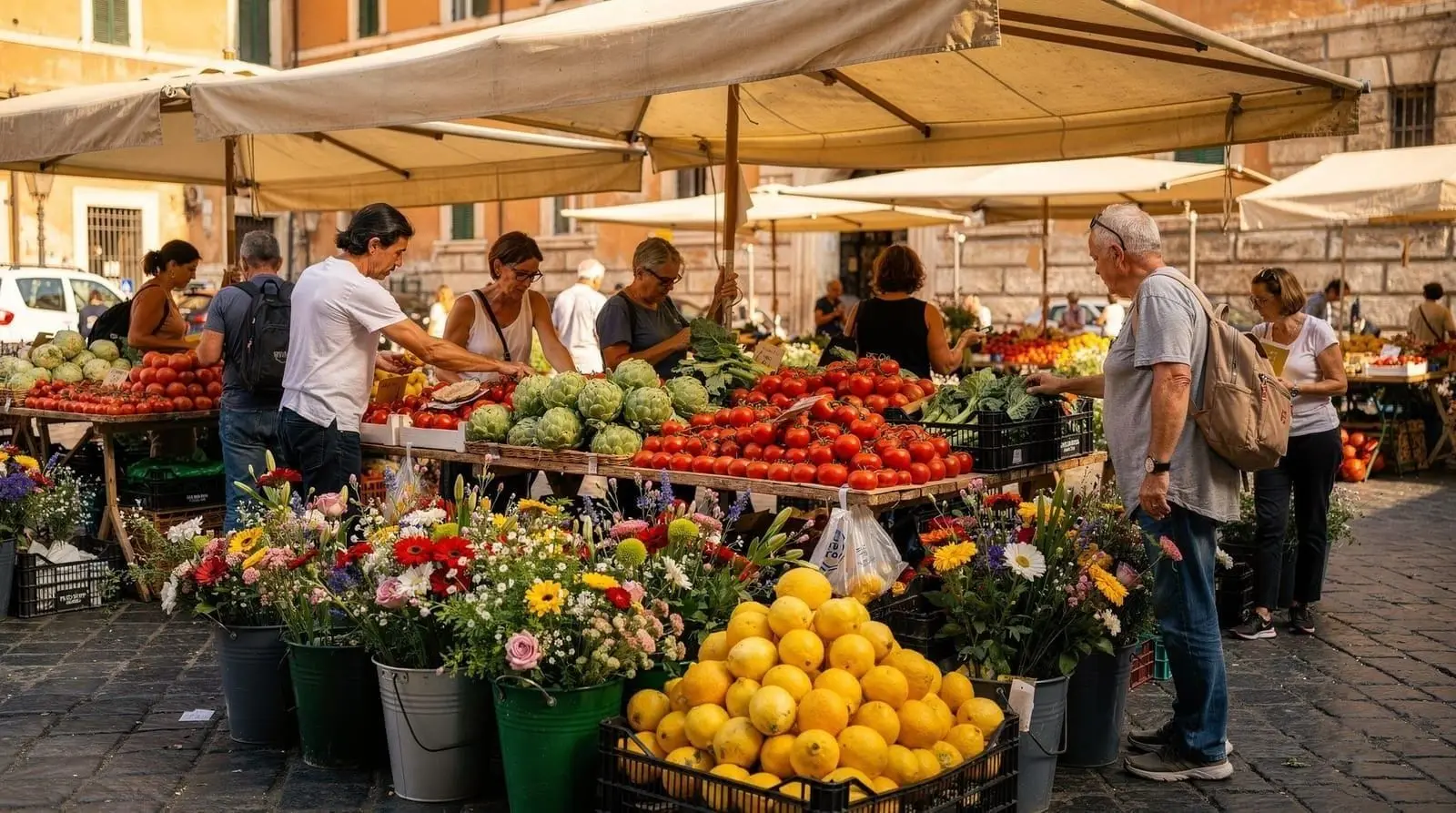
What it is in 2026 is a market in transition. On a weekday morning before 9:00, it still functions as a neighbourhood produce market: genuine vendors selling seasonal Roman vegetables to genuine Roman buyers, flower sellers with good-quality cut flowers, a few olive vendors worth stopping at. The espresso bar on the corner has been there for decades.
From about 9:00 onward, the dynamic shifts. Tourist foot traffic increases, and so do the tourist-oriented stalls — packaged pasta shaped like the Colosseum, “artisan” spice mixes in decorative ceramic pots at prices no local would pay, souvenir ceramics with dubious authenticity. By 11:00, the market is visibly half-tourist operation.
This is not unique to Campo de’ Fiori — it happens to any historic market in any major tourist city when visitor numbers reach a certain level. But it is worth knowing before you go.
| Where | Campo de’ Fiori piazza, Centro Storico, 10 min from Largo di Torre Argentina |
| Cost | Free to browse; produce and snacks a few euros each |
| Time needed | 30-45 minutes for the market, longer if you linger over Forno Campo de’ Fiori |
| Getting there | Bus 40/64 along Corso Vittorio Emanuele, or a 15-minute walk from the centre |
| Best time | 07:30-08:30, Monday-Saturday — closed Sundays |
How to visit the market well
Arrive early. 07:30–08:30 is the market at its best — locals doing weekly shopping, stalls fully stocked, coffee and a cornetto at the bar without waiting. The produce vendors have their best selection. The atmosphere is working-market rather than spectacle.
Buy the perishables; skip the packaged goods. The fresh produce — seasonal vegetables, herbs, olives from the speciality vendors — is generally genuine and at reasonable (if not bargain) prices. The packaged pasta, dried herbs in fancy containers, and souvenir ceramics are tourist-trap merchandise at tourist prices. You can find better versions of all of them in normal food shops throughout Rome.
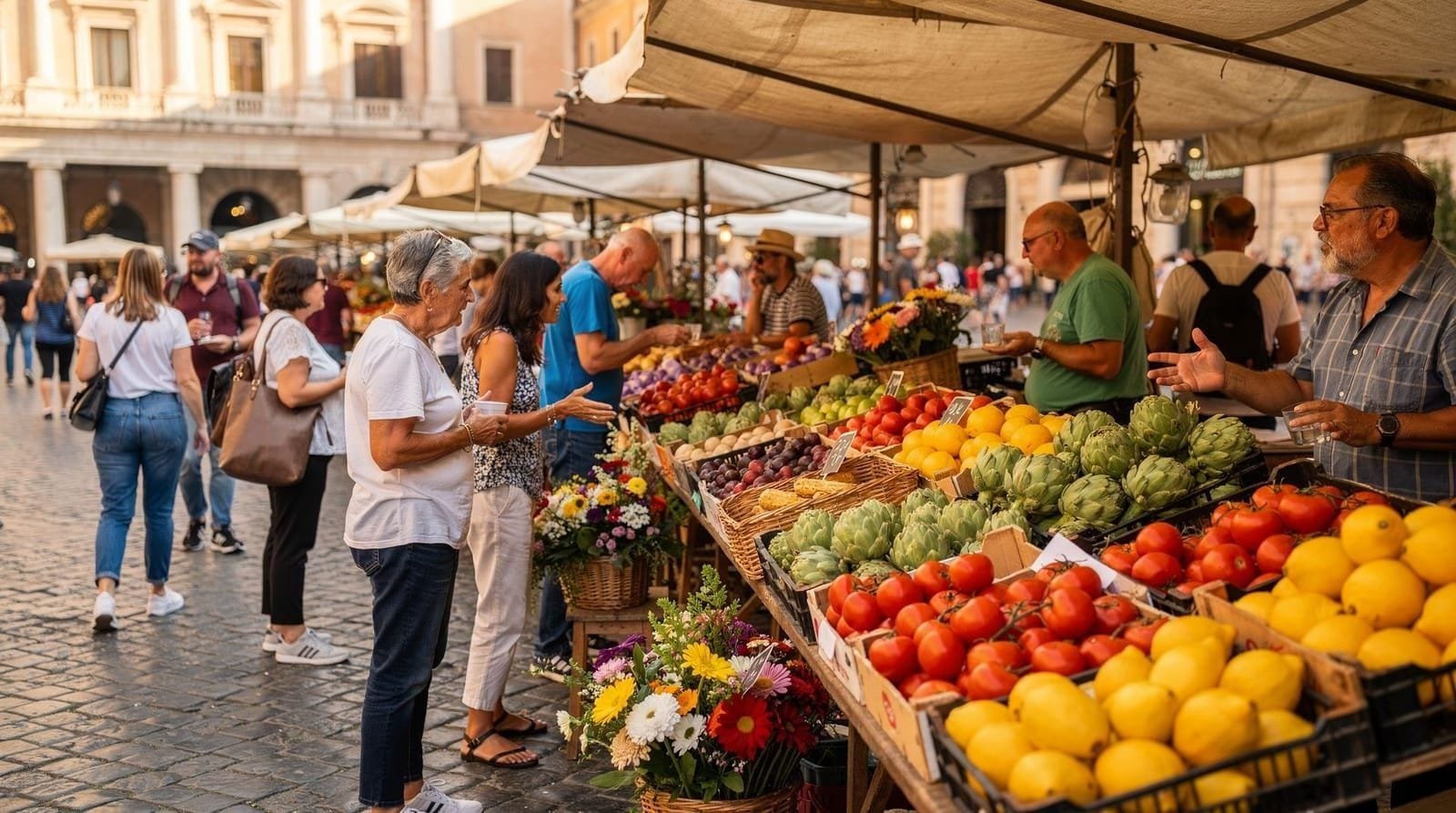
Learn the seasonal signals. The best Roman markets tell you what season it is more honestly than any calendar: violet artichokes in spring, glossy cherry tomatoes (pachino, datterino) in summer, porcini mushrooms and wild chicory in autumn, dark leafy greens (cicoria, agretti) in winter. Campo de’ Fiori follows this rhythm, at least at the honest produce stalls.
The flower vendors are worth it. Even if you skip the produce, the flower stalls are consistently good — well-sourced, at fair prices, and a useful reminder that the piazza’s name is not metaphorical.
Stalls worth finding
The vegetable vendors on the southern and western sides of the market (away from the main Via dei Baullari axis) tend to be more local-focused and less tourist-oriented than those on the main pedestrian approaches. Prices are slightly lower; quality is comparable.
Olives and pickled vegetables: One or two stalls stock genuine Roman-style olive varieties — Gaeta olives (small, purplish, mild), olive in salamoia (brine-cured), and preserved vegetables like sott’aceti (pickled) and artichokes preserved under oil. Ask to taste; good vendors expect it.
The herb vendors: Fresh herbs — rosemary, sage, bay, oregano, basil, mint — in volumes that make sense for cooking. Useful if you are in an apartment with a kitchen; impractical if you have three days left in a hotel room.
Eating and drinking around Campo de’ Fiori
The restaurants immediately around the piazza are, almost without exception, tourist-trap operations with inflated prices and mediocre cooking. This is a strong generalisation but a generally accurate one — the exceptions are short-lived because prime piazza frontage is expensive.
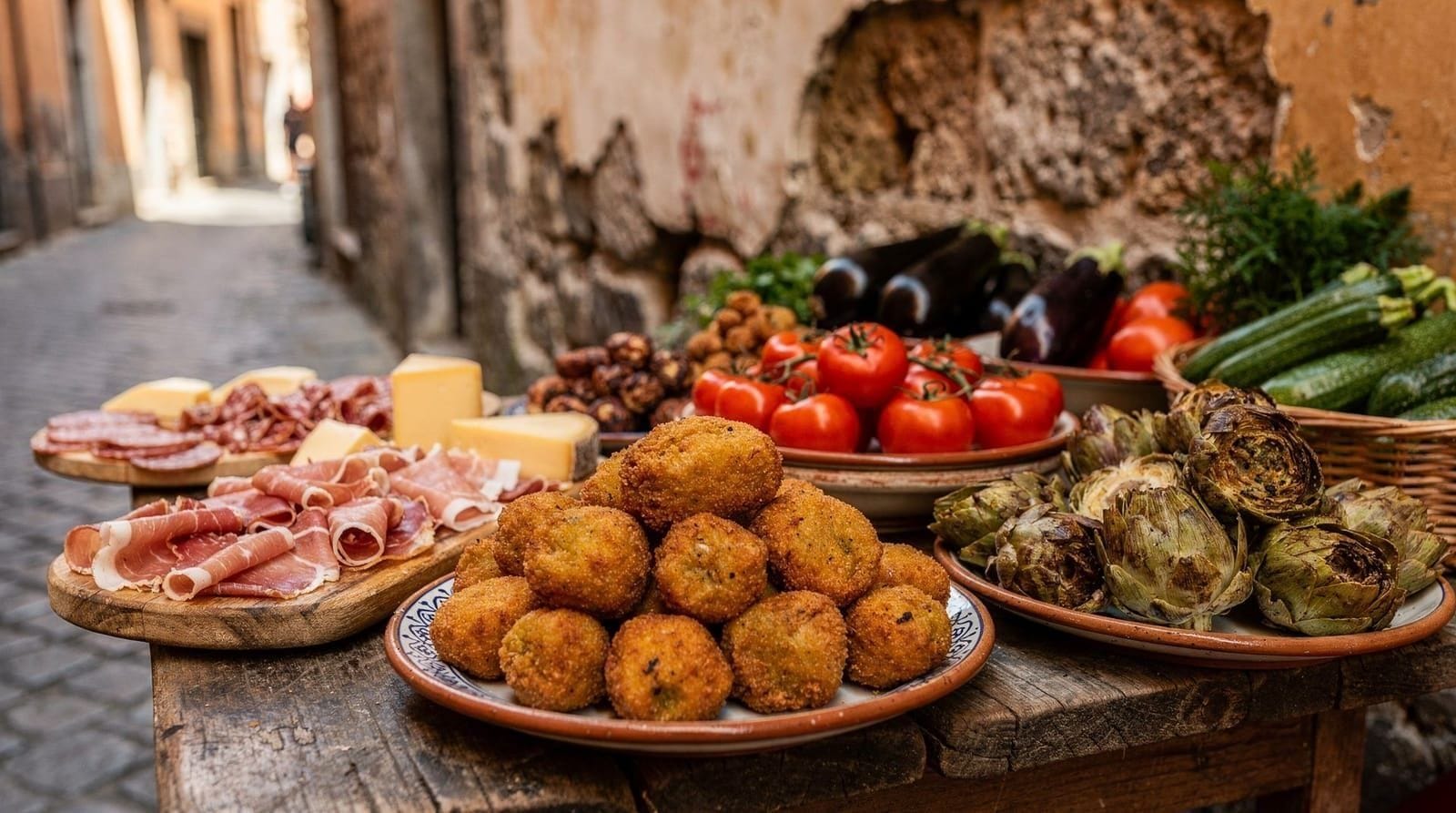
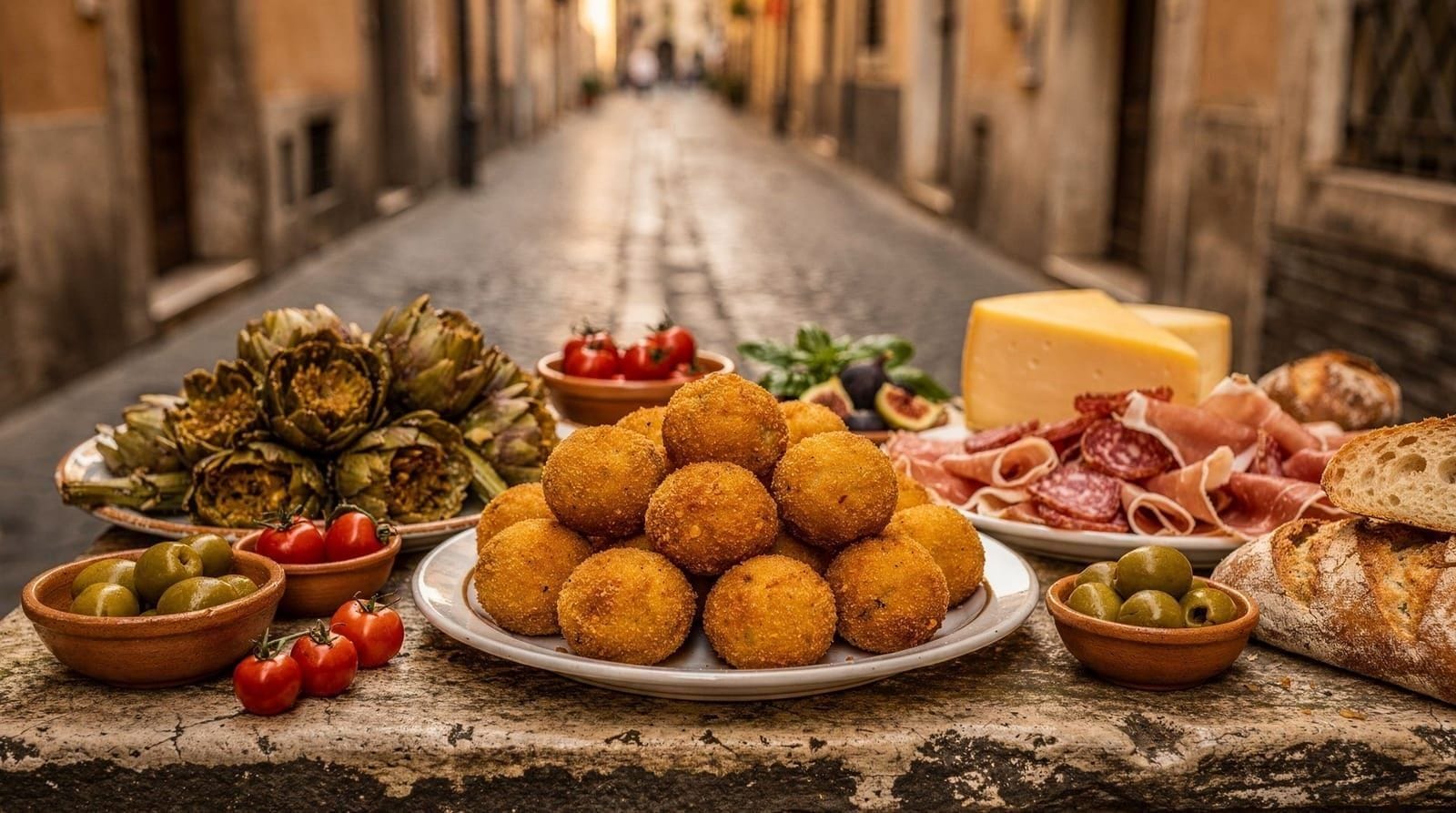
Forno Campo de’ Fiori (on the piazza, southwest corner): This is the legitimate exception. One of Rome’s most respected bakeries, operating in the same location for decades. The pizza bianca (plain flatbread with olive oil and salt) is excellent; the pizza rossa (with tomato) is outstanding. Supplì (fried rice balls with mozzarella) are among the best in the city. Arrive in the morning when the oven is at peak; expect a short queue. Cheap, cash-friendly, worth it.
Roscioli Salumeria con Cucina (Via dei Giubbonari, 2 minutes’ walk east): Rome’s most celebrated salumeria-restaurant, serving excellent charcuterie, cheese, pasta and wine in a converted delicatessen. Expensive by Roman standards but genuinely remarkable quality. For lunch, the counter service is more accessible than the full restaurant. Reserve for dinner.
The Jewish Ghetto, a 10-minute walk east along Via del Portico d’Ottavia, has the most concentrated selection of honest traditional Roman restaurants in central Rome — family-run trattorias that have been in the same location for generations. The fried artichokes (carciofi alla giudia) and salt cod (baccalà) fritto are defining dishes. See our Jewish Ghetto food guide.
For a structured walk through this part of Rome combining the market, the ghetto and Trastevere, guided food tours cover the ground efficiently:
Rome street food walking tour covering Trastevere and Campo de’ Fiori — a guided way to navigate the honest stops in an area where tourist-trap and genuine are side by side.The piazza beyond the market
Campo de’ Fiori in the afternoon and evening is a different place. The market vendors have packed up, the piazza is hosed down, and by late afternoon it is café and aperitivo territory — tables expand into the square, locals claim the steps around the Bruno statue, and the piazza becomes one of Rome’s most atmospheric outdoor bars.
It is also worth knowing: Campo de’ Fiori at night has a reputation as a party square. On Friday and Saturday evenings it can be loud, crowded with young tourists, and less pleasant than many alternative spots for a quiet aperitivo. The bars nearest the statue are particularly busy. If you want a quieter evening, the streets immediately behind the piazza (Via del Pellegrino, Via Monserrato) have wine bars and small restaurants with less crowd density.
The Giordano Bruno statue at the centre deserves a moment. Bruno was burned here in 1600 for his cosmological theories — he proposed an infinite universe with multiple suns and inhabited worlds, and refused to recant. The statue was erected over fierce papal opposition; it faces toward the Vatican. The plinth inscription reads “A Bruno — Il secolo da lui divinato — qui dove il rogo arse” (To Bruno — the century he divined — here where the pyre burned). For what is essentially a market square, Campo de’ Fiori carries unusually heavy historical weight.
Campo de’ Fiori versus Testaccio Market: an honest comparison
If your primary interest is an authentic Roman food market rather than a photogenic piazza, Testaccio Market (Mercato di Testaccio) is the better choice. It is covered, modern, genuinely local in character, and has an excellent prepared food section — prosciutto e melone at one stall, supplì at another, offal sandwiches at the famous Mordi e Vai. Prices are lower. The setting is less picturesque but the market is more honest.
Campo de’ Fiori wins on location and atmosphere — it is surrounded by medieval streets and is easy to combine with the Jewish Ghetto and Trastevere. Testaccio Market wins on authenticity and food quality. See our Rome best markets guide for a comparison across all major markets.
The neighbourhood around the market
Campo de’ Fiori sits at the junction of several historically and gastronomically interesting areas of the historic centre. A morning market visit pairs naturally with exploration of the surrounding streets.
Via del Pellegrino leads northwest from the piazza toward the Ponte Sisto — a quiet residential-commercial street with a few artisan workshops and cafés that function for locals rather than tourists. The contrast with the piazza itself is immediate and welcome.
Via dei Giubbonari runs east toward the Teatro Argentina and Largo di Torre Argentina, Rome’s ancient open-air cat sanctuary and the site where Julius Caesar was assassinated. The street has a working character — clothing shops, ordinary cafés, a few restaurants that serve the neighbourhood rather than tourist circuits. Roscioli Salumeria sits on this street and is the major food attraction.
Piazza Farnese is a three-minute walk south — one of Rome’s more dignified squares, home to the French embassy (Palazzo Farnese) and two small 16th-century fountains using basins brought from the Baths of Caracalla. Quieter than Campo de’ Fiori and worth the short detour.
Via del Governo Vecchio runs northwest from the Piazza del Governo Vecchio, parallel to Corso Vittorio Emanuele — an underexplored shopping street with independent fashion and vintage clothing shops, less tourist-dominated than the streets near the piazza.
Largo di Torre Argentina is a 10-minute walk east: a sunken ancient Roman sacred area with four Republican-era temple ruins dating from the 3rd–2nd centuries BCE. This is where Caesar was killed on the Ides of March 44 BCE, at the Curia of Pompey (since demolished; its location is within the precinct). The site is free to view from the surrounding pavement; guided tours are available. The ruins are also home to a large colony of stray cats managed by a volunteer association.
What the market tells you about the city
Markets reveal cities more honestly than tourist sights. Campo de’ Fiori in its current form — half working market, half tourist spectacle — is an accurate reflection of what central Rome has become: a city of genuine local life that exists in increasingly uncomfortable proximity to the commercial infrastructure that has grown up to serve its 30+ million annual visitors.
The vegetable vendor who has been at her stall for 30 years, selling to the same families who have been buying from her for 30 years, works three metres from a stall selling Colosseum-shaped pasta in decorative packaging to first-time visitors. Both are part of the same market. The skill is in knowing which is which and making conscious choices about where you spend your money.
The best souvenir from Campo de’ Fiori is not a ceramic Colosseum. It is a bunch of artichokes in season, eaten that evening with olive oil and lemon, or a bunch of basil whose smell conjures the market for years afterward. These cost less than the souvenir ceramics and are considerably more memorable.
Practical information
Location: Campo de’ Fiori, just south of Corso Vittorio Emanuele II, a 10-minute walk from Largo di Torre Argentina. Hours: Monday–Saturday, 07:00–14:00. No market on Sundays. Getting there: No direct metro. Bus 40, 64 (Corso Vittorio Emanuele) or a 15-minute walk from Campo de’ Fiori. Tram 8 from Largo di Torre Argentina. Pickpocket risk: Moderate. The market is crowded and tourist-heavy; standard precautions apply (bag in front, no phone in back pocket). Cash: Most produce vendors are cash-only. There is an ATM near the piazza but it may have queues on market mornings.
Gourmet food and wine tasting in Trastevere — from the Campo de’ Fiori area the walk to Trastevere is 15 minutes, making this tour a natural continuation of a market morning.Photography at the market
Campo de’ Fiori’s produce stalls, flower displays and the Giordano Bruno statue backdrop make it a genuinely rewarding photo stop, and the early morning window that’s best for shopping is also best for photography — soft light, working vendors rather than posed tourists, and none of the midday crowd cluttering the frame. Shoot the flower stalls straight on for colour, and the vegetable displays from a slight angle to catch the texture and stacking. Ask before photographing a vendor directly; a smile and a small purchase go a long way toward a genuine, unguarded portrait rather than a snatched shot. If photography is the main draw of your visit rather than the shopping itself, our best photo spots in Rome guide covers timing for the wider Centro Storico area, including Piazza Navona a five-minute walk north.
Shopping beyond the market
If the market’s souvenir stalls leave you unimpressed, the surrounding streets do better on genuine shopping. Via dei Giubbonari and the lanes toward Via del Governo Vecchio have independent boutiques and vintage shops that outlast the tourist churn around the piazza itself — see our Rome shopping guide for a fuller picture of where locals actually buy things across the city, Campo de’ Fiori included.
What locals actually buy here
Ask a genuine local shopper what they came for and the answer is rarely surprising: whatever’s cheapest and freshest that morning, bought from whichever stall has the shortest queue and the produce they trust. Regulars tend to gravitate to the same one or two vendors visit after visit, which is itself a useful signal — watching which stalls have Romans, rather than tourists, queuing is a faster way to spot the honest vendors than reading any guide, including this one.
Where this fits in a food-focused day
Campo de’ Fiori works best as one stop in a longer food morning rather than a destination on its own — 30-45 minutes here is genuinely enough. Pair it with a walk into Trastevere for lunch, or continue to Testaccio if you want to compare Rome’s most photogenic market against its most authentic one on the same day. For a wider view of how Rome’s markets, street food and trattorias fit together across a trip, our Rome street food guide and Rome food tours compared guide cover the landscape beyond this single piazza.
Sunday alternative: Porta Portese
Because Campo de’ Fiori’s produce market is closed on Sundays, visitors set on a market morning that day should redirect entirely rather than show up disappointed at an empty piazza. Porta Portese, Rome’s sprawling Sunday flea market in Trastevere, is a completely different experience — antiques, clothing, books and genuine junk rather than food — but it fills the same “market morning” slot in an itinerary and is worth planning around if your only free morning falls on a Sunday.
Frequently asked questions about Campo de' Fiori market: what's real and what's for tourists
What time does the Campo de' Fiori market open and close?
What can I actually buy at Campo de' Fiori?
What are the best things to buy at the market?
Is the area around Campo de' Fiori good for eating?
How does Campo de' Fiori compare to other Roman markets?
Who is the statue in the centre of the piazza?
Top experiences
Bookable activities with verified prices and instant confirmation on GetYourGuide.