The Jewish Ghetto food guide: carciofi alla giudia and Roman-Jewish cuisine
Rome: Trastevere & Campo de Fiori Street Food Walking Tour
What should I eat in Rome's Jewish Ghetto?
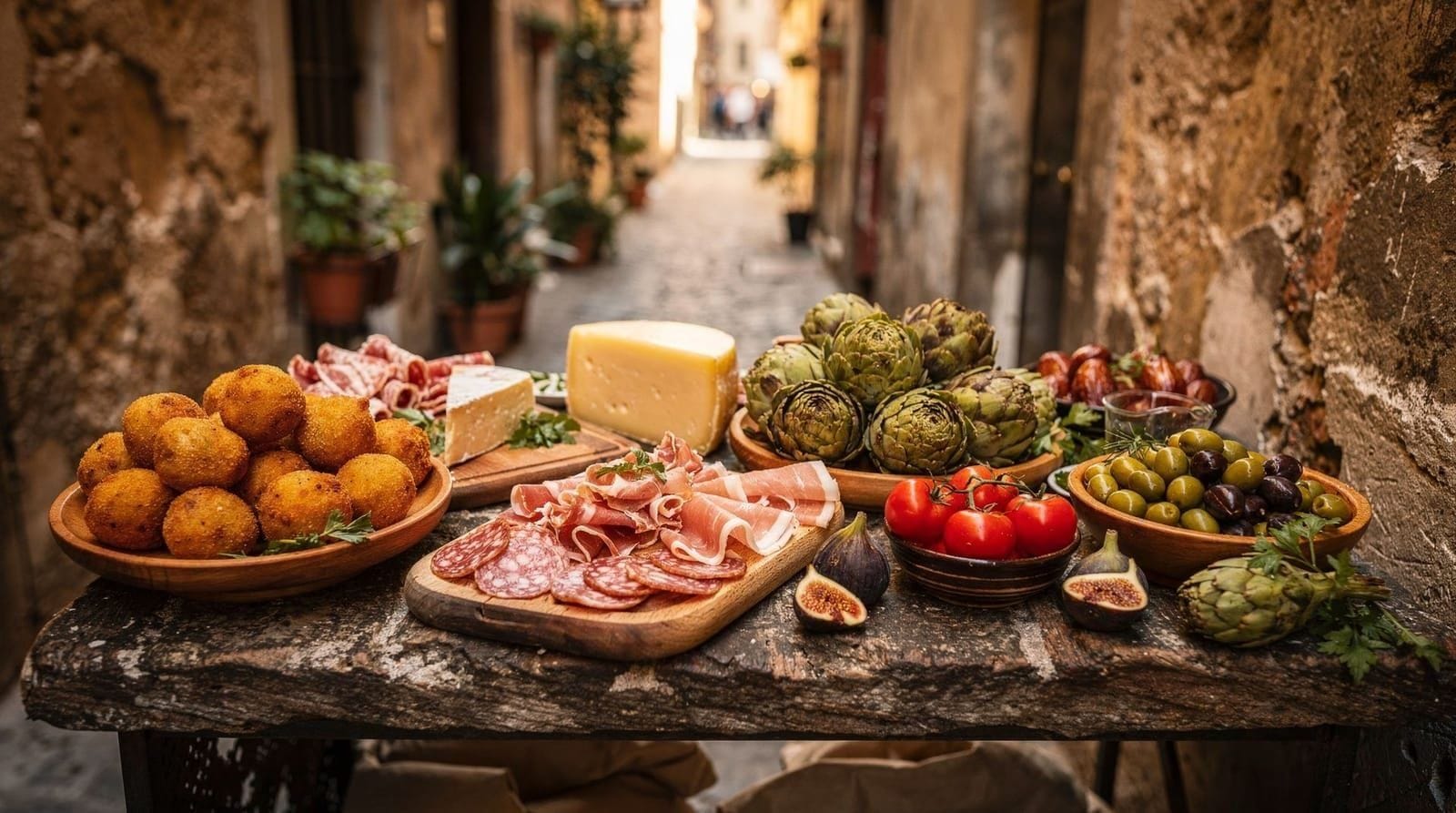
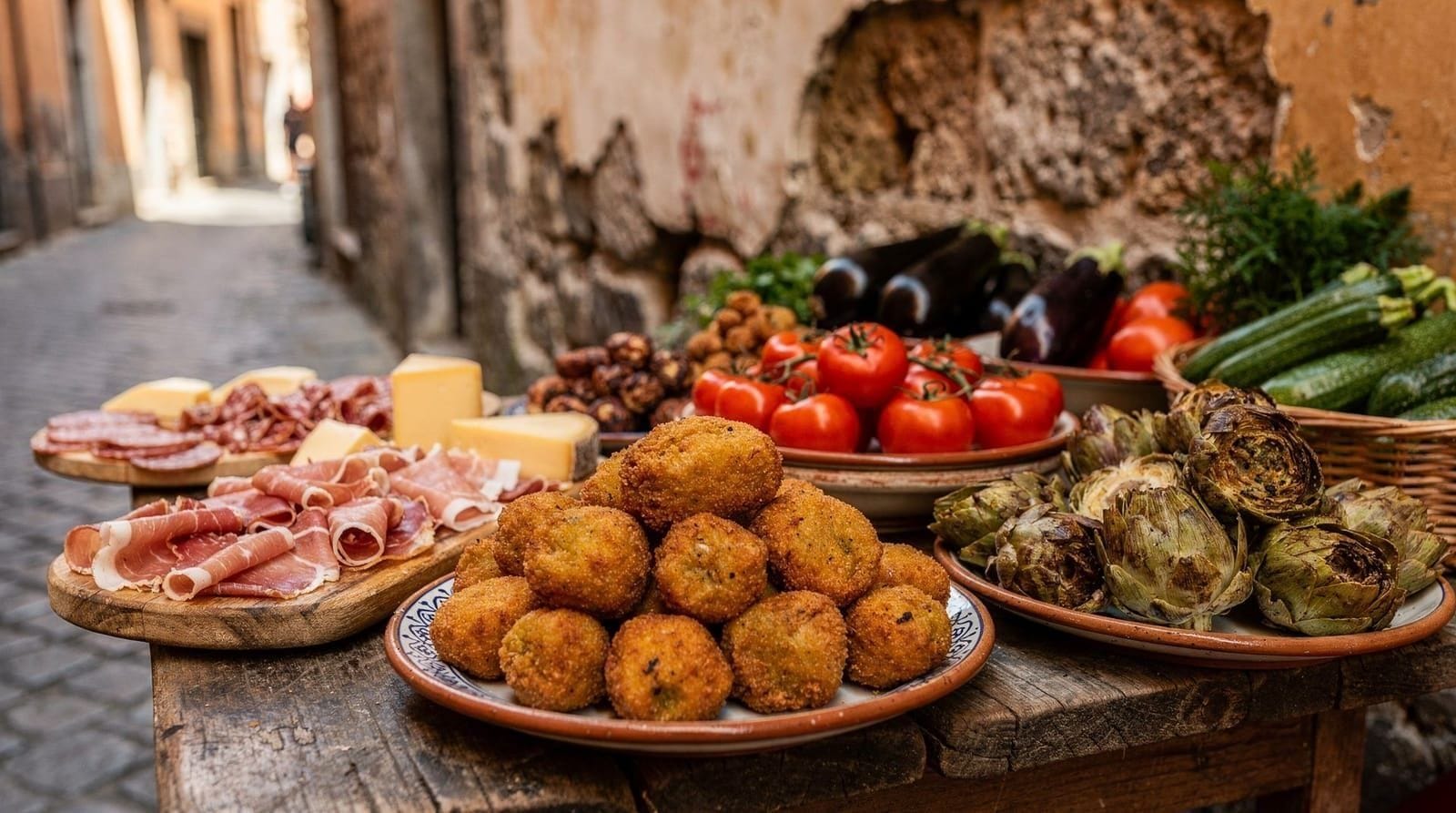
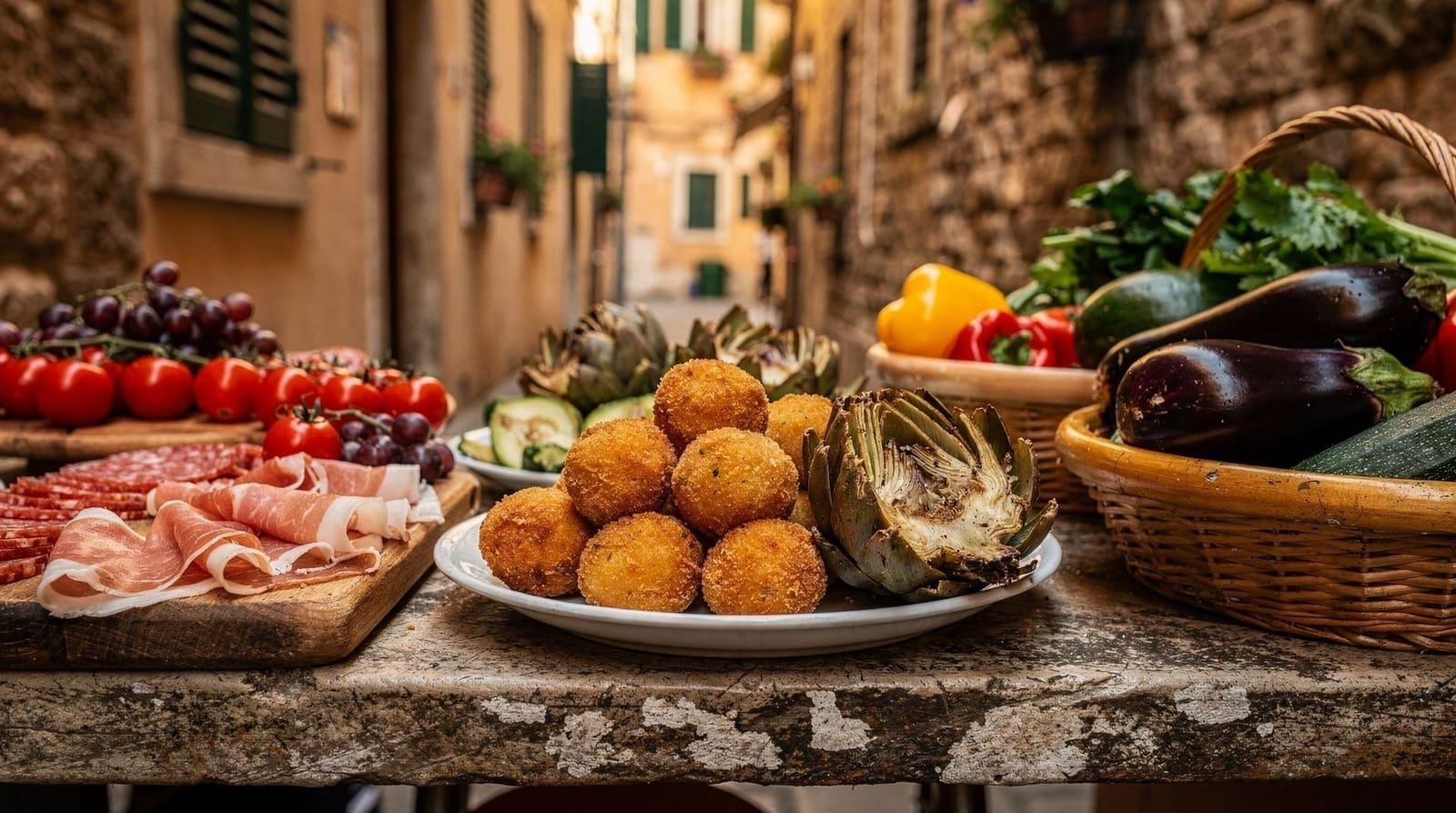
The essential dish is carciofi alla giudia — whole artichokes deep-fried twice until the outer leaves are crispy and the heart is sweet and tender. Available only in spring (February to April) when artichokes are fresh. The best versions are at Nonna Betta (Via del Portico d'Ottavia 16) and Ba'Ghetto (Via del Portico d'Ottavia 57). Beyond artichokes, the Ghetto is the place to eat carciofi alla romana, filetti di baccalà (battered salt cod), coda alla vaccinara and ricotta-based dolci.
Two thousand years of cooking in one neighbourhood
Rome’s Jewish community is the oldest in Western Europe. The first Jewish settlers arrived in Rome in the 2nd century BCE, and the community has been continuously present since. The Ghetto as an enforced enclosure dates from 1555, when Pope Paul IV confined Rome’s Jews to a small area beside the Tiber. The walls came down in 1848, and the forced confinement ended formally in 1870 — but the neighbourhood’s identity and its cuisine remained.
What grew in the Ghetto is one of the most historically layered culinary traditions in Italy. It developed under constraints — dietary law, poverty, limited access to certain ingredients — and those constraints produced a cuisine of exceptional ingenuity. The deep-frying tradition (olive oil rather than lard, since pork fat was off the table), the reliance on vegetables, the use of every part of a fish, the sweets built around honey and pine nuts — these aren’t accidents. They’re the product of two millennia of cooks working within limits and making something remarkable.
| Where | Via del Portico d’Ottavia, Centro Storico, 10 min from Campo de’ Fiori |
| Cost | €20–28/person (non-kosher) to €40–55/person (kosher restaurants) |
| Time needed | 2–3 hours for lunch plus a neighbourhood walk |
| Getting there | Walk from Campo de’ Fiori, Trastevere or Piazza Navona; bus 23/40/63/280 |
| Best time | February–April for fresh carciofi alla giudia; avoid Friday evening/Saturday for kosher spots |
The artichoke: what to understand before you order
The romanesco artichoke — large, round, tender and violet-tinged — is the raw material for both of the Ghetto’s canonical artichoke dishes. It grows in the fields around Rome and ripens between February and April. What happens to it after harvest defines two distinct traditions.
Carciofi alla giudia
The technique requires a whole artichoke, properly trimmed to remove the tough outer leaves and the thorny tips. The artichoke is then pressed open like a flower to create maximum surface area, and fried twice in hot olive oil — first at moderate temperature to cook through, then at high temperature to crisp the outer leaves to a paper-thin, golden crunch.
The result looks dramatic: a bronze flower with crispy fringe and a soft, sweet heart. The flavour is concentrated artichoke, slightly nutty from the frying, with none of the wateriness you get from steaming or boiling. It should be eaten hot. The crispy outer leaves are eaten whole. Budget €10–14 for a portion.
Critical timing note: This dish is only worth ordering when artichokes are in fresh season, roughly February through April. Outside that window, you get frozen artichokes that fry badly — greasy, soft, pale. Any restaurant serving carciofi alla giudia in June is using frozen. Ask.
Carciofi alla romana
A separate preparation entirely: the artichoke is stuffed with garlic, parsley and mentuccia (Roman wild mint), then braised in olive oil and white wine until completely tender. The result is aromatic, almost melting, served warm or at room temperature. No crispiness — instead, a concentrated umami depth from the long braise. Slightly more forgiving of frozen artichokes than the fried version, but still better fresh.
The two preparations are complementary and worth eating in the same meal if you’re in season — they demonstrate how dramatically technique changes the same vegetable.
Where to eat: the honest picks
Nonna Betta
Via del Portico d’Ottavia 16 — Certified kosher, family-run and one of the best cooking addresses in the Ghetto. The carciofi alla giudia here are consistently cited as a reference version: properly crispy outer leaves, not greasy, the heart cooked through. The menu extends well beyond artichokes: filetti di alici (fried fresh anchovies), lamb dishes, Jewish-style pasta (spaghetti with ceci — chickpea pasta — is a historic Ghetto preparation) and dolci including the ricotta e visciole tart.
Closed Friday evening and Saturday (Sabbath) and on Jewish holidays. Reservations recommended. Prices are higher than a standard trattoria — a full meal runs €40–55/person — but the cooking justifies it. Cash and card accepted.
Ba’Ghetto
Via del Portico d’Ottavia 57 — A larger, more contemporary space that is also certified kosher. The Levantine and North African influences are more visible here than at Nonna Betta — the menu includes hummus, baba ghanoush and shakshuka alongside carciofi alla giudia and Roman-Jewish classics. This reflects the community’s historical connections to Sephardic and Middle Eastern Jewish cuisine.
Good option for groups with mixed dietary needs, as the menu is broader and the style is slightly more accessible. Closed Friday evening and Saturday. Similar price range to Nonna Betta.
Sora Margherita
Piazza delle Cinque Scole 30 — Non-kosher, older, rougher around the edges. The setting (a tiny room off a small square) and the service (efficient but not warm) are authentically Roman. The artichokes are reliably good, the pasta is honest and the prices are lower than the kosher restaurants — pasta runs €10–13, artichokes €9–12. Expect to share a table at busy times.
Filetti di Baccalà
Largo dei Librari 88 — Technically just outside the Ghetto, but inseparable from its food tradition. A hole-in-the-wall that has been frying salt cod fillets since 1943. You eat standing or take away. The fish is battered, fried in olive oil, heavily salted and absolutely distinctive. The menu is almost entirely baccalà, with occasional additions (anchovies, artichokes in season). Cash only. Budget €5–7 per fillet, two is a meal. Open evenings only, Tuesday to Saturday.
Choosing between the four sit-down spots
If you only have time for one meal, this compares the main options directly:
| Restaurant | Kosher | Price/person | Best for |
|---|---|---|---|
| Nonna Betta | Yes | €40–55 | Reference-quality carciofi alla giudia, full menu |
| Ba’Ghetto | Yes | €40–55 | Groups with mixed tastes, Sephardic/Levantine dishes |
| Sora Margherita | No | €20–28 | Budget, authentically rough-edged atmosphere |
| Filetti di Baccalà | No | €10–15 | Quick, cheap, single-dish specialist — not a sit-down meal |
If budget is the deciding factor, Sora Margherita or Filetti di Baccalà deliver excellent food for roughly half the price of the kosher restaurants. If you want the fullest expression of the tradition in one sitting, Nonna Betta is the safer choice.
Dolceroma
Via del Portico d’Ottavia 20b — The dedicated patisserie for Roman-Jewish sweets: ricotta e visciole tart (by the slice or whole), torta di ricotta, ricciarelli (almond cookies), biscotti. Good for takeaway treats or a post-lunch coffee stop. The ricotta e visciole is the essential order — dense, slightly tart from the sour cherries, not too sweet.
The broader Roman-Jewish food tradition
Fish in the Ghetto
The absence of pork pushed the Ghetto’s food culture toward fish, and the community developed a sophisticated relationship with ingredients that mainstream Roman cooking undervalued. Baccalà (salt cod) became a Ghetto staple — cheap, storable, and kosher. Filetti di alici (fresh anchovies, battered and fried) are another institution. Triglie (red mullet) and orata (sea bream) appear on Nonna Betta’s menu prepared simply, in the Jewish-Roman style.
The fish frying tradition in the Ghetto directly influenced the broader Roman kitchen. Fritto misto of vegetables and fish — mixed deep-fried vegetables and seafood — is Roman today because it was Ghetto first.
Legumes and vegetables
Chickpea pasta (pasta e ceci) is ancient in this kitchen. So is the broader use of chicory, field greens and seasonal vegetables as main elements of a dish rather than side dishes. The cucina povera (poor kitchen) of the Ghetto produced a vegetable cooking tradition more sophisticated than anything in the mainstream Roman repertoire of the same period.
Dolci
Roman-Jewish sweets are largely based on olive oil, honey, pine nuts and almonds — the ingredients available and affordable before sugar became common. The result is denser, less sweet and more flavour-complex than European confectionery of the same period. Pizzarelle (honey-fried dough with pine nuts) are served at Passover but sometimes available year-round. Struffoli (honey-drenched dough balls) appear at Hanukkah.
The historical context that makes the food make sense
Eating in the Jewish Ghetto without knowing its history is like visiting the Roman Forum without knowing what the buildings were for. The food is better understood against its background.
The Ghetto was established in 1555 under Pope Paul IV’s bull Cum nimis absurdum, which confined Rome’s Jews to a small, flood-prone area beside the Tiber. The enclosure was roughly 3 hectares — cramped for a population that ranged from 2,000 to 8,000 over the following centuries. The walls were literally locked at night. Residents were subject to forced conversion attempts and periodic expulsions.
What persisted through this was an extraordinarily coherent community with its own language (Giudeo-Romanesco, a distinct dialect), its own liturgical traditions and, inevitably, its own cuisine. The food adapted to the constraints — olive oil because pork fat was prohibited; artichokes and chicory because they were cheap and plentiful in the Lazio fields; fish because it was kosher-accessible; honey-based sweets because sugar was expensive.
The emancipation in 1848 and the formal dissolution of the Ghetto after Italian unification in 1870 allowed families to move, but many chose to stay. The neighbourhood retains its Jewish character today — the Great Synagogue (completed 1904) and Jewish Museum on Lungotevere Cenci, the Piazza delle Cinque Scole (named for the five synagogues that once existed here), the kosher restaurants and delicatessens. Walking through it still feels like a distinct neighbourhood with its own logic, unlike anywhere else in Rome.
The food is inseparable from this history. When you eat carciofi alla giudia at Nonna Betta, you’re eating a dish that has been prepared in this neighbourhood, by this community, for several hundred years. That continuity is not incidental to the experience.
How the Ghetto fits into a Rome food day
The Jewish Ghetto is a natural addition to a Centro Storico food day. It’s within walking distance of Campo de’ Fiori (10 minutes), Trastevere (via the Tiber island, 15 minutes) and Piazza Navona (10 minutes). A logical route: Campo de’ Fiori morning market → Ghetto for lunch (carciofi alla giudia at Nonna Betta or Sora Margherita) → Trastevere in the evening.
For the Trastevere-side food experience, see the Trastevere food guide. For the market context, the Campo de’ Fiori market guide covers what’s worth buying and when.
The Trastevere and Campo de’ Fiori street food tour covers the historic centre’s food geography with a guide — a useful complement to an independent Ghetto lunch, covering the street food that runs between the Ghetto and Campo de’ Fiori.For the broader Roman pasta tradition that parallels Ghetto cooking without overlapping it, the five Roman pastas guide and Roman pasta food tour guide provide the parallel narrative.
Practical information
Getting there: Bus 23, 40, 63, 280 along the Lungotevere. 10 minutes walk from Campo de’ Fiori, 10 minutes from Piazza Venezia. No metro stop — the neighbourhood is car-free and best reached on foot.
Hours to plan around: Kosher restaurants are closed Friday evening and all Saturday. The fried cod spot (Largo dei Librari) is evenings only, Tuesday to Saturday. Lunch at the Ghetto restaurants typically runs 12:30–15:00. Plan around these constraints.
Artichoke season: February to April for fresh romanesco artichokes. Outside this window, ask before ordering carciofi alla giudia — you may be told they’re using frozen, which is honest; order something else.
Budget: Lunch at Sora Margherita, €20–28/person with wine. Lunch at Nonna Betta or Ba’Ghetto, €40–55/person. Filetti di baccalà, €10–15 for a filling takeaway meal.
Dietary notes: Both Nonna Betta and Ba’Ghetto are certified kosher. The separation of meat and dairy is observed. If you’re ordering at kosher restaurants, a fish or vegetable meal avoids the dairy/meat complexity. Non-kosher restaurants in the area (like Sora Margherita) don’t have these restrictions.
The neighbourhood itself — the old Portico d’Ottavia, the synagogue and Jewish Museum, the Teatro di Marcello — is worth an hour beyond the restaurants. The centro storico guide covers the neighbourhood context.
For an evening food experience in the historic centre neighbourhoods that extends from the Ghetto’s traditions toward Trastevere’s restaurant scene, the Trastevere food and drink tour covers the adjacent food geography well.Ordering etiquette and a few honest tips
A few small habits improve the meal noticeably. At the kosher restaurants, don’t expect a cheese course or a dish combining meat and dairy in the same course — this is a genuine dietary rule, not a stylistic choice, and asking for it puts staff in an awkward position. When ordering carciofi alla giudia out of season, simply ask “sono freschi?” (are they fresh?); a good restaurant will tell you honestly if they’re using frozen stock, and you can order something else without any awkwardness. Reservations at Nonna Betta and Ba’Ghetto are genuinely worth making a day or two ahead on weekends — both fill up with a mix of tourists and long-standing local regulars, and walk-up waits of 30–45 minutes are common at peak lunch and dinner hours. Cash is still preferred (though not always required) at the smaller, older spots like Sora Margherita and Filetti di Baccalà — carry some in case a card machine is “temporarily” out of service, a not-uncommon occurrence at the most old-school addresses.
Frequently asked questions about The Jewish Ghetto food guide: carciofi alla giudia and Roman-Jewish cuisine
What is carciofi alla giudia?
What makes Roman-Jewish cuisine different from regular Roman cuisine?
Is carciofi alla giudia available year-round?
Where is the Jewish Ghetto in Rome and how do I get there?
Are the Ghetto restaurants kosher?
What are the filetti di baccalà and where should I eat them?
What Roman-Jewish dolci should I try?
Top experiences
Bookable activities with verified prices and instant confirmation on GetYourGuide.