Esquilino & Termini
Esquilino & Termini is Rome's multicultural transit hub: budget hotels, Termini station, Santa Maria Maggiore, and the Baths of Diocletian. Honest guide.
Rome: City Sightseeing Hop-on Hop-off Bus with Audioguide
Quick facts
- Metro
- Lines A and B cross at Termini
- Character
- Gritty, multicultural, budget-friendly, transit hub
- Pickpocket risk
- High around Termini station — stay alert
- Best for
- Budget stays, transit connections, early departures
- Santa Maria Maggiore
- Free entry; stunning 5th-century mosaics
Esquilino and Termini is the part of Rome travel guides usually describe with coded language like “convenient but not picturesque” or “central but best used as a base.” That is fair. This is not the Rome of film sets. What it is: the most connected neighborhood in the city, the most genuinely multicultural, the most budget-friendly for accommodation, and the departure point for every high-speed train to Florence, Naples, and Pompeii.
It also has one of Rome’s best-kept art-historical secrets: Santa Maria Maggiore, a 5th-century basilica whose golden apse and nave mosaics rival the Vatican and are free to enter with minimal queuing.
The honest role of this neighborhood in your visit is largely logistical — but that does not mean it has nothing to offer.
Termini station: the city’s transport center
Roma Termini handles 150 million passengers annually — it is the seventh busiest railway station in Europe and Rome’s central metro interchange. Lines A and B cross here, connecting to every major sight in the city. All high-speed trains to Florence (90 min), Naples (1h10), and Pompeii (via Naples) depart from here.
Logistics you need to know:
- Ticket machines accept cash and cards; queues at windows can be long. Book high-speed train tickets in advance online (Trenitalia.com or Italo; prices are significantly lower booked early).
- The station interior has improved significantly — there are decent cafés, a large supermarket (Eataly-adjacent), and luggage storage.
- Connections to airports: The Leonardo Express to Fiumicino (FCO) departs from Termini Platform 23/24, every ~30 min, journey time 32 min; tickets ~€14. Book online to avoid queue. Shuttle buses to Ciampino (CIA) also depart from outside Termini.
Safety at Termini: The area around Termini station — particularly the front piazza, via Marsala, and the underground/metro concourses — has elevated pickpocket risk. Use zipped cross-body bags, nothing in back pockets, particularly on the metro platforms and escalators. This is a factual caution, not an exaggeration; Termini ranks among the top five pickpocket locations in Rome according to police reports. See the Rome scams and pickpocket guide for specific tactics.
Santa Maria Maggiore
The Basilica di Santa Maria Maggiore is one of Rome’s four major basilicas and the largest church dedicated to the Virgin Mary in the city. It was founded in the 5th century and the current structure, while modified, preserves original elements that are extraordinary.
What to see:
- The nave mosaics dating from 432–440 CE — among the oldest surviving figurative mosaic cycles in Rome, depicting Old Testament scenes. The gold ground predates the Byzantine tradition and is almost 1,600 years old.
- The apse mosaic (13th century, by Jacopo Torriti) — a Byzantine-influenced Coronation of the Virgin, gleaming gold.
- The Sistine Chapel (the other Sistine Chapel) — the funerary chapel of Pope Sixtus V (not the Vatican one), with the tomb of Cardinal Montalto and ceiling frescoes.
- The Borghese Chapel — containing the Salus Populi Romani, one of Rome’s most venerated icons of the Virgin, attributed legend to St. Luke.
Entry: Free. Open daily from about 7 am. Mass times affect accessibility. The basilica is consistently undervisited by tourists focused on the Vatican and Colosseum — arrive at 8–9 am and you often have the nave almost to yourself.
Dress code applies here as for all Roman churches: covered shoulders and knees.
The Esquilino neighborhood
Esquilino (the Esquiline Hill) has been a working-class neighborhood for centuries. The area between Termini and the Colosseum follows via Merulana and via Cavour — both with moderate tourist foot traffic but local life intact.
Via Carlo Alberto and the Piazza Vittorio Emanuele II market: The Piazza Vittorio market moved indoors in 2001 to a purpose-built hall (Nuovo Mercato Esquilino) on via Lamarmora. It is one of Rome’s most genuinely multicultural markets — Ethiopian, South Asian, Chinese, and Bangladeshi vendors alongside Italian produce sellers. Prices are low and the selection is wide. Open Monday–Saturday, morning hours.
Multiculturalism: Esquilino has Rome’s most concentrated Asian-food district, particularly along via Principe Amedeo and the streets around Piazza Vittorio. For Chinese, Vietnamese, Indian, and Bangladeshi food, this is Rome’s resource. It is an honest alternative to always eating Italian if you are in the city for a week or more.
Piazza Vittorio Emanuele II itself: The large public garden at the square’s centre is worth a slow lap even if you’re not shopping at the market — it contains the Porta Magica, an eccentric 17th-century alchemical gate covered in cryptic Latin inscriptions supposedly linked to attempts at turning base metal into gold, and fragments of the Republican-era Servian Wall, Rome’s oldest defensive fortification, visible at the garden’s edge. Almost no organised tour stops here, which is exactly why it rewards independent explorers with a spare half hour.
Baths of Diocletian and National Roman Museum
The Terme di Diocleziano (Baths of Diocletian) at Piazza della Repubblica were built between 298–305 CE and were, at their completion, the largest bathing complex in the ancient world — capable of accommodating 3,000 bathers simultaneously. The ruins now house part of the National Roman Museum, with one of the best collections of ancient sculpture in the world.
What is here: Inscriptions, sarcophagi, and funerary reliefs in the extensive halls. The collection is serious and specialized; it rewards visitors with an interest in Roman daily life, death, and epigraphy more than those seeking the dramatic single masterpiece.
Nearby: The Church of Santa Maria degli Angeli e dei Martiri, designed by Michelangelo within the surviving tepidarium of the Baths, is free to enter and architecturally remarkable — the scale of the original Roman vaulting is immediately apparent.
Piazza della Repubblica (the semicircular piazza in front) marks the curve of the original exedra of the Baths. The Fontana delle Naiadi at its center is late 19th century and considerably more risqué than the Vatican authorities approved of when unveiled in 1901 (the controversy was real).
Where to eat in Esquilino & Termini
The immediate station area has the usual tourist-trap density. Two to three blocks away, the situation improves considerably.
Good options:
- Trattoria da Danilo (via Petrarca) — consistently recommended for Roman classics at fair prices; popular with local workers at lunch.
- Ristorante Agata e Romeo (via Carlo Alberto) — one of Rome’s seriously regarded restaurants for refined Roman cuisine; expensive but worth knowing about.
- Pinsere (via Flavia) — Roman pizza pinsa (oblong, lighter dough); good value lunch option.
- Esquilino street food: Via dello Statuto and adjacent streets have Vietnamese, Chinese, and Indian fast-food options at €5–10 — entirely honest and good value.
Accommodation: the honest case for staying here
Esquilino and Termini have Rome’s widest selection of budget and mid-range hotels. The advantages:
- Price: €50–120/night for a decent double, vs €120–250 in Centro Storico.
- Connections: Metro A/B interchange; 10–20 minutes to every major sight.
- Day trips: Direct train connections to Florence, Naples, and Pompeii from Termini.
The disadvantage is honest: the streets immediately around Termini are grimy, the pickpocket risk is higher, and the neighborhood has no particular charm. If your priority is a beautiful street to walk out onto in the morning, stay in Monti or Trastevere and spend the savings on one good dinner.
If your priority is budget, early morning flights or trains, and a clean bed with metro access, this is practical and fine.
Hotels:
- Hotel Artemide — well-run 4-star on via Nazionale; comfortable and reliable.
- iQ Hotel Roma — design-forward, eco-certified, very convenient for Termini.
- Generator Rome Hostel — for budget travelers, well-located, social atmosphere.
Using Termini for day trips
Termini is the launch point for Rome’s best day trips. High-speed train schedules:
- Florence: ~1h30 (Frecciarossa), departs every 30 min from €19; buy early for best prices. See Florence from Rome.
- Naples: ~1h10 (Frecciarossa/Italo), from ~€15; connects to Pompeii via Circumvesuviana from Napoli Centrale.
- Pompeii: ~2h15 total (Frecciarossa to Naples + 35 min Circumvesuviana); see Pompeii from Rome.
- Orvieto: ~1h20 (regional train); see Orvieto from Rome.
A hop-on hop-off bus pass departs from near Termini and covers all major sights — useful for first-day orientation before deciding what to book in advance. An evening walking tour from the centro storico can be a good first evening if you arrive into Termini and want context quickly.
Santa Prassede and the Byzantine mosaics
Just off via Merulana, the church of Santa Prassede (via di Santa Prassede) contains the finest Byzantine mosaics in Rome outside of Ravenna. The main apse mosaic (9th century, commissioned by Pope Paschal I) shows Christ flanked by apostles on a gold ground. The Chapel of San Zeno — called the Garden of Paradise by contemporaries — is a small golden cube with ceiling, walls, and arch entirely covered in 9th-century mosaic. The quality rivals the great mosaic cycles of the eastern Mediterranean.
Why it is relevant to Esquilino: Santa Prassede sits exactly between Termini station and Monti, making it a natural stop for anyone walking between the two. It is free, rarely crowded, and takes 30–45 minutes to appreciate properly.
Santa Maria Maggiore, 200 metres away, contains 5th-century nave mosaics of comparable quality and also free. The concentration of extraordinary early Christian art in this small area of Esquilino is genuinely remarkable and consistently undervisited.
The Basilica of San Giovanni in Laterano
A 20-minute walk from Termini station, the Archbasilica of San Giovanni in Laterano is the cathedral of Rome — technically ranking above St. Peter’s in the Roman Catholic hierarchy (it is the seat of the Bishop of Rome). The current structure dates largely from the 17th–18th centuries but incorporates medieval elements including an extraordinary 13th-century mosaic in the apse.
Practical: Free entry. The Scala Santa (Holy Stairs) in the building opposite — traditionally identified as the stairs from Pontius Pilate’s palace, brought to Rome by Helena, mother of Constantine — are climbed on knees by pilgrims. Secular visitors may observe; the side staircase allows standing access.
This area (the Lateran) is rarely crowded because it is not on the standard tourist circuit. The walk from Termini follows via Merulana through the Esquilino neighborhood.
The multicultural food scene
Esquilino has, by some measures, Rome’s most internationally diverse food landscape. The area around Piazza Vittorio Emanuele II and along via Principe Amedeo, via Gioberti, and via Rattazzi includes:
- Chinese restaurants and grocery stores — the largest Chinese-Italian community in Rome is concentrated here; several restaurants serve genuine Chinese regional cuisine (Sichuan, Cantonese).
- Ethiopian and Eritrean restaurants — via Carlo Alberto and side streets have a cluster of restaurants serving injera-based East African food; good value and genuine.
- Indian and Pakistani food — several restaurants along via dell’Esquilino.
- Bangladeshi fast food and sweets — very cheap and very good for a quick meal.
This matters practically: If you are staying near Termini for a week, you will not want to eat expensive tourist-zone Italian every night. Esquilino’s international food scene solves that problem at €8–15 per meal.
Roma Tiburtina: the alternative station
Some long-distance and international trains — particularly certain overnight services and some Italo departures — use Roma Tiburtina rather than Termini. Tiburtina is a large, modern station about 15 minutes from Termini by Metro B, and it’s worth checking your ticket’s departure station carefully, since the two are not interchangeable and a mix-up can mean missing a train entirely.
Tiburtina itself has little to detain a visitor — it’s a functional modern interchange without Termini’s Baths-of-Diocletian-adjacent history or Esquilino’s neighborhood texture — but it’s useful to know it exists and to double-check which station your specific booking uses, especially for bookings made through non-Italian third-party sites that sometimes default to whichever station has cheaper availability that day.
Getting oriented at Termini: the essentials
Termini station is large enough that first-time visitors are routinely disoriented. Practical navigation:
- Leonardo Express departs from platforms 23–24 (follow “Leonardo Express / Fiumicino” signs from the main hall). Frequency every 30 minutes; book online at trenitalia.com to avoid the ticket window queue.
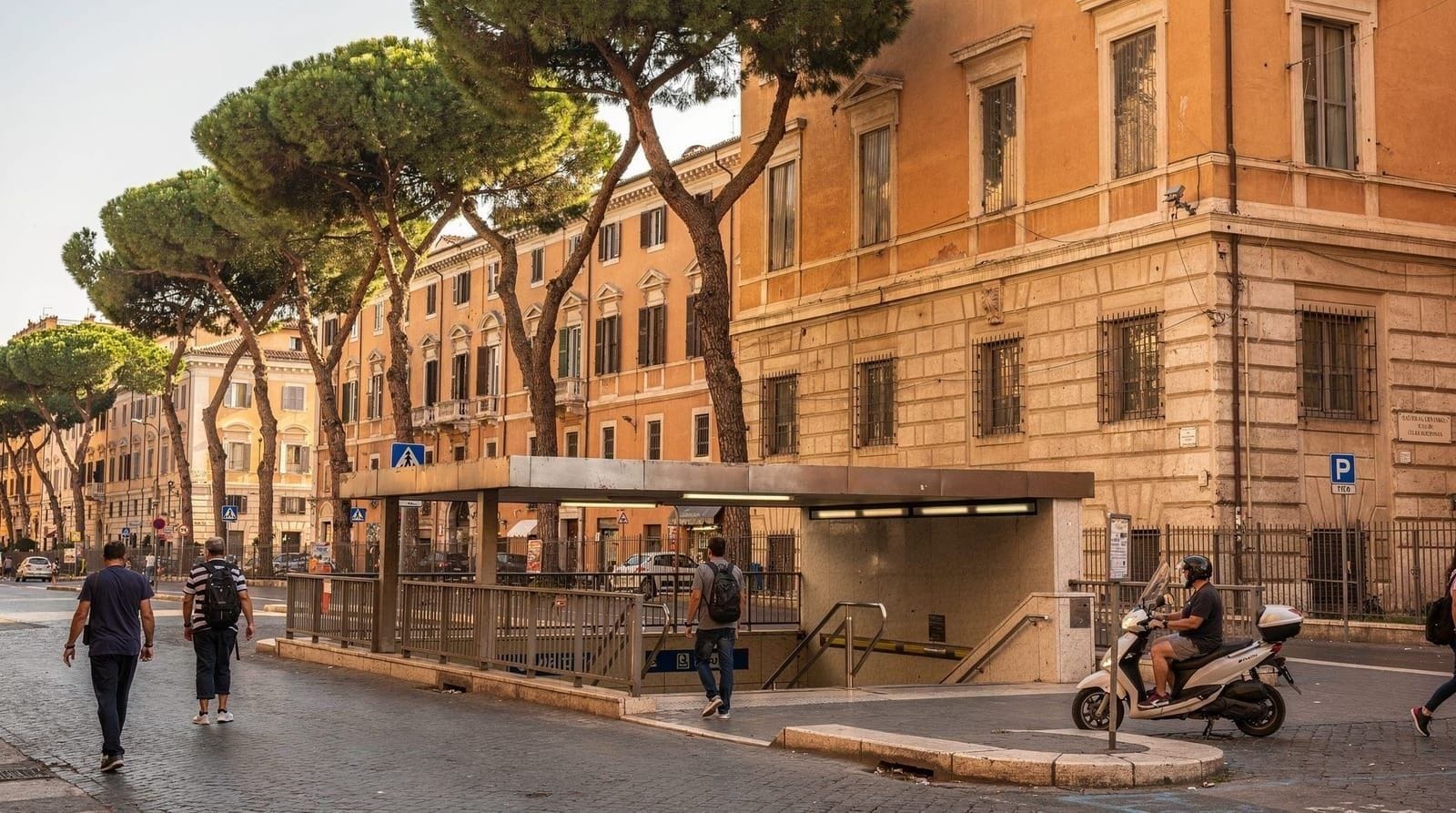
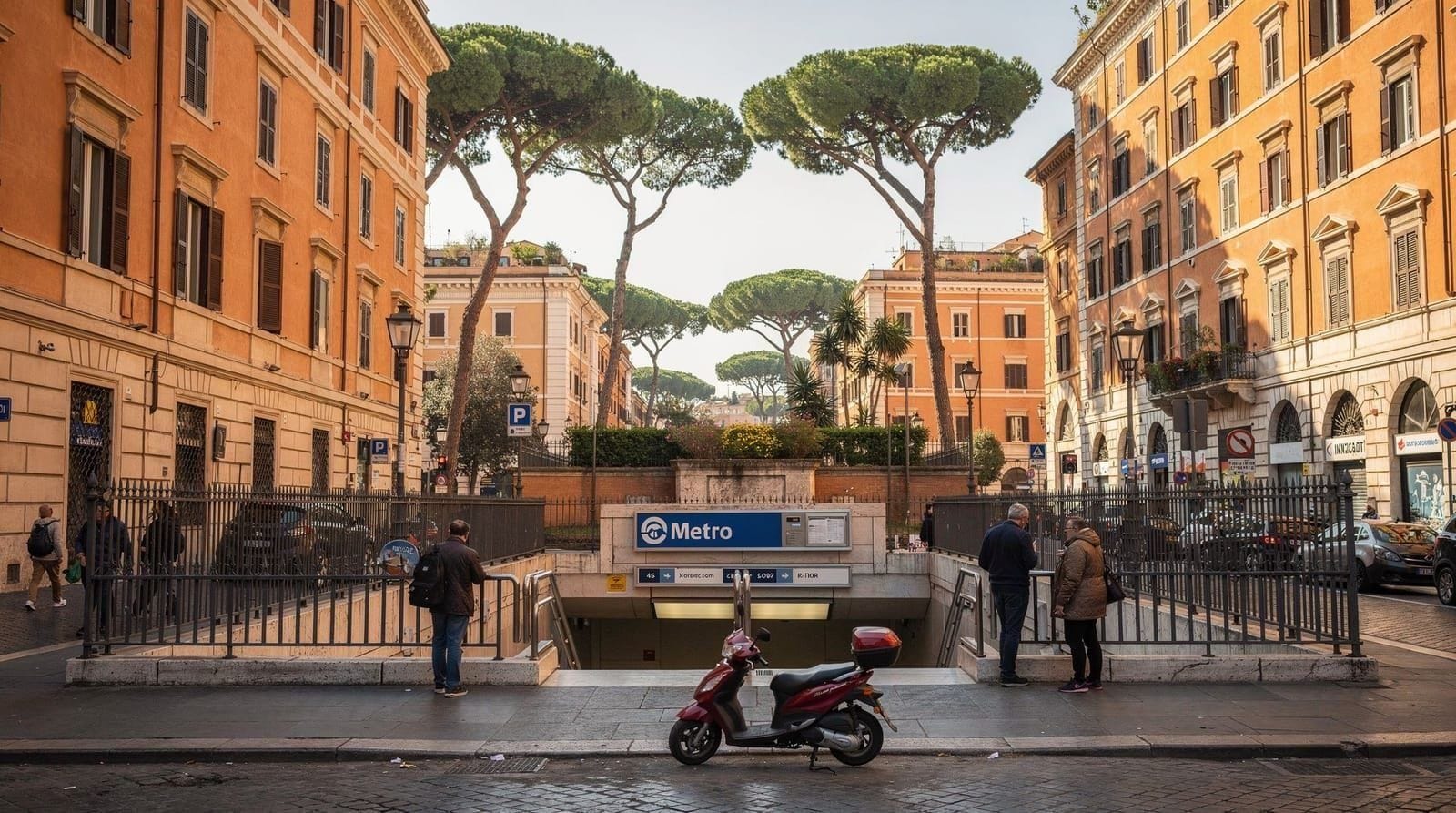
- Metro A (orange line) and Metro B (blue line) intersect under the station. They do not share a platform — follow signs for the specific line.
- Bus station: Buses (including the Ciampino shuttle) depart from outside the station’s front entrance (Piazza dei Cinquecento); specific bays are marked on ground-level signs.
- Luggage storage (deposito bagagli) is in the main gallery; fee applies (approximately €6–10 per bag per day).
- Tourist police office is at the station for reporting pickpocket thefts and obtaining a denuncia for insurance purposes.
Hop-on hop-off bus as orientation tool
For first-day orientation, a hop-on hop-off bus with audioguide provides a useful circuit of Rome’s major sights before you decide what to book for deeper visits. Multiple routes cover the Colosseum, Vatican, Borghese Gallery, and Termini departure points. The audio commentary is variable in quality but the geography lesson — seeing how Rome’s hills and neighborhoods relate to each other — is genuinely useful for planning subsequent days.
Termini for Ciampino connections too
Most guides only mention Termini’s Fiumicino link, but it’s also the hub for Rome’s other airport, Ciampino (CIA), used by many budget carriers (Ryanair, Wizz Air and others). Unlike Fiumicino, there’s no direct rail line to Ciampino — shuttle buses (operators including Terravision and SIT) depart from outside Termini’s front entrance (Piazza dei Cinquecento), taking approximately 40 minutes depending on traffic, with tickets around €6–10 one way. Book online rather than at the kiosk for slightly better pricing and to guarantee a seat at busy departure times.
For a full comparison of the bus, taxi and private-transfer options to Ciampino, including realistic timing for early-morning budget flights, see the Ciampino airport to Rome guide — the logistics are meaningfully different from the Fiumicino/Leonardo Express route described above, and travellers connecting through Ciampino should not assume the same train-based approach applies.
Frequently asked questions about Esquilino & Termini
Is Termini station safe?
Safe in the sense that violent crime is very low. Not safe in the sense that pickpocketing is endemic — Termini and the Metro A corridor are consistently among Rome’s highest-risk zones for petty theft. Use standard precautions: zipped front bags, no phones or wallets in back pockets.
Is it worth staying near Termini to save money?
For budget travelers: yes, the savings are real and the metro connections are the best in the city. For mid-range travelers who want neighborhood experience: stay in Monti instead (20 min walk, similar metro access, much better streets).
Can I buy train tickets to Florence or Naples at Termini on the day?
Yes but prices are significantly higher than advance online bookings. Trenitalia and Italo operate separate ticket offices and machines. Book online (trenitalia.com or italotreno.it) at least a few days ahead for the best fares. Same-day prices can be 2–3x higher.
What is there to see in Esquilino beyond Termini?
Santa Maria Maggiore (free, extraordinary mosaics), the Baths of Diocletian (National Roman Museum), the market at Piazza Vittorio (genuine multicultural market), and via Merulana leading toward Monti. The neighborhood rewards exploration rather than destination-specific sightseeing.
How do I get from Termini to the Colosseum?
Metro Line B to Colosseo (2 stops, 4 minutes). Then a 5-minute walk to the entrance. The fastest and cheapest connection in Rome.
What is the Leonardo Express and when should I take it?
The Leonardo Express is a nonstop train from Fiumicino airport (FCO) to Roma Termini, running every ~30 minutes, journey time 32 minutes. It costs about €14. This is the fastest option from FCO and significantly cheaper than the taxi flat fare (€55). See getting from Fiumicino to Rome for full options including bus alternatives.
How do I get from Termini to Ciampino airport?
There’s no direct train — take a shuttle bus (Terravision, SIT and others) from outside Termini’s main entrance, journey time approximately 40 minutes depending on traffic, tickets around €6–10. Book online ahead of budget-flight departure times. See the Ciampino airport to Rome guide for the full comparison of bus, taxi and private-transfer options.
Is Esquilino a good base for a longer stay with day trips?
Yes — it’s the strongest base in Rome specifically for day-trip logistics, since every high-speed train to Florence, Naples, Pompeii and Orvieto departs from Termini. Combine it with the neighborhood’s genuinely good multicultural food scene and the savings compared to Centro Storico hotels, and it’s a sensible choice for a week-long stay built around day trips rather than evening neighborhood atmosphere.
Top experiences
Bookable activities with verified prices and instant confirmation on GetYourGuide.