Civita di Bagnoregio
Civita di Bagnoregio is a medieval village on a crumbling tufa pinnacle — nicknamed "the dying city." 2h from Rome by tour or car. Honest day trip guide.
Day Trip from Rome to Orvieto & Civita di Bagnoregio
Quick facts
- Distance from Rome
- ~130 km northwest
- Best access
- By car or organized day tour (limited public transport)
- Entry fee
- €5 to cross the footbridge (paid at Bagnoregio)
- Village population
- ~5–10 permanent residents (varies seasonally)
- Best months
- April–June, September–October
La città che muore — the city that is dying
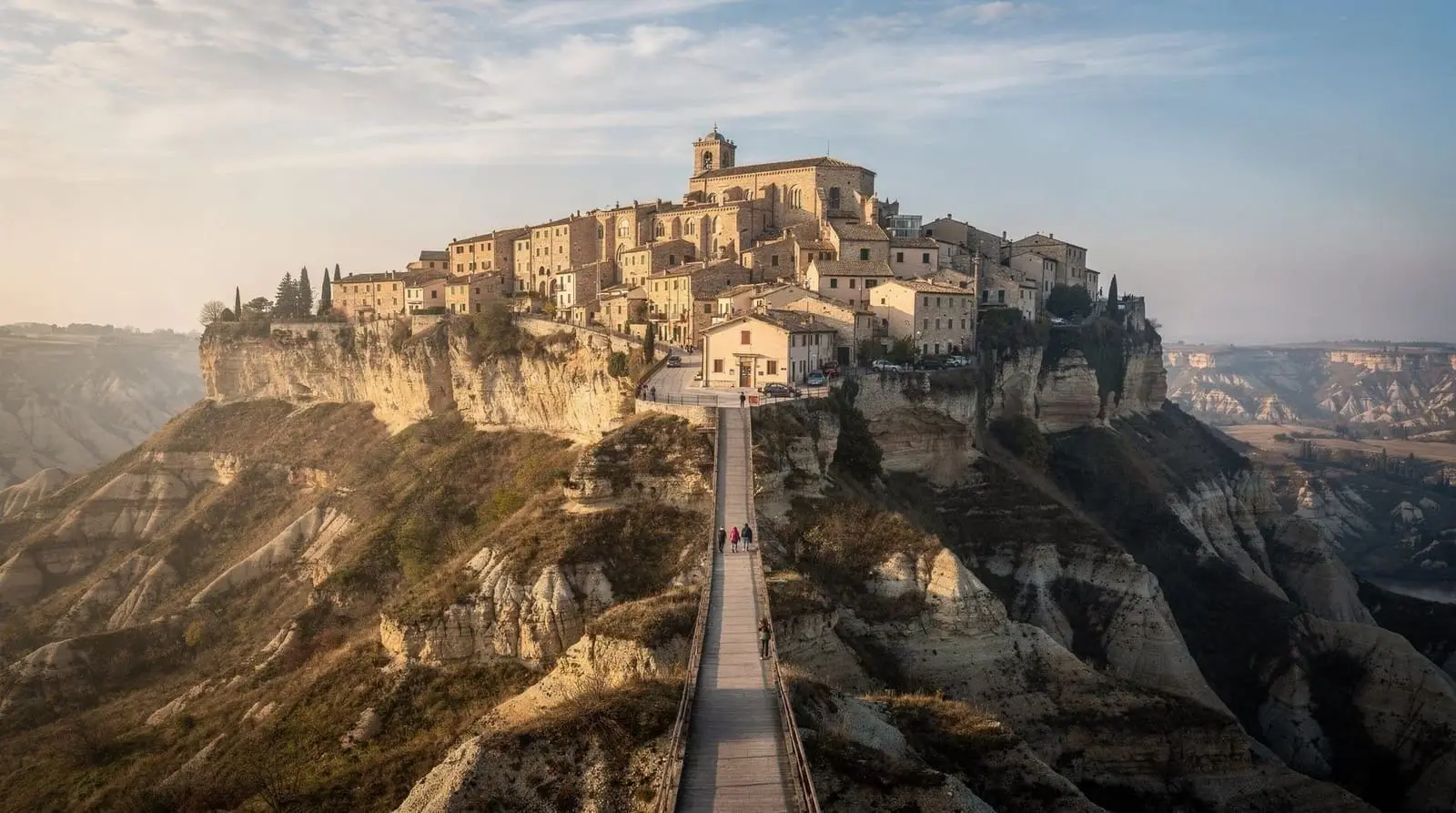
The phrase is not a metaphor. Civita di Bagnoregio is a medieval village sitting on a narrow tufa pinnacle above the Valle dei Calanchi — a landscape of wind and water-eroded clay gullies that is slowly consuming the rock beneath it. The village has been shrinking for centuries as the cliff face crumbles. Today, roughly five to ten people live there year-round (the number varies by season). The only access is a pedestrian footbridge, and the nearest parking is 500 metres away in the town of Bagnoregio.
The result is one of the most unusual places in central Italy: a medieval street plan frozen in the 14th century, a Romanesque church, a piazza, a handful of restaurants and souvenir shops — and the constant, slow erosion of the rock that supports it all. Geologists estimate it may not survive another century. Standing at the viewpoint in Bagnoregio and watching the late afternoon light hit the pinnacle, that geological fact makes the place feel genuinely dramatic rather than merely scenic.
Civita was added to UNESCO’s Tentative World Heritage List in 2024 — which has increased visits and made managing the flow of day-trippers more urgent.
Getting to Civita di Bagnoregio from Rome
By car (the practical choice)
From Rome, take the A1 motorway north to Attigliano, then the SS205 to Bagnoregio — about 1h45–2h total. Paid parking in Bagnoregio (around €2–3/hour). From the Bagnoregio car parks, it is a 10-minute walk to the footbridge ticket booth, then a 5-minute walk across the bridge to the village gate.
Driving allows you to combine Civita with Viterbo (30 km southwest, about 40 minutes’ drive) on the same day. Or with Orvieto (15 km north, across the Umbria border, about 20 minutes) — giving you three quite different sites in one northern Lazio/Umbria day.
By organized tour
No direct public bus links Bagnoregio adequately to Rome for a practical day trip. The most efficient way to reach Civita without a car is via an organized day tour from Rome, which typically pairs it with Orvieto (the nearby Umbrian clifftop town with a spectacular Duomo). These tours handle all transport and give you a guide for both sites.
This organized day trip from Rome covers both Orvieto and Civita di Bagnoregio — the most logical combination and the main reason people visit this part of northern Lazio/Umbria. A wine-focused version of the same day trip, adding a local cantina visit to the Orvieto–Civita itinerary.By public transport (difficult)
It is technically possible by regional bus from Orvieto (which is reachable by train from Rome in under 90 minutes). From Orvieto, Cotral buses run to Bagnoregio, but frequency is very low — sometimes two or three per day. Missing a return bus means a taxi or a long wait. Unless you are experienced with Italian regional bus systems and have confirmed current timetables, this is not a reliable option for a day trip.
The experience: what to expect
The viewpoint from Bagnoregio
Before you cross the bridge, stop at the belvedere in Bagnoregio. This is where the famous photograph is taken: Civita’s pinnacle floating above the Valle dei Calanchi, the clay gullies stretching in every direction, the sky usually large and operatic. The viewpoint is free and requires no entry fee. Spend at least 20 minutes here before and after your visit to the village.
Crossing the footbridge
Entry to Civita costs €5 per person (paid at the ticket booth at the foot of the bridge in Bagnoregio; verify current pricing as it has increased with tourist volume). The bridge itself is 300 metres long, gently ascending, with views down into the gullies on both sides. No vehicles. No bikes. Walking time: 5–7 minutes.
Inside the village
Civita’s street plan covers roughly 200 metres end to end. There is one main street, a piazza with the Chiesa di San Donato (Romanesque, 12th century, with some good Lombard stonework), a handful of caves in the tufa walls used as cellars and animal pens for centuries, and maybe six to eight small restaurants and shops.
The Museo Geologico Civita (in one of the cave dwellings) gives geological context about the erosion process — worth the €2 entry for understanding what you are standing on.
The views from the western end of the village, over the gullies and towards Orvieto in the distance, are excellent. The north side of the village has the most dramatic cliff-edge viewpoints.
Time needed: 45–90 minutes inside the village is enough for most visitors. If you sit for lunch (one small restaurant serves traditional Viterbo-region food — acquacotta, pasta with local sauce, roast meats around €15–25 per person), add another hour.
What not to expect: a typical tourist resort. There is no gelato stand, no postcard rack at every corner, no audio guide. The village is small, genuine, and slightly melancholy. That is the point.
Practical tips
Timing: Arrive in Bagnoregio by 9:00–10:00 (or after 16:00) to avoid the worst midday crowds in July–August. Weekday mornings in spring and autumn are the quietest. The golden-hour light on the pinnacle from the Bagnoregio viewpoint is best in late afternoon.
Footwear: The bridge is paved and manageable, but the village lanes are uneven tufa cobbles — comfortable shoes with ankle support are sensible.
Crowds and entry fee: Since the entry fee was raised (it has gone from €1.50 to €5 over recent years), visitor management has improved slightly but the village can feel very full on summer Saturdays and Sundays when tour coaches arrive from Orvieto. A weekday visit is noticeably more atmospheric.
Dogs: Welcome on a lead — locals appreciate it.
Photography: The bridge walkway in early morning offers a clean shot of the pinnacle without people on it. The viewpoint from Bagnoregio is best in late afternoon with raking light.
The residents of Civita: who actually lives there
The question visitors ask most often — “does anyone actually live here?” — has a complicated answer. Civita has between 5 and 15 permanent residents depending on season and how you define “permanent.” The same people who have primary residences in Bagnoregio may spend weekends and summers in Civita; a handful of older residents genuinely live there year-round.
The village functions commercially from April to October. The small restaurants (there are typically 3–4 operating) are run by people who cross the bridge daily and return to Bagnoregio each evening. The shops are staffed seasonally. One or two families maintain year-round residence out of a combination of inheritance, stubbornness, and attachment to a place their ancestors have lived in for generations.
In winter (November–March), Civita essentially closes. The restaurants pull their shutters; the shops lock up. The entry fee is still collected at the bridge, but far fewer people make the crossing. In snow, the village is accessible but isolated. The permanent residents who remain in winter live without many urban conveniences — no postal delivery on the pinnacle, limited emergency access.
This combination of near-abandonment and visible geological fragility gives Civita a quality that is genuinely unlike anything else. It is not ruined enough to be archaeological and not inhabited enough to be a functioning community. It exists in a state of photogenic suspension between the two — which is part of why it photographs so dramatically and why the UNESCO listing focuses on its intangible heritage value as much as its physical fabric.
Entry fee controversy and responsible visiting
Civita’s entry fee has been controversial locally. The fee was introduced to manage visitor flow and fund maintenance of the bridge and pathways — practical necessities given that a poorly-maintained bridge or path in this environment has obvious consequences. But the pricing has risen steeply (from €1.50 to €5 over about a decade), and critics argue it primarily benefits the Bagnoregio municipal authority rather than the residents of Civita directly.
For visitors, the relevant practical information is:
- The fee is collected at a staffed booth at the foot of the bridge in Bagnoregio — not on the bridge itself.
- The current fee (2026) is €5 per person. Reductions may apply for children, students, and over-65s; check at the booth.
- The fee is paid in cash or card at the booth.
- There is no timed-entry system (unlike, say, Pompeii or the Colosseum) — you pay and enter; no advance booking is needed or possible for individual visitors. Organized tour groups may have different arrangements.
The viewpoint from Bagnoregio (the Belvedere) is completely free and requires no ticket whatsoever. Many visitors choose to spend their time here rather than crossing the bridge — particularly those with limited mobility or who simply want the photographic experience without walking the village.
Combining Civita with Orvieto
Orvieto is 15 km north of Bagnoregio — 20 minutes by car. The combination of Civita di Bagnoregio (morning visit) and Orvieto (afternoon, for the extraordinary Duomo facade and underground city) is the definitive northern Lazio–Umbria day trip from Rome.
Orvieto is also reachable by direct train from Roma Termini (about 75–85 minutes, frequent service). If you arrive in Orvieto by train, you can arrange a taxi to Civita and back (around €30–35 each way) without needing a car for the full day.
For an even broader Umbria day that adds Assisi to Civita and Orvieto, this organized tour covers all three sites in one long but efficient day from Rome.Since the UNESCO Tentative List: what’s actually changed
Civita’s addition to UNESCO’s Tentative World Heritage List in 2024 has had a visible, if gradual, effect on the visitor experience. Local authorities have introduced modest visitor-flow measures at peak times — including occasional capacity limits on the bridge during major summer weekends — and there has been renewed investment in stabilising sections of the tufa cliff face most at risk of further collapse. None of this has fundamentally changed the day-trip experience described in this guide, but it does mean queueing at the bridge booth on a August Saturday is somewhat more likely than it was a few years ago.
The listing has also brought modestly increased media attention, which translates into busier weekends and a slightly higher proportion of first-time visitors compared to the returning Italy enthusiasts who made up more of the visitor base a decade ago. The fundamentals — the fragile geology, the tiny resident population, the single footbridge access — remain unchanged, and are, if anything, the actual subject of the UNESCO nomination rather than the built fabric alone.
The geology of Civita: understanding what you are walking on
The landscape of the Valle dei Calanchi — the extraordinary eroded terrain surrounding Civita — was formed by the interaction of two very different rock types. The upper layer is tufa, a volcanic rock formed from the ash of prehistoric eruptions in the Vulsini volcanic district (the same volcanic system that created Lake Bolsena). Tufa is relatively solid and was used by the Etruscans and Romans for building everything from walls to tombs to entire cities. Civita is built of it.
Below the tufa sits clay — softer, less stable, and easily eroded by rain and frost. As the clay weathers and retreats, the tufa above loses its support and breaks off in slabs. This process has been ongoing for at least a thousand years. Medieval maps show Civita as a much larger town connected to Bagnoregio by a wide land bridge; today that bridge has eroded completely and the footbridge was built in 1965 to maintain access. Sections of the town itself have disappeared — there are points at the western end of the village where you can look down and see the sheer face where streets and houses used to be.
The Valle dei Calanchi (calanchi means “eroded clay gullies”) is also a protected landscape — the Parco Fluviale del Fiume Tevere and various regional designations cover portions of it. The jagged white and grey ridges visible from the Bagnoregio viewpoint are entirely natural; the only human structures are Civita on its pinnacle and the ruins of smaller hamlets on other tufa outcrops.
Bagnoregio: the town most visitors walk past
The town of Bagnoregio sits on a plateau above the Valle dei Calanchi and is, ironically, where you must spend time to reach Civita — yet most visitors drive straight to the car park, cross the bridge, and leave without exploring it. This is a mistake.
Bagnoregio is a functioning small town with its own medieval quarter, the Rione Santa Maria, which is significantly larger than Civita itself and contains the 16th-century Cattedrale di San Donato, the town’s main church. The cathedral houses a remarkable painted polyptych and several notable artworks.
The town also has the most dramatic viewpoint of Civita — the Belvedere di Bagnoregio, accessible from the car park, is where the famous photograph is taken. Spend 20–30 minutes here before and after crossing the bridge; the view changes significantly with the angle of light.
Eating in Bagnoregio: There are several restaurants in Bagnoregio town (rather than Civita, where prices are noticeably higher and options limited). Osteria del Pozzo Antico (Via Marchesi Monaldeschi) serves traditional Tuscia cooking — lombrichelli with local ragù, roast pork, seasonal vegetable antipasti — at around €20–25 per person. This is the more relaxed lunch option if you want to sit down properly without paying Civita’s tourist premium.
The Etruscan heritage of the Tuscia
Civita and the surrounding territory were Etruscan before they were Roman — the hillside necropolises and rock-cut tombs that dot the Tuscia landscape are the evidence. Bagnoregio itself sits near the ancient Etruscan site of Vetulonia (do not confuse with the Tuscan Vetulonia), and the roads connecting Civita to Orvieto follow paths that pre-date Roman road-building.
The Etruscans chose tufa terrain deliberately: the rock is easy to carve (Bronze Age tools can cut it), naturally insulating, and defensible. Their towns sat on exactly the same kind of tufa pinnacles as Civita — the difference is that most Etruscan centres were abandoned or destroyed by Rome and have not been continuously inhabited since. Civita is unusual in having remained occupied, however tenuously, from the Etruscan period to the present.
The nearby Necropoli di Norchia (25 km west of Bagnoregio, accessible by car only) shows what the pre-Roman Tuscia looked like: rock-cut temple-tombs carved into a cliff face above a river gorge, partially overgrown, with a medieval castle ruin on top. It is one of the most atmospheric Etruscan sites in Lazio and sees almost no visitors.
Civita, Orvieto and Viterbo compared
If you’re planning a northern Lazio/Umbria day and deciding how to combine sites, here’s how the three main options compare.
| Civita di Bagnoregio | Orvieto | Viterbo | |
|---|---|---|---|
| Character | Tiny clifftop “dying city,” photography-focused | Gothic cathedral, underground city, wine | Medieval papal quarter, thermal baths nearby |
| Time needed | 1–2 hours (village is small) | Half day | Half day |
| Train access from Rome | None direct — car or tour only | Direct, ~75–85 min | Direct regional train, ~1h30–2h |
| Best paired with | Orvieto (definitive combination) | Civita, or a wine cantina detour | Civita, or the Tuscia’s Etruscan sites |
| Crowd level | High on summer weekends given its tiny size | Moderate | Low |
Civita and Orvieto together form the strongest single day; adding Viterbo turns it into a longer, car-dependent day covering the whole Tuscia region. If your Rome trip includes other Lazio day trips under consideration — Lake Bracciano, the Castelli Romani, or Tivoli — Civita stands apart from all of them in requiring a car or guided tour rather than a simple train ride, which is the single biggest factor in deciding whether it fits your itinerary.
This transit gap is also the main reason Civita suits a specific kind of traveller better than others: those with a rental car already booked for a wider Tuscany/Umbria loop get the most value from adding it almost for free, while travellers relying purely on trains and buses around Rome should weigh the extra cost and complexity of a dedicated tour against simply spending that day in Orvieto or the Castelli Romani instead, both of which deliver a comparably satisfying day with none of the same logistics friction.
Frequently asked questions about Civita di Bagnoregio
How do you get from Rome to Civita di Bagnoregio without a car?
The most practical option is an organized day tour from Rome that pairs Civita with Orvieto — these handle all transport logistics. Direct public bus connections are very limited (a Cotral bus from Orvieto to Bagnoregio runs a few times daily but schedules are unreliable for day-trippers). Civita is honestly the one major Lazio destination where a car or a guided tour significantly outperforms independent public transport.
How much does it cost to enter Civita di Bagnoregio?
Entry to cross the footbridge and enter the village is €5 per person (as of 2026; the fee has increased steadily in recent years and may rise again). There is no charge to visit Bagnoregio itself or to view the pinnacle from the free viewpoint. The Museo Geologico inside the village costs around €2.
Why is it called “the dying city”?
The medieval village sits on a tufa pinnacle that is being steadily eroded by rain and frost — the clay gullies of the Valle dei Calanchi surrounding it are the result of this geological process. Large sections of the cliff have collapsed in historical times, taking parts of the original medieval town with them. The village has shrunk from a substantial community to roughly five to ten permanent residents. Geologists estimate the erosion will continue; the village is on UNESCO’s Tentative World Heritage List.
Is it worth combining Civita with Viterbo?
Yes — both are in the Tuscia, about 30–40 minutes apart by car. Viterbo’s medieval quarter (San Pellegrino) and Papal Palace take 2–3 hours. Driving from Rome to Viterbo, spending the morning there, then heading to Civita for the late afternoon is a full but excellent day.
Is Civita di Bagnoregio suitable for people with limited mobility?
The footbridge is 300 metres long, gently inclined, and has no steps — it is manageable for most people. The village interior has uneven tufa cobble lanes with some gradient. Wheelchairs are technically permitted but the surface makes it challenging. The best experience for limited-mobility visitors is the viewpoint from Bagnoregio, which offers the most dramatic perspective without crossing the bridge.
When is the best time of year to visit Civita di Bagnoregio?
April–June and September–October for weather and crowds. The spring wildflowers on the gullies slopes are striking in April–May. October has excellent light for photography. Summer weekends are very crowded; winter visits (November–March) are atmospheric in the fog but some restaurants close. Weekdays are always preferable.
Should I visit Civita or just Orvieto if I only have one day?
If transit ease matters most, choose Orvieto alone — it’s reachable by direct train and offers a full half-day of sightseeing on its own. If the specific, unusual atmosphere of Civita is the priority, book an organized tour that pairs both, since a car or tour is required for Civita regardless of whether you also see Orvieto.
Can I visit Civita di Bagnoregio as part of a longer Lazio trip?
Yes — it combines naturally with Viterbo and the wider Tuscia region for travellers with a rental car, or with Orvieto for those relying on tours and trains. It’s a poor fit for a single tight day that also includes central Rome sightseeing, given the transit time involved.
Top experiences
Bookable activities with verified prices and instant confirmation on GetYourGuide.