Rome's aperitivo scene: where to drink before dinner and why it matters
Aperitivo is not a Roman invention — that belongs to Milan and Turin, where the tradition of free food with your pre-dinner drink reached its most elaborated form. Rome came to it later and never quite adopted the Milanese all-you-can-eat buffet model. The Roman version is subtler: a decent drink, perhaps a small plate of olives or bruschetta, sometimes something more substantial depending on the bar, and the implicit understanding that you are here to unwind before the main event of dinner, not to replace it.
This distinction matters because it shapes what the experience actually is. Rome’s aperitivo is not a hack for saving money on dinner. It is not a free food strategy. It is a ritual of transition between afternoon and evening, taken seriously by the bars and neighbourhoods that do it well, and worth understanding on its own terms before you participate in it.
| When | roughly 6:30–9pm, peak 7–8:30pm |
| Cost | drink around €6–8, snacks usually included |
| Best neighbourhoods | Pigneto, Monti, Prati, parts of Trastevere |
| What to order | Negroni or Campari Soda over a Spritz, if you want the local read |
| Booking | walk-in fine for a drink; book ahead for dinner after |
Where to go, by vibe
| Neighbourhood | Character | Best for |
|---|---|---|
| Pigneto | Local, creative, few tourists | The most authentic scene, worth the detour |
| Monti | Central, young, piazza-based | Easy access from the historic centre |
| Prati | Quiet, after-work, residential | A calm evening near the Vatican |
| Trastevere | Lively, tourist-heavy but scenic | Atmosphere over authenticity |
When and how it works
Aperitivo hour in Rome runs roughly 6:30pm to 9pm, with the peak intensity between 7 and 8:30. This is later than the northern Italian tradition and aligns with Rome’s later dinner rhythm — Romans eat at 8:30 or 9pm as a baseline, with 9:30 and 10pm entirely common. The aperitivo slot fills the gap between the end of work or afternoon and the start of dinner in a way that makes complete sense once you are living on that schedule.
The formula varies by bar. At the basic level, you order a drink — Aperol Spritz, Campari Soda, Negroni, a glass of white wine, or a beer depending on preference — and receive a small complimentary plate of snacks, typically olives, chips, small toasts, perhaps some bruschetta. At more generous establishments, the snacks expand to include cured meats, cheese, small fried things. At a handful of bars in certain neighbourhoods, the offering has grown into something that functions as a light meal.
The drink prices reflect the offering: a Spritz in an aperitivo bar will be €6–8, which accounts for the food component. You are not getting something for nothing; you are paying appropriately for a social ritual that has a food dimension.
The neighbourhoods worth knowing
Pigneto is where the city’s most coherent aperitivo scene operates. The neighbourhood, east of the Colosseum beyond Porta Maggiore, was working-class Roman for most of the twentieth century and became the city’s creative district in the 2000s. The bars on Via del Pigneto and the surrounding streets do aperitivo with genuine seriousness — better food, more interesting drinks, and a crowd that is overwhelmingly Roman rather than tourist. Necci dal 1924 is the most famous, open since the Fascist era and serving aperitivo in its courtyard in warm months. Bar Necci attracts an artsy crowd and the Campari Soda here is the real thing.
Pigneto is not on most tourist itineraries, which is precisely why it works. Getting there involves a 20-minute walk or a short bus ride from the Colosseum area — worth it for the experience of a neighbourhood aperitivo before a dinner in Pigneto’s cluster of good restaurants.
Monti is the closest to the centro storico that you find a genuinely functioning aperitivo neighbourhood. The area around Via della Madonna dei Monti and Piazza della Madonna dei Monti becomes a social centre on warm evenings, with young Romans drinking on the piazza steps and filling the surrounding bars. Fata Morgana’s bar has started serving aperitivo alongside its gelato. Several wine bars in the lower Monti streets do table aperitivo properly. The Monti neighborhood guide has the fuller geography; for aperitivo specifically, arrive around 7pm and follow the crowd.
Prati — the neighbourhood west of the Vatican — is underappreciated for drinking. The tree-lined streets around Via Cola di Rienzo have numerous wine bars and caffè that do aperitivo for an after-work Roman clientele, without the tourist intensity of the centro storico. The prices are reasonable and the atmosphere is genuinely neighbourhood-based. The Prati neighborhood guide covers this in detail.
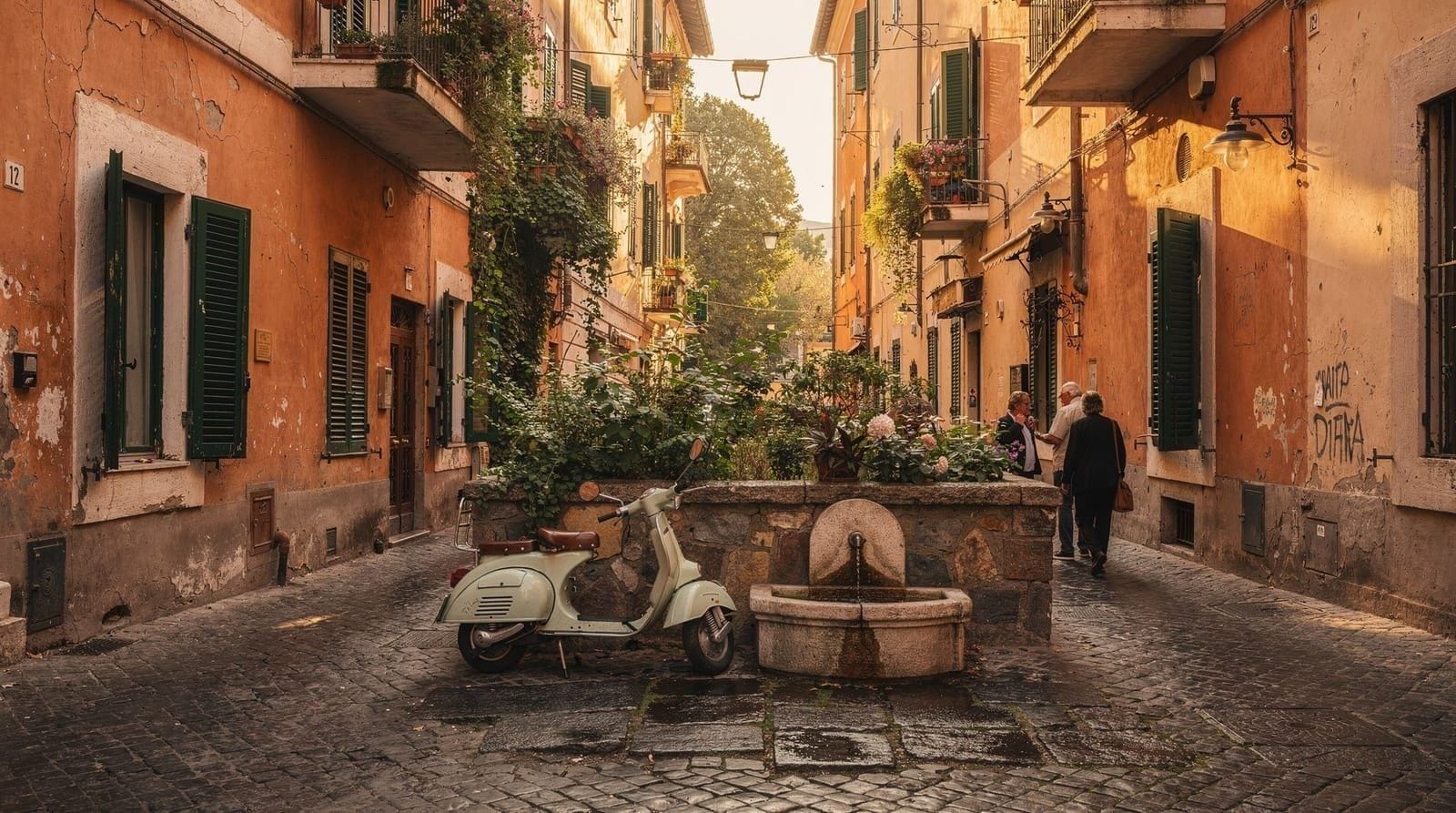
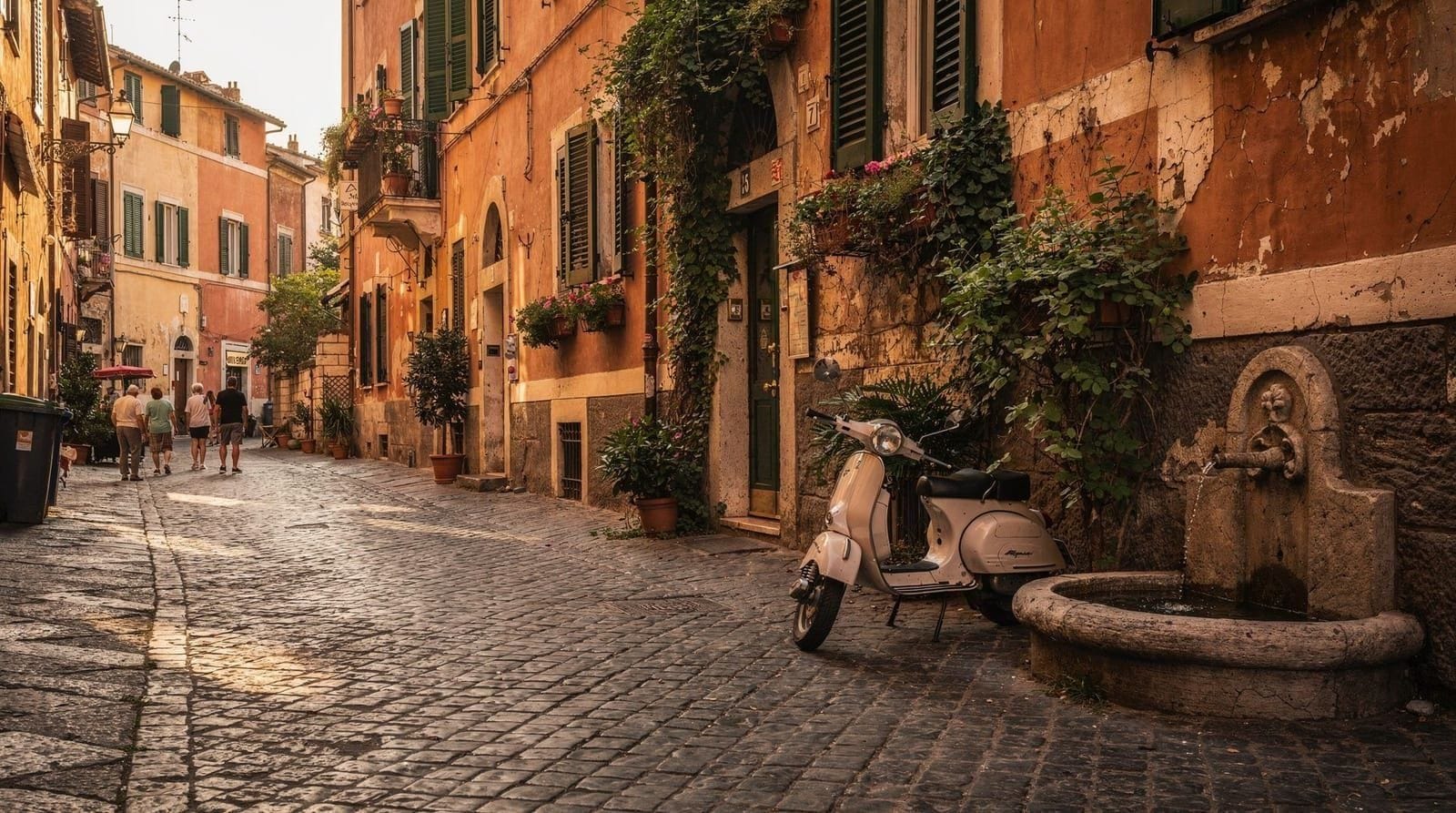
Trastevere is the most tourist-heavy of the aperitivo options but still functions for the purpose. The key is choosing bars that are slightly off the main pedestrian flow — on the streets leading away from Piazza di Santa Maria in Trastevere rather than around the piazza itself. The quality is variable and the prices are higher than Pigneto, but the setting on a warm evening is genuinely good and the Trastevere food guide helps you navigate.
What to drink
The Spritz has become the international default but is not necessarily the local choice. The Aperol Spritz — Aperol, Prosecco, a splash of soda — is fine and refreshing but sweet in a way that Romans of a certain generation find declassé. The Campari Soda in the stubby glass bottles, or a Campari and soda mixed at the bar, is more traditional. The Negroni — Campari, gin, sweet vermouth, equal parts — is the correct order if you want to signal that you know what you are doing.
Vermouth is having a significant moment in Rome and across Italy. Several bars, particularly in Monti and Prati, are serving vermouth on ice with an orange slice as an aperitivo drink that acknowledges the drink’s pre-dinner lineage more explicitly than a Spritz does.
Wine by the glass — a carafe of house white from Frascati or the Castelli Romani, or a glass of something more specific depending on the bar — is a legitimate and common aperitivo choice. Ask what they have from Lazio and you will often find something interesting.
The evening tour option
Rome evening walking tour with aperitif includedIf you are new to Rome and want to understand the geography of the evening city before navigating it independently, a guided evening walk with aperitivo included is a sensible starting point. The guides typically include a stop at a bar selected for quality rather than commercial arrangement, and the context they provide for the neighbourhoods — why Trastevere looks the way it does at night, why Campo de’ Fiori functions as it does — is more useful when you are actually walking through it in the right light.
Rooftop aperitivo as an alternative
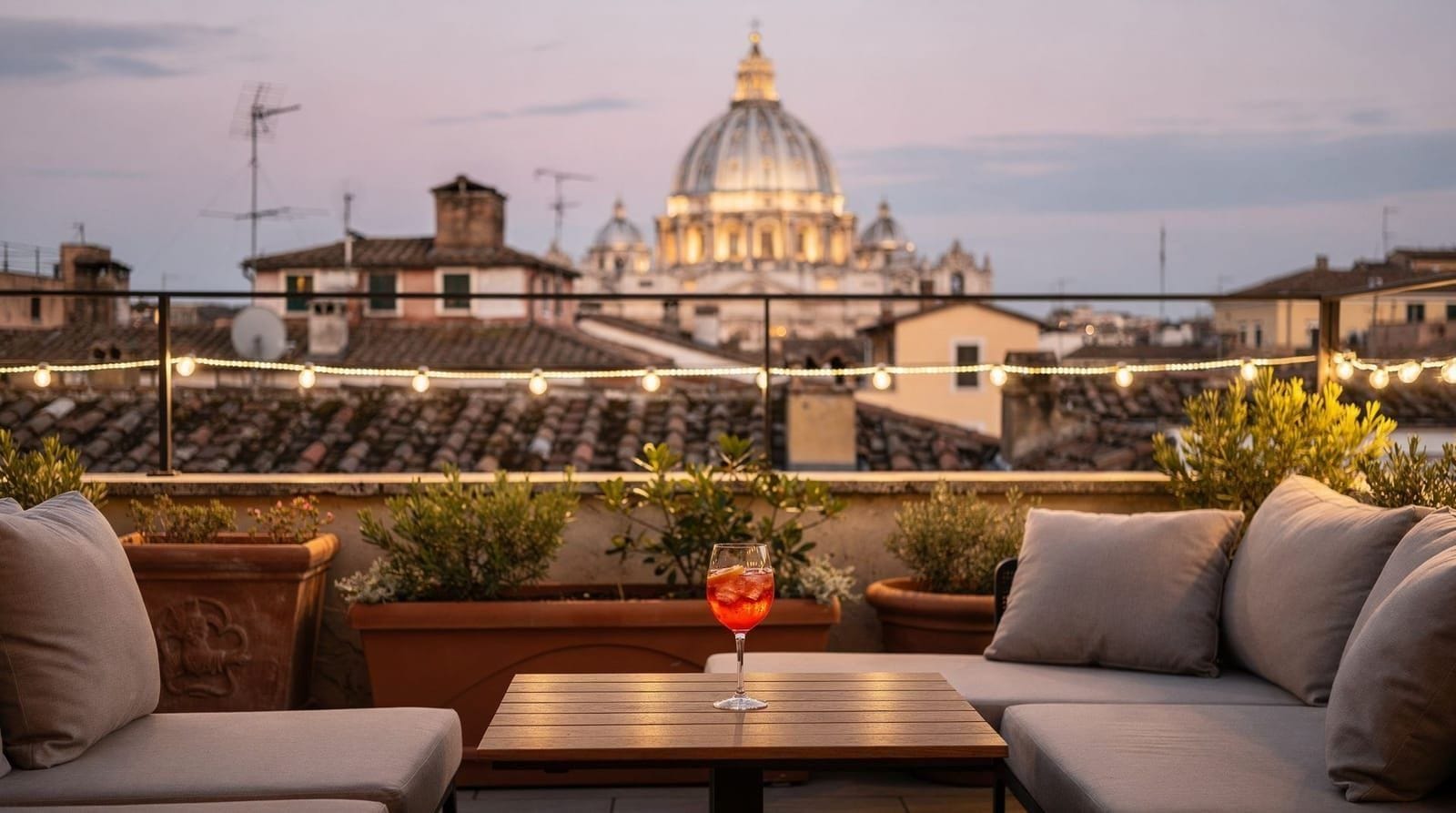
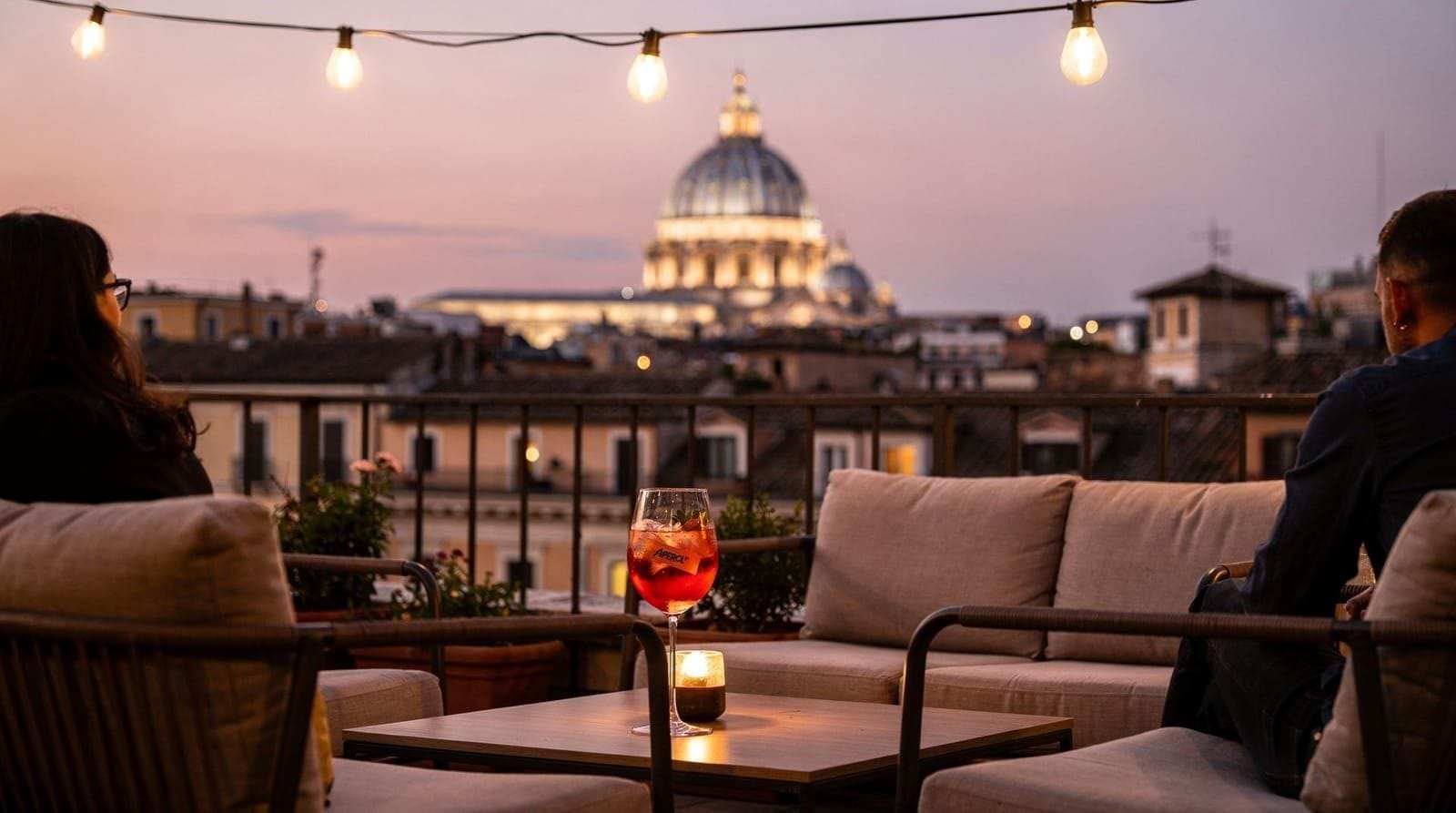
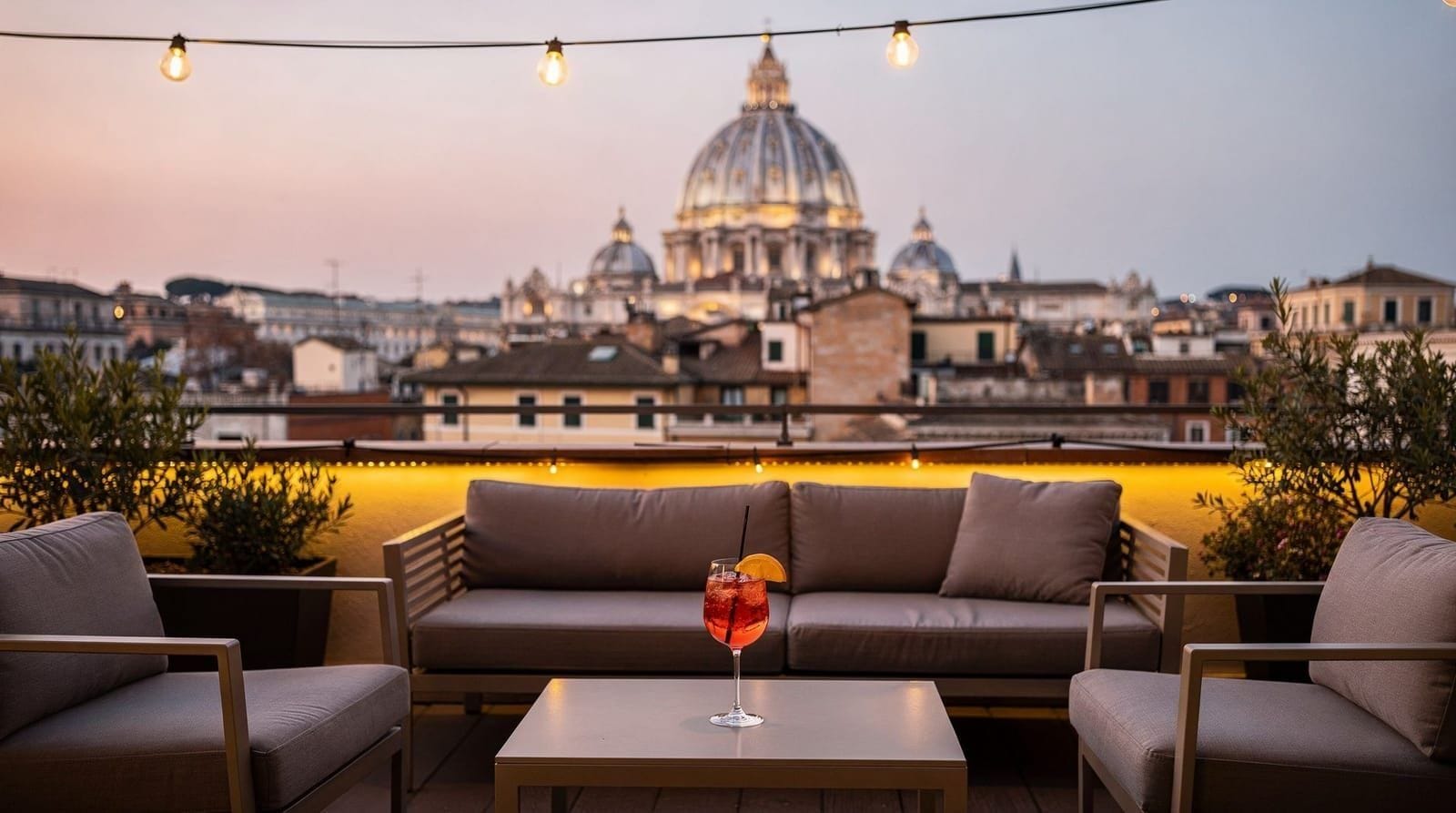
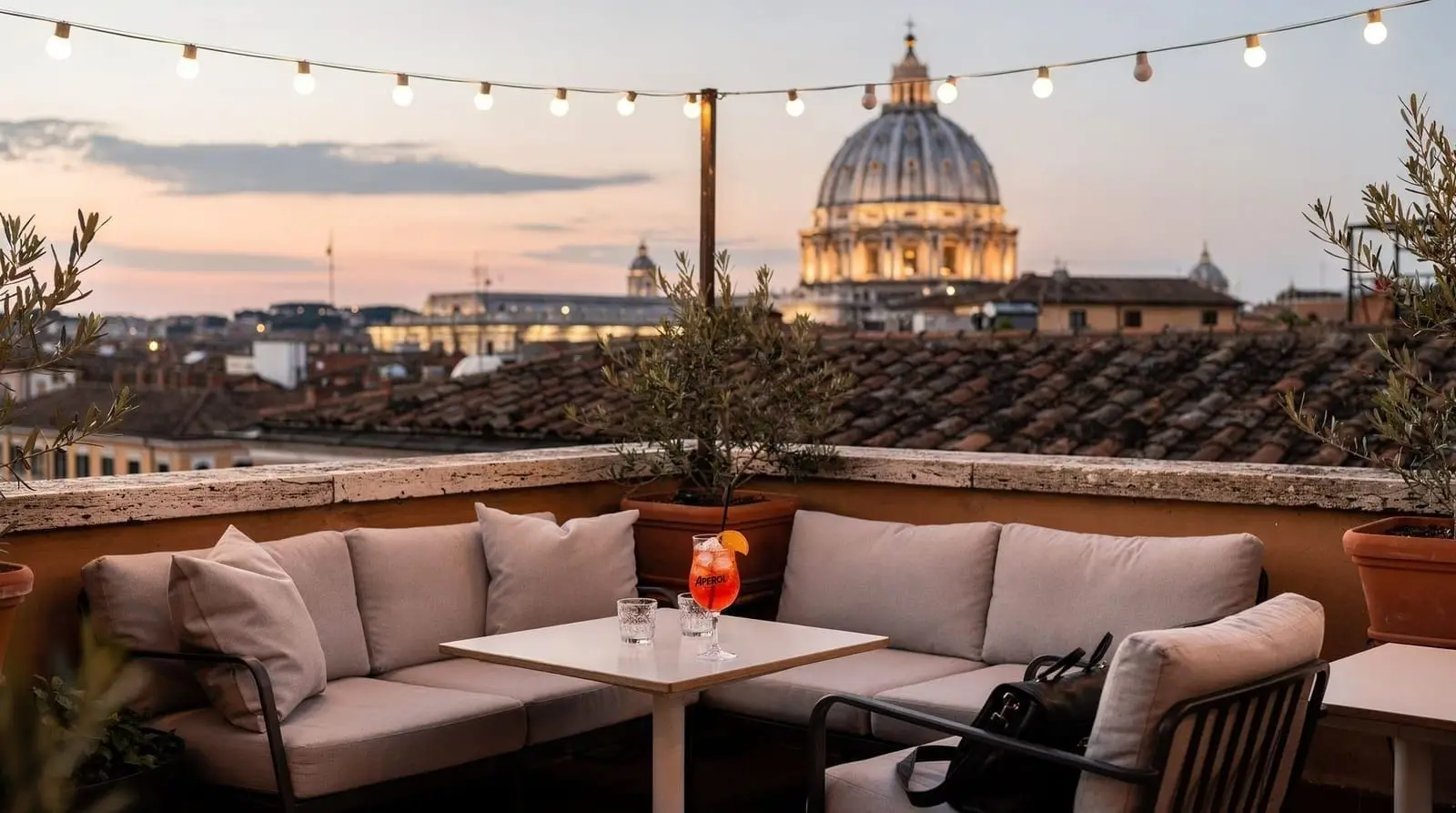
If the neighbourhood bar scene feels like a lot to navigate on a first evening, Rome’s rooftop bars offer a more predictable version of the same ritual, with a view attached. The best rooftop bars in Rome guide and the fuller Rome rooftop bars guide cover the best terraces near the centro storico, several of which run a proper aperitivo service rather than just cocktails. Prices run higher than a neighbourhood bar in Pigneto or Monti, but the view over the rooftops toward St Peter’s or the Vittoriano is a genuinely different experience worth having at least once.
Timing with dinner
The aperitivo slot in Rome ends naturally when restaurants begin filling — roughly 8:30 to 9pm. Romans do not eat before 8pm except under duress or with small children. This is worth calibrating if you are accustomed to eating at 6:30pm: arriving at a Rome restaurant at 7pm will find it empty and you will eat alone, which is fine but not the experience.
The rhythm that works: arrive at your aperitivo bar around 7pm, drink until 8:30, walk to your dinner reservation. If you do not have a dinner reservation for somewhere you want to go, make one — for the places worth eating, walk-ins after 9pm on a Friday or Saturday are often not available.
The full Rome evening architecture — aperitivo, dinner, a passeggiata, possibly a final drink — can extend until midnight without effort. This is not a problem. It is the point. Plan accordingly, and do not schedule anything for the following morning that requires an early start.
The nightlife and aperitivo guide has the comprehensive neighbourhood breakdown. Start there for planning, then come back here for the specific context of what makes a good aperitivo bar worth returning to.
FAQ
Is aperitivo the same as an all-you-can-eat buffet? No, not in Rome. That style is a Milanese tradition; the Roman version is a drink with a modest complimentary snack, not a meal replacement.
What time should I arrive for aperitivo in Rome? Around 7pm is the sweet spot — early enough to get a good spot before the peak crowd, and timed to finish by 8:30–9pm when dinner service in Rome properly begins.